
Market Overview:
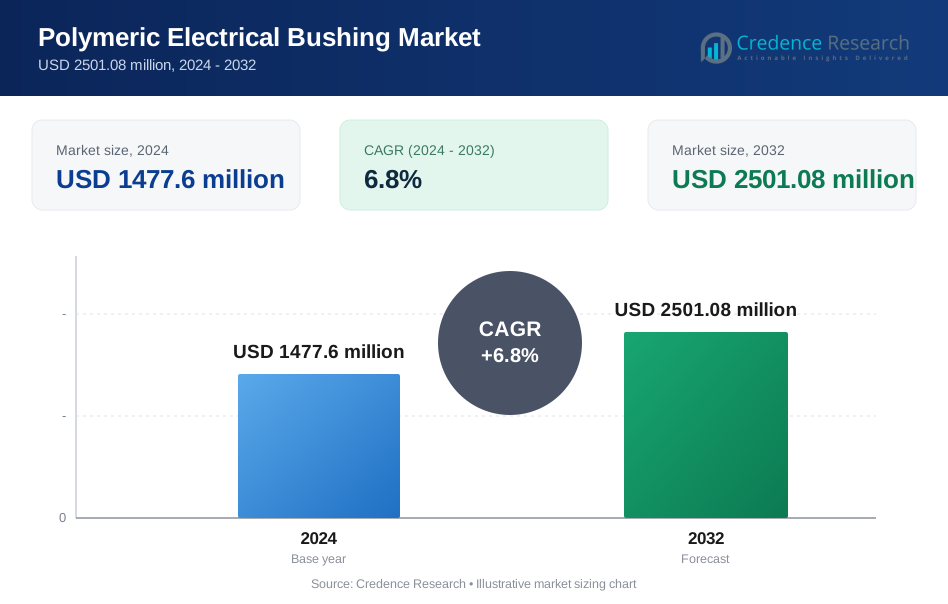
The Polymeric Electrical Bushing Market size was valued at USD 1477.6 million in 2024 and is anticipated to reach USD 2501.08 million by 2032, at a CAGR of 6.8 % during the forecast period.
| REPORT ATTRIBUTE | DETAILS |
|---|---|
| Historical Period | 2020-2023 |
| Base Year | 2024 |
| Forecast Period | 2025-2032 |
| Polymeric Electrical Bushing Market Size 2024 | USD 1477.6 Million |
| Polymeric Electrical Bushing Market, CAGR | 6.8% |
| Polymeric Electrical Bushing Market Size 2032 | USD 2501.08 Million |
The market benefits from strong drivers, including growing electricity demand, rising adoption of smart grids, and accelerated shift toward high-performance polymer materials. Utilities and industrial operators increasingly adopt polymeric bushings due to their lightweight nature, simplified installation, lower maintenance cost, and operational safety in harsh environmental conditions. Increasing use of high-voltage equipment in renewable power transmission, offshore wind projects, and urban power substations also supports broader application potential. Continuous advancements in composite insulation technology and digital monitoring features further stimulate industry growth.
Regionally, North America and Europe maintain significant market shares owing to advanced grid infrastructure, stringent operational standards, and rapid adoption of modern insulation systems. Asia-Pacific exhibits the fastest growth, driven by large-scale power network expansion, industrialization, and government investment in renewable electricity generation. Emerging economies in the Middle East, Latin America, and Africa demonstrate rising demand for polymeric bushings in new grid installations and infrastructure modernization programs.
Market Insights:
- The Polymeric Electrical Bushing Market was valued at USD 1,477.6 million in 2024 and is projected to reach USD 2,501.08 million by 2032, growing at a CAGR of 6.8% during the forecast period.
- North America leads with a 33.4% market share due to large-scale grid modernization and transformer replacement programs, followed by Europe at 28.9% driven by advanced electrical infrastructure and regulatory support, while Asia-Pacific holds 23.6% supported by industrial expansion and renewable integration.
- Asia-Pacific is the fastest-growing region with a CAGR above 7%, driven by rural electrification, offshore wind installations, and rising investments in high-voltage transmission projects across China, India, and Southeast Asia.
- By insulation type, the resin impregnated paper (RIP) segment holds the largest share at 46.7%, favored for its high mechanical strength, partial discharge resistance, and long operational life in harsh environments.
- The silicone rubber-based polymer segment accounts for 31.5% of the market, owing to its excellent hydrophobicity, UV resistance, and performance under contaminated or coastal conditions.
Market Drivers:
Growing Preference for High-Performance Insulation Materials
Demand for lightweight, durable, and reliable insulation solutions drives stronger acceptance of polymeric bushings. Utilities prefer polymer-based options for demanding operating conditions because they deliver stable electrical performance and resist moisture and pollution. Their lower maintenance need supports lifecycle cost reduction, making them more attractive than porcelain bushings. The Polymeric Electrical Bushing Market benefits from investments in upgraded insulation systems across medium- and high-voltage applications. It continues to gain momentum as operators prioritize long-term reliability and operational safety.
- For Instance, Hitachi Energy's polymeric bushings (specifically the GSB RIP type or AirRIP flex series) achieved partial discharge levels below 5 pC at rated system voltage in routine factory and type tests, which is a key design specification for their 'partial discharge-free' technology.
Rising Investment in Transmission and Distribution Network Expansion
Countries upgrade transmission capacity to meet rising electricity consumption and growing industrial activity. Grid operators expand substations, overhead lines, and high-voltage equipment to support renewable integration. Polymeric bushings enable stable operation of this critical infrastructure and reduce outage risks under diverse environments. Utilities rely on these bushings to strengthen asset resilience and minimize equipment failures. It supports network modernization and broadens demand across global power sectors.
- For instance, CFE's Nizuc GIS substation deployed a 115 kV polymeric bushing that endured 10 years of high humidity and sea contamination without failure.
Accelerated Adoption of Renewable Power and Grid Modernization Programs
Increasing wind and solar installations require robust high-voltage equipment to handle variable load flows. Power developers install polymeric bushings in substations and transformers to reduce space requirements and mitigate environmental and mechanical stress. Offshore wind projects benefit from their superior resistance to salt, humidity, and erosion. Governments fund smart grid projects that mandate reliable insulation performance and improved monitoring capabilities. It encourages the deployment of advanced polymer-based components.
Focus on Cost Efficiency and Operational Safety Across Utilities
Utilities seek reliable components that provide efficient installation and extended service life under harsh conditions. Polymeric bushings weigh less than porcelain alternatives, simplifying logistics and reducing mechanical strain on transformers. Their hydrophobic surface properties maintain insulation integrity in polluted or humid locations. Lower risk of catastrophic failure supports enhanced safety measures in high-voltage environments. It aligns with global efforts to reduce operational downtime and increase asset reliability.
Market Trends:
Advancements in Composite Materials and Hydrophobic Surface Technologies
Manufacturers invest in engineered polymers and composite materials to enhance performance under electrical, chemical, and thermal stress. Modern bushings integrate hydrophobic silicone rubber surfaces that maintain insulation strength in polluted and humid environments. These materials reduce maintenance frequency and support stable outdoor operation across variable climates. The Polymeric Electrical Bushing Market benefits from high-strength designs that resist mechanical damage, ultraviolet exposure, and corrosion. It encourages product differentiation through tailored formulations for medium- and high-voltage equipment. Suppliers expand laboratory testing capabilities to validate durability under extreme conditions and meet utility-specific standards. This trend supports safer and more efficient infrastructure development across expanding power networks.
- For instance, silicone rubber bushings in the power industry are generally designed to exhibit robust hydrophobicity recovery through the migration of low molecular weight siloxanes (LMW) to the surface.
Integration of Smart Monitoring Features and Digital Grid Applications
Utilities adopt smart technologies that enable real-time detection of insulation faults, partial discharge activity, and temperature variations. Modern polymeric bushings integrate sensors and communication modules to provide continuous asset health data. The shift toward intelligent substations encourages wider use of digitally enabled components that improve reliability and reduce unplanned outages. The Polymeric Electrical Bushing Market sees rising interest in predictive maintenance tools that extend asset life. It supports utility transition toward automated diagnostics and condition-based planning. Manufacturers collaborate with grid technology providers to create data-driven monitoring platforms. This trend strengthens long-term asset management strategies and improves operational efficiency across power distribution and transmission networks.
- For Instance, ABB's sensor-integrated polymeric bushings utilize internal temperature sensors that facilitate real-time monitoring, a critical component for condition-based maintenance.
Market Challenges Analysis:
Technical Limitations and Performance Variability in Extreme Environments
Polymeric bushings face challenges related to performance consistency under high thermal stress, heavy pollution, and long-term outdoor exposure. Some materials degrade faster than porcelain alternatives when exposed to extreme ultraviolet radiation or chemical contaminants. Utilities demand precise testing standards, yet global specifications for polymeric insulation remain fragmented. The Polymeric Electrical Bushing Market must address concerns over long-term reliability in high-voltage applications. It requires advanced formulations that maintain hydrophobic properties and dielectric strength for extended service life. Slow adoption in conservative utility sectors restricts wider deployment where proven durability is essential. Ongoing research efforts seek higher mechanical stability and improved environmental resistance.
Cost Pressures and Complex Qualification Procedures for Utility Adoption
High-quality polymeric bushings require specialized materials and manufacturing processes that increase product cost. Utilities compare pricing against porcelain components and often delay replacement decisions due to budget constraints. Lengthy qualification procedures from regulatory bodies add complexity to procurement cycles. It forces suppliers to provide extensive operational data before approval. Customization requirements for voltage ratings and environmental conditions raise cost barriers for smaller manufacturers. Limited awareness of lifecycle benefits restricts immediate purchase decisions. This challenge emphasizes the need for stronger industry education and standardized validation frameworks.
 Market Opportunities:
Growing Demand for High-Voltage Grid Expansion and Renewable Power Integration
Large-scale renewable installations and cross-border power transmission projects create strong opportunities for advanced polymeric bushings. Offshore wind and solar farms need compact, lightweight insulation solutions for transformers and switchgear deployed in constrained environments. The Polymeric Electrical Bushing Market benefits from grid investments focused on reliability, safety, and long-term operational resilience. It can supply products designed for harsh climates where salt, humidity, or pollution affect traditional insulation. Manufacturers that offer site-specific designs for high-voltage equipment will secure broader adoption in emerging power hubs. Growth avenues strengthen further through smart grid upgrades and rapid electrification in developing economies.
Opportunities in Smart Monitoring Solutions and Tailored Composite Materials
Manufacturers gain competitive growth through integration of sensors that track thermal, electrical, and mechanical parameters in real time. Utilities seek predictive maintenance to extend asset life and reduce unplanned downtime. It creates demand for polymeric bushings that support health diagnostics and remote management. Tailored composite formulations open opportunities in applications that require enhanced hydrophobicity, UV stability, and corrosion resistance. Suppliers that collaborate with grid software providers can deliver complete insulation and monitoring packages. This approach supports premium pricing strategies and unlocks value in high-performance digital infrastructure markets.
Market Segmentation Analysis:
By Type
Polymeric bushings are classified into solid, oil-filled, and gas-insulated types, each designed to meet different voltage and environmental requirements. Solid polymeric bushings gain wider use due to their compact structure, lower maintenance needs, and strong resistance to pollution. Oil-filled and gas-insulated variants support high-voltage applications where thermal stability and enhanced dielectric strength are critical. The Polymeric Electrical Bushing Market benefits from growing adoption of solid bushings in compact substations, renewable power systems, and urban distribution networks. It continues to gain traction as utilities prefer lightweight and reliable insulation technologies.
- For instance, Hitachi Energy's solid polymeric bushings (specifically the O Plus Dry or EasyDry product lines which use RIS technology) achieve a partial discharge level below 5 pC at 2 times maximum line-to-ground voltage in routine factory testing (which is done in accordance with IEC 60137 and IEEE standards), demonstrating superior dielectric performance.
By Insulation
Segments include silicone rubber, epoxy resin, and composite insulation, driven by performance needs under harsh weather conditions. Silicone rubber holds a strong share due to hydrophobic properties that maintain insulation integrity in polluted or humid regions. Epoxy resin bushings support medium-voltage systems with high mechanical strength and cost-effective production. Composite insulation offers advanced resistance to UV radiation and corrosion, making it suitable for outdoor and coastal applications. It secures long-term deployment in renewable power installations and industrial substations.
- For instance, PPG Industries launched PPG PITT-THERM 909, a silicone-based, fiber-reinforced spray-on insulation coating that withstands continuous and cyclic temperatures up to 500°F (260°C) while providing superior thermal insulation and corrosion resistance in extreme environments.
By Application
Transformer bushings dominate market use due to large installation volumes in power transmission and distribution networks. Switchgear, circuit breakers, and GIS systems adopt polymeric bushings for improved safety, compact design, and lightweight construction. Renewable grid infrastructure deploys these bushings to support offshore wind platforms, desert solar stations, and remote substations. Utilities prioritize polymeric insulation for environments where moisture, chemicals, or saltwater affect porcelain reliability. It accelerates growth in emerging regions with expanding electrification and smart grid projects.
Segmentations:
By Type
- Solid
- Oil-Filled
- Gas-Insulated
By Insulation
- Silicone Rubber
- Epoxy Resin
- Composite
By Application
- Transformers
- Switchgear
- Gas-Insulated Systems (GIS)
By Region
- North America
- U.S.
- Canada
- Mexico
- Europe
- Germany
- France
- U.K.
- Italy
- Spain
- Rest of Europe
- Asia Pacific
- China
- Japan
- India
- South Korea
- South-east Asia
- Rest of Asia Pacific
- Latin America
- Brazil
- Argentina
- Rest of Latin America
- Middle East & Africa
- GCC Countries
- South Africa
- Rest of the Middle East and Africa
Regional Analysis:
Strong Market Growth Driven by North American and European Grid Upgrades
North America secures a leading share due to heavy investment in grid modernization, renewable capacity expansion, and replacement of aging transformer infrastructure. Utilities adopt polymer-based bushings to meet stricter reliability standards and reduce long-term maintenance expenses. The Polymeric Electrical Bushing Market gains steady demand from urban substations, offshore wind connections, and industrial power systems. Europe follows with strong adoption supported by advanced electricity networks and regulatory mandates for safer insulation systems. It benefits from research and engineering programs that support composite materials with higher environmental resistance. Both regions continue prioritizing compact transformers and smart substations, driving consistent procurement of high-quality polymeric bushings.
Asia-Pacific Expansion Supported by Electrification and Renewable Integration
Asia-Pacific demonstrates the fastest growth due to rapid industrialization, urbanization, and large-scale investment in high-voltage transmission. China, India, South Korea, and Japan expand renewable and cross-border transmission projects that rely on polymeric bushings for improved durability in demanding climates. Governments increase funding for rural electrification, which fuels transformer deployment in remote locations. It strengthens adoption of lightweight bushings that reduce transport and installation complexity. Offshore wind farms in China and Taiwan drive demand for high-resistance silicone and composite bushings. The region benefits from manufacturing cost advantages that support large-volume production.
Emerging Growth Prospects Across Middle East, Africa, and Latin America
Middle Eastern countries invest in power grids for industrial zones, solar farms, and desalination facilities that require corrosion-resistant insulation technologies. Latin America strengthens renewable infrastructure to stabilize energy supply, boosting demand for durable polymeric bushings in substations and wind projects. Africa accelerates distribution network expansion to support electrification needs across rural and semi-urban regions. It adopts polymeric bushings due to lower maintenance requirements in areas with dust, humidity, and high pollution levels. Governments pursue smart grid programs that support transformer modernization and GIS installation. These regions unlock growth potential through infrastructure diversification, industrial expansion, and reliable high-voltage equipment deployment.
Key Player Analysis:
- ABB Group
- TRENCH Group (SIEMENS)
- General Electric
- Eaton
- Elliot Industries
- Gipro GMBH
- RHM International
- Toshiba
- Webster-Wilkinson
- Siemens
- Nexans
Competitive Analysis:
The Polymeric Electrical Bushing Market remains moderately consolidated, dominated by large manufacturers that supply high-voltage components for transmission and distribution networks. Major players include ABB Group, TRENCH Group (SIEMENS), General Electric, Eaton, Elliot Industries, and Gipro GmbH. These companies compete through advanced material engineering, digital monitoring features, and customized insulation solutions for different voltage classes. It focuses on improving hydrophobic performance, mechanical strength, and resistance to corrosion in demanding environments. Leading firms invest in research facilities to develop smart bushings that support predictive maintenance and remote diagnostics. Regional manufacturers target cost-sensitive markets by offering locally adapted designs and competitive pricing. Strategic collaborations with utility providers and substation equipment suppliers help expand product portfolios and secure long-term contracts.
Recent Developments:
- In May 2025, ABB signed an agreement to acquire BrightLoop, a French power electronics firm, to boost electrification in off-highway vehicles and marine sectors, with closure expected in Q3 2025.
- In May 2025, TRENCH Group entered a long-term framework agreement with Siemens Energy, GE Vernova, and Hitachi Energy for high-voltage grid components through the mid-2030s.
Report Coverage:
The research report offers an in-depth analysis based on Type, Insulation, Application and Region. It details leading Market players, providing an overview of their business, product offerings, investments, revenue streams, and key applications. Additionally, the report includes insights into the competitive environment, SWOT analysis, current Market trends, as well as the primary drivers and constraints. Furthermore, it discusses various factors that have driven Market expansion in recent years. The report also explores Market dynamics, regulatory scenarios, and technological advancements that are shaping the industry. It assesses the impact of external factors and global economic changes on Market growth. Lastly, it provides strategic recommendations for new entrants and established companies to navigate the complexities of the Market.
Future Outlook:
- Growing demand for renewable energy infrastructure will increase the use of lightweight, corrosion-resistant polymeric bushings in offshore and desert installations.
- Smart monitoring features will become standard in high-voltage bushings, supporting condition-based maintenance and remote diagnostics.
- Material innovations will focus on enhancing hydrophobicity, UV resistance, and mechanical durability for long-term outdoor performance.
- Utilities will prioritize polymeric bushings to reduce installation complexity and minimize asset downtime in critical grid operations.
- Manufacturers will expand partnerships with digital grid solution providers to integrate real-time performance analytics into equipment.
- Composite and silicone-based insulations will gain higher preference in areas with pollution, humidity, and salinity risks.
- Localized production and regional customization will increase to serve emerging markets with specific environmental requirements.
- Adoption in smart substations and compact transformers will accelerate due to growing urban infrastructure needs.
- Product sustainability and recyclability will become important factors in future material development and regulatory compliance.
- Expanded use in industrial facilities, renewable farms, and GIS systems will strengthen long-term market penetration across global power networks.
Request a Free Sample
Fill in your details and we'll send you a free sample report.
- Sample data tables & charts
- Research methodology
Need a Custom Version of This Report?
Tailor the scope, geography, or segments to your exact requirements.
- Custom geography or segment scope
- Direct access to our analyst team
Frequently Asked Questions
What is the current market size for the Polymeric Electrical Bushing Market, and what is its projected size in 2032?
At what Compound Annual Growth Rate is the Polymeric Electrical Bushing Market projected to grow between 2024 and 2032?
Which segment held the largest share of the Polymeric Electrical Bushing Market in 2024?
What are the primary factors fueling the growth of the Polymeric Electrical Bushing Market?
Who are the leading companies in the Polymeric Electrical Bushing Market?
Which region commanded the largest share of the Polymeric Electrical Bushing Market in 2024?
Table of Content
Chapter 1. Report Introduction
- 1.1 Report Description & Purpose
- 1.1.1 Report Title & Market Definition
- 1.1.2 Unique Selling Propositions (USP) & Key Differentiators
- 1.1.3 Value Proposition for Stakeholders
- 1.2 Research Objectives
- 1.2.1 Market Sizing Objectives (Volume & Revenue)
- 1.2.2 Segmentation Objectives
- 1.2.3 Competitive Intelligence Objectives
- 1.2.4 Forecast & Scenario Objectives
- 1.3 Report Scope
- 1.3.1 Polymeric Electrical Bushing Scope – Types & Subtypes Covered
- 1.3.2 Geographic Scope – Regions & Countries Covered
- 1.3.3 Historical Period, Base Year & Forecast Period (2024; forecast to 2032)
- 1.3.4 Inclusions & Exclusions
- 1.4 HS Code & Classification Framework
- 1.5 Currency, Units & Pricing Basis
- 1.6 Target Stakeholders
- 1.7 Limitations & Assumptions
Chapter 2. Executive Summary
- 2.1 Global Polymeric Electrical Bushing Market Snapshot
- 2.1.1 Market Size – Historical (2024) & Forecast (2024-2032) (2024: USD 1477.6 million → 2032: USD 2501.08 million)
- 2.1.2 Volume & Revenue – Global Totals
- 2.1.3 Key Market Highlights – Top Five Facts
- 2.2 Polymeric Electrical Bushing Market Segmentation Snapshot
- 2.2.1 Market Split by Region – 2024 vs. 2032
- 2.3 Competitive Snapshot
- 2.3.1 Top 10 Players by Revenue Share – 2024
- 2.3.2 Top 10 Players by Volume Share – 2024
- 2.3.3 Recent Strategic Developments (18-Month Summary)
- 2.4 Key Investment Highlights & Strategic Conclusions
Chapter 3. Polymeric Electrical Bushing Market Dynamics & Industry Analysis
- 3.1 Market Overview & Context
- 3.1.1 Polymeric Electrical Bushing Market Position in the Broader Automotive Value Chain
- 3.1.2 OEM vs. Replacement Market Dynamics
- 3.1.3 Market Maturity & Development Stage by Region
- 3.2 Polymeric Electrical Bushing Market Drivers
- 3.3 Polymeric Electrical Bushing Market Restraints & Challenges
- 3.4 Polymeric Electrical Bushing Market Opportunities
- 3.5 Porter's Five Forces Analysis
- 3.5.1 Threat of New Entrants
- 3.5.2 Bargaining Power of Suppliers
- 3.5.3 Bargaining Power of Buyers
- 3.5.4 Threat of Substitutes
- 3.5.5 Competitive Rivalry – Intensity Assessment
- 3.6 Polymeric Electrical Bushing Value Chain Analysis
- 3.6.1 Upstream – Raw Material/Input Suppliers
- 3.6.1.1 Raw Material/Input 1
- 3.6.1.2 Raw Material/Input 2
- 3.6.1.3 Raw Material/Input 3
- 3.6.2 Midstream – Production/Manufacturing/Service Delivery
- 3.6.2.1 Production/Process Overview
- 3.6.2.2 Key Facility Locations & Capacity by Manufacturer
- 3.6.3 Downstream – Distribution & End Consumer
- 3.6.3.1 Primary Channel – B2B/OEM
- 3.6.3.2 Secondary Channels – Dealer, Retail, Online, Direct
- 3.6.4 Value Chain Profitability Analysis
- 3.6.1 Upstream – Raw Material/Input Suppliers
- 3.7 PESTEL Analysis
- 3.7.1 Political Factors
- 3.7.2 Economic Factors
- 3.7.3 Social Factors
- 3.7.4 Technological Factors
- 3.7.5 Environmental Factors
- 3.7.6 Legal Factors
- 3.8 Polymeric Electrical Bushing Supply Chain Analysis
- 3.8.1 Raw Material/Input Supply Risk Assessment
- 3.8.2 Manufacturing Concentration Risk (Geographic Exposure)
- 3.8.3 Trade Disruption Impact Analysis
- 3.9 Regulatory & Policy Landscape
Note: The regulatory and policy landscape section covers regulations based on their applicability to the market, Polymeric Electrical Bushing category, geography, and scope of the study. Only regulatory frameworks with a material impact on operations, compliance, trade, sustainability, or market access are analyzed in detail.
Chapter 4. Key Investment Pockets & Opportunity Analysis
- 4.1 Polymeric Electrical Bushing Market Attractiveness Analysis
- 4.1.1 By Region – Investment Attractiveness Matrix (Volume × CAGR)
- 4.2 Absolute Revenue Growth Opportunity
- 4.2.1 By Region – Absolute USD Growth Through 2032
- 4.3 Incremental Volume Opportunity
- 4.3.1 By Region – Incremental Volume Through 2032
- 4.3.2 Segment – Incremental Volume
- 4.4 Emerging Submarket Opportunity Deep Dive (Subject to Applicability)
- 4.5 Emerging Market Opportunity Scorecards
- 4.5.1 United States
- 4.5.2 Europe
- 4.5.3 Asia
- 4.5.4 Middle East & Africa
Note: Emerging Market Opportunity Scorecards will be included based on relevance and strategic importance. Regions listed are indicative and may vary depending on data availability and market dynamics.
Chapter 5. Polymeric Electrical Bushing Import-Export Analysis & Trade Flows
- 5.1 Global Trade Overview
- 5.1.1 Global Export Value by Country (2024)
- 5.1.2 Global Export Volume by Country (2024)
- 5.1.3 Global Import Value by Country (2024)
- 5.1.4 Global Import Volume by Country (2024)
- 5.1.5 Net Trade Balance by Country (2024)
- 5.2 Export Analysis – Segment
- 5.2.1 Type 1 (HS Code)
- 5.2.2 Type 2 (HS Code)
- 5.2.3 Type 3 (HS Code)
- 5.2.4 Type 4 (HS Code)
- 5.2.5 Type 5 (HS Code)
- 5.3 Import Analysis – Segment
- 5.3.1 Type 1 (HS Code)
- 5.3.2 Type 2 (HS Code)
- 5.3.3 Type 3 (HS Code)
- 5.3.4 Type 4 (HS Code)
- 5.3.5 Type 5 (HS Code)
- 5.4 Average Unit Trade Prices
- 5.4.1 Average Export Price – Segment & Country
- 5.4.2 Average Import Price – Segment & Source Country
- 5.4.3 Price Trends (2024)
- 5.5 Key Trade Route Analysis
- 5.5.1 Trade Route 1
- 5.5.2 Trade Route 2
- 5.5.3 Trade Route 3
- 5.5.4 Trade Route 4
- 5.5.5 Trade Route 5
- 5.6 Trade Policy Impact Assessment
- 5.6.1 US Anti-Dumping & Section 301 Tariffs
- 5.6.2 EU Customs Union Impact
- 5.6.3 Major Free Trade Agreements
- 5.6.4 USMCA Rules of Origin
Note: Trade policy analysis will be included only where relevant to the Polymeric Electrical Bushing market.
Chapter 6. Competitive Landscape & Company Benchmarking
- 6.1 Polymeric Electrical Bushing Market Concentration & Structure
- 6.1.1 Herfindahl-Hirschman Index (HHI) – vs. 2024
- 6.1.2 Tier 1, Tier 2 & Tier 3 Market Structure
- 6.1.3 Global, Regional & Local Player Dynamics
- 6.2 Polymeric Electrical Bushing Market Share Analysis – 2024
- 6.2.1 Global Revenue Share by Company
- 6.2.2 Global Volume Share by Company
- 6.2.3 Regional Revenue Share
- 6.2.4 Market Share Evolution ( vs. 2024)
- 6.2.5 OEM Segment Share by Company
- 6.2.6 Replacement Segment Share by Company
- 6.3 Production/Delivery Capacity & Facility Analysis
- 6.3.1 Global Installed Capacity
- 6.3.2 Capacity Utilization Rates
- 6.3.3 Production/Output Volume
- 6.3.4 Facility Locations & Capacity Map
- 6.3.5 Planned Capacity Additions
- 6.4 Polymeric Electrical Bushing Competitive Benchmarking Matrix
- 6.4.1 Revenue, Volume, CAGR & Profitability Comparison
- 6.4.2 Channel Revenue Mix
- 6.4.3 Geographic Revenue Exposure
- 6.4.4 R&D Intensity
- 6.4.5 Sustainability Maturity
- 6.5 Strategic Developments in Polymeric Electrical Bushing (Last 24 Months)
- 6.5.1 Mergers, Acquisitions & Divestments
- 6.5.2 New Polymeric Electrical Bushing Launches
- 6.5.3 Facility Expansions
- 6.5.4 Strategic Alliances, Joint Ventures & Partnerships
- 6.5.5 Distribution Expansion & Market Entry
- 6.5.6 Sustainability & ESG Initiatives
- 6.6 Competitive Strategy Mapping
- 6.6.1 Leader, Challenger, Follower & Niche Classification
- 6.6.2 Pricing Strategy Comparison
- 6.6.3 Channel Strategy Matrix
Note: Strategic developments are included based on their materiality and the availability of reliable information.
Chapter 7. Global Polymeric Electrical Bushing Market – By Distribution Channel
- 7.1 Segment Overview
- 7.1.1 Volume & Revenue Split by Channel (2024 & 2032)
- 7.1.2 Channel Mix Evolution (2024-2032)
Chapter 8. Regional Market Analysis – Global Overview
- 8.1 Global Regional Overview
- 8.1.1 Regional Volume Share
- 8.1.2 Regional Revenue Share
- 8.1.3 Regional Volume by Region
- 8.1.4 Regional Revenue by Region
- 8.1.5 Regional Forecast Through 2032
- 8.2 Cross-Regional Segment Analysis
- 8.2.1 By Distribution Channel
- 8.2.2 By Brand/Price Tier
Chapter 9. North America Polymeric Electrical Bushing Market
- 9.1 United States
- 9.2 Canada
- 9.3 Mexico
Chapter 10. Europe Polymeric Electrical Bushing Market
- 10.1 Germany
- 10.2 France
- 10.3 Italy
- 10.4 United Kingdom
- 10.5 Spain
- 10.6 Poland
- 10.7 Russia
- 10.8 Netherlands
- 10.9 Belgium
- 10.10 Sweden
- 10.11 Denmark
- 10.12 Norway
- 10.13 Rest of Europe
Chapter 11. Asia Pacific Polymeric Electrical Bushing Market
- 11.1 China
- 11.2 India
- 11.3 Japan
- 11.4 South Korea
- 11.5 Thailand
- 11.6 Indonesia
- 11.7 Vietnam
- 11.8 Malaysia
- 11.9 Australia
- 11.10 Rest of Asia Pacific
Chapter 12. Latin America Polymeric Electrical Bushing Market
- 12.1 Brazil
- 12.2 Argentina
- 12.3 Colombia
- 12.4 Chile
- 12.5 Rest of Latin America
Chapter 13. Middle East Polymeric Electrical Bushing Market
- 13.1 Saudi Arabia
- 13.2 United Arab Emirates
- 13.3 Turkey
- 13.4 Israel
- 13.5 Iran
- 13.6 Rest of the Middle East
Chapter 14. Africa Polymeric Electrical Bushing Market
- 14.1 South Africa
- 14.2 Egypt
- 14.3 Nigeria
- 14.4 Morocco
- 14.5 Rest of Africa
Chapter 15. Polymeric Electrical Bushing Company Profiles
- 15.1 [Company 01]
- 15.1.1 Company Overview
- 15.1.2 Key Management Personnel
- 15.1.3 Products & Services Portfolio
- 15.1.4 Financial Performance
- 15.1.5 Key Market Focus & Geographic Presence
- 15.1.6 Recent Developments & Strategic Initiatives
Note: The company profile list is preliminary and may change based on research findings, market developments, data availability, and client requirements.
Chapter 16. Appendices
- Appendix A – List of Abbreviations & Acronyms
- Appendix B – Industry Classification Code Reference – Full Series
- Appendix C – Production & Capacity Data Tables
- Appendix D – End-Use & Demand Base Tables
- Appendix E – Consumption & Replacement Rate Assumptions
- Appendix F – ASP Reference Tables
- Appendix G – Manufacturing & Facility Database
- Appendix H – Import-Export Data Tables
- Appendix I – Regulatory Summary Tables
- Appendix J – Primary Research Participant List (Anonymized)
- Appendix K – Primary Research Questionnaire Framework
- Appendix L – Data Sources & Bibliography
- Appendix M – Market Size Divergence & Source Comparison
Chapter 17. Research Methodology
- 17.1 Research Framework & Philosophy
- 17.2 Secondary Research – Sources, Hierarchy & Data Extraction
- 17.3 Data Modeling – Bottom-Up & Top-Down Market Sizing
- 17.4 Primary Research – Stakeholder Framework, LOI & Sample Sizes
- 17.5 Forecast Methodology – Regression, Scenario & Sensitivity Analysis
- 17.6 Quality Control – Four-Layer Validation Framework
- 17.7 Limitations & Standard Assumptions
- 17.8 Disclaimer
