
Market Overview:
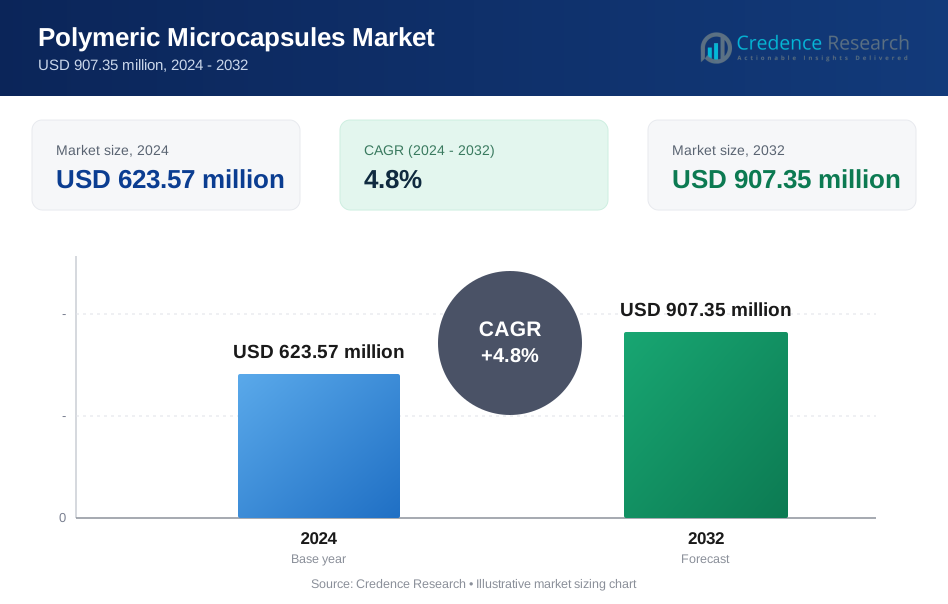
The Polymeric Microcapsules Market size was valued at USD 623.57 million in 2024 and is anticipated to reach USD 907.35 million by 2032, at a CAGR of 4.8 % during the forecast period.
| REPORT ATTRIBUTE | DETAILS |
|---|---|
| Historical Period | 2020-2023 |
| Base Year | 2024 |
| Forecast Period | 2025-2032 |
| Polymeric Foams Market Size 2024 | USD 623.57 Million |
| Polymeric Foams Market, CAGR | 4.8% |
| Polymeric Foams Market Size 2032 | USD 907.35 Million |
Key market drivers include growing utilization of microencapsulation in drug-delivery formulations, increasing demand for functional foods, and expansion of precision agriculture. Improved shelf-life of sensitive active ingredients and reduced dosage requirements further encourage adoption in medical formulations and crop protection chemicals. Manufacturers are also integrating biodegradable and biocompatible polymers to meet regulatory standards, creating new opportunities in tissue engineering, nutraceuticals, and personal care. Advancements in interfacial polymerization, coacervation, spray drying, and smart-release technologies add momentum to market growth.
Regionally, North America leads the market due to extensive pharmaceutical R&D and strong adoption of advanced delivery systems. Europe maintains robust demand supported by strict quality standards in food and cosmetics. Asia-Pacific is the fastest-growing region, driven by expanding healthcare infrastructure, rising agricultural productivity needs, and increasing investment in specialty materials. Emerging markets in Latin America and the Middle East show growing interest in microencapsulated agrochemicals and consumer goods.
Market Insights:
- The Polymeric Microcapsules Market was valued at USD 623.57 million in 2024 and is projected to reach USD 907.35 million by 2032, growing at a CAGR of 4.8% during the forecast period.
- North America leads the market with a 35.2% share, driven by advanced pharmaceutical R&D, strong adoption in functional foods, and high usage in premium cosmetics; Europe holds 29.5%, supported by stringent quality standards and innovation in controlled-release formulations; Asia-Pacific accounts for 22.8%, fueled by expanding healthcare, nutraceutical, and agrochemical sectors.
- Asia-Pacific is the fastest-growing region with a CAGR above 5.3%, supported by growing pharmaceutical manufacturing in China and India, increasing demand for functional foods, and high-volume agricultural applications.
- By application, the pharmaceutical segment holds the largest share at 41.6%, driven by rising adoption of controlled and sustained drug delivery systems using biocompatible polymer carriers.
- The food and beverage segment accounts for 27.4% of the market, supported by growing demand for nutrient fortification, extended shelf life, and functional ingredient protection in fortified and processed products.
 Market Drivers:
Rising Utilization of Advanced Drug Delivery Systems in Pharmaceuticals
The Polymeric Microcapsules Market gains strong momentum from expanding applications in controlled and sustained drug delivery. Pharmaceutical companies integrate microencapsulation to enhance bioavailability, protect active ingredients, and enable targeted release. It supports dose reduction and improves patient compliance by minimizing side effects. Biocompatible polymer systems deliver higher efficiency for vaccines, pain management drugs, hormones, and nutraceutical solutions.
- For instance, researchers using Evonik's RESOMER® RG505 PLGA microcapsules achieved an immunoglobulin G encapsulation efficiency exceeding 85% at 20% w/w loading.
Growing Need for Shelf-Life Enhancement in Food and Beverage Formulations
Food and beverage manufacturers adopt polymeric microcapsules to protect sensitive flavors, probiotics, functional ingredients, and vitamins. Controlled-release capsules maintain stability during processing and preserve nutrient potency throughout storage. It supports product differentiation by enriching texture, flavor retention, and nutrient delivery. Functional foods and fortified products require reliable encapsulation systems to meet evolving consumer expectations for quality and nutrition.
- For Instance, Balchem's microencapsulated vitamin premixes are designed to significantly extend the shelf life and enhance the stability of sensitive nutrients in fortified food and beverage applications, such as sports drinks, by protecting the vitamins from degradation caused by factors like light, oxygen, and moisture.
Increasing Demand for Smart and Sustainable Agrochemical Solutions
Rising focus on precision agriculture encourages the use of polymeric microcapsules for fertilizers, herbicides, pesticides, and growth stimulants. These systems prevent premature degradation of active substances and support controlled soil release. It enables lower input requirements and reduces environmental impact, aligning with strict regulatory norms. Smart-release performance expands applications in crop protection formulations that improve yield and optimize chemical usage.
Expanding Use in Cosmetics and Personal Care Products
Cosmetic brands deploy polymeric microcapsules to encapsulate fragrances, vitamins, antioxidants, and UV filters for sustained release. Microcapsules enhance sensory experience by releasing active materials gradually during skin contact or application. It helps protect sensitive compounds from heat, oxidation, and microbial contamination. Increasing demand for premium skincare and haircare products boosts adoption in formulations requiring controlled delivery and high-performance ingredient stability.
Market Trends:
Shift Toward Biodegradable and Functional Polymer Systems
A notable trend focuses on the development of biodegradable and biocompatible polymer shells that support eco-regulatory compliance and high-performance delivery. Researchers and manufacturers explore natural polymers, polysaccharides, protein-based carriers, and hybrid materials for safer encapsulation. These systems protect sensitive actives and reduce toxic residue concerns across medical, agricultural, cosmetic, and food sectors. Smart polymer matrices with pH, heat, and moisture responsiveness strengthen the precision of active compound release. It supports advanced encapsulation for targeted drug delivery, functional additives, and sustainable crop inputs. The Polymeric Microcapsules Market benefits from rising demand for controlled performance, enhanced stability, and greener formulation strategies.
- For instance, specific formulations of Evonik's RESOMER PLGA microspheres can enable high encapsulation efficiency (e.g., 95%) for certain drug actives in a controlled laboratory setting.
Integration of Microencapsulation in High-Value Industrial and Consumer Products
Wider adoption of polymeric microcapsules in industrial lubricants, adhesives, textiles, and self-healing coatings expands the scope of commercial use. Microcapsules improve product durability by releasing protective agents during wear, stress, or environmental exposure. Cosmetic and personal care brands leverage encapsulated vitamins, fragrances, anti-aging compounds, and UV filters to differentiate premium formulations. It supports higher sensory quality, prolonged effects, and stronger ingredient protection. Food manufacturers use encapsulation to retain flavor, aroma, and nutrients while supporting clean-label demands. Pharmaceutical companies invest in controlled-release platforms to improve patient outcomes through targeted therapeutic delivery. This trend strengthens cross-industry innovation, enabling broad value creation through sustained release and micro-scale precision.
- For instance, L'Oréal employs patented encapsulation technology and specialized formulations to improve retinol stability and efficacy.
Market Challenges Analysis:
High Production Costs and Complex Manufacturing Requirements
The production of polymeric microcapsules requires specialized processes, stringent material control, and precise formulation technologies. High capital investment in advanced equipment increases operational costs for producers. It demands expertise in polymer chemistry, interfacial reactions, and release mechanism design, which limits participation of small manufacturers. Quality control remains critical because improper encapsulation reduces performance and stability of active compounds. The Polymeric Microcapsules Market faces cost pressure when scaling microencapsulation for pharmaceuticals, agrochemicals, and premium food ingredients. Limited awareness of standardized methods further challenges commercial expansion.
Regulatory Compliance and Material Safety Limitations
Regulatory restrictions on polymer materials, biodegradability, and toxicity assessments create additional barriers for market players. It requires extensive testing to verify compatibility, controlled release behavior, and health safety across diverse applications. Cosmetic, food, and pharmaceutical sectors demand full documentation on material origin, polymer residues, and potential contamination. Compliance delays impact product launch timelines and raise certification expenses. Some synthetic polymers face scrutiny due to environmental concerns, prompting reformulation efforts. These constraints slow adoption and pressure manufacturers to adopt safer yet costlier alternatives.
Market Opportunities:
Rising Adoption of Microencapsulation in Sustainable Product Development
Growing demand for eco-friendly formulations creates strong scope for polymeric microcapsules made from biodegradable and bio-based polymers. Manufacturers can target high-growth applications in precision agriculture, functional foods, and clean-label cosmetics. It supports safer release profiles and reduces chemical waste in agrochemical usage, enhancing regulatory acceptance. Biodegradable encapsulation systems hold potential for natural preservatives, fragrances, and probiotics. The Polymeric Microcapsules Market benefits from sustainability-driven innovation that encourages more research partnerships and material development. Rising consumer preference for natural ingredients strengthens commercial viability.
Expansion of Controlled-Release Solutions Across Industrial Applications
Emerging opportunities in textiles, lubricants, construction materials, and self-healing coatings broaden the commercial value of microcapsules. These systems enable gradual release of antifungal agents, corrosion inhibitors, cooling agents, and aromatic compounds. It improves product durability and reduces maintenance costs for end users. Encapsulation in building materials enhances resilience against moisture, fire, and mechanical impact. Industrial brands can use microcapsules to differentiate performance and extend product life cycles. Growing adoption of smart materials creates a scalable market for advanced encapsulation technologies.
Market Segmentation Analysis:
By Type
Polymeric microcapsules are commonly produced as core–shell, matrix, and multilayer structures to support precise delivery functions. Core–shell types dominate due to high efficiency in protecting active ingredients and enabling controlled release across pharmaceuticals, cosmetics, and agrochemicals. Matrix microcapsules gain preference where sustained diffusion and stability of high-viscosity actives are required, particularly in food ingredients and adhesives. It encourages wider application of hybrid designs that combine mechanical strength with responsive release mechanisms. The Polymeric Microcapsules Market benefits from rising demand for multi-functional capsule structures that adapt to environmental triggers such as pH, moisture, or temperature.
- For instance, Encapsys produced matrix-type microcapsules with gelatin matrices that delivered sustained release over 30 days for flavor compounds in chewing gum, maintaining 85% active retention.
By Shell Thickness
Thin-shell microcapsules hold strong demand in drug delivery and fragrance-releasing cosmetics because they enable rapid activation with minimal residue. Thick-shell variants serve applications requiring long protection cycles, such as fertilizers, antimicrobials, and self-healing coatings. Medium-shell capsules offer balanced strength and permeability, driving usage in personal care and functional food formulations. It supports broader customization as manufacturers adjust thickness to control release duration, migration resistance, and storage stability.
- For instance, IFF employed thick-shell polymeric microcapsules in fabric care products, enabling sustained fragrance release triggered by friction or humidity over 2400 hours. This design ensured controlled rupture with minimal core leakage.
By End Use
Pharmaceutical end users rely on microcapsules for targeted therapies, vaccines, and nutraceuticals. Food and beverage brands use them to preserve flavors, probiotics, and vitamins while enhancing stability under processing conditions. Personal care products employ capsules for fragrance stabilization and active ingredient protection. Agrochemical companies expand use in pesticides and fertilizers to optimize dosing and align with environmental regulations. Industrial applications gain traction in textiles, lubricants, and coatings where controlled release enhances product durability.
Segmentations:
By Type
- Core–Shell Microcapsules
- Matrix Microcapsules
- Multilayer Microcapsules
By Shell Thickness
- Thin Shell
- Medium Shell
- Thick Shell
By End Use
- Pharmaceuticals
- Food & Beverages
- Personal Care & Cosmetics
- Agrochemicals
- Industrial Products
By Region
- North America
- U.S.
- Canada
- Mexico
- Europe
- Germany
- France
- U.K.
- Italy
- Spain
- Rest of Europe
- Asia Pacific
- China
- Japan
- India
- South Korea
- South-east Asia
- Rest of Asia Pacific
- Latin America
- Brazil
- Argentina
- Rest of Latin America
- Middle East & Africa
- GCC Countries
- South Africa
- Rest of the Middle East and Africa
Regional Analysis:
Strong Market Penetration in North America and Europe
North America holds a leading share due to advanced pharmaceutical manufacturing, strong investment in controlled-release drug systems, and high demand for functional food ingredients. Extensive use of microencapsulation in cosmetics, nutraceuticals, and premium consumer care products further supports market expansion in the region. It benefits from regulatory frameworks that encourage safe material development and support innovation in biocompatible polymers. The United States drives adoption through large-scale R&D in drug delivery, while Canada strengthens demand for encapsulated food additives and agrochemical inputs. Europe follows closely with high-quality standards in pharmaceuticals and cosmetics, pushing consistent innovation in encapsulation technologies. Germany, France, and the UK exhibit strong industrial usage, particularly in specialty coatings and healthcare products.
Fastest Growth Driven by Asia-Pacific Industrial and Healthcare Expansion
Asia-Pacific records the most rapid growth due to expanding pharmaceutical production, increasing investment in nutraceuticals, and high-volume agricultural activity. China and India lead in agrochemical consumption, encouraging encapsulated fertilizers and pesticides that comply with regulatory expectations for sustainable usage. Japan and South Korea strengthen demand in cosmetics and personal care, supported by high consumer preference for premium products. The Polymeric Microcapsules Market gains further momentum in this region through rising adoption of functional foods and fortified beverages. It benefits from regional manufacturing cost advantages that support commercial-scale encapsulation. Growing healthcare infrastructure and local R&D activity support stronger competitiveness across domestic players.
Emerging Adoption in Latin America and the Middle East & Africa
Latin America increases usage of encapsulated agrochemicals due to crop protection demand in Brazil, Argentina, and Mexico. Growing interest in nutraceuticals and functional ingredients boosts food-sector adoption. It supports gradual expansion of microencapsulation in industrial lubricants and building materials. The Middle East & Africa show rising use in pharmaceuticals and personal care products, supported by growing consumer markets and healthcare modernization. Limited manufacturing capabilities create import opportunities for global suppliers, while gradual regulatory adaptation encourages sustainable encapsulation. Both regions show long-term potential driven by agriculture, healthcare, and industrial sector development.
Key Player Analysis:
- BASF SE
- Balchem Corporation
- Calyxia
- Evonik Industries AG
- Givaudan SA
- IFF
- Lonza Group
- Microtek Laboratories
- Mikrocaps
- Milliken
- Tagra Biotechnologies
Competitive Analysis:
The competitive landscape emphasizes material innovation, controlled-release performance, and application-specific product development. Leading companies in the Polymeric Microcapsules Market include BASF SE, Balchem Corporation, Calyxia, Evonik Industries AG, Givaudan SA, and IFF. These players invest in advanced polymer engineering and scalable encapsulation technologies to serve pharmaceuticals, functional foods, cosmetics, agrochemicals, and industrial applications. It strengthens market presence by developing biodegradable polymers, smart-release systems, and high-barrier microcapsules tailored to regulatory and performance needs. Strategic partnerships with healthcare manufacturers, food producers, and agrochemical suppliers improve commercialization and application diversity. Companies target specific niches such as fragrance encapsulation, self-healing coatings, probiotic protection, and targeted drug delivery to differentiate their portfolios. R&D capabilities, patent ownership, and strong end-user collaboration remain key factors for long-term competitive advantage.
Recent Developments:
- In May 2025, BASF intended to acquire full ownership of Alsachimie joint venture by taking over DOMO Chemicals' shares.
- In October 2025, BASF and Carlyle reached a binding agreement to carve out its coatings business into a standalone entity.
Report Coverage:
The research report offers an in-depth analysis based on Type, Shell Thickness, End Use and Region. It details leading Market players, providing an overview of their business, product offerings, investments, revenue streams, and key applications. Additionally, the report includes insights into the competitive environment, SWOT analysis, current Market trends, as well as the primary drivers and constraints. Furthermore, it discusses various factors that have driven Market expansion in recent years. The report also explores Market dynamics, regulatory scenarios, and technological advancements that are shaping the industry. It assesses the impact of external factors and global economic changes on Market growth. Lastly, it provides strategic recommendations for new entrants and established companies to navigate the complexities of the Market.
Future Outlook:
- Smart-release systems will gain stronger demand in pharmaceuticals, nutraceuticals, and personal care due to precision delivery needs.
- Biodegradable and bio-based polymers will attract higher investment to support cleaner and safe encapsulation solutions.
- Encapsulated agrochemicals will expand adoption to align with sustainability goals and stricter agricultural regulations.
- Functional food manufacturers will increase use of microcapsules to protect probiotics, flavors, and vitamins under processing conditions.
- Self-healing coatings and specialty materials will create new industrial applications for long-duration release systems.
- High-performance fragrances and colorants in cosmetics will rely on long-lasting microencapsulation to enhance sensory value.
- Customized shell thickness technologies will support tailored performance in controlled diffusion and long-term protection.
- Partnerships between R&D institutions and industry players will accelerate polymer innovation and application diversification.
- Advanced manufacturing methods such as interfacial polymerization and spray drying will support scalable production efficiency.
- Regional manufacturers will strengthen competitiveness by adopting cost-effective encapsulation materials and localized production strategies.
Request a Free Sample
Fill in your details and we'll send you a free sample report.
- Sample data tables & charts
- Research methodology
Need a Custom Version of This Report?
Tailor the scope, geography, or segments to your exact requirements.
- Custom geography or segment scope
- Direct access to our analyst team
Frequently Asked Questions
What is the current market size for Polymeric Microcapsules Market, and what is its projected size in 2032?
At what Compound Annual Growth Rate is the Polymeric Microcapsules Market projected to grow between 2024 and 2032?
Which Polymeric Microcapsules Market segment held the largest share in 2024?
What are the primary factors fueling the growth of the Polymeric Microcapsules Market?
Who are the leading companies in the Polymeric Microcapsules Market?
Which region commanded the largest share of the Polymeric Microcapsules Market in 2024?
Table of Content
Chapter 1. Report Introduction
- 1.1 Report Description & Purpose
- 1.1.1 Report Title & Market Definition
- 1.1.2 Unique Selling Propositions (USP) & Key Differentiators
- 1.1.3 Value Proposition for Stakeholders
- 1.2 Research Objectives
- 1.2.1 Market Sizing Objectives (Volume & Revenue)
- 1.2.2 Segmentation Objectives
- 1.2.3 Competitive Intelligence Objectives
- 1.2.4 Forecast & Scenario Objectives
- 1.3 Report Scope
- 1.3.1 Polymeric Microcapsules Scope – Types & Subtypes Covered
- 1.3.2 Geographic Scope – Regions & Countries Covered
- 1.3.3 Historical Period, Base Year & Forecast Period (2024; forecast to 2032)
- 1.3.4 Inclusions & Exclusions
- 1.4 HS Code & Classification Framework
- 1.5 Currency, Units & Pricing Basis
- 1.6 Target Stakeholders
- 1.7 Limitations & Assumptions
Chapter 2. Executive Summary
- 2.1 Global Polymeric Microcapsules Market Snapshot
- 2.1.1 Market Size – Historical (2024) & Forecast (2024-2032) (2024: USD 623.57 million → 2032: USD 907.35 million)
- 2.1.2 Volume & Revenue – Global Totals
- 2.1.3 Key Market Highlights – Top Five Facts
- 2.2 Polymeric Microcapsules Market Segmentation Snapshot
- 2.2.1 Market Split by Region – 2024 vs. 2032
- 2.3 Competitive Snapshot
- 2.3.1 Top 10 Players by Revenue Share – 2024
- 2.3.2 Top 10 Players by Volume Share – 2024
- 2.3.3 Recent Strategic Developments (18-Month Summary)
- 2.4 Key Investment Highlights & Strategic Conclusions
Chapter 3. Polymeric Microcapsules Market Dynamics & Industry Analysis
- 3.1 Market Overview & Context
- 3.1.1 Polymeric Microcapsules Market Position in the Broader Automotive Value Chain
- 3.1.2 OEM vs. Replacement Market Dynamics
- 3.1.3 Market Maturity & Development Stage by Region
- 3.2 Polymeric Microcapsules Market Drivers
- 3.3 Polymeric Microcapsules Market Restraints & Challenges
- 3.4 Polymeric Microcapsules Market Opportunities
- 3.5 Porter's Five Forces Analysis
- 3.5.1 Threat of New Entrants
- 3.5.2 Bargaining Power of Suppliers
- 3.5.3 Bargaining Power of Buyers
- 3.5.4 Threat of Substitutes
- 3.5.5 Competitive Rivalry – Intensity Assessment
- 3.6 Polymeric Microcapsules Value Chain Analysis
- 3.6.1 Upstream – Raw Material/Input Suppliers
- 3.6.1.1 Raw Material/Input 1
- 3.6.1.2 Raw Material/Input 2
- 3.6.1.3 Raw Material/Input 3
- 3.6.2 Midstream – Production/Manufacturing/Service Delivery
- 3.6.2.1 Production/Process Overview
- 3.6.2.2 Key Facility Locations & Capacity by Manufacturer
- 3.6.3 Downstream – Distribution & End Consumer
- 3.6.3.1 Primary Channel – B2B/OEM
- 3.6.3.2 Secondary Channels – Dealer, Retail, Online, Direct
- 3.6.4 Value Chain Profitability Analysis
- 3.6.1 Upstream – Raw Material/Input Suppliers
- 3.7 PESTEL Analysis
- 3.7.1 Political Factors
- 3.7.2 Economic Factors
- 3.7.3 Social Factors
- 3.7.4 Technological Factors
- 3.7.5 Environmental Factors
- 3.7.6 Legal Factors
- 3.8 Polymeric Microcapsules Supply Chain Analysis
- 3.8.1 Raw Material/Input Supply Risk Assessment
- 3.8.2 Manufacturing Concentration Risk (Geographic Exposure)
- 3.8.3 Trade Disruption Impact Analysis
- 3.9 Regulatory & Policy Landscape
Note: The regulatory and policy landscape section covers regulations based on their applicability to the market, Polymeric Microcapsules category, geography, and scope of the study. Only regulatory frameworks with a material impact on operations, compliance, trade, sustainability, or market access are analyzed in detail.
Chapter 4. Key Investment Pockets & Opportunity Analysis
- 4.1 Polymeric Microcapsules Market Attractiveness Analysis
- 4.1.1 By Region – Investment Attractiveness Matrix (Volume × CAGR)
- 4.2 Absolute Revenue Growth Opportunity
- 4.2.1 By Region – Absolute USD Growth Through 2032
- 4.3 Incremental Volume Opportunity
- 4.3.1 By Region – Incremental Volume Through 2032
- 4.3.2 Segment – Incremental Volume
- 4.4 Emerging Submarket Opportunity Deep Dive (Subject to Applicability)
- 4.5 Emerging Market Opportunity Scorecards
- 4.5.1 United States
- 4.5.2 Europe
- 4.5.3 Asia
- 4.5.4 Middle East & Africa
Note: Emerging Market Opportunity Scorecards will be included based on relevance and strategic importance. Regions listed are indicative and may vary depending on data availability and market dynamics.
Chapter 5. Polymeric Microcapsules Import-Export Analysis & Trade Flows
- 5.1 Global Trade Overview
- 5.1.1 Global Export Value by Country (2024)
- 5.1.2 Global Export Volume by Country (2024)
- 5.1.3 Global Import Value by Country (2024)
- 5.1.4 Global Import Volume by Country (2024)
- 5.1.5 Net Trade Balance by Country (2024)
- 5.2 Export Analysis – Segment
- 5.2.1 Type 1 (HS Code)
- 5.2.2 Type 2 (HS Code)
- 5.2.3 Type 3 (HS Code)
- 5.2.4 Type 4 (HS Code)
- 5.2.5 Type 5 (HS Code)
- 5.3 Import Analysis – Segment
- 5.3.1 Type 1 (HS Code)
- 5.3.2 Type 2 (HS Code)
- 5.3.3 Type 3 (HS Code)
- 5.3.4 Type 4 (HS Code)
- 5.3.5 Type 5 (HS Code)
- 5.4 Average Unit Trade Prices
- 5.4.1 Average Export Price – Segment & Country
- 5.4.2 Average Import Price – Segment & Source Country
- 5.4.3 Price Trends (2024)
- 5.5 Key Trade Route Analysis
- 5.5.1 Trade Route 1
- 5.5.2 Trade Route 2
- 5.5.3 Trade Route 3
- 5.5.4 Trade Route 4
- 5.5.5 Trade Route 5
- 5.6 Trade Policy Impact Assessment
- 5.6.1 US Anti-Dumping & Section 301 Tariffs
- 5.6.2 EU Customs Union Impact
- 5.6.3 Major Free Trade Agreements
- 5.6.4 USMCA Rules of Origin
Note: Trade policy analysis will be included only where relevant to the Polymeric Microcapsules market.
Chapter 6. Competitive Landscape & Company Benchmarking
- 6.1 Polymeric Microcapsules Market Concentration & Structure
- 6.1.1 Herfindahl-Hirschman Index (HHI) – vs. 2024
- 6.1.2 Tier 1, Tier 2 & Tier 3 Market Structure
- 6.1.3 Global, Regional & Local Player Dynamics
- 6.2 Polymeric Microcapsules Market Share Analysis – 2024
- 6.2.1 Global Revenue Share by Company
- 6.2.2 Global Volume Share by Company
- 6.2.3 Regional Revenue Share
- 6.2.4 Market Share Evolution ( vs. 2024)
- 6.2.5 OEM Segment Share by Company
- 6.2.6 Replacement Segment Share by Company
- 6.3 Production/Delivery Capacity & Facility Analysis
- 6.3.1 Global Installed Capacity
- 6.3.2 Capacity Utilization Rates
- 6.3.3 Production/Output Volume
- 6.3.4 Facility Locations & Capacity Map
- 6.3.5 Planned Capacity Additions
- 6.4 Polymeric Microcapsules Competitive Benchmarking Matrix
- 6.4.1 Revenue, Volume, CAGR & Profitability Comparison
- 6.4.2 Channel Revenue Mix
- 6.4.3 Geographic Revenue Exposure
- 6.4.4 R&D Intensity
- 6.4.5 Sustainability Maturity
- 6.5 Strategic Developments in Polymeric Microcapsules (Last 24 Months)
- 6.5.1 Mergers, Acquisitions & Divestments
- 6.5.2 New Polymeric Microcapsules Launches
- 6.5.3 Facility Expansions
- 6.5.4 Strategic Alliances, Joint Ventures & Partnerships
- 6.5.5 Distribution Expansion & Market Entry
- 6.5.6 Sustainability & ESG Initiatives
- 6.6 Competitive Strategy Mapping
- 6.6.1 Leader, Challenger, Follower & Niche Classification
- 6.6.2 Pricing Strategy Comparison
- 6.6.3 Channel Strategy Matrix
Note: Strategic developments are included based on their materiality and the availability of reliable information.
Chapter 7. Global Polymeric Microcapsules Market – By Distribution Channel
- 7.1 Segment Overview
- 7.1.1 Volume & Revenue Split by Channel (2024 & 2032)
- 7.1.2 Channel Mix Evolution (2024-2032)
Chapter 8. Regional Market Analysis – Global Overview
- 8.1 Global Regional Overview
- 8.1.1 Regional Volume Share
- 8.1.2 Regional Revenue Share
- 8.1.3 Regional Volume by Region
- 8.1.4 Regional Revenue by Region
- 8.1.5 Regional Forecast Through 2032
- 8.2 Cross-Regional Segment Analysis
- 8.2.1 By Distribution Channel
- 8.2.2 By Brand/Price Tier
Chapter 9. North America Polymeric Microcapsules Market
- 9.1 United States
- 9.2 Canada
- 9.3 Mexico
Chapter 10. Europe Polymeric Microcapsules Market
- 10.1 Germany
- 10.2 France
- 10.3 Italy
- 10.4 United Kingdom
- 10.5 Spain
- 10.6 Poland
- 10.7 Russia
- 10.8 Netherlands
- 10.9 Belgium
- 10.10 Sweden
- 10.11 Denmark
- 10.12 Norway
- 10.13 Rest of Europe
Chapter 11. Asia Pacific Polymeric Microcapsules Market
- 11.1 China
- 11.2 India
- 11.3 Japan
- 11.4 South Korea
- 11.5 Thailand
- 11.6 Indonesia
- 11.7 Vietnam
- 11.8 Malaysia
- 11.9 Australia
- 11.10 Rest of Asia Pacific
Chapter 12. Latin America Polymeric Microcapsules Market
- 12.1 Brazil
- 12.2 Argentina
- 12.3 Colombia
- 12.4 Chile
- 12.5 Rest of Latin America
Chapter 13. Middle East Polymeric Microcapsules Market
- 13.1 Saudi Arabia
- 13.2 United Arab Emirates
- 13.3 Turkey
- 13.4 Israel
- 13.5 Iran
- 13.6 Rest of the Middle East
Chapter 14. Africa Polymeric Microcapsules Market
- 14.1 South Africa
- 14.2 Egypt
- 14.3 Nigeria
- 14.4 Morocco
- 14.5 Rest of Africa
Chapter 15. Polymeric Microcapsules Company Profiles
- 15.1 [Company 01]
- 15.1.1 Company Overview
- 15.1.2 Key Management Personnel
- 15.1.3 Products & Services Portfolio
- 15.1.4 Financial Performance
- 15.1.5 Key Market Focus & Geographic Presence
- 15.1.6 Recent Developments & Strategic Initiatives
Note: The company profile list is preliminary and may change based on research findings, market developments, data availability, and client requirements.
Chapter 16. Appendices
- Appendix A – List of Abbreviations & Acronyms
- Appendix B – Industry Classification Code Reference – Full Series
- Appendix C – Production & Capacity Data Tables
- Appendix D – End-Use & Demand Base Tables
- Appendix E – Consumption & Replacement Rate Assumptions
- Appendix F – ASP Reference Tables
- Appendix G – Manufacturing & Facility Database
- Appendix H – Import-Export Data Tables
- Appendix I – Regulatory Summary Tables
- Appendix J – Primary Research Participant List (Anonymized)
- Appendix K – Primary Research Questionnaire Framework
- Appendix L – Data Sources & Bibliography
- Appendix M – Market Size Divergence & Source Comparison
Chapter 17. Research Methodology
- 17.1 Research Framework & Philosophy
- 17.2 Secondary Research – Sources, Hierarchy & Data Extraction
- 17.3 Data Modeling – Bottom-Up & Top-Down Market Sizing
- 17.4 Primary Research – Stakeholder Framework, LOI & Sample Sizes
- 17.5 Forecast Methodology – Regression, Scenario & Sensitivity Analysis
- 17.6 Quality Control – Four-Layer Validation Framework
- 17.7 Limitations & Standard Assumptions
- 17.8 Disclaimer
