Market Overview:
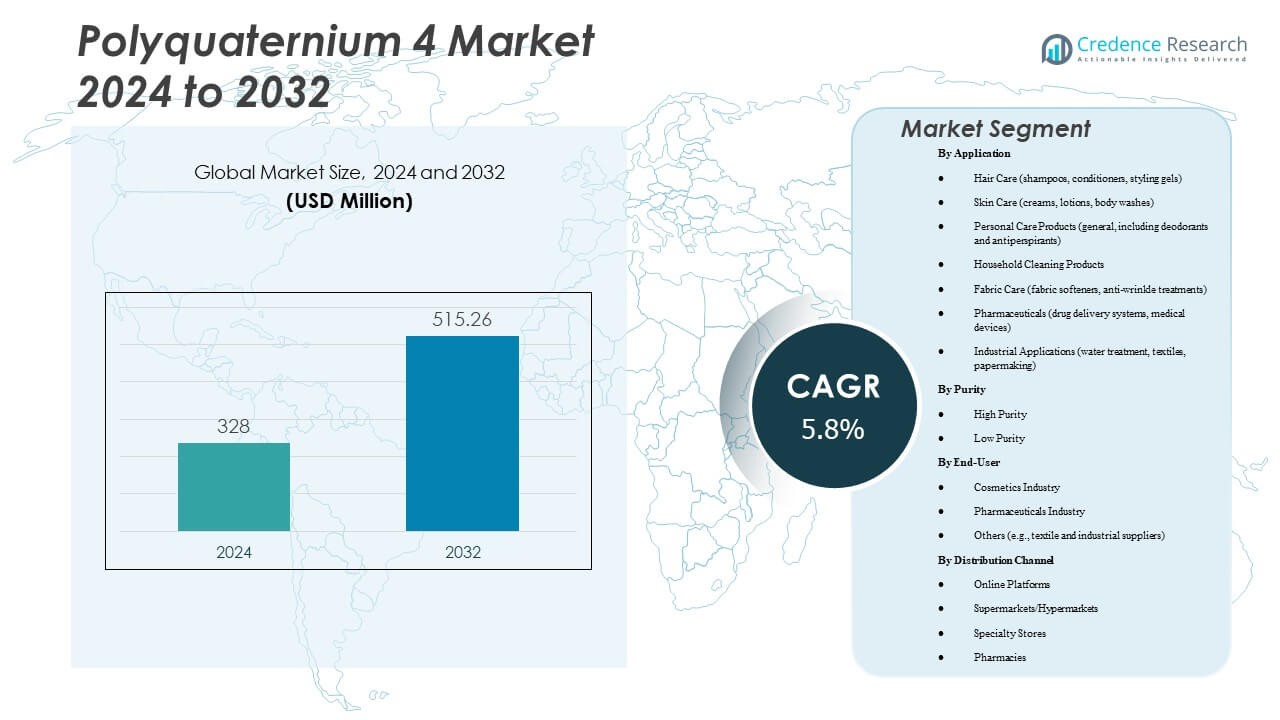
The Polyquaternium 4 Market is projected to grow from USD 328 million in 2024 to an estimated USD 515.26 million by 2032, with a compound annual growth rate (CAGR) of 5.8% from 2024 to 2032.
| REPORT ATTRIBUTE |
DETAILS |
| Historical Period |
2020-2023 |
| Base Year |
2024 |
| Forecast Period |
2025-2032 |
| Polyquaternium 4 Market Size 2024 |
USD 328 Million |
| Polyquaternium 4 Market, CAGR |
5.8% |
| Polyquaternium 4 Market Size 2032 |
USD 515.26 Million |
Growing consumer demand for advanced personal care and cosmetic formulations drives steady market expansion. Polyquaternium 4 is widely used in shampoos, conditioners, and styling products due to its superior film-forming, anti-static, and conditioning properties. Rising awareness of hair and scalp health, coupled with innovation in bio-based and sustainable ingredients, fuels its adoption across premium and mass-market product lines in both developed and emerging economies.
North America leads the Polyquaternium 4 Market due to its established cosmetics and personal care manufacturing base. Europe follows with strong regulatory support for sustainable and safe ingredients in formulations. Asia Pacific is emerging rapidly, driven by expanding middle-class populations, evolving beauty standards, and growing investments from global brands in local production facilities. Increasing consumer preference for premium beauty and wellness products further supports regional market growth across developing economies.
Access crucial information at unmatched prices!
Request your sample report today & start making informed decisions powered by Credence Research Inc.!
Download Sample
Market Insights:
- The Polyquaternium 4 Market is valued at USD 328 million in 2024 and projected to reach USD 515.26 million by 2032, growing at a CAGR of 5.8%.
- Demand is rising due to the expanding personal care and cosmetics industry emphasizing premium formulations.
- Polyquaternium 4’s superior conditioning, anti-static, and film-forming qualities enhance its role in hair and skincare products.
- Increasing preference for bio-based and sustainable ingredients supports long-term market growth.
- High production costs and stringent regulatory standards present key restraints for manufacturers.
- North America dominates due to strong cosmetic production and consumer preference for quality formulations.
- Asia Pacific is the fastest-growing region, supported by expanding middle-class consumers and regional manufacturing investments.
Market Drivers
Rising Demand for Hair Care and Styling Products Enhances Market Expansion
Increasing consumer preference for premium hair care products drives the use of Polyquaternium 4. It improves detangling, smoothness, and humidity resistance, strengthening its role in shampoos and conditioners. Global brands focus on advanced polymer-based solutions to meet texture and shine expectations. Rapid urbanization and lifestyle shifts support higher consumption of styling gels and sprays. Continuous product launches from personal care brands strengthen commercial adoption. Growing awareness of scalp health supports ingredient innovation. Rising disposable incomes elevate spending on beauty essentials. The Polyquaternium 4 Market gains momentum through this evolving demand landscape.
- For example, Henkel AG & Co. KGaA presents the Schwarzkopf Gliss hair-care line with Liquid Hair-Repair Technology, designed to repair hair damage both at the surface and core. The company introduced the line to the Gulf Cooperation Council (GCC) region in 2025, including a launch event where R&D experts demonstrated strand-strength after treatment.
Innovation in Bio-Based and Sustainable Formulations Drives Growth
The market benefits from the shift toward eco-friendly and biodegradable polymers. It supports sustainable formulations that align with global environmental goals. Companies invest in R&D to reduce dependency on synthetic polymers. Brands highlight renewable ingredients to attract health-conscious consumers. Manufacturers enhance film-forming properties while minimizing environmental impact. This aligns with regulations restricting non-biodegradable materials. Expansion of clean beauty segments increases polymer adoption. The Polyquaternium 4 Market experiences rising acceptance within green formulation strategies.
- For example, in April 2025, BASF expanded its EcoBalanced portfolio to include personal care ingredients such as Dehyton PK 45 and Dehyton KE UP, both certified under the REDcert biomass balance approach. The company also confirmed that six of its U.S. Care Chemicals sites now operate on 100% renewable electricity, reducing annual CO₂ emissions by approximately 33,000 tons.
Expanding Application Scope in Personal and Skin Care Strengthens Growth
The polymer’s multifunctionality extends beyond hair care into skincare and cosmetics. It provides film-forming, anti-static, and conditioning properties for lotions and serums. Product developers integrate it for improved spreadability and sensory appeal. Growing interest in multi-benefit skincare products supports usage expansion. Formulation flexibility enables better product stability and performance. It improves adhesion and feel in color cosmetics. Rising consumer focus on product efficiency increases adoption across categories. The Polyquaternium 4 Market benefits from broader use across personal care applications.
R&D Investments and Brand Differentiation Stimulate Product Development
R&D initiatives focus on enhancing formulation compatibility and performance. Manufacturers partner with chemical research firms to create advanced derivatives. It improves compatibility with cationic and anionic surfactants, expanding use in complex systems. Companies leverage innovation to differentiate their product lines. Continuous improvements in rheology and conditioning efficiency enhance end-user satisfaction. Collaboration with academic institutes boosts formulation technology. The polymer’s flexibility supports new product launches in premium segments. The Polyquaternium 4 Market evolves through steady innovation and brand competitiveness.
Market Trends
Surge in Clean Label and Natural Ingredient-Based Formulations
Global brands emphasize transparency and safety, fueling demand for clean-label ingredients. It aligns with consumer preference for low-toxicity and eco-friendly personal care solutions. Manufacturers develop natural polymer alternatives to maintain sustainability commitments. Regulatory standards encourage ingredient traceability and safety assurance. Brands reformulate existing lines to meet evolving expectations. Growth of plant-derived polymers improves market acceptance. Clean beauty trends influence ingredient innovation pipelines. The Polyquaternium 4 Market gains traction from its adaptability to natural formulation requirements.
- For example, Crodabond™ CSA is a 100% naturally-derived film-former and adhesive polymer explicitly designed for hair care and color cosmetics applications. The ingredient smooths and seals lifted cuticles, repairs split hair fibers, and offers long-wear effects in treated hair systems
Technological Advancements in Polymer Chemistry Improve Performance
Advanced polymer engineering enhances viscosity, conditioning, and film-forming effects. It enables better control over hair texture and skin feel. Companies adopt precision synthesis to improve molecular uniformity. Enhanced compatibility with surfactants expands formulation possibilities. New production methods reduce waste and energy use in processing. Innovations enhance polymer solubility in diverse pH ranges. Continuous improvement boosts product consistency and sensory results. The Polyquaternium 4 Market benefits from these technological upgrades in formulation science.
Growing Popularity of Premium and Customized Beauty Products
Personalized hair and skincare solutions shape the direction of product innovation. It allows brands to cater to specific consumer needs and hair types. Rising demand for tailored formulas boosts ingredient diversification. AI and data analytics guide new product design strategies. Consumers prefer solutions delivering visible and consistent outcomes. Growth of premium salons and cosmetic clinics expands ingredient demand. Formulators rely on performance polymers for stability and moisture control. The Polyquaternium 4 Market thrives through increased customization in beauty offerings.
Digital Transformation and E-Commerce Expansion Boost Market Visibility
Online retail channels drive global access to personal care products. It enables faster distribution and stronger consumer engagement. E-commerce platforms promote ingredient transparency and education. Marketing strategies highlight performance and safety through digital content. Rising influence of social media amplifies consumer awareness. Influencers shape ingredient perception across beauty segments. Brands leverage virtual consultations and online sampling programs. The Polyquaternium 4 Market gains momentum from digital commerce and brand outreach initiatives.
- For instance, L’Oréal’s consolidated e-commerce sales reached €12.3 billion in 2024—comprising 28.2% of the company’s sales and growing by 7.8% year-on-year, as reported in L’Oréal’s official financial reports and press announcements. The company attributes this growth to digital launches and transparent product labeling as promoted in its market statements.
Market Challenges Analysis
Regulatory Constraints and Environmental Compliance Requirements
Stringent regulations governing cosmetic ingredients affect formulation strategies. It requires compliance with biodegradability and toxicity standards across regions. Meeting certification norms increases production complexity and costs. Delays in approvals limit product introduction in certain markets. Evolving labeling laws demand extensive documentation and traceability. The shift toward green chemistry imposes adaptation costs on small manufacturers. Companies must reformulate existing products to meet global safety norms. The Polyquaternium 4 Market faces challenges in maintaining cost efficiency while adhering to environmental standards.
High Production Costs and Supply Chain Volatility Limit Scalability
Dependence on specialty chemical inputs elevates manufacturing expenses. It leads to price fluctuations and supply constraints during raw material shortages. Transportation delays and global trade instability affect cost structures. Limited domestic production in developing regions restricts volume scalability. Manufacturers face difficulty balancing price competitiveness with quality assurance. Complex polymer synthesis processes demand advanced equipment and expertise. Supply chain disruptions influence inventory management and delivery timelines. The Polyquaternium 4 Market encounters operational barriers that challenge profit margins and scalability.
Market Opportunities
Expansion Across Emerging Markets and Localized Manufacturing Investments
Rapid economic growth in Asia Pacific, Latin America, and the Middle East creates fresh opportunities. It drives regional demand for affordable yet effective cosmetic ingredients. Local manufacturing units reduce import dependency and enhance supply chain resilience. Partnerships with regional distributors expand reach to untapped markets. Growing consumer awareness supports diversification of personal care categories. Manufacturers can leverage free trade agreements to strengthen exports. Demand for multifunctional and climate-adaptive products supports innovation. The Polyquaternium 4 Market stands to gain from regional expansion and localized production.
Integration with Green Chemistry and Next-Generation Formulations
The transition to sustainable ingredients encourages new chemical synthesis pathways. It supports collaboration between polymer manufacturers and cosmetic formulators. Companies invest in biopolymer innovations to reduce carbon footprint. Enhanced focus on water-based and low-impact products promotes eco-friendly adoption. Brands targeting clean beauty certifications prefer biodegradable polymers. Evolving formulation needs create space for hybrid and multifunctional ingredients. Research in bio-cationic polymers opens avenues for next-generation developments. The Polyquaternium 4 Market finds long-term opportunities through alignment with green chemistry principles.
Market Segmentation Analysis:
By Application
Hair care products dominate the Polyquaternium 4 Market due to strong usage in shampoos, conditioners, and styling gels. It offers superior detangling, anti-static, and humidity control properties. Skin care follows closely, supported by its role in creams, lotions, and body washes for smooth texture and moisture retention. Personal care items, such as deodorants and antiperspirants, also use the polymer for better spreadability. Its use extends to household cleaning, fabric care, pharmaceuticals, and industrial sectors for conditioning and film-forming benefits. Broader formulation versatility strengthens long-term adoption.
- For example, BASF’s Luviquat® product line includes cationic polymers designed for use in shampoos, conditioners, and hair-styling formulations. These polymers provide conditioning, film-forming, and hold properties, as documented in BASF’s official technical brochures and product literature.
By Purity
High-purity Polyquaternium 4 accounts for the majority share due to its compatibility with sensitive formulations. It meets quality requirements of premium cosmetic and pharmaceutical products. Low-purity variants cater to cost-sensitive and industrial applications where strict standards are not mandatory. It provides functional performance at lower processing costs. Manufacturers emphasize purification technologies to meet safety certifications. High-purity grades dominate cosmetic innovation pipelines, while low-purity versions maintain steady utility in industrial applications.
By End-User
The cosmetics industry represents the leading end-user segment in the Polyquaternium 4 Market, driven by hair and skincare product innovation. Pharmaceutical companies employ the polymer in drug delivery systems and medical coatings for improved bioadhesion. Other users, including textile and industrial suppliers, rely on it for fabric conditioning and paper enhancement. Each end-user category benefits from its film-forming and electrostatic control properties. Its adaptability supports both consumer and technical formulations, maintaining balanced demand across sectors.
- For example, Matrix (a L’Oréal brand) incorporates Polyquaternium polymers such as Polyquaternium-37 in its Total Results Miracle Creator Multi-Tasking Hair Treatment, as disclosed on its official ingredient lists. This product is used by both consumers and salons internationally, easily verifiable via Matrix’s official website and product labeling.
By Distribution Channel
Online platforms capture increasing sales share due to wider product access and brand visibility. Supermarkets and hypermarkets remain crucial for bulk consumer product distribution. Specialty stores focus on professional-grade formulations targeting salons and cosmetic studios. Pharmacies distribute medicated and dermatological products containing the polymer. E-commerce growth fuels transparency and consumer education regarding ingredient quality. It benefits from digital retail integration that drives market expansion through multi-channel availability.
Segmentation:
By Application
- Hair Care (shampoos, conditioners, styling gels)
- Skin Care (creams, lotions, body washes)
- Personal Care Products (general, including deodorants and antiperspirants)
- Household Cleaning Products
- Fabric Care (fabric softeners, anti-wrinkle treatments)
- Pharmaceuticals (drug delivery systems, medical devices)
- Industrial Applications (water treatment, textiles, papermaking)
By Purity
By End-User
- Cosmetics Industry
- Pharmaceuticals Industry
- Others (e.g., textile and industrial suppliers)
By Distribution Channel
- Online Platforms
- Supermarkets/Hypermarkets
- Specialty Stores
- Pharmacies
By Region
- North America
- Europe
- Germany
- France
- U.K.
- Italy
- Spain
- Rest of Europe
- Asia Pacific
- China
- Japan
- India
- South Korea
- South-east Asia
- Rest of Asia Pacific
- Latin America
- Brazil
- Argentina
- Rest of Latin America
- Middle East & Africa
- GCC Countries
- South Africa
- Rest of the Middle East and Africa
Regional Analysis:
North America holds a dominant 34% share of the Polyquaternium 4 Market, driven by strong demand across personal care and pharmaceutical sectors. The United States leads regional growth through the presence of global cosmetic manufacturers and advanced formulation capabilities. High consumer awareness toward ingredient safety and clean-label products sustains long-term demand. Canada and Mexico support market expansion through strategic supply chain integration and regional production hubs. Regulatory standards encourage investment in eco-friendly polymers with improved performance. It maintains leadership through innovation, product diversification, and rising interest in sustainable beauty trends.
Europe accounts for 28% of the global market, supported by the region’s strong emphasis on sustainability and product safety. Countries such as Germany, France, and the U.K. lead production through advanced polymer research and regulated manufacturing environments. Consumer preference for bio-based and non-toxic ingredients aligns with EU directives promoting sustainable chemistry. The market benefits from partnerships between chemical producers and cosmetic formulators to develop premium formulations. Ongoing innovation in texture-enhancing and conditioning polymers supports market maturity. It continues to expand its footprint by focusing on green-certified product development and responsible sourcing initiatives.
Asia Pacific holds a 26% share and represents the fastest-growing regional market. Expanding middle-class populations in China, India, Japan, and South Korea support higher demand for affordable and effective personal care products. Local manufacturing strengthens product availability and cost competitiveness. Global brands are investing in regional R&D centers to tailor formulations for diverse climatic and consumer needs. Rapid urbanization, digital marketing, and e-commerce adoption enhance distribution efficiency. It benefits from government support for domestic cosmetic production and export development. South America and the Middle East & Africa jointly contribute 12% share, with rising consumer awareness encouraging gradual market penetration.
Key Player Analysis:
- BASF SE
- Evonik Industries AG
- Inolex Inc.
- Galaxy Surfactants Ltd.
- Lubrizol Corporation
- Clariant AG
- Solvay SA
- Cargill, Inc.
- Huntsman Corporation
- Akzo Nobel N.V.
- Wacker Chemie AG
- Croda International PLC
- Elementis Specialties
- Xiamen Hisunny Chemical Co., Ltd.
- Hangzhou Dayang Chem Co., Ltd.
Competitive Analysis:
The competitive landscape of the Polyquaternium 4 Market is characterized by innovation, quality improvement, and regional expansion strategies. Leading companies such as BASF SE, Lubrizol Corporation, Solvay SA, Clariant AG, and Evonik Industries AG emphasize advanced polymer chemistry to strengthen performance attributes. It features continuous R&D investment focused on green and bio-based formulations. Strategic collaborations between suppliers and personal care brands drive product differentiation. Companies target niche applications in skincare, pharmaceuticals, and textile processing to broaden market reach. Strong distribution networks and technical service programs support customer retention. Continuous improvements in purity levels, biodegradability, and formulation compatibility maintain competitive advantage and global market relevance.
Recent Developments:
- In March 2025, Inolex Inc. entered into an exclusive small-pack distribution partnership with The Ingredients Store, strengthening its reach across Europe and enhancing access to its sustainable ingredient portfolio, including those relevant to the Polyquaternium 4 market.
- In March 2025, Inolex Inc. announced the appointment of Art Knox as President to drive the company’s next phase of customer-focused growth and sustainable innovation, which supports its continued developments and outreach in the conditioning polymers space represented by products like Polyquaternium 4.
Shape Your Report to Specific Countries or Regions & Enjoy 30% Off!
Report Coverage:
The research report offers an in-depth analysis based on Application, Purity, End-User and Distribution Channel. It details leading market players, providing an overview of their business, product offerings, investments, revenue streams, and key applications. Additionally, the report includes insights into the competitive environment, SWOT analysis, current market trends, as well as the primary drivers and constraints. Furthermore, it discusses various factors that have driven market expansion in recent years. The report also explores market dynamics, regulatory scenarios, and technological advancements that are shaping the industry. It assesses the impact of external factors and global economic changes on market growth. Lastly, it provides strategic recommendations for new entrants and established companies to navigate the complexities of the market.
Future Outlook:
- Growing emphasis on sustainable and biodegradable polymers will define long-term market evolution.
- Expanding hair and skincare industries will continue driving ingredient innovation and adoption.
- Rising demand for clean-label and safe cosmetic formulations will increase regulatory compliance needs.
- Manufacturers will focus on developing high-purity grades to enhance performance and compatibility.
- Regional production expansion in Asia Pacific will improve cost efficiency and market penetration.
- Strategic partnerships between chemical firms and cosmetic brands will support new product launches.
- Technological advances in polymer chemistry will strengthen conditioning and film-forming performance.
- E-commerce growth will accelerate product visibility and end-user access to polymer-based formulations.
- Pharmaceutical and industrial applications will gain traction through bioadhesive and stabilizing uses.
- Continuous innovation in green chemistry will secure long-term sustainability and competitive advantage.



