
Market Overview:
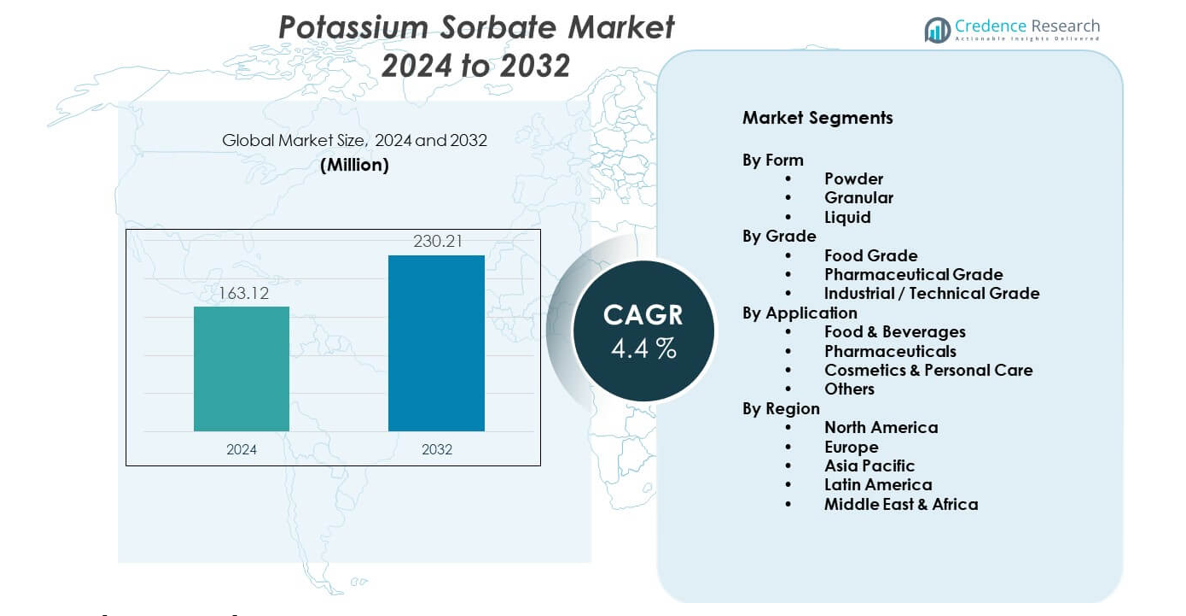
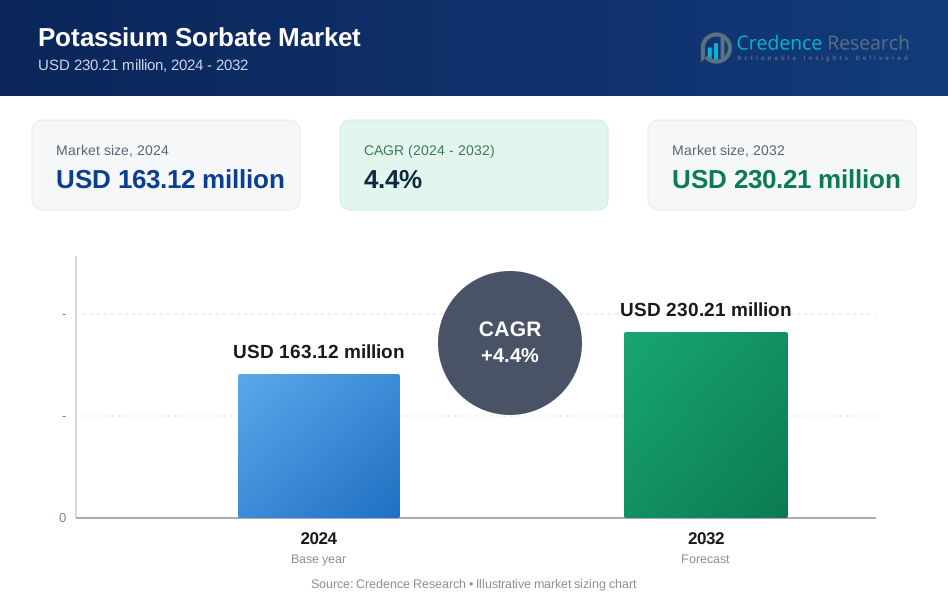
The Potassium Sorbate Market is projected to grow from USD 163.12 million in 2024 to an estimated USD 230.21 million by 2032, with a compound annual growth rate of 4.4% from 2024 to 2032. Potassium sorbate serves as a widely used food preservative due to strong antimicrobial performance.
| REPORT ATTRIBUTE | DETAILS |
|---|---|
| Historical Period | 2020-2023 |
| Base Year | 2024 |
| Forecast Period | 2025-2032 |
| Potassium Sorbate Market Size 2024 | USD 163.12 million |
| Potassium Sorbate Market, CAGR | 4.4% |
| Potassium Sorbate Market Size 2032 | USD 230.21 million |
Rising demand for packaged and processed food products drives the Potassium Sorbate Market. Food manufacturers rely on effective preservatives to prevent mold and yeast growth. Clean labeling trends encourage use of preservatives with proven safety profiles. Beverage producers use potassium sorbate to maintain flavor stability. Pharmaceutical formulations apply the compound to protect liquid medicines. Personal care brands adopt it in creams and lotions for microbial control. Expanding urban populations increase consumption of ready-to-eat products. Longer distribution chains raise shelf-life expectations. Regulatory approvals across major economies support sustained demand.
North America and Europe lead the Potassium Sorbate Market due to high processed food consumption. Strong food safety regulations support consistent preservative usage. The United States and Germany remain key production and consumption hubs. Asia-Pacific emerges as the fastest-growing region driven by food industry expansion. China and India see rising demand from bakery and beverage sectors. Growing middle-class populations boost packaged food intake. Latin America shows steady growth through dairy and beverage applications. Middle East and Africa expand gradually with improving food processing infrastructure.
Market Insights:
- The Potassium Sorbate Market reached USD 163.12 million in 2024 and is projected to reach USD 230.21 million by 2032, growing at a CAGR of 4.4% due to steady preservative demand.
- North America leads with about 32% share due to advanced food processing, Europe follows with 28% driven by strict regulations, and Asia Pacific holds 25% supported by rapid food industry expansion.
- Asia Pacific is the fastest-growing region with around 25% share, driven by urbanization, rising packaged food consumption, and expanding beverage production.
- By application, food and beverages account for nearly 58% share due to widespread use in bakery, dairy, and drinks.
- By grade, food grade holds around 62% share, supported by safety approvals and high demand from processed food manufacturers.
Market Drivers:
Rising Demand From Processed And Packaged Food Production
The Potassium Sorbate Market benefits from steady growth in processed food output. Food brands need reliable preservatives for shelf stability. Potassium sorbate controls mold and yeast effectively. Bakery, dairy, and beverage sectors rely on this compound. Urban lifestyles increase demand for packaged foods. Retail chains require longer product shelf life. Manufacturers value predictable performance across formulations. Regulatory approval supports wide food application use.
- For instance, FDA permits potassium sorbate up to 0.1% by weight in food products.
Expansion Of Beverage And Liquid Food Applications
The Potassium Sorbate Market gains strength from beverage sector expansion. Soft drinks require microbial stability during storage. Fruit juices depend on preservatives to maintain freshness. Alcoholic beverages use sorbate for fermentation control. It supports flavor consistency across distribution cycles. Bottled drinks face extended transport timelines. Producers seek cost-efficient preservation solutions. Potassium sorbate meets these operational needs.
- For instance, Coca-Cola uses sorbates (such as potassium sorbate) to support yeast control in acidic beverages, where the low pH enhances the preservative's effectiveness.
Growing Use In Pharmaceutical And Nutraceutical Formulations
The Potassium Sorbate Market sees demand from liquid pharmaceuticals. Syrups require protection against microbial growth. Nutraceutical liquids also depend on preservation. Shelf stability ensures product safety for consumers. Drug manufacturers prioritize compliant additives. Potassium sorbate fits approved excipient lists. Global healthcare demand supports steady usage. Reliable sourcing strengthens adoption across regions.
Increasing Adoption In Personal Care And Cosmetics
The Potassium Sorbate Market expands within personal care products. Creams and lotions need microbial protection. Brands prefer mild preservatives with proven safety. Potassium sorbate suits sensitive skin formulations. Rising skincare awareness boosts product launches. Natural-focused brands accept this preservative. Stable performance supports consistent texture quality. Cosmetic regulations favor controlled preservative use.
Market Trends:
Shift Toward Clean Label And Mild Preservation Solutions
The Potassium Sorbate Market reflects clean label product strategies. Brands simplify ingredient lists for transparency. Potassium sorbate holds a recognized safety image. Consumers prefer familiar preservative names. Food companies reduce complex chemical blends. It supports minimal formulation changes. Regulatory clarity improves consumer trust. Clean positioning strengthens long-term acceptance.
- For instance, EFSA reaffirmed potassium sorbate safety within approved food limits.
Increasing Preference For Standardized Food Grade Quality
The Potassium Sorbate Market shows focus on grade consistency. Buyers demand uniform purity levels. Food processors require batch reliability. Quality audits increase across supply chains. Producers invest in refined production controls. Certification compliance becomes a purchase factor. Standardized quality reduces formulation risk. Global trade favors consistent specifications.
- For instance, Kerry Group supplies food-grade potassium sorbate meeting FCC and E-number standards.
Growth Of Global Food Trade And Cold Chain Logistics
The Potassium Sorbate Market aligns with expanding food exports. Cold chain logistics extend product travel distance. Preservatives support stability during transit. Exporters prioritize shelf-life assurance. International food standards encourage approved additives. Potassium sorbate supports cross-border distribution. Longer storage cycles increase preservative need. Trade growth sustains volume demand.
Rising Demand For Cost-Efficient Preservation Systems
The Potassium Sorbate Market benefits from cost control strategies. Manufacturers seek effective low-dose preservatives. Potassium sorbate delivers strong antimicrobial action. It reduces overall formulation cost pressure. Price stability supports procurement planning. Producers avoid frequent ingredient switching. Efficient preservation improves margin control. Cost focus drives continued adoption.
Market Challenges Analysis:
Regulatory Compliance And Labeling Complexity Across Regions
The Potassium Sorbate Market faces varied regional regulations. Labeling rules differ across countries. Compliance increases administrative workload for producers. Exporters manage multiple documentation standards. Regulatory updates require frequent review. Smaller firms face higher compliance costs. Market entry barriers rise for new suppliers. Regulatory scrutiny affects formulation decisions.
Availability Of Alternative Preservatives And Substitutes
The Potassium Sorbate Market competes with alternative preservatives. Natural extracts gain attention in premium foods. Fermentation-based solutions attract niche demand. Some brands reduce preservative usage claims. Substitutes increase buyer negotiation power. Performance comparison affects procurement choices. R&D costs rise to defend market share. Competitive pressure challenges long-term pricing stability.
Market Opportunities:
Expansion In Emerging Food Processing Markets
The Potassium Sorbate Market holds opportunity in emerging economies. Food processing capacity expands rapidly. Urban populations increase packaged food demand. Local manufacturers seek proven preservatives. Potassium sorbate offers easy formulation integration. Cost efficiency suits developing market needs. Distribution networks improve steadily. Emerging regions support volume growth.
Product Innovation And Application-Specific Formulations
The Potassium Sorbate Market can expand through tailored solutions. Customized grades suit specific food applications. Beverage-focused variants improve solubility performance. Cosmetic blends address formulation compatibility. Pharmaceutical grades support strict compliance needs. Innovation strengthens supplier differentiation. Value-added products improve margins. Application focus drives future growth paths.
Market Segmentation Analysis:
By Form
The Potassium Sorbate Market shows clear differentiation across product forms. Powder form dominates due to easy handling and long shelf life. Food and pharmaceutical producers prefer powder for dry blends. Granular form supports controlled dosing in industrial processes. It improves flow properties during large-scale production. Liquid form serves beverage and liquid pharmaceutical applications. Liquid variants dissolve faster in aqueous systems. This form suits formulations that require uniform dispersion. Form selection depends on process efficiency and end-use needs.
- For instance, DSM-Firmenich supplies powder sorbate with moisture content below 1%.
By Grade
Food grade potassium sorbate holds the largest share due to strict safety standards. Food processors rely on this grade for preservative stability. Pharmaceutical grade supports syrups, suspensions, and liquid medicines. It meets purity and compliance requirements. Industrial or technical grade serves non-food uses with cost focus. Applications include coatings and chemical processing. Grade choice reflects regulatory demands and application sensitivity. Higher-grade products support premium pricing strategies.
- For instance, Merck provides pharmaceutical-grade potassium sorbate compliant with USP specifications.
By Application
Food and beverages represent the primary application segment. Bakery, dairy, and drinks depend on microbial control. Pharmaceuticals use potassium sorbate to protect liquid formulations. Cosmetics and personal care products apply it for shelf stability. Creams and lotions benefit from mild preservation. Other applications include specialty chemicals and niche industrial uses. Application diversity supports demand stability. End-user requirements shape formulation and grade selection.
Segmentation:
By Form
- Powder
- Granular
- Liquid
By Grade
- Food Grade
- Pharmaceutical Grade
- Industrial / Technical Grade
By Application
- Food & Beverages
- Pharmaceuticals
- Cosmetics & Personal Care
- Others
By Region
- North America
- U.S.
- Canada
- Mexico
- Europe
- Germany
- France
- U.K.
- Italy
- Spain
- Rest of Europe
- Asia Pacific
- China
- Japan
- India
- South Korea
- South-east Asia
- Rest of Asia Pacific
- Latin America
- Brazil
- Argentina
- Rest of Latin America
- Middle East & Africa
- GCC Countries
- South Africa
- Rest of the Middle East and Africa
Regional Analysis:
North America Dominates With Mature Food And Beverage Industries
The Potassium Sorbate Market in North America accounts for nearly 32% of global share. The United States leads due to strong packaged food consumption. Advanced food safety standards drive preservative usage. Beverage and dairy industries rely on stable shelf-life solutions. Pharmaceutical formulations support consistent demand. Personal care brands also contribute to volume growth. Established distribution networks sustain regional leadership.
Europe Maintains Strong Position Through Regulatory Compliance
Europe holds around 28% share in the Potassium Sorbate Market. Countries such as Germany, France, and the United Kingdom lead consumption. Strict food regulations encourage approved preservatives. Clean-label trends support potassium sorbate adoption. Bakery and processed meat sectors remain key users. Pharmaceutical manufacturing strengthens demand stability. Cross-border trade supports steady regional volume.
Asia Pacific Leads Growth While Other Regions Expand Gradually
Asia Pacific represents about 25% of the Potassium Sorbate Market and grows fastest. China and India drive demand through food processing expansion. Urbanization increases packaged food consumption. Beverage production rises across Southeast Asia. Latin America holds nearly 9% share, led by Brazil and Mexico. Middle East & Africa account for around 6%, supported by improving food infrastructure. Emerging markets strengthen long-term regional balance.
Key Player Analysis:
- Celanese Corporation
- Shandong Kunda Biological Technology Co., Ltd.
- Merck
- Titan Biotech
- Hunan Huari Pharmaceutical Co., Ltd.
Competitive Analysis:
The Potassium Sorbate Market features moderate competition with global and regional suppliers. Large players focus on scale, quality control, and regulatory compliance. Established firms benefit from long-term contracts with food processors. Product consistency remains a key competitive factor. Companies invest in purity improvement and process efficiency. Regional manufacturers compete through cost advantages. Distribution reach influences buyer preference across regions. Strategic partnerships support market access. Brand reputation strengthens trust among pharmaceutical and food clients. Competitive intensity remains stable due to standardized product nature.
Recent Developments:
- In April 2025, Merck KGaA announced a definitive agreement to acquire SpringWorks Therapeutics for an equity value of USD 3.9 billion. The acquisition was officially completed on July 1, 2025, for an enterprise value of €3 billion (USD 3.4 billion). This represents the largest acquisition by Merck's Healthcare sector in nearly 20 years.
- In June 2023, Celanese Corporation signed a definitive agreement to form a strategic joint venture with Mitsui & Co. for its Nutrinova functional food ingredients business. Under the terms of the agreement, Mitsui acquired a 70% equity stake in Nutrinova Netherlands B.V., while Celanese retained a 30% ownership stake.
Report Coverage:
The research report offers an in-depth analysis based on form, grade, and application segments. It details leading market players, providing an overview of their business, product offerings, investments, revenue streams, and key applications. Additionally, the report includes insights into the competitive environment, SWOT analysis, current market trends, as well as the primary drivers and constraints. Furthermore, it discusses various factors that have driven market expansion in recent years. The report also explores market dynamics, regulatory scenarios, and technological advancements that are shaping the industry. It assesses the impact of external factors and global economic changes on market growth. Lastly, it provides strategic recommendations for new entrants and established companies to navigate the complexities of the market.
Future Outlook:
- Demand from processed food production will remain strong
- Beverage sector expansion will support stable consumption
- Pharmaceutical applications will gain steady traction
- Cosmetic formulations will increase preservative usage
- Clean-label positioning will influence product selection
- Asia Pacific will drive volume growth
- Cost efficiency will shape supplier strategies
- Quality certification will gain importance
- Supply chain localization will expand
- Innovation will focus on application-specific grades
Request a Free Sample
Fill in your details and we'll send you a free sample report.
- Sample data tables & charts
- Research methodology
Need a Custom Version of This Report?
Tailor the scope, geography, or segments to your exact requirements.
- Custom geography or segment scope
- Direct access to our analyst team
Frequently Asked Questions
What is the current market size for Potassium Sorbate Market, and what is its projected size in 2032?
At what Compound Annual Growth Rate is the Potassium Sorbate Market projected to grow between 2025 and 2032?
Which Potassium Sorbate Market segment held the largest share in 2024?
What are the primary factors fueling the growth of the Potassium Sorbate Market
Who are the leading companies in the Potassium Sorbate Market?
Which region commanded the largest share of the Potassium Sorbate Market in 2024?
Table of Content
Chapter 1. Report Introduction
- 1.1 Report Description & Purpose
- 1.1.1 Report Title & Market Definition
- 1.1.2 Unique Selling Propositions (USP) & Key Differentiators
- 1.1.3 Value Proposition for Stakeholders
- 1.2 Research Objectives
- 1.2.1 Market Sizing Objectives (Volume & Revenue)
- 1.2.2 Segmentation Objectives
- 1.2.3 Competitive Intelligence Objectives
- 1.2.4 Forecast & Scenario Objectives
- 1.3 Report Scope
- 1.3.1 Potassium Sorbate Scope – Types & Subtypes Covered
- 1.3.2 Geographic Scope – Regions & Countries Covered
- 1.3.3 Historical Period, Base Year & Forecast Period (2024; forecast to 2032)
- 1.3.4 Inclusions & Exclusions
- 1.4 HS Code & Classification Framework
- 1.5 Currency, Units & Pricing Basis
- 1.6 Target Stakeholders
- 1.7 Limitations & Assumptions
Chapter 2. Executive Summary
- 2.1 Global Potassium Sorbate Market Snapshot
- 2.1.1 Market Size – Historical (2024) & Forecast (2024-2032) (2024: USD 163.12 million → 2032: USD 230.21 million)
- 2.1.2 Volume & Revenue – Global Totals
- 2.1.3 Key Market Highlights – Top Five Facts
- 2.2 Potassium Sorbate Market Segmentation Snapshot
- 2.2.1 Market Split by Region – 2024 vs. 2032
- 2.3 Competitive Snapshot
- 2.3.1 Top 10 Players by Revenue Share – 2024
- 2.3.2 Top 10 Players by Volume Share – 2024
- 2.3.3 Recent Strategic Developments (18-Month Summary)
- 2.4 Key Investment Highlights & Strategic Conclusions
Chapter 3. Potassium Sorbate Market Dynamics & Industry Analysis
- 3.1 Market Overview & Context
- 3.1.1 Potassium Sorbate Market Position in the Broader Automotive Value Chain
- 3.1.2 OEM vs. Replacement Market Dynamics
- 3.1.3 Market Maturity & Development Stage by Region
- 3.2 Potassium Sorbate Market Drivers
- 3.3 Potassium Sorbate Market Restraints & Challenges
- 3.4 Potassium Sorbate Market Opportunities
- 3.5 Porter's Five Forces Analysis
- 3.5.1 Threat of New Entrants
- 3.5.2 Bargaining Power of Suppliers
- 3.5.3 Bargaining Power of Buyers
- 3.5.4 Threat of Substitutes
- 3.5.5 Competitive Rivalry – Intensity Assessment
- 3.6 Potassium Sorbate Value Chain Analysis
- 3.6.1 Upstream – Raw Material/Input Suppliers
- 3.6.1.1 Raw Material/Input 1
- 3.6.1.2 Raw Material/Input 2
- 3.6.1.3 Raw Material/Input 3
- 3.6.2 Midstream – Production/Manufacturing/Service Delivery
- 3.6.2.1 Production/Process Overview
- 3.6.2.2 Key Facility Locations & Capacity by Manufacturer
- 3.6.3 Downstream – Distribution & End Consumer
- 3.6.3.1 Primary Channel – B2B/OEM
- 3.6.3.2 Secondary Channels – Dealer, Retail, Online, Direct
- 3.6.4 Value Chain Profitability Analysis
- 3.6.1 Upstream – Raw Material/Input Suppliers
- 3.7 PESTEL Analysis
- 3.7.1 Political Factors
- 3.7.2 Economic Factors
- 3.7.3 Social Factors
- 3.7.4 Technological Factors
- 3.7.5 Environmental Factors
- 3.7.6 Legal Factors
- 3.8 Potassium Sorbate Supply Chain Analysis
- 3.8.1 Raw Material/Input Supply Risk Assessment
- 3.8.2 Manufacturing Concentration Risk (Geographic Exposure)
- 3.8.3 Trade Disruption Impact Analysis
- 3.9 Regulatory & Policy Landscape
Note: The regulatory and policy landscape section covers regulations based on their applicability to the market, Potassium Sorbate category, geography, and scope of the study. Only regulatory frameworks with a material impact on operations, compliance, trade, sustainability, or market access are analyzed in detail.
Chapter 4. Key Investment Pockets & Opportunity Analysis
- 4.1 Potassium Sorbate Market Attractiveness Analysis
- 4.1.1 By Region – Investment Attractiveness Matrix (Volume × CAGR)
- 4.2 Absolute Revenue Growth Opportunity
- 4.2.1 By Region – Absolute USD Growth Through 2032
- 4.3 Incremental Volume Opportunity
- 4.3.1 By Region – Incremental Volume Through 2032
- 4.3.2 Segment – Incremental Volume
- 4.4 Emerging Submarket Opportunity Deep Dive (Subject to Applicability)
- 4.5 Emerging Market Opportunity Scorecards
- 4.5.1 United States
- 4.5.2 Europe
- 4.5.3 Asia
- 4.5.4 Middle East & Africa
Note: Emerging Market Opportunity Scorecards will be included based on relevance and strategic importance. Regions listed are indicative and may vary depending on data availability and market dynamics.
Chapter 5. Potassium Sorbate Import-Export Analysis & Trade Flows
- 5.1 Global Trade Overview
- 5.1.1 Global Export Value by Country (2024)
- 5.1.2 Global Export Volume by Country (2024)
- 5.1.3 Global Import Value by Country (2024)
- 5.1.4 Global Import Volume by Country (2024)
- 5.1.5 Net Trade Balance by Country (2024)
- 5.2 Export Analysis – Segment
- 5.2.1 Type 1 (HS Code)
- 5.2.2 Type 2 (HS Code)
- 5.2.3 Type 3 (HS Code)
- 5.2.4 Type 4 (HS Code)
- 5.2.5 Type 5 (HS Code)
- 5.3 Import Analysis – Segment
- 5.3.1 Type 1 (HS Code)
- 5.3.2 Type 2 (HS Code)
- 5.3.3 Type 3 (HS Code)
- 5.3.4 Type 4 (HS Code)
- 5.3.5 Type 5 (HS Code)
- 5.4 Average Unit Trade Prices
- 5.4.1 Average Export Price – Segment & Country
- 5.4.2 Average Import Price – Segment & Source Country
- 5.4.3 Price Trends (2024)
- 5.5 Key Trade Route Analysis
- 5.5.1 Trade Route 1
- 5.5.2 Trade Route 2
- 5.5.3 Trade Route 3
- 5.5.4 Trade Route 4
- 5.5.5 Trade Route 5
- 5.6 Trade Policy Impact Assessment
- 5.6.1 US Anti-Dumping & Section 301 Tariffs
- 5.6.2 EU Customs Union Impact
- 5.6.3 Major Free Trade Agreements
- 5.6.4 USMCA Rules of Origin
Note: Trade policy analysis will be included only where relevant to the Potassium Sorbate market.
Chapter 6. Competitive Landscape & Company Benchmarking
- 6.1 Potassium Sorbate Market Concentration & Structure
- 6.1.1 Herfindahl-Hirschman Index (HHI) – vs. 2024
- 6.1.2 Tier 1, Tier 2 & Tier 3 Market Structure
- 6.1.3 Global, Regional & Local Player Dynamics
- 6.2 Potassium Sorbate Market Share Analysis – 2024
- 6.2.1 Global Revenue Share by Company
- 6.2.2 Global Volume Share by Company
- 6.2.3 Regional Revenue Share
- 6.2.4 Market Share Evolution ( vs. 2024)
- 6.2.5 OEM Segment Share by Company
- 6.2.6 Replacement Segment Share by Company
- 6.3 Production/Delivery Capacity & Facility Analysis
- 6.3.1 Global Installed Capacity
- 6.3.2 Capacity Utilization Rates
- 6.3.3 Production/Output Volume
- 6.3.4 Facility Locations & Capacity Map
- 6.3.5 Planned Capacity Additions
- 6.4 Potassium Sorbate Competitive Benchmarking Matrix
- 6.4.1 Revenue, Volume, CAGR & Profitability Comparison
- 6.4.2 Channel Revenue Mix
- 6.4.3 Geographic Revenue Exposure
- 6.4.4 R&D Intensity
- 6.4.5 Sustainability Maturity
- 6.5 Strategic Developments in Potassium Sorbate (Last 24 Months)
- 6.5.1 Mergers, Acquisitions & Divestments
- 6.5.2 New Potassium Sorbate Launches
- 6.5.3 Facility Expansions
- 6.5.4 Strategic Alliances, Joint Ventures & Partnerships
- 6.5.5 Distribution Expansion & Market Entry
- 6.5.6 Sustainability & ESG Initiatives
- 6.6 Competitive Strategy Mapping
- 6.6.1 Leader, Challenger, Follower & Niche Classification
- 6.6.2 Pricing Strategy Comparison
- 6.6.3 Channel Strategy Matrix
Note: Strategic developments are included based on their materiality and the availability of reliable information.
Chapter 7. Global Potassium Sorbate Market – By Distribution Channel
- 7.1 Segment Overview
- 7.1.1 Volume & Revenue Split by Channel (2024 & 2032)
- 7.1.2 Channel Mix Evolution (2024-2032)
Chapter 8. Regional Market Analysis – Global Overview
- 8.1 Global Regional Overview
- 8.1.1 Regional Volume Share
- 8.1.2 Regional Revenue Share
- 8.1.3 Regional Volume by Region
- 8.1.4 Regional Revenue by Region
- 8.1.5 Regional Forecast Through 2032
- 8.2 Cross-Regional Segment Analysis
- 8.2.1 By Distribution Channel
- 8.2.2 By Brand/Price Tier
Chapter 9. North America Potassium Sorbate Market
- 9.1 United States
- 9.2 Canada
- 9.3 Mexico
Chapter 10. Europe Potassium Sorbate Market
- 10.1 Germany
- 10.2 France
- 10.3 Italy
- 10.4 United Kingdom
- 10.5 Spain
- 10.6 Poland
- 10.7 Russia
- 10.8 Netherlands
- 10.9 Belgium
- 10.10 Sweden
- 10.11 Denmark
- 10.12 Norway
- 10.13 Rest of Europe
Chapter 11. Asia Pacific Potassium Sorbate Market
- 11.1 China
- 11.2 India
- 11.3 Japan
- 11.4 South Korea
- 11.5 Thailand
- 11.6 Indonesia
- 11.7 Vietnam
- 11.8 Malaysia
- 11.9 Australia
- 11.10 Rest of Asia Pacific
Chapter 12. Latin America Potassium Sorbate Market
- 12.1 Brazil
- 12.2 Argentina
- 12.3 Colombia
- 12.4 Chile
- 12.5 Rest of Latin America
Chapter 13. Middle East Potassium Sorbate Market
- 13.1 Saudi Arabia
- 13.2 United Arab Emirates
- 13.3 Turkey
- 13.4 Israel
- 13.5 Iran
- 13.6 Rest of the Middle East
Chapter 14. Africa Potassium Sorbate Market
- 14.1 South Africa
- 14.2 Egypt
- 14.3 Nigeria
- 14.4 Morocco
- 14.5 Rest of Africa
Chapter 15. Potassium Sorbate Company Profiles
- 15.1 [Company 01]
- 15.1.1 Company Overview
- 15.1.2 Key Management Personnel
- 15.1.3 Products & Services Portfolio
- 15.1.4 Financial Performance
- 15.1.5 Key Market Focus & Geographic Presence
- 15.1.6 Recent Developments & Strategic Initiatives
Note: The company profile list is preliminary and may change based on research findings, market developments, data availability, and client requirements.
Chapter 16. Appendices
- Appendix A – List of Abbreviations & Acronyms
- Appendix B – Industry Classification Code Reference – Full Series
- Appendix C – Production & Capacity Data Tables
- Appendix D – End-Use & Demand Base Tables
- Appendix E – Consumption & Replacement Rate Assumptions
- Appendix F – ASP Reference Tables
- Appendix G – Manufacturing & Facility Database
- Appendix H – Import-Export Data Tables
- Appendix I – Regulatory Summary Tables
- Appendix J – Primary Research Participant List (Anonymized)
- Appendix K – Primary Research Questionnaire Framework
- Appendix L – Data Sources & Bibliography
- Appendix M – Market Size Divergence & Source Comparison
Chapter 17. Research Methodology
- 17.1 Research Framework & Philosophy
- 17.2 Secondary Research – Sources, Hierarchy & Data Extraction
- 17.3 Data Modeling – Bottom-Up & Top-Down Market Sizing
- 17.4 Primary Research – Stakeholder Framework, LOI & Sample Sizes
- 17.5 Forecast Methodology – Regression, Scenario & Sensitivity Analysis
- 17.6 Quality Control – Four-Layer Validation Framework
- 17.7 Limitations & Standard Assumptions
- 17.8 Disclaimer
