
Market Overview:
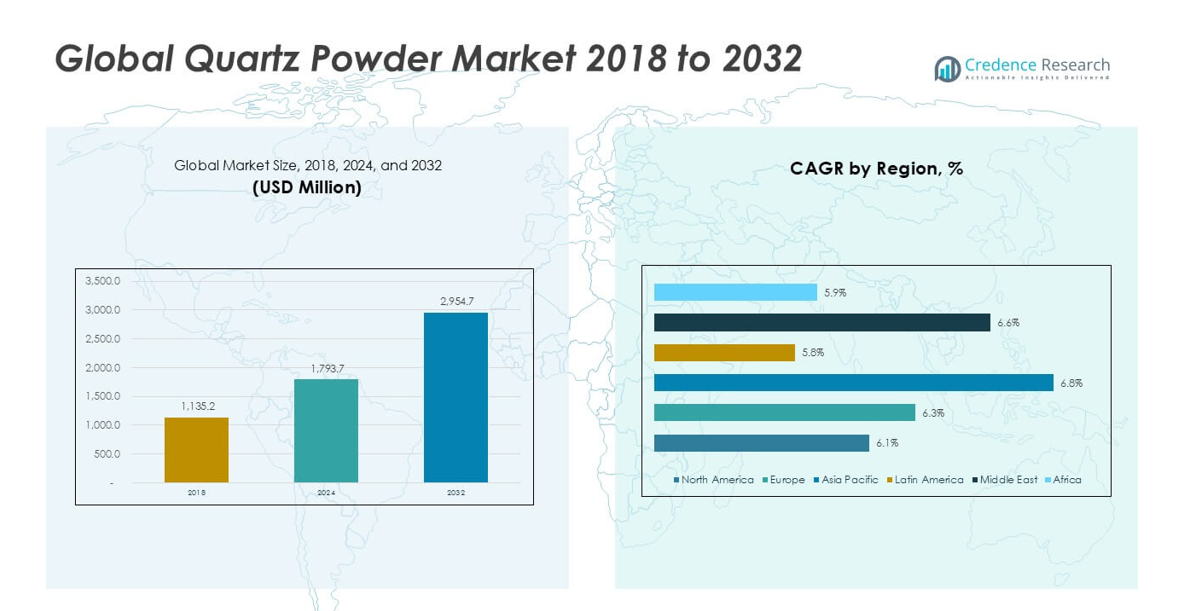
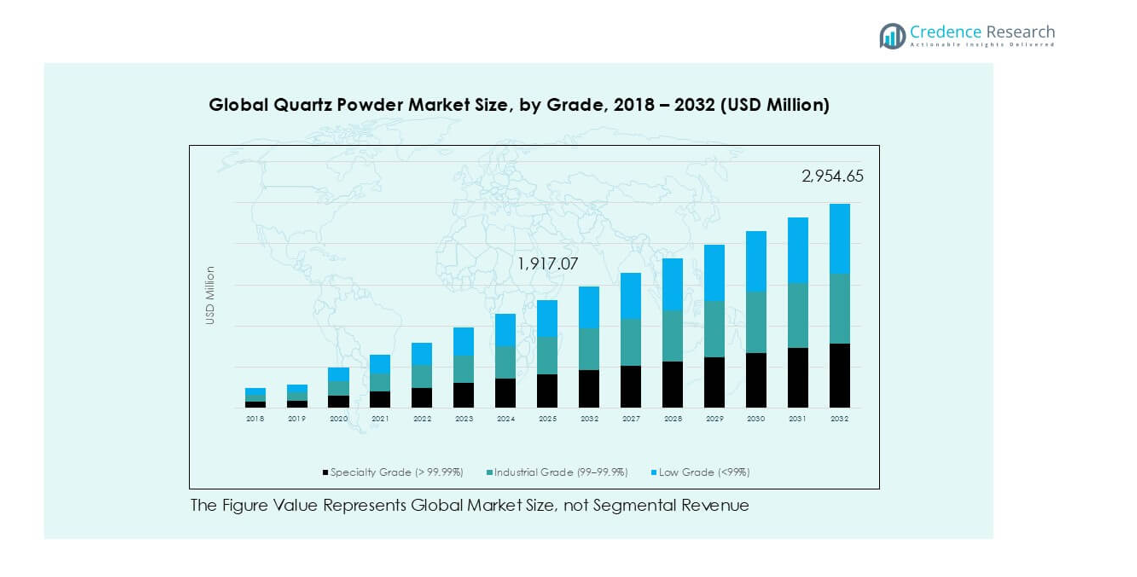
The global quartz powder market size was valued at USD 1,135.2 million in 2018 and increased to USD 1,793.7 million in 2024. It is anticipated to reach USD 2,954.7 million by 2032, growing at a CAGR of 6.37% during the forecast period (2024–2032).
| REPORT ATTRIBUTE | DETAILS |
|---|---|
| Historical Period | 2020-2023 |
| Base Year | 2024 |
| Forecast Period | 2025-2032 |
| Quartz Powder Market Size 2024 | USD 1,793.7 million |
| Quartz Powder Market, CAGR | 6.37% |
| Quartz Powder Market Size 2032 | USD 2,954.7 million |
Leading companies in the global quartz powder market include Tanvi Mines & Minerals, Sibelco, Dow, Imerys S.A., and Quarzwerke Group. These players maintain strong market positions through advanced purification technologies, extensive mining networks, and global distribution systems. Tanvi Mines & Minerals and Sibelco lead in high-purity quartz production, catering to electronics and solar sectors. Imerys S.A. and Dow emphasize innovation in coatings and construction-grade materials. Regionally, Asia Pacific dominated the market with a 35.6% share in 2024, followed by North America at 25.7% and Europe at 22%, supported by expanding semiconductor, glass, and renewable energy industries.
Market Insights
- The global quartz powder market was valued at USD 1,793.7 million in 2024 and is projected to reach USD 2,954.7 million by 2032, growing at a CAGR of 6.37%.
- Growing demand from the electronics and semiconductor sectors is driving market growth, with industrial-grade quartz holding a 54% share due to its wide industrial applications.
- Technological advancements in high-purity quartz processing and rising solar energy adoption are major market trends supporting sustained expansion.
- The market is moderately consolidated, with leading players such as Tanvi Mines & Minerals, Sibelco, Dow, and Imerys S.A. focusing on innovation, capacity expansion, and sustainable mining practices.
- Asia Pacific led the global market with a 35.6% share in 2024, followed by North America with 25.7% and Europe with 22%, while electronics and semiconductors accounted for te dominant 36% share among applications.
Market Segmentation Analysis:
By Grade
The industrial grade segment dominated the global quartz powder market with a share of around 54% in 2024. Its leadership is driven by extensive use in glass manufacturing, ceramics, and foundry applications requiring high purity but cost-effective material. Industrial-grade quartz offers excellent thermal and chemical stability, making it ideal for metallurgical and refractories use. Specialty grade, with purity above 99.99%, is expanding rapidly due to demand from semiconductor and photovoltaic industries. Low-grade quartz serves construction and filler applications where precision purity is less critical, sustaining steady but limited growth.
- For instance, Sibelco operates quartz processing plants producing over 2.4 million tons annually for industrial applications, while The Quartz Corp supplies high-purity 99.999% SiO₂ quartz used in advanced semiconductor wafers for companies like Samsung Electronics.
By Application
Electronics and semiconductors held the largest market share of about 36% in 2024, supported by increasing adoption in integrated circuits, solar cells, and optical components. High-purity quartz is crucial in wafer fabrication and microelectronics due to its dielectric strength and low thermal expansion. Glass and ceramics followed closely, fueled by demand for architectural glass and tableware products. Paints, coatings, and adhesives utilize quartz powder as a filler for improved hardness and wear resistance, while construction materials and oil & gas applications benefit from its mechanical strength and durability.
- For instance, Ferroglobe PLC supplies silicon metal and high-purity quartz-a raw material for silicon metal production-to solar and optical component producers across Asia and Europe. The company is vertically integrated, with mining operations that produce over 300,000 tons of quartz per year, which is used to produce the high-purity silicon metal for use in solar wafers and other high-tech applications.
Key Growth Drivers
Rising Demand from Electronics and Semiconductor Industry
The rapid expansion of the electronics and semiconductor industry is a major growth driver for the global quartz powder market. High-purity quartz powder is essential in producing silicon wafers, integrated circuits, and photovoltaic cells due to its superior dielectric strength and thermal stability. The rise in demand for smartphones, 5G devices, and electric vehicles is fueling consumption of semiconductor-grade quartz. Increasing investments in chip manufacturing by companies like TSMC, Intel, and Samsung further strengthen market demand. As global governments promote domestic semiconductor production, the requirement for high-purity quartz materials continues to grow, driving steady market expansion.
- For example, Intel disclosed that its 2023–2024 construction projects used 145,000 tons of steel and poured more than 2 million cubic yards of concrete.
Expanding Applications in Glass and Ceramics Manufacturing
Growing use of quartz powder in glass and ceramics production significantly boosts market growth. Quartz enhances the hardness, transparency, and resistance of glass and ceramic products, making it vital for architectural, automotive, and consumer applications. The surge in smart glass installations, solar panels, and decorative ceramics has amplified demand for industrial-grade quartz. Rising construction and automotive output across Asia-Pacific and Europe also supports steady consumption. Manufacturers are increasingly adopting precision grinding and micronization technologies to achieve better particle uniformity, ensuring enhanced performance in high-temperature and optical-grade glass formulations.
- For instance, high-purity quartz powder used in specialty glass typically has a SiO₂ content of ≥ 5%, iron oxide (Fe₂O₃) content of ≤ 0.02%, moisture content of ≤ 0.2%, and particle sizes ranging from 5 µm to 100 µm.
Growing Adoption in Paints, Coatings, and Construction Sectors
The construction and coatings industries are witnessing rising adoption of quartz powder as a key filler and strengthening agent. In paints and coatings, it improves durability, abrasion resistance, and surface gloss. In construction materials, quartz powder enhances compressive strength and longevity in concrete, tiles, and adhesives. Rapid urbanization and infrastructure development in emerging economies such as India, China, and Brazil are driving sustained consumption. Additionally, eco-friendly coating formulations and advanced composites incorporating fine quartz particles are supporting long-term growth. Manufacturers are focusing on energy-efficient processing and product standardization to meet the evolving needs of the building and industrial sectors.
Key Trends & Opportunities
Advancements in High-Purity Quartz Processing
Technological innovations in purification and refinement processes are creating new opportunities in the quartz powder market. Advanced processing techniques like plasma fusion, flotation, and acid leaching are enabling the production of ultra-high-purity quartz for semiconductor and solar applications. The growing shift toward automation and precision control in production ensures consistent particle size and purity levels. Companies are investing in automated quality inspection systems and advanced optical sensors to achieve minimal impurity content. This trend supports expansion into high-value sectors such as photonics and energy storage, where consistent purity and performance are critical.
- For instance, Sinonine reports achieving a SiO₂ content of 99.999% in its ultra-high-purity quartz sand production line.
Rising Demand from Renewable Energy Applications
The growing renewable energy industry is another key opportunity for the quartz powder market. High-purity quartz is crucial in manufacturing photovoltaic cells and solar glass, both of which are integral to solar power generation. Global efforts to achieve carbon neutrality and increase solar energy capacity are driving investment in quartz-based materials. Nations like China, India, and the U.S. are scaling up solar module manufacturing, directly boosting quartz powder consumption. Additionally, quartz’s superior thermal and UV resistance makes it ideal for next-generation solar technologies, reinforcing its long-term role in the renewable energy ecosystem.
- For instance, Sibelco’s IOTA ® high-purity quartz sands are mined from ore bodies in Spruce Pine (North Carolina) and used to produce fused quartz for high-tech solar glass and semiconductor applications.
Key Challenges
High Processing Costs for Ultra-Pure Quartz
Producing ultra-high-purity quartz powder involves complex and energy-intensive purification processes, making cost management a major challenge. Advanced leaching, magnetic separation, and flotation systems require high capital investment and specialized expertise. The dependence on high-quality raw quartz deposits further adds to operational expenses. Supply limitations and transport costs from remote mining areas increase pricing volatility. As semiconductor and solar industries demand stricter purity standards, manufacturers face growing pressure to reduce production costs without compromising quality. Balancing profitability while maintaining technical precision remains a critical challenge for global producers.
Environmental and Regulatory Constraints
Environmental regulations concerning mining and processing of quartz are tightening across major producing regions. Dust emissions, waste disposal, and groundwater contamination are primary concerns associated with quartz extraction. Regulatory frameworks in the European Union and North America demand sustainable mining practices and waste reduction measures, raising compliance costs for producers. Additionally, rising scrutiny of energy use and carbon footprint in industrial mineral processing adds operational complexity. Companies must adopt greener technologies and efficient recycling methods to align with sustainability goals. These environmental and regulatory constraints could slow production growth if not effectively addressed.
Regional Analysis
North America
North America accounted for approximately 25.7% of the global quartz powder market in 2024, valued at USD 460.58 million, up from USD 296.41 million in 2018. The region is projected to reach USD 741.62 million by 2032, expanding at a CAGR of 6.1%. Growth is driven by robust demand from electronics, semiconductor, and glass manufacturing industries across the United States and Canada. Increasing use of high-purity quartz in chip fabrication and solar panels further supports expansion. Favorable industrial infrastructure and sustained R&D investments continue to strengthen North America’s position in the global market.
Europe
Europe represented around 22% of the global quartz powder market in 2024, reaching USD 394.06 million from USD 251.00 million in 2018. The market is anticipated to rise to USD 643.52 million by 2032, registering a CAGR of 6.3%. Strong growth in construction materials, ceramics, and coatings sectors is supporting demand across Germany, France, and Italy. The region’s focus on renewable energy and photovoltaic technologies further enhances consumption of high-purity quartz. Stringent environmental regulations are also encouraging sustainable mining and processing practices, ensuring steady long-term development in the European market.
Asia Pacific
Asia Pacific dominated the global quartz powder market with a 35.6% share in 2024, valued at USD 638.11 million, up from USD 393.58 million in 2018. The region is projected to reach USD 1,086.72 million by 2032, growing at the fastest CAGR of 6.8%. Strong industrialization, rapid semiconductor expansion, and increasing solar power installations are the primary growth drivers. China, Japan, and India lead in electronics and construction demand, supported by government initiatives for renewable energy and infrastructure. Expanding manufacturing capacity and low production costs further solidify Asia Pacific’s leadership in global supply.
Latin America
Latin America captured roughly 8.5% of the global quartz powder market in 2024, valued at USD 152.06 million, increasing from USD 99.45 million in 2018. The market is forecast to reach USD 239.33 million by 2032, advancing at a CAGR of 5.8%. Brazil and Mexico dominate regional consumption due to expanding construction, glass production, and oilfield operations. Infrastructure development projects and rising industrial investments are boosting demand for industrial-grade quartz. The region’s growing focus on local manufacturing and reduced import dependency supports gradual but consistent market growth through the forecast period.
Middle East
The Middle East held an estimated 4.8% share of the global quartz powder market in 2024, valued at USD 86.66 million, up from USD 54.26 million in 2018. It is projected to reach USD 144.78 million by 2032, growing at a CAGR of 6.6%. Demand is fueled by the expanding glass, ceramics, and construction industries in Saudi Arabia, the UAE, and Qatar. Large-scale infrastructure and renewable energy projects under national diversification plans drive quartz consumption. The region’s increasing investment in industrial minerals and modernization of processing facilities further enhance its market outlook.
Africa
Africa accounted for around 3.4% of the global quartz powder market in 2024, valued at USD 62.27 million, compared to USD 40.53 million in 2018. The market is expected to grow to USD 98.69 million by 2032 at a CAGR of 5.9%. South Africa dominates regional output due to its vast mineral resources and growing industrial base. Rising demand from construction, oilfield services, and ceramics manufacturing supports expansion. Ongoing foreign investments in mining and industrial processing are likely to improve supply capabilities, positioning Africa as a developing but promising contributor to the global market.
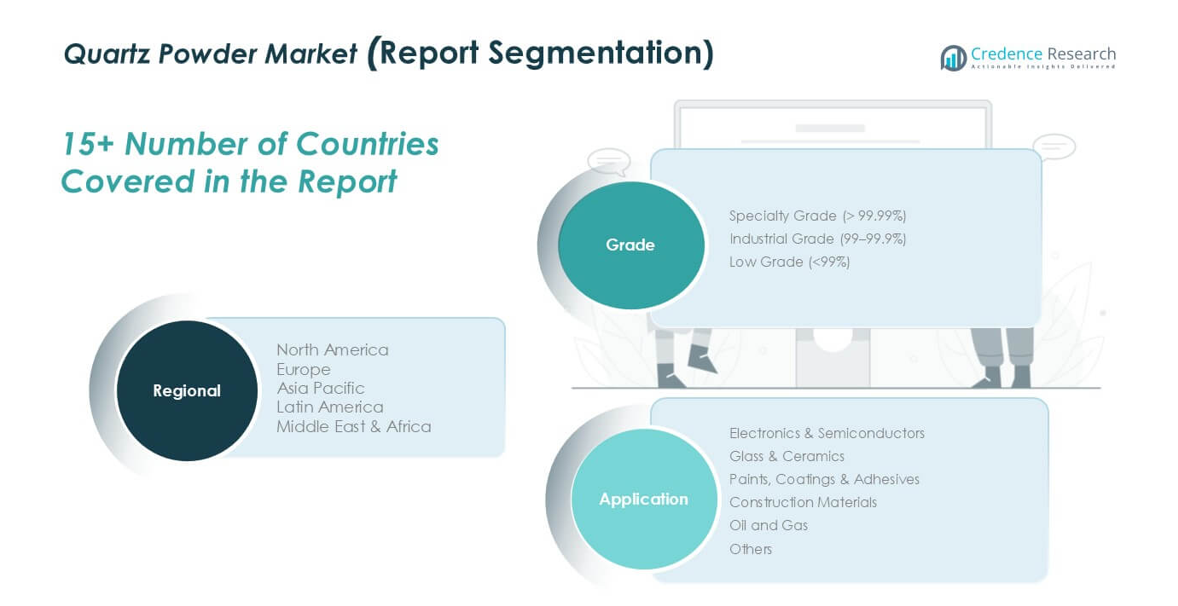
Market Segmentations:
By Grade
- Specialty Grade (> 99.99%)
- Industrial Grade (99–99.9%)
- Low Grade (<99%)
By Application
- Electronics & Semiconductors
- Glass & Ceramics
- Paints, Coatings & Adhesives
- Construction Materials
- Oil and Gas
- Others
By Geography
- North America
- U.S.
- Canada
- Mexico
- Europe
- Germany
- France
- U.K.
- Italy
- Spain
- Rest of Europe
- Asia Pacific
- China
- Japan
- India
- South Korea
- South-east Asia
- Rest of Asia Pacific
- Latin America
- Brazil
- Argentina
- Rest of Latin America
- Middle East & Africa
- GCC Countries
- South Africa
- Rest of the Middle East and Africa
Competitive Landscape
The global quartz powder market is moderately consolidated, with key players focusing on quality enhancement, capacity expansion, and product innovation to strengthen their competitive edge. Major companies such as Tanvi Mines & Minerals, Sibelco, Dow, and Imerys S.A. dominate the market through diversified product portfolios and global supply networks. These companies invest heavily in advanced purification and micronization technologies to achieve higher purity levels suited for semiconductor, solar, and glass applications. Strategic collaborations, long-term supply agreements, and sustainable mining practices are central to their growth strategies. Regional players like The Sharad Group and Speciality Geochem are expanding their processing facilities to meet rising demand from Asia-Pacific. The competition also centers on efficient logistics, cost control, and regulatory compliance, with leading firms emphasizing eco-friendly extraction and low-emission production. Overall, innovation and quality consistency remain key differentiators driving market leadership in the quartz powder industry.
Key Player Analysis
- Tanvi Mines & Minerals
- Eon Enterprises
- Dow
- Sibelco
- The Sharad Group
- Speciality Geochem
- Quarzwerke Group
- Imerys S.A
- PAL Quartz
- HTMC Group
- Other Key Players
Recent Developments
- In August 2024, Caesarstone introduced The Time Collection, which included ten new items, seven of which were new Porcelain colors and three Mineral Surfaces. These Mineral Surfaces represent a big step forward in surface design and are a testament to Caesarstone's latest innovation. Using its vast expertise and advanced technology, the company has developed surfaces that combine minerals like Feldspar and Quartz with recycled content to create surfaces that are better performing and better for the environment.
- In January 2023, Caesarstone Ltd. declared the launch of its line of multi-material surfaces, which includes porcelain and natural stone in addition to outdoor quartz.
- In December 2022, Kyocera Corporation announced its purpose to invest 1.3 trillion yen ($9.78 billion), or through March 2026, in novel chip component manufacturing and the evolution of other sectors of its capabilities.
Report Coverage
The research report offers an in-depth analysis based on Grade, Application and Geography. It details leading market players, providing an overview of their business, product offerings, investments, revenue streams, and key applications. Additionally, the report includes insights into the competitive environment, SWOT analysis, current market trends, as well as the primary drivers and constraints. Furthermore, it discusses various factors that have driven market expansion in recent years. The report also explores market dynamics, regulatory scenarios, and technological advancements that are shaping the industry. It assesses the impact of external factors and global economic changes on market growth. Lastly, it provides strategic recommendations for new entrants and established companies to navigate the complexities of the market.
Future Outlook
- Demand for high-purity quartz will continue rising in semiconductor and solar industries.
- Advancements in purification and processing technologies will improve material efficiency.
- Growing renewable energy investments will boost quartz use in photovoltaic applications.
- The construction sector will sustain steady demand for industrial-grade quartz powder.
- Asia Pacific will remain the leading regional market through continued industrial expansion.
- Increasing focus on sustainable mining will shape future production strategies.
- Global players will expand capacity to meet rising demand from electronics manufacturing.
- Technological integration in processing plants will enhance quality consistency and output.
- Regulatory emphasis on eco-friendly extraction will drive innovation in production methods.
- Strategic partnerships between quartz suppliers and end-use industries will strengthen long-term growth.

Request a Free Sample
Fill in your details and we'll send you a free sample report.
- Sample data tables & charts
- Research methodology
Need a Custom Version of This Report?
Tailor the scope, geography, or segments to your exact requirements.
- Custom geography or segment scope
- Direct access to our analyst team
Frequently Asked Questions
What is the current market size for the Global Quartz Powder market, and what is its projected size in 2032?
At what Compound Annual Growth Rate is the Global Quartz Powder market projected to grow between 2025 and 2032?
Which Global Quartz Powder market segment held the largest share in 2024?
What are the primary factors fueling the growth of the Global Quartz Powder market?
Who are the leading companies in the Global Quartz Powder market?
Which region commanded the largest share of the Global Quartz Powder market in 2024?
Table of Content
Chapter 1 Market Segmentation
- 1.1 Segmentation Framework
- 1.1.1 Product and Service Classification
- 1.1.2 Application and End-Use Classification
- 1.1.3 Technology and Solution Classification
- 1.1.4 Customer and Distribution Channel Classification
- 1.1.5 Geographic Segmentation
- 1.1.6 Market Segment Definitions and Boundaries
Chapter 2 Introduction
- 2.1 Report Objectives and Scope
- 2.2 Product Definition and Industry Terminology
- 2.3 Market Inclusions and Exclusions
- 2.4 Research Process
- 2.4.1 Primary Research and Expert Interviews
- 2.4.2 Secondary Research and Source Review
- 2.4.3 Top-Down and Bottom-Up Estimation
- 2.4.4 Data Triangulation and Verification
- 2.5 Market Size Measurement Basis
- 2.5.1 2024: USD 1,793.7 million → 2032: USD 2,954.7 million
- 2.6 Historical and Forecast Reference Periods
- 2.6.1 Base Year: 2024
- 2.6.2 Forecast Period: 2024-2032
- 2.7 Research Assumptions and Limitations
Chapter 3 Executive Summary
- 3.1 Market Snapshot and Key Findings
- 3.2 Base-Year Market Size, 2024
- 3.3 Forecast Market Size, 2032
- 3.4 Revenue and Volume Growth Outlook
- 3.5 Key Demand and Supply Indicators
- 3.6 Leading Market Segments
- 3.7 Fastest-Growing Market Opportunities
- 3.8 Regional Performance Highlights
- 3.9 Technology and Industry Transformation
- 3.10 Competitive Landscape Summary
- 3.11 Analyst View and Strategic Implications
Chapter 4 Global Quartz Powder Market Trends and Developments
- 4.1 Historical Industry Development
- 4.2 Recent Market Trends and Developments
- 4.3 Demand and Customer Behavior Trends
- 4.4 Technology and Product Innovation
- 4.5 Artificial Intelligence, Automation and Digitalization
- 4.6 Local Manufacturing and Supply Chain Realignment
- 4.7 Industry Partnerships, Mergers and Acquisitions
- 4.8 Sustainability and Circular Economy Developments
- 4.9 Government and Private Sector Investment Trends
- 4.10 Emerging Business Models and Commercialization
- 4.11 Industry Developments and Announcements
Chapter 5 Global Quartz Powder Market Production, Supply and Demand Analysis
- 5.1 Demand Trend and Consumption Analysis
- 5.2 Demand Forecast, 2024-2032
- 5.3 Production and Output Trend
- 5.4 Production and Output Forecast, 2024-2032
- 5.5 Installed Capacity and Capacity Utilization
- 5.6 Company-Wise Production Plants and Statistics
- 5.6.1 Installed Production Capacity
- 5.6.2 Actual Production
- 5.6.3 Planned Capacity and Expansion Targets
- 5.7 Supply Chain Structure and Procurement Trends
- 5.8 Supply-Demand Gap and Bottlenecks
- 5.9 Import Dependence and Sourcing Structure
- 5.10 Contract Manufacturing and Outsourcing
- 5.11 Regional Supply and Demand Concentration
Chapter 6 Global Quartz Powder Market Pricing Analysis
- 6.1 Pricing Structure and Measurement
- 6.2 Historical Pricing Trends
- 6.3 Pricing Outlook, 2024-2032
- 6.4 Average Selling Price and Unit Economics
- 6.5 Pricing by Product and Market Segment
- 6.6 Geographic Pricing Differences
- 6.7 Key Input, Energy, Labor and Logistics Costs
- 6.8 Contract Pricing and Purchasing Models
- 6.9 Pricing Sensitivity and Competitive Positioning
- 6.10 Price, Margin and Profitability Implications
Chapter 7 Global Quartz Powder Market Dynamics
- 7.1 Market Growth Drivers
- 7.1.1 Demand-Side Drivers
- 7.1.2 Technology and Innovation Drivers
- 7.1.3 Infrastructure and Investment Drivers
- 7.1.4 Regulatory and Policy Drivers
- 7.2 Market Restraints
- 7.2.1 Cost and Affordability Constraints
- 7.2.2 Technology and Adoption Barriers
- 7.2.3 Supply Chain and Operational Constraints
- 7.3 Market Challenges
- 7.3.1 Competitive Pressure and Margin Erosion
- 7.3.2 Skills, Infrastructure and Implementation Gaps
- 7.4 Emerging Market Opportunities
- 7.5 Market Dynamics Impact and Time-Horizon Assessment
Chapter 8 Global Quartz Powder Value Chain Analysis
- 8.1 Industry Value Chain Overview
- 8.2 Upstream Suppliers and Critical Inputs
- 8.3 Technology and Component Providers
- 8.4 Manufacturing or Service Delivery
- 8.5 Distribution, Channel Partners and Integrators
- 8.6 Downstream Applications and End Users
- 8.7 Value Addition and Profit Pools
- 8.8 Vertical Integration and Outsourcing
- 8.9 Supplier Concentration and Risk
- 8.10 Supply Chain Localization and Resilience
Chapter 9 Global Quartz Powder Market Regulations and Policies
- 9.1 Relevant Laws, Standards and Compliance Frameworks
- 9.2 Product, Service, Safety and Quality Requirements
- 9.3 Government Policies, Incentives and Subsidies
- 9.4 Imports, Exports and Trade Barriers
- 9.5 Public Procurement and Local Content Requirements
- 9.6 Environmental and Sustainability Compliance
- 9.7 Upcoming Policy Changes and Market Implications
Chapter 10 Global Quartz Powder Market Hotspots and Opportunities
- 10.1 Market Opportunity Mapping and Growth Hotspots
- 10.2 High-Growth Applications and Customer Groups
- 10.3 Underserved Markets and White-Space Opportunities
- 10.4 Emerging Technology and Product Opportunities
- 10.5 New Capacity and Investment Hotspots
- 10.6 Market Entry and Expansion Opportunities
- 10.7 Distribution and Partnership Opportunities
- 10.8 Near-Term and Long-Term Commercial Potential
- 10.9 Opportunity Attractiveness and Execution Risks
Chapter 11 Global Quartz Powder Market Outlook, 2024-2032
- 11.1 Market Size and Analysis
- 11.1.1 Revenue (Market Measurement: 2024: USD 1,793.7 million → 2032: USD 2,954.7 million)
- 11.1.2 Market Volume and Quantity Sold
- 11.1.3 Historical Market Size
- 11.1.4 Base-Year Market Size, 2024
- 11.2 Market Forecast, 2024-2032
- 11.2.1 Revenue Forecast to 2032
- 11.2.2 Volume Forecast to 2032
- 11.2.3 CAGR and Year-on-Year Growth
- 11.2.4 Incremental Revenue Opportunity
- 11.3 Forecast Assumptions and Scenario Analysis
- 11.3.1 Base-Case Forecast
- 11.3.2 Optimistic and Conservative Scenarios
- 11.3.3 Technology, Pricing and Policy Sensitivities
- 11.4 Market Attractiveness and Growth Outlook
Chapter 12 Global Quartz Powder Market Segmentation and Outlook
- 12.1 Segmentation Summary and Market Shares, 2024
- 12.2 Largest and Fastest-Growing Segments
- 12.3 Segment Growth Comparison
- 12.4 Segment Attractiveness and Priority Matrix
Chapter 13 Global Quartz Powder Geographic Market Outlook, 2024-2032
- 13.1 Regional Market Size and Share, 2024
- 13.2 Regional Market Forecast, 2024-2032
- 13.3 Regional Pricing, Production and Demand Differences
- 13.4 North America
- 13.4.1 United States
- 13.4.2 Canada
- 13.4.3 Mexico
- 13.5 Europe
- 13.5.1 Germany
- 13.5.2 France
- 13.5.3 Italy
- 13.5.4 United Kingdom
- 13.5.5 Spain
- 13.5.6 Poland
- 13.5.7 Russia
- 13.5.8 Netherlands
- 13.5.9 Belgium
- 13.5.10 Sweden
- 13.5.11 Denmark
- 13.5.12 Norway
- 13.5.13 Rest of Europe
- 13.6 Asia Pacific
- 13.6.1 China
- 13.6.2 India
- 13.6.3 Japan
- 13.6.4 South Korea
- 13.6.5 Thailand
- 13.6.6 Indonesia
- 13.6.7 Vietnam
- 13.6.8 Malaysia
- 13.6.9 Australia
- 13.6.10 Rest of Asia Pacific
- 13.7 Latin America
- 13.7.1 Brazil
- 13.7.2 Argentina
- 13.7.3 Colombia
- 13.7.4 Chile
- 13.7.5 Rest of Latin America
- 13.8 Middle East
- 13.8.1 Saudi Arabia
- 13.8.2 United Arab Emirates
- 13.8.3 Turkey
- 13.8.4 Israel
- 13.8.5 Iran
- 13.8.6 Rest of the Middle East
- 13.9 Africa
- 13.9.1 South Africa
- 13.9.2 Egypt
- 13.9.3 Nigeria
- 13.9.4 Morocco
- 13.9.5 Rest of Africa
- 13.10 Regional Investment, Policy and Supply Chain Differences
- 13.11 Regional Competitive Landscape
- 13.12 Geographic Growth Hotspots
Chapter 14 Global Quartz Powder Technology, Innovation and Sustainability Outlook
- 14.1 Technology Landscape and Maturity
- 14.2 Product, Process and Service Innovation
- 14.3 AI, Automation and Digital Tools in the Industry
- 14.4 Technology Adoption and Performance Benchmarking
- 14.5 Innovation Pipeline and R&D Investment
- 14.6 Patent and Intellectual Property Trends
- 14.7 Energy Efficiency and Resource Management
- 14.8 Sustainability, Recycling and Circularity
- 14.9 Technology Roadmap, 2024-2032
- 14.10 Risks of Obsolescence and Technology Substitution
Chapter 15 Global Quartz Powder Market Key Strategic Imperatives
- 15.1 Growth and Market Entry Priorities
- 15.2 High-Return Products and Segments
- 15.3 Pricing, Profitability and Cost Optimization
- 15.4 Technology Investment and Product Differentiation
- 15.5 Supply Chain Localization and Resilience
- 15.6 Distribution and Customer Acquisition
- 15.7 Partnership, Acquisition and Capacity Strategy
- 15.8 Regional Expansion Priorities
- 15.9 Short-, Medium- and Long-Term Actions
Chapter 16 Competition Outlook
- 16.1 Industry Competition Characteristics
- 16.2 Market Structure and Concentration
- 16.3 Market Share and Competitive Positioning, 2024
- 16.4 Company-Wise Revenue and Product Benchmarking
- 16.5 Production and Service Capacity Benchmarking
- 16.6 Technology, Pricing and Differentiation
- 16.7 Regional Footprint and Distribution Strength
- 16.8 Mergers, Acquisitions and Strategic Alliances
- 16.9 New Entrants and Competitive Threats
- 16.10 Porter's Five Forces and Industry Attractiveness
- 16.11 Competitive Outlook, 2024-2032
Chapter 17 Company Profiles
- 17.1 Company Coverage and Selection Criteria
- 17.2 Leading Market Participants – Standard Profile Structure
- 17.2.1 Business Description
- 17.2.2 Company Ownership and Geographic Presence
- 17.2.3 Product and Service Portfolio
- 17.2.4 Manufacturing and Operating Footprint
- 17.2.5 Production Capacity and Expansion Plans
- 17.2.6 Financial Performance and Investment
- 17.2.7 Market Share and Competitive Position
- 17.2.8 Technology and Innovation Capabilities
- 17.2.9 Strategic Alliances or Partnerships
- 17.2.10 Recent Developments
- 17.2.11 Growth Strategy and Outlook
- 17.3 Other Relevant Market Participants
Note: Every listed company is profiled on the structure shown under the first company. The company list is preliminary and may change based on research findings, market developments, data availability and client requirements.
Chapter 18 Disclaimer
- 18.1 Research and Forecast Disclaimer
- 18.2 Data Source and Estimation Limitations
Note: The depth of individual sections depends on data availability for this market. Volume, capacity, trade and other unit-based metrics are included where applicable.

