
Market Overview:
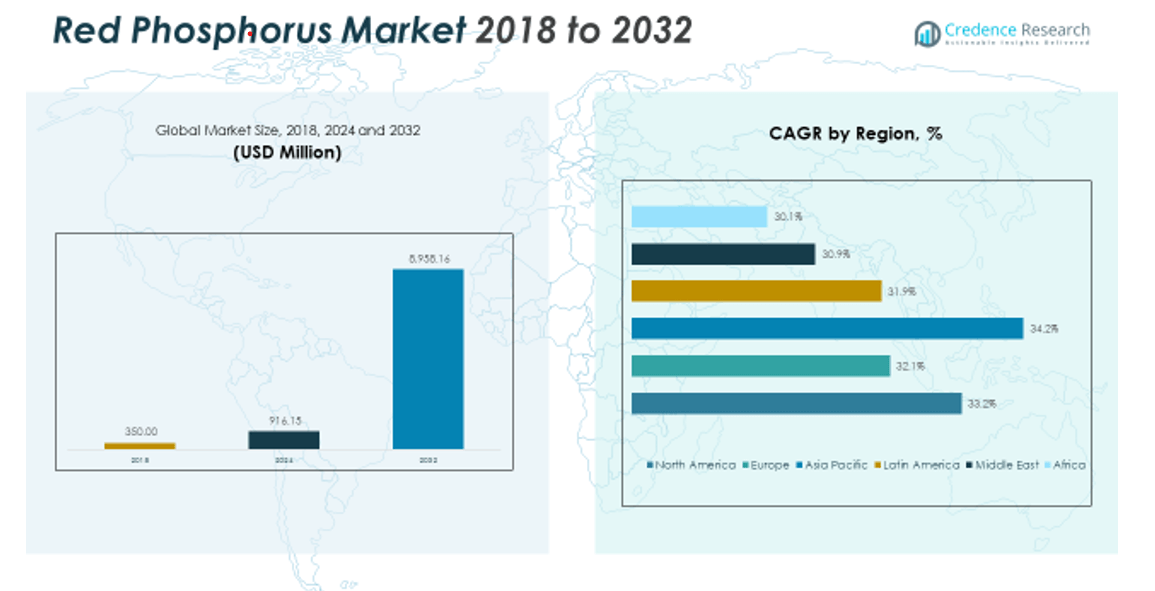
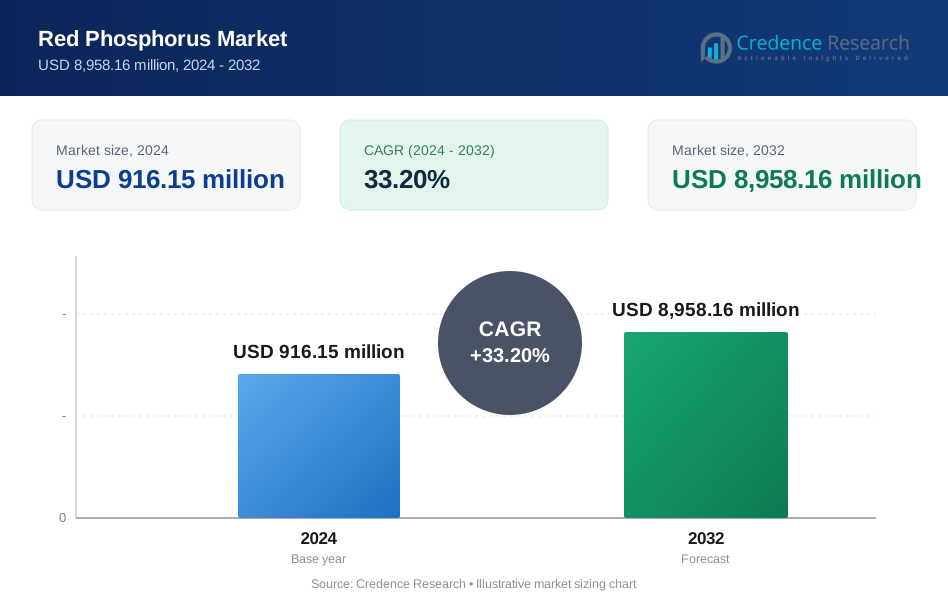
The Red Phosphorus Market size was valued at USD 350.00 million in 2018 to USD 916.15 million in 2024 and is anticipated to reach USD 8,958.16 million by 2032, at a CAGR of 33.20% during the forecast period.
| REPORT ATTRIBUTE | DETAILS |
|---|---|
| Historical Period | 2020-2023 |
| Base Year | 2024 |
| Forecast Period | 2025-2032 |
| Red Phosphorus Market Size 2024 | USD 916.15 million |
| Red Phosphorus Market, CAGR | 33.20% |
| Red Phosphorus Market Size 2032 | USD 8,958.16 million |
Strong demand from flame retardants, safety matches, and semiconductor manufacturing is driving market growth. Red phosphorus is widely used for its non-toxic and thermally stable properties, supporting safer and more efficient product formulations. Expanding use in lithium-ion batteries and chemical synthesis also contributes to industry growth. It is gaining traction across diverse applications due to stricter fire safety regulations and increased R&D in high-performance materials.
Asia Pacific leads the market due to its strong production base in China, Japan, and South Korea. North America and Europe follow with growing adoption in electronics, flame retardants, and energy applications. Emerging markets in Southeast Asia and Latin America are experiencing rapid industrialization, boosting demand in manufacturing and agricultural sectors.
Market Insights:
- The Red Phosphorus Market was valued at USD 350.00 million in 2018, reached USD 916.15 million in 2024, and is projected to attain USD 8,958.16 million by 2032, growing at a CAGR of 33.20%.
- Asia Pacific leads with a 46% share due to its strong manufacturing base in China, Japan, and South Korea, supported by rapid industrialization and large-scale electronics production.
- North America holds a 24% share, driven by the expanding semiconductor, flame retardant, and EV industries, while Europe follows with 20% owing to its environmental regulations and advanced R&D focus.
- Latin America represents the fastest-growing emerging region with a 6% share, fueled by expanding fertilizer and pyrotechnics industries supported by rising agricultural modernization.
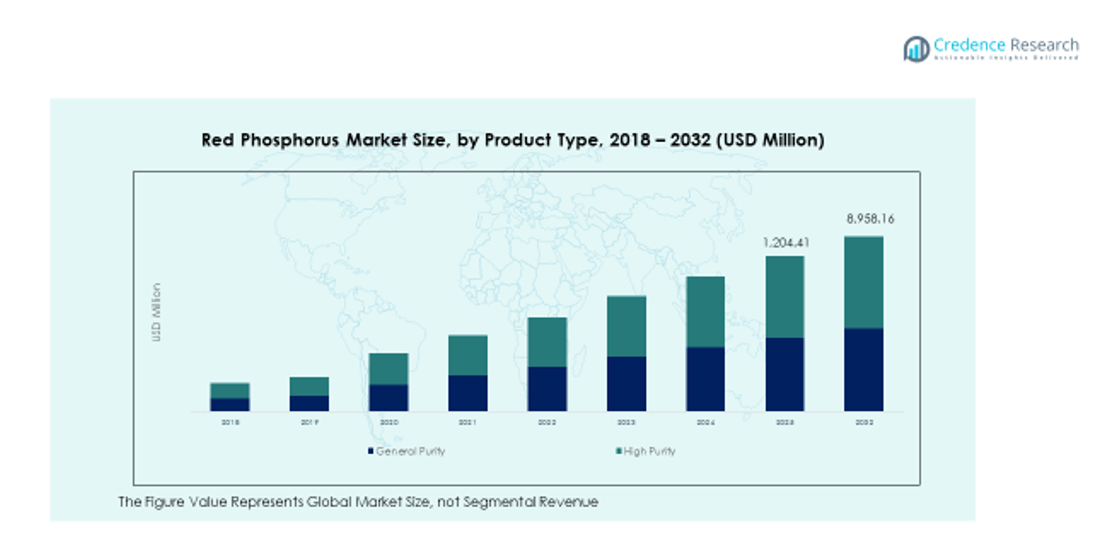
- Segment-wise, general purity accounted for 60% of the market in 2024, while high purity held 40%, reflecting strong demand from both traditional and advanced manufacturing applications.
Market Drivers
Rising Demand from Flame Retardant and Safety Match Applications
The Red Phosphorus Market is driven by growing demand from flame retardant and safety match industries. Its non-toxic and stable nature makes it suitable for preventing ignition in plastics, electronics, and textiles. Governments are enforcing strict fire safety regulations that encourage adoption of phosphorus-based retardants. Industries seek environmentally safer alternatives to halogen-based materials, fueling usage. Red phosphorus offers efficient flame inhibition without toxic gas release. Safety match manufacturing uses it for friction-sensitive ignition. Rising urbanization and consumer safety awareness further push demand. The trend supports stable growth in end-use sectors.
Increasing Adoption in Semiconductor and Electronic Component Manufacturing
Rising use of red phosphorus in semiconductor fabrication supports industry expansion. It is a key material in producing dopants for electronic and optoelectronic components. The compound’s thermal and chemical stability enhances manufacturing efficiency. With rising demand for compact electronic devices, semiconductor producers are adopting high-purity phosphorus grades. It also supports applications in lithium-ion battery anodes, improving energy storage capacity. The Red Phosphorus Market benefits from ongoing electronic miniaturization and energy innovation. Government support for advanced manufacturing strengthens the industry. The semiconductor supply chain’s growth reinforces its importance in modern electronics.
- For example, Nippon Chemical Industrial Co., Ltd. is a major Japanese manufacturer known for producing high-purity red phosphorus used in semiconductors, flame retardants, and electronic materials. The company emphasizes stringent quality control and advanced purification processes to meet global standards in high-tech manufacturing applications.
Expanding Role in Fertilizer and Agrochemical Applications
Red phosphorus is increasingly used in producing phosphorus-based fertilizers and agrochemicals. Farmers depend on phosphorus nutrients for improving soil fertility and crop yields. Industrial production of fertilizers uses phosphorus as a key raw material. Rising global food demand and limited arable land drive the need for efficient nutrient solutions. Governments are promoting sustainable fertilizer formulations, supporting phosphorus utilization. The Red Phosphorus Market gains traction from agricultural modernization in developing regions. It enhances nutrient management and supports long-term soil health. Continuous research focuses on eco-friendly agricultural applications.
- For example, in 2020, India implemented the Red Phosphorus (Quality Control) Order, mandating a minimum purity of 98.5% for all imported and domestically manufactured red phosphorus under the IS 2012:2006 standard. This regulation ensures consistent product quality and safer industrial handling across the chemical and agrochemical sectors.
Technological Advancements and R&D in High-Performance Materials
Continuous R&D investments are creating high-performance phosphorus derivatives for industrial use. Advanced material producers are developing heat-resistant and conductive composites. These materials are applied in defense, aerospace, and energy sectors. The Red Phosphorus Market is benefiting from technology integration in performance materials. Companies are focusing on nanoscale formulations to improve reactivity and safety. Research institutions collaborate with chemical manufacturers to enhance purity levels. Such developments open opportunities in high-value manufacturing sectors. It strengthens competitiveness across innovation-driven markets.
Market Trends
Growing Integration of Red Phosphorus in Energy Storage and Battery Technologies
The demand for red phosphorus in energy storage applications is growing rapidly. Its high theoretical capacity makes it suitable for lithium-ion and sodium-ion battery anodes. Researchers are developing phosphorus-carbon composites to enhance cycle life and safety. The Red Phosphorus Market benefits from rising electric vehicle production and renewable energy storage systems. Manufacturers focus on stability improvements to reduce material expansion during charge cycles. Strategic partnerships between chemical and battery firms accelerate material scaling. It helps achieve cost-effective energy storage solutions. Global sustainability goals further reinforce this trend.
- For example, research on phosphorus–carbon anodes confirms a high theoretical capacity of 2,596 mAh/g, highlighting red phosphorus’s strong potential for next-generation lithium-ion batteries. Multiple studies continue to explore ways to improve its cycling stability and rate performance through carbon composite designs.
Shift Toward Sustainable and Halogen-Free Flame Retardant Solutions
Flame retardant manufacturers are shifting toward halogen-free and environmentally safe materials. Red phosphorus provides effective fire resistance while meeting green compliance norms. Regulations across Europe and North America restrict halogen-based retardants in electronics and construction. The Red Phosphorus Market experiences strong substitution demand from eco-conscious industries. Research focuses on improving thermal stability and dispersion of phosphorus compounds. Manufacturers are optimizing production to reduce emissions and enhance recyclability. It aligns with circular economy goals in the chemical sector. Growing public awareness of product safety strengthens adoption rates.
- For example, Clariant AG announced in October 2025 that it had expanded its Exolit OP flame-retardant portfolio at the Daya Bay facility in China, introducing Exolit OP 1242 (TP) and Exolit OP 1266 (TP). Both halogen-free products meet UL 94 V-0 standards at 0.4 mm thickness and are designed to replace antimony-trioxide-based systems while improving safety and material performance in e-mobility and electronics applications.
Rising Use in Specialty Chemicals and Industrial Catalysts
Red phosphorus finds growing applications in specialty chemical synthesis and catalyst production. It plays a key role in producing phosphine gas and organophosphorus intermediates. These compounds are essential in pharmaceuticals, electronics, and polymer industries. The Red Phosphorus Market benefits from the chemical industry’s expansion in Asia Pacific. Industrial players invest in high-purity production to meet global standards. Research into catalytic applications is improving material efficiency. It supports cleaner chemical production and process optimization. This diversification trend ensures long-term industrial relevance.
Increasing Focus on High-Purity Grades for Advanced Manufacturing
Manufacturers are focusing on developing high-purity red phosphorus for precision applications. High-grade phosphorus improves performance in semiconductors, batteries, and optics. The Red Phosphorus Market gains traction from ongoing advancements in materials science. Stringent quality control standards drive investments in purification technologies. Demand from electronics and defense sectors supports capacity expansion. Research centers are testing nano-engineered variants with improved safety profiles. It enhances the scope of integration in advanced products. Growing industrial standards push suppliers toward ultra-pure material solutions.
Market Challenges Analysis
Safety Concerns and Stringent Handling Regulations in Production and Storage
Safety management remains a significant challenge for producers due to red phosphorus’s flammability and reactivity. Handling requires controlled environments and strict compliance with safety protocols. Fire hazards during transport and storage increase operational costs for manufacturers. The Red Phosphorus Market faces limitations from government-imposed chemical safety standards. Regulatory frameworks mandate extensive documentation and inspection for export and import. It creates logistical hurdles for small-scale producers. Insurance and transportation expenses add to overall costs. These factors limit rapid capacity expansion despite rising demand.
Environmental and Supply Chain Constraints Affecting Raw Material Availability
Environmental concerns over phosphorus mining and refining processes affect material availability. Limited phosphate reserves and high extraction costs restrict global supply. The Red Phosphorus Market experiences volatility due to uneven distribution of raw materials. Supply chain disruptions increase dependency on a few producing countries. Regulatory restrictions on mining operations impact cost stability. Sustainability pressure urges companies to explore recycling and recovery from industrial waste. It challenges the industry to maintain quality and cost balance. Rising input costs and ecological risks remain persistent obstacles.
Market Opportunities
Expanding Scope in Energy Storage and Next-Generation Battery Development
Rising investments in electric mobility and renewable power storage open growth avenues. Red phosphorus provides high energy density for next-generation batteries. It supports research into safer and longer-lasting alternatives to graphite anodes. The Red Phosphorus Market benefits from collaborations between energy firms and material scientists. Governments funding clean energy initiatives further encourage development. It strengthens commercial prospects in automotive and grid-scale energy sectors. Battery makers exploring solid-state and sodium-ion systems increase material utilization. Such advancements ensure strong opportunities in the evolving energy market.
R&D Innovation in Eco-Friendly and High-Performance Industrial Materials
Innovation in red phosphorus applications supports sustainable product development. It enables production of eco-friendly flame retardants, catalysts, and coatings. The Red Phosphorus Market benefits from industrial preference for safe and efficient materials. Technological advances reduce reactivity while improving process control. Research collaborations with universities and chemical firms enhance material functionality. It creates opportunities in electronics, construction, and specialty polymers. The growing focus on performance improvement supports long-term demand. Industry modernization continues to expand global application reach.
Market Segmentation Analysis:
The Red Phosphorus Market is segmented
By product type into general purity and high purity grades. General purity red phosphorus holds a dominant share due to its wide use in safety matches, pyrotechnics, and fertilizers. It offers stable combustion properties and easy availability, supporting large-scale industrial applications. High purity red phosphorus is gaining traction in electronics, semiconductor fabrication, and battery materials. It provides enhanced performance, low impurity levels, and consistent thermal behavior, meeting the standards of high-tech industries. Demand for high purity grades continues to rise with increasing use in lithium-ion batteries and advanced manufacturing.
- For example, Nagase supplies high-quality red phosphorus designed for flame retardant and semiconductor applications, emphasizing controlled reactivity and safe handling. The company focuses on providing stable, high-purity materials that meet industrial safety and performance standards across global manufacturing sectors.
By application, the market includes safety matches, flame retardants, fertilizers, pyrotechnics, and others. Safety matches lead due to their established industrial use and regulated safety standards. Flame retardants form another major segment, driven by strict fire safety regulations in construction and electronics. Fertilizer applications expand steadily with the need for phosphorus-based nutrients in agriculture. Pyrotechnics create demand from entertainment and defense industries, requiring controlled ignition materials. The others segment includes specialty chemicals, catalysts, and research-based applications. Each segment contributes distinct value across industrial and commercial domains, reflecting the material’s versatility and strategic relevance in modern manufacturing.
- For example, Clariant’s Exolit™ OP line of halogen-free flame retardants is certified to meet UL 94 V-0 fire safety standards in multiple polymer systems. The product range is engineered to provide reliable flame-retardant performance while supporting material durability, safety, and circular-use objectives in industrial manufacturing.
Segmentation:
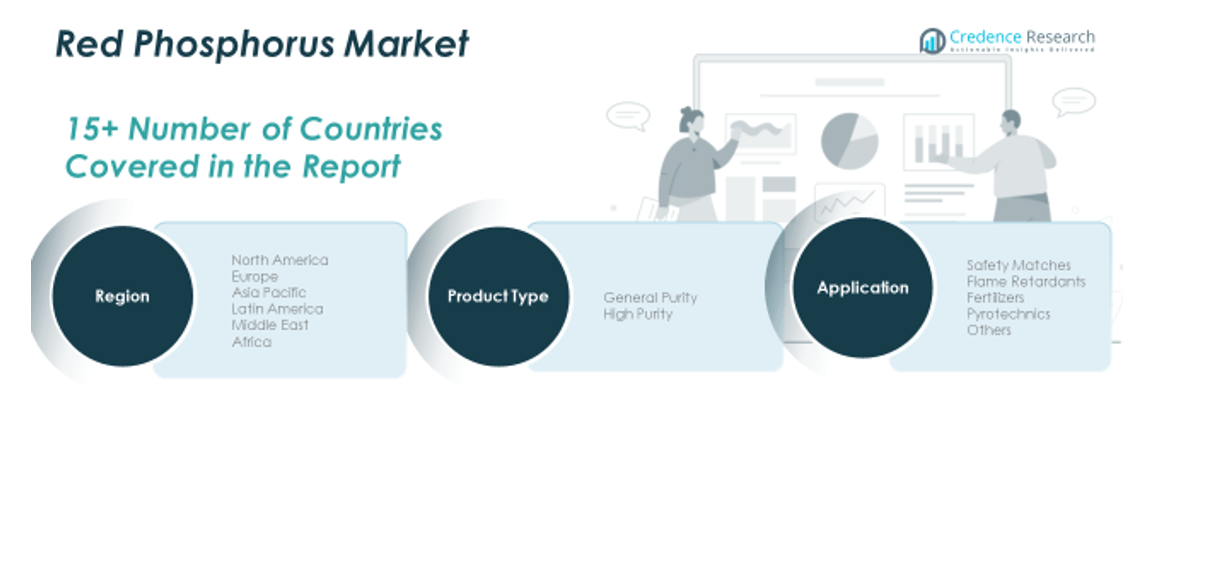
By Product Type
- General Purity
- High Purity
By Application
- Safety Matches
- Flame Retardants
- Fertilizers
- Pyrotechnics
- Others
By Region
- North America
- U.S.
- Canada
- Mexico
- Europe
- Germany
- France
- U.K.
- Italy
- Spain
- Rest of Europe
- Asia Pacific
- China
- Japan
- India
- South Korea
- South-east Asia
- Rest of Asia Pacific
- Latin America
- Brazil
- Argentina
- Rest of Latin America
- Middle East & Africa
- GCC Countries
- South Africa
- Rest of the Middle East and Africa
Regional Analysis:
North America
The North America Red Phosphorus Market size was valued at USD 85.75 million in 2018 to USD 220.42 million in 2024 and is anticipated to reach USD 2,150.87 million by 2032, at a CAGR of 33.2% during the forecast period. North America holds around 24% market share, driven by high demand in flame retardants, electronics, and safety match industries. Strong manufacturing bases in the U.S. and Canada support product adoption in advanced materials. The region’s growing electric vehicle and semiconductor sectors enhance consumption of high-purity red phosphorus. Favorable fire safety regulations encourage industrial usage in construction and consumer goods. Companies invest in advanced phosphorus refining technologies to improve product consistency. Strategic collaborations among chemical producers promote innovation and domestic supply security. It continues to experience steady growth driven by technology integration and sustainability standards.
Europe
The Europe Red Phosphorus Market size was valued at USD 77.35 million in 2018 to USD 193.10 million in 2024 and is anticipated to reach USD 1,762.54 million by 2032, at a CAGR of 32.1% during the forecast period. Europe represents nearly 20% of the global share, supported by stringent environmental regulations and mature industrial frameworks. Demand is led by Germany, France, and the UK with strong chemical and automotive industries. Flame retardant and semiconductor applications dominate regional usage. Policy emphasis on green chemistry drives interest in halogen-free phosphorus compounds. European firms are upgrading facilities to meet REACH and RoHS directives. It benefits from advanced R&D infrastructure and increasing investments in specialty materials. Continuous innovation strengthens its role in high-performance industrial production.
Asia Pacific
The Asia Pacific Red Phosphorus Market size was valued at USD 148.05 million in 2018 to USD 397.47 million in 2024 and is anticipated to reach USD 4,123.45 million by 2032, at a CAGR of 34.2% during the forecast period. Asia Pacific leads the global market with a 46% share, driven by strong demand in China, Japan, and South Korea. Expanding electronics, chemical, and automotive industries drive large-scale consumption. Red phosphorus is widely used in semiconductor fabrication and flame retardant applications. Local manufacturing advantages and cost-efficient production support regional dominance. Governments promote R&D in battery technology, boosting adoption in energy storage applications. Rapid industrialization in India and Southeast Asia expands the customer base. It remains the primary growth hub with strong export-oriented production capacity.
Latin America
The Latin America Red Phosphorus Market size was valued at USD 21.35 million in 2018 to USD 55.33 million in 2024 and is anticipated to reach USD 500.49 million by 2032, at a CAGR of 31.9% during the forecast period. Latin America holds nearly 6% share, with Brazil and Argentina leading consumption. The region’s industrial expansion supports demand from match manufacturing and fertilizers. Rising agricultural modernization increases use of phosphorus-based compounds. Local producers are focusing on import substitution to strengthen supply stability. It benefits from new investments in chemical infrastructure and raw material processing. The region’s improving trade relationships support export opportunities. Growing government focus on industrial safety and environmental compliance enhances market prospects.
Middle East
The Middle East Red Phosphorus Market size was valued at USD 10.12 million in 2018 to USD 24.27 million in 2024 and is anticipated to reach USD 206.09 million by 2032, at a CAGR of 30.9% during the forecast period. The region accounts for nearly 2% of the market, with demand centered in GCC countries and Turkey. Expanding construction and defense sectors support steady growth. Flame retardant applications in infrastructure and polymer materials drive consumption. Government initiatives promoting chemical diversification foster local manufacturing. The Red Phosphorus Market in the region benefits from trade connections with Asia and Europe. Investment in safety material production aligns with regional sustainability goals. It is expected to grow with industrial diversification and regulatory alignment.
Africa
The Africa Red Phosphorus Market size was valued at USD 7.39 million in 2018 to USD 25.56 million in 2024 and is anticipated to reach USD 214.72 million by 2032, at a CAGR of 30.1% during the forecast period. Africa captures around 2% market share, led by South Africa and Egypt. Rising demand for fertilizers and safety products drives growth. Limited domestic production encourages imports from Asia Pacific producers. Governments are emphasizing self-sufficiency through chemical industry development. Infrastructure expansion and safety regulations support long-term opportunities. It benefits from new investments in energy and agricultural sectors. Gradual industrialization and regulatory improvements contribute to regional progress and market stability.
Key Player Analysis:
- Clariant AG
- BASF SE
- Changzhou Chuanlin Chemical Co., Ltd.
- Nippon Chemical Industrial Co., Ltd.
- Prasol Chemicals Pvt. Ltd.
- UPL Limited
Competitive Analysis:
The Red Phosphorus Market features a moderately consolidated landscape with key players focusing on innovation, safety, and product quality. Leading companies such as Clariant AG, BASF SE, Changzhou Chuanlin Chemical Co., Ltd., Nippon Chemical Industrial Co., Ltd., Prasol Chemicals Pvt. Ltd., and UPL Limited dominate global production. It is characterized by continuous investments in purification technology, process safety, and environmental compliance. Manufacturers aim to strengthen their supply chains and reduce dependence on volatile raw material sources. Strategic mergers, capacity expansions, and R&D collaborations support competitive positioning. Firms are developing high-purity grades to cater to electronics and battery applications. Regional players are entering partnerships with global producers to enhance product reach. The competition remains driven by technological advancement, regulatory alignment, and performance differentiation across key application sectors.
Recent Developments:
- In October 2025, Clariant AG marked a significant expansion in the red phosphorus-based flame retardant market by completing a $126 million investment to boost its production capacity in China, with its second line expected to be fully operational in November 2025. This move positions Clariant as a leader in localized, halogen-free flame retardant solutions for the booming e-mobility and electronics sectors, and supports stricter global fire safety regulations.
Report Coverage:
The research report offers an in-depth analysis based on Product Type and Application. It details leading market players, providing an overview of their business, product offerings, investments, revenue streams, and key applications. Additionally, the report includes insights into the competitive environment, SWOT analysis, current market trends, as well as the primary drivers and constraints. Furthermore, it discusses various factors that have driven market expansion in recent years. The report also explores market dynamics, regulatory scenarios, and technological advancements that are shaping the industry. It assesses the impact of external factors and global economic changes on market growth. Lastly, it provides strategic recommendations for new entrants and established companies to navigate the complexities of the market.
Future Outlook:
- Increasing adoption of red phosphorus in next-generation batteries will drive its presence in energy storage industries.
- Growing demand for halogen-free flame retardants will strengthen its role in sustainable manufacturing.
- Advancements in semiconductor and optoelectronic applications will enhance its technological relevance.
- Investments in high-purity production will improve product quality and meet global industrial standards.
- Expansion of fertilizer and agrochemical sectors will sustain phosphorus consumption in agricultural use.
- Asia Pacific will maintain leadership due to robust manufacturing and export-oriented production bases.
- Rising R&D into nano-structured phosphorus materials will open new opportunities in electronics and defense.
- Increasing government focus on chemical safety and regulation will refine global production frameworks.
- Strategic mergers and process innovations will improve market competitiveness and technological capability.
- Growing digitalization in production and monitoring will boost efficiency, consistency, and worker safety.
Request a Free Sample
Fill in your details and we'll send you a free sample report.
- Sample data tables & charts
- Research methodology
Need a Custom Version of This Report?
Tailor the scope, geography, or segments to your exact requirements.
- Custom geography or segment scope
- Direct access to our analyst team
Frequently Asked Questions
What is the current market size for Red Phosphorus Market, and what is its projected size in 2032?
At what Compound Annual Growth Rate is the Red Phosphorus Market projected to grow between 2024 and 2032?
Which Red Phosphorus Market market segment held the largest share in 2024?
What is the major growth driving factors for global Red Phosphorus market?
Who are the leading companies in the Red Phosphorus Market?
Which region commanded the largest share of the Red Phosphorus Market in 2024?
Table of Content
Chapter 1. Report Introduction
- 1.1 Report Description & Purpose
- 1.1.1 Report Title & Market Definition
- 1.1.2 Unique Selling Propositions (USP) & Key Differentiators
- 1.1.3 Value Proposition for Stakeholders
- 1.2 Research Objectives
- 1.2.1 Market Sizing Objectives (Volume & Revenue) (Volume Where Applicable)
- 1.2.2 Segmentation Objectives
- 1.2.3 Competitive Intelligence Objectives
- 1.2.4 Forecast & Scenario Objectives
- 1.3 Report Scope
- 1.3.1 Red Phosphorus Scope – Segments & Subsegments Covered
- 1.3.2 Geographic Scope – Regions & Countries Covered
- 1.3.3 Historical Period, Base Year & Forecast Period (2024; forecast to 2032)
- 1.3.4 Inclusions & Exclusions
- 1.4 Industry Classification & Applicable Codes
- 1.5 Currency, Measurement Units & Valuation Basis
- 1.6 Target Stakeholders
- 1.7 Limitations & Assumptions
Chapter 2. Executive Summary
- 2.1 Global Red Phosphorus Market Snapshot
- 2.1.1 Market Size – Historical (2024) & Forecast (2024-2032) (2024: USD 916.15 million → 2032: USD 8,958.16 million)
- 2.1.2 Volume & Revenue – Global Totals (Volume Where Applicable)
- 2.1.3 Key Market Highlights – Top Five Facts
- 2.2 Red Phosphorus Market Segmentation Snapshot
- 2.2.1 Market Split by Region – 2024 vs. 2032
- 2.3 Competitive Snapshot
- 2.3.1 Top 10 Players by Revenue Share – 2024
- 2.3.2 Top 10 Players by Volume Share – 2024 (Volume Where Applicable)
- 2.3.3 Recent Strategic Developments (18-Month Summary)
- 2.4 Key Investment Highlights & Strategic Conclusions
Chapter 3. Red Phosphorus Market Dynamics & Industry Analysis
- 3.1 Market Overview & Context
- 3.1.1 Red Phosphorus Market Position in the Broader Industry Value Chain
- 3.1.2 Demand Structure & Purchasing Dynamics
- 3.1.3 Market Maturity & Development Stage by Region
- 3.2 Red Phosphorus Market Drivers
- 3.3 Red Phosphorus Market Restraints & Challenges
- 3.4 Red Phosphorus Market Opportunities
- 3.5 Porter's Five Forces Analysis
- 3.5.1 Threat of New Entrants
- 3.5.2 Bargaining Power of Suppliers
- 3.5.3 Bargaining Power of Buyers
- 3.5.4 Threat of Substitutes
- 3.5.5 Competitive Rivalry – Intensity Assessment
- 3.6 Red Phosphorus Value Chain Analysis
- 3.6.1 Upstream – Key Inputs, Resources & Suppliers
- 3.6.1.1 Key Input/Resource 1
- 3.6.1.2 Key Input/Resource 2
- 3.6.1.3 Key Input/Resource 3
- 3.6.2 Midstream – Core Operations & Value Creation
- 3.6.2.1 Operating Model & Process Overview
- 3.6.2.2 Key Operating Locations & Capabilities by Company
- 3.6.3 Downstream – Market Channels & End Users
- 3.6.3.1 Direct Sales & Customer Engagement Channels
- 3.6.3.2 Indirect Sales, Intermediaries & Partner Channels
- 3.6.4 Value Chain Profitability Analysis
- 3.6.1 Upstream – Key Inputs, Resources & Suppliers
- 3.7 PESTEL Analysis
- 3.7.1 Political Factors
- 3.7.2 Economic Factors
- 3.7.3 Social Factors
- 3.7.4 Technological Factors
- 3.7.5 Environmental Factors
- 3.7.6 Legal Factors
- 3.8 Red Phosphorus Supply Chain Analysis
- 3.8.1 Critical Input & Resource Availability Risk Assessment
- 3.8.2 Supplier & Operational Concentration Risk (Geographic Exposure)
- 3.8.3 Supply & Service Disruption Impact Analysis
- 3.9 Regulatory & Policy Landscape
Note: The regulatory and policy landscape section covers regulations based on their applicability to the market, Red Phosphorus category, geography, and scope of the study. Only regulatory frameworks with a material impact on operations, compliance, trade, sustainability, or market access are analyzed in detail.
Chapter 4. Key Investment Pockets & Opportunity Analysis
- 4.1 Red Phosphorus Market Attractiveness Analysis
- 4.1.1 By Region – Investment Attractiveness Matrix (Market Size × CAGR)
- 4.2 Absolute Revenue Growth Opportunity
- 4.2.1 By Region – Absolute Revenue Growth Through 2032
- 4.3 Incremental Demand Opportunity
- 4.3.1 By Region – Incremental Demand Through 2032
- 4.3.2 Segment – Incremental Demand
- 4.4 Emerging Submarket Opportunity Deep Dive (Subject to Applicability)
- 4.5 Priority Market Opportunity Scorecards
- 4.5.1 United States
- 4.5.2 Europe
- 4.5.3 Asia
- 4.5.4 Middle East & Africa
Note: Priority market opportunity scorecards reflect the geographic scope and strategic relevance of the study. Listed markets are indicative and may be adapted to the industry.
Chapter 5. Red Phosphorus Cross-Border Trade & Market Access Analysis
- 5.1 International Trade & Cross-Border Activity Overview
- 5.1.1 Global Export Value by Country (2024)
- 5.1.2 Global Export Volume by Country (2024) (Volume Where Applicable)
- 5.1.3 Global Import Value by Country (2024)
- 5.1.4 Global Import Volume by Country (2024) (Volume Where Applicable)
- 5.1.5 Net Trade Balance by Country (2024)
- 5.2 Export Analysis – Segment
- 5.2.1 Category 1 (Applicable Classification Code)
- 5.2.2 Category 2 (Applicable Classification Code)
- 5.2.3 Category 3 (Applicable Classification Code)
- 5.2.4 Category 4 (Applicable Classification Code)
- 5.2.5 Category 5 (Applicable Classification Code)
- 5.3 Import Analysis – Segment
- 5.3.1 Category 1 (Applicable Classification Code)
- 5.3.2 Category 2 (Applicable Classification Code)
- 5.3.3 Category 3 (Applicable Classification Code)
- 5.3.4 Category 4 (Applicable Classification Code)
- 5.3.5 Category 5 (Applicable Classification Code)
- 5.4 Cross-Border Pricing & Transaction Benchmarks
- 5.4.1 Export Pricing – Segment & Country
- 5.4.2 Import Pricing – Segment & Source Country
- 5.4.3 Price Trends (2024)
- 5.5 Key Cross-Border Trade & Delivery Routes
- 5.5.1 Cross-Border Trade/Delivery Route 1
- 5.5.2 Cross-Border Trade/Delivery Route 2
- 5.5.3 Cross-Border Trade/Delivery Route 3
- 5.5.4 Cross-Border Trade/Delivery Route 4
- 5.5.5 Cross-Border Trade/Delivery Route 5
- 5.6 Trade Policy & Market Access Impact Assessment
- 5.6.1 Tariff & Non-Tariff Barriers
- 5.6.2 Regional Trade & Economic Integration Frameworks
- 5.6.3 Bilateral & Multilateral Trade Agreements
- 5.6.4 Cross-Border Operating, Licensing & Localization Requirements
Note: This chapter applies where cross-border trade or delivery is relevant to Red Phosphorus. Goods, services, and digital offerings are assessed using applicable classifications and transaction measures. Import-export volumes, trade balances, and route analyses are included only where meaningful to the market.
Chapter 6. Competitive Landscape & Company Benchmarking
- 6.1 Red Phosphorus Market Concentration & Structure
- 6.1.1 Herfindahl-Hirschman Index (HHI) – vs. 2024
- 6.1.2 Leading, Mid-Sized & Emerging Player Structure
- 6.1.3 Global, Regional & Local Player Dynamics
- 6.2 Red Phosphorus Market Share Analysis – 2024
- 6.2.1 Global Revenue Share by Company
- 6.2.2 Global Volume Share by Company (Volume Where Applicable)
- 6.2.3 Regional Revenue Share
- 6.2.4 Market Share Evolution ( vs. 2024)
- 6.2.5 Company Market Share by Key Segment
- 6.2.6 Company Market Share by Customer Group
- 6.3 Operating Scale, Capacity & Infrastructure Analysis
- 6.3.1 Global Operating Scale & Supply Capacity
- 6.3.2 Resource Utilization & Operating Efficiency
- 6.3.3 Output, Service Delivery & Activity Metrics
- 6.3.4 Operating Footprint & Infrastructure Map
- 6.3.5 Planned Operational & Capacity Expansion
- 6.4 Red Phosphorus Competitive Benchmarking Matrix
- 6.4.1 Revenue, Growth, Profitability & Operating Metric Comparison
- 6.4.2 Channel Revenue Mix
- 6.4.3 Geographic Revenue Exposure
- 6.4.4 R&D Intensity
- 6.4.5 Sustainability Maturity
- 6.5 Strategic Developments in Red Phosphorus (Last 24 Months)
- 6.5.1 Mergers, Acquisitions & Divestments
- 6.5.2 New Products, Services & Solutions in Red Phosphorus
- 6.5.3 Operational & Infrastructure Expansions
- 6.5.4 Strategic Alliances, Joint Ventures & Partnerships
- 6.5.5 Distribution Expansion & Market Entry
- 6.5.6 Sustainability & ESG Initiatives
- 6.6 Competitive Strategy Mapping
- 6.6.1 Leader, Challenger, Follower & Niche Classification
- 6.6.2 Pricing Strategy Comparison
- 6.6.3 Channel Strategy Matrix
Note: Strategic developments are included based on their materiality and the availability of reliable information.
Chapter 7. Global Red Phosphorus Market – By Sales & Delivery Channel
- 7.1 Segment Overview
- 7.1.1 Volume & Revenue Split by Channel (2024 & 2032) (Volume Where Applicable)
- 7.1.2 Channel Mix Evolution (2024-2032)
Chapter 8. Regional Market Analysis – Global Overview
- 8.1 Global Regional Overview
- 8.1.1 Regional Volume Share (Volume Where Applicable)
- 8.1.2 Regional Revenue Share
- 8.1.3 Regional Volume by Region (Volume Where Applicable)
- 8.1.4 Regional Revenue by Region
- 8.1.5 Regional Forecast Through 2032
- 8.2 Cross-Regional Segment Analysis
- 8.2.1 By Sales & Delivery Channel
- 8.2.2 By Competitive Positioning & Price Tier
Chapter 9. North America Red Phosphorus Market
- 9.1 United States
- 9.2 Canada
- 9.3 Mexico
Chapter 10. Europe Red Phosphorus Market
- 10.1 Germany
- 10.2 France
- 10.3 Italy
- 10.4 United Kingdom
- 10.5 Spain
- 10.6 Poland
- 10.7 Russia
- 10.8 Netherlands
- 10.9 Belgium
- 10.10 Sweden
- 10.11 Denmark
- 10.12 Norway
- 10.13 Rest of Europe
Chapter 11. Asia Pacific Red Phosphorus Market
- 11.1 China
- 11.2 India
- 11.3 Japan
- 11.4 South Korea
- 11.5 Thailand
- 11.6 Indonesia
- 11.7 Vietnam
- 11.8 Malaysia
- 11.9 Australia
- 11.10 Rest of Asia Pacific
Chapter 12. Latin America Red Phosphorus Market
- 12.1 Brazil
- 12.2 Argentina
- 12.3 Colombia
- 12.4 Chile
- 12.5 Rest of Latin America
Chapter 13. Middle East Red Phosphorus Market
- 13.1 Saudi Arabia
- 13.2 United Arab Emirates
- 13.3 Turkey
- 13.4 Israel
- 13.5 Iran
- 13.6 Rest of the Middle East
Chapter 14. Africa Red Phosphorus Market
- 14.1 South Africa
- 14.2 Egypt
- 14.3 Nigeria
- 14.4 Morocco
- 14.5 Rest of Africa
Chapter 15. Red Phosphorus Company Profiles
- 15.1 [Company 01]
- 15.1.1 Company Overview
- 15.1.2 Key Management Personnel
- 15.1.3 Products & Services Portfolio
- 15.1.4 Financial Performance
- 15.1.5 Key Market Focus & Geographic Presence
- 15.1.6 Recent Developments & Strategic Initiatives
Note: The company profile list is preliminary and may change based on research findings, market developments, data availability, and client requirements.
Chapter 16. Appendices
- Appendix A – List of Abbreviations & Acronyms
- Appendix B – Industry Classification Code Reference – Full Series
- Appendix C – Supply, Output & Operating Capacity Data Tables
- Appendix D – End-Use & Demand Base Tables
- Appendix E – Demand, Adoption & Usage Assumptions
- Appendix F – Pricing & Revenue Metric Reference Tables
- Appendix G – Company Operations & Infrastructure Database
- Appendix H – Cross-Border Trade & Activity Data Tables (Where Applicable)
- Appendix I – Regulatory Summary Tables
- Appendix J – Primary Research Participant List (Anonymized)
- Appendix K – Primary Research Questionnaire Framework
- Appendix L – Data Sources & Bibliography
- Appendix M – Market Size Divergence & Source Comparison
Chapter 17. Research Methodology
- 17.1 Research Framework & Philosophy
- 17.2 Secondary Research – Sources, Hierarchy & Data Extraction
- 17.3 Data Modeling – Bottom-Up & Top-Down Market Sizing
- 17.4 Primary Research – Stakeholder Framework, LOI & Sample Sizes
- 17.5 Forecast Methodology – Regression, Scenario & Sensitivity Analysis
- 17.6 Quality Control – Four-Layer Validation Framework
- 17.7 Limitations & Standard Assumptions
- 17.8 Disclaimer
