
Market Overview
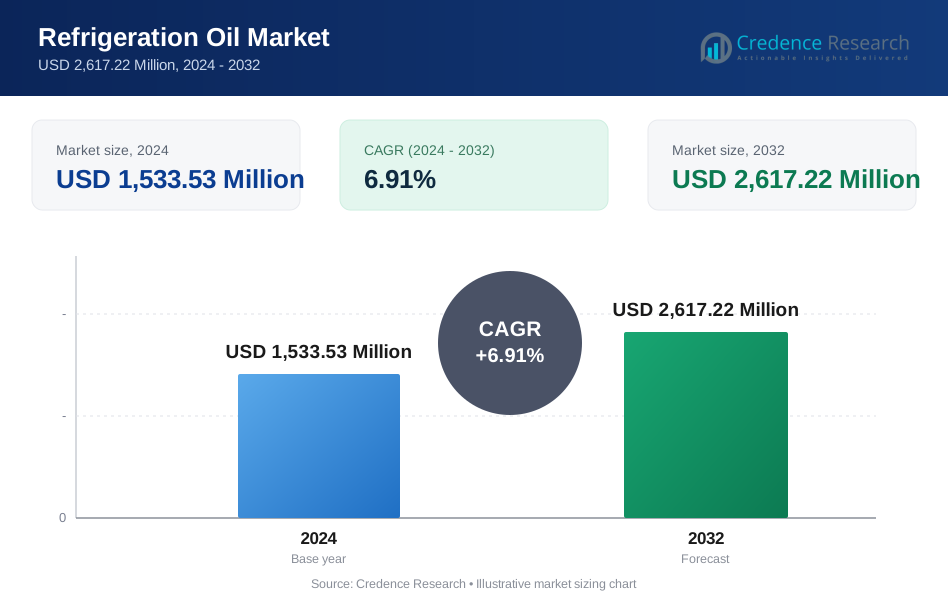
Refrigeration Oil Market size was valued at USD 1,533.53 Million in 2024 and is anticipated to reach USD 2,617.22 Million by 2032, at a CAGR of 6.91% during the forecast period.
| REPORT ATTRIBUTE | DETAILS |
|---|---|
| Historical Period | 2020-2023 |
| Base Year | 2024 |
| Forecast Period | 2025-2032 |
| Refrigerated Vending Machine MarketSize 2024 | USD 1,533.53 Million |
| Refrigerated Vending Machine Market, CAGR | 6.91% |
| Refrigerated Vending Machine Market Size 2032 | USD 2,617.22 Million |
Refrigeration Oil Market is shaped by the presence of major players such as ExxonMobil, Chevron Corporation, TotalEnergies SE, Royal Dutch Shell, Sinopec Group, PETRONAS, BASF SE, Johnson Controls, Petro-Canada Lubricants Inc (HollyFrontier), and Behr Hella Service GmbH, all of whom focus on advanced synthetic and semi-synthetic formulations to meet evolving HVACR requirements. These companies emphasize product innovation, system compatibility, and enhanced lubrication performance to support the transition toward energy-efficient and low-GWP refrigerant technologies. Asia-Pacific emerged as the leading regional market in 2024, accounting for a 37.6% share, driven by rapid industrialization, rising AC adoption, and expanding cold chain infrastructure across major economies.
Market Insights
- The Refrigeration Oil Market reached USD 1,533.53 Million in 2024 and will grow at a CAGR of 6.91% through 2032.
- Rising demand for energy-efficient HVACR systems and expansion of global cold chain networks are driving strong growth in the Refrigeration Oil Market.
- Synthetic oil remained the dominant segment with a 62.4% share in 2024, supported by increasing adoption of low-GWP refrigerants and advanced compressor technologies.
- Key players such as ExxonMobil, Chevron Corporation, Royal Dutch Shell, Sinopec Group, and TotalEnergies SE focus on product innovation, improved miscibility, and R&D investment to strengthen market presence.
- Asia-Pacific led the Refrigeration Oil Market with a 37.6% share in 2024, followed by North America at 29.4%, driven by expanding industrial refrigeration, rising AC installations, and strong cold chain infrastructure across major economies.
 Market Segmentation Analysis:
By Product Type:
In 2024, the Synthetic Oil segment dominated the Refrigeration Oil Market with a 62.4% share, driven by its superior thermal stability, low volatility, and compatibility with next-generation low-GWP refrigerants. Industries increasingly prefer synthetic oils for high-performance air conditioning and commercial refrigeration systems due to their enhanced lubrication, oxidation resistance, and longer service life. Mineral oil accounted for the remaining share, primarily serving legacy systems, but ongoing transitions toward energy-efficient and environmentally compliant solutions continue to strengthen the demand for synthetic formulations across residential, commercial, and industrial applications.
- For instance, Shell Refrigeration Oil S4 FR-F, a POE-based synthetic lubricant, ensures thermal stability and compatibility with low-GWP HFCs such as R410A in rotary and reciprocating compressors for commercial systems.
By Refrigerant Type:
The Hydro-fluorocarbon (HFC) segment led the market with a 46.7% share in 2024, supported by its widespread use in air conditioners, commercial freezers, and chillers globally. HFCs remain dominant due to their favorable thermodynamic properties and compatibility with both mineral and synthetic refrigeration oils. However, growth is also influenced by regulatory-driven transitions toward low-GWP refrigerants, which encourage demand for advanced oil formulations. Ammonia and HCFC systems maintain significant use in industrial applications, while CFC consumption continues to decline due to global phase-out mandates.
- For instance, Carrier uses R-410A in many residential and commercial air conditioning systems, leveraging its higher pressure operation and energy-efficient heat absorption for reliable performance.
By Application:
In 2024, Air Conditioners emerged as the leading application segment with a 38.9% share, propelled by rising HVAC installations across residential, commercial, and industrial sectors. The increasing need for energy-efficient cooling systems and the expansion of construction activities in emerging economies further supported segment growth. Refrigerators/freezers and chillers also contributed significantly to market demand, driven by the expanding cold chain, food processing, and retail industries. The growing adoption of advanced cooling technologies and higher lubricant performance requirements continue to strengthen consumption across coolers, condensers, and related refrigeration equipment.
Key Growth Drivers
Rising Demand for Energy-Efficient Cooling Systems
The Refrigeration Oil Market is experiencing strong growth as industries shift toward high-efficiency air conditioning, refrigeration, and HVAC systems that require advanced lubrication solutions. Increasing regulatory pressure to reduce energy consumption and greenhouse gas emissions accelerates the adoption of premium synthetic oils that enhance compressor performance and reduce frictional losses. Rapid urbanization, expanding commercial infrastructure, and rising global temperatures further boost the installation of AC units and refrigeration equipment, creating sustained demand for high-performance refrigeration oils across residential, commercial, and industrial applications.
- For instance, Lubrizol's Emkarate RL polyol ester (POE) lubricants feature enhanced miscibility with HFC refrigerants such as R134a and R410A, enabling efficient oil return to compressors in residential and commercial systems while maintaining excellent thermal stability per ASHRAE 97 sealed tube tests.
Expansion of Cold Chain and Food Preservation Infrastructure
The expansion of cold chain networks for food processing, pharmaceuticals, and perishable goods logistics remains a critical driver of the Refrigeration Oil Market. Countries worldwide are investing in temperature-controlled storage, refrigerated transportation, and frozen food distribution systems to meet rising consumption and ensure product quality. These facilities depend heavily on reliable refrigeration systems that require consistent lubrication to maintain efficiency and prevent equipment wear. As global trade in frozen foods and biopharmaceuticals accelerates, demand for refrigeration oil continues to rise, particularly in high-capacity compressors and industrial cooling systems.
- For instance, Lineage Logistics acquired four cold storage warehouses from Tyson Foods, providing 49 million cubic feet of storage capacity and 160,000 pallet positions across sites in Pennsylvania, Kansas, Illinois, and Arizona.
Shift Toward Low-GWP and Environmentally Friendly Refrigerants
Global regulatory mandates, such as the Kigali Amendment and regional F-gas regulations, are encouraging the transition toward low-GWP refrigerants. This shift fuels demand for compatible refrigeration oils designed to operate efficiently with emerging alternatives such as HFOs and natural refrigerants. Manufacturers are investing in the development of chemically stable synthetic oils that maintain lubrication efficiency under new operating conditions. As industries replace legacy CFC and HCFC systems, the need for advanced oil formulations that ensure system durability and regulatory compliance significantly strengthens growth prospects for the refrigeration oil sector.
Key Trends & Opportunities
Growing Adoption of Synthetic and Hybrid Lubricants
A major trend shaping the Refrigeration Oil Market is the accelerating adoption of synthetic and hybrid lubricant technologies due to their superior thermal stability, oxidation resistance, and extended service intervals. These formulations are increasingly favored in high-efficiency cooling systems and environmentally friendly refrigerant applications. As end users prioritize performance optimization, reduced maintenance costs, and environmental compliance, manufacturers are focusing on advanced lubricant innovations. This trend presents significant opportunities for suppliers offering high-grade POE, PAG, and PAO-based refrigeration oils tailored to next-generation cooling technologies.
- For instance, FUCHS offers RENISO TRITON SE 170, a POE-based oil designed for HFO refrigerants like R1234ze and R1234yf, providing optimal adaptation to compressors and systems with enhanced chemical-thermal stability.
Technological Advancements in Compressor and HVAC Systems
Rapid advancements in compressor design, including variable-speed technology, microchannel heat exchangers, and smart HVAC controls, are creating new opportunities for high-performance refrigeration oils. Modern cooling systems operate under higher pressures and varying load conditions, requiring lubricants with enhanced stability and superior film-forming capabilities. The integration of IoT-based monitoring and predictive maintenance platforms further supports demand for oils engineered to maintain consistent performance over extended periods. These innovations enable manufacturers to introduce specialized formulations that enhance efficiency, extend equipment life, and meet evolving system requirements.
- For instance, Danfoss microchannel heat exchangers feature refrigerant flow through micro channels in an all-aluminum design, demanding oils with high stability to handle the 30% reduced refrigerant charge while maintaining corrosion resistance and efficiency.
Key Challenges
Regulatory Pressures and Refrigerant Transition Complexity
Stringent environmental regulations governing high-GWP refrigerants pose a significant challenge for refrigeration oil producers. As industries transition to alternative refrigerants such as ammonia, CO₂, and HFOs, lubricant compatibility becomes increasingly complex. Manufacturers must innovate rapidly to develop oils that maintain stability, miscibility, and lubrication performance under new operating conditions. Compliance with evolving global standards increases development costs, testing requirements, and certification burdens, creating operational challenges for market players navigating regulatory shifts and refrigerant phase-outs.
High Maintenance Requirements and System Contamination Risks
Refrigeration systems demand precise lubrication to prevent wear, overheating, and efficiency losses, making maintenance a critical challenge in the market. Issues such as moisture ingress, acid formation, and particulate contamination can degrade refrigeration oil performance, leading to compressor failures and costly downtime. End users often face difficulties in maintaining oil purity, especially in large-scale industrial environments. These risks necessitate frequent monitoring and replacement of lubricants, increasing operating costs and posing barriers for price-sensitive customers in emerging markets who rely on older or poorly maintained equipment.
Regional Analysis
North America
North America held a 29.4% share of the Refrigeration Oil Market in 2024, supported by the widespread adoption of advanced HVAC systems, strong cold chain infrastructure, and stringent energy-efficiency regulations. The region’s expanding pharmaceutical logistics sector and rising consumption of frozen and packaged foods further strengthen demand. Technological upgrades in commercial refrigeration, coupled with the transition toward low-GWP refrigerants, drive significant adoption of high-performance synthetic oils. The U.S. continues to lead due to large-scale industrial cooling applications, while Canada’s growing focus on sustainable refrigeration solutions contributes to steady market expansion.
Europe
Europe accounted for a 24.8% share in 2024, driven by strict F-gas regulations that accelerate the shift to environmentally friendly refrigerants and compatible lubrication technologies. The region’s established cold chain network, advanced food processing sector, and widespread modernization of commercial refrigeration systems underpin strong demand. Manufacturers increasingly invest in high-quality POE and PAG oils to meet evolving environmental and performance standards. Growth is particularly robust in Germany, France, and the U.K., where industrial refrigeration upgrades and energy-efficient HVAC adoption continue to expand the use of premium refrigeration oil formulations.
Asia-Pacific
Asia-Pacific dominated the market with a 37.6% share in 2024, fueled by rapid industrialization, rising urbanization, and booming demand for residential and commercial air conditioning. Expanding cold storage capacity across China, India, Japan, and Southeast Asia significantly increases refrigeration lubricant consumption. The region’s growing food processing industry and pharmaceutical distribution networks further accelerate adoption. Rising manufacturing activity and large-scale deployment of HVAC systems in commercial buildings create strong demand for synthetic oils, while government initiatives promoting energy-efficient cooling technologies reinforce long-term market growth across developing economies.
Latin America
Latin America captured an 5.9% share in 2024, supported by the expansion of food retail chains, increasing use of refrigerated logistics, and modernization of commercial cooling systems. Brazil and Mexico lead market demand as investments in cold storage facilities and supermarket refrigeration continue to rise. The adoption of synthetic oils gains momentum as industries upgrade HVAC and refrigeration units to improve performance and reduce operating costs. Growing pharmaceutical distribution networks and rising consumption of frozen foods further contribute to the regional demand for high-quality refrigeration oils.
Middle East & Africa
The Middle East & Africa region accounted for a 2.3% share in 2024, driven by increasing installation of HVAC systems due to extreme climatic conditions and rapid urban development. Rising investments in food storage, hospitality, and industrial refrigeration support steady growth in lubricant consumption. Gulf countries lead due to large-scale infrastructure projects and the growing need for energy-efficient cooling technologies. In Africa, expanding cold chain capabilities and rising adoption of commercial refrigeration units contribute to market penetration, although limited technological advancement and high costs remain challenges for wider adoption.
Market Segmentations:
By Product Type:
- Mineral Oil
- Synthetic Oil
By Refrigerant Type:
- Chlorofluorocarbon (CFC)
- Hydro-chlorofluorocarbon (HCFC)
- Hydro-fluorocarbon (HFC)
- Ammonia
By Application:
- Air Conditioners
- Coolers
- Chillers
- Refrigerators/ Freezers
- Condensers
By End Use:
- Industrial
- Commercial
- Residential
By Geography
- North America
- U.S.
- Canada
- Mexico
- Europe
- Germany
- France
- U.K.
- Italy
- Spain
- Rest of Europe
- Asia Pacific
- China
- Japan
- India
- South Korea
- South-east Asia
- Rest of Asia Pacific
- Latin America
- Brazil
- Argentina
- Rest of Latin America
- Middle East & Africa
- GCC Countries
- South Africa
- Rest of the Middle East and Africa
Competitive Landscape
The Refrigeration Oil Market analysis highlights key players including ExxonMobil, Chevron Corporation, TotalEnergies SE, Royal Dutch Shell, Sinopec Group, PETRONAS, BASF SE, Johnson Controls, Petro-Canada Lubricants Inc (HollyFrontier), and Behr Hella Service GmbH. These companies focus on developing high-performance synthetic and semi-synthetic oils that match evolving refrigerant technologies and support next-generation HVACR systems. Market participants invest heavily in R&D to enhance lubricant stability, miscibility, and thermal efficiency, particularly for low-GWP refrigerants such as HFOs and natural alternatives. Strategic initiatives—such as capacity expansions, product innovation, global distribution strengthening, and partnerships with compressor and HVAC manufacturers—play a crucial role in improving market presence. Several players are also emphasizing sustainability by offering eco-friendly oil formulations aligned with energy-efficiency regulations. Together, these competitive strategies enable companies to meet the rising demand for advanced refrigeration oil across industrial, commercial, and residential applications while maintaining strong global positioning.
Key Player Analysis
- Behr Hella Service GmbH
- PETRONAS
- Johnson Controls
- Royal Dutch Shell
- TotalEnergies SE
- Chevron Corporation
- Petro-Canada Lubricants Inc (HollyFrontier)
- ExxonMobil
- Sinopec Group (China Petrochemical Corporation)
- BASF SE
Recent Developments
- In October 2025, RelaDyne acquired Domestic Fuels & Lubes to expand its U.S. distribution network for lubricants, including refrigeration oils.
- In November 2024, LANXESS launched a new synthetic ester lubricant Everest ESR 220 for HVAC and refrigeration systems using low-GWP refrigerant R-1234ze.
- In September 2025, Shree Refrigerations Limited formed a strategic partnership with Smardt Inc. to introduce advanced oil-free chiller technologies in India.
Report Coverage
The research report offers an in-depth analysis based on Product Type, Refrigerant Type, Application, End Use and Geography. It details leading market players, providing an overview of their business, product offerings, investments, revenue streams, and key applications. Additionally, the report includes insights into the competitive environment, SWOT analysis, current market trends, as well as the primary drivers and constraints. Furthermore, it discusses various factors that have driven market expansion in recent years. The report also explores market dynamics, regulatory scenarios, and technological advancements that are shaping the industry. It assesses the impact of external factors and global economic changes on market growth. Lastly, it provides strategic recommendations for new entrants and established companies to navigate the complexities of the market.
Future Outlook
- The Refrigeration Oil Market will grow steadily as demand for high-efficiency cooling systems expands across residential, commercial, and industrial sectors.
- Adoption of synthetic oils will accelerate due to increasing compatibility requirements with low-GWP and advanced refrigerants.
- Cold chain expansion for food, pharmaceuticals, and logistics will remain a major driver of long-term lubricant consumption.
- Technological advancements in compressors and HVAC systems will boost demand for high-performance, thermally stable oil formulations.
- Environmental regulations will continue to influence product innovation and encourage development of eco-friendly refrigeration oils.
- Growth in emerging economies will strengthen market penetration through rising AC installations and industrial refrigeration needs.
- Manufacturers will increasingly invest in R&D for enhanced lubricant formulations supporting improved efficiency and extended equipment life.
- Digital monitoring and predictive maintenance adoption will raise the need for oils engineered for stable long-duration performance.
- Partnerships between oil manufacturers and HVACR system producers will expand to ensure optimized compatibility and system efficiency.
- The shift toward sustainable cooling technologies will create new opportunities for next-generation synthetic and hybrid refrigeration oils.
Request a Free Sample
Fill in your details and we'll send you a free sample report.
- Sample data tables & charts
- Research methodology
Need a Custom Version of This Report?
Tailor the scope, geography, or segments to your exact requirements.
- Custom geography or segment scope
- Direct access to our analyst team
Frequently Asked Questions
What is the current market size for Refrigeration Oil Market, and what is its projected size in 2032?
At what Compound Annual Growth Rate is the Refrigeration Oil Market projected to grow between 2024 and 2032?
Which Refrigeration Oil Market segment held the largest share in 2024?
What are the primary factors fueling the growth of the Refrigeration Oil Market?
Who are the leading companies in the Refrigeration Oil Market?
Which region commanded the largest share of the Refrigeration Oil Market in 2024?
Table of Content
Chapter 1. Report Introduction
- 1.1 Report Description & Purpose
- 1.1.1 Report Title & Market Definition
- 1.1.2 Unique Selling Propositions (USP) & Key Differentiators
- 1.1.3 Value Proposition for Stakeholders
- 1.2 Research Objectives
- 1.2.1 Market Sizing Objectives (Volume & Revenue)
- 1.2.2 Segmentation Objectives
- 1.2.3 Competitive Intelligence Objectives
- 1.2.4 Forecast & Scenario Objectives
- 1.3 Report Scope
- 1.3.1 Refrigeration Oil Scope – Types & Subtypes Covered
- 1.3.2 Geographic Scope – Regions & Countries Covered
- 1.3.3 Historical Period, Base Year & Forecast Period (2024; forecast to 2032)
- 1.3.4 Inclusions & Exclusions
- 1.4 HS Code & Classification Framework
- 1.5 Currency, Units & Pricing Basis
- 1.6 Target Stakeholders
- 1.7 Limitations & Assumptions
Chapter 2. Executive Summary
- 2.1 Global Refrigeration Oil Market Snapshot
- 2.1.1 Market Size – Historical (2024) & Forecast (2024-2032) (2024: USD 1,533.53 Million → 2032: USD 2,617.22 Million)
- 2.1.2 Volume & Revenue – Global Totals
- 2.1.3 Key Market Highlights – Top Five Facts
- 2.2 Refrigeration Oil Market Segmentation Snapshot
- 2.2.1 Market Split by Region – 2024 vs. 2032
- 2.3 Competitive Snapshot
- 2.3.1 Top 10 Players by Revenue Share – 2024
- 2.3.2 Top 10 Players by Volume Share – 2024
- 2.3.3 Recent Strategic Developments (18-Month Summary)
- 2.4 Key Investment Highlights & Strategic Conclusions
Chapter 3. Refrigeration Oil Market Dynamics & Industry Analysis
- 3.1 Market Overview & Context
- 3.1.1 Refrigeration Oil Market Position in the Broader Automotive Value Chain
- 3.1.2 OEM vs. Replacement Market Dynamics
- 3.1.3 Market Maturity & Development Stage by Region
- 3.2 Refrigeration Oil Market Drivers
- 3.3 Refrigeration Oil Market Restraints & Challenges
- 3.4 Refrigeration Oil Market Opportunities
- 3.5 Porter's Five Forces Analysis
- 3.5.1 Threat of New Entrants
- 3.5.2 Bargaining Power of Suppliers
- 3.5.3 Bargaining Power of Buyers
- 3.5.4 Threat of Substitutes
- 3.5.5 Competitive Rivalry – Intensity Assessment
- 3.6 Refrigeration Oil Value Chain Analysis
- 3.6.1 Upstream – Raw Material/Input Suppliers
- 3.6.1.1 Raw Material/Input 1
- 3.6.1.2 Raw Material/Input 2
- 3.6.1.3 Raw Material/Input 3
- 3.6.2 Midstream – Production/Manufacturing/Service Delivery
- 3.6.2.1 Production/Process Overview
- 3.6.2.2 Key Facility Locations & Capacity by Manufacturer
- 3.6.3 Downstream – Distribution & End Consumer
- 3.6.3.1 Primary Channel – B2B/OEM
- 3.6.3.2 Secondary Channels – Dealer, Retail, Online, Direct
- 3.6.4 Value Chain Profitability Analysis
- 3.6.1 Upstream – Raw Material/Input Suppliers
- 3.7 PESTEL Analysis
- 3.7.1 Political Factors
- 3.7.2 Economic Factors
- 3.7.3 Social Factors
- 3.7.4 Technological Factors
- 3.7.5 Environmental Factors
- 3.7.6 Legal Factors
- 3.8 Refrigeration Oil Supply Chain Analysis
- 3.8.1 Raw Material/Input Supply Risk Assessment
- 3.8.2 Manufacturing Concentration Risk (Geographic Exposure)
- 3.8.3 Trade Disruption Impact Analysis
- 3.9 Regulatory & Policy Landscape
Note: The regulatory and policy landscape section covers regulations based on their applicability to the market, Refrigeration Oil category, geography, and scope of the study. Only regulatory frameworks with a material impact on operations, compliance, trade, sustainability, or market access are analyzed in detail.
Chapter 4. Key Investment Pockets & Opportunity Analysis
- 4.1 Refrigeration Oil Market Attractiveness Analysis
- 4.1.1 By Region – Investment Attractiveness Matrix (Volume × CAGR)
- 4.2 Absolute Revenue Growth Opportunity
- 4.2.1 By Region – Absolute USD Growth Through 2032
- 4.3 Incremental Volume Opportunity
- 4.3.1 By Region – Incremental Volume Through 2032
- 4.3.2 Segment – Incremental Volume
- 4.4 Emerging Submarket Opportunity Deep Dive (Subject to Applicability)
- 4.5 Emerging Market Opportunity Scorecards
- 4.5.1 United States
- 4.5.2 Europe
- 4.5.3 Asia
- 4.5.4 Middle East & Africa
Note: Emerging Market Opportunity Scorecards will be included based on relevance and strategic importance. Regions listed are indicative and may vary depending on data availability and market dynamics.
Chapter 5. Refrigeration Oil Import-Export Analysis & Trade Flows
- 5.1 Global Trade Overview
- 5.1.1 Global Export Value by Country (2024)
- 5.1.2 Global Export Volume by Country (2024)
- 5.1.3 Global Import Value by Country (2024)
- 5.1.4 Global Import Volume by Country (2024)
- 5.1.5 Net Trade Balance by Country (2024)
- 5.2 Export Analysis – Segment
- 5.2.1 Type 1 (HS Code)
- 5.2.2 Type 2 (HS Code)
- 5.2.3 Type 3 (HS Code)
- 5.2.4 Type 4 (HS Code)
- 5.2.5 Type 5 (HS Code)
- 5.3 Import Analysis – Segment
- 5.3.1 Type 1 (HS Code)
- 5.3.2 Type 2 (HS Code)
- 5.3.3 Type 3 (HS Code)
- 5.3.4 Type 4 (HS Code)
- 5.3.5 Type 5 (HS Code)
- 5.4 Average Unit Trade Prices
- 5.4.1 Average Export Price – Segment & Country
- 5.4.2 Average Import Price – Segment & Source Country
- 5.4.3 Price Trends (2024)
- 5.5 Key Trade Route Analysis
- 5.5.1 Trade Route 1
- 5.5.2 Trade Route 2
- 5.5.3 Trade Route 3
- 5.5.4 Trade Route 4
- 5.5.5 Trade Route 5
- 5.6 Trade Policy Impact Assessment
- 5.6.1 US Anti-Dumping & Section 301 Tariffs
- 5.6.2 EU Customs Union Impact
- 5.6.3 Major Free Trade Agreements
- 5.6.4 USMCA Rules of Origin
Note: Trade policy analysis will be included only where relevant to the Refrigeration Oil market.
Chapter 6. Competitive Landscape & Company Benchmarking
- 6.1 Refrigeration Oil Market Concentration & Structure
- 6.1.1 Herfindahl-Hirschman Index (HHI) – vs. 2024
- 6.1.2 Tier 1, Tier 2 & Tier 3 Market Structure
- 6.1.3 Global, Regional & Local Player Dynamics
- 6.2 Refrigeration Oil Market Share Analysis – 2024
- 6.2.1 Global Revenue Share by Company
- 6.2.2 Global Volume Share by Company
- 6.2.3 Regional Revenue Share
- 6.2.4 Market Share Evolution ( vs. 2024)
- 6.2.5 OEM Segment Share by Company
- 6.2.6 Replacement Segment Share by Company
- 6.3 Production/Delivery Capacity & Facility Analysis
- 6.3.1 Global Installed Capacity
- 6.3.2 Capacity Utilization Rates
- 6.3.3 Production/Output Volume
- 6.3.4 Facility Locations & Capacity Map
- 6.3.5 Planned Capacity Additions
- 6.4 Refrigeration Oil Competitive Benchmarking Matrix
- 6.4.1 Revenue, Volume, CAGR & Profitability Comparison
- 6.4.2 Channel Revenue Mix
- 6.4.3 Geographic Revenue Exposure
- 6.4.4 R&D Intensity
- 6.4.5 Sustainability Maturity
- 6.5 Strategic Developments in Refrigeration Oil (Last 24 Months)
- 6.5.1 Mergers, Acquisitions & Divestments
- 6.5.2 New Refrigeration Oil Launches
- 6.5.3 Facility Expansions
- 6.5.4 Strategic Alliances, Joint Ventures & Partnerships
- 6.5.5 Distribution Expansion & Market Entry
- 6.5.6 Sustainability & ESG Initiatives
- 6.6 Competitive Strategy Mapping
- 6.6.1 Leader, Challenger, Follower & Niche Classification
- 6.6.2 Pricing Strategy Comparison
- 6.6.3 Channel Strategy Matrix
Note: Strategic developments are included based on their materiality and the availability of reliable information.
Chapter 7. Global Refrigeration Oil Market – By Distribution Channel
- 7.1 Segment Overview
- 7.1.1 Volume & Revenue Split by Channel (2024 & 2032)
- 7.1.2 Channel Mix Evolution (2024-2032)
Chapter 8. Regional Market Analysis – Global Overview
- 8.1 Global Regional Overview
- 8.1.1 Regional Volume Share
- 8.1.2 Regional Revenue Share
- 8.1.3 Regional Volume by Region
- 8.1.4 Regional Revenue by Region
- 8.1.5 Regional Forecast Through 2032
- 8.2 Cross-Regional Segment Analysis
- 8.2.1 By Distribution Channel
- 8.2.2 By Brand/Price Tier
Chapter 9. North America Refrigeration Oil Market
- 9.1 United States
- 9.2 Canada
- 9.3 Mexico
Chapter 10. Europe Refrigeration Oil Market
- 10.1 Germany
- 10.2 France
- 10.3 Italy
- 10.4 United Kingdom
- 10.5 Spain
- 10.6 Poland
- 10.7 Russia
- 10.8 Netherlands
- 10.9 Belgium
- 10.10 Sweden
- 10.11 Denmark
- 10.12 Norway
- 10.13 Rest of Europe
Chapter 11. Asia Pacific Refrigeration Oil Market
- 11.1 China
- 11.2 India
- 11.3 Japan
- 11.4 South Korea
- 11.5 Thailand
- 11.6 Indonesia
- 11.7 Vietnam
- 11.8 Malaysia
- 11.9 Australia
- 11.10 Rest of Asia Pacific
Chapter 12. Latin America Refrigeration Oil Market
- 12.1 Brazil
- 12.2 Argentina
- 12.3 Colombia
- 12.4 Chile
- 12.5 Rest of Latin America
Chapter 13. Middle East Refrigeration Oil Market
- 13.1 Saudi Arabia
- 13.2 United Arab Emirates
- 13.3 Turkey
- 13.4 Israel
- 13.5 Iran
- 13.6 Rest of the Middle East
Chapter 14. Africa Refrigeration Oil Market
- 14.1 South Africa
- 14.2 Egypt
- 14.3 Nigeria
- 14.4 Morocco
- 14.5 Rest of Africa
Chapter 15. Refrigeration Oil Company Profiles
- 15.1 [Company 01]
- 15.1.1 Company Overview
- 15.1.2 Key Management Personnel
- 15.1.3 Products & Services Portfolio
- 15.1.4 Financial Performance
- 15.1.5 Key Market Focus & Geographic Presence
- 15.1.6 Recent Developments & Strategic Initiatives
Note: The company profile list is preliminary and may change based on research findings, market developments, data availability, and client requirements.
Chapter 16. Appendices
- Appendix A – List of Abbreviations & Acronyms
- Appendix B – Industry Classification Code Reference – Full Series
- Appendix C – Production & Capacity Data Tables
- Appendix D – End-Use & Demand Base Tables
- Appendix E – Consumption & Replacement Rate Assumptions
- Appendix F – ASP Reference Tables
- Appendix G – Manufacturing & Facility Database
- Appendix H – Import-Export Data Tables
- Appendix I – Regulatory Summary Tables
- Appendix J – Primary Research Participant List (Anonymized)
- Appendix K – Primary Research Questionnaire Framework
- Appendix L – Data Sources & Bibliography
- Appendix M – Market Size Divergence & Source Comparison
Chapter 17. Research Methodology
- 17.1 Research Framework & Philosophy
- 17.2 Secondary Research – Sources, Hierarchy & Data Extraction
- 17.3 Data Modeling – Bottom-Up & Top-Down Market Sizing
- 17.4 Primary Research – Stakeholder Framework, LOI & Sample Sizes
- 17.5 Forecast Methodology – Regression, Scenario & Sensitivity Analysis
- 17.6 Quality Control – Four-Layer Validation Framework
- 17.7 Limitations & Standard Assumptions
- 17.8 Disclaimer
