
Market Overview
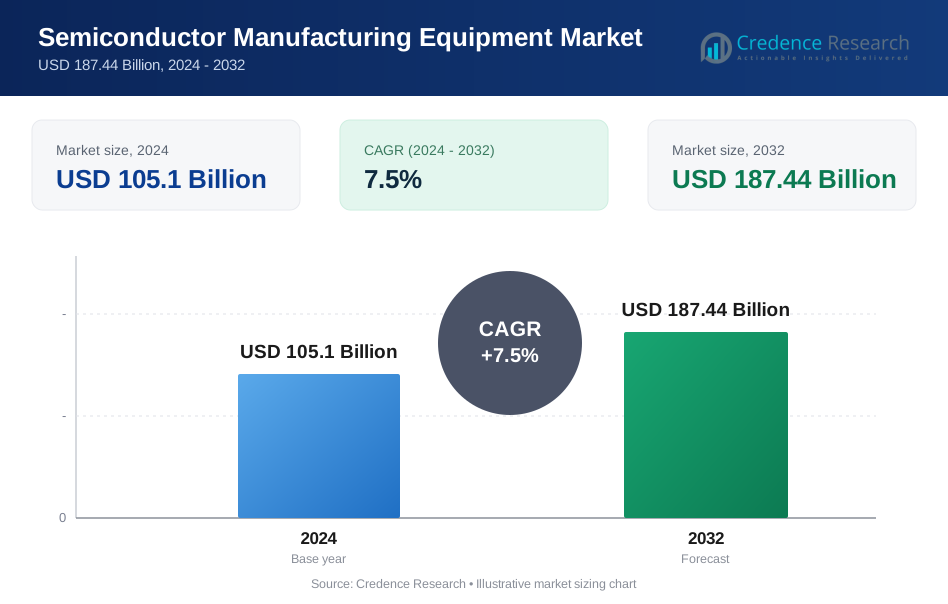
Semiconductor Manufacturing Equipment Market size was valued at USD 105.1 Billion in 2024 and is anticipated to reach USD 187.44 Billion by 2032, at a CAGR of 7.5% during the forecast period.
| REPORT ATTRIBUTE | DETAILS |
|---|---|
| Historical Period | 2020-2023 |
| Base Year | 2024 |
| Forecast Period | 2025-2032 |
| Semiconductor Manufacturing Equipment Market Size 2024 | USD 105.1 Billion |
| Semiconductor Manufacturing Equipment Market, CAGR | 7.5% |
| Semiconductor Manufacturing Equipment Market Size 2032 | USD 187.44 Billion |
Semiconductor Manufacturing Equipment Market is led by prominent players such as Applied Materials Inc., ASML, Lam Research Corporation, KLA Corporation, and Tokyo Electron Limited, who collectively account for a significant share through their investments in cutting-edge technologies like EUV lithography, 3D wafer processing, and advanced metrology. These companies are driving innovation to meet the growing demands of high-performance, miniaturized chips. In 2024, Asia-Pacific emerges as the dominant region, holding over 55% market share, driven by major fabrication hubs in Taiwan, South Korea, Japan, and China. North America follows with a strong share due to government-backed semiconductor initiatives and R&D strength.
Market Insights
- The Semiconductor Manufacturing Equipment Market was valued at USD 105.1 Billion in 2024 and is projected to reach USD 187.44 Billion by 2032, growing at a CAGR of 7.5%.
- Increasing demand for advanced nodes such as 5nm and below in consumer electronics, automotive, and data center applications is driving significant investments in wafer fabrication technology.
- Trends include the rapid adoption of 3D packaging, heterogeneous integration, and sustainability-focused smart manufacturing processes that enhance efficiency and reduce waste.
- The market is dominated by key players such as ASML, Applied Materials, Lam Research, and KLA Corporation, who hold a combined strong share through technology leadership and global expansion strategies.
- Asia-Pacific remains the dominant region with over 55% market share in 2024, led by Taiwan and South Korea, while the wafer fabrication segment leads by type, accounting for over 65% of total equipment demand.
Market Segmentation Analysis
By Type
Wafer Processing/Wafer Manufacturing is the dominant sub-segment in the Semiconductor Manufacturing Equipment Market, accounting for over 65% market share in 2024. This dominance is driven by the growing need for advanced semiconductor nodes like 5nm and 3nm, which require high-precision wafer fabrication systems. This segment benefits from increasing demand across consumer electronics, automotive, and telecom industries. Although Assembly & Testing Equipment plays a crucial role in downstream processes, its market share remains smaller due to its later-stage involvement in the semiconductor production cycle.
- For instance, ASML’s latest NXE:3600D EUV lithography system is capable of processing up to 160 wafers per hour and is crucial for fabricating 3nm chips used in high-performance computing.
By Application
Fabrication Plant/Foundry leads the application segment with approximately 70% share in 2024, driven by rapid fab expansions and increased outsourcing by fabless chip manufacturers. Rising investments by key foundry players like TSMC, Samsung, and Intel to meet global chip demand have significantly boosted the demand for semiconductor manufacturing equipment. Semiconductor electronics manufacturers and testing homes account for the remainder, supporting quality assurance and device validation across various end-use applications.
- For instance, Advantest's V93000 test systems have a significant installed base across all major global OSAT facilities to validate AI and automotive-grade SoCs at high throughput rates.
By Dimension
The 3D segment holds a dominant share of 55% in 2024 within the dimension category, supported by a major transition towards 3D NAND and logic designs for enhanced performance and storage capacity. This shift is essential for AI, cloud computing, and data storage applications where higher transistor density and lower power consumption are crucial. While 2D architectures are still used in simpler or legacy products, demand continues to decline as manufacturers prioritize 3D systems to maintain scalability and improve computational efficiency.
Key Growth Drivers
Demand for Advanced Semiconductor Nodes
The increasing need for smaller, faster, and more efficient semiconductor chips is a core growth driver in the Semiconductor Manufacturing Equipment Market. Consumer electronics, automotive, and high-performance computing sectors are pushing toward 5nm and below nodes, requiring substantial investments in state-of-the-art lithography, etching, and deposition systems. The rise of AI, machine learning, and edge computing has further accelerated the demand for advanced semiconductors. Leading semiconductor manufacturers are expanding production capacities for next-generation chips, resulting in elevated capital expenditure on process innovation and fab expansions. This shift toward smaller geometries is expected to boost revenue for equipment makers like ASML, Lam Research, and Applied Materials. Additionally, geopolitical factors and the need for domestic chip production are driving government incentives in regions like the U.S., China, and Europe, further supporting the adoption of advanced manufacturing technologies.
- For instance, NVIDIA’s Hopper H100 GPU is manufactured using TSMC’s 4N process, featuring 80 billion transistors, and requires specialized etch and deposition tools for its stacked chip architecture.
Surge in Automotive Electronics and Electrification
Automotive electrification and the transition toward autonomous vehicles are significantly impacting the Semiconductor Manufacturing Equipment Market. Modern vehicles increasingly rely on advanced semiconductor components such as power electronics, sensors, microcontrollers, and connectivity modules. These components require precise manufacturing techniques, leading to the adoption of specialized equipment for high-reliability applications. The expansion of electric vehicle (EV) infrastructure, coupled with government policies favoring sustainability, is accelerating semiconductor usage in battery management systems, motor control, infotainment, and driver assistance technologies. Furthermore, the growth in silicon carbide (SiC) and gallium nitride (GaN) semiconductor adoption is spurring demand for equipment tailored to wide-bandgap materials. As the automotive industry becomes more digital, chip shortages have underlined the need for robust supply chains, prompting automakers and semiconductor fabs to collaborate on capacity-building and long-term manufacturing strategies.
- For instance, Bosch’s Reutlingen fab expanded its SiC production line with a 3,600 m² clean room, enabling annual output of more than 1 million power semiconductor chips used in EV inverters and charging systems.
Rising Fab Investments and Government Incentives
Global fab capacity expansion is a major catalyst for the Semiconductor Manufacturing Equipment Market, supported by significant government policies seeking to achieve chip self-sufficiency. The United States CHIPS Act, Europe's Chips Act, and China’s “Made in China 2025” are notable programs aiming to support domestic semiconductor infrastructure through grants, tax incentives, and R&D investments. These initiatives encourage the establishment of new fabrication facilities and modernization of existing ones. Companies like TSMC, Samsung, Intel, and SMIC have announced multi-billion-dollar expansion plans, greatly increasing demand for equipment across front-end and back-end processes. This investment cycle is also driven by the growing need for operational resilience and supply chain diversification—lessening reliance on single geographic regions. As a result, the semiconductor equipment ecosystem is witnessing rising sales from lithography, metrology, inspection, and packaging systems to support rapid technology scaling.

Key Trends & Opportunities
Growth of 3D Packaging and Heterogeneous Integration
The market is witnessing strong growth in 3D packaging technologies and heterogeneous integration as devices require more functionality within increasingly smaller footprints. 3D stacking allows multiple dies to be integrated vertically, enhancing performance while reducing power consumption and latency—crucial for AI accelerators, 5G chips, and data center systems. Heterogeneous integration, which combines different semiconductor technologies into a single package, offers flexibility and performance advantages. These trends present opportunities for equipment makers to expand product offerings, especially in advanced packaging, wafer bonding, and metrology systems. As demand grows for high-bandwidth memory and chiplet architectures, manufacturers are investing in equipment that can support new packaging architectures efficiently and at scale.
- For example, AMD's EPYC processors use a chiplet architecture with up to 96 cores, interconnected with Infinity Fabric within a multi-chip module (MCM) package assembled using a standard organic substrate.
Shift Toward Sustainable Manufacturing and Green Fabs
The semiconductor industry is under increasing pressure to adopt sustainable manufacturing practices. With rising concerns over energy consumption, water usage, and greenhouse gas emissions, manufacturers are focusing on eco-friendly production processes. Semiconductor equipment companies are developing tools that improve resource utilization, lower emissions, and enable high-yield production with minimal waste. Digital twins, AI-driven yield management, and efficient etching and deposition technologies offer promising opportunities to reduce environmental impact and operational costs. Companies that incorporate sustainable solutions into their fabrication equipment—such as reduced energy usage and chemical recycling—stand to gain a competitive advantage. Government initiatives promoting carbon neutrality also present an opportunity for equipment vendors specializing in clean tech solutions for next-generation fabs.
- For instance, the Applied Materials SmartFactory AI platform uses AI to optimize equipment performance by dynamically adjusting processing parameters based on real-time data, ensuring efficient production cycles and contributing to overall energy efficiency, though specific universal energy savings percentages like 'up to 15%' are illustrative rather than guaranteed across all applications.
Key Challenges
High Capital Investment and Long Payback Cycles
The semiconductor manufacturing equipment industry faces the challenge of high capital costs and lengthy payback periods, which can deter new entrants and complicate expansion plans for smaller fabs. Advanced equipment, such as EUV lithography systems, can cost more than USD 150 million per unit, requiring significant upfront investment. Additionally, the complex installation, maintenance, and calibration processes necessitate specialized expertise and infrastructure. These expenses are compounded by volatile demand cycles, which can lead to underutilization during downturns. Equipment manufacturers therefore need to continually innovate cost-effective solutions while maintaining precision and performance standards.
Supply Chain Disruptions and Geopolitical Tensions
Semiconductor equipment manufacturers are increasingly vulnerable to supply chain disruptions, particularly due to dependency on critical components, rare materials, and cross-border trade uncertainties. The global chip shortage highlighted vulnerabilities in logistics and sourcing, especially for high-precision components. Geopolitical tensions, particularly between the U.S. and China, have further complicated the trade of semiconductor technology and equipment, delaying shipments and restricting access to essential parts. Export controls and sanctions on advanced equipment pose significant risks to equipment makers and fabs. Ensuring a resilient supply ecosystem and diversifying supplier bases has become essential for industry stability and long-term growth.
Regional Analysis
North America
North America holds a significant share of the Semiconductor Manufacturing Equipment market, accounting for approximately 35% in 2024, driven by substantial investments in fab expansions and government-backed initiatives like the CHIPS Act. The United States is the key contributor, home to leading equipment makers like Applied Materials and Lam Research. Rising demand for advanced semiconductors in defense, automotive, and cloud computing sectors further accelerates growth. Companies are enhancing local manufacturing to reduce dependence on Asian production. The region’s robust R&D ecosystem and strategic focus on strengthening supply chains continue to support market growth through 2032.
Asia-Pacific
Asia-Pacific dominates the global Semiconductor Manufacturing Equipment market with over 55% share in 2024, led by countries like Taiwan, South Korea, Japan, and China. These nations are home to leading semiconductor foundries, including TSMC, Samsung, and SMIC, contributing heavily to equipment demand. Increasing government incentives and capacity expansion plans to support domestic chip production are boosting market growth. China’s focus on self-reliance and rapid expansion of local fabs further amplify equipment needs. Moreover, the region benefits from a strong supply chain, skilled labor, and close proximity to major electronic OEMs, reinforcing its global leadership.
Europe
Europe accounts for approximately 7% share in 2024 of the Semiconductor Manufacturing Equipment market, driven by strong presence in advanced lithography technologies and growing automotive semiconductor demand. The region’s leading equipment maker, ASML, plays a pivotal role in global EUV wafer production. European chipmakers are investing in next-generation technologies for industrial automation, aerospace, and electric vehicles. The EU Chips Act aims to strengthen domestic chip design and fabrication, fostering collaboration with global companies. Sustainable manufacturing practices and strong support for R&D make Europe a strategic hub for specialized semiconductor equipment development and supply chain diversification.
Rest of the World (RoW)
The Rest of the World contributes around 3% share in 2024, with emerging markets in the Middle East, Latin America, and Africa beginning to explore semiconductor manufacturing opportunities. While these regions lack large-scale fabrication facilities, government initiatives and strategic partnerships are slowly creating growth prospects. Countries like Israel play a significant role in semiconductor design and equipment research. Growing demand for electronics, automotive components, and digital infrastructure across developing economies presents long-term opportunities for equipment suppliers. However, limited manufacturing capacity, infrastructure challenges, and talent shortages remain key barriers to accelerated market expansion in the RoW region.
Market Segmentations
By Type
- Wafer Processing/Wafer Manufacturing
- Assembly & Testing Equipment
By Application
- Fabrication Plant/Foundry
- Semiconductor Electronics Manufacturer
- Testing Home
By Dimension
- 2D
- 3D
By Geography
- North America
- U.S.
- Canada
- Mexico
- Europe
- Germany
- France
- U.K.
- Italy
- Spain
- Rest of Europe
- Asia Pacific
- China
- Japan
- India
- South Korea
- South-east Asia
- Rest of Asia Pacific
- Latin America
- Brazil
- Argentina
- Rest of Latin America
- Middle East & Africa
- GCC Countries
- South Africa
- Rest of the Middle East and Africa
Competitive Landscape
The competitive landscape of the Semiconductor Manufacturing Equipment market is defined by a concentrated group of global leaders that dominate across various technological segments. Key players include Applied Materials Inc., ASML, Lam Research Corporation, KLA Corporation, Tokyo Electron Limited, Advantest Corporation, SCREEN Semiconductor Solutions Co., Ltd., Cohu, Inc., ACM Research Inc., and Nordson Corporation. These companies are continually investing in advanced lithography, deposition, etching, metrology, and inspection technologies to support increasing semiconductor complexity and smaller process nodes. Innovations in EUV lithography, 3D packaging, and advanced wafer processing are central to competitive differentiation. Strategic alliances, long-term supply agreements, and regional expansions are widely adopted to secure market presence amid rising demand. Moreover, companies are focusing on sustainability and productivity enhancements through AI-enabled process optimization. The ongoing semiconductor capacity expansions in Asia-Pacific, coupled with government-backed incentives in the United States and Europe, present significant opportunities for equipment manufacturers to strengthen their global footprint and drive growth.
Key Player Analysis
- KLA Corporation
- SCREEN Semiconductor Solutions Co., Ltd.
- Nordson Corporation
- Lam Research Corporation
- Advantest Corporation
- Cohu, Inc.
- ACM Research Inc.
- Tokyo Electron Limited
- ASML
- Applied Materials Inc.
Recent Developments
- In July 2025, Tata Electronics Private Limited and Robert Bosch GmbH signed an MoU for a strategic collaboration in semiconductor manufacturing and chip‑packaging services in India.
- In July 2025, the industry association SEMI reported that global OEM sales of semiconductor manufacturing equipment are forecast to reach US $125.5 billion in 2025, driven by investments in leading‑edge logic, memory and AI applications.
- In April 2025, Applied Materials, Inc. acquired a 9 % stake in BE Semiconductor Industries (BESI), making it the largest shareholder, signalling a strategic move to deepen collaboration rather than compete directly.
Report Coverage
The research report offers an in-depth analysis based on Type, Application, Dimension and Geography. It details leading market players, providing an overview of their business, product offerings, investments, revenue streams, and key applications. Additionally, the report includes insights into the competitive environment, SWOT analysis, current market trends, as well as the primary drivers and constraints. Furthermore, it discusses various factors that have driven market expansion in recent years. The report also explores market dynamics, regulatory scenarios, and technological advancements that are shaping the industry. It assesses the impact of external factors and global economic changes on market growth. Lastly, it provides strategic recommendations for new entrants and established companies to navigate the complexities of the market.
Future Outlook
- Rising demand for smaller and more powerful chips will continue to drive adoption of advanced semiconductor manufacturing equipment.
- Increased investment in EUV lithography technologies will accelerate production of next-generation nodes.
- Expansion of global fabrication plants will boost equipment sales, particularly in Asia-Pacific and North America.
- Adoption of 3D integration and packaging will grow due to higher transistor density and performance needs.
- AI and machine learning integration will enhance process optimization and yield management across fabs.
- Sustainability initiatives will push manufacturers to adopt energy-efficient and low-emission equipment solutions.
- Government incentives and policies will support domestic chip production and fabrication infrastructure.
- Demand for equipment supporting wide-bandgap semiconductors like SiC and GaN will expand in automotive and power electronics.
- Increased collaboration between fabs and equipment suppliers will drive innovation for tailored manufacturing solutions.
- Supply chain resilience will remain a key focus to mitigate disruptions and ensure timely delivery of critical components.
Request a Free Sample
Fill in your details and we'll send you a free sample report.
- Sample data tables & charts
- Research methodology
Need a Custom Version of This Report?
Tailor the scope, geography, or segments to your exact requirements.
- Custom geography or segment scope
- Direct access to our analyst team
Frequently Asked Questions
What is the current market size for Semiconductor Manufacturing Equipment Market, and what is its projected size in 2032?
At what Compound Annual Growth Rate is the Semiconductor Manufacturing Equipment Market projected to grow between 2025 and 2032?
Which Semiconductor Manufacturing Equipment Market segment held the largest share in 2024?
What are the primary factors fueling the growth of the Semiconductor Manufacturing Equipment Market?
Who are the leading companies in the Semiconductor Manufacturing Equipment Market?
Which region commanded the largest share of the Semiconductor Manufacturing Equipment Market in 2024?
Table of Content
Chapter 1. Report Introduction
- 1.1 Report Description & Purpose
- 1.1.1 Report Title & Market Definition
- 1.1.2 Unique Selling Propositions (USP) & Key Differentiators
- 1.1.3 Value Proposition for Stakeholders
- 1.2 Research Objectives
- 1.2.1 Market Sizing Objectives (Volume & Revenue)
- 1.2.2 Segmentation Objectives
- 1.2.3 Competitive Intelligence Objectives
- 1.2.4 Forecast & Scenario Objectives
- 1.3 Report Scope
- 1.3.1 Semiconductor Manufacturing Equipment Scope – Types & Subtypes Covered
- 1.3.2 Geographic Scope – Regions & Countries Covered
- 1.3.3 Historical Period, Base Year & Forecast Period (2024; forecast to 2032)
- 1.3.4 Inclusions & Exclusions
- 1.4 HS Code & Classification Framework
- 1.5 Currency, Units & Pricing Basis
- 1.6 Target Stakeholders
- 1.7 Limitations & Assumptions
Chapter 2. Executive Summary
- 2.1 Global Semiconductor Manufacturing Equipment Market Snapshot
- 2.1.1 Market Size – Historical (2024) & Forecast (2024-2032) (2024: USD 105.1 Billion → 2032: USD 187.44 Billion)
- 2.1.2 Volume & Revenue – Global Totals
- 2.1.3 Key Market Highlights – Top Five Facts
- 2.2 Semiconductor Manufacturing Equipment Market Segmentation Snapshot
- 2.2.1 Market Split by Region – 2024 vs. 2032
- 2.3 Competitive Snapshot
- 2.3.1 Top 10 Players by Revenue Share – 2024
- 2.3.2 Top 10 Players by Volume Share – 2024
- 2.3.3 Recent Strategic Developments (18-Month Summary)
- 2.4 Key Investment Highlights & Strategic Conclusions
Chapter 3. Semiconductor Manufacturing Equipment Market Dynamics & Industry Analysis
- 3.1 Market Overview & Context
- 3.1.1 Semiconductor Manufacturing Equipment Market Position in the Broader Automotive Value Chain
- 3.1.2 OEM vs. Replacement Market Dynamics
- 3.1.3 Market Maturity & Development Stage by Region
- 3.2 Semiconductor Manufacturing Equipment Market Drivers
- 3.3 Semiconductor Manufacturing Equipment Market Restraints & Challenges
- 3.4 Semiconductor Manufacturing Equipment Market Opportunities
- 3.5 Porter's Five Forces Analysis
- 3.5.1 Threat of New Entrants
- 3.5.2 Bargaining Power of Suppliers
- 3.5.3 Bargaining Power of Buyers
- 3.5.4 Threat of Substitutes
- 3.5.5 Competitive Rivalry – Intensity Assessment
- 3.6 Semiconductor Manufacturing Equipment Value Chain Analysis
- 3.6.1 Upstream – Raw Material/Input Suppliers
- 3.6.1.1 Raw Material/Input 1
- 3.6.1.2 Raw Material/Input 2
- 3.6.1.3 Raw Material/Input 3
- 3.6.2 Midstream – Production/Manufacturing/Service Delivery
- 3.6.2.1 Production/Process Overview
- 3.6.2.2 Key Facility Locations & Capacity by Manufacturer
- 3.6.3 Downstream – Distribution & End Consumer
- 3.6.3.1 Primary Channel – B2B/OEM
- 3.6.3.2 Secondary Channels – Dealer, Retail, Online, Direct
- 3.6.4 Value Chain Profitability Analysis
- 3.6.1 Upstream – Raw Material/Input Suppliers
- 3.7 PESTEL Analysis
- 3.7.1 Political Factors
- 3.7.2 Economic Factors
- 3.7.3 Social Factors
- 3.7.4 Technological Factors
- 3.7.5 Environmental Factors
- 3.7.6 Legal Factors
- 3.8 Semiconductor Manufacturing Equipment Supply Chain Analysis
- 3.8.1 Raw Material/Input Supply Risk Assessment
- 3.8.2 Manufacturing Concentration Risk (Geographic Exposure)
- 3.8.3 Trade Disruption Impact Analysis
- 3.9 Regulatory & Policy Landscape
Note: The regulatory and policy landscape section covers regulations based on their applicability to the market, Semiconductor Manufacturing Equipment category, geography, and scope of the study. Only regulatory frameworks with a material impact on operations, compliance, trade, sustainability, or market access are analyzed in detail.
Chapter 4. Key Investment Pockets & Opportunity Analysis
- 4.1 Semiconductor Manufacturing Equipment Market Attractiveness Analysis
- 4.1.1 By Region – Investment Attractiveness Matrix (Volume × CAGR)
- 4.2 Absolute Revenue Growth Opportunity
- 4.2.1 By Region – Absolute USD Growth Through 2032
- 4.3 Incremental Volume Opportunity
- 4.3.1 By Region – Incremental Volume Through 2032
- 4.3.2 Segment – Incremental Volume
- 4.4 Emerging Submarket Opportunity Deep Dive (Subject to Applicability)
- 4.5 Emerging Market Opportunity Scorecards
- 4.5.1 United States
- 4.5.2 Europe
- 4.5.3 Asia
- 4.5.4 Middle East & Africa
Note: Emerging Market Opportunity Scorecards will be included based on relevance and strategic importance. Regions listed are indicative and may vary depending on data availability and market dynamics.
Chapter 5. Semiconductor Manufacturing Equipment Import-Export Analysis & Trade Flows
- 5.1 Global Trade Overview
- 5.1.1 Global Export Value by Country (2024)
- 5.1.2 Global Export Volume by Country (2024)
- 5.1.3 Global Import Value by Country (2024)
- 5.1.4 Global Import Volume by Country (2024)
- 5.1.5 Net Trade Balance by Country (2024)
- 5.2 Export Analysis – Segment
- 5.2.1 Type 1 (HS Code)
- 5.2.2 Type 2 (HS Code)
- 5.2.3 Type 3 (HS Code)
- 5.2.4 Type 4 (HS Code)
- 5.2.5 Type 5 (HS Code)
- 5.3 Import Analysis – Segment
- 5.3.1 Type 1 (HS Code)
- 5.3.2 Type 2 (HS Code)
- 5.3.3 Type 3 (HS Code)
- 5.3.4 Type 4 (HS Code)
- 5.3.5 Type 5 (HS Code)
- 5.4 Average Unit Trade Prices
- 5.4.1 Average Export Price – Segment & Country
- 5.4.2 Average Import Price – Segment & Source Country
- 5.4.3 Price Trends (2024)
- 5.5 Key Trade Route Analysis
- 5.5.1 Trade Route 1
- 5.5.2 Trade Route 2
- 5.5.3 Trade Route 3
- 5.5.4 Trade Route 4
- 5.5.5 Trade Route 5
- 5.6 Trade Policy Impact Assessment
- 5.6.1 US Anti-Dumping & Section 301 Tariffs
- 5.6.2 EU Customs Union Impact
- 5.6.3 Major Free Trade Agreements
- 5.6.4 USMCA Rules of Origin
Note: Trade policy analysis will be included only where relevant to the Semiconductor Manufacturing Equipment market.
Chapter 6. Competitive Landscape & Company Benchmarking
- 6.1 Semiconductor Manufacturing Equipment Market Concentration & Structure
- 6.1.1 Herfindahl-Hirschman Index (HHI) – vs. 2024
- 6.1.2 Tier 1, Tier 2 & Tier 3 Market Structure
- 6.1.3 Global, Regional & Local Player Dynamics
- 6.2 Semiconductor Manufacturing Equipment Market Share Analysis – 2024
- 6.2.1 Global Revenue Share by Company
- 6.2.2 Global Volume Share by Company
- 6.2.3 Regional Revenue Share
- 6.2.4 Market Share Evolution ( vs. 2024)
- 6.2.5 OEM Segment Share by Company
- 6.2.6 Replacement Segment Share by Company
- 6.3 Production/Delivery Capacity & Facility Analysis
- 6.3.1 Global Installed Capacity
- 6.3.2 Capacity Utilization Rates
- 6.3.3 Production/Output Volume
- 6.3.4 Facility Locations & Capacity Map
- 6.3.5 Planned Capacity Additions
- 6.4 Semiconductor Manufacturing Equipment Competitive Benchmarking Matrix
- 6.4.1 Revenue, Volume, CAGR & Profitability Comparison
- 6.4.2 Channel Revenue Mix
- 6.4.3 Geographic Revenue Exposure
- 6.4.4 R&D Intensity
- 6.4.5 Sustainability Maturity
- 6.5 Strategic Developments in Semiconductor Manufacturing Equipment (Last 24 Months)
- 6.5.1 Mergers, Acquisitions & Divestments
- 6.5.2 New Semiconductor Manufacturing Equipment Launches
- 6.5.3 Facility Expansions
- 6.5.4 Strategic Alliances, Joint Ventures & Partnerships
- 6.5.5 Distribution Expansion & Market Entry
- 6.5.6 Sustainability & ESG Initiatives
- 6.6 Competitive Strategy Mapping
- 6.6.1 Leader, Challenger, Follower & Niche Classification
- 6.6.2 Pricing Strategy Comparison
- 6.6.3 Channel Strategy Matrix
Note: Strategic developments are included based on their materiality and the availability of reliable information.
Chapter 7. Global Semiconductor Manufacturing Equipment Market – By Distribution Channel
- 7.1 Segment Overview
- 7.1.1 Volume & Revenue Split by Channel (2024 & 2032)
- 7.1.2 Channel Mix Evolution (2024-2032)
Chapter 8. Regional Market Analysis – Global Overview
- 8.1 Global Regional Overview
- 8.1.1 Regional Volume Share
- 8.1.2 Regional Revenue Share
- 8.1.3 Regional Volume by Region
- 8.1.4 Regional Revenue by Region
- 8.1.5 Regional Forecast Through 2032
- 8.2 Cross-Regional Segment Analysis
- 8.2.1 By Distribution Channel
- 8.2.2 By Brand/Price Tier
Chapter 9. North America Semiconductor Manufacturing Equipment Market
- 9.1 United States
- 9.2 Canada
- 9.3 Mexico
Chapter 10. Europe Semiconductor Manufacturing Equipment Market
- 10.1 Germany
- 10.2 France
- 10.3 Italy
- 10.4 United Kingdom
- 10.5 Spain
- 10.6 Poland
- 10.7 Russia
- 10.8 Netherlands
- 10.9 Belgium
- 10.10 Sweden
- 10.11 Denmark
- 10.12 Norway
- 10.13 Rest of Europe
Chapter 11. Asia Pacific Semiconductor Manufacturing Equipment Market
- 11.1 China
- 11.2 India
- 11.3 Japan
- 11.4 South Korea
- 11.5 Thailand
- 11.6 Indonesia
- 11.7 Vietnam
- 11.8 Malaysia
- 11.9 Australia
- 11.10 Rest of Asia Pacific
Chapter 12. Latin America Semiconductor Manufacturing Equipment Market
- 12.1 Brazil
- 12.2 Argentina
- 12.3 Colombia
- 12.4 Chile
- 12.5 Rest of Latin America
Chapter 13. Middle East Semiconductor Manufacturing Equipment Market
- 13.1 Saudi Arabia
- 13.2 United Arab Emirates
- 13.3 Turkey
- 13.4 Israel
- 13.5 Iran
- 13.6 Rest of the Middle East
Chapter 14. Africa Semiconductor Manufacturing Equipment Market
- 14.1 South Africa
- 14.2 Egypt
- 14.3 Nigeria
- 14.4 Morocco
- 14.5 Rest of Africa
Chapter 15. Semiconductor Manufacturing Equipment Company Profiles
- 15.1 [Company 01]
- 15.1.1 Company Overview
- 15.1.2 Key Management Personnel
- 15.1.3 Products & Services Portfolio
- 15.1.4 Financial Performance
- 15.1.5 Key Market Focus & Geographic Presence
- 15.1.6 Recent Developments & Strategic Initiatives
Note: The company profile list is preliminary and may change based on research findings, market developments, data availability, and client requirements.
Chapter 16. Appendices
- Appendix A – List of Abbreviations & Acronyms
- Appendix B – Industry Classification Code Reference – Full Series
- Appendix C – Production & Capacity Data Tables
- Appendix D – End-Use & Demand Base Tables
- Appendix E – Consumption & Replacement Rate Assumptions
- Appendix F – ASP Reference Tables
- Appendix G – Manufacturing & Facility Database
- Appendix H – Import-Export Data Tables
- Appendix I – Regulatory Summary Tables
- Appendix J – Primary Research Participant List (Anonymized)
- Appendix K – Primary Research Questionnaire Framework
- Appendix L – Data Sources & Bibliography
- Appendix M – Market Size Divergence & Source Comparison
Chapter 17. Research Methodology
- 17.1 Research Framework & Philosophy
- 17.2 Secondary Research – Sources, Hierarchy & Data Extraction
- 17.3 Data Modeling – Bottom-Up & Top-Down Market Sizing
- 17.4 Primary Research – Stakeholder Framework, LOI & Sample Sizes
- 17.5 Forecast Methodology – Regression, Scenario & Sensitivity Analysis
- 17.6 Quality Control – Four-Layer Validation Framework
- 17.7 Limitations & Standard Assumptions
- 17.8 Disclaimer
