
Market Overview:
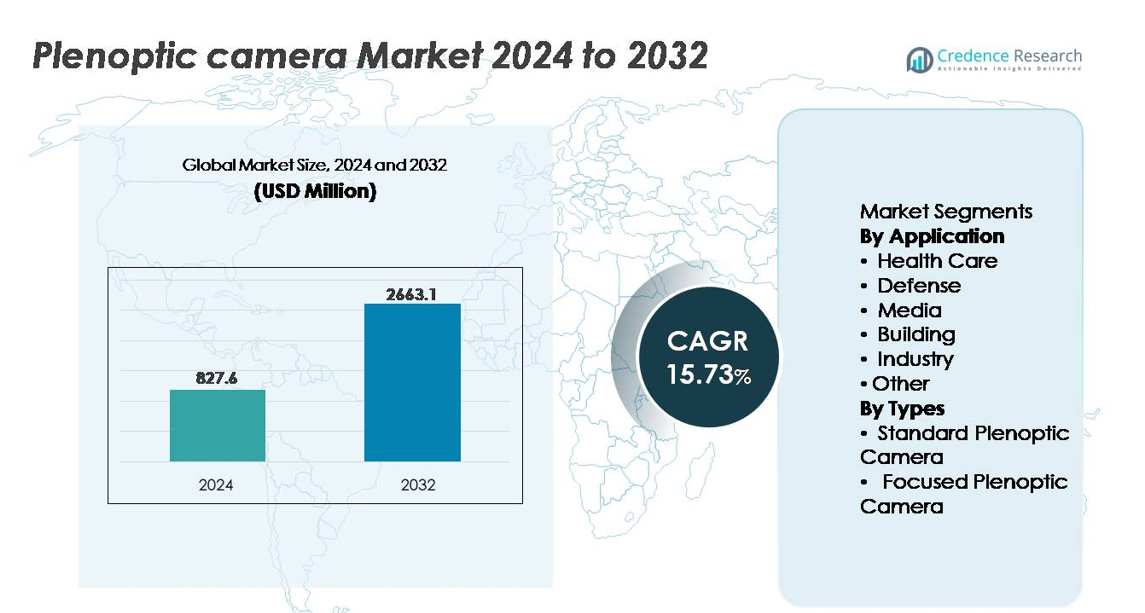
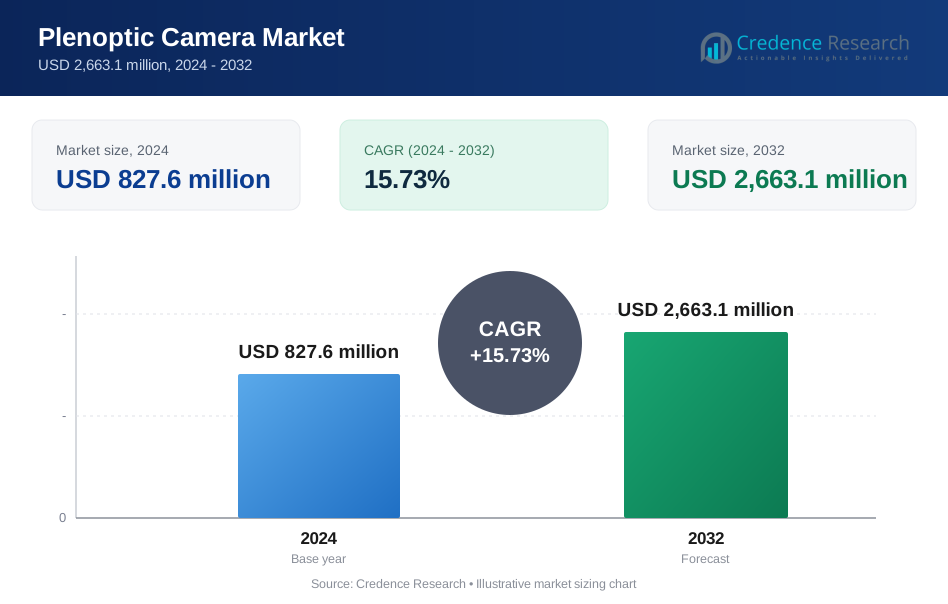
The global plenoptic camera market was valued at USD 827.6 million in 2024 and is projected to reach USD 2,663.1 million by 2032, expanding at a CAGR of 15.73% throughout the forecast period (2025-2032).
| REPORT ATTRIBUTE | DETAILS |
|---|---|
| Historical Period | 2020-2023 |
| Base Year | 2024 |
| Forecast Period | 2025-2032 |
| Plenoptic Camera Market Size 2024 | USD 827.6 million |
| Plenoptic Camera Market, CAGR | 15.73% |
| Plenoptic Camera Market Size 2032 | USD 2,663.1 million |
The plenoptic camera market features strong participation from technology innovators such as Light Field Lab, Leia, Raytrix, OTOY, Lytro, Lumii, Japan Display Inc. (JDI), FoVI 3D, Avegant, and Holografika, each focusing on advancements in computational imaging, immersive visualization, and light-field display solutions. These companies compete through sensor innovation, AI-supported depth processing, and volumetric content production capabilities to address opportunities across media, simulation, healthcare imaging, and autonomous systems. North America leads the global plenoptic camera market with an approximate 34% share, driven by the presence of pioneering imaging technology firms and significant investments in AR/VR, defense, and digital content creation.
Market Insights:
- The global plenoptic camera market was valued at USD 827.6 million in 2024 and is projected to reach USD 2,663.1 million by 2032, registering a CAGR of 15.73% during the forecast period.
- Increasing demand for immersive content creation, volumetric video, and AR/VR experiences drives market growth, particularly within media and simulation platforms that require dynamic refocusing and depth-rich imagery.
- Key trends include AI-driven computational imaging, integration of light-field capture in autonomous navigation, and expanding applications across medical imaging and precision industrial inspection.
- The competitive landscape features firms such as Light Field Lab, Leia, Raytrix, and OTOY, focusing on resolution enhancement, software ecosystems, and volumetric display innovations, intensifying technology-led differentiation.
- North America holds approximately 34% market share, followed by Europe at 28% and Asia Pacific at 27%, while the Media segment remains the largest application segment, supported by adoption in filmmaking, virtual production, and digital content engineering.
Market Segmentation Analysis:
By Application:
The Media segment holds the dominant share in the plenoptic camera market, driven by growing demand for computational imaging, immersive cinematography, and light-field visual effects that allow refocusing after capture and multi-angle content generation. Production studios increasingly adopt plenoptic technology to reduce post-production time and create volumetric video for AR/VR platforms. In healthcare, adoption is accelerating for minimally invasive procedures and depth-guided imaging, while defense agencies leverage light-field cameras for enhanced target recognition. Building and industrial applications benefit from 3D structural mapping, predictive maintenance, and machine vision integration, supported by the expanding digital-twin ecosystem.
- For instance, Leia Inc.’s Lightfield Display panels for industrial visualization, such as the 12.3-inch automotive display developed with Continental, incorporate nanotechnology-based diffraction gratings, enabling real-time 3D visualization for applications like navigation and driver safety interfaces in vehicle cockpits.
By Types:
The Standard Plenoptic Camera segment currently leads the market share due to its broad use in cinematography, scientific imaging, and photography, offering cost-effective depth capture and computational refocus capabilities. These systems remain the preferred choice for commercial deployments, training environments, and visual content studios. However, Focused Plenoptic Cameras are gaining momentum, particularly in precision measurements, robotics, and medical imaging, because they provide higher spatial resolution and superior depth accuracy. Their role is expanding as autonomous navigation, surgical robotics, and industrial inspection platforms increasingly require real-time light-field data processing.
- For instance, Raytrix’s R12 standard plenoptic camera employs a 12-megapixel sensor combined with a micro-lens array consisting of more than 40,000 lenslets, enabling depth reconstruction starting from as close as 5 millimeters for laboratory and scientific object imaging.
Key Growth Drivers:
Growing Demand for Immersive Imaging and Content Digitization
The rapid shift toward immersive content formats, including augmented reality (AR), virtual reality (VR), and mixed reality (MR), is a major driver of plenoptic camera adoption. The ability to capture volumetric depth, refocus images post-capture, and generate multi-perspective visual assets makes plenoptic cameras integral to next-generation content pipelines. Production houses, gaming environments, simulation platforms, and live broadcast technology providers increasingly leverage these systems to streamline CGI integration and eliminate costly multi-camera setups. Furthermore, rising consumer appetite for 3D interactive media, digital exhibitions, photogrammetry-driven virtual tours, and experiential marketing continues to expand demand. As industries prioritize digital-first engagement strategies, plenoptic imaging is evolving from experimental innovation to a commercial necessity, accelerating deployment in entertainment, advertising, and educational ecosystems.
- For instance,OTOY’s OctaneRender engine leverages GPU acceleration and supports multiple rendering algorithms (known as kernels, including Path Tracing and Direct Lighting). It enables real-time light-field and volumetric rendering for cinematic VR and holographic media, often utilizing large-scale network or cloud rendering configurations (including configurations with dozens of GPUs, such as 64-GPU clusters) without needing traditional multi-array camera rigs.
Advancements in Computational Photography and AI-Based Processing
Continuous improvements in computational algorithms, GPU acceleration, neural rendering, and machine-learning-based image reconstruction significantly enhance plenoptic camera capabilities. Modern systems integrate AI-driven super-resolution, automatic depth correction, and noise elimination, enabling sharper outputs with reduced manual adjustments. These advancements open opportunities across scientific research, medical diagnostics, industrial automation, and real-time surveillance. Edge AI further supports plenoptic cameras in robotics and autonomous vehicles, enabling faster decision-making from multidimensional visual data. As chipsets evolve to support higher frames-per-second light-field processing and low-power embedded computing, more compact and commercially viable plenoptic modules enter the market. The convergence of plenoptic imaging and AI is redefining performance benchmarks and reshaping competitive dynamics through scalable, software-driven differentiation.
- For instance, NVIDIA’s Instant NeRF technology demonstrated the ability to generate a fully rendered neural radiance field representation of a 3D scene in under 5 seconds using its RTX GPU platform powered by third-generation Tensor Cores, drastically reducing photogrammetry and light-field data reconstruction timelines previously measured in hours.
Expanding Application in Precision-Based Industrial and Healthcare Systems
The adoption of plenoptic cameras is increasing across industrial inspection, robotics, and healthcare due to their ability to generate 3D depth and surface measurements without mechanical scanning. In minimally invasive surgery, light-field imaging enables better navigation and anatomical mapping, enhancing outcomes and reducing procedural risk. Similarly, factory automation platforms utilize plenoptic cameras for defect detection, assembly verification, and predictive maintenance operations. The technology supports automated handling in logistics and strengthens machine vision in warehouse robotics. As the shift toward smart manufacturing and medical imaging modernization intensifies, plenoptic cameras address the market need for real-time, high-accuracy, data-rich visualization—positioning them as a key enabler in Industry 4.0 and next-generation clinical diagnostics.
Key Trends & Opportunities:
Emergence of Volumetric Video and Metaverse-Ready Imaging
One of the most prominent trends is the adoption of plenoptic devices for volumetric recording, enabling immersive content compatible with metaverse, simulation training, and collaborative digital environments. Light-field capture allows creators to generate 360-degree perspectives, holographic projections, and navigable digital twins without traditional green-screen captures or motion rigs. As the entertainment ecosystem expands toward spatial content, real-time rendering engines and holographic communication platforms present a new growth frontier. The technology aligns with evolving markets for remote interaction, digital avatars, and AI-assisted content production, establishing strong opportunities for camera manufacturers and software stack developers.
- For instance, Light Field Lab’s SolidLight holographic platform demonstrated modular display units capable of producing over 10 billion pixels per square meter with sub-millimeter pitch precision below 2.5 microns, enabling freestanding holographic objects exceeding 28 inches in size without headsets or wearable devices, supporting future metaverse-ready live volumetric communication.
Integration of Plenoptic Imaging in Autonomous Platforms
Rising demand for high-precision imaging in driverless vehicles, agricultural drones, inspection robots, and unmanned defense systems creates new opportunities for focused plenoptic cameras. These devices deliver accurate object recognition in low light, cluttered backgrounds, and fast-motion environments—where conventional cameras struggle. Integration with SLAM (Simultaneous Localization and Mapping), sensor fusion modules, and onboard computing makes plenoptic technology an attractive upgrade pathway for autonomy engineers. As regulatory approval for unmanned operations accelerates and industries replace manual navigation with intelligent systems, plenoptic imaging is positioned to become a standard component within high-level automation stacks.
- For instance, Japan Display Inc. (JDI) introduced its automotive light-field imaging module built around a 12.3-inch display panel featuring 1,920 × 720 resolution supported by proprietary backlight control using 5,000 mini-LEDs, enabling multi-view volumetric visualization required for ADAS perception validation and cockpit simulation without headset-based augmentation.
Key Challenges:
High System Cost and Limited Commercial-Level Manufacturing Scalability
Despite accelerating innovation, plenoptic cameras face challenges related to complex design, advanced optics, computational hardware requirements, and specialized image processing software. High acquisition and integration costs restrict adoption among small and mid-sized production studios and limit penetration in cost-sensitive industrial segments. The lack of large-scale mass manufacturing channels keeps unit pricing elevated compared to conventional or stereo-based imaging systems. Additionally, the need for specialized HDR light-field sensors, bespoke calibration, and heat-optimized chipsets contributes to expensive research and manufacturing cycles. Cost barriers slow market expansion and delay broad consumer-level adoption.
Data Processing Complexity and Integration Barriers Across Legacy Systems
Plenoptic cameras generate large multidimensional datasets that demand robust storage, edge computing, and advanced software optimization. Existing industrial and medical imaging infrastructure often lacks compatibility with light-field formats, creating integration friction and additional system investment. The complexity of processing refocusing algorithms, real-time depth reconstruction, and AI-driven rendering presents a steep learning curve for end users. Without standardized output formats and universal software platforms, adoption may remain limited to organizations with advanced digital maturity. The market must address operational complexity and workflow fragmentation to ensure scalable growth across mainstream applications.
Regional Analysis:
North America
North America holds the largest share of the plenoptic camera market at approximately 34%, driven by rapid adoption across media production, defense intelligence, and research institutions. The region hosts leading technology developers specializing in computational imaging and AI-assisted light-field processing, strengthening commercialization. Growth is supported by film studios adopting volumetric capture and defense agencies investing in next-generation situational awareness systems. Widespread integration within AR/VR simulation platforms across aerospace and medical training further contributes to market expansion. Federal funding for digital imaging innovation and strong enterprise adoption of immersive content technologies reinforce North America’s dominant market position.
Europe
Europe accounts for around 28% of the market, supported by strong academic research infrastructure and extensive penetration in industrial inspection, robotics, and healthcare imaging. Countries such as Germany, France, and the U.K. are at the forefront of computational optics, supported by collaborative R&D initiatives. Demand increases from medical visualization and automotive engineering, particularly autonomous vehicle testing and digital-factory environments. Regulatory support for advanced manufacturing and digital twin adoption strengthens deployment. The region’s expanding medical device ecosystem and high-value engineering sectors underpin sustained demand for high-resolution depth capture provided by plenoptic cameras.
Asia Pacific
Asia Pacific represents approximately 27% of the global market and is the fastest-growing region due to expanding adoption in electronics manufacturing, robotics automation, surveillance, and emerging content studios. China, Japan, and South Korea lead in advanced imaging sensors and semiconductor integration, enabling cost-efficient plenoptic components. The region benefits from large-scale investment in industrial automation and smart factory initiatives. Additionally, the accelerating gaming and cinematic content market creates opportunities for volumetric and AR-supported production. Expansion in healthcare imaging modernization and adoption in minimally invasive procedures support further penetration across high-growth economies in Southeast Asia.
Latin America
Latin America holds around 6% market share, with growth led by increasing adoption of digital imaging tools in media production, architectural reconstruction, and industrial inspection. Brazil and Mexico drive demand through expanding broadcast and advertising ecosystems and modernization of manufacturing capabilities. Limited technological infrastructure and higher system acquisition costs moderately restrict adoption; however, rising interest in 3D mapping for mining, oil, and construction presents new opportunities. Government-driven digital transformation strategies and uptake of aerial imaging for agriculture monitoring create early-stage but promising growth potential for plenoptic camera deployment.
Middle East & Africa
The Middle East & Africa region accounts for approximately 5% of the global market, supported by growing investments in smart cities, security surveillance, and infrastructure visualization. The UAE and Saudi Arabia lead adoption, leveraging plenoptic cameras for digital twin development, defense observation, and intelligent monitoring. Expansion in megaproject construction drives increased demand for 3D structural mapping and immersive walkthrough imaging. However, limited local manufacturing and technical integration capabilities challenge wider penetration. Rising innovation hubs, government-backed technology clusters, and adoption of AR/VR simulation in training environments are expected to create steady long-term opportunities.
Market Segmentations:
By Application
- Health Care
- Defense
- Media
- Building
- Industry
- Other
By Types
- Standard Plenoptic Camera
- Focused Plenoptic Camera
By Geography
- North America
- U.S.
- Canada
- Mexico
- Europe
- Germany
- France
- U.K.
- Italy
- Spain
- Rest of Europe
- Asia Pacific
- China
- Japan
- India
- South Korea
- South-east Asia
- Rest of Asia Pacific
- Latin America
- Brazil
- Argentina
- Rest of Latin America
- Middle East & Africa
- GCC Countries
- South Africa
- Rest of the Middle East and Africa
Competitive Landscape:
The competitive landscape of the plenoptic camera market is defined by a mix of specialized imaging technology developers, computational optics innovators, and software-focused light-field solution providers. Companies compete through advancements in sensor resolution, depth-mapping accuracy, AI-driven image reconstruction, and compact hardware architecture designed for industrial and medical applications. Strategic partnerships with film production studios, robotics manufacturers, and semiconductor companies are increasingly common as firms seek to expand application versatility and accelerate commercialization. Investments in volumetric capture platforms, cloud-based processing, and AR/VR content pipelines differentiate offerings and strengthen brand positioning. However, the market remains price-sensitive, prompting players to focus on modular designs and software-led value creation to enhance affordability. Continuous improvement in GPU performance and neural rendering models has intensified competition, favoring organizations with integrated hardware–software ecosystems. Additionally, emerging startups targeting niche use cases—such as surgical visualization, real-time inspection, and autonomous navigation—contribute to a dynamic and innovation-centric market environment.
Key Player Analysis:
- Light Field Lab
- Leia
- Raytrix
- OTOY
- Lytro
- Lumii
- Japan Display Inc (JDI)
- FoVI 3D
- Avegant
- Holografika
Recent Developments:
- In Oct 2025, Raytrix A new research dataset and benchmark called LiFMCR was released, based on two high-resolution Raytrix R32 plenoptic cameras, along with associated high-precision 6-DoF pose ground truths (via motion-capture). This enables rigorous evaluation of multi-camera light-field registration.
- In Jan 2025, Avegant announced a new technology called ZeroMount™ for binocular alignment of waveguide and light-engine in AR glasses.
- In 2025, Leia Inc., a significant player in the light-field and 3D display technology market, is a leading provider of glasses-free 3D display hardware and software solutions that leverage proprietary nanotechnology and AI. The company develops cost-optimized, switchable light-field displays designed for integration into a variety of OEM consumer devices, including mobile phones and automotive dashboards via strategic partnerships with major industry players like Continental AG. The company has consolidated its platform under the brand name Immersity AI, and its former flagship consumer product, the Lume Pad 2tablet, was officially discontinued in August 2025 to focus on software and OEM integrations.
Report Coverage:
The research report offers an in-depth analysis based on Application, Types and Geography. It details leading market players, providing an overview of their business, product offerings, investments, revenue streams, and key applications. Additionally, the report includes insights into the competitive environment, SWOT analysis, current market trends, as well as the primary drivers and constraints. Furthermore, it discusses various factors that have driven market expansion in recent years. The report also explores market dynamics, regulatory scenarios, and technological advancements that are shaping the industry. It assesses the impact of external factors and global economic changes on market growth. Lastly, it provides strategic recommendations for new entrants and established companies to navigate the complexities of the market.
Future Outlook:
- Plenoptic cameras will gain broader adoption in media production to enable real-time volumetric capture and immersive visual storytelling.
- Integration with AR, VR, and MR platforms will accelerate, supporting next-generation simulation and training ecosystems.
- AI and neural rendering advancements will significantly improve image clarity, resolution, and depth analytics.
- Medical imaging will increasingly utilize plenoptic systems for enhanced minimally invasive procedures and anatomical mapping.
- Autonomous robots and vehicles will incorporate plenoptic cameras for reliable 3D perception and navigation.
- Compact and modular plenoptic designs will make integration easier for consumer electronics and smart devices.
- Software-driven capabilities will become a critical competitive differentiator across vendors and applications.
- Cloud and edge processing will enable real-time depth computation and spatial content streaming.
- Adoption in architecture and construction will grow for digital twins and project visualization.
- Cost optimization and scalability improvements will expand commercial and industrial deployment opportunities.
Request a Free Sample
Fill in your details and we'll send you a free sample report.
- Sample data tables & charts
- Research methodology
Need a Custom Version of This Report?
Tailor the scope, geography, or segments to your exact requirements.
- Custom geography or segment scope
- Direct access to our analyst team
Frequently Asked Questions
What is the current market size for the Plenoptic Camera market, and what is its projected size in 2032?
what Compound Annual Growth Rate is the Plenoptic Camera market projected to grow between 2024 and 2032?
Which Plenoptic Camera application segment held the largest market share in 2024?
What are the primary factors fueling the growth of the Plenoptic Camera market?
Who are the leading companies in the Plenoptic Camera market?
Table of Content
Chapter 1. Report Introduction
- 1.1 Report Description & Purpose
- 1.1.1 Report Title & Market Definition
- 1.1.2 Unique Selling Propositions (USP) & Key Differentiators
- 1.1.3 Value Proposition for Stakeholders
- 1.2 Research Objectives
- 1.2.1 Market Sizing Objectives (Volume & Revenue)
- 1.2.2 Segmentation Objectives
- 1.2.3 Competitive Intelligence Objectives
- 1.2.4 Forecast & Scenario Objectives
- 1.3 Report Scope
- 1.3.1 Plenoptic Camera Scope – Types & Subtypes Covered
- 1.3.2 Geographic Scope – Regions & Countries Covered
- 1.3.3 Historical Period, Base Year & Forecast Period (2024; forecast to 2032)
- 1.3.4 Inclusions & Exclusions
- 1.4 HS Code & Classification Framework
- 1.5 Currency, Units & Pricing Basis
- 1.6 Target Stakeholders
- 1.7 Limitations & Assumptions
Chapter 2. Executive Summary
- 2.1 Global Plenoptic Camera Market Snapshot
- 2.1.1 Market Size – Historical (2024) & Forecast (2024-2032) (2024: USD 827.6 million → 2032: USD 2,663.1 million)
- 2.1.2 Volume & Revenue – Global Totals
- 2.1.3 Key Market Highlights – Top Five Facts
- 2.2 Plenoptic Camera Market Segmentation Snapshot
- 2.2.1 Market Split by Region – 2024 vs. 2032
- 2.3 Competitive Snapshot
- 2.3.1 Top 10 Players by Revenue Share – 2024
- 2.3.2 Top 10 Players by Volume Share – 2024
- 2.3.3 Recent Strategic Developments (18-Month Summary)
- 2.4 Key Investment Highlights & Strategic Conclusions
Chapter 3. Plenoptic Camera Market Dynamics & Industry Analysis
- 3.1 Market Overview & Context
- 3.1.1 Plenoptic Camera Market Position in the Broader Automotive Value Chain
- 3.1.2 OEM vs. Replacement Market Dynamics
- 3.1.3 Market Maturity & Development Stage by Region
- 3.2 Plenoptic Camera Market Drivers
- 3.3 Plenoptic Camera Market Restraints & Challenges
- 3.4 Plenoptic Camera Market Opportunities
- 3.5 Porter's Five Forces Analysis
- 3.5.1 Threat of New Entrants
- 3.5.2 Bargaining Power of Suppliers
- 3.5.3 Bargaining Power of Buyers
- 3.5.4 Threat of Substitutes
- 3.5.5 Competitive Rivalry – Intensity Assessment
- 3.6 Plenoptic Camera Value Chain Analysis
- 3.6.1 Upstream – Raw Material/Input Suppliers
- 3.6.1.1 Raw Material/Input 1
- 3.6.1.2 Raw Material/Input 2
- 3.6.1.3 Raw Material/Input 3
- 3.6.2 Midstream – Production/Manufacturing/Service Delivery
- 3.6.2.1 Production/Process Overview
- 3.6.2.2 Key Facility Locations & Capacity by Manufacturer
- 3.6.3 Downstream – Distribution & End Consumer
- 3.6.3.1 Primary Channel – B2B/OEM
- 3.6.3.2 Secondary Channels – Dealer, Retail, Online, Direct
- 3.6.4 Value Chain Profitability Analysis
- 3.6.1 Upstream – Raw Material/Input Suppliers
- 3.7 PESTEL Analysis
- 3.7.1 Political Factors
- 3.7.2 Economic Factors
- 3.7.3 Social Factors
- 3.7.4 Technological Factors
- 3.7.5 Environmental Factors
- 3.7.6 Legal Factors
- 3.8 Plenoptic Camera Supply Chain Analysis
- 3.8.1 Raw Material/Input Supply Risk Assessment
- 3.8.2 Manufacturing Concentration Risk (Geographic Exposure)
- 3.8.3 Trade Disruption Impact Analysis
- 3.9 Regulatory & Policy Landscape
Note: The regulatory and policy landscape section covers regulations based on their applicability to the market, Plenoptic Camera category, geography, and scope of the study. Only regulatory frameworks with a material impact on operations, compliance, trade, sustainability, or market access are analyzed in detail.
Chapter 4. Key Investment Pockets & Opportunity Analysis
- 4.1 Plenoptic Camera Market Attractiveness Analysis
- 4.1.1 By Region – Investment Attractiveness Matrix (Volume × CAGR)
- 4.2 Absolute Revenue Growth Opportunity
- 4.2.1 By Region – Absolute USD Growth Through 2032
- 4.3 Incremental Volume Opportunity
- 4.3.1 By Region – Incremental Volume Through 2032
- 4.3.2 Segment – Incremental Volume
- 4.4 Emerging Submarket Opportunity Deep Dive (Subject to Applicability)
- 4.5 Emerging Market Opportunity Scorecards
- 4.5.1 United States
- 4.5.2 Europe
- 4.5.3 Asia
- 4.5.4 Middle East & Africa
Note: Emerging Market Opportunity Scorecards will be included based on relevance and strategic importance. Regions listed are indicative and may vary depending on data availability and market dynamics.
Chapter 5. Plenoptic Camera Import-Export Analysis & Trade Flows
- 5.1 Global Trade Overview
- 5.1.1 Global Export Value by Country (2024)
- 5.1.2 Global Export Volume by Country (2024)
- 5.1.3 Global Import Value by Country (2024)
- 5.1.4 Global Import Volume by Country (2024)
- 5.1.5 Net Trade Balance by Country (2024)
- 5.2 Export Analysis – Segment
- 5.2.1 Type 1 (HS Code)
- 5.2.2 Type 2 (HS Code)
- 5.2.3 Type 3 (HS Code)
- 5.2.4 Type 4 (HS Code)
- 5.2.5 Type 5 (HS Code)
- 5.3 Import Analysis – Segment
- 5.3.1 Type 1 (HS Code)
- 5.3.2 Type 2 (HS Code)
- 5.3.3 Type 3 (HS Code)
- 5.3.4 Type 4 (HS Code)
- 5.3.5 Type 5 (HS Code)
- 5.4 Average Unit Trade Prices
- 5.4.1 Average Export Price – Segment & Country
- 5.4.2 Average Import Price – Segment & Source Country
- 5.4.3 Price Trends (2024)
- 5.5 Key Trade Route Analysis
- 5.5.1 Trade Route 1
- 5.5.2 Trade Route 2
- 5.5.3 Trade Route 3
- 5.5.4 Trade Route 4
- 5.5.5 Trade Route 5
- 5.6 Trade Policy Impact Assessment
- 5.6.1 US Anti-Dumping & Section 301 Tariffs
- 5.6.2 EU Customs Union Impact
- 5.6.3 Major Free Trade Agreements
- 5.6.4 USMCA Rules of Origin
Note: Trade policy analysis will be included only where relevant to the Plenoptic Camera market.
Chapter 6. Competitive Landscape & Company Benchmarking
- 6.1 Plenoptic Camera Market Concentration & Structure
- 6.1.1 Herfindahl-Hirschman Index (HHI) – vs. 2024
- 6.1.2 Tier 1, Tier 2 & Tier 3 Market Structure
- 6.1.3 Global, Regional & Local Player Dynamics
- 6.2 Plenoptic Camera Market Share Analysis – 2024
- 6.2.1 Global Revenue Share by Company
- 6.2.2 Global Volume Share by Company
- 6.2.3 Regional Revenue Share
- 6.2.4 Market Share Evolution ( vs. 2024)
- 6.2.5 OEM Segment Share by Company
- 6.2.6 Replacement Segment Share by Company
- 6.3 Production/Delivery Capacity & Facility Analysis
- 6.3.1 Global Installed Capacity
- 6.3.2 Capacity Utilization Rates
- 6.3.3 Production/Output Volume
- 6.3.4 Facility Locations & Capacity Map
- 6.3.5 Planned Capacity Additions
- 6.4 Plenoptic Camera Competitive Benchmarking Matrix
- 6.4.1 Revenue, Volume, CAGR & Profitability Comparison
- 6.4.2 Channel Revenue Mix
- 6.4.3 Geographic Revenue Exposure
- 6.4.4 R&D Intensity
- 6.4.5 Sustainability Maturity
- 6.5 Strategic Developments in Plenoptic Camera (Last 24 Months)
- 6.5.1 Mergers, Acquisitions & Divestments
- 6.5.2 New Plenoptic Camera Launches
- 6.5.3 Facility Expansions
- 6.5.4 Strategic Alliances, Joint Ventures & Partnerships
- 6.5.5 Distribution Expansion & Market Entry
- 6.5.6 Sustainability & ESG Initiatives
- 6.6 Competitive Strategy Mapping
- 6.6.1 Leader, Challenger, Follower & Niche Classification
- 6.6.2 Pricing Strategy Comparison
- 6.6.3 Channel Strategy Matrix
Note: Strategic developments are included based on their materiality and the availability of reliable information.
Chapter 7. Global Plenoptic Camera Market – By Distribution Channel
- 7.1 Segment Overview
- 7.1.1 Volume & Revenue Split by Channel (2024 & 2032)
- 7.1.2 Channel Mix Evolution (2024-2032)
Chapter 8. Regional Market Analysis – Global Overview
- 8.1 Global Regional Overview
- 8.1.1 Regional Volume Share
- 8.1.2 Regional Revenue Share
- 8.1.3 Regional Volume by Region
- 8.1.4 Regional Revenue by Region
- 8.1.5 Regional Forecast Through 2032
- 8.2 Cross-Regional Segment Analysis
- 8.2.1 By Distribution Channel
- 8.2.2 By Brand/Price Tier
Chapter 9. North America Plenoptic Camera Market
- 9.1 United States
- 9.2 Canada
- 9.3 Mexico
Chapter 10. Europe Plenoptic Camera Market
- 10.1 Germany
- 10.2 France
- 10.3 Italy
- 10.4 United Kingdom
- 10.5 Spain
- 10.6 Poland
- 10.7 Russia
- 10.8 Netherlands
- 10.9 Belgium
- 10.10 Sweden
- 10.11 Denmark
- 10.12 Norway
- 10.13 Rest of Europe
Chapter 11. Asia Pacific Plenoptic Camera Market
- 11.1 China
- 11.2 India
- 11.3 Japan
- 11.4 South Korea
- 11.5 Thailand
- 11.6 Indonesia
- 11.7 Vietnam
- 11.8 Malaysia
- 11.9 Australia
- 11.10 Rest of Asia Pacific
Chapter 12. Latin America Plenoptic Camera Market
- 12.1 Brazil
- 12.2 Argentina
- 12.3 Colombia
- 12.4 Chile
- 12.5 Rest of Latin America
Chapter 13. Middle East Plenoptic Camera Market
- 13.1 Saudi Arabia
- 13.2 United Arab Emirates
- 13.3 Turkey
- 13.4 Israel
- 13.5 Iran
- 13.6 Rest of the Middle East
Chapter 14. Africa Plenoptic Camera Market
- 14.1 South Africa
- 14.2 Egypt
- 14.3 Nigeria
- 14.4 Morocco
- 14.5 Rest of Africa
Chapter 15. Plenoptic Camera Company Profiles
- 15.1 [Company 01]
- 15.1.1 Company Overview
- 15.1.2 Key Management Personnel
- 15.1.3 Products & Services Portfolio
- 15.1.4 Financial Performance
- 15.1.5 Key Market Focus & Geographic Presence
- 15.1.6 Recent Developments & Strategic Initiatives
Note: The company profile list is preliminary and may change based on research findings, market developments, data availability, and client requirements.
Chapter 16. Appendices
- Appendix A – List of Abbreviations & Acronyms
- Appendix B – Industry Classification Code Reference – Full Series
- Appendix C – Production & Capacity Data Tables
- Appendix D – End-Use & Demand Base Tables
- Appendix E – Consumption & Replacement Rate Assumptions
- Appendix F – ASP Reference Tables
- Appendix G – Manufacturing & Facility Database
- Appendix H – Import-Export Data Tables
- Appendix I – Regulatory Summary Tables
- Appendix J – Primary Research Participant List (Anonymized)
- Appendix K – Primary Research Questionnaire Framework
- Appendix L – Data Sources & Bibliography
- Appendix M – Market Size Divergence & Source Comparison
Chapter 17. Research Methodology
- 17.1 Research Framework & Philosophy
- 17.2 Secondary Research – Sources, Hierarchy & Data Extraction
- 17.3 Data Modeling – Bottom-Up & Top-Down Market Sizing
- 17.4 Primary Research – Stakeholder Framework, LOI & Sample Sizes
- 17.5 Forecast Methodology – Regression, Scenario & Sensitivity Analysis
- 17.6 Quality Control – Four-Layer Validation Framework
- 17.7 Limitations & Standard Assumptions
- 17.8 Disclaimer
