
| REPORT ATTRIBUTE | DETAILS |
|---|---|
| Historical Period | 2020-2023 |
| Base Year | 2024 |
| Forecast Period | 2025-2032 |
| SiC Laser Annealing Equipment Market Size 2024 | USD 150 Million |
| SiC Laser Annealing Equipment Market, CAGR | 8.1% |
| SiC Laser Annealing Equipment Market Size 2032 | USD 279.7 Million |
Market Overview:
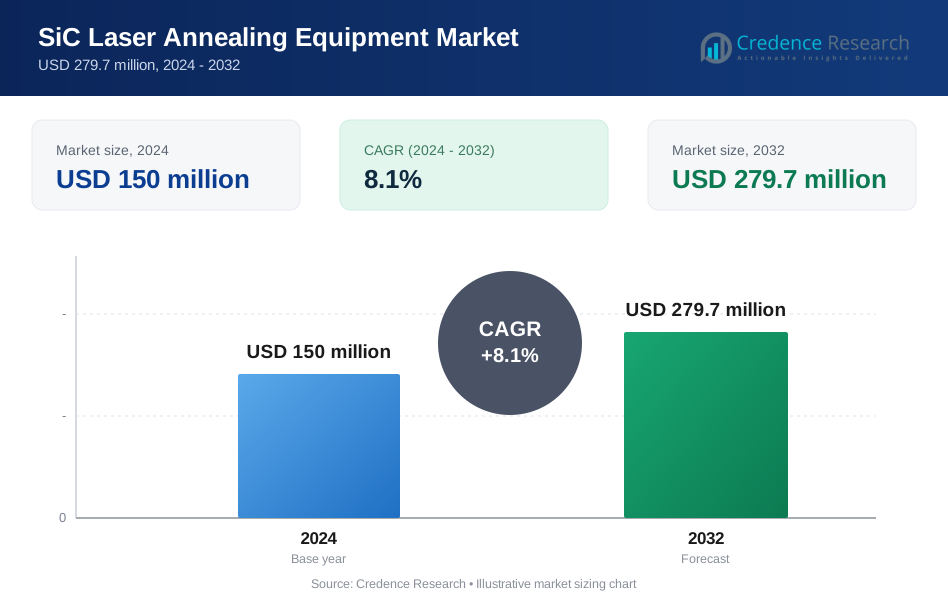
The SiC Laser Annealing Equipment Market is projected to grow from USD 150 million in 2024 to an estimated USD 279.7 million by 2032, with a compound annual growth rate (CAGR) of 8.1% from 2024 to 2032.
Several key factors are propelling the growth of the SiC laser annealing equipment market. The rapid expansion of industries such as electronics, automotive, and energy is driving the demand for efficient and high-performance materials. In particular, the growing adoption of electric vehicles (EVs) and the expansion of renewable energy sources require efficient and high-performance materials. Silicon carbide, with its excellent thermal conductivity, power efficiency, and chemical stability, is a key material in these applications. The growing demand for SiC-based power devices in electric vehicles is expected to propel the demand for SiC laser annealing equipment, as laser annealing is an efficient process for enhancing the material properties of SiC crystals. Furthermore, government initiatives aimed at promoting green technologies, such as tax incentives for electric vehicles and renewable energy projects, are further accelerating the demand for high-performance SiC materials.
Geographically, the SiC laser annealing equipment market is witnessing varied growth patterns. In 2023, North America held a significant market share of 35%, driven by substantial investments in semiconductor manufacturing and research and development activities. The presence of leading semiconductor companies and a robust technological infrastructure contribute to this dominance. Asia Pacific closely follows with a 32% share, attributed to rapid industrialization and the presence of a large number of semiconductor manufacturing companies in the region. Countries like China, South Korea, Taiwan, and Japan lead in chip production, supported by advanced foundries and strong supply chain networks. These regions benefit from favorable government policies, skilled labor, and significant foreign investments in fabrication facilities. Europe accounts for 22% of the market share, with countries such as Germany and France investing in semiconductor technologies. Latin America and the Middle East & Africa contribute smaller shares but are anticipated to experience growth due to increasing industrial activities and adoption of advanced manufacturing technologies
Market Insights:
- The SiC Laser Annealing Equipment Market is projected to grow from USD 150 million in 2024 to USD 279.7 million by 2032, reflecting a CAGR of 8.1% driven by rising demand for high-performance semiconductor devices.
- Expansion in industries such as electronics, automotive, and energy, particularly electric vehicles and renewable energy, fuels demand for efficient SiC materials and laser annealing equipment.
- Silicon carbide’s superior thermal conductivity, power efficiency, and chemical stability make it essential for power electronics, increasing reliance on laser annealing to enhance SiC wafer properties.
- North America holds a 35% market share due to strong semiconductor manufacturing investments and R&D, while Asia Pacific commands 32%, driven by rapid industrialization and chip production hubs like China, South Korea, Taiwan, and Japan.
- Europe accounts for 22% of the market, supported by investments from Germany and France, with Latin America and Middle East & Africa poised for growth amid rising industrial activity and technology adoption.
- Technological advances in laser systems improve annealing precision, speed, and repeatability, incorporating automation and real-time monitoring to boost yield and reduce costs.
- Market challenges include high capital investment, complex integration into existing lines, and technical difficulties in controlling laser parameters and material handling, which require ongoing innovation to overcome.
Market Drivers:
Rising Demand for High-Performance Semiconductor Devices Fuels Market Growth
The increasing demand for high-performance semiconductor devices significantly drives the growth of the SiC Laser Annealing Equipment Market. Silicon carbide (SiC) offers superior thermal conductivity, high breakdown voltage, and chemical stability, making it ideal for power electronics and high-frequency applications. Manufacturers rely on laser annealing equipment to enhance the material properties of SiC wafers, ensuring better device reliability and efficiency. Growing adoption of SiC components in electric vehicles, power grids, and industrial automation pushes equipment demand. The shift towards energy-efficient and compact devices creates a steady need for advanced annealing technologies. With semiconductor companies investing heavily in next-generation devices, the requirement for precise and efficient annealing solutions rises continuously.
Expansion of Electric Vehicle Industry Drives Adoption of SiC Technology
The rapid growth of the electric vehicle (EV) industry acts as a major catalyst for the demand for SiC laser annealing equipment. SiC-based power devices outperform traditional silicon-based components in EV powertrains due to their higher efficiency and reduced energy loss. It enables faster charging, longer driving range, and improved thermal management in electric vehicles. The EV industry's push for better performance and reliability compels manufacturers to adopt laser annealing processes that optimize SiC wafer characteristics. Government policies promoting cleaner transportation technologies also support the expansion of the EV sector. Consequently, the surge in EV production directly elevates the need for sophisticated annealing equipment to meet quality and volume requirements.
For example, Tesla’s Model 3 platform, which utilizes SiC MOSFETs in its inverter, has demonstrated up to a 5% increase in driving range and a 10% reduction in energy losses, according to Tesla’s 2023 Impact Report.Increasing Investments in Renewable Energy Infrastructure Stimulate Market Demand
Renewable energy systems such as solar inverters and wind turbines depend heavily on robust power electronics, where SiC technology plays a crucial role. The growing global focus on renewable energy adoption encourages development of SiC devices with enhanced performance and durability. Laser annealing improves the electrical and mechanical properties of SiC wafers, making it indispensable in manufacturing power modules for renewable applications. Energy companies and governments worldwide invest heavily in green energy projects, which indirectly propels the market for SiC laser annealing equipment. The shift toward cleaner energy sources require efficient power conversion, amplifying the demand for high-quality SiC components and related manufacturing equipment.
For instance, Mitsubishi Electric reported in 2024 that integrating SiC modules in its wind turbine converters led to a 20% reduction in system losses and extended operational lifespans by up to 40%.Advancements in Laser Technology Enhance Process Efficiency and Precision
Technological progress in laser annealing equipment boosts market growth by improving process speed, accuracy, and repeatability. Modern laser systems allow precise control over annealing parameters, minimizing wafer damage and enhancing yield. These advancements enable manufacturers to produce SiC devices with superior electrical properties and reduced defects. Integration of automation and real-time monitoring features further optimizes production lines and lowers operational costs. Continuous innovation in laser sources and beam delivery systems expands the application range for annealing processes. The capability to meet evolving semiconductor industry standards reinforces the position of SiC laser annealing equipment as a vital manufacturing tool.
Market Trends:
Growing Integration of Automation and Real-Time Monitoring in Laser Annealing Processes
The SiC Laser Annealing Equipment Market is witnessing increased integration of automation and real-time monitoring technologies to enhance manufacturing efficiency. Automated systems reduce human error and improve consistency across production batches. Real-time sensors and feedback loops enable precise control of laser parameters, ensuring optimal annealing conditions and reducing material waste. Manufacturers focus on incorporating intelligent software to analyze process data for predictive maintenance and quality control. This trend supports higher throughput and lowers operational costs in semiconductor fabrication facilities. It reflects the industry's demand for scalable and reliable annealing solutions that can meet stringent device performance standards.
For instance, Applied Materials has implemented advanced automation and real-time monitoring in its laser annealing systems. Their Centura® APX™ platform features integrated sensors and AI-driven process control to optimize annealing conditions and wafer quality.Adoption of Advanced Laser Sources to Improve Annealing Precision and Speed
Market players continuously adopt advanced laser sources such as ultrafast pulsed lasers and fiber lasers to enhance the precision and speed of the annealing process. These laser technologies offer superior control over energy delivery, minimizing thermal damage to SiC wafers. It enables manufacturers to produce devices with improved electrical and mechanical properties while maintaining high throughput. The use of innovative laser sources also supports miniaturization and integration of complex semiconductor components. The trend toward adopting cutting-edge laser technologies aligns with the broader semiconductor industry's push for next-generation devices. It ensures that annealing equipment keeps pace with evolving performance and quality requirements.
For instance, Coherent Corp.(formerly II-VI Incorporated) offers the HyperRapid NXT ultrafast laser, which is widely used for semiconductor wafer processing, including SiC. Coherent’s product documentation states.Expansion of SiC Applications Beyond Automotive Drives Market Diversification
While electric vehicles remain a dominant driver, the SiC Laser Annealing Equipment Market is expanding into diverse application areas such as renewable energy, industrial power electronics, and consumer electronics. This diversification broadens market opportunities for equipment manufacturers and suppliers. SiC devices find increased use in solar inverters, power supplies, and communication infrastructure due to their efficiency and durability. The expansion encourages development of specialized annealing processes tailored to various SiC device types. It also stimulates innovation in equipment design to accommodate different wafer sizes and production scales. This trend highlights the growing recognition of SiC technology's value across multiple industries beyond automotive.
Focus on Sustainability and Energy Efficiency in Semiconductor Manufacturing Processes
Sustainability concerns and energy efficiency increasingly influence the development and adoption of SiC laser annealing equipment. The equipment enables lower energy consumption and reduced processing times compared to traditional thermal annealing methods. Manufacturers prioritize technologies that minimize environmental impact while maintaining product quality and throughput. The trend also drives investment in equipment with enhanced energy-saving features and recyclable components. Semiconductor companies align with global sustainability goals, prompting supply chain partners to adopt greener manufacturing practices. This focus reinforces the strategic importance of laser annealing in producing environmentally responsible and high-performance SiC devices.
Market Challenges Analysis:
High Capital Investment and Complex Integration Pose Significant Barriers to Market Growth
The SiC Laser Annealing Equipment Market faces challenges due to the high capital investment required for advanced laser systems. The cost of procuring, installing, and maintaining sophisticated equipment limits adoption, especially among smaller manufacturers and emerging markets. Integrating laser annealing technology into existing semiconductor production lines demands technical expertise and customization, which can extend implementation timelines and increase operational complexity. The need for skilled operators and ongoing training further adds to expenses and resource allocation. These factors create entry barriers that slow market penetration and limit widespread use. Manufacturers must balance equipment performance with cost-effectiveness to attract a broader customer base.
For instacne, Wolfspeed, Inc., a leading SiC device manufacturer, highlighted in its 2023 investor presentation that capital expenditures for expanding SiC wafer fabrication facilities-including advanced laser annealing equipment-exceeded $500 million over two years.Technical Limitations and Material Handling Issues Affect Process Efficiency and Yield
Technical challenges related to laser annealing of SiC wafers also impact the market's expansion. Precise control over laser parameters remains critical to avoid wafer damage or incomplete annealing, which can reduce device yield and reliability. SiC’s hardness and thermal properties complicate uniform energy absorption during annealing, demanding advanced equipment capabilities. Material handling during the annealing process requires careful management to prevent contamination and mechanical stress. The market must address these technical limitations through continuous innovation in laser technology and process optimization. Overcoming these hurdles is essential to improve manufacturing efficiency and meet the growing demand for high-quality SiC devices.
Market Opportunities:
The SiC Laser Annealing Equipment Market holds substantial opportunities in emerging economies where semiconductor manufacturing is rapidly expanding. Countries in Asia-Pacific, Latin America, and Eastern Europe are investing in advanced fabrication facilities, creating new demand for high-precision annealing equipment. It enables manufacturers to capitalize on regional growth and diversify their customer base. Collaborations with local semiconductor firms and government-backed initiatives supporting technology upgrades further enhance market potential. Expanding into these markets allows equipment providers to establish early presence and build long-term partnerships.
There is increasing demand for tailored laser annealing equipment designed for specific SiC device applications such as power electronics, automotive, and renewable energy sectors. The market can leverage this trend by developing modular, flexible systems that accommodate various wafer sizes and process requirements. It allows manufacturers to address niche needs and improve customer satisfaction. Innovations focused on enhancing throughput, energy efficiency, and precision offer additional competitive advantages. Meeting specialized demands positions the market for sustained growth amid evolving industry standards.
Market Segmentation Analysis:
The SiC Laser Annealing Equipment Market segments
By equipment type include Continuous Wave (CW) lasers, Pulsed lasers, Diode lasers, and Solid-State lasers. Each type offers distinct advantages depending on the precision and energy delivery required for annealing processes. Pulsed lasers dominate due to their ability to provide controlled energy bursts ideal for SiC wafer treatment, while Continuous Wave lasers suit applications needing steady energy output.
By technology, the market breaks down into Infrared, Ultraviolet, Excimer, and Fiber laser annealing. Fiber lasers gain traction for their high efficiency and precision, enabling enhanced process control and reduced thermal damage. Infrared and Ultraviolet laser annealing also maintain strong demand due to their specific wavelength benefits tailored to different material properties.
By Power output segments range from Low Power Lasers (up to 500W) to Ultra-High Power Lasers. Medium and High Power lasers find extensive use in industrial-scale production, balancing throughput and energy efficiency. Ultra-High Power lasers address applications demanding rapid processing of thicker or more complex SiC substrates.
By Application-wise, the market focuses on Wafer annealing, Poly-Si Thin Film annealing, Silicon Carbide (SiC) device annealing, and Glass annealing. SiC device annealing remains the primary application, driven by growth in power electronics and electric vehicles.
By End-use industries include Semiconductor, Photovoltaics, Consumer Electronics, and Aerospace and Defense. The semiconductor sector holds the largest share, fueled by continuous innovation and increasing SiC device adoption across multiple technology fields.
Segmentation:
By Equipment Type
- Continuous Wave (CW) Lasers
- Pulsed Lasers
- Diode Lasers
- Solid-State Lasers
By Technology
- Infrared Laser Annealing
- Ultraviolet Laser Annealing
- Excimer Laser Annealing
- Fiber Laser Annealing
By Power Output
- Low Power Lasers (Up to 500W)
- Medium Power Lasers (501W to 1000W)
- High Power Lasers (Above 1000W)
- Ultra-High Power Lasers
By Application
- Wafer Annealing
- Poly-Si Thin Film Annealing
- Silicon Carbide (SiC) Device Annealing
- Glass Annealing
By End-Use Industry
- Semiconductor Industry
- Photovoltaics
- Consumer Electronics
- Aerospace and Defense
Regional Analysis:
North America Leads the SiC Laser Annealing Equipment Market with Strong Technological Infrastructure
North America holds a commanding share of approximately 35% in the SiC Laser Annealing Equipment Market, driven by its advanced semiconductor manufacturing capabilities and extensive R&D investments. The presence of leading semiconductor companies and research institutions creates a robust ecosystem for adopting cutting-edge annealing technologies. It benefits from well-established supply chains and access to skilled labor, enabling rapid deployment of new equipment. Government support for innovation and sustainable technologies further stimulates market growth. The region’s focus on electric vehicle development and renewable energy applications fuels demand for high-performance SiC devices. North America’s strong regulatory framework and emphasis on quality ensure steady demand for precise laser annealing solutions.
Asia Pacific Gains Significant Market Share Through Rapid Industrialization and Semiconductor Expansion Asia Pacific commands close to 32% of the market share due to rapid industrial growth and the concentration of semiconductor manufacturing hubs in countries like China, Japan, South Korea, and Taiwan. It leads global chip production, supported by investments in advanced fabrication plants and technology upgrades. The region benefits from cost-efficient manufacturing, a skilled workforce, and favorable government policies encouraging semiconductor innovation. Demand for SiC devices in automotive electronics, consumer electronics, and renewable energy sectors stimulates the need for efficient laser annealing equipment. Equipment providers capitalize on this growing market by establishing local partnerships and customizing solutions for regional manufacturers. Asia Pacific continues to attract significant foreign investment, strengthening its position as a key market player.
Europe and Other Regions Show Steady Growth with Focus on Specialized Applications
Europe holds around 22% of the SiC Laser Annealing Equipment Market, supported by strong industrial bases in Germany, France, and the Netherlands. It emphasizes high-quality manufacturing and precision engineering in semiconductor fabrication. It encourages innovation through collaborations between industry and academia, fostering advancements in laser annealing technology. The region targets applications in automotive electronics, power management, and renewable energy sectors. Latin America, the Middle East, and Africa collectively account for the remaining market share but show promising growth potential due to increasing industrialization and technology adoption. Emerging markets in these regions focus on modernizing semiconductor production capabilities, offering new opportunities for equipment suppliers. Steady infrastructure development and government incentives contribute to gradual market expansion.
Key Player Analysis:
- 3D-Micromac AG
- Applied Materials, Inc.
- Dezhu Xinyuan Technology Co., Ltd.
- EO Technics
- Hitachi Information & Telecommunication Engineering
- SCREEN Semiconductor Solutions
- Sumitomo Heavy Industries, Ltd.
- Veeco
- Wolfspeed, Inc.
- Yoshinaga Shoji
Competitive Analysis:
The SiC Laser Annealing Equipment Market features a competitive landscape dominated by established players specializing in advanced laser technologies and semiconductor manufacturing solutions. Leading companies focus on innovation, developing equipment that offers higher precision, improved energy efficiency, and greater automation capabilities. It drives differentiation through investments in R&D and strategic collaborations with semiconductor manufacturers. Market leaders also emphasize expanding global footprints by establishing regional offices and service centers to enhance customer support. Emerging companies challenge incumbents by introducing cost-effective and customizable solutions targeting niche applications. Competitive pricing, technology upgrades, and strong after-sales services remain critical factors influencing buyer decisions. The market’s dynamic nature encourages continuous product development to meet evolving semiconductor industry standards. Companies that combine technological excellence with flexible solutions position themselves for sustained growth in the SiC Laser Annealing Equipment Market.
Recent Developments:
- In January 2025, Sumitomo Heavy Industries, Ltd. (SHI) completed the acquisition of Laser Systems & Solutions of Europe SASU (LASSE), a French company specializing in advanced laser annealing equipment for semiconductor manufacturing. This strategic move, aligned with SHI’s Medium-Term Management Plan 2026, aims to strengthen SHI’s global footprint in the rapidly expanding semiconductor market, particularly in power semiconductor fabrication for applications such as electric vehicles and renewable energy
- In January 2024, Veeco Instruments Inc. announced the launch of its next-generation laser annealing system specifically designed for advanced SiC (silicon carbide) device manufacturing. This new equipment aims to address the increasing demand for high-performance power electronics by offering improved wafer uniformity and higher throughput. Veeco’s innovation is expected to support the rapid adoption of SiC devices in electric vehicles and renewable energy applications.
- In July 2023, 3D-Micromac AG showcased new developments in laser micromachining, including its microPRO XS OCF system, at SEMICON West. The microPRO XS OCF is engineered for ohmic contact formation in SiC power devices, offering high precision and repeatability while avoiding thermal damage to device front sides.
Market Concentration & Characteristics:
The SiC Laser Annealing Equipment Market exhibits a moderately concentrated structure, with a few key players controlling a significant portion of the market share. It features a high entry barrier due to the substantial capital investment required for advanced laser technology development and manufacturing. The market demands continuous innovation, precision, and reliability, favoring established companies with strong R&D capabilities and robust supply chains. Customers prioritize equipment that delivers consistent performance, energy efficiency, and seamless integration into semiconductor production lines. It also reflects growing specialization, with manufacturers offering customized solutions to address diverse application needs in automotive, renewable energy, and industrial sectors. The competitive intensity drives companies to enhance product features and service quality, maintaining their market positions while exploring emerging opportunities globally.
Report Coverage:
The research report offers an in-depth analysis based on Equipment Type, Technology, Power Output, Application and End-Use Industry. It details leading market players, providing an overview of their business, product offerings, investments, revenue streams, and key applications. Additionally, the report includes insights into the competitive environment, SWOT analysis, current market trends, as well as the primary drivers and constraints. Furthermore, it discusses various factors that have driven market expansion in recent years. The report also explores market dynamics, regulatory scenarios, and technological advancements that are shaping the industry. It assesses the impact of external factors and global economic changes on market growth. Lastly, it provides strategic recommendations for new entrants and established companies to navigate the complexities of the market.
Future Outlook:
- The SiC Laser Annealing Equipment Market will experience steady growth driven by expanding electric vehicle adoption worldwide.
- Advances in laser technology will enable faster, more precise annealing processes, improving device quality and yield.
- Rising investments in renewable energy infrastructure will increase demand for SiC-based power electronics and related annealing equipment.
- Emerging markets in Asia-Pacific and Latin America will offer new growth opportunities due to expanding semiconductor manufacturing capabilities.
- Integration of automation and AI-driven process controls will enhance manufacturing efficiency and reduce operational costs.
- Equipment customization for diverse SiC device applications will become a key competitive differentiator.
- Environmental regulations will encourage adoption of energy-efficient annealing technologies to reduce manufacturing carbon footprints.
- Collaboration between equipment manufacturers and semiconductor companies will accelerate innovation and tailored solutions.
- Continuous improvements in wafer handling and contamination control will boost production reliability.
- Growing interest in SiC devices beyond automotive, such as in industrial and consumer electronics, will diversify market demand.
Request a Free Sample
Fill in your details and we'll send you a free sample report.
- Sample data tables & charts
- Research methodology
Market Dynamics
Expansion of Electric Vehicle Industry
The rapid growth of the electric vehicle sector is driving demand for SiC-based power devices, which require advanced laser annealing equipment to optimize wafer properties for higher efficiency and reliability. As automakers increasingly adopt SiC technology for improved performance, the need for precise and scalable annealing solutions rises.
Investments in Renewable Energy Infrastructure
Global investments in solar and wind energy systems are boosting demand for robust SiC power electronics, which benefit from laser annealing processes that enhance device durability and efficiency. This trend is fueling the adoption of SiC laser annealing equipment in the production of power modules for renewable applications.
Technological Advancements in Laser Systems
Continuous innovation in laser technology, such as the development of ultrafast pulsed and fiber lasers, is improving annealing precision, speed, and repeatability. These advancements enable manufacturers to achieve higher yields and better device performance, making laser annealing equipment more attractive for SiC wafer processing.
Government Policies Supporting Green Technologies
Incentives and regulations promoting electric vehicles and renewable energy are accelerating the shift toward SiC-based devices, which require advanced annealing processes. Supportive government policies are encouraging manufacturers to invest in high-performance SiC laser annealing equipment to meet evolving industry standards.
Diversification of SiC Applications
Beyond automotive, SiC devices are increasingly used in industrial power electronics, consumer electronics, and communication infrastructure, broadening the market for laser annealing equipment. This diversification creates new opportunities for equipment suppliers to address a wider range of application-specific requirements.
Need a Custom Version of This Report?
Tailor the scope, geography, or segments to your exact requirements.
- Custom geography or segment scope
- Direct access to our analyst team
Frequently Asked Questions
What is the current size of the SiC Laser Annealing Equipment Market?
What factors are driving the growth of the SiC Laser Annealing Equipment Market?
What are the key segments within the SiC Laser Annealing Equipment Market?
What are some challenges faced by the SiC Laser Annealing Equipment Market?
Who are the major players in the SiC Laser Annealing Equipment Market?
Table of Content
Chapter 1 Market Segmentation
- 1.1 Segmentation Framework
- 1.1.1 Product and Service Classification
- 1.1.2 Application and End-Use Classification
- 1.1.3 Technology and Solution Classification
- 1.1.4 Customer and Distribution Channel Classification
- 1.1.5 Geographic Segmentation
- 1.1.6 Market Segment Definitions and Boundaries
- 1.2 By Technology
- 1.2.1 Infrared Laser Annealing
- 1.2.2 Ultraviolet Laser Annealing
- 1.2.3 Excimer Laser Annealing
- 1.2.4 Fiber Laser Annealing
- 1.3 By Application
- 1.3.1 Wafer Annealing
- 1.3.2 Poly-Si Thin Film Annealing
- 1.3.3 Silicon Carbide (SiC) Device Annealing
- 1.3.4 Glass Annealing
- 1.4 By Equipment Type
- 1.4.1 Continuous Wave (CW) Lasers
- 1.4.2 Pulsed Lasers
- 1.4.3 Diode Lasers
- 1.4.4 Solid-State Lasers
- 1.5 By End-Use Industry
- 1.5.1 Semiconductor Industry
- 1.5.2 Photovoltaics
- 1.5.3 Consumer Electronics
- 1.5.4 Aerospace and Defense
Chapter 2 Introduction
- 2.1 Report Objectives and Scope
- 2.2 Product Definition and Industry Terminology
- 2.3 Market Inclusions and Exclusions
- 2.4 Research Process
- 2.4.1 Primary Research and Expert Interviews
- 2.4.2 Secondary Research and Source Review
- 2.4.3 Top-Down and Bottom-Up Estimation
- 2.4.4 Data Triangulation and Verification
- 2.5 Market Size Measurement Basis
- 2.5.1 2024: USD 150 million → 2032: USD 279.7 million
- 2.6 Historical and Forecast Reference Periods
- 2.6.1 Base Year: 2024
- 2.6.2 Forecast Period: 2024-2032
- 2.7 Research Assumptions and Limitations
Chapter 3 Executive Summary
- 3.1 Market Snapshot and Key Findings
- 3.2 Base-Year Market Size, 2024
- 3.3 Forecast Market Size, 2032
- 3.4 Revenue and Volume Growth Outlook
- 3.5 Key Demand and Supply Indicators
- 3.6 Leading Market Segments
- 3.7 Fastest-Growing Market Opportunities
- 3.8 Regional Performance Highlights
- 3.9 Technology and Industry Transformation
- 3.10 Competitive Landscape Summary
- 3.11 Analyst View and Strategic Implications
Chapter 4 Global SiC Laser Annealing Equipment Market Trends and Developments
- 4.1 Historical Industry Development
- 4.2 Recent Market Trends and Developments
- 4.3 Demand and Customer Behavior Trends
- 4.4 Technology and Product Innovation
- 4.5 Artificial Intelligence, Automation and Digitalization
- 4.6 Local Manufacturing and Supply Chain Realignment
- 4.7 Industry Partnerships, Mergers and Acquisitions
- 4.8 Sustainability and Circular Economy Developments
- 4.9 Government and Private Sector Investment Trends
- 4.10 Emerging Business Models and Commercialization
- 4.11 Industry Developments and Announcements
Chapter 5 Global SiC Laser Annealing Equipment Market Production, Supply and Demand Analysis
- 5.1 Demand Trend and Consumption Analysis
- 5.2 Demand Forecast, 2024-2032
- 5.3 Production and Output Trend
- 5.4 Production and Output Forecast, 2024-2032
- 5.5 Installed Capacity and Capacity Utilization
- 5.6 Company-Wise Production Plants and Statistics
- 5.6.1 Installed Production Capacity
- 5.6.2 Actual Production
- 5.6.3 Planned Capacity and Expansion Targets
- 5.7 Supply Chain Structure and Procurement Trends
- 5.8 Supply-Demand Gap and Bottlenecks
- 5.9 Import Dependence and Sourcing Structure
- 5.10 Contract Manufacturing and Outsourcing
- 5.11 Regional Supply and Demand Concentration
Chapter 6 Global SiC Laser Annealing Equipment Market Pricing Analysis
- 6.1 Pricing Structure and Measurement
- 6.2 Historical Pricing Trends
- 6.3 Pricing Outlook, 2024-2032
- 6.4 Average Selling Price and Unit Economics
- 6.5 Pricing by Product and Market Segment
- 6.6 Geographic Pricing Differences
- 6.7 Key Input, Energy, Labor and Logistics Costs
- 6.8 Contract Pricing and Purchasing Models
- 6.9 Pricing Sensitivity and Competitive Positioning
- 6.10 Price, Margin and Profitability Implications
Chapter 7 Global SiC Laser Annealing Equipment Market Dynamics
- 7.1 Market Growth Drivers
- 7.1.1 Demand-Side Drivers
- 7.1.2 Technology and Innovation Drivers
- 7.1.3 Infrastructure and Investment Drivers
- 7.1.4 Regulatory and Policy Drivers
- 7.2 Market Restraints
- 7.2.1 Cost and Affordability Constraints
- 7.2.2 Technology and Adoption Barriers
- 7.2.3 Supply Chain and Operational Constraints
- 7.3 Market Challenges
- 7.3.1 Competitive Pressure and Margin Erosion
- 7.3.2 Skills, Infrastructure and Implementation Gaps
- 7.4 Emerging Market Opportunities
- 7.5 Market Dynamics Impact and Time-Horizon Assessment
Chapter 8 Global SiC Laser Annealing Equipment Value Chain Analysis
- 8.1 Industry Value Chain Overview
- 8.2 Upstream Suppliers and Critical Inputs
- 8.3 Technology and Component Providers
- 8.4 Manufacturing or Service Delivery
- 8.5 Distribution, Channel Partners and Integrators
- 8.6 Downstream Applications and End Users
- 8.7 Value Addition and Profit Pools
- 8.8 Vertical Integration and Outsourcing
- 8.9 Supplier Concentration and Risk
- 8.10 Supply Chain Localization and Resilience
Chapter 9 Global SiC Laser Annealing Equipment Market Regulations and Policies
- 9.1 Relevant Laws, Standards and Compliance Frameworks
- 9.2 Product, Service, Safety and Quality Requirements
- 9.3 Government Policies, Incentives and Subsidies
- 9.4 Imports, Exports and Trade Barriers
- 9.5 Public Procurement and Local Content Requirements
- 9.6 Environmental and Sustainability Compliance
- 9.7 Upcoming Policy Changes and Market Implications
Chapter 10 Global SiC Laser Annealing Equipment Market Hotspots and Opportunities
- 10.1 Market Opportunity Mapping and Growth Hotspots
- 10.2 High-Growth Applications and Customer Groups
- 10.3 Underserved Markets and White-Space Opportunities
- 10.4 Emerging Technology and Product Opportunities
- 10.5 New Capacity and Investment Hotspots
- 10.6 Market Entry and Expansion Opportunities
- 10.7 Distribution and Partnership Opportunities
- 10.8 Near-Term and Long-Term Commercial Potential
- 10.9 Opportunity Attractiveness and Execution Risks
Chapter 11 Global SiC Laser Annealing Equipment Market Outlook, 2024-2032
- 11.1 Market Size and Analysis
- 11.1.1 Revenue (Market Measurement: 2024: USD 150 million → 2032: USD 279.7 million)
- 11.1.2 Market Volume and Quantity Sold
- 11.1.3 Historical Market Size
- 11.1.4 Base-Year Market Size, 2024
- 11.2 Market Forecast, 2024-2032
- 11.2.1 Revenue Forecast to 2032
- 11.2.2 Volume Forecast to 2032
- 11.2.3 CAGR and Year-on-Year Growth
- 11.2.4 Incremental Revenue Opportunity
- 11.3 Forecast Assumptions and Scenario Analysis
- 11.3.1 Base-Case Forecast
- 11.3.2 Optimistic and Conservative Scenarios
- 11.3.3 Technology, Pricing and Policy Sensitivities
- 11.4 Market Attractiveness and Growth Outlook
Chapter 12 Global SiC Laser Annealing Equipment Market Segmentation and Outlook
- 12.1 Segmentation Summary and Market Shares, 2024
- 12.2 Largest and Fastest-Growing Segments
- 12.3 By Technology - Market Size and Forecast, 2024-2032
- 12.3.1 Segment Definition and Scope
- 12.3.2 Historical Market Size
- 12.3.3 Revenue Forecast, 2024-2032
- 12.3.4 Volume Forecast, 2024-2032
- 12.3.5 Base-Year Market Share, 2024
- 12.3.6 Segment CAGR and Growth Drivers
- 12.3.7 Subsegment Market Size and Forecast
- 12.3.7.1 Infrared Laser Annealing
- 12.3.7.2 Ultraviolet Laser Annealing
- 12.3.7.3 Excimer Laser Annealing
- 12.3.7.4 Fiber Laser Annealing
- 12.3.8 Subsegment Pricing and Adoption Trends
- 12.3.9 Leading Suppliers and Competition
- 12.3.10 Regional Demand and Opportunities
- 12.4 By Application - Market Size and Forecast, 2024-2032
- 12.4.1 Segment Definition and Scope
- 12.4.2 Historical Market Size
- 12.4.3 Revenue Forecast, 2024-2032
- 12.4.4 Volume Forecast, 2024-2032
- 12.4.5 Base-Year Market Share, 2024
- 12.4.6 Segment CAGR and Growth Drivers
- 12.4.7 Subsegment Market Size and Forecast
- 12.4.7.1 Wafer Annealing
- 12.4.7.2 Poly-Si Thin Film Annealing
- 12.4.7.3 Silicon Carbide (SiC) Device Annealing
- 12.4.7.4 Glass Annealing
- 12.4.8 Subsegment Pricing and Adoption Trends
- 12.4.9 Leading Suppliers and Competition
- 12.4.10 Regional Demand and Opportunities
- 12.5 By Equipment Type - Market Size and Forecast, 2024-2032
- 12.5.1 Segment Definition and Scope
- 12.5.2 Historical Market Size
- 12.5.3 Revenue Forecast, 2024-2032
- 12.5.4 Volume Forecast, 2024-2032
- 12.5.5 Base-Year Market Share, 2024
- 12.5.6 Segment CAGR and Growth Drivers
- 12.5.7 Subsegment Market Size and Forecast
- 12.5.7.1 Continuous Wave (CW) Lasers
- 12.5.7.2 Pulsed Lasers
- 12.5.7.3 Diode Lasers
- 12.5.7.4 Solid-State Lasers
- 12.5.8 Subsegment Pricing and Adoption Trends
- 12.5.9 Leading Suppliers and Competition
- 12.5.10 Regional Demand and Opportunities
- 12.6 By End-Use Industry - Market Size and Forecast, 2024-2032
- 12.6.1 Segment Definition and Scope
- 12.6.2 Historical Market Size
- 12.6.3 Revenue Forecast, 2024-2032
- 12.6.4 Volume Forecast, 2024-2032
- 12.6.5 Base-Year Market Share, 2024
- 12.6.6 Segment CAGR and Growth Drivers
- 12.6.7 Subsegment Market Size and Forecast
- 12.6.7.1 Semiconductor Industry
- 12.6.7.2 Photovoltaics
- 12.6.7.3 Consumer Electronics
- 12.6.7.4 Aerospace and Defense
- 12.6.8 Subsegment Pricing and Adoption Trends
- 12.6.9 Leading Suppliers and Competition
- 12.6.10 Regional Demand and Opportunities
- 12.7 Segment Growth Comparison
- 12.8 Segment Attractiveness and Priority Matrix
Chapter 13 Global SiC Laser Annealing Equipment End-Use and Application Market Outlook
- 13.1 End-Use Industry and Customer Demand Structure
- 13.2 Leading Applications and Customer Groups
- 13.3 End-Use Market Size, Share and Forecast
- 13.4 Major End-Use Industry Deep Dives
- 13.4.1 Customer Requirements and Use Cases
- 13.4.2 Demand and Replacement Cycles
- 13.4.3 Technical and Regulatory Considerations
- 13.4.4 Purchasing and Procurement Models
- 13.4.5 Leading Vendors and Distribution Channels
- 13.4.6 Forecast and Commercial Opportunities
- 13.5 Emerging Applications and Cross-Segment Demand
- 13.6 End-Use Industry Investment Priorities
Chapter 14 Global SiC Laser Annealing Equipment Geographic Market Outlook, 2024-2032
- 14.1 Regional Market Size and Share, 2024
- 14.2 Regional Market Forecast, 2024-2032
- 14.3 Regional Pricing, Production and Demand Differences
- 14.4 North America
- 14.4.1 United States
- 14.4.2 Canada
- 14.4.3 Mexico
- 14.5 Europe
- 14.5.1 Germany
- 14.5.2 France
- 14.5.3 Italy
- 14.5.4 United Kingdom
- 14.5.5 Spain
- 14.5.6 Poland
- 14.5.7 Russia
- 14.5.8 Netherlands
- 14.5.9 Belgium
- 14.5.10 Sweden
- 14.5.11 Denmark
- 14.5.12 Norway
- 14.5.13 Rest of Europe
- 14.6 Asia Pacific
- 14.6.1 China
- 14.6.2 India
- 14.6.3 Japan
- 14.6.4 South Korea
- 14.6.5 Thailand
- 14.6.6 Indonesia
- 14.6.7 Vietnam
- 14.6.8 Malaysia
- 14.6.9 Australia
- 14.6.10 Rest of Asia Pacific
- 14.7 Latin America
- 14.7.1 Brazil
- 14.7.2 Argentina
- 14.7.3 Colombia
- 14.7.4 Chile
- 14.7.5 Rest of Latin America
- 14.8 Middle East
- 14.8.1 Saudi Arabia
- 14.8.2 United Arab Emirates
- 14.8.3 Turkey
- 14.8.4 Israel
- 14.8.5 Iran
- 14.8.6 Rest of the Middle East
- 14.9 Africa
- 14.9.1 South Africa
- 14.9.2 Egypt
- 14.9.3 Nigeria
- 14.9.4 Morocco
- 14.9.5 Rest of Africa
- 14.10 Regional Investment, Policy and Supply Chain Differences
- 14.11 Regional Competitive Landscape
- 14.12 Geographic Growth Hotspots
Chapter 15 Global SiC Laser Annealing Equipment Technology, Innovation and Sustainability Outlook
- 15.1 Technology Landscape and Maturity
- 15.2 Product, Process and Service Innovation
- 15.3 AI, Automation and Digital Tools in the Industry
- 15.4 Technology Adoption and Performance Benchmarking
- 15.5 Innovation Pipeline and R&D Investment
- 15.6 Patent and Intellectual Property Trends
- 15.7 Energy Efficiency and Resource Management
- 15.8 Sustainability, Recycling and Circularity
- 15.9 Technology Roadmap, 2024-2032
- 15.10 Risks of Obsolescence and Technology Substitution
Chapter 16 Global SiC Laser Annealing Equipment Market Key Strategic Imperatives
- 16.1 Growth and Market Entry Priorities
- 16.2 High-Return Products and Segments
- 16.3 Pricing, Profitability and Cost Optimization
- 16.4 Technology Investment and Product Differentiation
- 16.5 Supply Chain Localization and Resilience
- 16.6 Distribution and Customer Acquisition
- 16.7 Partnership, Acquisition and Capacity Strategy
- 16.8 Regional Expansion Priorities
- 16.9 Short-, Medium- and Long-Term Actions
Chapter 17 Competition Outlook
- 17.1 Industry Competition Characteristics
- 17.2 Market Structure and Concentration
- 17.3 Market Share and Competitive Positioning, 2024
- 17.4 Company-Wise Revenue and Product Benchmarking
- 17.5 Production and Service Capacity Benchmarking
- 17.6 Technology, Pricing and Differentiation
- 17.7 Regional Footprint and Distribution Strength
- 17.8 Mergers, Acquisitions and Strategic Alliances
- 17.9 New Entrants and Competitive Threats
- 17.10 Porter's Five Forces and Industry Attractiveness
- 17.11 Competitive Outlook, 2024-2032
Chapter 18 Company Profiles
- 18.1 Company Coverage and Selection Criteria
- 18.2 3D-Micromac AG
- 18.2.1 Business Description
- 18.2.2 Company Ownership and Geographic Presence
- 18.2.3 Product and Service Portfolio
- 18.2.4 Manufacturing and Operating Footprint
- 18.2.5 Production Capacity and Expansion Plans
- 18.2.6 Financial Performance and Investment
- 18.2.7 Market Share and Competitive Position
- 18.2.8 Technology and Innovation Capabilities
- 18.2.9 Strategic Alliances or Partnerships
- 18.2.10 Recent Developments
- 18.2.11 Growth Strategy and Outlook
- 18.3 Applied Materials, Inc.
- 18.4 Dezhu Xinyuan Technology Co., Ltd.
- 18.5 EO Technics
- 18.6 Hitachi Information & Telecommunication Engineering
- 18.7 SCREEN Semiconductor Solutions
- 18.8 Sumitomo Heavy Industries, Ltd.
- 18.9 Veeco
- 18.10 Wolfspeed, Inc.
- 18.11 Yoshinaga Shoji
- 18.12 Other Relevant Market Participants
Note: Every listed company is profiled on the structure shown under the first company. The company list is preliminary and may change based on research findings, market developments, data availability and client requirements.
Chapter 19 Disclaimer
- 19.1 Research and Forecast Disclaimer
- 19.2 Data Source and Estimation Limitations
Note: The depth of individual sections depends on data availability for this market. Volume, capacity, trade and other unit-based metrics are included where applicable.

