
Smart Grid Managed Services Market Overview:
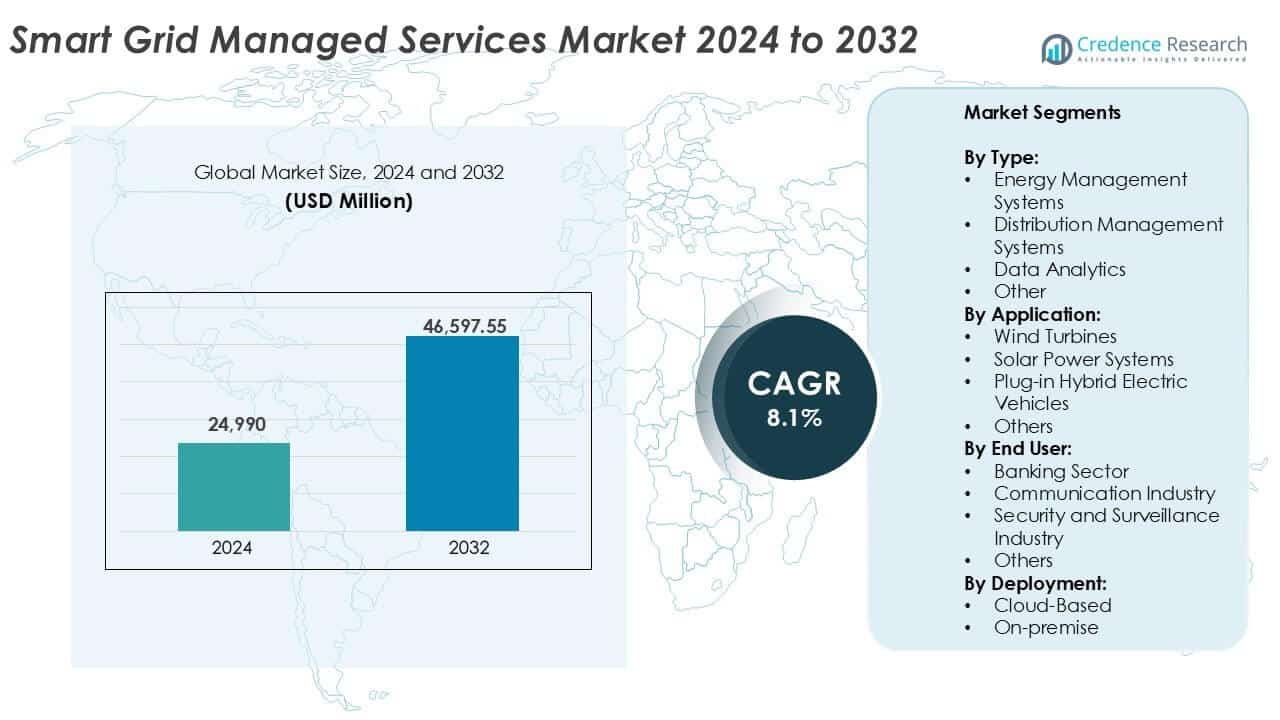
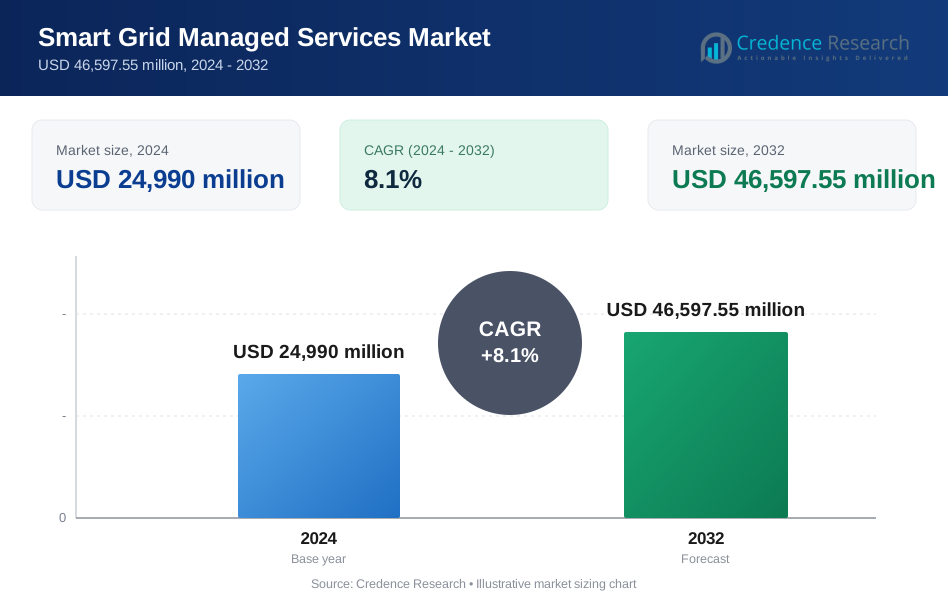
The Smart Grid Managed Services Market was valued at USD 24,990 million in 2024 and is projected to reach USD 46,597.55 million by 2032, growing at a CAGR of 8.1% during the forecast period from 2025 to 2032.
| REPORT ATTRIBUTE | DETAILS |
|---|---|
| Historical Period | 2020-2023 |
| Base Year | 2024 |
| Forecast Period | 2025-2032 |
| Smart Grid Managed Services Market Size 2024 | USD 24,990 million |
| Smart Grid Managed Services Market, CAGR | 8.1% |
| Smart Grid Managed Services Market Size 2032 | USD 46,597.55 million |
The Smart Grid Managed Services market is led by global players such as Siemens AG, General Electric Company, Schneider Electric SE, ABB Ltd., and IBM, known for their advanced grid automation, analytics, and cybersecurity capabilities. These companies offer end-to-end service models for utilities transitioning to digital infrastructure. Wipro Limited, SAP SE, and Cisco Systems, Inc. support grid modernization through cloud-based platforms and AI-driven insights, while niche firms like Grid4C and EsyaSoft Technologies specialize in demand forecasting and distributed energy management. North America emerged as the leading region in 2024, holding a 33% market share, supported by strong regulatory support, grid digitization, and widespread adoption of smart meters and DERs. The region’s early deployment of smart grid infrastructure and utility outsourcing models has positioned it as the most mature market for managed grid services.
Smart Grid Managed Services Market Insights
- The Smart Grid Managed Services market was valued at USD 24,990 million in 2024 and is projected to reach USD 46,597.55 million by 2032, growing at a CAGR of 8.1% during the forecast period.
- Grid modernization initiatives and increasing deployment of renewable energy sources are driving demand for real-time monitoring, predictive analytics, and distributed energy integration support.
- Cloud-based deployment accounted for over 60% of the market due to its scalability and cost-efficiency, while Energy Management Systems led the type segment with more than 35% share.
- North America held the largest regional share at 33% in 2024, followed by Europe at 28% and Asia Pacific at 24%, with rapid growth driven by smart meter rollouts and utility outsourcing.
- High integration costs and data privacy concerns pose key restraints, especially in regions with legacy infrastructure and limited digital readiness, slowing adoption among smaller utilities.
Smart Grid Managed Services Market Segmentation Analysis:
By Type
Energy Management Systems (EMS) dominated the Smart Grid Managed Services market by type in 2024, accounting for over 35% of the segment share. EMS adoption is driven by growing energy efficiency mandates and real-time grid monitoring requirements. Utilities and enterprises use EMS to reduce operational costs and optimize electricity usage. The rising integration of distributed energy resources and demand response programs further boosts EMS deployment. Distribution Management Systems and Data Analytics are gaining traction due to the need for outage management, predictive maintenance, and actionable insights across grid networks.
- For instance, Siemens’ Spectrum Power EMS supports grids with more than 1 million endpoints and processes data refresh cycles every 2 seconds for real-time monitoring.
By Application:
Solar Power Systems led the market by application in 2024, contributing over 38% of the overall share. The growing global solar energy capacity, driven by decarbonization goals, supports demand for advanced grid integration and monitoring services. Smart grid managed services help solar operators maintain grid stability and forecast output fluctuations. Wind Turbines follow as a key segment, benefiting from similar clean energy transitions. The Plug-in Hybrid Electric Vehicles (PHEVs) segment is expanding steadily, supported by EV infrastructure growth and vehicle-to-grid (V2G) integration initiatives.
- For instance, GE Digital’s GridOS supports solar plants exceeding 500 MW capacity with forecasting intervals of 5 minutes.
By End User & Deployment:
The Communication Industry emerged as the leading end-user in 2024, holding around 33% of the market share. High reliance on uninterrupted power and network reliability supports demand for grid monitoring and control solutions. The Banking Sector and Security & Surveillance Industries also show rising adoption due to critical infrastructure needs. In deployment, Cloud-Based solutions dominated with over 60% share, driven by lower upfront costs, scalability, and ease of integration. On-premise deployment remains relevant in security-sensitive applications and regions with strict data control regulations.
Smart Grid Managed Services Market Key Growth Drivers
Rising Grid Modernization and Infrastructure Investments
Smart grid managed services benefit from growing investments in power grid modernization across developed and emerging economies. Governments and utilities allocate substantial budgets to upgrade outdated transmission and distribution systems. These initiatives often include the deployment of sensors, advanced metering infrastructure (AMI), and automation technologies. Managed services play a crucial role in operating, maintaining, and optimizing these modern digital grids. For instance, many North American and European utilities outsource grid operations to third-party providers to enhance efficiency and reduce operational risks. In Asia-Pacific, rapid urbanization and industrial expansion push national grids toward digital transformation. Utilities rely on managed service partners to bridge the digital skills gap and implement scalable solutions. These developments increase long-term demand for smart grid monitoring, predictive maintenance, outage response, and data analytics support, fueling market growth.
- For instance, Duke Energy deployed over 7 million smart meters across U.S. service areas and uses managed services for meter data management and outage analytics.
Growing Renewable Energy Integration and Distributed Energy Resources (DER)
The global shift toward clean energy is accelerating the adoption of smart grid managed services. Utilities face increasing pressure to integrate intermittent energy sources like wind and solar into existing power grids. These sources introduce volatility and complexity that legacy infrastructure cannot handle alone. Smart grid managed services offer real-time load balancing, remote asset monitoring, and predictive analytics to ensure grid stability. With the rise of distributed energy resources such as rooftop solar, energy storage, and microgrids, utilities must manage two-way power flows and decentralized generation. Managed service providers enable this transition by offering scalable tools for DER coordination, virtual power plant operations, and demand response management. As global renewable capacity continues to rise, especially in Europe, China, and the U.S., the need for flexible and reliable grid services will remain a major driver.
- For instance, Enel X manages over 15,000 commercial and industrial sites and 9.5 GW of flexible capacity globally, utilizing advanced platforms like DER.OS and the VPP Connect API for distributed energy resource control and virtual power plant coordination.
Increasing Cybersecurity Risks and Compliance Requirements
Cybersecurity has become a key driver for smart grid managed services as utilities digitize their operations and expand connectivity. With the proliferation of IoT-enabled grid assets, the attack surface for cyber threats has grown significantly. Utilities must comply with strict cybersecurity regulations such as NERC CIP, GDPR, and national data protection laws. Managed services offer advanced security monitoring, threat detection, and incident response capabilities that help utilities reduce risk exposure. These services ensure continuous compliance by regularly updating security protocols and conducting vulnerability assessments. Smaller utilities especially benefit from outsourcing security functions they cannot manage in-house. As cyberattacks targeting critical infrastructure become more frequent and sophisticated, demand for managed cybersecurity services in the grid sector continues to grow. This trend makes security compliance not only a necessity but also a competitive differentiator in the managed services landscape.
Smart Grid Managed Services Market Key Trends & Opportunities
Expansion of AI and Predictive Analytics in Grid Operations
Artificial Intelligence (AI) and predictive analytics are transforming how utilities manage grid operations. AI-powered solutions enable real-time load forecasting, fault detection, and predictive maintenance, helping reduce downtime and operational costs. Managed service providers now embed machine learning algorithms into platforms to process data from thousands of smart meters and grid sensors. This shift allows utilities to shift from reactive to proactive strategies, enhancing service quality and customer satisfaction. Predictive analytics also support better asset management by identifying equipment failures before they occur. As the volume of grid data grows, AI becomes essential for decision-making at scale. The combination of smart meters, IoT devices, and cloud-based analytics opens new opportunities for managed service firms to offer value-added services like energy optimization and automated grid balancing.
- For instance, the Siemens Spectrum Power grid management software leverages data from smart meters to execute load forecasts, which can be performed at 15-minute intervals.
Growth of Electric Vehicle (EV) Charging Infrastructure
The rapid expansion of electric vehicles globally presents a strong opportunity for smart grid managed services. EV adoption increases grid demand and creates new load profiles that must be managed dynamically. Utilities turn to managed services to monitor and balance EV charging activity, especially during peak hours. Managed platforms help forecast EV energy needs, optimize charging schedules, and prevent local grid overloads. Vehicle-to-grid (V2G) technologies also require continuous monitoring and integration, which managed service providers are well-equipped to handle. Governments in Europe, China, and the U.S. are investing heavily in EV infrastructure, further boosting service demand. The shift from traditional to electrified mobility ensures a long-term opportunity for grid operators and service providers to collaborate on seamless EV-grid integration solutions.
Smart Grid Managed Services Market Key Challenges
High Initial Integration and Transition Costs
Despite long-term cost savings, many utilities face financial hurdles in transitioning to smart grid managed services. Integrating legacy systems with advanced managed platforms requires upfront investment in hardware upgrades, software licenses, and training. These transition costs deter smaller utilities and municipal agencies with limited budgets. Additionally, compatibility issues between old infrastructure and modern service architectures add complexity. Some utilities prefer maintaining in-house control due to data sensitivity or operational risks associated with outsourcing. Delays in regulatory approvals and procurement cycles further slow down project execution. To address this challenge, managed service providers must offer flexible pricing models, staged implementation strategies, and strong ROI justifications to gain market acceptance.
Data Privacy Concerns and Limited Trust in Third-Party Vendors
Smart grid operations generate vast volumes of sensitive consumer and infrastructure data. Utilities often hesitate to share this data with third-party service providers due to privacy and compliance concerns. End-users, regulators, and corporate stakeholders demand strict control over customer data, especially in regions with strong privacy laws. Breaches or misuse of data by service vendors can lead to reputational damage and legal consequences. This limits the willingness of utilities to fully adopt outsourced services, particularly in critical areas like billing, customer engagement, and cybersecurity. Building trust through transparent data governance, compliance certifications, and secure cloud infrastructure becomes essential for service providers to overcome this challenge and scale their solutions.
Smart Grid Managed Services Market Regional Analysis
North America
North America led the Smart Grid Managed Services market in 2024, accounting for approximately 33% of the global share. The region benefits from advanced grid infrastructure, strong regulatory frameworks, and high utility digitalization levels. The U.S. drives most of the demand, supported by government-funded modernization programs and renewable integration targets. Canada also shows growth due to its clean energy push and smart meter adoption. Utilities in North America increasingly outsource monitoring, cybersecurity, and analytics services to manage growing grid complexity and distributed energy assets, making it the most mature regional market for smart grid managed services.
Europe
Europe held around 28% of the market share in 2024, driven by aggressive climate targets, renewable energy adoption, and smart grid deployment initiatives. Countries like Germany, the U.K., France, and the Netherlands invest in grid automation, demand-side management, and real-time analytics. The European Union’s energy transition policies and funding programs encourage utilities to partner with managed service providers for secure, scalable grid operations. Grid digitization is further supported by growing electric vehicle infrastructure and smart home technologies. The region maintains high service adoption rates due to its strong focus on data security, operational transparency, and regulatory compliance.
Asia Pacific
Asia Pacific captured 24% of the global Smart Grid Managed Services market in 2024 and is the fastest-growing region. Rapid urbanization, rising electricity demand, and large-scale smart meter rollouts in China, India, Japan, and South Korea support strong market growth. Governments invest in resilient grid infrastructure to support renewable integration, especially solar and wind. China leads with extensive digital grid initiatives under its energy modernization plans, while India accelerates distribution automation through its Revamped Distribution Sector Scheme (RDSS). The need for remote grid management, real-time load forecasting, and outage response services fuels strong regional demand.
Latin America
Latin America accounted for approximately 8% of the global market in 2024. The region shows gradual adoption of smart grid technologies, with Brazil, Mexico, and Chile taking the lead in deploying advanced metering infrastructure and grid automation. Aging infrastructure and grid reliability issues drive the need for managed services, especially in energy management and predictive maintenance. Government incentives and multilateral funding for smart energy programs support this transition. However, budget constraints and regulatory delays slow broader rollout. Despite these challenges, managed service providers see opportunities in modernizing transmission networks and integrating distributed generation across urban centers.
Middle East & Africa
The Middle East & Africa region held a 7% market share in 2024, with growing interest in digital grid services to support energy diversification. Gulf countries like the UAE and Saudi Arabia invest in smart city initiatives and renewable energy, driving demand for managed grid services. Utilities in South Africa and Kenya adopt smart solutions to manage grid losses and improve service reliability. The region’s adoption is rising but remains uneven due to infrastructure gaps and funding limitations. Managed service providers focus on modular solutions and public-private partnerships to address deployment barriers and improve grid performance.
Smart Grid Managed Services Market Segmentations:
By Type:
- Energy Management Systems
- Distribution Management Systems
- Data Analytics
- Other
By Application:
- Wind Turbines
- Solar Power Systems
- Plug-in Hybrid Electric Vehicles
- Others
By End User:
- Banking Sector
- Communication Industry
- Security and Surveillance Industry
- Others
By Deployment:
- Cloud-Based
- On-premise
By Geography:
- North America
- U.S.
- Canada
- Mexico
- Europe
- Germany
- France
- U.K.
- Italy
- Spain
- Rest of Europe
- Asia Pacific
- China
- Japan
- India
- South Korea
- South-east Asia
- Rest of Asia Pacific
- Latin America
- Brazil
- Argentina
- Rest of Latin America
- Middle East & Africa
- GCC Countries
- South Africa
- Rest of the Middle East and Africa
Competitive Landscape
The Smart Grid Managed Services market features a mix of multinational corporations and specialized technology firms competing on scalability, service integration, and innovation. Major players such as General Electric Company, Siemens AG, ABB Ltd., and Schneider Electric SE lead with comprehensive grid service portfolios and strong global utility partnerships. Companies like IBM, Wipro, and SAP SE provide advanced analytics, AI-powered solutions, and cloud-based management platforms, catering to both mature and emerging grids. Meanwhile, firms such as EsyaSoft Technologies, Grid4C, and Globema offer niche capabilities in grid forecasting, distributed energy resource (DER) integration, and meter data management. Itron, Eaton, and Xylem Inc. expand service offerings through hardware-software synergy. Cloud deployment and cybersecurity have become key differentiators. Market players increasingly focus on strategic collaborations, utility-specific customization, and managed energy optimization services to strengthen their presence in a highly competitive and rapidly evolving grid service ecosystem.
Key Player Analysis
- ABB Ltd.
- Cisco Systems, Inc.
- Eaton Corporation plc
- EsyaSoft Technologies Private Limited
- General Electric Company
- Globema Sp. z o.o.
- Grid4C Inc.
- International Business Machines Corporation (IBM)
- Itron, Inc.
- Mitsubishi Electric Corporation
- SAP SE
- Schneider Electric SE
- Siemens AG
- Wipro Limited
- Xylem Inc.
Recent Developments
- In June 2025, Eaton and Siemens Energy launched a strategic initiative to deliver modular, grid-independent power systems for data centers in North America. The joint solution integrates on-site generation and smart infrastructure to improve grid resilience and accelerate renewable integration.
- In February 2024, Itron and Schneider Electric partnered to integrate EcoStruxure ADMS and Grid Edge Intelligence, enabling real-time visibility from smart meters and DERs. This collaboration supported decentralized energy adoption and strengthened grid flexibility across North America.
Report Coverage
The research report offers an in-depth analysis based on Type, Application, End-User, Deployment and Geography. It details leading market players, providing an overview of their business, product offerings, investments, revenue streams, and key applications. Additionally, the report includes insights into the competitive environment, SWOT analysis, current market trends, as well as the primary drivers and constraints. Furthermore, it discusses various factors that have driven market expansion in recent years. The report also explores market dynamics, regulatory scenarios, and technological advancements that are shaping the industry. It assesses the impact of external factors and global economic changes on market growth. Lastly, it provides strategic recommendations for new entrants and established companies to navigate the complexities of the market.
Future Outlook
- Demand for managed services will grow as utilities accelerate grid digitalization efforts worldwide.
- Integration of AI and machine learning will enhance predictive maintenance and fault detection capabilities.
- Cloud-based deployment models will continue to dominate due to scalability and operational flexibility.
- Renewable energy expansion will increase reliance on grid balancing and DER coordination services.
- Cybersecurity services will see higher demand as grid infrastructure becomes more connected and data-driven.
- Utilities will outsource more operational functions to reduce costs and address workforce skill gaps.
- EV charging infrastructure growth will drive new managed service opportunities in load forecasting and optimization.
- Partnerships between utilities and tech firms will intensify to co-develop specialized grid management platforms.
- Emerging markets will adopt smart grid services at a faster pace to modernize aging power infrastructure.
- Regulatory frameworks will increasingly support third-party service models to ensure grid reliability and efficiency.
Request a Free Sample
Fill in your details and we'll send you a free sample report.
- Sample data tables & charts
- Research methodology
Need a Custom Version of This Report?
Tailor the scope, geography, or segments to your exact requirements.
- Custom geography or segment scope
- Direct access to our analyst team
Frequently Asked Questions
What is the current market size for the Smart Grid Managed Services market, and what is its projected size in 2032?
At what Compound Annual Growth Rate is the Smart Grid Managed Services market projected to grow between 2024 and 2032?
Which Smart Grid Managed Services market segment held the largest share in 2024?
What are the primary factors fueling the growth of the Smart Grid Managed Services market?
Who are the leading companies in the Smart Grid Managed Services market?
Which region commanded the largest share of the Smart Grid Managed Services market in 2024?
Table of Content
Chapter 1. Report Introduction
- 1.1 Report Description & Purpose
- 1.1.1 Report Title & Market Definition
- 1.1.2 Unique Selling Propositions (USP) & Key Differentiators
- 1.1.3 Value Proposition for Stakeholders
- 1.2 Research Objectives
- 1.2.1 Market Sizing Objectives (Volume & Revenue)
- 1.2.2 Segmentation Objectives
- 1.2.3 Competitive Intelligence Objectives
- 1.2.4 Forecast & Scenario Objectives
- 1.3 Report Scope
- 1.3.1 Smart Grid Managed Services Scope – Types & Subtypes Covered
- 1.3.2 Geographic Scope – Regions & Countries Covered
- 1.3.3 Historical Period, Base Year & Forecast Period (2024; forecast to 2032)
- 1.3.4 Inclusions & Exclusions
- 1.4 HS Code & Classification Framework
- 1.5 Currency, Units & Pricing Basis
- 1.6 Target Stakeholders
- 1.7 Limitations & Assumptions
Chapter 2. Executive Summary
- 2.1 Global Smart Grid Managed Services Market Snapshot
- 2.1.1 Market Size – Historical (2024) & Forecast (2024-2032) (2024: USD 24,990 million → 2032: USD 46,597.55 million)
- 2.1.2 Volume & Revenue – Global Totals
- 2.1.3 Key Market Highlights – Top Five Facts
- 2.2 Smart Grid Managed Services Market Segmentation Snapshot
- 2.2.1 Market Split by Region – 2024 vs. 2032
- 2.3 Competitive Snapshot
- 2.3.1 Top 10 Players by Revenue Share – 2024
- 2.3.2 Top 10 Players by Volume Share – 2024
- 2.3.3 Recent Strategic Developments (18-Month Summary)
- 2.4 Key Investment Highlights & Strategic Conclusions
Chapter 3. Smart Grid Managed Services Market Dynamics & Industry Analysis
- 3.1 Market Overview & Context
- 3.1.1 Smart Grid Managed Services Market Position in the Broader Automotive Value Chain
- 3.1.2 OEM vs. Replacement Market Dynamics
- 3.1.3 Market Maturity & Development Stage by Region
- 3.2 Smart Grid Managed Services Market Drivers
- 3.3 Smart Grid Managed Services Market Restraints & Challenges
- 3.4 Smart Grid Managed Services Market Opportunities
- 3.5 Porter's Five Forces Analysis
- 3.5.1 Threat of New Entrants
- 3.5.2 Bargaining Power of Suppliers
- 3.5.3 Bargaining Power of Buyers
- 3.5.4 Threat of Substitutes
- 3.5.5 Competitive Rivalry – Intensity Assessment
- 3.6 Smart Grid Managed Services Value Chain Analysis
- 3.6.1 Upstream – Raw Material/Input Suppliers
- 3.6.1.1 Raw Material/Input 1
- 3.6.1.2 Raw Material/Input 2
- 3.6.1.3 Raw Material/Input 3
- 3.6.2 Midstream – Production/Manufacturing/Service Delivery
- 3.6.2.1 Production/Process Overview
- 3.6.2.2 Key Facility Locations & Capacity by Manufacturer
- 3.6.3 Downstream – Distribution & End Consumer
- 3.6.3.1 Primary Channel – B2B/OEM
- 3.6.3.2 Secondary Channels – Dealer, Retail, Online, Direct
- 3.6.4 Value Chain Profitability Analysis
- 3.6.1 Upstream – Raw Material/Input Suppliers
- 3.7 PESTEL Analysis
- 3.7.1 Political Factors
- 3.7.2 Economic Factors
- 3.7.3 Social Factors
- 3.7.4 Technological Factors
- 3.7.5 Environmental Factors
- 3.7.6 Legal Factors
- 3.8 Smart Grid Managed Services Supply Chain Analysis
- 3.8.1 Raw Material/Input Supply Risk Assessment
- 3.8.2 Manufacturing Concentration Risk (Geographic Exposure)
- 3.8.3 Trade Disruption Impact Analysis
- 3.9 Regulatory & Policy Landscape
Note: The regulatory and policy landscape section covers regulations based on their applicability to the market, Smart Grid Managed Services category, geography, and scope of the study. Only regulatory frameworks with a material impact on operations, compliance, trade, sustainability, or market access are analyzed in detail.
Chapter 4. Key Investment Pockets & Opportunity Analysis
- 4.1 Smart Grid Managed Services Market Attractiveness Analysis
- 4.1.1 By Region – Investment Attractiveness Matrix (Volume × CAGR)
- 4.2 Absolute Revenue Growth Opportunity
- 4.2.1 By Region – Absolute USD Growth Through 2032
- 4.3 Incremental Volume Opportunity
- 4.3.1 By Region – Incremental Volume Through 2032
- 4.3.2 Segment – Incremental Volume
- 4.4 Emerging Submarket Opportunity Deep Dive (Subject to Applicability)
- 4.5 Emerging Market Opportunity Scorecards
- 4.5.1 United States
- 4.5.2 Europe
- 4.5.3 Asia
- 4.5.4 Middle East & Africa
Note: Emerging Market Opportunity Scorecards will be included based on relevance and strategic importance. Regions listed are indicative and may vary depending on data availability and market dynamics.
Chapter 5. Smart Grid Managed Services Import-Export Analysis & Trade Flows
- 5.1 Global Trade Overview
- 5.1.1 Global Export Value by Country (2024)
- 5.1.2 Global Export Volume by Country (2024)
- 5.1.3 Global Import Value by Country (2024)
- 5.1.4 Global Import Volume by Country (2024)
- 5.1.5 Net Trade Balance by Country (2024)
- 5.2 Export Analysis – Segment
- 5.2.1 Type 1 (HS Code)
- 5.2.2 Type 2 (HS Code)
- 5.2.3 Type 3 (HS Code)
- 5.2.4 Type 4 (HS Code)
- 5.2.5 Type 5 (HS Code)
- 5.3 Import Analysis – Segment
- 5.3.1 Type 1 (HS Code)
- 5.3.2 Type 2 (HS Code)
- 5.3.3 Type 3 (HS Code)
- 5.3.4 Type 4 (HS Code)
- 5.3.5 Type 5 (HS Code)
- 5.4 Average Unit Trade Prices
- 5.4.1 Average Export Price – Segment & Country
- 5.4.2 Average Import Price – Segment & Source Country
- 5.4.3 Price Trends (2024)
- 5.5 Key Trade Route Analysis
- 5.5.1 Trade Route 1
- 5.5.2 Trade Route 2
- 5.5.3 Trade Route 3
- 5.5.4 Trade Route 4
- 5.5.5 Trade Route 5
- 5.6 Trade Policy Impact Assessment
- 5.6.1 US Anti-Dumping & Section 301 Tariffs
- 5.6.2 EU Customs Union Impact
- 5.6.3 Major Free Trade Agreements
- 5.6.4 USMCA Rules of Origin
Note: Trade policy analysis will be included only where relevant to the Smart Grid Managed Services market.
Chapter 6. Competitive Landscape & Company Benchmarking
- 6.1 Smart Grid Managed Services Market Concentration & Structure
- 6.1.1 Herfindahl-Hirschman Index (HHI) – vs. 2024
- 6.1.2 Tier 1, Tier 2 & Tier 3 Market Structure
- 6.1.3 Global, Regional & Local Player Dynamics
- 6.2 Smart Grid Managed Services Market Share Analysis – 2024
- 6.2.1 Global Revenue Share by Company
- 6.2.2 Global Volume Share by Company
- 6.2.3 Regional Revenue Share
- 6.2.4 Market Share Evolution ( vs. 2024)
- 6.2.5 OEM Segment Share by Company
- 6.2.6 Replacement Segment Share by Company
- 6.3 Production/Delivery Capacity & Facility Analysis
- 6.3.1 Global Installed Capacity
- 6.3.2 Capacity Utilization Rates
- 6.3.3 Production/Output Volume
- 6.3.4 Facility Locations & Capacity Map
- 6.3.5 Planned Capacity Additions
- 6.4 Smart Grid Managed Services Competitive Benchmarking Matrix
- 6.4.1 Revenue, Volume, CAGR & Profitability Comparison
- 6.4.2 Channel Revenue Mix
- 6.4.3 Geographic Revenue Exposure
- 6.4.4 R&D Intensity
- 6.4.5 Sustainability Maturity
- 6.5 Strategic Developments in Smart Grid Managed Services (Last 24 Months)
- 6.5.1 Mergers, Acquisitions & Divestments
- 6.5.2 New Smart Grid Managed Services Launches
- 6.5.3 Facility Expansions
- 6.5.4 Strategic Alliances, Joint Ventures & Partnerships
- 6.5.5 Distribution Expansion & Market Entry
- 6.5.6 Sustainability & ESG Initiatives
- 6.6 Competitive Strategy Mapping
- 6.6.1 Leader, Challenger, Follower & Niche Classification
- 6.6.2 Pricing Strategy Comparison
- 6.6.3 Channel Strategy Matrix
Note: Strategic developments are included based on their materiality and the availability of reliable information.
Chapter 7. Global Smart Grid Managed Services Market – By Distribution Channel
- 7.1 Segment Overview
- 7.1.1 Volume & Revenue Split by Channel (2024 & 2032)
- 7.1.2 Channel Mix Evolution (2024-2032)
Chapter 8. Regional Market Analysis – Global Overview
- 8.1 Global Regional Overview
- 8.1.1 Regional Volume Share
- 8.1.2 Regional Revenue Share
- 8.1.3 Regional Volume by Region
- 8.1.4 Regional Revenue by Region
- 8.1.5 Regional Forecast Through 2032
- 8.2 Cross-Regional Segment Analysis
- 8.2.1 By Distribution Channel
- 8.2.2 By Brand/Price Tier
Chapter 9. North America Smart Grid Managed Services Market
- 9.1 United States
- 9.2 Canada
- 9.3 Mexico
Chapter 10. Europe Smart Grid Managed Services Market
- 10.1 Germany
- 10.2 France
- 10.3 Italy
- 10.4 United Kingdom
- 10.5 Spain
- 10.6 Poland
- 10.7 Russia
- 10.8 Netherlands
- 10.9 Belgium
- 10.10 Sweden
- 10.11 Denmark
- 10.12 Norway
- 10.13 Rest of Europe
Chapter 11. Asia Pacific Smart Grid Managed Services Market
- 11.1 China
- 11.2 India
- 11.3 Japan
- 11.4 South Korea
- 11.5 Thailand
- 11.6 Indonesia
- 11.7 Vietnam
- 11.8 Malaysia
- 11.9 Australia
- 11.10 Rest of Asia Pacific
Chapter 12. Latin America Smart Grid Managed Services Market
- 12.1 Brazil
- 12.2 Argentina
- 12.3 Colombia
- 12.4 Chile
- 12.5 Rest of Latin America
Chapter 13. Middle East Smart Grid Managed Services Market
- 13.1 Saudi Arabia
- 13.2 United Arab Emirates
- 13.3 Turkey
- 13.4 Israel
- 13.5 Iran
- 13.6 Rest of the Middle East
Chapter 14. Africa Smart Grid Managed Services Market
- 14.1 South Africa
- 14.2 Egypt
- 14.3 Nigeria
- 14.4 Morocco
- 14.5 Rest of Africa
Chapter 15. Smart Grid Managed Services Company Profiles
- 15.1 [Company 01]
- 15.1.1 Company Overview
- 15.1.2 Key Management Personnel
- 15.1.3 Products & Services Portfolio
- 15.1.4 Financial Performance
- 15.1.5 Key Market Focus & Geographic Presence
- 15.1.6 Recent Developments & Strategic Initiatives
Note: The company profile list is preliminary and may change based on research findings, market developments, data availability, and client requirements.
Chapter 16. Appendices
- Appendix A – List of Abbreviations & Acronyms
- Appendix B – Industry Classification Code Reference – Full Series
- Appendix C – Production & Capacity Data Tables
- Appendix D – End-Use & Demand Base Tables
- Appendix E – Consumption & Replacement Rate Assumptions
- Appendix F – ASP Reference Tables
- Appendix G – Manufacturing & Facility Database
- Appendix H – Import-Export Data Tables
- Appendix I – Regulatory Summary Tables
- Appendix J – Primary Research Participant List (Anonymized)
- Appendix K – Primary Research Questionnaire Framework
- Appendix L – Data Sources & Bibliography
- Appendix M – Market Size Divergence & Source Comparison
Chapter 17. Research Methodology
- 17.1 Research Framework & Philosophy
- 17.2 Secondary Research – Sources, Hierarchy & Data Extraction
- 17.3 Data Modeling – Bottom-Up & Top-Down Market Sizing
- 17.4 Primary Research – Stakeholder Framework, LOI & Sample Sizes
- 17.5 Forecast Methodology – Regression, Scenario & Sensitivity Analysis
- 17.6 Quality Control – Four-Layer Validation Framework
- 17.7 Limitations & Standard Assumptions
- 17.8 Disclaimer
