
Market Overview:
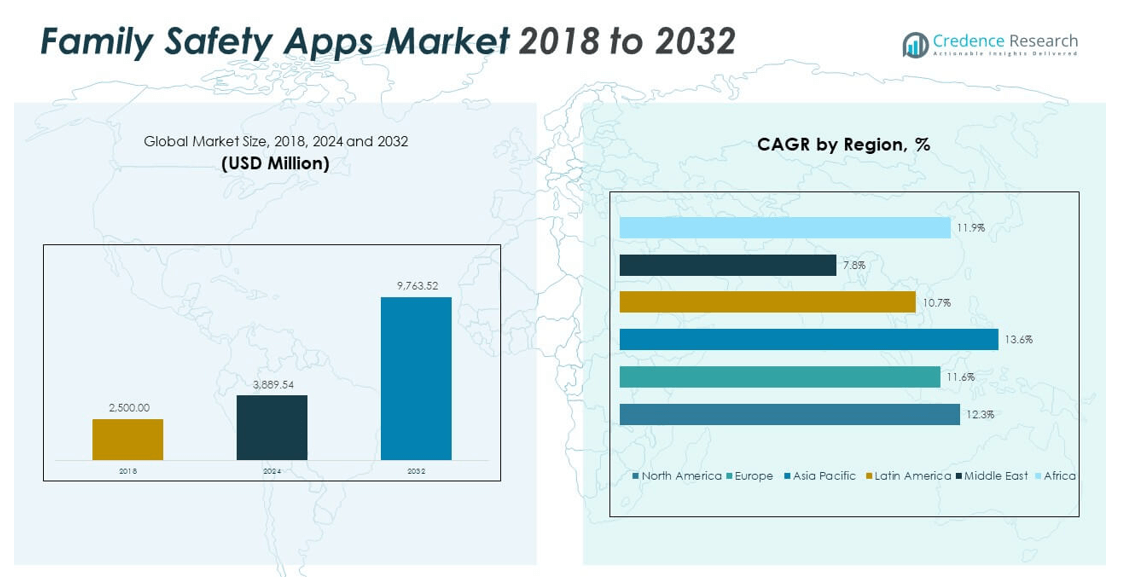
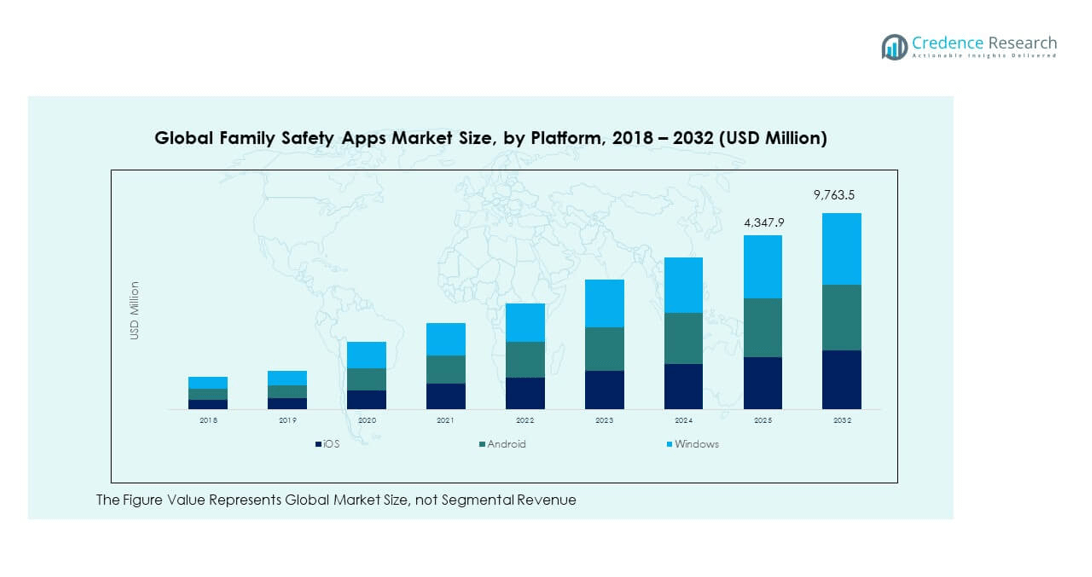
The Global Family Safety Apps Market size was valued at USD 2,500.00 million in 2018 to USD 3,889.54 million in 2024 and is anticipated to reach USD 9,763.52 million by 2032, at a CAGR of 12.25% during the forecast period.
| REPORT ATTRIBUTE | DETAILS |
|---|---|
| Historical Period | 2020-2023 |
| Base Year | 2024 |
| Forecast Period | 2025-2032 |
| Family Safety Apps Market Size 2024 | USD 3,889.54 million |
| Family Safety Apps Market, CAGR | 12.25% |
| Family Safety Apps Market Size 2032 | USD 9,763.52 million |
The market is driven by rising awareness of digital safety, parental monitoring, and family well-being. Increasing smartphone penetration and internet connectivity are enabling families to adopt apps that provide location tracking, emergency alerts, and activity monitoring. Demand is further supported by the growing focus on child safety, senior citizen care, and real-time connectivity in urbanized households. Integration of AI and predictive analytics within these apps enhances threat detection, user personalization, and proactive safety management, making adoption more attractive across diverse demographics.
Regionally, North America leads the market due to high digital adoption, established technology providers, and strong awareness of safety applications. Europe follows with increased adoption driven by stringent regulations around child safety and digital privacy. Asia-Pacific is emerging as the fastest-growing region, fueled by expanding smartphone usage, rapid urbanization, and heightened safety concerns among younger populations in countries like India and China. Latin America and the Middle East are also witnessing gradual uptake as affordability improves and digital infrastructure strengthens.
Market Insights:
- The Global Family Safety Apps Market size was valued at USD 2,500.0 million in 2018, reached USD 3,889.5 million in 2024, and is projected to hit USD 9,763.5 million by 2032, growing at a CAGR of 12.25%.
- Asia Pacific holds the largest share at 32%, supported by rising smartphone adoption, urbanization, and parental safety concerns. Europe follows with 23%, driven by GDPR compliance and digital privacy focus, while North America accounts for 21% with high digital adoption and established players.
- Asia Pacific is the fastest-growing region with a 13.6% CAGR, fueled by expanding internet connectivity, rapid urbanization, and strong demand in China and India.
- By platform, Android accounts for the largest share of the market at 47% in 2024, driven by affordability and global user base.
- iOS follows with 38% share in 2024, reflecting premium user adoption, while Windows holds 15%, largely in enterprise-focused safety solutions.
Market Drivers:
Rising Awareness of Digital Safety Among Families
The Global Family Safety Apps Market is growing due to heightened concerns about online safety. Families are increasingly aware of threats from cyberbullying, identity theft, and inappropriate content. Parents seek solutions to monitor digital activities and safeguard children across platforms. Safety apps provide real-time alerts and location tracking, enhancing peace of mind. Demand rises as smartphone penetration increases globally, supporting the adoption of safety solutions. Integration of digital education with safety apps strengthens the appeal among tech-savvy families. Enterprises also incorporate such tools for employee safety during travel. This heightened awareness continues to serve as a strong driver for the industry.
- For instance, Google Family Link enables parents to set up and manage their child’s Google account, monitor device activity, block or approve apps, set content filters across Chrome, Play, YouTube, and Search, and track location in real-time for each child profile.
Increasing Adoption of Smartphones and Internet Connectivity
Rising smartphone ownership and internet expansion are directly driving the Global Family Safety Apps Market. Affordable mobile data and enhanced connectivity allow apps to reach urban and rural populations. Safety apps integrate seamlessly with mobile devices, offering simple usability for parents and guardians. Families rely on apps for navigation, tracking, and real-time communication. Emerging economies show strong adoption, supported by rapid digital penetration. Developers leverage app store ecosystems to improve distribution and reach. Cloud-based platforms also boost accessibility and performance. These factors collectively accelerate the market’s global adoption trajectory.
Growing Focus on Child and Senior Citizen Safety Solutions
Families are prioritizing the safety of vulnerable groups such as children and elderly members. The Global Family Safety Apps Market benefits from apps tailored to monitoring kids’ locations and activities. Senior citizens use these solutions for medical alerts and fall detection. Governments and NGOs also support initiatives promoting safety technologies for these groups. Partnerships between telecom firms and app developers increase awareness of such services. Demand for wearable integration expands safety capabilities beyond smartphones. Families value reliable emergency response features, which improve adoption rates. This segment remains one of the most influential demand drivers globally.
Integration of Advanced Features Such as AI and Predictive Analytics
AI-driven analytics and predictive modeling enhance the effectiveness of safety apps. The Global Family Safety Apps Market is adopting smart algorithms for proactive threat detection. Predictive tools alert families before potential risks escalate. Developers integrate machine learning to improve accuracy of alerts and insights. Apps also personalize recommendations based on user behavior and patterns. Enhanced features attract higher adoption among tech-savvy demographics. Integration with smart home devices further expands usage scope. These innovations establish safety apps as essential components of digital households worldwide.
Market Trends:
Emergence of Subscription-Based Revenue Models for Safety Apps
The Global Family Safety Apps Market is witnessing a clear trend toward subscription pricing. Families prefer paying monthly or yearly fees for premium safety features. This model provides developers with recurring revenue streams and stable growth. Subscription services often include unlimited device tracking and advanced reporting. Customers value customizable packages for children, seniors, or entire families. Enterprises also adopt subscription models for workforce safety tools. Developers focus on offering affordable tiers to attract a wider base. This trend ensures sustainability and consistent innovation funding.
- For instance, Google Family Link remains a free service, enabling parents to establish daily screen time limits, approve or block app downloads, and lock devices remotely without requiring any paid subscription or in-app purchases for its core parental control features.
Integration of Safety Applications With Smart Home Ecosystems
Family safety solutions are evolving with integration into connected home devices. The Global Family Safety Apps Market increasingly features links with cameras, alarms, and sensors. These apps sync data across platforms to improve security management. Voice assistants also enable seamless access to emergency alerts and monitoring. Families value centralized platforms that combine physical and digital protection. The trend promotes stronger adoption of apps as part of broader IoT systems. Tech giants partner with developers to expand reach. This integration enhances app value and fosters greater consumer trust.
- For instance, new Google Family Link updates in 2025 allow parents to synchronize parental settings across Android tablets, Chromebooks, and Google-connected devices, enabling seamless management of school time, device downtime, and content filters through an integrated Google ecosystem.
Focus on Data Privacy and Compliance With Global Regulations
Privacy and compliance have become defining trends within the Global Family Safety Apps Market. Developers prioritize GDPR, COPPA, and other data protection standards. Families demand assurance that sensitive information is secure. Regulatory compliance increases user trust and reduces risks of misuse. Encryption and anonymization practices are becoming industry norms. Investors support companies that build transparent data policies. Compliance also opens opportunities in regions with strict digital governance. This trend emphasizes trust-building as a market differentiator.
Rise of Gamified Features and User-Friendly Interfaces for Engagement
Gamification is reshaping how families interact with safety solutions. The Global Family Safety Apps Market sees developers adding rewards and progress trackers. Families, especially children, engage more with apps when interactive features are present. Educational tools also combine with gamified elements to reinforce digital safety. Intuitive interfaces simplify adoption across age groups. Gamified systems encourage consistent usage rather than one-time reliance. User experience design remains a competitive differentiator among app developers. This trend expands app usage beyond safety into lifestyle management.
Market Challenges Analysis:
Concerns Over Data Security and Consumer Trust in Safety Applications
Data security remains a critical challenge for the Global Family Safety Apps Market. Families hesitate to share sensitive personal information across platforms. Reports of data breaches and misuse erode user confidence. Developers face pressure to maintain robust encryption and compliance measures. Privacy concerns deter adoption in regions with limited digital trust. Companies must invest heavily in cybersecurity to retain credibility. Regulatory scrutiny further intensifies challenges for smaller developers. It requires continuous investment, which impacts profitability for many emerging players.
High Competition and Market Saturation in Developed Economies
The Global Family Safety Apps Market experiences intense competition among established providers. Developed economies host numerous apps with similar offerings, creating saturation. Differentiating features becomes difficult without significant innovation investment. Price sensitivity limits revenue potential in crowded segments. Marketing costs rise as companies strive to gain visibility. Smaller players often struggle to compete with established tech brands. User loyalty shifts quickly when alternatives offer more value. This competitive environment creates long-term sustainability challenges for new entrants.
Market Opportunities:
Expansion in Emerging Economies With Rapid Smartphone Penetration
The Global Family Safety Apps Market has strong opportunities in emerging economies. Rising smartphone ownership and internet access create new adoption potential. Families in urban centers prioritize solutions for child safety and connectivity. Governments also support awareness campaigns on digital protection. Telecom providers partner with developers to improve app distribution. Emerging middle-class consumers show willingness to invest in family security. This creates a robust environment for growth-focused players. It enables faster expansion across underserved regions.
Integration With Wearable Devices and Broader Healthcare Ecosystems
Wearable technology integration creates new opportunities for family safety solutions. The Global Family Safety Apps Market benefits from health-tracking devices linked to emergency apps. Families value real-time monitoring of vital signs and location. Seniors and patients with chronic conditions especially benefit from these features. Healthcare firms collaborate with developers to broaden service offerings. Apps extend beyond safety into preventive healthcare management. This convergence expands market appeal to wider demographics. It drives future opportunities through innovation and partnerships.
Market Segmentation Analysis:
Platform Segmentation
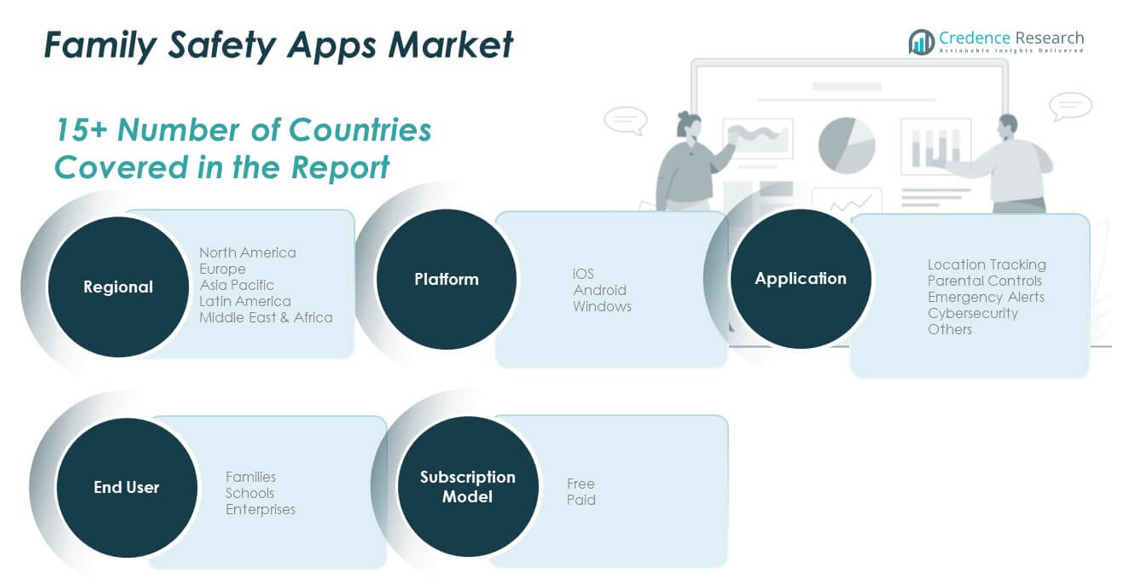
The Global Family Safety Apps Market is divided into iOS, Android, and Windows platforms. Android dominates due to its extensive global user base and affordability across diverse markets. iOS maintains a strong share, driven by premium device users prioritizing safety and security features. Windows contributes marginally but finds relevance in enterprise-focused safety solutions. Cross-platform compatibility remains a key driver as families demand seamless experiences across multiple devices. Developers prioritize integration with operating system updates to enhance performance. The growing reliance on mobile ecosystems continues to shape platform adoption.
- For instance, Google Family Link supports Android and Chromebook platforms, with unified dashboards so parents can swipe between multiple child profiles and manage device usage, app activity, and privacy settings from a single page. While parents can also use the Family Link app on an iPhone to manage their child's account, direct supervision and most parental controls only work on the child's supervised Android or Chromebook device.
Application Segmentation
Applications include Location Tracking, Parental Controls, Emergency Alerts, Cybersecurity, and Others. Location tracking leads adoption as families prioritize real-time monitoring and navigation safety. Parental controls gain importance with rising digital content exposure among children. Emergency alerts attract users due to their critical role in crisis response. Cybersecurity features are gaining traction as families face threats like malware and phishing. Other applications provide supplementary functions that strengthen overall safety. Developers focus on expanding multifunctional apps that integrate these capabilities. This breadth of applications drives demand across varied user groups.
- For instance, Google Family Link allows parents to set per-app time limits, schedule daily downtime, receive geofencing alerts when a child arrives or leaves a set location, and remotely lock devices, all verifiable directly within the Family Link app’s controls tab and help documentation.
End-User Segmentation
End-users include Families, Schools, and Enterprises. Families remain the primary consumers, adopting safety apps for child and elderly protection. Schools increasingly deploy these solutions for student safety and digital monitoring. Enterprises adopt apps to ensure workforce protection, especially in remote or travel-heavy environments. The Global Family Safety Apps Market benefits from growing institutional awareness of safety needs. Customization for different end-users improves adoption across demographics. Integration with existing management systems also strengthens enterprise and school usage. This segmentation ensures the market caters to both personal and organizational demands.
Subscription Model Segmentation
The market offers Free and Paid models. Free models attract first-time users, particularly in emerging economies. Paid subscriptions dominate revenue generation due to advanced features and premium support. Families prefer paid plans offering cross-device tracking and enhanced cybersecurity. Enterprises often invest in premium solutions for reliable workforce safety management. Developers leverage freemium strategies to convert users into paying customers. Subscription flexibility drives loyalty and long-term adoption. It enables market players to balance affordability with profitability while serving diverse global users.
Segmentation:
By Platform:- iOS
- Android
- Windows.
- Location Tracking
- Parental Controls
- Emergency Alerts
- Cybersecurity
- Others.
- Families
- Schools
- Enterprises.
- Free
- Paid
- North America
- U.S.
- Canada
- Mexico
- Europe
- Germany
- France
- U.K.
- Italy
- Spain
- Rest of Europe
- Asia Pacific
- China
- Japan
- India
- South Korea
- South-east Asia
- Rest of Asia Pacific
- Latin America
- Brazil
- Argentina
- Rest of Latin America
- Middle East & Africa
- GCC Countries
- South Africa
- Rest of the Middle East and Africa
Regional Analysis:
North America
The North America Family Safety Apps Market size was valued at USD 991.25 million in 2018 to USD 823.04 million in 2024 and is anticipated to reach USD 2,061.19 million by 2032, at a CAGR of 12.3% during the forecast period. North America holds around 21% of the Global Family Safety Apps Market share. The region leads due to high digital penetration, strong smartphone adoption, and widespread awareness of safety solutions. Families prioritize child safety, cybersecurity, and emergency response features. Enterprises adopt apps for workforce monitoring and employee safety. The U.S. dominates with strong app innovation and investment in AI-based safety tools. Canada and Mexico also show growing adoption, supported by improving digital infrastructure. The presence of established players strengthens the regional competitive landscape. It continues to lead through innovation, regulations, and consumer readiness.
Europe
The Europe Family Safety Apps Market size was valued at USD 735.50 million in 2018 to USD 1,104.52 million in 2024 and is anticipated to reach USD 2,635.69 million by 2032, at a CAGR of 11.6% during the forecast period. Europe accounts for nearly 23% of the Global Family Safety Apps Market share. Strong regulations around data protection, such as GDPR, increase trust and adoption. Families adopt safety apps for digital privacy and child monitoring needs. Schools integrate apps to ensure safer online engagement for students. Countries like the UK, Germany, and France dominate adoption due to high awareness and strong infrastructure. Southern and Eastern Europe also expand steadily with growing internet penetration. Partnerships with telecom providers increase access across the region. It remains a critical market driven by compliance and advanced safety integration.
Asia Pacific
The Asia Pacific Family Safety Apps Market size was valued at USD 603.00 million in 2018 to USD 980.34 million in 2024 and is anticipated to reach USD 2,719.15 million by 2032, at a CAGR of 13.6% during the forecast period. Asia Pacific represents the largest share, around 32% of the Global Family Safety Apps Market. The region grows fastest due to rapid urbanization, strong smartphone penetration, and increasing parental concerns. China and India lead adoption with large digitally active populations. Japan, South Korea, and Australia also contribute significantly with advanced app features and strong digital ecosystems. Families demand solutions for child monitoring and cybersecurity. Schools and enterprises add to adoption with rising emphasis on digital safety policies. Partnerships between local developers and telecom companies expand app usage. It emerges as the growth engine of the global market.
Latin America
The Latin America Family Safety Apps Market size was valued at USD 105.00 million in 2018 to USD 160.99 million in 2024 and is anticipated to reach USD 359.98 million by 2032, at a CAGR of 10.7% during the forecast period. Latin America contributes around 4% of the Global Family Safety Apps Market share. Growing smartphone adoption and improving internet infrastructure drive usage. Families adopt safety apps for tracking and emergency alerts. Brazil and Mexico dominate demand due to their large populations and rising digital literacy. Governments and NGOs promote safety awareness initiatives, encouraging adoption. The market faces challenges of affordability and uneven digital access. Enterprises slowly adopt workforce safety apps in logistics and services. It shows potential growth as connectivity improves across the region.
Middle East
The Middle East Family Safety Apps Market size was valued at USD 37.50 million in 2018 to USD 48.98 million in 2024 and is anticipated to reach USD 88.90 million by 2032, at a CAGR of 7.8% during the forecast period. The region accounts for around 1% of the Global Family Safety Apps Market share. Adoption remains slower due to limited affordability and digital readiness. Urban centers like UAE, Saudi Arabia, and Israel show higher uptake. Families use apps mainly for location tracking and parental monitoring. Enterprises in oil, gas, and construction sectors integrate apps for employee safety. Governments encourage adoption of digital safety initiatives, especially in education. Market growth is steady but faces challenges of economic diversity. It remains a small but gradually expanding market.
Africa
The Africa Family Safety Apps Market size was valued at USD 27.75 million in 2018 to USD 771.66 million in 2024 and is anticipated to reach USD 1,898.61 million by 2032, at a CAGR of 11.9% during the forecast period. Africa holds around 19% of the Global Family Safety Apps Market share, showing sharp growth from its low base. Rising smartphone penetration and affordable internet packages fuel adoption. Families increasingly adopt location tracking and emergency alert features. Nigeria, South Africa, and Egypt lead usage due to their stronger digital infrastructure. Rural areas show gradual adoption as connectivity improves. Partnerships with telecom companies expand access to safety apps. NGOs and governments also support child safety initiatives, enhancing trust in digital solutions. It emerges as a promising region with untapped growth potential.
Key Player Analysis:
- Google Family Link.
- Net Nanny.
- Norton Family.
- Screen Time Labs.
- Kaspersky Safe Kids.
- ESET Parental Control.
Competitive Analysis:
The Global Family Safety Apps Market is highly competitive, with both established technology firms and emerging players actively driving innovation. Leading companies such as Life360, Google Family Link, Qustodio, and Norton Family dominate through extensive product portfolios and strong brand recognition. It is defined by continuous product enhancements, integration of AI, and partnerships with telecom providers to expand reach. Startups also compete by offering niche solutions in parental controls, cybersecurity, and emergency alerts. The market demonstrates high rivalry, where differentiation depends on advanced features, privacy protection, and subscription models that appeal to families, schools, and enterprises.
Recent Developments:
- In July 2025, Qustodio launched a redesigned parent app interface to make managing family digital wellbeing easier, as confirmed directly through Qustodio’s official blog update.
- In February 2025, Google Family Link rolled out new parental supervision tools, such as School Time and parent-managed contacts, formally announced on Google's own blog and widely covered by Google News.
Report Coverage:
The research report offers an in-depth analysis based on platform, application, end-user, and subscription model. It details leading market players, providing an overview of their business, product offerings, investments, revenue streams, and key applications. Additionally, the report includes insights into the competitive environment, SWOT analysis, current market trends, as well as the primary drivers and constraints. Furthermore, it discusses various factors that have driven market expansion in recent years. The report also explores market dynamics, regulatory scenarios, and technological advancements that are shaping the industry. It assesses the impact of external factors and global economic changes on market growth. Lastly, it provides strategic recommendations for new entrants and established companies to navigate the complexities of the market.
Future Outlook:
- Rising adoption of AI-powered safety features will reshape app functionality.
- Wearable integration will expand monitoring and healthcare-related applications.
- Schools will increasingly adopt safety apps for student protection.
- Enterprises will invest in workforce safety and compliance-focused solutions.
- Subscription-based models will dominate revenue generation across platforms.
- Privacy-focused features will remain critical for consumer trust.
- Asia Pacific will continue to lead growth due to rising smartphone penetration.
- Partnerships with telecom providers will broaden global access.
- Emerging markets will show accelerated adoption driven by affordability.
- Product innovation will focus on unified safety ecosystems across devices.

Request a Free Sample
Fill in your details and we'll send you a free sample report.
- Sample data tables & charts
- Research methodology
Market Dynamics
Rising Awareness of Digital Safety Among Families
Growing concerns about online threats such as cyberbullying, identity theft, and inappropriate content are prompting families to adopt safety apps for real-time monitoring and alerts, driving market expansion.
Increasing Adoption of Smartphones and Internet Connectivity
Widespread smartphone ownership and improved internet access globally enable families to easily use safety apps, expanding the market’s reach into both urban and rural areas.
Growing Focus on Child and Senior Citizen Safety Solutions
Families are prioritizing the protection of vulnerable members, such as children and seniors, leading to increased demand for apps that offer location tracking, emergency alerts, and health monitoring.
Integration of Advanced Features Such as AI and Predictive Analytics
The adoption of AI-driven analytics and predictive tools enhances threat detection and personalization, making safety apps more effective and attractive to tech-savvy users.
Expansion in Emerging Economies With Rapid Smartphone Penetration
Emerging markets are experiencing rapid growth in smartphone usage and digital literacy, creating new opportunities for family safety app adoption as affordability and awareness improve.
Need a Custom Version of This Report?
Tailor the scope, geography, or segments to your exact requirements.
- Custom geography or segment scope
- Direct access to our analyst team
Frequently Asked Questions
What is the current market size for Global Family Safety Apps Market, and what is its projected size in 2032?
At what Compound Annual Growth Rate is the Global Family Safety Apps Market projected to grow between 2025 and 2032?
Which Global Family Safety Apps Market market segment held the largest share in 2024?
What are the primary factors fueling the growth of the Global Family Safety Apps Market?
Who are the leading companies in the Global Family Safety Apps Market?
Table of Content
Chapter 1 Market Segmentation
- 1.1 Segmentation Framework
- 1.1.1 Product and Service Classification
- 1.1.2 Application and End-Use Classification
- 1.1.3 Technology and Solution Classification
- 1.1.4 Customer and Distribution Channel Classification
- 1.1.5 Geographic Segmentation
- 1.1.6 Market Segment Definitions and Boundaries
- 1.2 By End-User
- 1.2.1 Families
- 1.2.2 Schools
- 1.2.3 Enterprises
- 1.3 By Platform
- 1.3.1 iOS
- 1.3.2 Android
- 1.3.3 Windows
- 1.4 By Application
- 1.4.1 Location Tracking
- 1.4.2 Parental Controls
- 1.4.3 Emergency Alerts
- 1.4.4 Cybersecurity
- 1.4.5 Others
- 1.5 By Subscription Model
- 1.5.1 Free
- 1.5.2 Paid
Chapter 2 Introduction
- 2.1 Report Objectives and Scope
- 2.2 Product Definition and Industry Terminology
- 2.3 Market Inclusions and Exclusions
- 2.4 Research Process
- 2.4.1 Primary Research and Expert Interviews
- 2.4.2 Secondary Research and Source Review
- 2.4.3 Top-Down and Bottom-Up Estimation
- 2.4.4 Data Triangulation and Verification
- 2.5 Market Size Measurement Basis
- 2.5.1 2018: USD 2,500.00 million → 2032: USD 9,763.52 million
- 2.6 Historical and Forecast Reference Periods
- 2.6.1 Base Year: 2018
- 2.6.2 Forecast Period: 2018-2032
- 2.7 Research Assumptions and Limitations
Chapter 3 Executive Summary
- 3.1 Market Snapshot and Key Findings
- 3.2 Base-Year Market Size, 2018
- 3.3 Forecast Market Size, 2032
- 3.4 Revenue and Volume Growth Outlook
- 3.5 Key Demand and Supply Indicators
- 3.6 Leading Market Segments
- 3.7 Fastest-Growing Market Opportunities
- 3.8 Regional Performance Highlights
- 3.9 Technology and Industry Transformation
- 3.10 Competitive Landscape Summary
- 3.11 Analyst View and Strategic Implications
Chapter 4 Global Family Safety Apps Market Trends and Developments
- 4.1 Historical Industry Development
- 4.2 Recent Market Trends and Developments
- 4.3 Demand and Customer Behavior Trends
- 4.4 Technology and Product Innovation
- 4.5 Artificial Intelligence, Automation and Digitalization
- 4.6 Local Manufacturing and Supply Chain Realignment
- 4.7 Industry Partnerships, Mergers and Acquisitions
- 4.8 Sustainability and Circular Economy Developments
- 4.9 Government and Private Sector Investment Trends
- 4.10 Emerging Business Models and Commercialization
- 4.11 Industry Developments and Announcements
Chapter 5 Global Family Safety Apps Market Production, Supply and Demand Analysis
- 5.1 Demand Trend and Consumption Analysis
- 5.2 Demand Forecast, 2018-2032
- 5.3 Production and Output Trend
- 5.4 Production and Output Forecast, 2018-2032
- 5.5 Installed Capacity and Capacity Utilization
- 5.6 Company-Wise Production Plants and Statistics
- 5.6.1 Installed Production Capacity
- 5.6.2 Actual Production
- 5.6.3 Planned Capacity and Expansion Targets
- 5.7 Supply Chain Structure and Procurement Trends
- 5.8 Supply-Demand Gap and Bottlenecks
- 5.9 Import Dependence and Sourcing Structure
- 5.10 Contract Manufacturing and Outsourcing
- 5.11 Regional Supply and Demand Concentration
Chapter 6 Global Family Safety Apps Market Pricing Analysis
- 6.1 Pricing Structure and Measurement
- 6.2 Historical Pricing Trends
- 6.3 Pricing Outlook, 2018-2032
- 6.4 Average Selling Price and Unit Economics
- 6.5 Pricing by Product and Market Segment
- 6.6 Geographic Pricing Differences
- 6.7 Key Input, Energy, Labor and Logistics Costs
- 6.8 Contract Pricing and Purchasing Models
- 6.9 Pricing Sensitivity and Competitive Positioning
- 6.10 Price, Margin and Profitability Implications
Chapter 7 Global Family Safety Apps Market Dynamics
- 7.1 Market Growth Drivers
- 7.1.1 Demand-Side Drivers
- 7.1.2 Technology and Innovation Drivers
- 7.1.3 Infrastructure and Investment Drivers
- 7.1.4 Regulatory and Policy Drivers
- 7.2 Market Restraints
- 7.2.1 Cost and Affordability Constraints
- 7.2.2 Technology and Adoption Barriers
- 7.2.3 Supply Chain and Operational Constraints
- 7.3 Market Challenges
- 7.3.1 Competitive Pressure and Margin Erosion
- 7.3.2 Skills, Infrastructure and Implementation Gaps
- 7.4 Emerging Market Opportunities
- 7.5 Market Dynamics Impact and Time-Horizon Assessment
Chapter 8 Global Family Safety Apps Value Chain Analysis
- 8.1 Industry Value Chain Overview
- 8.2 Upstream Suppliers and Critical Inputs
- 8.3 Technology and Component Providers
- 8.4 Manufacturing or Service Delivery
- 8.5 Distribution, Channel Partners and Integrators
- 8.6 Downstream Applications and End Users
- 8.7 Value Addition and Profit Pools
- 8.8 Vertical Integration and Outsourcing
- 8.9 Supplier Concentration and Risk
- 8.10 Supply Chain Localization and Resilience
Chapter 9 Global Family Safety Apps Market Regulations and Policies
- 9.1 Relevant Laws, Standards and Compliance Frameworks
- 9.2 Product, Service, Safety and Quality Requirements
- 9.3 Government Policies, Incentives and Subsidies
- 9.4 Imports, Exports and Trade Barriers
- 9.5 Public Procurement and Local Content Requirements
- 9.6 Environmental and Sustainability Compliance
- 9.7 Data Protection, AI and Cybersecurity Compliance
- 9.8 Upcoming Policy Changes and Market Implications
Chapter 10 Global Family Safety Apps Market Hotspots and Opportunities
- 10.1 Market Opportunity Mapping and Growth Hotspots
- 10.2 High-Growth Applications and Customer Groups
- 10.3 Underserved Markets and White-Space Opportunities
- 10.4 Emerging Technology and Product Opportunities
- 10.5 New Capacity and Investment Hotspots
- 10.6 Market Entry and Expansion Opportunities
- 10.7 Distribution and Partnership Opportunities
- 10.8 Near-Term and Long-Term Commercial Potential
- 10.9 Opportunity Attractiveness and Execution Risks
Chapter 11 Global Family Safety Apps Market Outlook, 2018-2032
- 11.1 Market Size and Analysis
- 11.1.1 Revenue (Market Measurement: 2018: USD 2,500.00 million → 2032: USD 9,763.52 million)
- 11.1.2 Market Volume and Quantity Sold
- 11.1.3 Historical Market Size
- 11.1.4 Base-Year Market Size, 2018
- 11.2 Market Forecast, 2018-2032
- 11.2.1 Revenue Forecast to 2032
- 11.2.2 Volume Forecast to 2032
- 11.2.3 CAGR and Year-on-Year Growth
- 11.2.4 Incremental Revenue Opportunity
- 11.3 Forecast Assumptions and Scenario Analysis
- 11.3.1 Base-Case Forecast
- 11.3.2 Optimistic and Conservative Scenarios
- 11.3.3 Technology, Pricing and Policy Sensitivities
- 11.4 Market Attractiveness and Growth Outlook
Chapter 12 Global Family Safety Apps Market Segmentation and Outlook
- 12.1 Segmentation Summary and Market Shares, 2018
- 12.2 Largest and Fastest-Growing Segments
- 12.3 By End-User - Market Size and Forecast, 2018-2032
- 12.3.1 Segment Definition and Scope
- 12.3.2 Historical Market Size
- 12.3.3 Revenue Forecast, 2018-2032
- 12.3.4 Volume Forecast, 2018-2032
- 12.3.5 Base-Year Market Share, 2018
- 12.3.6 Segment CAGR and Growth Drivers
- 12.3.7 Subsegment Market Size and Forecast
- 12.3.7.1 Families
- 12.3.7.2 Schools
- 12.3.7.3 Enterprises
- 12.3.8 Subsegment Pricing and Adoption Trends
- 12.3.9 Leading Suppliers and Competition
- 12.3.10 Regional Demand and Opportunities
- 12.4 By Platform - Market Size and Forecast, 2018-2032
- 12.4.1 Segment Definition and Scope
- 12.4.2 Historical Market Size
- 12.4.3 Revenue Forecast, 2018-2032
- 12.4.4 Volume Forecast, 2018-2032
- 12.4.5 Base-Year Market Share, 2018
- 12.4.6 Segment CAGR and Growth Drivers
- 12.4.7 Subsegment Market Size and Forecast
- 12.4.7.1 iOS
- 12.4.7.2 Android
- 12.4.7.3 Windows
- 12.4.8 Subsegment Pricing and Adoption Trends
- 12.4.9 Leading Suppliers and Competition
- 12.4.10 Regional Demand and Opportunities
- 12.5 By Application - Market Size and Forecast, 2018-2032
- 12.5.1 Segment Definition and Scope
- 12.5.2 Historical Market Size
- 12.5.3 Revenue Forecast, 2018-2032
- 12.5.4 Volume Forecast, 2018-2032
- 12.5.5 Base-Year Market Share, 2018
- 12.5.6 Segment CAGR and Growth Drivers
- 12.5.7 Subsegment Market Size and Forecast
- 12.5.7.1 Location Tracking
- 12.5.7.2 Parental Controls
- 12.5.7.3 Emergency Alerts
- 12.5.7.4 Cybersecurity
- 12.5.7.5 Others
- 12.5.8 Subsegment Pricing and Adoption Trends
- 12.5.9 Leading Suppliers and Competition
- 12.5.10 Regional Demand and Opportunities
- 12.6 By Subscription Model - Market Size and Forecast, 2018-2032
- 12.6.1 Segment Definition and Scope
- 12.6.2 Historical Market Size
- 12.6.3 Revenue Forecast, 2018-2032
- 12.6.4 Volume Forecast, 2018-2032
- 12.6.5 Base-Year Market Share, 2018
- 12.6.6 Segment CAGR and Growth Drivers
- 12.6.7 Subsegment Market Size and Forecast
- 12.6.7.1 Free
- 12.6.7.2 Paid
- 12.6.8 Subsegment Pricing and Adoption Trends
- 12.6.9 Leading Suppliers and Competition
- 12.6.10 Regional Demand and Opportunities
- 12.7 Segment Growth Comparison
- 12.8 Segment Attractiveness and Priority Matrix
Chapter 13 Global Family Safety Apps End-Use and Application Market Outlook
- 13.1 End-Use Industry and Customer Demand Structure
- 13.2 Leading Applications and Customer Groups
- 13.3 End-Use Market Size, Share and Forecast
- 13.4 Major End-Use Industry Deep Dives
- 13.4.1 Customer Requirements and Use Cases
- 13.4.2 Demand and Replacement Cycles
- 13.4.3 Technical and Regulatory Considerations
- 13.4.4 Purchasing and Procurement Models
- 13.4.5 Leading Vendors and Distribution Channels
- 13.4.6 Forecast and Commercial Opportunities
- 13.5 Emerging Applications and Cross-Segment Demand
- 13.6 End-Use Industry Investment Priorities
Chapter 14 Global Family Safety Apps Geographic Market Outlook, 2018-2032
- 14.1 Regional Market Size and Share, 2018
- 14.2 Regional Market Forecast, 2018-2032
- 14.3 Regional Pricing, Production and Demand Differences
- 14.4 North America
- 14.4.1 United States
- 14.4.2 Canada
- 14.4.3 Mexico
- 14.5 Europe
- 14.5.1 Germany
- 14.5.2 France
- 14.5.3 Italy
- 14.5.4 United Kingdom
- 14.5.5 Spain
- 14.5.6 Poland
- 14.5.7 Russia
- 14.5.8 Netherlands
- 14.5.9 Belgium
- 14.5.10 Sweden
- 14.5.11 Denmark
- 14.5.12 Norway
- 14.5.13 Rest of Europe
- 14.6 Asia Pacific
- 14.6.1 China
- 14.6.2 India
- 14.6.3 Japan
- 14.6.4 South Korea
- 14.6.5 Thailand
- 14.6.6 Indonesia
- 14.6.7 Vietnam
- 14.6.8 Malaysia
- 14.6.9 Australia
- 14.6.10 Rest of Asia Pacific
- 14.7 Latin America
- 14.7.1 Brazil
- 14.7.2 Argentina
- 14.7.3 Colombia
- 14.7.4 Chile
- 14.7.5 Rest of Latin America
- 14.8 Middle East
- 14.8.1 Saudi Arabia
- 14.8.2 United Arab Emirates
- 14.8.3 Turkey
- 14.8.4 Israel
- 14.8.5 Iran
- 14.8.6 Rest of the Middle East
- 14.9 Africa
- 14.9.1 South Africa
- 14.9.2 Egypt
- 14.9.3 Nigeria
- 14.9.4 Morocco
- 14.9.5 Rest of Africa
- 14.10 Regional Investment, Policy and Supply Chain Differences
- 14.11 Regional Competitive Landscape
- 14.12 Geographic Growth Hotspots
Chapter 15 Global Family Safety Apps Technology, Innovation and Sustainability Outlook
- 15.1 Technology Landscape and Maturity
- 15.2 Product, Process and Service Innovation
- 15.3 AI, Automation and Digital Tools in the Industry
- 15.4 Technology Adoption and Performance Benchmarking
- 15.5 Innovation Pipeline and R&D Investment
- 15.6 Patent and Intellectual Property Trends
- 15.7 Energy Efficiency and Resource Management
- 15.8 Sustainability, Recycling and Circularity
- 15.9 Technology Roadmap, 2018-2032
- 15.10 Risks of Obsolescence and Technology Substitution
Chapter 16 Global Family Safety Apps Market Key Strategic Imperatives
- 16.1 Growth and Market Entry Priorities
- 16.2 High-Return Products and Segments
- 16.3 Pricing, Profitability and Cost Optimization
- 16.4 Technology Investment and Product Differentiation
- 16.5 Supply Chain Localization and Resilience
- 16.6 Distribution and Customer Acquisition
- 16.7 Partnership, Acquisition and Capacity Strategy
- 16.8 Regional Expansion Priorities
- 16.9 Short-, Medium- and Long-Term Actions
Chapter 17 Competition Outlook
- 17.1 Industry Competition Characteristics
- 17.2 Market Structure and Concentration
- 17.3 Market Share and Competitive Positioning, 2018
- 17.4 Company-Wise Revenue and Product Benchmarking
- 17.5 Production and Service Capacity Benchmarking
- 17.6 Technology, Pricing and Differentiation
- 17.7 Regional Footprint and Distribution Strength
- 17.8 Mergers, Acquisitions and Strategic Alliances
- 17.9 New Entrants and Competitive Threats
- 17.10 Porter's Five Forces and Industry Attractiveness
- 17.11 Competitive Outlook, 2018-2032
Chapter 18 Company Profiles
- 18.1 Company Coverage and Selection Criteria
- 18.2 Google Family Link
- 18.2.1 Business Description
- 18.2.2 Company Ownership and Geographic Presence
- 18.2.3 Product and Service Portfolio
- 18.2.4 Manufacturing and Operating Footprint
- 18.2.5 Production Capacity and Expansion Plans
- 18.2.6 Financial Performance and Investment
- 18.2.7 Market Share and Competitive Position
- 18.2.8 Technology and Innovation Capabilities
- 18.2.9 Strategic Alliances or Partnerships
- 18.2.10 Recent Developments
- 18.2.11 Growth Strategy and Outlook
- 18.3 Net Nanny
- 18.4 Norton Family
- 18.5 Screen Time Labs
- 18.6 Kaspersky Safe Kids
- 18.7 ESET Parental Control
- 18.8 Life360
- 18.9 Qustodio
- 18.10 Bark
- 18.11 FamiSafe
- 18.12 Other Relevant Market Participants
Note: Every listed company is profiled on the structure shown under the first company. The company list is preliminary and may change based on research findings, market developments, data availability and client requirements.
Chapter 19 Disclaimer
- 19.1 Research and Forecast Disclaimer
- 19.2 Data Source and Estimation Limitations
Note: The depth of individual sections depends on data availability for this market. Volume, capacity, trade and other unit-based metrics are included where applicable.

