
| REPORT ATTRIBUTE | DETAILS |
|---|---|
| Historical Period | 2019-2022 |
| Base Year | 2023 |
| Forecast Period | 2024-2032 |
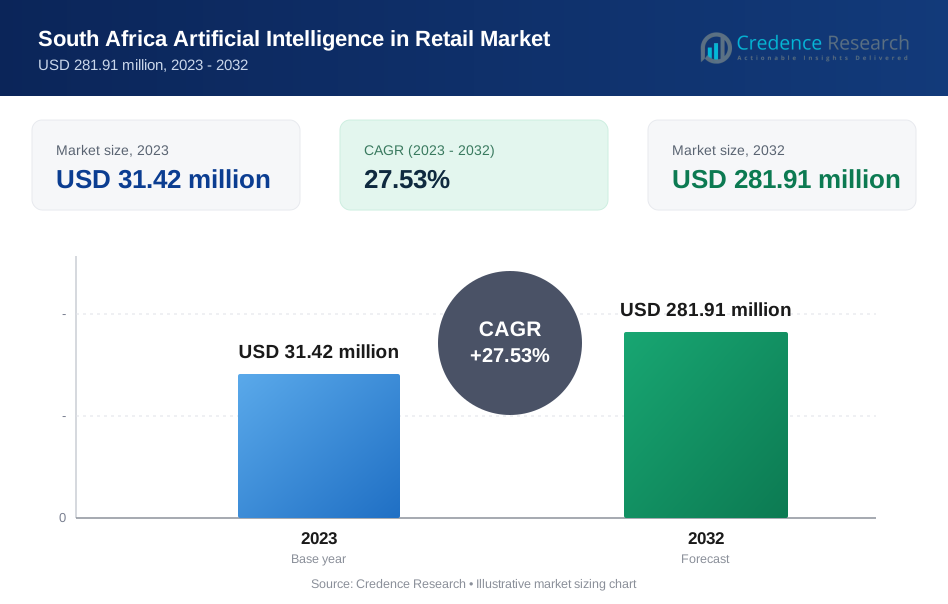
| South Africa Artificial Intelligence in Retail Market Size 2023 | USD 31.42 million |
| South Africa Artificial Intelligence in Retail Market, CAGR | 27.53% |
| South Africa Artificial Intelligence in Retail Market Size 2032 | USD 281.91 million |
Market Overview
The South Africa Artificial Intelligence in Retail market is projected to grow from USD 31.42 million in 2023 to USD 281.91 million by 2032, exhibiting a compound annual growth rate (CAGR) of 27.53%.
The South Africa Artificial Intelligence in Retail market is driven by the increasing adoption of AI technologies to enhance customer experience, streamline operations, and improve decision-making. Retailers are leveraging AI for personalized recommendations, predictive analytics, and inventory management, which are helping to optimize sales and customer satisfaction. Additionally, the growing demand for automation and AI-powered chatbots for customer service is fueling market growth. Key trends include the rise of AI-driven supply chain optimization, real-time data analysis, and the integration of AI with Internet of Things (IoT) devices for improved retail experiences. With advancements in machine learning and natural language processing, retailers are also deploying AI solutions to anticipate consumer behavior and offer targeted promotions. The shift toward e-commerce and the increasing use of AI to enhance online shopping experiences are further accelerating the market's expansion.
The South African Artificial Intelligence in Retail market is characterized by significant regional adoption, with key players focusing on driving technological innovations across various regions, including Gauteng, Western Cape, KwaZulu-Natal, and Eastern Cape. Major global companies such as Microsoft, Amazon, and IBM are leading the charge in providing AI solutions, offering products ranging from data analytics platforms to machine learning tools that help retailers optimize operations, personalize customer experiences, and enhance supply chain management. Local players are also making strides in the AI space, adapting solutions to the unique needs of the South African market. The retail sector is leveraging AI technologies to cater to the growing demand for e-commerce and omnichannel retail strategies. With increasing investment in AI-driven customer service, inventory management, and personalized marketing, key players are driving the market towards digital transformation, enhancing the overall retail experience in the region.
Market Insights
- The South African Artificial Intelligence in Retail market is projected to grow from USD 31.42 million in 2023 to USD 281.91 million by 2032, with a CAGR of 27.53%.
- Growing demand for personalized shopping experiences is driving AI adoption in the retail sector.
- AI is increasingly being used for enhancing operational efficiency, such as supply chain management and inventory optimization.
- Retailers are leveraging AI-driven predictive analytics to better understand customer behavior and forecast demand.
- Competition is intensifying with major players like Microsoft, Amazon, IBM, and SAP leading the market, alongside emerging local companies.
- High implementation costs and data privacy concerns are key restraints in the market’s growth.
- The Gauteng and Western Cape regions are leading in AI adoption, with other regions like KwaZulu-Natal and Eastern Cape showing increasing interest and growth potential.
Market Drivers
Operational Efficiency and Automation
AI-powered automation is transforming the way retailers manage their operations, leading to significant improvements in efficiency and cost reduction. Retailers in South Africa are adopting AI to optimize supply chain management, streamline inventory control, and enhance demand forecasting. Automated systems help retailers accurately track inventory levels, reduce stockouts, and ensure the right products are available at the right time. For instance, a report by World Wide Worx indicated that South African retailers are leveraging AI to improve inventory management and reduce operational costs. Additionally, AI-driven tools like chatbots and virtual assistants are improving customer service by providing instant responses to inquiries, further reducing operational costs.
Growing Demand for Personalization
The increasing consumer expectation for personalized shopping experiences is a major driver for the adoption of Artificial Intelligence (AI) in South Africa's retail sector. AI enables retailers to analyze vast amounts of customer data, allowing them to offer tailored product recommendations, promotions, and services. By leveraging machine learning algorithms, retailers can provide more relevant experiences to their customers, increasing engagement, satisfaction, and loyalty. Personalized experiences have proven to enhance conversion rates and drive repeat business, motivating retailers to invest in AI solutions.
Enhancing Customer Insights with Data Analytics
AI’s ability to analyze vast amounts of data and extract valuable insights is another key driver for its adoption in the retail industry. Retailers are increasingly relying on AI to gather and interpret customer behavior data, sales trends, and market conditions. This information allows businesses to make data-driven decisions regarding product offerings, pricing strategies, and marketing campaigns. For instance, a report by Webber Wentzel highlighted that AI-powered analytics helps South African retailers understand customer preferences and market trends, enabling more targeted marketing efforts. AI-powered analytics also helps retailers understand customer preferences, enabling them to offer more targeted and effective marketing, which in turn boosts sales and profitability.
Growth of E-commerce and Omnichannel Strategies
The shift towards e-commerce and the integration of omnichannel strategies are fueling the demand for AI in South Africa’s retail market. As online shopping continues to grow, retailers are using AI to enhance the online shopping experience through personalized recommendations, virtual try-ons, and customer service automation. Additionally, AI is playing a crucial role in bridging the gap between physical stores and online platforms, allowing retailers to provide a seamless shopping experience across multiple channels. This shift is accelerating the need for AI technologies in the retail sector.
Market Trends
Use of AI for Predictive Analytics
Predictive analytics powered by AI is becoming increasingly popular in the South African retail sector. Retailers are using AI tools to predict customer purchasing behavior, optimize inventory levels, and forecast demand with greater accuracy. By analyzing historical data and consumer trends, AI helps businesses anticipate shifts in the market, ensuring they are always prepared to meet consumer needs. For instance, Oracle South Africa reported that predictive analytics helps retailers make informed decisions about inventory management and marketing strategies. Predictive analytics also aids in reducing overstocking or stockouts, improving inventory turnover, and ultimately enhancing profitability. As a result, more retailers are turning to AI to stay ahead of the curve and manage supply chain challenges effectively.
Integration of AI with IoT for Smarter Retail Experiences
One of the significant trends in South Africa's AI in retail market is the growing integration of Artificial Intelligence with the Internet of Things (IoT). This convergence is helping retailers create smarter shopping experiences by collecting real-time data from connected devices. For example, AI systems can analyze data from sensors in stores to optimize product placement, manage foot traffic, and even predict which items will be in demand. IoT-enabled devices are also providing insights into customer behavior, allowing for more targeted marketing and operational improvements, thereby enhancing the overall retail experience.
AI-Driven Customer Service Automation
AI-driven customer service solutions, such as chatbots and virtual assistants, are becoming an integral part of the South African retail market. These tools are improving the efficiency and responsiveness of customer service by providing instant assistance and answering queries 24/7. AI chatbots are capable of handling complex tasks such as processing orders, tracking shipments, and offering product recommendations based on customer preferences. As more retailers adopt these AI-driven solutions, they are enhancing customer satisfaction while reducing labor costs, making them a key trend in the sector.
AI for Enhanced Security and Fraud Detection
Another emerging trend in South Africa’s AI in retail market is the increasing use of AI for security and fraud detection. Retailers are implementing AI-based systems to monitor transactions and identify fraudulent activities in real time. Machine learning algorithms can analyze purchasing patterns, flag suspicious behavior, and even predict potential security breaches. This trend is particularly relevant as e-commerce continues to grow, and businesses seek to protect themselves and their customers from fraud. AI’s role in enhancing security is expected to continue expanding as retail businesses prioritize safeguarding sensitive data and financial transactions.
Market Challenges Analysis
High Implementation Costs
One of the primary challenges facing the adoption of Artificial Intelligence in South Africa’s retail sector is the high implementation cost. The initial investment in AI technologies, including software, hardware, and training, can be prohibitive for many retailers, especially small and medium-sized enterprises. While AI offers long-term benefits such as improved efficiency and customer satisfaction, the upfront financial burden can deter businesses from fully embracing these technologies. Additionally, the need for ongoing maintenance, updates, and expert personnel to manage AI systems adds to the overall cost. As a result, many retailers may hesitate to invest in AI, limiting its widespread adoption in the industry.
Data Privacy and Security Concerns
As the use of Artificial Intelligence in retail increases, so do concerns about data privacy and security. AI technologies often require access to large amounts of customer data, including personal preferences and purchasing behavior, to function effectively. This creates significant risks related to data breaches and misuse, particularly in an era where cyber threats are becoming more sophisticated. For instance, a report by Polity highlighted that data privacy and security are top concerns for South African retailers when implementing AI technologies. Retailers must invest in robust security measures to protect customer data and ensure compliance with local data protection regulations, such as the Protection of Personal Information Act (POPIA) in South Africa. Failure to do so could lead to reputational damage, legal issues, and loss of customer trust, making data security a major challenge in the implementation of AI in retail.
Market Opportunities
Expansion of E-commerce and Omnichannel Retail
A significant opportunity for the growth of Artificial Intelligence in South Africa’s retail sector lies in the continued expansion of e-commerce and omnichannel retail strategies. As online shopping continues to gain traction, AI can help retailers optimize their digital platforms by offering personalized shopping experiences, improving product recommendations, and enhancing customer engagement. Furthermore, AI-powered tools can integrate physical and online retail operations, ensuring seamless shopping experiences across multiple channels. Retailers can capitalize on these advancements by implementing AI to boost sales and customer satisfaction, leading to stronger competitive positioning in the growing digital marketplace.
AI for Supply Chain Optimization and Inventory Management
Another key opportunity for AI in the South African retail market is its potential to revolutionize supply chain management and inventory optimization. With AI, retailers can use predictive analytics to forecast demand more accurately, optimize stock levels, and reduce waste. AI-powered systems can also streamline logistics by improving delivery routes, reducing costs, and enhancing operational efficiency. Retailers can leverage AI to enhance their supply chain resilience, ensuring they can meet customer demands with minimal disruptions. This opportunity not only reduces operational costs but also improves service levels, making AI a valuable tool for achieving long-term growth and sustainability in the competitive retail sector.
Market Segmentation Analysis:
By Component:
The South African Artificial Intelligence in Retail market is primarily divided into two segments: solutions and services. The solutions segment encompasses AI software, tools, and platforms that enable retailers to implement AI technologies for various functions, such as personalized recommendations, predictive analytics, and inventory management. These solutions are integral in enhancing customer experiences and operational efficiencies. The services segment, on the other hand, includes consulting, implementation, maintenance, and support services that help retailers effectively adopt and integrate AI solutions. As AI adoption grows, both segments are expected to see significant demand, with solutions driving the core technology adoption and services supporting ongoing system management and optimization.
By Business Function:
The South African AI in retail market is also segmented based on business functions, including marketing & sales, human resources, finance & accounting, operations, and cybersecurity. AI is increasingly used in marketing and sales to personalize customer experiences, optimize pricing strategies, and drive targeted promotions. In human resources, AI is streamlining recruitment processes and employee management. In finance and accounting, AI tools are used for financial forecasting, fraud detection, and automating manual tasks. Operations benefit from AI through supply chain optimization and process automation, while cybersecurity applications focus on threat detection, data protection, and fraud prevention. These business functions reflect the diverse applications of AI across the retail sector, each contributing to enhanced efficiency and competitiveness.
Segments:
Based on Component:
- Solution
- Services
Based on Business Function:
- Marketing & Sales
- Human Resources
- Finance & Accounting
- Operations
- Cybersecurity
Based on Technology:
- Machine Learning
- Natural Language Processing
- Chatbots
- Image and Video Analytics
- Swarm Intelligence
Based on Sales Channel:
- Omnichannel
- Brick and Mortar
Based on the Geography:
- Gauteng
- Western Cape
- KwaZulu-Natal
- Eastern Cape
Regional Analysis
Gauteng
Gauteng dominates the South African Artificial Intelligence in Retail market, holding the largest market share due to its status as the economic hub of the country. As of 2024, Gauteng is responsible for approximately 40% of the market share, driven by its highly developed infrastructure, concentration of major retail brands, and increasing adoption of AI technologies. The region’s vibrant retail landscape, coupled with its proximity to technology innovation hubs, has led to significant investments in AI-driven solutions. Retailers in Gauteng are focusing on enhancing customer experiences through AI-based personalization, improving operational efficiencies, and utilizing predictive analytics. The growing e-commerce sector and adoption of omnichannel strategies are further propelling AI adoption in Gauteng, with retail businesses seeking AI solutions to optimize sales, marketing, and customer service operations.
Western Cape
The Western Cape region follows Gauteng with a market share of approximately 30% in South Africa's AI in retail market. Cape Town, the capital of the Western Cape, has seen a surge in tech start-ups and digital innovation, positioning the region as a key player in the AI sector. Retailers in Western Cape are embracing AI for customer engagement, supply chain management, and inventory optimization. The region’s strong tourism sector also drives demand for AI solutions in the retail space, as retailers seek to personalize experiences for both local and international customers. Additionally, the growing emphasis on sustainability and eco-conscious retailing in the Western Cape has led to increased adoption of AI-driven solutions that enhance resource management and reduce waste, further expanding the market.
KwaZulu-Natal
KwaZulu-Natal is a growing region in the South African Artificial Intelligence in Retail market, accounting for around 15% of the market share. The region's economic development is focused on boosting the retail industry, and AI technologies are playing a crucial role in transforming retail operations. Retailers in KwaZulu-Natal are beginning to invest in AI to enhance customer service, optimize inventory management, and improve demand forecasting. The region’s strong agricultural sector also provides unique opportunities for AI in retail, particularly in the food and beverage industry, where AI can be utilized for supply chain optimization, product traceability, and waste reduction. As retail businesses in KwaZulu-Natal look to expand their digital presence, the adoption of AI is expected to accelerate in the coming years.
Eastern Cape
The Eastern Cape, while smaller in market share, holds significant potential in the South African Artificial Intelligence in Retail sector, contributing to approximately 10% of the market. Retailers in this region are beginning to explore AI-driven solutions to enhance their competitiveness, particularly in smaller retail chains and independent businesses. With a focus on cost efficiency, AI solutions in the Eastern Cape are primarily utilized for inventory management, operational automation, and customer insights. The region’s ongoing development in digital infrastructure and growing interest in technology adoption is expected to drive increased AI investment in retail. While AI adoption may be slower compared to Gauteng or Western Cape, the Eastern Cape presents opportunities for AI solutions tailored to the unique challenges of smaller retailers and regional markets.
Key Player Analysis
- Microsoft Corporation
- Amazon
- IBM Corporation
- Oracle Corporation
- SAP SE
- Fujitsu
- Capgemini
- Alibaba
- Infosys
- ServiceNow
- Accenture
- Company 12
- Company 13
- Company 14
- Company 15
- Others
Competitive Analysis
The South African Artificial Intelligence in Retail market is highly competitive, with global giants and local companies vying for market share. Key players such as Microsoft Corporation, Amazon, IBM Corporation, Oracle Corporation, SAP SE, Fujitsu, Capgemini, Alibaba, Infosys, ServiceNow, and Accenture are leading the charge by offering innovative AI-driven solutions that enable retailers to optimize operations, enhance customer experiences, and improve supply chain management. These companies leverage their global expertise and vast resources to provide cutting-edge technologies such as machine learning, predictive analytics, and data-driven insights tailored to the retail sector. For instance, a report by Webber Wentzel highlighted that South African retailers are increasingly using AI to enhance customer experiences and operational efficiency. Companies offering advanced machine learning platforms, predictive analytics, and personalized shopping solutions are gaining traction. The competition is primarily driven by the need for better customer engagement, data-driven decision-making, and the ability to manage the growing complexities of e-commerce and omnichannel retail.
Retailers are increasingly investing in AI-driven tools for real-time data processing, inventory optimization, and personalized marketing. The demand for solutions that provide actionable insights into consumer behavior and trends is growing. However, as the market expands, players must also address challenges such as high implementation costs, data privacy concerns, and the need for robust cybersecurity measures to protect sensitive customer data. Local companies are emerging with innovative solutions tailored to the South African market, which are helping them compete against established global brands. The dynamic and evolving nature of AI technology in retail is expected to intensify competition, pushing al players to continuously innovate and offer more efficient, cost-effective solutions.
Recent Developments
- In January 2025, NVIDIA announced the NVIDIA AI Blueprint for retail shopping assistants, designed to transform shopping experiences both online and in stores. This blueprint helps developers create AI-powered digital assistants that can deliver personalized shopping experiences, drive higher conversion rates, and lower product return rates.
- In April 2024, Oracle introduced new AI capabilities within Oracle Fusion Cloud Customer Experience (CX) to help marketers, sellers, and service agents accelerate deal cycles. These capabilities automate time-consuming tasks and enable more precise targeting, engagement, and service of buyers.
- In January 2024, Microsoft unveiled new generative AI and data solutions at NRF 2024 to transform shopping experiences. These solutions span the retail shopper journey, from personalized shopping experiences to empowering store associates and unifying retail data.
- In January 2024, Salesforce announced new data and AI-powered tools at NRF 2024 to transform shopping experiences. These tools, powered by the Einstein 1 Platform, include AI content creation, digital storefronts, and shopper insights to enhance customer interactions, increase loyalty, and drive revenue.
- In January 2024, IBM reported at NRF 2024 that generative AI can bridge the consumer expectation gap by creating unified, integrated shopping experiences. The study showed dissatisfaction with current retail experiences and emphasized the role of AI in meeting consumer demands.
Market Concentration & Characteristics
The South African Artificial Intelligence in Retail market exhibits moderate market concentration, with a blend of established global players and emerging local companies. Large multinational corporations dominate the landscape, offering comprehensive AI solutions such as predictive analytics, machine learning, and automation tools tailored for retail applications. These players leverage their global resources and expertise to provide advanced technologies that enhance customer experiences, optimize operations, and improve supply chain efficiency. However, the market is becoming increasingly competitive as local firms innovate and create AI solutions that are specifically designed to address the unique needs of the South African retail sector. The characteristics of the market reflect a growing trend towards digital transformation, as retailers seek to implement AI technologies to enhance their e-commerce strategies and omnichannel operations. AI adoption is seen as a way to deliver personalized experiences, boost customer loyalty, and streamline business processes. The market also faces challenges such as high implementation costs and concerns over data privacy and security, which could hinder growth. Despite these obstacles, the market's potential for growth is significant, with the demand for AI solutions increasing across retail sectors, including fashion, electronics, and groceries. As technology continues to evolve, both global and local companies are expected to play a key role in shaping the future of AI in South African retail.
Report Coverage
The research report offers an in-depth analysis based on Component, Business Function, Technology, Sales Channel and Geography. It details leading market players, providing an overview of their business, product offerings, investments, revenue streams, and key applications. Additionally, the report includes insights into the competitive environment, SWOT analysis, current market trends, as well as the primary drivers and constraints. Furthermore, it discusses various factors that have driven market expansion in recent years. The report also explores market dynamics, regulatory scenarios, and technological advancements that are shaping the industry. It assesses the impact of external factors and global economic changes on market growth. Lastly, it provides strategic recommendations for new entrants and established companies to navigate the complexities of the market.
Future Outlook
- The South African Artificial Intelligence in Retail market is expected to experience significant growth, driven by the increasing adoption of AI technologies by retailers.
- Retailers will continue to leverage AI for personalized customer experiences, enhancing engagement and satisfaction.
- AI-driven predictive analytics will become more integral to inventory management, helping retailers optimize stock levels and reduce waste.
- The demand for AI-powered chatbots and virtual assistants will rise as retailers seek to improve customer service and streamline interactions.
- E-commerce and omnichannel strategies will rely heavily on AI to provide seamless shopping experiences across multiple platforms.
- AI will play a critical role in improving supply chain efficiency by enabling real-time data analysis and smarter decision-making.
- The focus on data privacy and cybersecurity will increase, with retailers seeking robust AI solutions that ensure customer data protection.
- Local AI solution providers will gain traction as they offer tailored solutions suited to the South African retail market.
- The integration of AI in retail operations will drive cost reductions and improve operational efficiencies.
- As AI technologies evolve, the South African retail market will see more advanced applications, such as automated checkout systems and AI-driven product recommendations.
Request a Free Sample
Fill in your details and we'll send you a free sample report.
- Sample data tables & charts
- Research methodology
Need a Custom Version of This Report?
Tailor the scope, geography, or segments to your exact requirements.
- Custom geography or segment scope
- Direct access to our analyst team
Frequently Asked Questions
What is the current size of the South Africa Artificial Intelligence in Retail market?
What factors are driving the growth of the South Africa Artificial Intelligence in Retail market?
What are the key segments within the South Africa Artificial Intelligence in Retail market?
What are some challenges faced by the South Africa Artificial Intelligence in Retail market?
Who are the major players in the South Africa Artificial Intelligence in Retail market?
Table of Content
Chapter 1. Report Introduction
- 1.1 Report Description & Purpose
- 1.1.1 Report Title & Market Definition
- 1.1.2 Unique Selling Propositions (USP) & Key Differentiators
- 1.1.3 Value Proposition for Stakeholders
- 1.2 Research Objectives
- 1.2.1 Market Sizing Objectives (Volume & Revenue) (Volume Where Applicable)
- 1.2.2 Segmentation Objectives
- 1.2.3 Competitive Intelligence Objectives
- 1.2.4 Forecast & Scenario Objectives
- 1.3 Report Scope
- 1.3.1 South Africa Artificial Intelligence in Retail Scope – Segments & Subsegments Covered
- 1.3.2 Geographic Scope – Selected Country & Subnational Markets Covered
- 1.3.3 Historical Period, Base Year & Forecast Period (2023; forecast to 2032)
- 1.3.4 Inclusions & Exclusions
- 1.4 Industry Classification & Applicable Codes
- 1.5 Currency, Measurement Units & Valuation Basis
- 1.6 Target Stakeholders
- 1.7 Limitations & Assumptions
Chapter 2. Executive Summary
- 2.1 South Africa Artificial Intelligence in Retail Snapshot
- 2.1.1 Market Size – Historical (2023) & Forecast (2023-2032) (2023: USD 31.42 million → 2032: USD 281.91 million)
- 2.1.2 Volume & Revenue – National Totals (Volume Where Applicable)
- 2.1.3 Key Market Highlights – Top Five Facts
- 2.2 South Africa Artificial Intelligence in Retail Segmentation Snapshot
- 2.2.1 Market Split by Subnational Area – 2023 vs. 2032
- 2.3 Competitive Snapshot
- 2.3.1 Top 10 Players by Revenue Share – 2023
- 2.3.2 Top 10 Players by Volume Share – 2023 (Volume Where Applicable)
- 2.3.3 Recent Strategic Developments (18-Month Summary)
- 2.4 Key Investment Highlights & Strategic Conclusions
Chapter 3. South Africa Artificial Intelligence in Retail Dynamics & Industry Analysis
- 3.1 Market Overview & Context
- 3.1.1 South Africa Artificial Intelligence in Retail Position in the Broader Industry Value Chain
- 3.1.2 Demand Structure & Purchasing Dynamics
- 3.1.3 Market Maturity & Development Stage Across Domestic Markets
- 3.2 South Africa Artificial Intelligence in Retail Drivers
- 3.3 South Africa Artificial Intelligence in Retail Restraints & Challenges
- 3.4 South Africa Artificial Intelligence in Retail Opportunities
- 3.5 Porter's Five Forces Analysis
- 3.5.1 Threat of New Entrants
- 3.5.2 Bargaining Power of Suppliers
- 3.5.3 Bargaining Power of Buyers
- 3.5.4 Threat of Substitutes
- 3.5.5 Competitive Rivalry – Intensity Assessment
- 3.6 South Africa Artificial Intelligence in Retail Value Chain Analysis
- 3.6.1 Upstream – Key Inputs, Resources & Suppliers
- 3.6.1.1 Key Input/Resource 1
- 3.6.1.2 Key Input/Resource 2
- 3.6.1.3 Key Input/Resource 3
- 3.6.2 Midstream – Core Operations & Value Creation
- 3.6.2.1 Operating Model & Process Overview
- 3.6.2.2 Key Operating Locations & Capabilities by Company
- 3.6.3 Downstream – Market Channels & End Users
- 3.6.3.1 Direct Sales & Customer Engagement Channels
- 3.6.3.2 Indirect Sales, Intermediaries & Partner Channels
- 3.6.4 Value Chain Profitability Analysis
- 3.6.1 Upstream – Key Inputs, Resources & Suppliers
- 3.7 PESTEL Analysis
- 3.7.1 Political Factors
- 3.7.2 Economic Factors
- 3.7.3 Social Factors
- 3.7.4 Technological Factors
- 3.7.5 Environmental Factors
- 3.7.6 Legal Factors
- 3.8 South Africa Artificial Intelligence in Retail Supply Chain Analysis
- 3.8.1 Critical Input & Resource Availability Risk Assessment
- 3.8.2 Supplier & Operational Concentration Risk (Geographic Exposure)
- 3.8.3 Supply & Service Disruption Impact Analysis
- 3.9 National & Subnational Regulatory Landscape
Note: The regulatory and policy landscape section covers regulations based on their applicability to the market, South Africa Artificial Intelligence in Retail category, geography, and scope of the study. Only regulatory frameworks with a material impact on operations, compliance, trade, sustainability, or market access are analyzed in detail.
Chapter 4. Key Investment Pockets & Opportunity Analysis
- 4.1 South Africa Artificial Intelligence in Retail Attractiveness Analysis
- 4.1.1 By Subnational Area – Investment Attractiveness Matrix (Market Size × CAGR)
- 4.2 Absolute Revenue Growth Opportunity
- 4.2.1 By Subnational Area – Absolute Revenue Growth Through 2032
- 4.3 Incremental Demand Opportunity
- 4.3.1 By Subnational Area – Incremental Demand Through 2032
- 4.3.2 Segment – Incremental Demand
- 4.4 Emerging Submarket Opportunity Deep Dive (Subject to Applicability)
- 4.5 Priority Domestic Market Opportunity Scorecards
- 4.5.1 Priority Domestic Market 1
- 4.5.2 Priority Domestic Market 2
- 4.5.3 Priority Domestic Market 3
- 4.5.4 Priority Domestic Market 4
Note: Domestic market scorecards cover relevant states, provinces, territories, cities, or economic zones within the selected country. Numbered entries are populated with market names suited to the national administrative structure and research scope. Geographic share tables use one consistent, nonoverlapping set of areas.
Chapter 5. South Africa Artificial Intelligence in Retail Cross-Border Trade & Market Access Analysis
- 5.1 National Trade & International Partner Overview
- 5.1.1 Export Value by Destination Country (2023)
- 5.1.2 Export Volume by Destination Country (2023) (Where Applicable)
- 5.1.3 Import Value by Source Country (2023)
- 5.1.4 Import Volume by Source Country (2023) (Where Applicable)
- 5.1.5 National & Partner-Country Trade Balances (2023)
- 5.2 Export Analysis – Segment
- 5.2.1 Category 1 (Applicable Classification Code)
- 5.2.2 Category 2 (Applicable Classification Code)
- 5.2.3 Category 3 (Applicable Classification Code)
- 5.2.4 Category 4 (Applicable Classification Code)
- 5.2.5 Category 5 (Applicable Classification Code)
- 5.3 Import Analysis – Segment
- 5.3.1 Category 1 (Applicable Classification Code)
- 5.3.2 Category 2 (Applicable Classification Code)
- 5.3.3 Category 3 (Applicable Classification Code)
- 5.3.4 Category 4 (Applicable Classification Code)
- 5.3.5 Category 5 (Applicable Classification Code)
- 5.4 Cross-Border Pricing & Transaction Benchmarks
- 5.4.1 Export Pricing – Segment & Destination Country
- 5.4.2 Import Pricing – Segment & Source Country
- 5.4.3 Price Trends (2023)
- 5.5 Key Cross-Border Trade & Delivery Routes
- 5.5.1 Cross-Border Trade/Delivery Route 1
- 5.5.2 Cross-Border Trade/Delivery Route 2
- 5.5.3 Cross-Border Trade/Delivery Route 3
- 5.5.4 Cross-Border Trade/Delivery Route 4
- 5.5.5 Cross-Border Trade/Delivery Route 5
- 5.6 Trade Policy & Market Access Impact Assessment
- 5.6.1 Tariff & Non-Tariff Barriers
- 5.6.2 National Participation in Regional Trade & Economic Frameworks
- 5.6.3 Bilateral & Multilateral Trade Agreements
- 5.6.4 Cross-Border Operating, Licensing & Localization Requirements
Note: This chapter covers international trade relevant to South Africa Artificial Intelligence in Retail in the selected country. Exports are analyzed by destination and imports by source. Domestic interregional flows are excluded from international trade totals. Goods, services, and digital offerings use applicable classifications; volume and route analyses apply only where meaningful.
Chapter 6. Competitive Landscape & Company Benchmarking
- 6.1 South Africa Artificial Intelligence in Retail Concentration & Structure
- 6.1.1 Herfindahl-Hirschman Index (HHI) – vs. 2023
- 6.1.2 Leading, Mid-Sized & Emerging Player Structure
- 6.1.3 Multinational, National & Local Player Dynamics
- 6.2 South Africa Artificial Intelligence in Retail Share Analysis – 2023
- 6.2.1 National Revenue Share by Company
- 6.2.2 National Volume Share by Company (Volume Where Applicable)
- 6.2.3 Company Revenue Share by Subnational Area
- 6.2.4 Market Share Evolution ( vs. 2023)
- 6.2.5 Company Market Share by Key Segment
- 6.2.6 Company Market Share by Customer Group
- 6.3 Operating Scale, Capacity & Infrastructure Analysis
- 6.3.1 National Operating Scale & Supply Capacity
- 6.3.2 Resource Utilization & Operating Efficiency
- 6.3.3 Output, Service Delivery & Activity Metrics
- 6.3.4 Operating Footprint & Infrastructure Map
- 6.3.5 Planned Operational & Capacity Expansion
- 6.4 South Africa Artificial Intelligence in Retail Competitive Benchmarking Matrix
- 6.4.1 Revenue, Growth, Profitability & Operating Metric Comparison
- 6.4.2 Channel Revenue Mix
- 6.4.3 Revenue Exposure Across Domestic Markets
- 6.4.4 R&D Intensity
- 6.4.5 Sustainability Maturity
- 6.5 Strategic Developments in South Africa Artificial Intelligence in Retail (Last 24 Months)
- 6.5.1 Mergers, Acquisitions & Divestments
- 6.5.2 New Products, Services & Solutions in South Africa Artificial Intelligence in Retail
- 6.5.3 Operational & Infrastructure Expansions
- 6.5.4 Strategic Alliances, Joint Ventures & Partnerships
- 6.5.5 Distribution Expansion & Market Entry
- 6.5.6 Sustainability & ESG Initiatives
- 6.6 Competitive Strategy Mapping
- 6.6.1 Leader, Challenger, Follower & Niche Classification
- 6.6.2 Pricing Strategy Comparison
- 6.6.3 Channel Strategy Matrix
Note: Strategic developments are included based on their materiality and the availability of reliable information.
Chapter 7. South Africa Artificial Intelligence in Retail – By Sales & Delivery Channel
- 7.1 Segment Overview
- 7.1.1 Volume & Revenue Split by Channel (2023 & 2032) (Volume Where Applicable)
- 7.1.2 Channel Mix Evolution (2023-2032)
Chapter 8. Subnational Market Analysis – Country Overview
- 8.1 Domestic Geographic Market Overview
- 8.1.1 Subnational Volume Share (Where Applicable)
- 8.1.2 Subnational Revenue Share
- 8.1.3 Market Volume by Subnational Area (Where Applicable)
- 8.1.4 Market Revenue by Subnational Area
- 8.1.5 Subnational Forecasts Through 2032
- 8.2 Cross-Area Segment Analysis Within the Country
- 8.2.1 By Sales & Delivery Channel
- 8.2.2 By Competitive Positioning & Price Tier
Chapter 9. South Africa Artificial Intelligence in Retail – Priority Domestic Market 1
Chapter 10. South Africa Artificial Intelligence in Retail – Priority Domestic Market 2
Chapter 11. South Africa Artificial Intelligence in Retail – Priority Domestic Market 3
Chapter 12. South Africa Artificial Intelligence in Retail – Priority Domestic Market 4
Chapter 13. South Africa Artificial Intelligence in Retail Company Profiles
- 13.1 [Company 01]
- 13.1.1 Company Overview
- 13.1.2 Key Management Personnel
- 13.1.3 Products & Services Portfolio
- 13.1.4 Financial Performance
- 13.1.5 Domestic Market Focus & Local Operating Presence
- 13.1.6 Recent Developments & Strategic Initiatives
Note: The company profile list is preliminary and may change based on research findings, market developments, data availability, and client requirements.
Chapter 14. Appendices
- Appendix A – List of Abbreviations & Acronyms
- Appendix B – Industry Classification Code Reference – Full Series
- Appendix C – Supply, Output & Operating Capacity Data Tables
- Appendix D – End-Use & Demand Base Tables
- Appendix E – Demand, Adoption & Usage Assumptions
- Appendix F – Pricing & Revenue Metric Reference Tables
- Appendix G – Company Operations & Infrastructure Database
- Appendix H – Cross-Border Trade & Activity Data Tables (Where Applicable)
- Appendix I – Regulatory Summary Tables
- Appendix J – Primary Research Participant List (Anonymized)
- Appendix K – Primary Research Questionnaire Framework
- Appendix L – Data Sources & Bibliography
- Appendix M – Market Size Divergence & Source Comparison
Chapter 15. Research Methodology
- 15.1 Research Framework & Philosophy
- 15.2 Secondary Research – Sources, Hierarchy & Data Extraction
- 15.3 Data Modeling – National Market Sizing & Subnational Allocation
- 15.4 Primary Research – Stakeholder Framework, LOI & Sample Sizes
- 15.5 Forecast Methodology – Regression, Scenario & Sensitivity Analysis
- 15.6 Quality Control – Four-Layer Validation Framework
- 15.7 Limitations & Standard Assumptions
- 15.8 Disclaimer
