
Market Overview
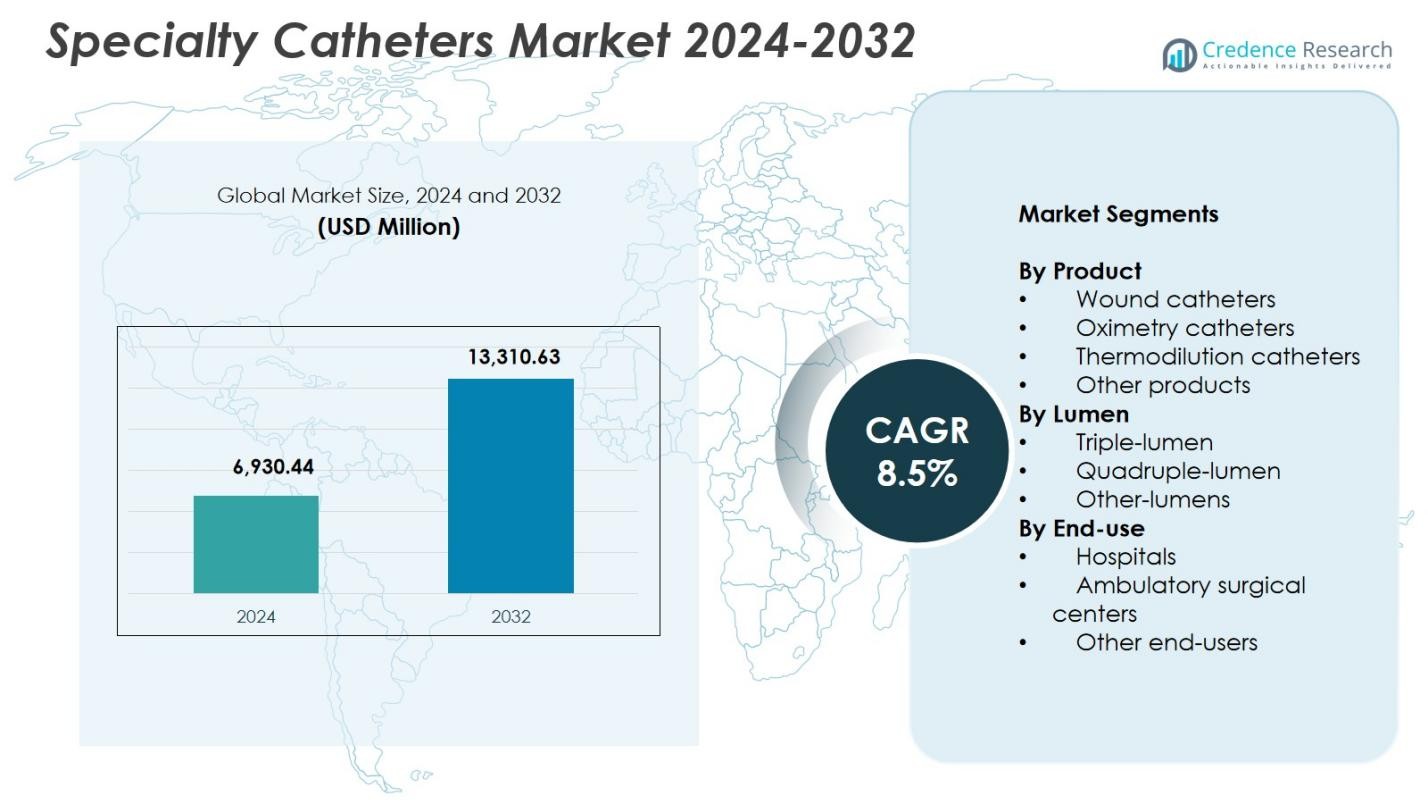
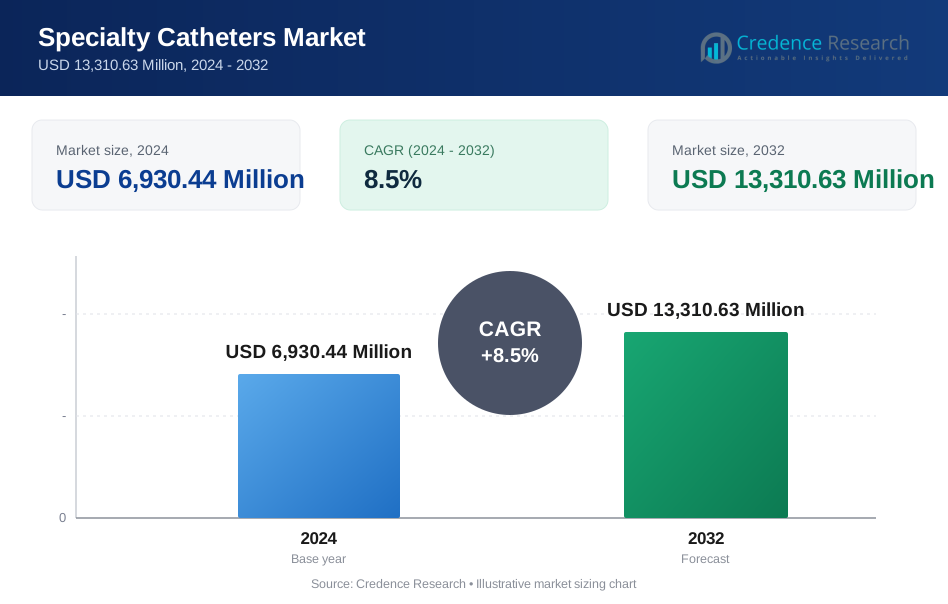
Specialty Catheters Market size was valued at USD 6,930.44 Million in 2024 and is anticipated to reach USD 13,310.63 Million by 2032, at a CAGR of 8.5% during the forecast period.
| REPORT ATTRIBUTE | DETAILS |
|---|---|
| Historical Period | 2020-2023 |
| Base Year | 2024 |
| Forecast Period | 2025-2032 |
| Specialty Catheters Market Size 2024 | USD 6,930.44 Million |
| Specialty Catheters Market , CAGR | 8.5% |
| Specialty Catheters Market Size 2032 | USD 13,310.63 Million |
Specialty Catheters Market features leading players such as Merit Medical Systems, Inc., Abbott, B. Braun, Medline, Edward Life Science Corporation, Hollister Incorporated, ICU Medical, Deroyal, Dyna Medical, and Bioptimal International Pte. Ltd., all focusing on advanced catheter technologies and expanded clinical applications. These companies strengthen their presence through product innovation, enhanced multi-lumen designs, and infection-resistant materials that support high-acuity care. Regionally, North America led the market with a 37.4% share in 2024, driven by strong healthcare infrastructure and high procedure volumes, while Europe and Asia-Pacific followed with accelerating demand from expanding critical care and surgical capacities.
Market Insights
- Specialty Catheters Market reached USD 6,930.44 Million in 2024 and will grow at a CAGR of 8.5% through 2032.
- Growth is driven by rising cardiovascular and chronic disease cases, increasing minimally invasive procedures, and strong adoption of thermodilution catheters, which held a 38.6% share in 2024.
- Key trends include rapid integration of smart monitoring catheters, advanced multi-lumen designs, and expanding use in high-acuity critical care settings across hospitals, which dominated with a 58.4% share.
- Major players such as Abbott, B. Braun, ICU Medical, Medline, and Merit Medical Systems, Inc. enhance market presence through innovation, capacity expansion, and product diversification.
- North America led with a 37.4% share, followed by Europe at 29.6% and Asia-Pacific at 23.1%, while Latin America and Middle East & Africa showed steady growth due to improving healthcare infrastructure.
Market Segmentation Analysis:
By Product:
In the Specialty Catheters Market, thermodilution catheters dominated the product segment with a 38.6% share in 2024, driven by their extensive adoption in cardiac output monitoring and critical care settings. The rising prevalence of cardiovascular diseases and the increasing demand for precise hemodynamic assessment support their strong uptake. Wound catheters and oximetry catheters also gained traction due to expanding minimally invasive procedures and enhanced postoperative drainage needs. Other product types continued to serve niche clinical applications, but thermodilution catheters maintained leadership due to their proven accuracy and strong integration into advanced monitoring systems.
- For instance, Teleflex's Arrow® Thermodilution Catheters feature four- and five-lumen designs with torque, flexi-torque, and flotation body firmness options for optimized insertion and fluid infusion during pressure and cardiac output measurements.
By Lumen:
The triple-lumen segment accounted for 46.2% of the Specialty Catheters Market in 2024, emerging as the dominant category owing to its higher flexibility in administering medications, performing sampling, and facilitating multiple simultaneous procedures. Their widespread use in intensive care units, emergency care, and complex surgeries significantly contributes to segment leadership. Quadruple-lumen catheters followed due to their utility in high-acuity environments requiring enhanced infusion capabilities. Other-lumen configurations continued to address specialized applications; however, rising demand for multifunctional access devices cemented the strong growth trajectory of triple-lumen catheters.
- For instance, Merit Medical's trio-ct® triple lumen catheter features a 17G independent lumen for power injection of contrast media at up to 5 mL/sec, alongside two dialysis lumens for short-term hemodialysis and apheresis in ICU patients requiring concurrent CVP monitoring and infusions.
By End-use:
The hospital segment held a commanding 58.4% share of the Specialty Catheters Market in 2024, supported by the large volume of surgical procedures, advanced critical care infrastructure, and higher adoption of premium catheter technologies. Hospitals benefit from improved procurement capabilities and continuous integration of advanced monitoring catheters, reinforcing their dominance. Ambulatory surgical centers captured notable demand as outpatient and day-care procedures increased globally. Other end-users, including specialty clinics and long-term care facilities, contributed steadily; however, hospitals maintained leadership due to high patient throughput and expanded interventional capabilities.
Key Growth Drivers
Rising Burden of Cardiovascular and Chronic Diseases
The growing incidence of cardiovascular disorders, diabetes, and chronic kidney disease continues to fuel demand for specialty catheters across diagnostic and therapeutic procedures. As hospitals increasingly prioritize early intervention and continuous monitoring, catheters such as thermodilution and oximetry devices play a central role in improving clinical outcomes. Expanded adoption of minimally invasive procedures further accelerates usage, as these catheters enable greater precision, reduced procedural risks, and faster recovery times. Together, these clinical needs strengthen long-term market growth and increase procedural volumes globally.
- For instance, BD's Swan-Ganz IQ Pulmonary Artery Catheters enable continuous monitoring of parameters including SvO2, CCO, SV, SVR, RVEF, and RVEDV for real-time oxygen delivery and right ventricle insights in complex cardiac cases.
Advances in Catheter Design and Material Technologies
The Specialty Catheters Market benefits from rapid advancements in material science, including biocompatible polymers, hydrophilic coatings, and shape-memory alloys that enhance flexibility, durability, and patient comfort. These innovations reduce infection risks, improve navigation through complex anatomies, and enhance performance in critical care applications. Manufacturers are increasingly integrating real-time sensing technologies and improved fluid management capabilities, expanding their utility in cardiology, oncology, and surgical care. Such technological improvements strengthen clinical confidence and drive higher adoption across both mature and emerging healthcare systems.
- For instance, Hydromer™ Hydrophilic Coatings from Hydromer provide superior lubricity and biocompatibility on catheters for cardiovascular and urological applications, reducing friction for smoother insertion while adhering to diverse substrates.
Expansion of Critical Care and Surgical Infrastructure
Global expansion of intensive care units, ambulatory surgical centers, and specialized treatment facilities continues to propel specialty catheter demand. Healthcare systems in developing regions are investing heavily in advanced monitoring tools and interventional capabilities, broadening the market base. Growth in cardiac surgeries, trauma care services, and complex infusion therapies further strengthens usage across high-acuity settings. Training programs and improved clinician familiarity also contribute to broader deployment, ensuring consistent demand for multifunctional and high-performance catheters.
Key Trends & Opportunities
Integration of Sensor-Based and Smart Monitoring Catheters
A major trend shaping the Specialty Catheters Market is the integration of embedded sensors and data-driven monitoring features. Smart catheters capable of measuring pressure, flow, and oxygen saturation in real time enhance diagnostic accuracy and procedural safety. This evolution enables precise hemodynamic assessment and supports personalized therapeutic interventions. The increasing shift toward AI-enabled monitoring platforms creates future opportunities for connected catheter systems, improving decision-making and reducing clinical complications, particularly in critical care and cardiac applications.
- For instance, Nuwellis' Aquadex SmartFlow System features an integrated hematocrit sensor for real-time percent blood volume change measurement alongside SvO2 monitoring to track tissue oxygen delivery.
Growing Adoption of Minimally Invasive and Outpatient Procedures
The rising preference for minimally invasive surgeries and outpatient interventions presents strong opportunities for specialized catheters designed for efficiency, lower trauma, and rapid recovery. Ambulatory surgical centers increasingly rely on catheters that support shorter procedure times and reduced hospital stays. As aging populations drive higher procedural volumes, demand grows for catheters optimized for vascular access, drainage, and continuous monitoring. Product innovations that improve ease of insertion and reduce postoperative complications further expand opportunities in both high-income and emerging healthcare markets.
- For instance, Catheter Precision's LockeT suture retention device achieves 98% hemostasis two hours post-removal, supporting same-day discharge after cardiac ablation by simplifying wound closure for catheters up to 27F.
Key Challenges
Risk of Catheter-Associated Infections and Complications
Despite technological advancements, catheter-associated infections and procedural complications remain a significant restraint in the Specialty Catheters Market. Hospitals must adhere to strict sterilization and insertion protocols, increasing operational burdens and limiting product adoption in resource-constrained settings. Complications such as thrombosis, device occlusion, and tissue irritation also affect clinical outcomes and may reduce clinician confidence. These risks drive demand for improved coatings and antimicrobial materials but continue to pose compliance and safety challenges across diverse end-use environments.
High Cost of Advanced Catheters and Limited Access in Developing Regions
The high cost of specialty catheters, particularly sensor-enabled and multi-lumen variants, poses barriers to widespread adoption, especially in low- and middle-income countries. Limited reimbursement frameworks and strained healthcare budgets restrict procurement of advanced devices, slowing market penetration. Additionally, inadequate training and shortage of skilled personnel constrain effective use of complex catheter technologies. These economic and infrastructural constraints create disparities in adoption rates, hindering market expansion despite rising global demand for advanced interventional and monitoring solutions.
Regional Analysis
North America
North America dominated the Specialty Catheters Market with a 37.4% share in 2024, driven by strong healthcare infrastructure, high adoption of advanced interventional procedures, and substantial investment in critical care technologies. The region benefits from a large patient base with cardiovascular and chronic illnesses, supporting demand for thermodilution, oximetry, and multi-lumen catheters. Growing preference for minimally invasive procedures and rapid integration of smart catheter technologies strengthen market expansion. The presence of leading manufacturers and favorable reimbursement frameworks further enhance utilization across hospitals and ambulatory surgical centers.
Europe
Europe accounted for 29.6% of the Specialty Catheters Market in 2024, supported by rising procedural volumes, strong clinical adoption of advanced monitoring tools, and well-established regulatory systems emphasizing patient safety. Demand is reinforced by high prevalence of chronic diseases such as heart failure and respiratory disorders, which accelerate utilization across intensive care and surgical environments. Continuous investments in digital health and training programs enhance clinician proficiency in specialized catheter applications. Additionally, expanding interventional cardiology and oncology services contribute to steady market growth across major European nations.
Asia-Pacific
Asia-Pacific held a 23.1% share of the Specialty Catheters Market in 2024, emerging as the fastest-growing region due to expanding healthcare infrastructure, rising critical care capacity, and increasing adoption of advanced minimally invasive procedures. Growing populations and higher prevalence of cardiovascular and metabolic diseases significantly drive demand for specialty catheters across hospitals and surgical centers. Government initiatives aimed at strengthening emergency care and improving access to high-tech medical devices further support market penetration. Rapid urbanization and rising medical tourism also contribute to increasing procedure volumes and broader product utilization.
Latin America
Latin America captured a 6.8% share of the Specialty Catheters Market in 2024, with growth supported by increasing investment in public and private healthcare facilities. Higher demand for cardiovascular and surgical interventions drives adoption of multi-lumen and thermodilution catheters across hospitals. Although resource limitations and uneven access to advanced technologies restrain rapid expansion, rising medical training programs and gradual modernization of intensive care units enhance future market potential. Countries such as Brazil and Mexico lead regional demand due to improving infrastructure and rising chronic disease prevalence.
Middle East & Africa
The Middle East & Africa region accounted for 3.1% of the Specialty Catheters Market in 2024, driven by ongoing improvements in tertiary care facilities and rising demand for advanced monitoring devices in high-acuity settings. Growth is concentrated in Gulf countries where investments in cardiovascular care and surgical infrastructure are expanding. However, limited reimbursement systems and constrained access to high-cost specialty catheters in several African nations hinder broader adoption. Increasing partnerships with global manufacturers and government initiatives to enhance critical care capabilities support steady, long-term market development.
Market Segmentations:
By Product
- Wound catheters
- Oximetry catheters
- Thermodilution catheters
- Other products
By Lumen
- Triple-lumen
- Quadruple-lumen
- Other-lumens
By End-use
- Hospitals
- Ambulatory surgical centers
- Other end-users
By Geography
- North America
- U.S.
- Canada
- Mexico
- Europe
- Germany
- France
- U.K.
- Italy
- Spain
- Rest of Europe
- Asia Pacific
- China
- Japan
- India
- South Korea
- South-east Asia
- Rest of Asia Pacific
- Latin America
- Brazil
- Argentina
- Rest of Latin America
- Middle East & Africa
- GCC Countries
- South Africa
- Rest of the Middle East and Africa
Competitive Landscape
The Specialty Catheters Market analysis highlights leading players including Abbott, B. Braun, Bioptimal International Pte. Ltd., Deroyal, Dyna Medical, Edward Life Science Corporation, Hollister Incorporated, ICU Medical, Medline, and Merit Medical Systems, Inc. These companies focus on expanding their product portfolios, enhancing catheter performance, and integrating advanced materials to strengthen clinical outcomes. Continuous innovations in multi-lumen configurations, infection-resistant coatings, and sensor-enabled monitoring technologies help manufacturers differentiate their offerings. Strategic initiatives such as product launches, capacity expansions, and collaborations with healthcare institutions further reinforce their industry position. Rising demand for thermodilution and oximetry catheters encourages players to invest in R&D and regulatory approvals. Additionally, global distribution networks and strong relationships with hospitals and surgical centers enable sustained market visibility, while increasing adoption of minimally invasive procedures presents further growth opportunities for established and emerging companies.
Key Player Analysis
- Merit Medical Systems, Inc.
- Abbott
- Dyna Medical
- Medline
- Edward Life Science Corporation
- Hollister Incorporated
- ICU Medical
- Deroyal
- Bioptimal International Pte. Ltd.
- B Braun
Recent Developments
- In January 2025, Argon Medical acquired the SeQure® and DraKon™ microcatheters from Accurate Medical Therapeutics to expand its oncology interventional portfolio with therapeutic delivery options.
- In January 2025, B. Braun Medical Inc. introduced the Clik-FIX Epidural/Peripheral Nerve Block Catheter Securement Device to reduce catheter displacement risks during regional anesthesia procedures.
- In May 2025, Catheter Precision, Inc. completed the acquisition of Cardionomic's heart failure assets to broaden its product offerings in cardiac treatments.
Report Coverage
The research report offers an in-depth analysis based on Product, Lumen, End Use and Geography. It details leading market players, providing an overview of their business, product offerings, investments, revenue streams, and key applications. Additionally, the report includes insights into the competitive environment, SWOT analysis, current market trends, as well as the primary drivers and constraints. Furthermore, it discusses various factors that have driven market expansion in recent years. The report also explores market dynamics, regulatory scenarios, and technological advancements that are shaping the industry. It assesses the impact of external factors and global economic changes on market growth. Lastly, it provides strategic recommendations for new entrants and established companies to navigate the complexities of the market.
Future Outlook
- The market will experience sustained growth driven by rising cardiovascular and chronic disease burdens.
- Adoption of minimally invasive and image-guided procedures will continue to accelerate catheter utilization.
- Smart and sensor-enabled catheters will gain strong traction across critical care and surgical applications.
- Multi-lumen catheter demand will increase as hospitals prioritize multifunctional access devices.
- Improved biocompatible materials and antimicrobial coatings will drive product innovation.
- Emerging markets will expand rapidly with rising healthcare investments and ICU capacity.
- Outpatient and ambulatory surgical centers will contribute significantly to procedural volume growth.
- Partnerships between manufacturers and healthcare providers will enhance technology integration.
- Regulatory focus on safety and infection control will accelerate adoption of advanced catheter designs.
- Training programs and clinician upskilling will strengthen global penetration of specialty catheter technologies.
Request a Free Sample
Fill in your details and we'll send you a free sample report.
- Sample data tables & charts
- Research methodology
Need a Custom Version of This Report?
Tailor the scope, geography, or segments to your exact requirements.
- Custom geography or segment scope
- Direct access to our analyst team
Frequently Asked Questions
What is the current market size for Specialty Catheters Market, and what is its projected size in 2032?
At what Compound Annual Growth Rate is the Specialty Catheters Market projected to grow between 2024 and 2032?
Which Specialty Catheters Market segment held the largest share in 2024?
What are the primary factors fueling the growth of the Specialty Catheters Market?
Who are the leading companies in the Specialty Catheters Market?
Which region commanded the largest share of the Specialty Catheters Market in 2024?
Table of Content
Chapter 1. Report Introduction
- 1.1 Report Description & Purpose
- 1.1.1 Report Title & Market Definition
- 1.1.2 Unique Selling Propositions (USP) & Key Differentiators
- 1.1.3 Value Proposition for Stakeholders
- 1.2 Research Objectives
- 1.2.1 Market Sizing Objectives (Volume & Revenue)
- 1.2.2 Segmentation Objectives
- 1.2.3 Competitive Intelligence Objectives
- 1.2.4 Forecast & Scenario Objectives
- 1.3 Report Scope
- 1.3.1 Specialty Catheters Scope – Types & Subtypes Covered
- 1.3.2 Geographic Scope – Regions & Countries Covered
- 1.3.3 Historical Period, Base Year & Forecast Period (2024; forecast to 2032)
- 1.3.4 Inclusions & Exclusions
- 1.4 HS Code & Classification Framework
- 1.5 Currency, Units & Pricing Basis
- 1.6 Target Stakeholders
- 1.7 Limitations & Assumptions
Chapter 2. Executive Summary
- 2.1 Global Specialty Catheters Market Snapshot
- 2.1.1 Market Size – Historical (2024) & Forecast (2024-2032) (2024: USD 6,930.44 Million → 2032: USD 13,310.63 Million)
- 2.1.2 Volume & Revenue – Global Totals
- 2.1.3 Key Market Highlights – Top Five Facts
- 2.2 Specialty Catheters Market Segmentation Snapshot
- 2.2.1 Market Split by Region – 2024 vs. 2032
- 2.3 Competitive Snapshot
- 2.3.1 Top 10 Players by Revenue Share – 2024
- 2.3.2 Top 10 Players by Volume Share – 2024
- 2.3.3 Recent Strategic Developments (18-Month Summary)
- 2.4 Key Investment Highlights & Strategic Conclusions
Chapter 3. Specialty Catheters Market Dynamics & Industry Analysis
- 3.1 Market Overview & Context
- 3.1.1 Specialty Catheters Market Position in the Broader Automotive Value Chain
- 3.1.2 OEM vs. Replacement Market Dynamics
- 3.1.3 Market Maturity & Development Stage by Region
- 3.2 Specialty Catheters Market Drivers
- 3.3 Specialty Catheters Market Restraints & Challenges
- 3.4 Specialty Catheters Market Opportunities
- 3.5 Porter's Five Forces Analysis
- 3.5.1 Threat of New Entrants
- 3.5.2 Bargaining Power of Suppliers
- 3.5.3 Bargaining Power of Buyers
- 3.5.4 Threat of Substitutes
- 3.5.5 Competitive Rivalry – Intensity Assessment
- 3.6 Specialty Catheters Value Chain Analysis
- 3.6.1 Upstream – Raw Material/Input Suppliers
- 3.6.1.1 Raw Material/Input 1
- 3.6.1.2 Raw Material/Input 2
- 3.6.1.3 Raw Material/Input 3
- 3.6.2 Midstream – Production/Manufacturing/Service Delivery
- 3.6.2.1 Production/Process Overview
- 3.6.2.2 Key Facility Locations & Capacity by Manufacturer
- 3.6.3 Downstream – Distribution & End Consumer
- 3.6.3.1 Primary Channel – B2B/OEM
- 3.6.3.2 Secondary Channels – Dealer, Retail, Online, Direct
- 3.6.4 Value Chain Profitability Analysis
- 3.6.1 Upstream – Raw Material/Input Suppliers
- 3.7 PESTEL Analysis
- 3.7.1 Political Factors
- 3.7.2 Economic Factors
- 3.7.3 Social Factors
- 3.7.4 Technological Factors
- 3.7.5 Environmental Factors
- 3.7.6 Legal Factors
- 3.8 Specialty Catheters Supply Chain Analysis
- 3.8.1 Raw Material/Input Supply Risk Assessment
- 3.8.2 Manufacturing Concentration Risk (Geographic Exposure)
- 3.8.3 Trade Disruption Impact Analysis
- 3.9 Regulatory & Policy Landscape
Note: The regulatory and policy landscape section covers regulations based on their applicability to the market, Specialty Catheters category, geography, and scope of the study. Only regulatory frameworks with a material impact on operations, compliance, trade, sustainability, or market access are analyzed in detail.
Chapter 4. Key Investment Pockets & Opportunity Analysis
- 4.1 Specialty Catheters Market Attractiveness Analysis
- 4.1.1 By Region – Investment Attractiveness Matrix (Volume × CAGR)
- 4.2 Absolute Revenue Growth Opportunity
- 4.2.1 By Region – Absolute USD Growth Through 2032
- 4.3 Incremental Volume Opportunity
- 4.3.1 By Region – Incremental Volume Through 2032
- 4.3.2 Segment – Incremental Volume
- 4.4 Emerging Submarket Opportunity Deep Dive (Subject to Applicability)
- 4.5 Emerging Market Opportunity Scorecards
- 4.5.1 United States
- 4.5.2 Europe
- 4.5.3 Asia
- 4.5.4 Middle East & Africa
Note: Emerging Market Opportunity Scorecards will be included based on relevance and strategic importance. Regions listed are indicative and may vary depending on data availability and market dynamics.
Chapter 5. Specialty Catheters Import-Export Analysis & Trade Flows
- 5.1 Global Trade Overview
- 5.1.1 Global Export Value by Country (2024)
- 5.1.2 Global Export Volume by Country (2024)
- 5.1.3 Global Import Value by Country (2024)
- 5.1.4 Global Import Volume by Country (2024)
- 5.1.5 Net Trade Balance by Country (2024)
- 5.2 Export Analysis – Segment
- 5.2.1 Type 1 (HS Code)
- 5.2.2 Type 2 (HS Code)
- 5.2.3 Type 3 (HS Code)
- 5.2.4 Type 4 (HS Code)
- 5.2.5 Type 5 (HS Code)
- 5.3 Import Analysis – Segment
- 5.3.1 Type 1 (HS Code)
- 5.3.2 Type 2 (HS Code)
- 5.3.3 Type 3 (HS Code)
- 5.3.4 Type 4 (HS Code)
- 5.3.5 Type 5 (HS Code)
- 5.4 Average Unit Trade Prices
- 5.4.1 Average Export Price – Segment & Country
- 5.4.2 Average Import Price – Segment & Source Country
- 5.4.3 Price Trends (2024)
- 5.5 Key Trade Route Analysis
- 5.5.1 Trade Route 1
- 5.5.2 Trade Route 2
- 5.5.3 Trade Route 3
- 5.5.4 Trade Route 4
- 5.5.5 Trade Route 5
- 5.6 Trade Policy Impact Assessment
- 5.6.1 US Anti-Dumping & Section 301 Tariffs
- 5.6.2 EU Customs Union Impact
- 5.6.3 Major Free Trade Agreements
- 5.6.4 USMCA Rules of Origin
Note: Trade policy analysis will be included only where relevant to the Specialty Catheters market.
Chapter 6. Competitive Landscape & Company Benchmarking
- 6.1 Specialty Catheters Market Concentration & Structure
- 6.1.1 Herfindahl-Hirschman Index (HHI) – vs. 2024
- 6.1.2 Tier 1, Tier 2 & Tier 3 Market Structure
- 6.1.3 Global, Regional & Local Player Dynamics
- 6.2 Specialty Catheters Market Share Analysis – 2024
- 6.2.1 Global Revenue Share by Company
- 6.2.2 Global Volume Share by Company
- 6.2.3 Regional Revenue Share
- 6.2.4 Market Share Evolution ( vs. 2024)
- 6.2.5 OEM Segment Share by Company
- 6.2.6 Replacement Segment Share by Company
- 6.3 Production/Delivery Capacity & Facility Analysis
- 6.3.1 Global Installed Capacity
- 6.3.2 Capacity Utilization Rates
- 6.3.3 Production/Output Volume
- 6.3.4 Facility Locations & Capacity Map
- 6.3.5 Planned Capacity Additions
- 6.4 Specialty Catheters Competitive Benchmarking Matrix
- 6.4.1 Revenue, Volume, CAGR & Profitability Comparison
- 6.4.2 Channel Revenue Mix
- 6.4.3 Geographic Revenue Exposure
- 6.4.4 R&D Intensity
- 6.4.5 Sustainability Maturity
- 6.5 Strategic Developments in Specialty Catheters (Last 24 Months)
- 6.5.1 Mergers, Acquisitions & Divestments
- 6.5.2 New Specialty Catheters Launches
- 6.5.3 Facility Expansions
- 6.5.4 Strategic Alliances, Joint Ventures & Partnerships
- 6.5.5 Distribution Expansion & Market Entry
- 6.5.6 Sustainability & ESG Initiatives
- 6.6 Competitive Strategy Mapping
- 6.6.1 Leader, Challenger, Follower & Niche Classification
- 6.6.2 Pricing Strategy Comparison
- 6.6.3 Channel Strategy Matrix
Note: Strategic developments are included based on their materiality and the availability of reliable information.
Chapter 7. Global Specialty Catheters Market – By Distribution Channel
- 7.1 Segment Overview
- 7.1.1 Volume & Revenue Split by Channel (2024 & 2032)
- 7.1.2 Channel Mix Evolution (2024-2032)
Chapter 8. Regional Market Analysis – Global Overview
- 8.1 Global Regional Overview
- 8.1.1 Regional Volume Share
- 8.1.2 Regional Revenue Share
- 8.1.3 Regional Volume by Region
- 8.1.4 Regional Revenue by Region
- 8.1.5 Regional Forecast Through 2032
- 8.2 Cross-Regional Segment Analysis
- 8.2.1 By Distribution Channel
- 8.2.2 By Brand/Price Tier
Chapter 9. North America Specialty Catheters Market
- 9.1 United States
- 9.2 Canada
- 9.3 Mexico
Chapter 10. Europe Specialty Catheters Market
- 10.1 Germany
- 10.2 France
- 10.3 Italy
- 10.4 United Kingdom
- 10.5 Spain
- 10.6 Poland
- 10.7 Russia
- 10.8 Netherlands
- 10.9 Belgium
- 10.10 Sweden
- 10.11 Denmark
- 10.12 Norway
- 10.13 Rest of Europe
Chapter 11. Asia Pacific Specialty Catheters Market
- 11.1 China
- 11.2 India
- 11.3 Japan
- 11.4 South Korea
- 11.5 Thailand
- 11.6 Indonesia
- 11.7 Vietnam
- 11.8 Malaysia
- 11.9 Australia
- 11.10 Rest of Asia Pacific
Chapter 12. Latin America Specialty Catheters Market
- 12.1 Brazil
- 12.2 Argentina
- 12.3 Colombia
- 12.4 Chile
- 12.5 Rest of Latin America
Chapter 13. Middle East Specialty Catheters Market
- 13.1 Saudi Arabia
- 13.2 United Arab Emirates
- 13.3 Turkey
- 13.4 Israel
- 13.5 Iran
- 13.6 Rest of the Middle East
Chapter 14. Africa Specialty Catheters Market
- 14.1 South Africa
- 14.2 Egypt
- 14.3 Nigeria
- 14.4 Morocco
- 14.5 Rest of Africa
Chapter 15. Specialty Catheters Company Profiles
- 15.1 [Company 01]
- 15.1.1 Company Overview
- 15.1.2 Key Management Personnel
- 15.1.3 Products & Services Portfolio
- 15.1.4 Financial Performance
- 15.1.5 Key Market Focus & Geographic Presence
- 15.1.6 Recent Developments & Strategic Initiatives
Note: The company profile list is preliminary and may change based on research findings, market developments, data availability, and client requirements.
Chapter 16. Appendices
- Appendix A – List of Abbreviations & Acronyms
- Appendix B – Industry Classification Code Reference – Full Series
- Appendix C – Production & Capacity Data Tables
- Appendix D – End-Use & Demand Base Tables
- Appendix E – Consumption & Replacement Rate Assumptions
- Appendix F – ASP Reference Tables
- Appendix G – Manufacturing & Facility Database
- Appendix H – Import-Export Data Tables
- Appendix I – Regulatory Summary Tables
- Appendix J – Primary Research Participant List (Anonymized)
- Appendix K – Primary Research Questionnaire Framework
- Appendix L – Data Sources & Bibliography
- Appendix M – Market Size Divergence & Source Comparison
Chapter 17. Research Methodology
- 17.1 Research Framework & Philosophy
- 17.2 Secondary Research – Sources, Hierarchy & Data Extraction
- 17.3 Data Modeling – Bottom-Up & Top-Down Market Sizing
- 17.4 Primary Research – Stakeholder Framework, LOI & Sample Sizes
- 17.5 Forecast Methodology – Regression, Scenario & Sensitivity Analysis
- 17.6 Quality Control – Four-Layer Validation Framework
- 17.7 Limitations & Standard Assumptions
- 17.8 Disclaimer
