
Market Overview
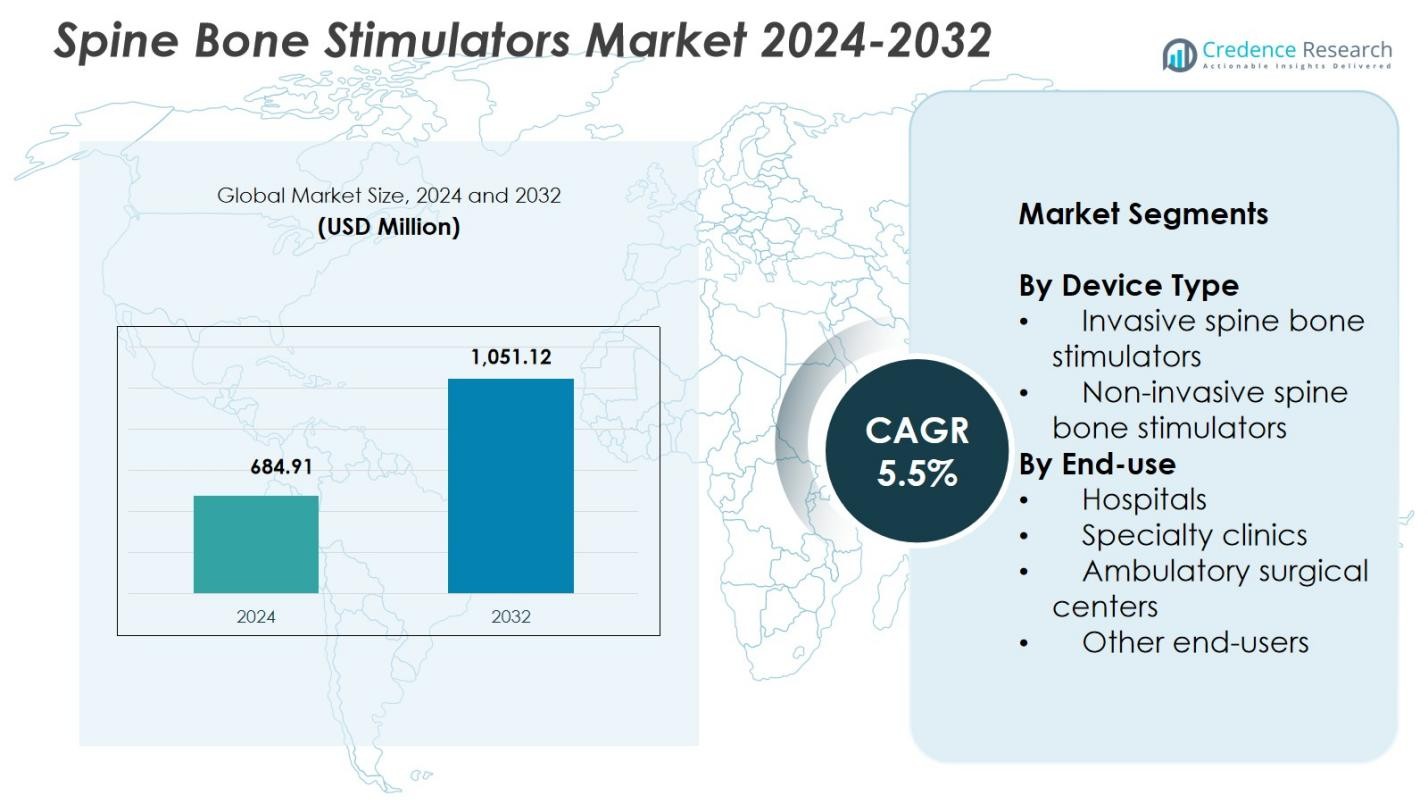
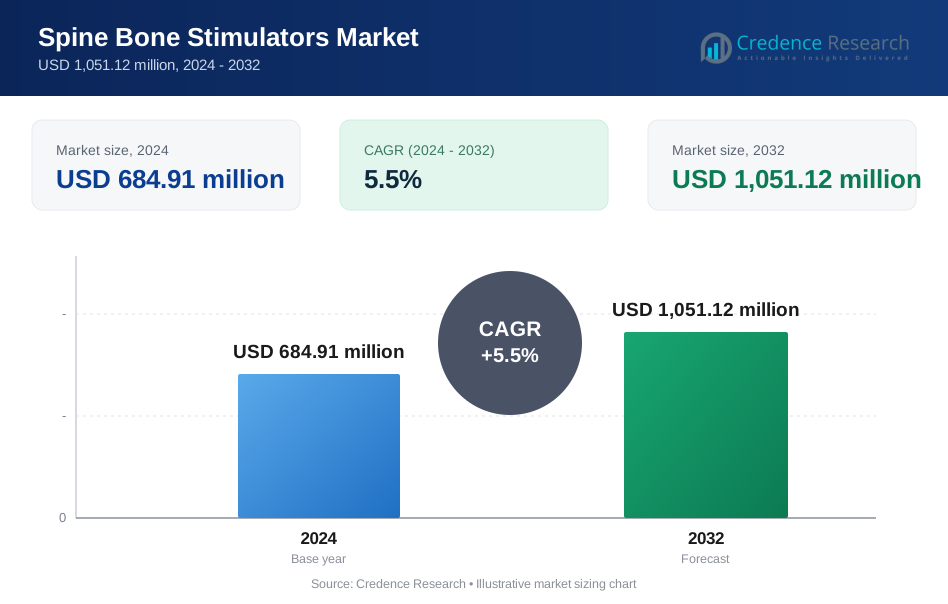
Spine Bone Stimulators Market size was valued at USD 684.91 million in 2024 and is anticipated to reach USD 1,051.12 million by 2032, at a CAGR of 5.5% during the forecast period.
| REPORT ATTRIBUTE | DETAILS |
|---|---|
| Historical Period | 2020-2023 |
| Base Year | 2024 |
| Forecast Period | 2025-2032 |
| Spine Bone Stimulators Market Size 2024 | USD 684.91 Million |
| Spine Bone Stimulators Market, CAGR | 5.5% |
| Spine Bone Stimulators Market Size 2032 | USD 1,051.12 Million |
Spine Bone Stimulators Market features leading companies such as Bioventus, ZimVie Inc., Enovis, Medtronic plc, Orthofix Medical Inc., Theragen Inc., Synergy Orthopedics, Ossatec Benelux BV, IGEA S.p.A., and Elizur Corporation that drive innovation across invasive and non-invasive stimulation technologies. These players focus on enhancing device efficacy, expanding non-invasive offerings, and integrating remote monitoring capabilities to support improved spinal fusion outcomes. North America leads the Spine Bone Stimulators Market with a 41.6% share in 2024, supported by strong procedure volumes, advanced healthcare infrastructure, and high adoption of digital-enabled bone healing solutions. Europe and Asia-Pacific follow as significant growth regions.
Market Insights
- Spine Bone Stimulators Market was valued at USD 684.91 million in 2024 and is projected to reach USD 1,051.12 million by 2032, registering a CAGR of 5.5%.
- Rising spinal fusion procedures and increasing prevalence of degenerative spine disorders drive demand, with non-invasive stimulators leading the market at a 63.4% share due to strong clinical adoption and patient convenience.
- Key trends include rapid integration of remote monitoring, growing use of home-based therapy models, and advancements in PEMF and ultrasound-based stimulation technologies that enhance treatment precision and compliance.
- Major players such as Bioventus, ZimVie Inc., Enovis, Medtronic, Orthofix Medical Inc., and Theragen Inc. strengthen market presence through product innovation, partnerships with healthcare providers, and expansion into emerging economies.
- North America leads with a 41.6% share, followed by Europe at 28.4% and Asia-Pacific at 20.7%, reflecting strong regional adoption supported by advanced care infrastructure and growing awareness of bone healing therapies.
Market Segmentation Analysis:
By Device Type:
In the Spine Bone Stimulators Market, non-invasive spine bone stimulators dominate with a market share of 63.4% in 2024, supported by strong adoption due to their ease of use, lower risk profile, and suitability for outpatient settings. These devices gain traction as they eliminate surgical complications and enable routine home-based therapy, improving patient compliance in spinal fusion and fracture healing. Increasing clinical preference for external electrical and ultrasound-based bone stimulation, along with expanding reimbursement support, further accelerates segment growth. Invasive stimulators continue to serve complex cases, but overall demand remains led by non-invasive technologies.
- For instance, Orthofix's SpinalStim device uses Pulsed Electromagnetic Field (PEMF) technology to generate a low-level electric field, promoting spinal fusion as a non-surgical adjunct treatment.
By End-use:
Hospitals lead the Spine Bone Stimulators Market with a 48.7% share in 2024, driven by high patient inflow for spinal fusion procedures, trauma care, and post-operative rehabilitation. Hospitals benefit from advanced surgical infrastructure, multidisciplinary care teams, and higher utilization of both invasive and non-invasive stimulators, supporting strong segment leadership. Rising adoption of bone stimulation therapy for degenerative spine disorders and growing preference for hospital-based treatment pathways further strengthen dominance. Specialty clinics and ambulatory surgical centers also experience steady growth as minimally invasive procedures increase, but hospitals remain the primary end-use setting.
- For instance, Zimmer Biomet's SpinalPak Non-invasive Spine Fusion Stimulator System showed 92.7% clinical or radiological healing in posterolateral fusions and 84.7% overall success versus 64.9% placebo in lumbar fusions.
Key Growth Drivers
Rising Prevalence of Spinal Disorders
The Spine Bone Stimulators Market grows significantly as the global burden of spinal degenerative diseases, fractures, and non-union cases increases. Rising incidences of osteoporosis-related complications and trauma injuries drive greater adoption of bone stimulation therapies across clinical settings. Healthcare providers increasingly integrate bone stimulators into post-surgical care for spinal fusion procedures to enhance healing and reduce revision surgery rates. The growing elderly population, which faces a higher risk of delayed bone healing, further strengthens the demand for advanced stimulation technologies.
- For instance, the Orthofix SpinalStim™ device demonstrated a 92% overall success rate in clinical studies for spinal fusion surgery patients, significantly reducing the need for revision surgeries and improving healing outcomes in real-world use.
Advancements in Non-Invasive Bone Stimulation Technologies
Technological innovation strongly accelerates market expansion, particularly in non-invasive bone stimulators that offer improved patient comfort, portability, and therapeutic precision. Advancements in pulsed electromagnetic field (PEMF) therapy, capacitive coupling, and low-intensity ultrasound systems enhance treatment outcomes and appeal to both patients and clinicians. These technologies reduce procedure time, eliminate surgical risks, and support remote or home-based therapy models. Continuous R&D investments by manufacturers strengthen device efficacy, enabling broader adoption across chronic non-union fractures and spinal fusion recovery.
- For instance, BTT Health's bone4ce device applies low-intensity pulsed ultrasound at 30 mW/cm² and 1.5 MHz to stimulate calcium channel opening in bone tissues at the fracture gap.
Increasing Volume of Spinal Fusion Surgeries
The rising number of spinal fusion surgeries directly fuels demand for bone stimulators that support faster healing and minimize post-operative complications. Hospitals and specialty clinics increasingly use bone stimulation devices for high-risk patients, including smokers, diabetics, and individuals with comorbidities that slow bone regeneration. The expanding use of minimally invasive spine surgeries also contributes to higher stimulator utilization, as faster recovery expectations align with non-invasive stimulation benefits. Growing clinical evidence supporting improved fusion success rates continues to reinforce market adoption.
Key Trends & Opportunities
Growing Adoption of Home-Based and Remote Healing Therapies
A notable trend shaping the market is the shift toward home-based treatment models supported by portable and patient-friendly non-invasive bone stimulators. Healthcare systems increasingly promote remote therapeutic monitoring to reduce hospital visits, cut overall care costs, and improve patient compliance. Digital-enabled devices with data tracking and clinician connectivity provide enhanced oversight of treatment progress. This transition opens strong opportunities for manufacturers to integrate smart health platforms, expand telehealth partnerships, and introduce personalized healing protocols to meet evolving patient needs.
- For instance, DJO's CMF Spinalogic is a lightweight, battery-powered electromagnetic stimulator designed for home use over casts or braces post-lumbar spinal fusion, featuring one-button operation for easy patient compliance during daily routines.
Expansion in Emerging Markets Through Improved Access and Awareness
Emerging economies present strong growth opportunities as awareness of bone healing technologies increases and healthcare investment rises. Improving access to advanced orthopedic care, expanding insurance coverage, and rising patient willingness to adopt innovative therapies contribute to greater market penetration. Governments and private healthcare providers prioritize modernizing spine surgery infrastructure, creating favorable conditions for device adoption. Manufacturers expanding distribution networks and partnering with regional medical institutions can capitalize on unmet clinical needs and growing demand for non-invasive spinal healing solutions.
- For instance, Orthofix launched the STIM onTrack mobile app compatible with its Bone Growth Therapy devices like SpinalStim and PhysioStim, delivering treatment reminders to boost patient adherence in regions with rising orthopedic procedures.
Key Challenges
High Cost of Advanced Bone Stimulators
The high cost of spine bone stimulators, especially technologically advanced non-invasive devices, remains a major barrier to widespread adoption. Limited reimbursement in several regions and high out-of-pocket expenses deter patients from seeking bone stimulation therapy. Healthcare providers, particularly in resource-constrained markets, may prioritize alternative treatment methods due to budget limitations. These financial constraints slow market expansion and restrict access to effective healing technologies, emphasizing the need for cost-optimized solutions and broader reimbursement support.
Limited Clinical Awareness and Inconsistent Adoption Rates
In many regions, a lack of clinical awareness regarding the benefits, indications, and comparative effectiveness of bone stimulators leads to inconsistent adoption across healthcare settings. Some clinicians remain uncertain about long-term outcomes or prefer conventional healing pathways, reducing device utilization. Variability in training, access to evidence-based guidelines, and patient education gaps further contribute to slow uptake. Strengthening clinical education, generating robust real-world data, and enhancing physician–patient engagement are essential to overcoming hesitancy and driving widespread market adoption.
Regional Analysis
North America
North America leads the Spine Bone Stimulators Market with a 41.6% share in 2024, supported by advanced healthcare infrastructure, strong reimbursement frameworks, and high adoption of non-invasive stimulation technologies. The region benefits from a significant volume of spinal fusion procedures driven by a growing elderly population and high prevalence of degenerative spine conditions. Continuous technological innovation by leading manufacturers and strong clinician acceptance further reinforce regional dominance. Expanding home-based therapy models and increasing integration of digital monitoring solutions also contribute to sustained market growth.
Europe
Europe holds a 28.4% share of the Spine Bone Stimulators Market in 2024, driven by rising demand for minimally invasive treatments and structured care pathways for spinal disorders. The region benefits from strong orthopedic expertise, wide availability of advanced diagnostic systems, and growing emphasis on enhancing post-surgical outcomes. Increasing adoption of non-invasive bone stimulators in Germany, the U.K., France, and Italy fuels market expansion. Supportive reimbursement policies in developed countries and rising awareness of fusion success optimization strengthen Europe’s position as a key market for bone stimulation solutions.
Asia-Pacific
Asia-Pacific accounts for a 20.7% share of the Spine Bone Stimulators Market in 2024 and represents the fastest-growing region due to rising healthcare investments, expanding spine surgery volumes, and growing acceptance of advanced therapeutic devices. Countries such as China, India, Japan, and South Korea increasingly adopt bone stimulators amid rising incidences of spinal injuries and degenerative diseases. Improvements in healthcare access, favorable government initiatives, and increasing patient awareness support strong regional momentum. Manufacturers expanding distribution networks gain significant opportunities across both urban and emerging healthcare settings.
Latin America
Latin America captures a 5.6% share of the Spine Bone Stimulators Market in 2024, driven by gradual improvements in healthcare infrastructure and increasing adoption of advanced orthopedic treatments. Brazil and Mexico lead regional demand due to higher procedure volumes and strengthening availability of non-invasive stimulators. Growing partnerships between medical device manufacturers and regional healthcare providers enhance market penetration. Despite challenges such as limited reimbursement and cost constraints, rising awareness of fusion-enhancing technologies and expanding private healthcare investments support steady regional growth.
Middle East & Africa
The Middle East & Africa region holds a 3.7% share of the Spine Bone Stimulators Market in 2024, supported by ongoing advancements in healthcare modernization and rising demand for effective spinal healing therapies. Gulf countries, particularly the UAE and Saudi Arabia, drive adoption due to expanding specialty orthopedic centers and increasing medical tourism. Growing prevalence of trauma-related spinal injuries and chronic spine disorders further stimulates market interest. Although affordability and access gaps persist in several African nations, improving healthcare expenditure and awareness contribute to gradual market expansion.
Market Segmentations:
By Device Type
- Invasive spine bone stimulators
- Non-invasive spine bone stimulators
By End-use
- Hospitals
- Specialty clinics
- Ambulatory surgical centers
- Other end-users
By Geography
- North America
- U.S.
- Canada
- Mexico
- Europe
- Germany
- France
- U.K.
- Italy
- Spain
- Rest of Europe
- Asia Pacific
- China
- Japan
- India
- South Korea
- South-east Asia
- Rest of Asia Pacific
- Latin America
- Brazil
- Argentina
- Rest of Latin America
- Middle East & Africa
- GCC Countries
- South Africa
- Rest of the Middle East and Africa
Competitive Landscape
The Spine Bone Stimulators Market features a diverse and innovation-driven competitive landscape, with key players including Bioventus, ZimVie Inc., Enovis, Medtronic plc, Orthofix Medical Inc., Theragen Inc., Synergy Orthopedics, Ossatec Benelux BV, IGEA S.p.A., and Elizur Corporation leading advancements across both invasive and non-invasive stimulation technologies. Companies focus heavily on expanding non-invasive product portfolios, enhancing PEMF and ultrasound-based devices, and integrating digital health capabilities to strengthen treatment monitoring. Strategic initiatives such as clinical trials, product upgrades, geographic expansion, and physician outreach programs are central to sustaining market leadership. Partnerships with hospitals and specialty clinics support wider adoption, while R&D investments aim to improve efficacy for complex spinal fusion cases and non-union fractures. Competitive differentiation increasingly centers on device portability, patient adherence features, and reimbursement support, enabling leading manufacturers to reinforce their position in a rapidly evolving therapeutic landscape.
Key Player Analysis
- Synergy Orthopedics
- ZimVie Inc.
- Enovis (DJO Global, Inc.)
- Ossatec Benelux BV
- Medtronic plc
- Theragen, Inc. (Neurotech NA Inc.)
- Orthofix Medical Inc.
- IGEA S.p.A.
- Elizur Corporation
- Bioventus
Recent Developments
- In July 2025, Enovis launched the portable, battery-operated LIPUS device Manafuse Bone Growth Stimulator, aimed at accelerating fracture and non-union healing.
- In June 2025, Avista Healthcare Partners acquired EBI from Highridge Medical, establishing EBI as a pure-play company focused on bone growth stimulation solutions for spinal fusion and fracture nonunion healing.
- In May 2023, Zimmer Biomet launched a new external, non-invasive bone growth stimulator named Amplitude targeting non-union and delayed-union fractures.
Report Coverage
The research report offers an in-depth analysis based on Device Type, End Use and Geography. It details leading market players, providing an overview of their business, product offerings, investments, revenue streams, and key applications. Additionally, the report includes insights into the competitive environment, SWOT analysis, current market trends, as well as the primary drivers and constraints. Furthermore, it discusses various factors that have driven market expansion in recent years. The report also explores market dynamics, regulatory scenarios, and technological advancements that are shaping the industry. It assesses the impact of external factors and global economic changes on market growth. Lastly, it provides strategic recommendations for new entrants and established companies to navigate the complexities of the market.
Future Outlook
- The market will experience steady growth as spinal fusion procedures continue to rise globally.
- Non-invasive bone stimulators will gain stronger adoption due to higher patient compliance and clinical preference.
- Digital-enabled devices with remote monitoring features will become increasingly integrated into treatment pathways.
- Expansion in emerging markets will accelerate as healthcare access and awareness improve.
- Manufacturers will invest more in R&D to enhance device efficacy for complex non-union and high-risk cases.
- Home-based therapy models will strengthen, supported by portable and user-friendly stimulation technologies.
- Regulatory approvals will increase as clinical evidence supporting bone stimulator effectiveness grows.
- Collaborations between device companies and healthcare providers will expand to improve adoption and training.
- Reimbursement enhancements in key regions will support broader patient access to bone stimulation therapies.
- Innovation in minimally invasive and hybrid stimulation technologies will shape the next phase of market evolution.
Request a Free Sample
Fill in your details and we'll send you a free sample report.
- Sample data tables & charts
- Research methodology
Need a Custom Version of This Report?
Tailor the scope, geography, or segments to your exact requirements.
- Custom geography or segment scope
- Direct access to our analyst team
Frequently Asked Questions
What is the current market size for Spine Bone Stimulators Market, and what is its projected size in 2032?
At what Compound Annual Growth Rate is the Spine Bone Stimulators Market projected to grow between 2024 and 2032?
Which Spine Bone Stimulators Market segment held the largest share in 2024?
What are the primary factors fueling the growth of the Spine Bone Stimulators Market?
Who are the leading companies in the Spine Bone Stimulators Market?
Which region commanded the largest share of the Spine Bone Stimulators Market in 2024?
Table of Content
Chapter 1. Report Introduction
- 1.1 Report Description & Purpose
- 1.1.1 Report Title & Market Definition
- 1.1.2 Unique Selling Propositions (USP) & Key Differentiators
- 1.1.3 Value Proposition for Stakeholders
- 1.2 Research Objectives
- 1.2.1 Market Sizing Objectives (Volume & Revenue)
- 1.2.2 Segmentation Objectives
- 1.2.3 Competitive Intelligence Objectives
- 1.2.4 Forecast & Scenario Objectives
- 1.3 Report Scope
- 1.3.1 Spine Bone Stimulators Scope – Types & Subtypes Covered
- 1.3.2 Geographic Scope – Regions & Countries Covered
- 1.3.3 Historical Period, Base Year & Forecast Period (2024; forecast to 2032)
- 1.3.4 Inclusions & Exclusions
- 1.4 HS Code & Classification Framework
- 1.5 Currency, Units & Pricing Basis
- 1.6 Target Stakeholders
- 1.7 Limitations & Assumptions
Chapter 2. Executive Summary
- 2.1 Global Spine Bone Stimulators Market Snapshot
- 2.1.1 Market Size – Historical (2024) & Forecast (2024-2032) (2024: USD 684.91 million → 2032: USD 1,051.12 million)
- 2.1.2 Volume & Revenue – Global Totals
- 2.1.3 Key Market Highlights – Top Five Facts
- 2.2 Spine Bone Stimulators Market Segmentation Snapshot
- 2.2.1 Market Split by Region – 2024 vs. 2032
- 2.3 Competitive Snapshot
- 2.3.1 Top 10 Players by Revenue Share – 2024
- 2.3.2 Top 10 Players by Volume Share – 2024
- 2.3.3 Recent Strategic Developments (18-Month Summary)
- 2.4 Key Investment Highlights & Strategic Conclusions
Chapter 3. Spine Bone Stimulators Market Dynamics & Industry Analysis
- 3.1 Market Overview & Context
- 3.1.1 Spine Bone Stimulators Market Position in the Broader Automotive Value Chain
- 3.1.2 OEM vs. Replacement Market Dynamics
- 3.1.3 Market Maturity & Development Stage by Region
- 3.2 Spine Bone Stimulators Market Drivers
- 3.3 Spine Bone Stimulators Market Restraints & Challenges
- 3.4 Spine Bone Stimulators Market Opportunities
- 3.5 Porter's Five Forces Analysis
- 3.5.1 Threat of New Entrants
- 3.5.2 Bargaining Power of Suppliers
- 3.5.3 Bargaining Power of Buyers
- 3.5.4 Threat of Substitutes
- 3.5.5 Competitive Rivalry – Intensity Assessment
- 3.6 Spine Bone Stimulators Value Chain Analysis
- 3.6.1 Upstream – Raw Material/Input Suppliers
- 3.6.1.1 Raw Material/Input 1
- 3.6.1.2 Raw Material/Input 2
- 3.6.1.3 Raw Material/Input 3
- 3.6.2 Midstream – Production/Manufacturing/Service Delivery
- 3.6.2.1 Production/Process Overview
- 3.6.2.2 Key Facility Locations & Capacity by Manufacturer
- 3.6.3 Downstream – Distribution & End Consumer
- 3.6.3.1 Primary Channel – B2B/OEM
- 3.6.3.2 Secondary Channels – Dealer, Retail, Online, Direct
- 3.6.4 Value Chain Profitability Analysis
- 3.6.1 Upstream – Raw Material/Input Suppliers
- 3.7 PESTEL Analysis
- 3.7.1 Political Factors
- 3.7.2 Economic Factors
- 3.7.3 Social Factors
- 3.7.4 Technological Factors
- 3.7.5 Environmental Factors
- 3.7.6 Legal Factors
- 3.8 Spine Bone Stimulators Supply Chain Analysis
- 3.8.1 Raw Material/Input Supply Risk Assessment
- 3.8.2 Manufacturing Concentration Risk (Geographic Exposure)
- 3.8.3 Trade Disruption Impact Analysis
- 3.9 Regulatory & Policy Landscape
Note: The regulatory and policy landscape section covers regulations based on their applicability to the market, Spine Bone Stimulators category, geography, and scope of the study. Only regulatory frameworks with a material impact on operations, compliance, trade, sustainability, or market access are analyzed in detail.
Chapter 4. Key Investment Pockets & Opportunity Analysis
- 4.1 Spine Bone Stimulators Market Attractiveness Analysis
- 4.1.1 By Region – Investment Attractiveness Matrix (Volume × CAGR)
- 4.2 Absolute Revenue Growth Opportunity
- 4.2.1 By Region – Absolute USD Growth Through 2032
- 4.3 Incremental Volume Opportunity
- 4.3.1 By Region – Incremental Volume Through 2032
- 4.3.2 Segment – Incremental Volume
- 4.4 Emerging Submarket Opportunity Deep Dive (Subject to Applicability)
- 4.5 Emerging Market Opportunity Scorecards
- 4.5.1 United States
- 4.5.2 Europe
- 4.5.3 Asia
- 4.5.4 Middle East & Africa
Note: Emerging Market Opportunity Scorecards will be included based on relevance and strategic importance. Regions listed are indicative and may vary depending on data availability and market dynamics.
Chapter 5. Spine Bone Stimulators Import-Export Analysis & Trade Flows
- 5.1 Global Trade Overview
- 5.1.1 Global Export Value by Country (2024)
- 5.1.2 Global Export Volume by Country (2024)
- 5.1.3 Global Import Value by Country (2024)
- 5.1.4 Global Import Volume by Country (2024)
- 5.1.5 Net Trade Balance by Country (2024)
- 5.2 Export Analysis – Segment
- 5.2.1 Type 1 (HS Code)
- 5.2.2 Type 2 (HS Code)
- 5.2.3 Type 3 (HS Code)
- 5.2.4 Type 4 (HS Code)
- 5.2.5 Type 5 (HS Code)
- 5.3 Import Analysis – Segment
- 5.3.1 Type 1 (HS Code)
- 5.3.2 Type 2 (HS Code)
- 5.3.3 Type 3 (HS Code)
- 5.3.4 Type 4 (HS Code)
- 5.3.5 Type 5 (HS Code)
- 5.4 Average Unit Trade Prices
- 5.4.1 Average Export Price – Segment & Country
- 5.4.2 Average Import Price – Segment & Source Country
- 5.4.3 Price Trends (2024)
- 5.5 Key Trade Route Analysis
- 5.5.1 Trade Route 1
- 5.5.2 Trade Route 2
- 5.5.3 Trade Route 3
- 5.5.4 Trade Route 4
- 5.5.5 Trade Route 5
- 5.6 Trade Policy Impact Assessment
- 5.6.1 US Anti-Dumping & Section 301 Tariffs
- 5.6.2 EU Customs Union Impact
- 5.6.3 Major Free Trade Agreements
- 5.6.4 USMCA Rules of Origin
Note: Trade policy analysis will be included only where relevant to the Spine Bone Stimulators market.
Chapter 6. Competitive Landscape & Company Benchmarking
- 6.1 Spine Bone Stimulators Market Concentration & Structure
- 6.1.1 Herfindahl-Hirschman Index (HHI) – vs. 2024
- 6.1.2 Tier 1, Tier 2 & Tier 3 Market Structure
- 6.1.3 Global, Regional & Local Player Dynamics
- 6.2 Spine Bone Stimulators Market Share Analysis – 2024
- 6.2.1 Global Revenue Share by Company
- 6.2.2 Global Volume Share by Company
- 6.2.3 Regional Revenue Share
- 6.2.4 Market Share Evolution ( vs. 2024)
- 6.2.5 OEM Segment Share by Company
- 6.2.6 Replacement Segment Share by Company
- 6.3 Production/Delivery Capacity & Facility Analysis
- 6.3.1 Global Installed Capacity
- 6.3.2 Capacity Utilization Rates
- 6.3.3 Production/Output Volume
- 6.3.4 Facility Locations & Capacity Map
- 6.3.5 Planned Capacity Additions
- 6.4 Spine Bone Stimulators Competitive Benchmarking Matrix
- 6.4.1 Revenue, Volume, CAGR & Profitability Comparison
- 6.4.2 Channel Revenue Mix
- 6.4.3 Geographic Revenue Exposure
- 6.4.4 R&D Intensity
- 6.4.5 Sustainability Maturity
- 6.5 Strategic Developments in Spine Bone Stimulators (Last 24 Months)
- 6.5.1 Mergers, Acquisitions & Divestments
- 6.5.2 New Spine Bone Stimulators Launches
- 6.5.3 Facility Expansions
- 6.5.4 Strategic Alliances, Joint Ventures & Partnerships
- 6.5.5 Distribution Expansion & Market Entry
- 6.5.6 Sustainability & ESG Initiatives
- 6.6 Competitive Strategy Mapping
- 6.6.1 Leader, Challenger, Follower & Niche Classification
- 6.6.2 Pricing Strategy Comparison
- 6.6.3 Channel Strategy Matrix
Note: Strategic developments are included based on their materiality and the availability of reliable information.
Chapter 7. Global Spine Bone Stimulators Market – By Distribution Channel
- 7.1 Segment Overview
- 7.1.1 Volume & Revenue Split by Channel (2024 & 2032)
- 7.1.2 Channel Mix Evolution (2024-2032)
Chapter 8. Regional Market Analysis – Global Overview
- 8.1 Global Regional Overview
- 8.1.1 Regional Volume Share
- 8.1.2 Regional Revenue Share
- 8.1.3 Regional Volume by Region
- 8.1.4 Regional Revenue by Region
- 8.1.5 Regional Forecast Through 2032
- 8.2 Cross-Regional Segment Analysis
- 8.2.1 By Distribution Channel
- 8.2.2 By Brand/Price Tier
Chapter 9. North America Spine Bone Stimulators Market
- 9.1 United States
- 9.2 Canada
- 9.3 Mexico
Chapter 10. Europe Spine Bone Stimulators Market
- 10.1 Germany
- 10.2 France
- 10.3 Italy
- 10.4 United Kingdom
- 10.5 Spain
- 10.6 Poland
- 10.7 Russia
- 10.8 Netherlands
- 10.9 Belgium
- 10.10 Sweden
- 10.11 Denmark
- 10.12 Norway
- 10.13 Rest of Europe
Chapter 11. Asia Pacific Spine Bone Stimulators Market
- 11.1 China
- 11.2 India
- 11.3 Japan
- 11.4 South Korea
- 11.5 Thailand
- 11.6 Indonesia
- 11.7 Vietnam
- 11.8 Malaysia
- 11.9 Australia
- 11.10 Rest of Asia Pacific
Chapter 12. Latin America Spine Bone Stimulators Market
- 12.1 Brazil
- 12.2 Argentina
- 12.3 Colombia
- 12.4 Chile
- 12.5 Rest of Latin America
Chapter 13. Middle East Spine Bone Stimulators Market
- 13.1 Saudi Arabia
- 13.2 United Arab Emirates
- 13.3 Turkey
- 13.4 Israel
- 13.5 Iran
- 13.6 Rest of the Middle East
Chapter 14. Africa Spine Bone Stimulators Market
- 14.1 South Africa
- 14.2 Egypt
- 14.3 Nigeria
- 14.4 Morocco
- 14.5 Rest of Africa
Chapter 15. Spine Bone Stimulators Company Profiles
- 15.1 [Company 01]
- 15.1.1 Company Overview
- 15.1.2 Key Management Personnel
- 15.1.3 Products & Services Portfolio
- 15.1.4 Financial Performance
- 15.1.5 Key Market Focus & Geographic Presence
- 15.1.6 Recent Developments & Strategic Initiatives
Note: The company profile list is preliminary and may change based on research findings, market developments, data availability, and client requirements.
Chapter 16. Appendices
- Appendix A – List of Abbreviations & Acronyms
- Appendix B – Industry Classification Code Reference – Full Series
- Appendix C – Production & Capacity Data Tables
- Appendix D – End-Use & Demand Base Tables
- Appendix E – Consumption & Replacement Rate Assumptions
- Appendix F – ASP Reference Tables
- Appendix G – Manufacturing & Facility Database
- Appendix H – Import-Export Data Tables
- Appendix I – Regulatory Summary Tables
- Appendix J – Primary Research Participant List (Anonymized)
- Appendix K – Primary Research Questionnaire Framework
- Appendix L – Data Sources & Bibliography
- Appendix M – Market Size Divergence & Source Comparison
Chapter 17. Research Methodology
- 17.1 Research Framework & Philosophy
- 17.2 Secondary Research – Sources, Hierarchy & Data Extraction
- 17.3 Data Modeling – Bottom-Up & Top-Down Market Sizing
- 17.4 Primary Research – Stakeholder Framework, LOI & Sample Sizes
- 17.5 Forecast Methodology – Regression, Scenario & Sensitivity Analysis
- 17.6 Quality Control – Four-Layer Validation Framework
- 17.7 Limitations & Standard Assumptions
- 17.8 Disclaimer
