
Biocatalysis Market Overview:
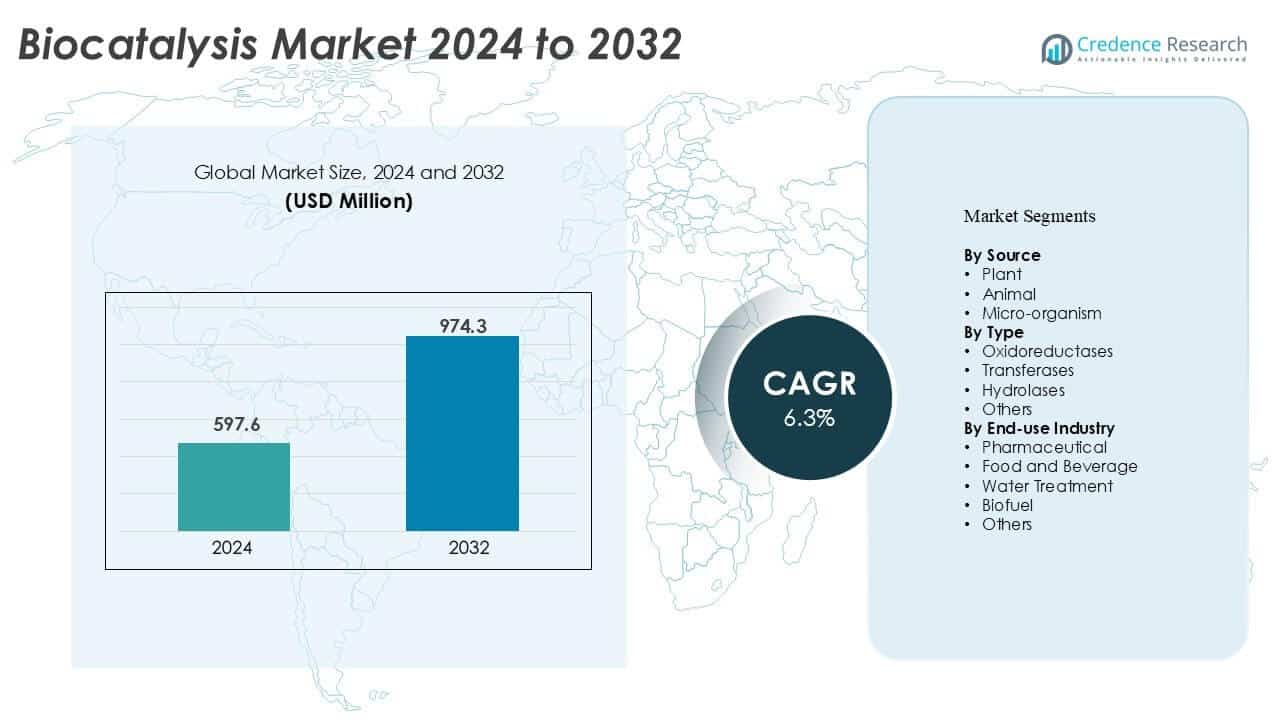
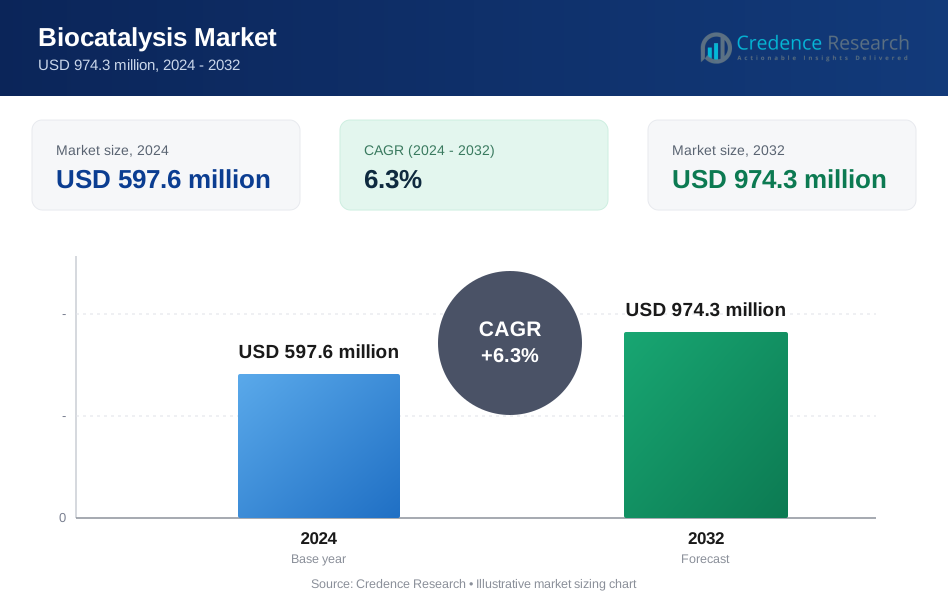
The Biocatalysis Market size was valued at USD 597.6 million in 2024 and is anticipated to reach USD 974.3 million by 2032, at a CAGR of 6.3% during the forecast period.
| REPORT ATTRIBUTE | DETAILS |
|---|---|
| Historical Period | 2020-2024 |
| Base Year | 2025 |
| Forecast Period | 2026-2032 |
| Biocatalysis Market Size 2024 | USD 597.6 million |
| Biocatalysis Market, CAGR | 6.3% |
| Biocatalysis Market Size 2032 | USD 974.3 million |
Biocatalysis Market Insights
- Growth is primarily driven by rising demand for sustainable manufacturing, particularly in pharmaceutical and biofuel industries.
- Advancements in enzyme engineering and immobilization are reshaping the market, enabling broader application and improving efficiency.
- Key players such as DuPont, BASF SE, Novozymes, and DSM lead through strategic collaborations and enzyme innovation.
- North America holds the highest share at over 35%, followed by Europe at 30% and Asia Pacific at 22%. Microorganism-sourced enzymes dominate by source, while oxidoreductases lead by type.
Biocatalysis Market Segmentation Analysis:
By Source
The microorganism-based biocatalysis segment holds the largest market share in 2024 due to its broad enzymatic diversity, rapid growth rate, and ease of genetic modification. Microorganisms such as bacteria and fungi serve as primary enzyme sources in industrial-scale applications, enabling high specificity and scalability. Their robust metabolic activity supports efficient production in pharmaceuticals, biofuels, and food processing. In contrast, plant and animal sources lag due to limited enzyme yields and lower process consistency. Demand for sustainable and cost-effective biocatalysts further strengthens the dominance of microbe-based enzyme systems across global industries.
- For instance, Novozymes operates microbial fermentation systems with reactor volumes above 200,000 liters. Company technical disclosures show enzyme titers exceeding 50 grams per liter in optimized bacterial strains.
By Type
Oxidoreductases dominate the market among biocatalyst types, accounting for the highest share in 2024 due to their critical role in oxidation-reduction reactions across pharmaceutical synthesis, environmental remediation, and biofuel production. Their broad substrate specificity and high efficiency in catalyzing redox processes drive widespread use. Transferases and hydrolases follow, serving in biosynthesis and hydrolysis reactions, respectively, with applications in food, detergent, and chemical industries. Rising investment in green chemistry solutions supports the growing interest in advanced enzyme classes, but oxidoreductases remain the core enzyme type due to their versatile catalytic functions.
- For instance, Novozymes operates microbial fermentation systems with reactor volumes above 200,000 liters. Company technical disclosures show enzyme titers exceeding 50 grams per liter in optimized bacterial
By End-use Industry
Pharmaceuticals emerge as the leading end-use industry, commanding the largest market share in 2024 due to the sector’s high demand for selective and sustainable synthesis processes. Biocatalysts enable chiral synthesis and reduce the reliance on harsh chemicals, making them vital in API manufacturing. The food and beverage sector follows, where enzymes enhance processing efficiency and product quality. Water treatment and biofuel industries also utilize biocatalysis for pollutant breakdown and energy conversion. The push for greener industrial processes and regulatory pressure for eco-friendly methods support the pharmaceutical segment’s continued leadership.
- For instance, BASF applies oxidoreductase enzymes in pharmaceutical intermediate synthesis. Process data confirms reaction completion times below 6 hours under mild temperature conditions.
Key Growth Drivers
Demand for Sustainable and Green Chemistry Solutions
The shift towards sustainable production methods is a major growth driver for the biocatalysis market. Traditional chemical synthesis often involves toxic solvents and harsh conditions. In contrast, biocatalysis offers eco-friendly processes with reduced waste, lower energy consumption, and biodegradable byproducts. Regulatory bodies globally are pushing industries to lower their environmental footprint, making biocatalysis a preferred alternative. Industries such as pharmaceuticals, food processing, and biofuels benefit from this cleaner technology. Companies are also embracing biocatalysis to meet sustainability goals and improve public image. As environmental compliance becomes stricter, demand for biocatalysis-based solutions will continue rising across various end-use sectors.
- For instance, DSM-Firmenich applies enzyme-driven synthesis in vitamin manufacturing. Process documentation shows operating temperatures reduced to 40 °C from conventional 120 °C routes.
Expanding Pharmaceutical and Biotech Industry
The pharmaceutical industry’s reliance on precise, efficient, and cost-effective synthesis drives biocatalysis adoption. Biocatalysts enable stereoselective reactions critical for active pharmaceutical ingredient (API) development. These enzymes ensure high product purity with fewer processing steps, which reduces production time and cost. Biopharma firms are scaling enzyme-based platforms for complex molecule synthesis and chiral resolution. Increasing R&D investments in biologics and personalized medicine further push biocatalyst demand. Contract research and manufacturing organizations (CROs and CDMOs) increasingly incorporate biocatalysis to improve process efficiency and scalability. The biocatalysis market benefits from this robust pharmaceutical pipeline and the global push for biologically derived therapeutics.
- For instance, Lonza uses enzyme-catalyzed steps for chiral API intermediates. Manufacturing data confirms enantiomeric excess levels above 99:1 in commercial-scale batches.
Rising Adoption in Biofuel and Wastewater Treatment
Growing energy demand and environmental concerns fuel the adoption of biocatalysis in biofuel production. Enzymes play a crucial role in converting biomass into bioethanol, biodiesel, and biogas. This helps reduce dependence on fossil fuels and supports decarbonization efforts. Similarly, wastewater treatment facilities use enzymes to degrade complex organic pollutants efficiently. Biocatalytic processes lower sludge formation, reduce operational costs, and enhance pollutant breakdown under mild conditions. The biofuel and water treatment sectors are expanding in response to climate goals and resource scarcity. These industries increasingly recognize biocatalysis as a scalable, green, and effective solution for sustainable operations.
Key Trends and Opportunities
Advancements in Enzyme Engineering and Immobilization Technologies
Breakthroughs in protein engineering have enabled the creation of highly stable and substrate-specific biocatalysts. Techniques such as directed evolution and site-directed mutagenesis allow for the design of custom enzymes tailored for industrial needs. Immobilization technologies further enhance enzyme reuse, shelf-life, and reaction stability, making processes more cost-effective. These innovations open new applications in fine chemicals, flavors, and agrochemicals. Engineered enzymes also support continuous flow systems, improving throughput and scalability. As biotechnology and AI converge, new opportunities arise to optimize enzyme performance for complex industrial reactions, widening the commercial reach of biocatalysis.
- For instance, Codexis developed engineered transaminases through iterative mutation cycles. Published process data shows good activity retention for immobilized carriers, typically over at least 10 cycles or for continuous operation over several days.
Expansion of Biocatalysis in Food Processing and Specialty Chemicals
Biocatalysis is gaining momentum in the food and beverage industry for applications such as flavor enhancement, texture modification, and shelf-life improvement. Enzymes ensure product consistency and allow label-friendly formulations. As consumer preference shifts toward clean-label and natural ingredients, enzymatic solutions offer a competitive edge. In specialty chemicals, biocatalysts are used to synthesize high-value compounds with greater precision and lower cost. The growth of these end-use sectors creates fresh opportunities for enzyme manufacturers. Companies are investing in customized enzyme blends for niche applications, expanding the scope of biocatalysis beyond traditional sectors.
Key Challenges
High Cost of Enzyme Development and Production
Despite operational benefits, the initial cost of developing industrial-grade biocatalysts remains high. Research, optimization, and production of enzymes require significant investment in biotechnology infrastructure and skilled personnel. Scaling up from lab to industrial use also demands extensive testing and regulatory approvals. Small- and mid-sized enterprises often lack the capital to adopt these solutions, limiting market penetration. Although enzyme reusability through immobilization helps offset costs, economic feasibility remains a challenge for many new applications. Cost reduction through innovations in recombinant technology and production platforms is necessary to drive wider adoption.
Limited Substrate Scope and Operational Stability in Harsh Conditions
Biocatalysts often operate under specific temperature, pH, and pressure conditions, which may not match industrial process requirements. Their narrow substrate specificity limits their flexibility in handling diverse feedstocks or reaction environments. Enzymes can lose activity in the presence of solvents, high temperatures, or contaminants, affecting process efficiency. Although enzyme engineering has improved stability, many commercial processes still favor chemical catalysts for their robustness. Addressing these challenges requires continued innovation in enzyme stabilization and process integration to ensure consistent performance under varied industrial conditions.
Regional Analysis
North America
North America holds the largest market share in the global biocatalysis market, accounting for over 35% in 2024. The region benefits from strong pharmaceutical manufacturing, advanced biotechnology infrastructure, and favorable regulatory frameworks supporting green chemistry. The United States leads in enzyme innovation, supported by public and private R&D funding. High adoption of biocatalysis in drug development, food processing, and wastewater treatment drives regional growth. Strategic partnerships between biotech firms and academic institutions enhance enzyme commercialization. With strong industrial demand and innovation-driven initiatives, North America is expected to maintain its dominant position throughout the forecast period.
Europe
Europe captures approximately 30% of the global biocatalysis market share in 2024, driven by stringent environmental regulations and the region’s early adoption of sustainable technologies. Germany, France, and the UK lead the market due to their advanced pharmaceutical and specialty chemical sectors. The EU’s circular economy goals and emphasis on green production processes support biocatalyst demand. Government incentives for bio-based industries further promote innovation. Industrial players in Europe invest heavily in enzyme R&D and applications in biofuels and food sectors. This regulatory push and technological maturity position Europe as a key contributor to global market growth.
Asia Pacific
Asia Pacific accounts for around 22% of the global biocatalysis market share in 2024 and is the fastest-growing region. China, India, and Japan are major contributors due to expanding pharmaceutical and food industries. Rising environmental awareness and industrialization accelerate demand for biocatalysts across sectors. Supportive government policies in China and India promote green technologies in manufacturing. Growing investments in R&D and enzyme production capabilities further boost regional prospects. The presence of low-cost manufacturing hubs enhances export potential. Asia Pacific is expected to grow at the highest CAGR through 2032, driven by large-scale adoption across emerging economies.
Latin America
Latin America holds about 7% of the biocatalysis market share in 2024. Brazil and Mexico lead regional adoption, especially in biofuel production, driven by abundant biomass and supportive renewable energy policies. The food and beverage industry also leverages enzymatic processes to improve product quality. However, limited R&D infrastructure and dependence on imported enzymes constrain broader adoption. Regional governments are investing in biotechnology hubs and sustainability programs to encourage domestic enzyme production. With growing interest in bio-based industries and regulatory improvements, Latin America is gradually expanding its presence in the global biocatalysis market.
Middle East & Africa
The Middle East & Africa region contributes roughly 6% to the global biocatalysis market in 2024. The region’s growth is supported by rising demand for wastewater treatment solutions and clean energy alternatives. South Africa and GCC countries are early adopters, driven by water scarcity and environmental regulations. The pharmaceutical and food industries remain small but are expanding steadily. Infrastructure gaps and limited technological access slow market development. However, government-backed sustainability efforts and partnerships with international firms are creating new opportunities. Continued focus on water reuse and green chemistry may boost adoption across select countries in the coming years.
Biocatalysis Market Segmentations:
By Source
- Plant
- Animal
- Micro-organism
By Type
- Oxidoreductases
- Transferases
- Hydrolases
- Others
By End-use Industry
- Pharmaceutical
- Food and Beverage
- Water Treatment
- Biofuel
- Others
By Geography
- North America
- U.S.
- Canada
- Mexico
- Europe
- Germany
- France
- U.K.
- Italy
- Spain
- Rest of Europe
- Asia Pacific
- China
- Japan
- India
- South Korea
- South-east Asia
- Rest of Asia Pacific
- Latin America
- Brazil
- Argentina
- Rest of Latin America
- Middle East & Africa
- GCC Countries
- South Africa
- Rest of the Middle East and Africa
Competitive Landscape
The competitive landscape of the biocatalysis market is moderately consolidated, with key players focusing on innovation, strategic collaborations, and capacity expansion. Companies like DuPont de Nemours, BASF SE, DSM, and Novozymes dominate due to their extensive enzyme portfolios, global reach, and advanced R&D infrastructure. These firms invest heavily in protein engineering, immobilization technologies, and sustainable bioprocessing to strengthen market presence. Emerging players such as Codexis and Prozomix focus on customized enzyme solutions for niche applications in pharmaceuticals and fine chemicals. Strategic alliances with pharmaceutical manufacturers and biotech startups enhance technology transfer and product development. Regional players, including Amano Enzyme Inc. and Biocatalysts, also contribute significantly by offering tailored enzyme solutions across food and beverage, biofuels, and wastewater sectors. Market participants continuously seek differentiation through patent-protected products and efficient production platforms. As demand for green and efficient bioprocessing grows, competition will intensify, pushing companies to enhance innovation, pricing strategies, and global distribution capabilities.
Key Player Analysis
- DuPont de Nemours, Inc.
- BASF SE
- DSM
- Novozymes
- Lonza
- Codexis, Inc.
- Amano Enzyme Inc.
- Biocatalysts
- Prozomix Limited
- AB Enzymes
Recent Developments
- In July 2025, the CATCO2NVERS project, presented at Biotrans, involves a collaboration with Wageningen University to use engineered enzymes to convert carbon dioxide into high-value chiral molecules, such as D-lactic acid.
- In March 2024, Kerry launched Biobake Fibre in Europe, an enzyme solution for bakery products. While primarily a European launch, such innovations often signal future rollouts or increased availability in the highly connected APAC markets.
Report Coverage
The research report offers an in-depth analysis based on Source, Type, End-use Industry Geography. It details leading market players, providing an overview of their business, product offerings, investments, revenue streams, and key applications. Additionally, the report includes insights into the competitive environment, SWOT analysis, current market trends, as well as the primary drivers and constraints. Furthermore, it discusses various factors that have driven market expansion in recent years. The report also explores market dynamics, regulatory scenarios, and technological advancements that are shaping the industry. It assesses the impact of external factors and global economic changes on market growth. Lastly, it provides strategic recommendations for new entrants and established companies to navigate the complexities of the market.
Future Outlook
- The market will expand steadily due to rising demand for eco-friendly manufacturing processes.
- Pharmaceutical companies will increase enzyme use for efficient and selective drug synthesis.
- Biofuel production will adopt more biocatalysts to reduce reliance on fossil-based processes.
- Enzyme engineering will improve substrate range and operational stability.
- Food and beverage companies will rely more on enzymes for clean-label product formulations.
- Biocatalysis in wastewater treatment will gain traction for cost-effective pollutant removal.
- Asia Pacific will see the fastest market growth, driven by industrialization and green regulations.
- Strategic partnerships between enzyme producers and end-users will shape competitive dynamics.
- Advances in immobilization technology will boost enzyme reusability and lower costs.
- Customized enzyme solutions will create new revenue streams across specialty applications.
Request a Free Sample
Fill in your details and we'll send you a free sample report.
- Sample data tables & charts
- Research methodology
Need a Custom Version of This Report?
Tailor the scope, geography, or segments to your exact requirements.
- Custom geography or segment scope
- Direct access to our analyst team
Frequently Asked Questions
What is the current market size for the Biocatalysis market, and what is its projected size in 2032?
At what Compound Annual Growth Rate is the Biocatalysis market projected to grow between 2024 and 2032?
Which Biocatalysis market segment held the largest share in 2024?
What are the primary factors fueling the growth of the Biocatalysis market?
Who are the leading companies in the Biocatalysis market?
Which region commanded the largest share of the Biocatalysis market in 2024?
Table of Content
Chapter 1. Report Introduction
- 1.1 Report Description & Purpose
- 1.1.1 Report Title & Market Definition
- 1.1.2 Unique Selling Propositions (USP) & Key Differentiators
- 1.1.3 Value Proposition for Stakeholders
- 1.2 Research Objectives
- 1.2.1 Market Sizing Objectives (Volume & Revenue)
- 1.2.2 Segmentation Objectives
- 1.2.3 Competitive Intelligence Objectives
- 1.2.4 Forecast & Scenario Objectives
- 1.3 Report Scope
- 1.3.1 Biocatalysis Scope – Types & Subtypes Covered
- 1.3.2 Geographic Scope – Regions & Countries Covered
- 1.3.3 Historical Period, Base Year & Forecast Period (2024; forecast to 2032)
- 1.3.4 Inclusions & Exclusions
- 1.4 HS Code & Classification Framework
- 1.5 Currency, Units & Pricing Basis
- 1.6 Target Stakeholders
- 1.7 Limitations & Assumptions
Chapter 2. Executive Summary
- 2.1 Global Biocatalysis Market Snapshot
- 2.1.1 Market Size – Historical (2024) & Forecast (2024-2032) (2024: USD 597.6 million → 2032: USD 974.3 million)
- 2.1.2 Volume & Revenue – Global Totals
- 2.1.3 Key Market Highlights – Top Five Facts
- 2.2 Biocatalysis Market Segmentation Snapshot
- 2.2.1 Market Split by Region – 2024 vs. 2032
- 2.3 Competitive Snapshot
- 2.3.1 Top 10 Players by Revenue Share – 2024
- 2.3.2 Top 10 Players by Volume Share – 2024
- 2.3.3 Recent Strategic Developments (18-Month Summary)
- 2.4 Key Investment Highlights & Strategic Conclusions
Chapter 3. Biocatalysis Market Dynamics & Industry Analysis
- 3.1 Market Overview & Context
- 3.1.1 Biocatalysis Market Position in the Broader Automotive Value Chain
- 3.1.2 OEM vs. Replacement Market Dynamics
- 3.1.3 Market Maturity & Development Stage by Region
- 3.2 Biocatalysis Market Drivers
- 3.3 Biocatalysis Market Restraints & Challenges
- 3.4 Biocatalysis Market Opportunities
- 3.5 Porter's Five Forces Analysis
- 3.5.1 Threat of New Entrants
- 3.5.2 Bargaining Power of Suppliers
- 3.5.3 Bargaining Power of Buyers
- 3.5.4 Threat of Substitutes
- 3.5.5 Competitive Rivalry – Intensity Assessment
- 3.6 Biocatalysis Value Chain Analysis
- 3.6.1 Upstream – Raw Material/Input Suppliers
- 3.6.1.1 Raw Material/Input 1
- 3.6.1.2 Raw Material/Input 2
- 3.6.1.3 Raw Material/Input 3
- 3.6.2 Midstream – Production/Manufacturing/Service Delivery
- 3.6.2.1 Production/Process Overview
- 3.6.2.2 Key Facility Locations & Capacity by Manufacturer
- 3.6.3 Downstream – Distribution & End Consumer
- 3.6.3.1 Primary Channel – B2B/OEM
- 3.6.3.2 Secondary Channels – Dealer, Retail, Online, Direct
- 3.6.4 Value Chain Profitability Analysis
- 3.6.1 Upstream – Raw Material/Input Suppliers
- 3.7 PESTEL Analysis
- 3.7.1 Political Factors
- 3.7.2 Economic Factors
- 3.7.3 Social Factors
- 3.7.4 Technological Factors
- 3.7.5 Environmental Factors
- 3.7.6 Legal Factors
- 3.8 Biocatalysis Supply Chain Analysis
- 3.8.1 Raw Material/Input Supply Risk Assessment
- 3.8.2 Manufacturing Concentration Risk (Geographic Exposure)
- 3.8.3 Trade Disruption Impact Analysis
- 3.9 Regulatory & Policy Landscape
Note: The regulatory and policy landscape section covers regulations based on their applicability to the market, Biocatalysis category, geography, and scope of the study. Only regulatory frameworks with a material impact on operations, compliance, trade, sustainability, or market access are analyzed in detail.
Chapter 4. Key Investment Pockets & Opportunity Analysis
- 4.1 Biocatalysis Market Attractiveness Analysis
- 4.1.1 By Region – Investment Attractiveness Matrix (Volume × CAGR)
- 4.2 Absolute Revenue Growth Opportunity
- 4.2.1 By Region – Absolute USD Growth Through 2032
- 4.3 Incremental Volume Opportunity
- 4.3.1 By Region – Incremental Volume Through 2032
- 4.3.2 Segment – Incremental Volume
- 4.4 Emerging Submarket Opportunity Deep Dive (Subject to Applicability)
- 4.5 Emerging Market Opportunity Scorecards
- 4.5.1 United States
- 4.5.2 Europe
- 4.5.3 Asia
- 4.5.4 Middle East & Africa
Note: Emerging Market Opportunity Scorecards will be included based on relevance and strategic importance. Regions listed are indicative and may vary depending on data availability and market dynamics.
Chapter 5. Biocatalysis Import-Export Analysis & Trade Flows
- 5.1 Global Trade Overview
- 5.1.1 Global Export Value by Country (2024)
- 5.1.2 Global Export Volume by Country (2024)
- 5.1.3 Global Import Value by Country (2024)
- 5.1.4 Global Import Volume by Country (2024)
- 5.1.5 Net Trade Balance by Country (2024)
- 5.2 Export Analysis – Segment
- 5.2.1 Type 1 (HS Code)
- 5.2.2 Type 2 (HS Code)
- 5.2.3 Type 3 (HS Code)
- 5.2.4 Type 4 (HS Code)
- 5.2.5 Type 5 (HS Code)
- 5.3 Import Analysis – Segment
- 5.3.1 Type 1 (HS Code)
- 5.3.2 Type 2 (HS Code)
- 5.3.3 Type 3 (HS Code)
- 5.3.4 Type 4 (HS Code)
- 5.3.5 Type 5 (HS Code)
- 5.4 Average Unit Trade Prices
- 5.4.1 Average Export Price – Segment & Country
- 5.4.2 Average Import Price – Segment & Source Country
- 5.4.3 Price Trends (2024)
- 5.5 Key Trade Route Analysis
- 5.5.1 Trade Route 1
- 5.5.2 Trade Route 2
- 5.5.3 Trade Route 3
- 5.5.4 Trade Route 4
- 5.5.5 Trade Route 5
- 5.6 Trade Policy Impact Assessment
- 5.6.1 US Anti-Dumping & Section 301 Tariffs
- 5.6.2 EU Customs Union Impact
- 5.6.3 Major Free Trade Agreements
- 5.6.4 USMCA Rules of Origin
Note: Trade policy analysis will be included only where relevant to the Biocatalysis market.
Chapter 6. Competitive Landscape & Company Benchmarking
- 6.1 Biocatalysis Market Concentration & Structure
- 6.1.1 Herfindahl-Hirschman Index (HHI) – vs. 2024
- 6.1.2 Tier 1, Tier 2 & Tier 3 Market Structure
- 6.1.3 Global, Regional & Local Player Dynamics
- 6.2 Biocatalysis Market Share Analysis – 2024
- 6.2.1 Global Revenue Share by Company
- 6.2.2 Global Volume Share by Company
- 6.2.3 Regional Revenue Share
- 6.2.4 Market Share Evolution ( vs. 2024)
- 6.2.5 OEM Segment Share by Company
- 6.2.6 Replacement Segment Share by Company
- 6.3 Production/Delivery Capacity & Facility Analysis
- 6.3.1 Global Installed Capacity
- 6.3.2 Capacity Utilization Rates
- 6.3.3 Production/Output Volume
- 6.3.4 Facility Locations & Capacity Map
- 6.3.5 Planned Capacity Additions
- 6.4 Biocatalysis Competitive Benchmarking Matrix
- 6.4.1 Revenue, Volume, CAGR & Profitability Comparison
- 6.4.2 Channel Revenue Mix
- 6.4.3 Geographic Revenue Exposure
- 6.4.4 R&D Intensity
- 6.4.5 Sustainability Maturity
- 6.5 Strategic Developments in Biocatalysis (Last 24 Months)
- 6.5.1 Mergers, Acquisitions & Divestments
- 6.5.2 New Biocatalysis Launches
- 6.5.3 Facility Expansions
- 6.5.4 Strategic Alliances, Joint Ventures & Partnerships
- 6.5.5 Distribution Expansion & Market Entry
- 6.5.6 Sustainability & ESG Initiatives
- 6.6 Competitive Strategy Mapping
- 6.6.1 Leader, Challenger, Follower & Niche Classification
- 6.6.2 Pricing Strategy Comparison
- 6.6.3 Channel Strategy Matrix
Note: Strategic developments are included based on their materiality and the availability of reliable information.
Chapter 7. Global Biocatalysis Market – By Distribution Channel
- 7.1 Segment Overview
- 7.1.1 Volume & Revenue Split by Channel (2024 & 2032)
- 7.1.2 Channel Mix Evolution (2024-2032)
Chapter 8. Regional Market Analysis – Global Overview
- 8.1 Global Regional Overview
- 8.1.1 Regional Volume Share
- 8.1.2 Regional Revenue Share
- 8.1.3 Regional Volume by Region
- 8.1.4 Regional Revenue by Region
- 8.1.5 Regional Forecast Through 2032
- 8.2 Cross-Regional Segment Analysis
- 8.2.1 By Distribution Channel
- 8.2.2 By Brand/Price Tier
Chapter 9. North America Biocatalysis Market
- 9.1 United States
- 9.2 Canada
- 9.3 Mexico
Chapter 10. Europe Biocatalysis Market
- 10.1 Germany
- 10.2 France
- 10.3 Italy
- 10.4 United Kingdom
- 10.5 Spain
- 10.6 Poland
- 10.7 Russia
- 10.8 Netherlands
- 10.9 Belgium
- 10.10 Sweden
- 10.11 Denmark
- 10.12 Norway
- 10.13 Rest of Europe
Chapter 11. Asia Pacific Biocatalysis Market
- 11.1 China
- 11.2 India
- 11.3 Japan
- 11.4 South Korea
- 11.5 Thailand
- 11.6 Indonesia
- 11.7 Vietnam
- 11.8 Malaysia
- 11.9 Australia
- 11.10 Rest of Asia Pacific
Chapter 12. Latin America Biocatalysis Market
- 12.1 Brazil
- 12.2 Argentina
- 12.3 Colombia
- 12.4 Chile
- 12.5 Rest of Latin America
Chapter 13. Middle East Biocatalysis Market
- 13.1 Saudi Arabia
- 13.2 United Arab Emirates
- 13.3 Turkey
- 13.4 Israel
- 13.5 Iran
- 13.6 Rest of the Middle East
Chapter 14. Africa Biocatalysis Market
- 14.1 South Africa
- 14.2 Egypt
- 14.3 Nigeria
- 14.4 Morocco
- 14.5 Rest of Africa
Chapter 15. Biocatalysis Company Profiles
- 15.1 [Company 01]
- 15.1.1 Company Overview
- 15.1.2 Key Management Personnel
- 15.1.3 Products & Services Portfolio
- 15.1.4 Financial Performance
- 15.1.5 Key Market Focus & Geographic Presence
- 15.1.6 Recent Developments & Strategic Initiatives
Note: The company profile list is preliminary and may change based on research findings, market developments, data availability, and client requirements.
Chapter 16. Appendices
- Appendix A – List of Abbreviations & Acronyms
- Appendix B – Industry Classification Code Reference – Full Series
- Appendix C – Production & Capacity Data Tables
- Appendix D – End-Use & Demand Base Tables
- Appendix E – Consumption & Replacement Rate Assumptions
- Appendix F – ASP Reference Tables
- Appendix G – Manufacturing & Facility Database
- Appendix H – Import-Export Data Tables
- Appendix I – Regulatory Summary Tables
- Appendix J – Primary Research Participant List (Anonymized)
- Appendix K – Primary Research Questionnaire Framework
- Appendix L – Data Sources & Bibliography
- Appendix M – Market Size Divergence & Source Comparison
Chapter 17. Research Methodology
- 17.1 Research Framework & Philosophy
- 17.2 Secondary Research – Sources, Hierarchy & Data Extraction
- 17.3 Data Modeling – Bottom-Up & Top-Down Market Sizing
- 17.4 Primary Research – Stakeholder Framework, LOI & Sample Sizes
- 17.5 Forecast Methodology – Regression, Scenario & Sensitivity Analysis
- 17.6 Quality Control – Four-Layer Validation Framework
- 17.7 Limitations & Standard Assumptions
- 17.8 Disclaimer
