
Market Overview:
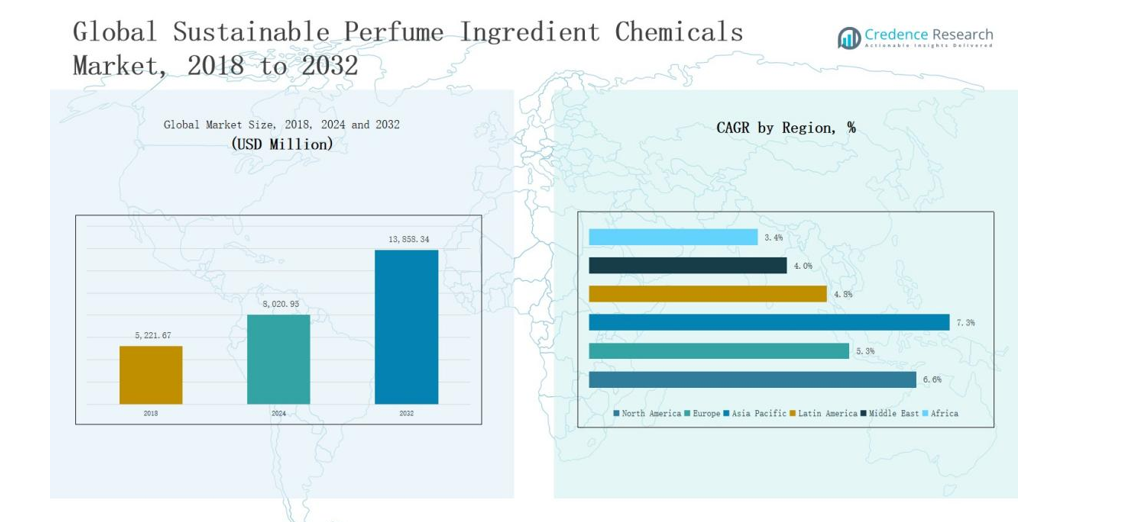
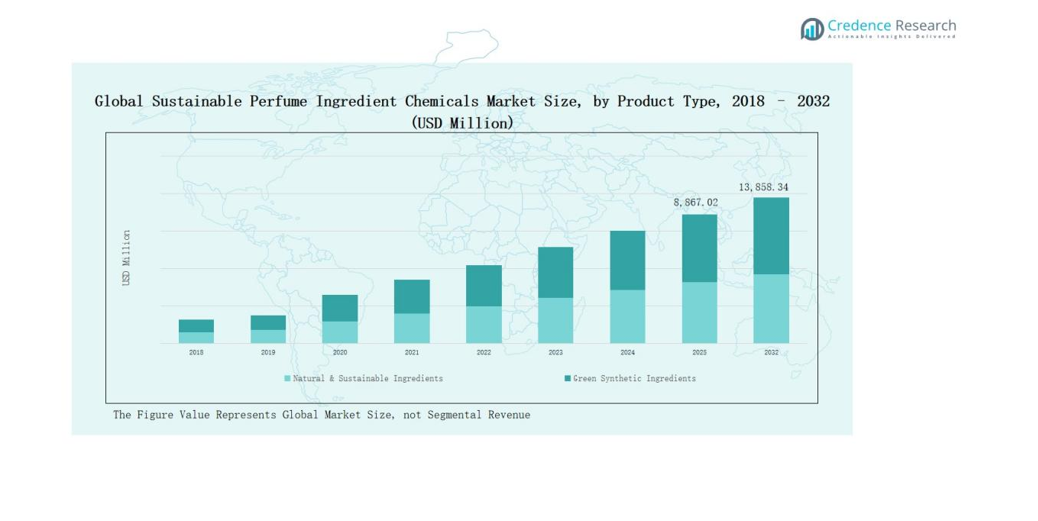
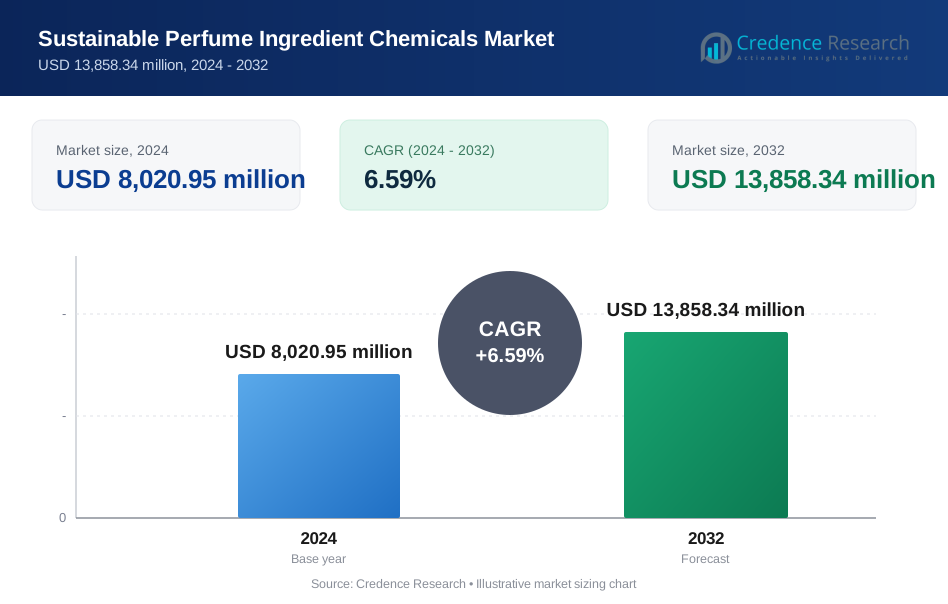
The Sustainable Perfume Ingredient Chemicals Market size was valued at USD 5,221.67 million in 2018, increased to USD 8,020.95 million in 2024, and is projected to reach USD 13,858.34 million by 2032, growing at a CAGR of 6.59% during the forecast period.
| REPORT ATTRIBUTE | DETAILS |
|---|---|
| Historical Period | 2020-2023 |
| Base Year | 2024 |
| Forecast Period | 2025-2032 |
| Sustainable Perfume Ingredient Chemicals Market Size 2024 | USD 8,020.95 million |
| Sustainable Perfume Ingredient Chemicals Market, CAGR | 6.59% |
| Sustainable Perfume Ingredient Chemicals Market Size 2032 | USD 13,858.34 million |
The Sustainable Perfume Ingredient Chemicals Market is led by major global players including Givaudan, DSM-Firmenich, Symrise AG, International Flavors & Fragrances (IFF), BASF SE, Takasago International Corporation, and Mane SA. These companies dominate through extensive R&D capabilities, sustainable ingredient innovation, and strong partnerships with cosmetic and fragrance brands. Their focus on biodegradable solvents, biotech-derived aroma compounds, and ethical sourcing reinforces their market leadership. Among all regions, Asia Pacific emerged as the leading market in 2024, accounting for 48.2% of the global share, supported by rapid industrial growth, expanding beauty sectors, and increasing consumer preference for natural and eco-certified fragrances.
Market Insights
- The Sustainable Perfume Ingredient Chemicals Market grew from USD 5,221.67 million in 2018 to USD 8,020.95 million in 2024 and is projected to reach USD 13,858.34 million by 2032, expanding at a CAGR of 6.59%.
- The Natural & Sustainable Ingredients segment led the market with a 3% share in 2024, driven by demand for biodegradable and traceable materials such as certified organic essential oils and floral extracts.
- The Personal Care segment held 6% share in 2024, supported by rising adoption of clean-label grooming products like sulfate-free shampoos, aluminum-free deodorants, and organic lotions.
- The B2B channel accounted for 8% share in 2024, supported by large-scale procurement by cosmetic and fragrance manufacturers emphasizing certified, cost-efficient, and sustainable ingredient sourcing.
- Asia Pacific dominated the global market with 2% share in 2024, driven by expanding cosmetic industries in China, Japan, and India and the rising preference for natural, plant-based perfume ingredients.
Market Segment Insights
By Product Type:
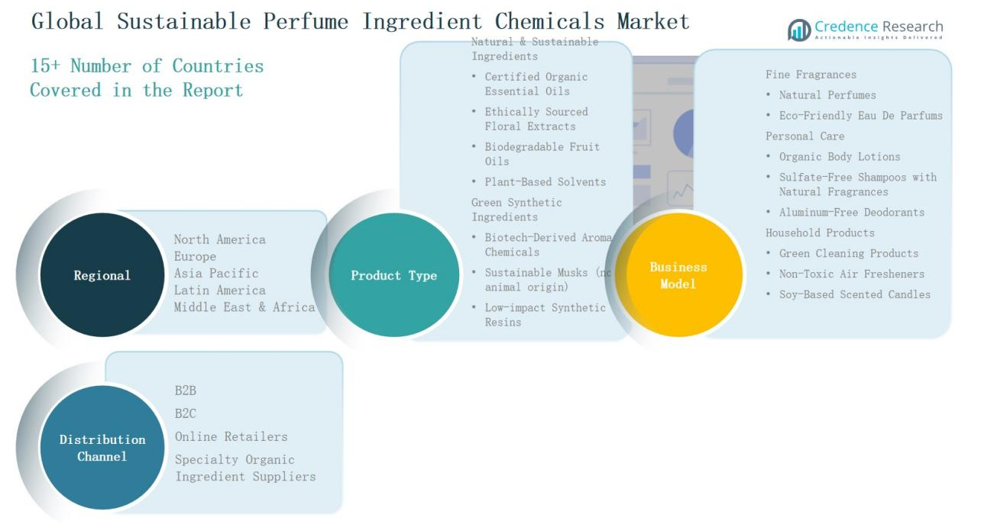
The Natural & Sustainable Ingredients segment dominated the Sustainable Perfume Ingredient Chemicals Market in 2024, accounting for 61.3% of the total share. Growth is driven by rising consumer preference for clean-label and biodegradable ingredients. Certified organic essential oils and ethically sourced floral extracts are leading sub-segments due to their traceability and authenticity. Demand for biodegradable fruit oils and plant-based solvents is also rising as brands emphasize eco-friendly formulations and sustainable sourcing across product development.
- For instance, Health and Beauty Natural Oils (HBNO®) supplies USDA-certified organic essential oils, such as lavender and citrus, sourced from plants cultivated without synthetic pesticides or herbicides, meeting the demand for eco-friendly options.
By Application:
The Personal Care segment held the largest market share of 49.6% in 2024, fueled by the strong adoption of organic body lotions, sulfate-free shampoos, and aluminum-free deodorants. Rising awareness about chemical-free grooming products and sustainable beauty drives this dominance. Fine fragrances, including natural perfumes and eco-friendly eau de parfums, are gaining steady traction, while household products show moderate growth with green cleaning and non-toxic air freshener formulations.
- For instance, Giorgio Armani's My Way Parfum, produced under license by L’Oréal, features sustainably sourced vanilla and refillable glass bottles to reduce the product’s carbon footprint.
By Distribution Channel:
The B2B segment accounted for 57.8% of the Sustainable Perfume Ingredient Chemicals Market in 2024, supported by bulk purchasing by fragrance houses and cosmetic manufacturers. It benefits from stable supplier partnerships, quality certifications, and cost-efficient procurement. The B2C and online retailer channels are expanding rapidly, driven by direct-to-consumer sustainable brands and transparent ingredient marketing. Specialty organic ingredient suppliers are further strengthening market accessibility and customization for niche fragrance formulators.
Key Growth Drivers
Rising Demand for Eco-Friendly and Clean Label Fragrances
The growing consumer shift toward sustainable and non-toxic beauty products drives strong market demand. Brands increasingly use biodegradable, plant-based, and ethically sourced perfume ingredients to meet environmental standards. Clean-label certifications and eco-conscious packaging further attract conscious buyers. This shift pushes fragrance manufacturers to replace synthetic petrochemical compounds with natural and green alternatives, enhancing brand reputation and long-term sustainability appeal.
- For instance, Lush has launched its "Lord of Misrule" Eau de Parfum, which is cruelty-free, vegan, and utilizes minimal packaging, exemplifying the shift toward sustainable perfume production.
Expansion of Green Chemistry and Biotechnological Innovations
Advances in green chemistry and biotechnology enable the creation of bio-based aroma compounds with lower environmental impact. Companies are investing in fermentation-derived musks and bioengineered aromatic molecules to ensure ethical and consistent fragrance profiles. These innovations reduce dependency on animal or petrochemical sources, offering scalable and cost-efficient production. The integration of sustainable R&D practices is strengthening the market’s innovation pipeline and supporting circular fragrance manufacturing.
- For instance, Givaudan expanded its Active Beauty line with bio-based fragrance ingredients developed using white biotechnology to lower carbon emissions.
Increasing Adoption in Personal Care and Household Applications
Growing use of sustainable perfume chemicals in personal care and home products supports steady expansion. Consumers prefer sulfate-free shampoos, organic lotions, and natural air fresheners formulated with green fragrances. Brands across skincare, haircare, and home fragrance categories are prioritizing clean scent compositions to meet regulatory and consumer expectations. This broadening application base enhances long-term market stability and diversification across end-use industries.
Key Trends & Opportunities
Shift Toward Transparency and Ethical Ingredient Sourcing
Brands are adopting full ingredient disclosure and traceable sourcing to build consumer trust. Ethical certifications like Fair Trade and RSPO are gaining importance in supply chains. Consumers demand transparency about environmental and social impact, prompting companies to invest in verifiable, sustainably sourced essential oils and natural resins. This trend presents opportunities for suppliers focusing on traceable and certified sustainable materials.
- For instance, Symrise actively promotes climate action and sustainability among its 5,000+ suppliers globally. The company requires its suppliers to adhere to its Code of Conduct, which includes transparent disclosure of raw material origins.
Growing Penetration of Digital and Direct-to-Consumer Sales Channels
Online retail and direct-to-consumer fragrance models are expanding rapidly. Sustainable perfume brands leverage e-commerce platforms to promote eco-friendly compositions and connect with younger demographics. Personalized fragrance curation, clean beauty branding, and digital marketing campaigns increase market visibility. This digital transformation provides growth potential for ingredient suppliers offering small-batch and customizable sustainable fragrance solutions.
- For instance, Le Labo’s refill program for 50ml to 500ml bottles promotes sustainability by encouraging consumers to refill rather than repurchase, strengthening customer retention and supporting eco-friendly product narratives.
Key Challenges
High Production Costs and Supply Chain Complexity
Producing sustainable perfume ingredients involves expensive extraction and certification processes. Organic essential oils and ethically sourced raw materials have limited supply, leading to cost fluctuations. Complex global supply chains and quality verification increase operational expenses. This limits scalability for smaller manufacturers and constrains profit margins for large players.
Limited Availability of Natural Raw Materials
Seasonal variations, climate change, and land use restrictions impact the supply of natural ingredients such as floral and fruit extracts. Overharvesting and agricultural constraints affect long-term availability and sustainability. These factors force companies to balance natural sourcing with synthetic alternatives, creating challenges in maintaining consistency and performance.
Regulatory Compliance and Standardization Issues
Evolving environmental and safety regulations across regions complicate product development. Companies face strict labeling, biodegradability, and allergen compliance requirements, particularly in the EU and North America. The absence of global standardization for sustainable fragrance certification increases formulation complexity and market entry barriers for emerging suppliers.
Regional Analysis
North America
The North America Sustainable Perfume Ingredient Chemicals Market was valued at USD 1,390.19 million in 2018, increased to USD 2,099.08 million in 2024, and is expected to reach USD 3,643.35 million by 2032, growing at a CAGR of 6.6%. North America accounted for 26.2% of the global market share in 2024. Growth is driven by strong consumer demand for clean beauty, advanced biotechnology in fragrance formulation, and the presence of major players like Givaudan and IFF. The U.S. leads the region due to its mature personal care and premium fragrance industries.
Europe
The Europe Sustainable Perfume Ingredient Chemicals Market grew from USD 952.15 million in 2018 to USD 1,380.55 million in 2024 and is projected to reach USD 2,163.53 million by 2032, expanding at a CAGR of 5.3%. Europe represented 17.2% of the global market in 2024, driven by stringent environmental regulations and consumer preference for eco-certified fragrances. Countries such as France, Germany, and Italy remain the innovation hubs for natural and organic perfumery, supported by evolving green chemistry initiatives and sustainable luxury trends.
Asia Pacific
The Asia Pacific Sustainable Perfume Ingredient Chemicals Market dominated globally, accounting for 48.2% of the total market in 2024. It was valued at USD 2,439.75 million in 2018, grew to USD 3,877.08 million in 2024, and is anticipated to reach USD 7,081.75 million by 2032, registering the highest CAGR of 7.3%. Growth is fueled by rising disposable income, expanding cosmetic industries in China, Japan, and India, and increasing adoption of plant-based personal care products. Regional manufacturers are investing in biotechnological and locally sourced aroma compounds to meet sustainable demand.
Latin America
The Latin America Sustainable Perfume Ingredient Chemicals Market reached USD 230.40 million in 2018, expanded to USD 349.20 million in 2024, and is projected to achieve USD 529.05 million by 2032, registering a CAGR of 4.8%. The region held 4.3% of the global market in 2024. Growth is supported by the increasing popularity of natural fragrances in Brazil and Mexico and rising investments in ethical sourcing of tropical botanical ingredients. Consumer awareness of sustainable personal care products is steadily enhancing regional demand.
Middle East
The Middle East Sustainable Perfume Ingredient Chemicals Market was valued at USD 131.76 million in 2018, rose to USD 183.10 million in 2024, and is expected to reach USD 260.92 million by 2032, growing at a CAGR of 4.0%. The region accounted for 3.2% of the global share in 2024. Growth is supported by the premiumization of fragrances in GCC countries and increasing interest in sustainable musks and natural oud blends. Demand from luxury and niche perfume houses is expanding due to the regional focus on high-quality, ethically sourced ingredients.
Africa
The Africa Sustainable Perfume Ingredient Chemicals Market grew from USD 77.43 million in 2018 to USD 131.94 million in 2024 and is forecasted to reach USD 179.74 million by 2032, at a CAGR of 3.4%. Africa represented 0.9% of the global market in 2024. Growth remains modest due to limited industrial infrastructure, yet increasing demand for organic body care and natural air fresheners in South Africa and Egypt indicates emerging opportunities. Local sourcing of floral and fruit-based raw materials may support gradual market development.
Market Segmentations:
By Product Type
Natural & Sustainable Ingredients
- Certified Organic Essential Oils
- Ethically Sourced Floral Extracts
- Biodegradable Fruit Oils
- Plant-Based Solvents
Green Synthetic Ingredients
- Biotech-Derived Aroma Chemicals
- Sustainable Musks (Non-Animal Origin)
- Low-Impact Synthetic Resins
By Application
Fine Fragrances
- Natural Perfumes
- Eco-Friendly Eau De Parfums
Personal Care
- Organic Body Lotions
- Sulfate-Free Shampoos with Natural Fragrances
- Aluminum-Free Deodorants
Household Products
- Green Cleaning Products
- Non-Toxic Air Fresheners
- Soy-Based Scented Candles
By Distribution Channel
- B2B
- B2C
- Online Retailers
- Specialty Organic Ingredient Suppliers
By Region
- North America
- U.S.
- Canada
- Mexico
- Europe
- Germany
- France
- U.K.
- Italy
- Spain
- Rest of Europe
- Asia Pacific
- China
- Japan
- India
- South Korea
- South-east Asia
- Rest of Asia Pacific
- Latin America
- Brazil
- Argentina
- Rest of Latin America
- Middle East & Africa
- GCC Countries
- South Africa
- Rest of the Middle East and Africa
Competitive Landscape
The Sustainable Perfume Ingredient Chemicals Market is moderately consolidated, with global leaders focusing on innovation, ethical sourcing, and green chemistry. Key players such as Givaudan, DSM-Firmenich, Symrise AG, International Flavors & Fragrances (IFF), BASF SE, Takasago International Corporation, and Mane SA dominate through advanced R&D, diversified portfolios, and strong sustainability frameworks. These companies invest heavily in biotechnological aroma compounds, biodegradable solvents, and traceable supply chains to meet evolving environmental regulations. Strategic partnerships with cosmetic brands, acquisitions of niche natural ingredient suppliers, and expansion of eco-certified facilities enhance competitiveness. Emerging regional players are entering through localized botanical sourcing and digital fragrance innovation. Continuous investment in sustainable extraction technologies and transparent ingredient labeling strengthens brand equity, positioning major firms to capture rising demand from personal care and fine fragrance sectors worldwide.
Key Players
- Givaudan
- Firmenich (DSM-Firmenich)
- Symrise AG
- International Flavors & Fragrances (IFF)
- BASF SE
- Takasago International Corporation
- Mane SA
- Robertet Group
- Sensient Technologies Corporation
- Bedoukian Research, Inc.
- Kao Corporation
- Bell Flavors & Fragrances
- Vigon International, Inc.
- Sigma-Aldrich (Merck KGaA)
- Penta Manufacturing Company
Recent Developments
- In July 2025, IFF launched ENVIROCAP™, a biodegradable and vegan scent-delivery technology for fabric applications.
- In July 2025, Turpaz completed the acquisition of Attractive Scent in Grasse, France, boosting its sustainable fragrance operations.
- In May 2024, IFF partnered with LMR Naturals to develop new natural fragrance ingredients supporting sustainable perfume chemistry.
Report Coverage
The research report offers an in-depth analysis based on Type, Application, Material Composition, Distribution Channel and Region. It details leading market players, providing an overview of their business, product offerings, investments, revenue streams, and key applications. Additionally, the report includes insights into the competitive environment, SWOT analysis, current market trends, as well as the primary drivers and constraints. Furthermore, it discusses various factors that have driven market expansion in recent years. The report also explores market dynamics, regulatory scenarios, and technological advancements that are shaping the industry. It assesses the impact of external factors and global economic changes on market growth. Lastly, it provides strategic recommendations for new entrants and established companies to navigate the complexities of the market.
Future Outlook
- Demand for biodegradable and ethically sourced fragrance ingredients will continue to accelerate.
- Green chemistry and biotechnology will drive large-scale production of sustainable aroma compounds.
- Companies will expand transparent supply chains and traceability for natural ingredient sourcing.
- Personal care and household fragrance applications will witness growing product diversification.
- Digital fragrance platforms and AI-based formulation tools will support faster innovation.
- Regulatory pressure will increase adoption of eco-certified and allergen-free formulations.
- Investment in bio-based solvents and fermentation-derived musks will enhance sustainability.
- Regional suppliers will leverage local botanical resources to reduce import dependency.
- Strategic collaborations between fragrance manufacturers and cosmetic brands will intensify.
- Consumer education and green branding will shape long-term purchasing behavior in premium fragrance segments.
Request a Free Sample
Fill in your details and we'll send you a free sample report.
- Sample data tables & charts
- Research methodology
Need a Custom Version of This Report?
Tailor the scope, geography, or segments to your exact requirements.
- Custom geography or segment scope
- Direct access to our analyst team
Frequently Asked Questions
What is the current market size for Sustainable Perfume Ingredient Chemicals Market, and what is its projected size in 2032?
At what Compound Annual Growth Rate is the Sustainable Perfume Ingredient Chemicals Market projected to grow between 2025 and 2032?
Which Sustainable Perfume Ingredient Chemicals Market segment held the largest share in 2024?
What are the primary factors fueling the growth of the Sustainable Perfume Ingredient Chemicals Market?
Who are the leading companies in the Sustainable Perfume Ingredient Chemicals Market?
Table of Content
Chapter 1. Report Introduction
- 1.1 Report Description & Purpose
- 1.1.1 Report Title & Market Definition
- 1.1.2 Unique Selling Propositions (USP) & Key Differentiators
- 1.1.3 Value Proposition for Stakeholders
- 1.2 Research Objectives
- 1.2.1 Market Sizing Objectives (Volume & Revenue) (Volume Where Applicable)
- 1.2.2 Segmentation Objectives
- 1.2.3 Competitive Intelligence Objectives
- 1.2.4 Forecast & Scenario Objectives
- 1.3 Report Scope
- 1.3.1 Sustainable Perfume Ingredient Chemicals Scope – Segments & Subsegments Covered
- 1.3.2 Geographic Scope – Regions & Countries Covered
- 1.3.3 Historical Period, Base Year & Forecast Period (2024; forecast to 2032)
- 1.3.4 Inclusions & Exclusions
- 1.4 Industry Classification & Applicable Codes
- 1.5 Currency, Measurement Units & Valuation Basis
- 1.6 Target Stakeholders
- 1.7 Limitations & Assumptions
Chapter 2. Executive Summary
- 2.1 Global Sustainable Perfume Ingredient Chemicals Market Snapshot
- 2.1.1 Market Size – Historical (2024) & Forecast (2024-2032) (2024: USD 8,020.95 million → 2032: USD 13,858.34 million)
- 2.1.2 Volume & Revenue – Global Totals (Volume Where Applicable)
- 2.1.3 Key Market Highlights – Top Five Facts
- 2.2 Sustainable Perfume Ingredient Chemicals Market Segmentation Snapshot
- 2.2.1 Market Split by Region – 2024 vs. 2032
- 2.3 Competitive Snapshot
- 2.3.1 Top 10 Players by Revenue Share – 2024
- 2.3.2 Top 10 Players by Volume Share – 2024 (Volume Where Applicable)
- 2.3.3 Recent Strategic Developments (18-Month Summary)
- 2.4 Key Investment Highlights & Strategic Conclusions
Chapter 3. Sustainable Perfume Ingredient Chemicals Market Dynamics & Industry Analysis
- 3.1 Market Overview & Context
- 3.1.1 Sustainable Perfume Ingredient Chemicals Market Position in the Broader Industry Value Chain
- 3.1.2 Demand Structure & Purchasing Dynamics
- 3.1.3 Market Maturity & Development Stage by Region
- 3.2 Sustainable Perfume Ingredient Chemicals Market Drivers
- 3.3 Sustainable Perfume Ingredient Chemicals Market Restraints & Challenges
- 3.4 Sustainable Perfume Ingredient Chemicals Market Opportunities
- 3.5 Porter's Five Forces Analysis
- 3.5.1 Threat of New Entrants
- 3.5.2 Bargaining Power of Suppliers
- 3.5.3 Bargaining Power of Buyers
- 3.5.4 Threat of Substitutes
- 3.5.5 Competitive Rivalry – Intensity Assessment
- 3.6 Sustainable Perfume Ingredient Chemicals Value Chain Analysis
- 3.6.1 Upstream – Key Inputs, Resources & Suppliers
- 3.6.1.1 Key Input/Resource 1
- 3.6.1.2 Key Input/Resource 2
- 3.6.1.3 Key Input/Resource 3
- 3.6.2 Midstream – Core Operations & Value Creation
- 3.6.2.1 Operating Model & Process Overview
- 3.6.2.2 Key Operating Locations & Capabilities by Company
- 3.6.3 Downstream – Market Channels & End Users
- 3.6.3.1 Direct Sales & Customer Engagement Channels
- 3.6.3.2 Indirect Sales, Intermediaries & Partner Channels
- 3.6.4 Value Chain Profitability Analysis
- 3.6.1 Upstream – Key Inputs, Resources & Suppliers
- 3.7 PESTEL Analysis
- 3.7.1 Political Factors
- 3.7.2 Economic Factors
- 3.7.3 Social Factors
- 3.7.4 Technological Factors
- 3.7.5 Environmental Factors
- 3.7.6 Legal Factors
- 3.8 Sustainable Perfume Ingredient Chemicals Supply Chain Analysis
- 3.8.1 Critical Input & Resource Availability Risk Assessment
- 3.8.2 Supplier & Operational Concentration Risk (Geographic Exposure)
- 3.8.3 Supply & Service Disruption Impact Analysis
- 3.9 Regulatory & Policy Landscape
Note: The regulatory and policy landscape section covers regulations based on their applicability to the market, Sustainable Perfume Ingredient Chemicals category, geography, and scope of the study. Only regulatory frameworks with a material impact on operations, compliance, trade, sustainability, or market access are analyzed in detail.
Chapter 4. Key Investment Pockets & Opportunity Analysis
- 4.1 Sustainable Perfume Ingredient Chemicals Market Attractiveness Analysis
- 4.1.1 By Region – Investment Attractiveness Matrix (Market Size × CAGR)
- 4.2 Absolute Revenue Growth Opportunity
- 4.2.1 By Region – Absolute Revenue Growth Through 2032
- 4.3 Incremental Demand Opportunity
- 4.3.1 By Region – Incremental Demand Through 2032
- 4.3.2 Segment – Incremental Demand
- 4.4 Emerging Submarket Opportunity Deep Dive (Subject to Applicability)
- 4.5 Priority Market Opportunity Scorecards
- 4.5.1 United States
- 4.5.2 Europe
- 4.5.3 Asia
- 4.5.4 Middle East & Africa
Note: Priority market opportunity scorecards reflect the geographic scope and strategic relevance of the study. Listed markets are indicative and may be adapted to the industry.
Chapter 5. Sustainable Perfume Ingredient Chemicals Cross-Border Trade & Market Access Analysis
- 5.1 International Trade & Cross-Border Activity Overview
- 5.1.1 Global Export Value by Country (2024)
- 5.1.2 Global Export Volume by Country (2024) (Volume Where Applicable)
- 5.1.3 Global Import Value by Country (2024)
- 5.1.4 Global Import Volume by Country (2024) (Volume Where Applicable)
- 5.1.5 Net Trade Balance by Country (2024)
- 5.2 Export Analysis – Segment
- 5.2.1 Category 1 (Applicable Classification Code)
- 5.2.2 Category 2 (Applicable Classification Code)
- 5.2.3 Category 3 (Applicable Classification Code)
- 5.2.4 Category 4 (Applicable Classification Code)
- 5.2.5 Category 5 (Applicable Classification Code)
- 5.3 Import Analysis – Segment
- 5.3.1 Category 1 (Applicable Classification Code)
- 5.3.2 Category 2 (Applicable Classification Code)
- 5.3.3 Category 3 (Applicable Classification Code)
- 5.3.4 Category 4 (Applicable Classification Code)
- 5.3.5 Category 5 (Applicable Classification Code)
- 5.4 Cross-Border Pricing & Transaction Benchmarks
- 5.4.1 Export Pricing – Segment & Country
- 5.4.2 Import Pricing – Segment & Source Country
- 5.4.3 Price Trends (2024)
- 5.5 Key Cross-Border Trade & Delivery Routes
- 5.5.1 Cross-Border Trade/Delivery Route 1
- 5.5.2 Cross-Border Trade/Delivery Route 2
- 5.5.3 Cross-Border Trade/Delivery Route 3
- 5.5.4 Cross-Border Trade/Delivery Route 4
- 5.5.5 Cross-Border Trade/Delivery Route 5
- 5.6 Trade Policy & Market Access Impact Assessment
- 5.6.1 Tariff & Non-Tariff Barriers
- 5.6.2 Regional Trade & Economic Integration Frameworks
- 5.6.3 Bilateral & Multilateral Trade Agreements
- 5.6.4 Cross-Border Operating, Licensing & Localization Requirements
Note: This chapter applies where cross-border trade or delivery is relevant to Sustainable Perfume Ingredient Chemicals. Goods, services, and digital offerings are assessed using applicable classifications and transaction measures. Import-export volumes, trade balances, and route analyses are included only where meaningful to the market.
Chapter 6. Competitive Landscape & Company Benchmarking
- 6.1 Sustainable Perfume Ingredient Chemicals Market Concentration & Structure
- 6.1.1 Herfindahl-Hirschman Index (HHI) – vs. 2024
- 6.1.2 Leading, Mid-Sized & Emerging Player Structure
- 6.1.3 Global, Regional & Local Player Dynamics
- 6.2 Sustainable Perfume Ingredient Chemicals Market Share Analysis – 2024
- 6.2.1 Global Revenue Share by Company
- 6.2.2 Global Volume Share by Company (Volume Where Applicable)
- 6.2.3 Regional Revenue Share
- 6.2.4 Market Share Evolution ( vs. 2024)
- 6.2.5 Company Market Share by Key Segment
- 6.2.6 Company Market Share by Customer Group
- 6.3 Operating Scale, Capacity & Infrastructure Analysis
- 6.3.1 Global Operating Scale & Supply Capacity
- 6.3.2 Resource Utilization & Operating Efficiency
- 6.3.3 Output, Service Delivery & Activity Metrics
- 6.3.4 Operating Footprint & Infrastructure Map
- 6.3.5 Planned Operational & Capacity Expansion
- 6.4 Sustainable Perfume Ingredient Chemicals Competitive Benchmarking Matrix
- 6.4.1 Revenue, Growth, Profitability & Operating Metric Comparison
- 6.4.2 Channel Revenue Mix
- 6.4.3 Geographic Revenue Exposure
- 6.4.4 R&D Intensity
- 6.4.5 Sustainability Maturity
- 6.5 Strategic Developments in Sustainable Perfume Ingredient Chemicals (Last 24 Months)
- 6.5.1 Mergers, Acquisitions & Divestments
- 6.5.2 New Products, Services & Solutions in Sustainable Perfume Ingredient Chemicals
- 6.5.3 Operational & Infrastructure Expansions
- 6.5.4 Strategic Alliances, Joint Ventures & Partnerships
- 6.5.5 Distribution Expansion & Market Entry
- 6.5.6 Sustainability & ESG Initiatives
- 6.6 Competitive Strategy Mapping
- 6.6.1 Leader, Challenger, Follower & Niche Classification
- 6.6.2 Pricing Strategy Comparison
- 6.6.3 Channel Strategy Matrix
Note: Strategic developments are included based on their materiality and the availability of reliable information.
Chapter 7. Global Sustainable Perfume Ingredient Chemicals Market – By Sales & Delivery Channel
- 7.1 Segment Overview
- 7.1.1 Volume & Revenue Split by Channel (2024 & 2032) (Volume Where Applicable)
- 7.1.2 Channel Mix Evolution (2024-2032)
Chapter 8. Regional Market Analysis – Global Overview
- 8.1 Global Regional Overview
- 8.1.1 Regional Volume Share (Volume Where Applicable)
- 8.1.2 Regional Revenue Share
- 8.1.3 Regional Volume by Region (Volume Where Applicable)
- 8.1.4 Regional Revenue by Region
- 8.1.5 Regional Forecast Through 2032
- 8.2 Cross-Regional Segment Analysis
- 8.2.1 By Sales & Delivery Channel
- 8.2.2 By Competitive Positioning & Price Tier
Chapter 9. North America Sustainable Perfume Ingredient Chemicals Market
- 9.1 United States
- 9.2 Canada
- 9.3 Mexico
Chapter 10. Europe Sustainable Perfume Ingredient Chemicals Market
- 10.1 Germany
- 10.2 France
- 10.3 Italy
- 10.4 United Kingdom
- 10.5 Spain
- 10.6 Poland
- 10.7 Russia
- 10.8 Netherlands
- 10.9 Belgium
- 10.10 Sweden
- 10.11 Denmark
- 10.12 Norway
- 10.13 Rest of Europe
Chapter 11. Asia Pacific Sustainable Perfume Ingredient Chemicals Market
- 11.1 China
- 11.2 India
- 11.3 Japan
- 11.4 South Korea
- 11.5 Thailand
- 11.6 Indonesia
- 11.7 Vietnam
- 11.8 Malaysia
- 11.9 Australia
- 11.10 Rest of Asia Pacific
Chapter 12. Latin America Sustainable Perfume Ingredient Chemicals Market
- 12.1 Brazil
- 12.2 Argentina
- 12.3 Colombia
- 12.4 Chile
- 12.5 Rest of Latin America
Chapter 13. Middle East Sustainable Perfume Ingredient Chemicals Market
- 13.1 Saudi Arabia
- 13.2 United Arab Emirates
- 13.3 Turkey
- 13.4 Israel
- 13.5 Iran
- 13.6 Rest of the Middle East
Chapter 14. Africa Sustainable Perfume Ingredient Chemicals Market
- 14.1 South Africa
- 14.2 Egypt
- 14.3 Nigeria
- 14.4 Morocco
- 14.5 Rest of Africa
Chapter 15. Sustainable Perfume Ingredient Chemicals Company Profiles
- 15.1 [Company 01]
- 15.1.1 Company Overview
- 15.1.2 Key Management Personnel
- 15.1.3 Products & Services Portfolio
- 15.1.4 Financial Performance
- 15.1.5 Key Market Focus & Geographic Presence
- 15.1.6 Recent Developments & Strategic Initiatives
Note: The company profile list is preliminary and may change based on research findings, market developments, data availability, and client requirements.
Chapter 16. Appendices
- Appendix A – List of Abbreviations & Acronyms
- Appendix B – Industry Classification Code Reference – Full Series
- Appendix C – Supply, Output & Operating Capacity Data Tables
- Appendix D – End-Use & Demand Base Tables
- Appendix E – Demand, Adoption & Usage Assumptions
- Appendix F – Pricing & Revenue Metric Reference Tables
- Appendix G – Company Operations & Infrastructure Database
- Appendix H – Cross-Border Trade & Activity Data Tables (Where Applicable)
- Appendix I – Regulatory Summary Tables
- Appendix J – Primary Research Participant List (Anonymized)
- Appendix K – Primary Research Questionnaire Framework
- Appendix L – Data Sources & Bibliography
- Appendix M – Market Size Divergence & Source Comparison
Chapter 17. Research Methodology
- 17.1 Research Framework & Philosophy
- 17.2 Secondary Research – Sources, Hierarchy & Data Extraction
- 17.3 Data Modeling – Bottom-Up & Top-Down Market Sizing
- 17.4 Primary Research – Stakeholder Framework, LOI & Sample Sizes
- 17.5 Forecast Methodology – Regression, Scenario & Sensitivity Analysis
- 17.6 Quality Control – Four-Layer Validation Framework
- 17.7 Limitations & Standard Assumptions
- 17.8 Disclaimer
