
Market Overview:
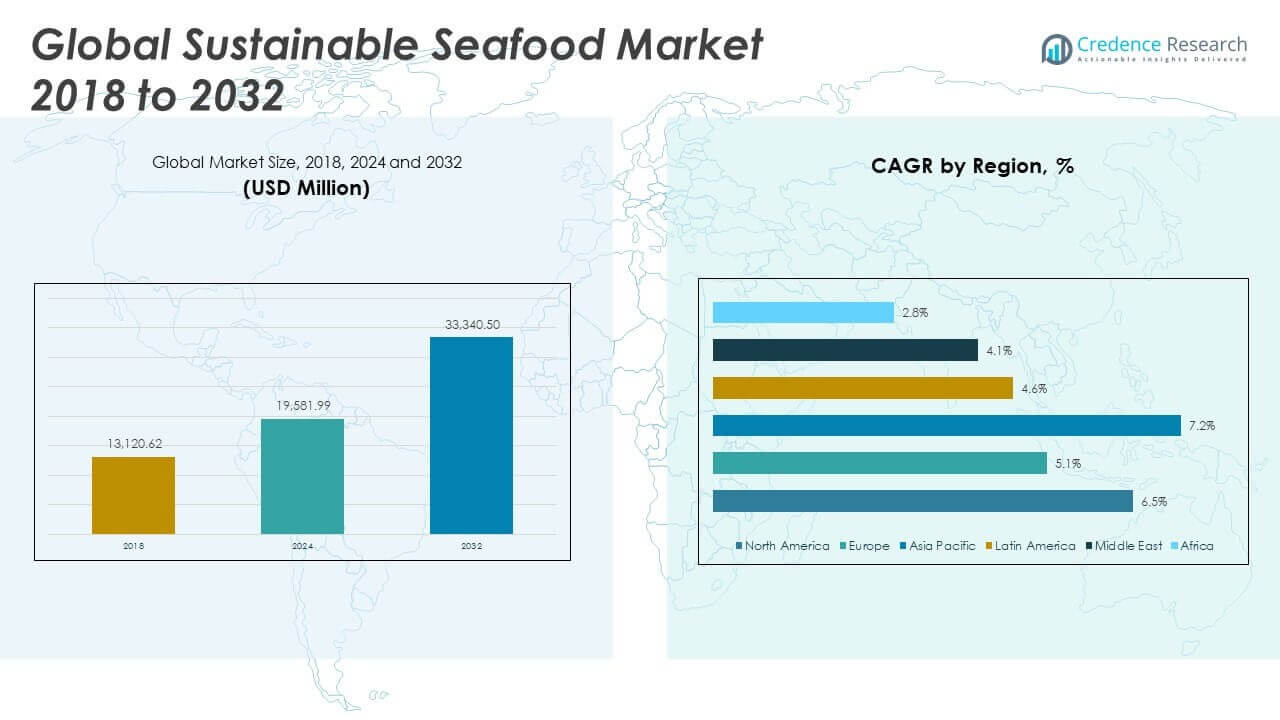
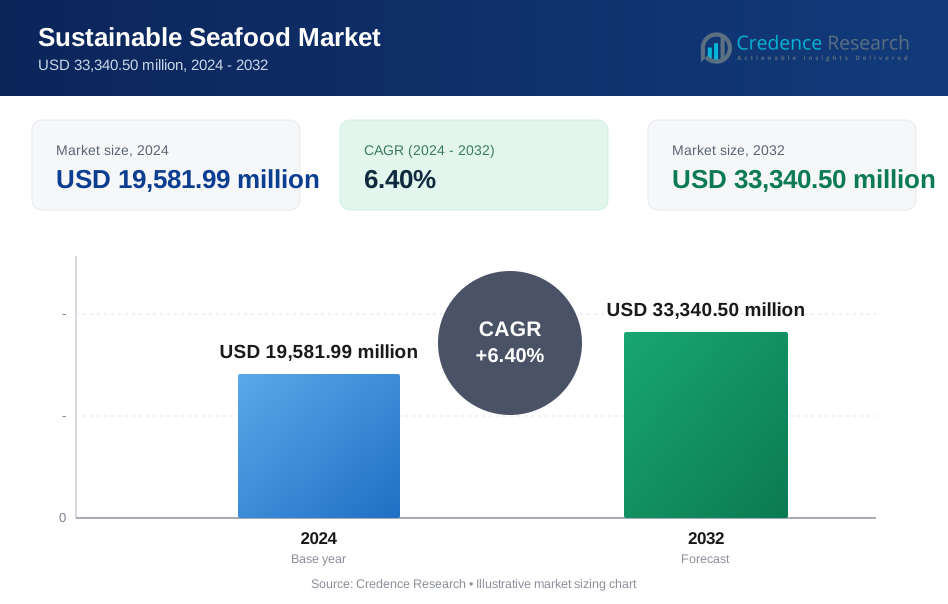
The Global Sustainable Seafood Market size was valued at USD 13,120.62 million in 2018 to USD 19,581.99 million in 2024 and is anticipated to reach USD 33,340.50 million by 2032, at a CAGR of 6.40% during the forecast period.
| REPORT ATTRIBUTE | DETAILS |
|---|---|
| Historical Period | 2020-2023 |
| Base Year | 2024 |
| Forecast Period | 2025-2032 |
| Sustainable Seafood Market Size 2024 | USD 19,581.99 million |
| Sustainable Seafood Market, CAGR | 6.40% |
| Sustainable Seafood Market Size 2032 | USD 33,340.50 million |
Rising environmental concerns, regulatory enforcement, and shifting consumer preferences are driving the growth of sustainable seafood. Buyers now demand traceable, certified products with transparent supply chains. Food retailers and processors prioritize eco-labels like MSC, ASC, and BAP to meet internal ESG goals. Governments are tightening fishing laws, while aquaculture producers invest in low-impact systems. Foodservice operators and institutional buyers adopt certified sourcing policies. These combined efforts support long-term ecosystem protection, market transparency, and commercial scalability.
Asia Pacific dominates the market due to high production capacity and increasing export-driven certification adoption. North America and Europe lead in retail alignment, regulatory maturity, and consumer awareness. Countries like Norway, Japan, and the U.S. enforce strict sustainability frameworks. Latin America and Southeast Asia are emerging through aquaculture upgrades and NGO-backed initiatives. The Middle East and Africa show gradual improvements in self-sufficiency and infrastructure development.
Market Insights:
- The Global Sustainable Seafood Market was valued at USD 13,120.62 million in 2018, reached USD 19,581.99 million in 2024, and is projected to hit USD 33,340.50 million by 2032, expanding at a 40% CAGR, driven by certification‑led sourcing and regulatory alignment.
- Asia Pacific (~45.2%), North America (~29.0%), and Europe (~17.6%) together dominate global share due to strong aquaculture output, strict retail standards, and mature certification adoption across supply chains.
- Asia Pacific is the fastest‑growing region, holding the largest share and supported by export‑oriented aquaculture, government support, and rapid certification scaling across major producing countries.
- By source, farmed (aquaculture) seafood accounts for ~60%, while wild‑caught holds ~40%, reflecting better supply control, traceability, and scalability in certified aquaculture systems.
- By distribution, retail channels contribute ~48% of demand, followed by HoReCa at ~32%, as supermarkets and foodservice operators prioritize certified, traceable seafood offerings.
Market Drivers
Government Regulations and Global Fisheries Reform Strengthen Sustainable Harvesting Enforcement
Governments worldwide are enforcing stronger policies to counter overfishing and illegal harvesting. New legislation establishes strict quotas and mandates catch documentation. Coastal states enhance monitoring and surveillance of fishing fleets through satellite and onboard systems. These measures limit exploitation of marine resources and improve fish stock recovery. Public institutions back initiatives that promote habitat conservation and restoration. International trade agreements are increasingly linked to sustainable catch certification. It supports long-term ecological balance and protects livelihoods of small-scale fishers. The Global Sustainable Seafood Market aligns closely with these reforms, reinforcing supply security and export compliance.
- For example, Mowi ASA has committed to have 100% of its yearly harvest volumes certified to recognised sustainability standards, working with ASC, BAP or equivalent schemes across its global operations.
Consumer Awareness and Labeling Preferences Drive Ethical Product Choices at Scale
Modern consumers demand visibility into where and how seafood is sourced. Health-conscious buyers prioritize traceable products with clear environmental and social credentials. Eco-labels like MSC, ASC, and Fair Trade provide recognizable assurance. Surveys show high willingness to pay more for certified, responsibly sourced seafood. Retailers respond by stocking verified products and promoting them through digital and physical campaigns. This transparency creates accountability across the supply chain. Market education campaigns continue to shift preferences toward sustainable options. It helps bridge knowledge gaps and builds loyalty. The Global Sustainable Seafood Market is increasingly shaped by this buyer-driven dynamic.
- For example, Sainsbury’s reports that about 86.8% of its wild‑caught seafood is independently certified to the MSC standard and aims for fully certified seafood across its range, demonstrating strong retailer alignment with sustainable sourcing.
Supply Chain Integration and Fishing/Aquaculture Innovation Expand Verified Product Volumes
Seafood producers adopt integrated value chain models to support end-to-end sustainability. Investments in low-impact fishing gear and selective harvesting improve resource efficiency. Aquaculture operators upgrade to responsible feed, reduce antibiotic use, and implement closed-loop systems. Traceability tools track batches from hatchery to table. These changes enhance compliance and limit ecological harm. Feed suppliers and hatchery operators also adopt verification to align with buyer demands. Certifications apply across the lifecycle, not just the final harvest. It allows processors and retailers to ensure authenticity. The Global Sustainable Seafood Market benefits from these ecosystem-level changes across sourcing, processing, and distribution.
Retail and Foodservice Procurement Standards Raise Baseline for Supplier Compliance
Retailers and foodservice companies embed sustainable sourcing into procurement contracts. Buyers require documentation, audit history, and third-party certification for all seafood categories. Institutional food buyers schools, hospitals, and government canteens adopt similar standards. Supply chain audits verify traceability, species legitimacy, and labor practices. High-volume buyers offer incentives for certified volumes and support supplier transitions. Food distributors streamline product lines around verified offerings. It creates commercial pressure on uncertified suppliers to upgrade. The Global Sustainable Seafood Market reflects this shift in sourcing dynamics, where compliance becomes essential to access major markets and retain buyer relationships.
Market Trends
Growth of Direct-to-Consumer Platforms Offering Certified and Traceable Seafood Products
Direct-to-consumer models now offer traceable seafood through subscription boxes, e-commerce platforms, and specialty retail. These platforms work with certified fishers and farms to deliver quality, sustainability, and transparency. QR codes and mobile apps provide catch location, method, and harvest date. Consumers engage with origin stories and learn about environmental impact. These channels promote underutilized species and seasonal availability. It helps reduce overreliance on a few commercial fish stocks. Brands build loyalty through education and ethical sourcing narratives. The Global Sustainable Seafood Market sees increased D2C activity as buyers seek trustworthy and convenient options.
Adoption of Alternative Seafood and Cell-Based Technologies as Sustainable Protein Pathways
Innovation in cell-based seafood and plant-based alternatives is gaining traction. Startups and research labs replicate the taste and texture of popular species without harvesting wild stocks. These products use fewer resources and avoid mercury or microplastic contamination. Retailers and foodservice chains pilot these options alongside traditional seafood. Regulatory bodies create approval pathways for alternative proteins. It supports resilience and diversity in the sustainable protein supply. Hybrid products mix plant ingredients with certified seafood to lower impact. The Global Sustainable Seafood Market incorporates these emerging solutions to meet environmental and dietary goals.
- For instance, companies like Good Catch (a seafood brand focused on plant‑based alternatives) offer legumes‑based seafood alternatives that reduce pressure on wild stocks and enable retailers to provide sustainable protein options without traditional harvesting.
Increased Focus on Social Sustainability and Labor Standards Within Fishing Supply Chains
Ethical sourcing now includes human rights and labor conditions across fishing and aquaculture operations. Buyers require verification of fair wages, safe working conditions, and anti-trafficking measures. Certifications expand their scope to cover social criteria. NGOs and watchdog groups monitor forced labor in remote fleets. Retailers publish ethical sourcing reports and supplier scorecards. Supplier audits include on-site worker interviews and documentation checks. Technology enables anonymous reporting of abuse. The Global Sustainable Seafood Market evolves to reflect a broader definition of sustainability that includes social responsibility and workforce safety.
- For instance, certification schemes such as Friend of the Sea require strict independent audits that verify environmental and social standards, including responsible labor practices, for sustainable fisheries and aquaculture products.
Rising Role of Blockchain and Smart Contracts in Securing Product Authenticity
Blockchain-based solutions ensure immutable seafood traceability and transaction transparency. Each stage of the supply chain logs key data in a tamper-proof ledger. Smart contracts automate compliance checks and certification renewals. It reduces fraud, mislabeling, and document forgery. Processors and exporters gain access to global markets with trusted traceability. Retailers and restaurants build customer confidence by offering verifiable digital histories. Governments explore blockchain for customs clearance and illegal fishing prevention. The Global Sustainable Seafood Market sees blockchain as a critical tool in boosting transparency and audit reliability.
Market Challenges Analysis
Fragmented Supply Chains and Limited Infrastructure for Verification in Developing Regions
Sustainable seafood production in emerging economies faces serious structural constraints. Small-scale fishers operate outside formal systems and lack access to certification support. Cold storage, digital traceability, and documentation systems remain scarce. Fragmented landing and auction practices prevent consistent tracking. It hampers supplier readiness for large buyers with sustainability mandates. Government support for upgrades remains uneven. Language, literacy, and technology barriers limit certification outreach. The Global Sustainable Seafood Market faces adoption delays in developing zones without integrated infrastructure and support programs.
Cost and Capacity Barriers for Small Producers to Achieve Certification Compliance
Certification involves costs for audits, recordkeeping, technology, and operational upgrades. Many small and mid-sized producers lack capital or management capacity to meet these requirements. Annual fees and document renewals add burden. Buyers often pass compliance risks to suppliers without offering support. Without cooperative models, individual actors struggle to meet traceability goals. Collective certification remains underdeveloped. It reduces inclusion and equity in sustainability efforts. The Global Sustainable Seafood Market must address this imbalance to ensure widespread participation across coastal and rural communities.
Market Opportunities
Expansion of Domestic Sustainable Seafood Labels and Local Brand Building Strategies
Countries are launching national eco-labels to boost local supply participation in sustainability. Domestic certification lowers entry barriers by reducing audit costs and aligning with local practices. Regional branding encourages pride in responsible sourcing. Tourism-linked seafood branding helps boost rural livelihoods. Local retailers promote regional traceability through clear packaging. These efforts increase consumer awareness and preference for homegrown sustainable seafood. The Global Sustainable Seafood Market finds new growth paths by supporting localized standards and regional demand.
Rising Institutional Procurement and ESG-Linked Public Spending on Sustainable Food
Governments, universities, and hospitals commit to buying only certified seafood across meal programs. ESG-linked policies influence public procurement decisions. Sustainability criteria are embedded in supplier eligibility. This creates large-volume demand for certified producers. Public spending becomes a driver for better compliance and broader adoption. Supplier networks scale to meet institutional needs. The Global Sustainable Seafood Market gains support from this shift in food system governance and impact-driven purchasing.
Market Segmentation Analysis:
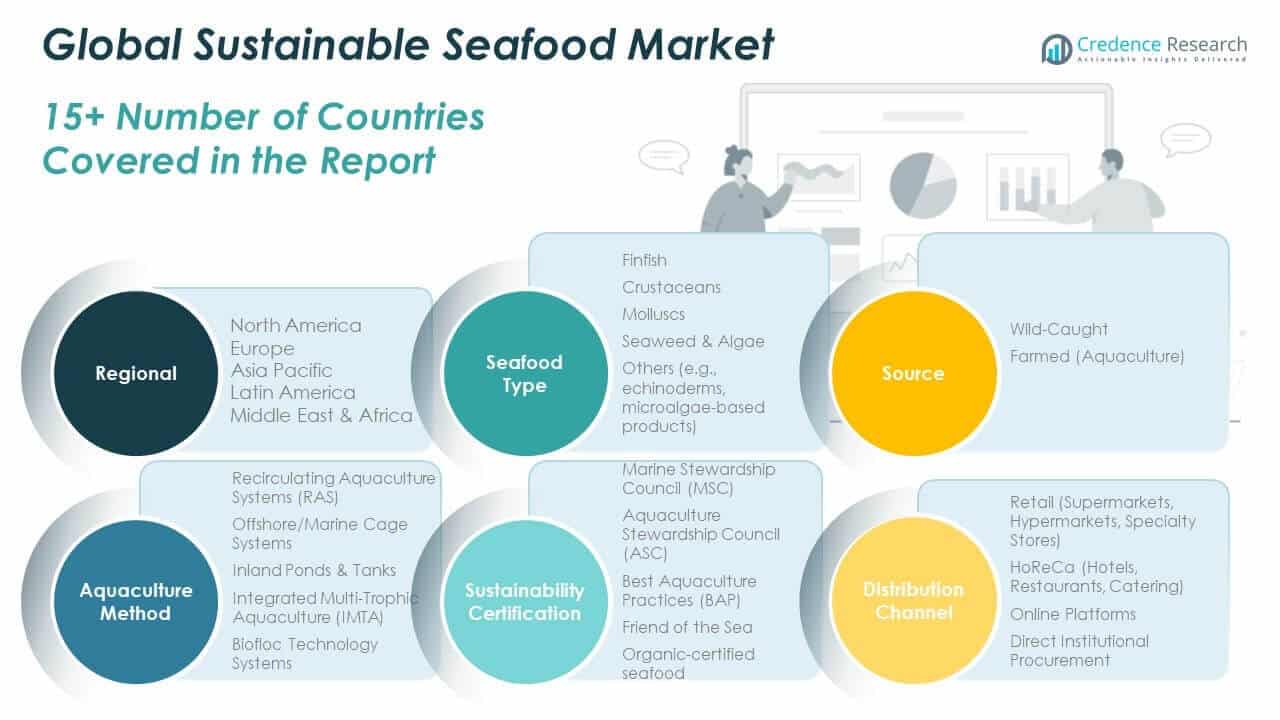
The Global Sustainable Seafood Market spans a diverse set of product and supply categories.
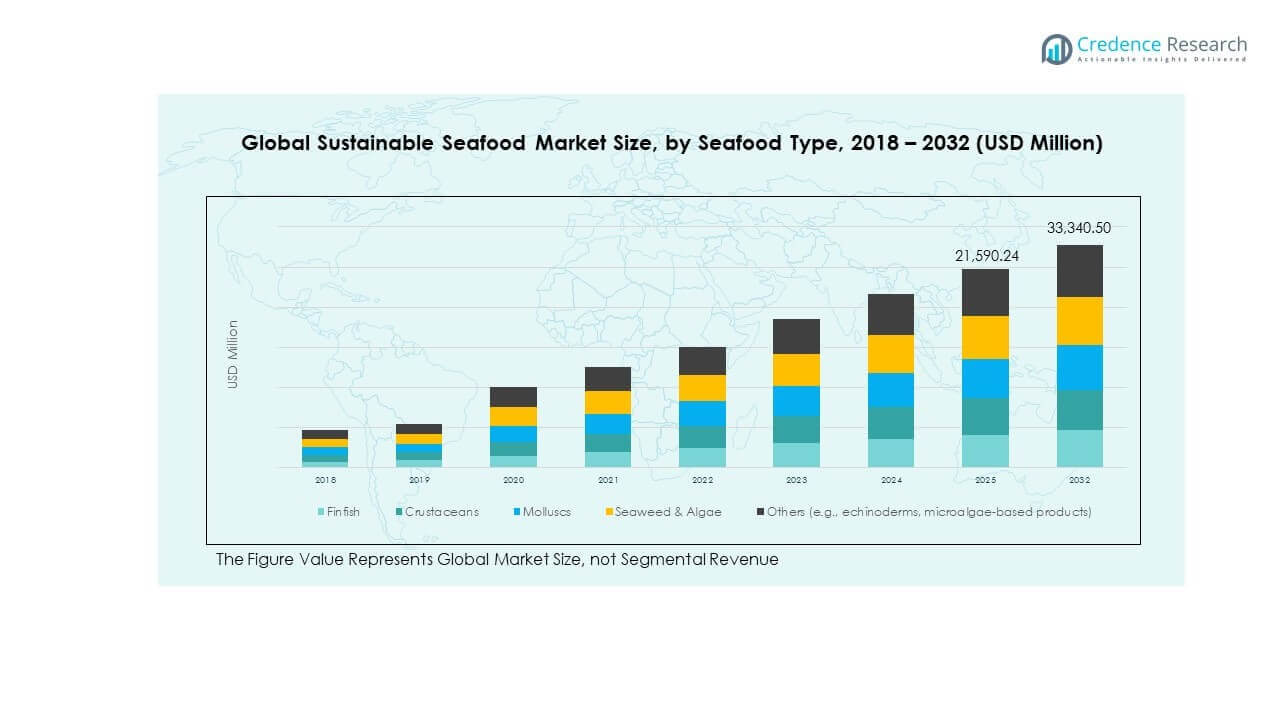
By seafood type, finfish holds the largest share due to high consumption rates and availability. Crustaceans and molluscs also show steady demand across premium and mass segments. Seaweed & algae gain traction as plant-based nutrition and functional food trends expand. The “others” segment, including echinoderms and microalgae-based products, grows through innovation in alternative seafood solutions.
By source, farmed seafood (aquaculture) leads due to supply control, cost efficiency, and traceability benefits. Wild-caught seafood maintains strong presence through certified fisheries and premium-grade sourcing.
By aquaculture methods, Recirculating Aquaculture Systems (RAS) and marine cage systems show strong uptake due to water efficiency and coastal production capacity. Biofloc and IMTA systems attract attention in sustainability-driven regions for their environmental benefits.
- For instance, companies such as Atlantic Sapphire deploy Recirculating Aquaculture Systems (RAS) for Atlantic salmon production, showing how land‑based sustainable farming technologies are being implemented in practice.
By sustainability certification, Marine Stewardship Council (MSC), Aquaculture Stewardship Council (ASC), and Best Aquaculture Practices (BAP) dominate labeling adoption in retail and exports. Organic-certified seafood grows among health-conscious consumers, while Friend of the Sea expands partnerships across markets.
- For instance, the Friend of the Sea program certifies both wild and farmed seafood under strict environmental and social standards, with many producers participating to meet global sustainability benchmarks
By distribution channel, retail remains dominant, driven by certified product demand in supermarkets and hypermarkets. HoReCa and online platforms expand reach across urban consumers. Direct institutional procurement gains momentum from ESG-aligned policies.
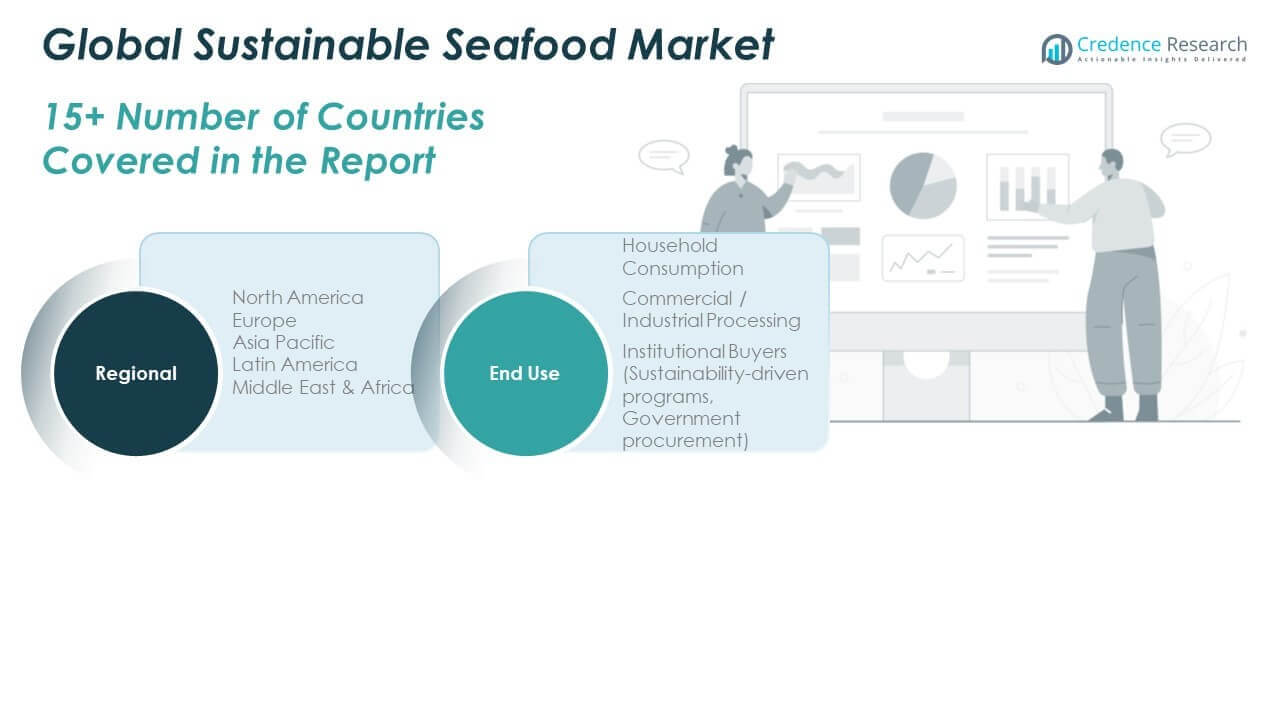
By end use, household consumption leads overall demand, while commercial and industrial processing ensure stable volumes in bulk categories. Institutional buyers, driven by government programs and public procurement mandates, represent a growing segment in certified seafood supply chains. The Global Sustainable Seafood Market continues to evolve across these interconnected segments.
Segmentation:
By Seafood Type
- Finfish
- Crustaceans
- Molluscs
- Seaweed & Algae
- Others (e.g., echinoderms, microalgae-based products)
By Source
- Wild-Caught
- Farmed (Aquaculture)
By Aquaculture Method
- Recirculating Aquaculture Systems (RAS)
- Offshore/Marine Cage Systems
- Inland Ponds & Tanks
- Integrated Multi-Trophic Aquaculture (IMTA)
- Biofloc Technology Systems
By Sustainability Certification
- Marine Stewardship Council (MSC)
- Aquaculture Stewardship Council (ASC)
- Best Aquaculture Practices (BAP)
- Friend of the Sea
- Organic-certified seafood
By Distribution Channel
- Retail (Supermarkets, Hypermarkets, Specialty Stores)
- HoReCa (Hotels, Restaurants, Catering)
- Online Platforms
- Direct Institutional Procurement
By End Use
- Household Consumption
- Commercial / Industrial Processing
- Institutional Buyers (Sustainability-driven programs, Government procurement)
By Regional
- North America
- The U.S.
- Canada
- Mexico
- Europe
- Germany
- France
- The U.K.
- Italy
- Spain
- Rest of Europe
- Asia Pacific
- China
- Japan
- India
- South Korea
- South-east Asia
- Rest of Asia Pacific
- Latin America
- Brazil
- Argentina
- Rest of Latin America
- Middle East & Africa
- GCC Countries
- South Africa
- Rest of the Middle East and Africa
Regional Analysis:
North America
The North America Global Sustainable Seafood Market size was valued at USD 3,858.77 million in 2018 to USD 5,670.26 million in 2024 and is anticipated to reach USD 9,694.25 million by 2032, at a CAGR of 6.5% during the forecast period. North America holds the largest share of the Global Sustainable Seafood Market, accounting for approximately 29% of the global revenue in 2024. Strong regulatory enforcement and consumer demand for eco-certified seafood drive this dominance. U.S. retailers and food service giants enforce strict procurement standards. MSC- and ASC-certified products dominate supermarket shelves. Canada supports traceable supply chains with advanced fisheries management programs. Indigenous fisheries play an active role in sustainable sourcing. Digital traceability tools and satellite monitoring systems improve compliance. Public institutions increase demand through ESG-aligned food procurement. It reflects a mature market with steady volume and premium pricing opportunities.
Europe
The Europe Global Sustainable Seafood Market size was valued at USD 2,444.96 million in 2018 to USD 3,448.73 million in 2024 and is anticipated to reach USD 5,338.40 million by 2032, at a CAGR of 5.1% during the forecast period. Europe contributes around 17.6% of the 2024 market, supported by strong public policy, industry alignment, and consumer awareness. The EU Common Fisheries Policy enforces quotas, bycatch limits, and regional ecosystem protection. Northern Europe, especially Norway and the UK, leads in certified wild-caught exports. Retailers promote eco-labels on all private-label seafood lines. France and Germany invest in low-impact aquaculture systems. Social sustainability and labor transparency also shape procurement. NGOs and certification bodies maintain high consumer trust. It continues to set sustainability benchmarks and ethical standards globally.
Asia Pacific
The Asia Pacific Global Sustainable Seafood Market size was valued at USD 5,723.67 million in 2018 to USD 8,858.29 million in 2024 and is anticipated to reach USD 16,003.76 million by 2032, at a CAGR of 7.2% during the forecast period. Asia Pacific leads in volume and accounts for 45.2% of the global market value in 2024. Major producers such as China, India, Vietnam, and Thailand drive the region’s output. Export markets demand compliance with MSC, ASC, and BAP standards. Governments support certification through technical training and modernization grants. Large aquaculture players invest in biosecure and low-emission systems. Domestic consumption of sustainable seafood is growing in urban centers. Japan and South Korea support traceability across cold chain networks. It offers strong growth prospects through technology adoption and regional certification scaling.
Latin America
The Latin America Global Sustainable Seafood Market size was valued at USD 565.80 million in 2018 to USD 832.94 million in 2024 and is anticipated to reach USD 1,239.46 million by 2032, at a CAGR of 4.6% during the forecast period. Latin America holds approximately 4.2% of the 2024 global market share. Chile and Ecuador are major exporters of farmed salmon and shrimp, with growing ASC and BAP certifications. National aquaculture plans in Peru and Brazil promote sustainable farming and inland pond systems. Coastal communities participate in NGO-led traceability programs. Compliance challenges remain in small-scale fisheries. Institutional buyers in the U.S. and EU drive demand for certified Latin American exports. Governments aim to strengthen enforcement and upgrade cold chain logistics. It remains export-driven with strong ties to North American and European retail.
Middle East
The Middle East Global Sustainable Seafood Market size was valued at USD 357.33 million in 2018 to USD 486.18 million in 2024 and is anticipated to reach USD 694.42 million by 2032, at a CAGR of 4.1% during the forecast period. The region contributes 2.5% to the global market in 2024. Gulf countries invest in desert aquaculture and RAS systems to ensure food security. The UAE and Saudi Arabia lead in commercial-scale aquaculture initiatives. Imports dominate seafood consumption, and buyers increasingly demand eco-certified imports. Local farms adopt IMTA and water recycling to meet sustainability standards. Certification adoption is growing through partnerships with European certifiers. Retailers align product offerings with national sustainability strategies. It is an emerging market driven by self-sufficiency goals and premium consumer segments.
Africa
The Africa Global Sustainable Seafood Market size was valued at USD 170.08 million in 2018 to USD 285.58 million in 2024 and is anticipated to reach USD 370.21 million by 2032, at a CAGR of 2.8% during the forecast period. Africa represents the smallest regional share, about 1.5% of the global market in 2024. Nigeria, Egypt, and South Africa lead in aquaculture development. Small-scale coastal fisheries dominate production but lack access to certification frameworks. NGOs and development agencies support sustainable fishing training and infrastructure upgrades. Institutional procurement and donor-driven nutrition programs support local sustainable seafood projects. Export growth remains limited by compliance gaps and logistics constraints. Adoption of RAS and Biofloc systems is increasing across inland farms. It shows long-term promise through localized investment, government support, and international partnerships.
Key Player Analysis:
- Mowi ASA
- Thai Union Group
- Charoen Pokphand Foods (CPF)
- BlueNalu / New Wave Foods
- Nova Sea / Cermaq
Competitive Analysis:
The Global Sustainable Seafood Market features a mix of multinational producers, regional suppliers, and emerging technology-driven entrants. Large companies leverage vertically integrated operations to secure certified supply and maintain cost control. Market leaders focus on MSC, ASC, and BAP certifications to strengthen buyer trust and meet retail procurement standards. Strategic partnerships with fisheries, aquaculture farms, and certification bodies support consistent sourcing. Product diversification across finfish, crustaceans, and value-added seafood enhances portfolio strength. Firms invest in traceability systems, digital monitoring, and transparent reporting to improve compliance. Expansion into premium and private‑label segments helps defend market position. Regional players compete through local sourcing and export specialization. New entrants emphasize alternative seafood and advanced aquaculture systems. Competitive intensity remains moderate, with differentiation driven by certification depth, supply reliability, and long‑term sustainability commitments.
Recent Developments:
- In October 2025, Mowi ASA received final approval from the Norwegian competition authority to acquire a controlling stake in Nova Sea AS, completing the regulatory process for the transaction.
- In October 2025, CPF partnered with Japan's NH Foods to launch CPF NH Foods, a joint venture targeting Japanese food demand in Thailand and Asia
Report Coverage:
The research report offers an in-depth analysis based on Seafood Type, Source, Aquaculture Method, Sustainability Certification, Distribution Channel and End Use. It details leading market players, providing an overview of their business, product offerings, investments, revenue streams, and key applications. Additionally, the report includes insights into the competitive environment, SWOT analysis, current market trends, as well as the primary drivers and constraints. Furthermore, it discusses various factors that have driven market expansion in recent years. The report also explores market dynamics, regulatory scenarios, and technological advancements that are shaping the industry. It assesses the impact of external factors and global economic changes on market growth. Lastly, it provides strategic recommendations for new entrants and established companies to navigate the complexities of the market.
Future Outlook:
- Consumer trust will deepen as certified sourcing becomes standard across retail, foodservice, and institutional seafood procurement channels worldwide.
- Governments will tighten fisheries governance and aquaculture rules, pushing producers toward verified sustainability and stronger compliance systems.
- Technology adoption will accelerate, with blockchain, satellite tracking, and digital audits improving traceability and supply chain accountability.
- Aquaculture expansion will focus on low-impact systems such as RAS, IMTA, and biofloc to support resource efficiency.
- Retail private labels will expand sustainable seafood portfolios to strengthen brand loyalty and meet ESG commitments.
- Foodservice operators will integrate certified seafood into menus to align with sustainability goals and consumer expectations.
- Alternative seafood and cell-based innovations will complement traditional supply and reduce pressure on wild stocks.
- Emerging markets will invest in certification readiness to improve export access and global competitiveness.
- Social sustainability will gain importance, covering labor standards, worker safety, and community welfare.
- Strategic partnerships will shape growth, linking producers, certifiers, technology providers, and global buyers.
Request a Free Sample
Fill in your details and we'll send you a free sample report.
- Sample data tables & charts
- Research methodology
Need a Custom Version of This Report?
Tailor the scope, geography, or segments to your exact requirements.
- Custom geography or segment scope
- Direct access to our analyst team
Frequently Asked Questions
What is the current market size for Global Sustainable Seafood Market, and what is its projected size in 2032?
At what Compound Annual Growth Rate is the Global Sustainable Seafood Market projected to grow between 2024 and 2032?
Which Global Sustainable Seafood Market market segment held the largest share in 2024?
What are the primary factors fueling the growth of the Global Sustainable Seafood Market?
Who are the leading companies in the Global Sustainable Seafood Market?
Which region commanded the largest share of the Global Sustainable Seafood Market in 2024?
Table of Content
Chapter 1. Report Introduction
- 1.1 Report Description & Purpose
- 1.1.1 Report Title & Market Definition
- 1.1.2 Unique Selling Propositions (USP) & Key Differentiators
- 1.1.3 Value Proposition for Stakeholders
- 1.2 Research Objectives
- 1.2.1 Market Sizing Objectives (Volume & Revenue)
- 1.2.2 Segmentation Objectives
- 1.2.3 Competitive Intelligence Objectives
- 1.2.4 Forecast & Scenario Objectives
- 1.3 Report Scope
- 1.3.1 Sustainable Seafood Scope – Types & Subtypes Covered
- 1.3.2 Geographic Scope – Regions & Countries Covered
- 1.3.3 Historical Period, Base Year & Forecast Period (2024; forecast to 2032)
- 1.3.4 Inclusions & Exclusions
- 1.4 HS Code & Classification Framework
- 1.5 Currency, Units & Pricing Basis
- 1.6 Target Stakeholders
- 1.7 Limitations & Assumptions
Chapter 2. Executive Summary
- 2.1 Global Sustainable Seafood Market Snapshot
- 2.1.1 Market Size – Historical (2024) & Forecast (2024-2032) (2024: USD 19,581.99 million → 2032: USD 33,340.50 million)
- 2.1.2 Volume & Revenue – Global Totals
- 2.1.3 Key Market Highlights – Top Five Facts
- 2.2 Sustainable Seafood Market Segmentation Snapshot
- 2.2.1 Market Split by Region – 2024 vs. 2032
- 2.3 Competitive Snapshot
- 2.3.1 Top 10 Players by Revenue Share – 2024
- 2.3.2 Top 10 Players by Volume Share – 2024
- 2.3.3 Recent Strategic Developments (18-Month Summary)
- 2.4 Key Investment Highlights & Strategic Conclusions
Chapter 3. Sustainable Seafood Market Dynamics & Industry Analysis
- 3.1 Market Overview & Context
- 3.1.1 Sustainable Seafood Market Position in the Broader Automotive Value Chain
- 3.1.2 OEM vs. Replacement Market Dynamics
- 3.1.3 Market Maturity & Development Stage by Region
- 3.2 Sustainable Seafood Market Drivers
- 3.3 Sustainable Seafood Market Restraints & Challenges
- 3.4 Sustainable Seafood Market Opportunities
- 3.5 Porter's Five Forces Analysis
- 3.5.1 Threat of New Entrants
- 3.5.2 Bargaining Power of Suppliers
- 3.5.3 Bargaining Power of Buyers
- 3.5.4 Threat of Substitutes
- 3.5.5 Competitive Rivalry – Intensity Assessment
- 3.6 Sustainable Seafood Value Chain Analysis
- 3.6.1 Upstream – Raw Material/Input Suppliers
- 3.6.1.1 Raw Material/Input 1
- 3.6.1.2 Raw Material/Input 2
- 3.6.1.3 Raw Material/Input 3
- 3.6.2 Midstream – Production/Manufacturing/Service Delivery
- 3.6.2.1 Production/Process Overview
- 3.6.2.2 Key Facility Locations & Capacity by Manufacturer
- 3.6.3 Downstream – Distribution & End Consumer
- 3.6.3.1 Primary Channel – B2B/OEM
- 3.6.3.2 Secondary Channels – Dealer, Retail, Online, Direct
- 3.6.4 Value Chain Profitability Analysis
- 3.6.1 Upstream – Raw Material/Input Suppliers
- 3.7 PESTEL Analysis
- 3.7.1 Political Factors
- 3.7.2 Economic Factors
- 3.7.3 Social Factors
- 3.7.4 Technological Factors
- 3.7.5 Environmental Factors
- 3.7.6 Legal Factors
- 3.8 Sustainable Seafood Supply Chain Analysis
- 3.8.1 Raw Material/Input Supply Risk Assessment
- 3.8.2 Manufacturing Concentration Risk (Geographic Exposure)
- 3.8.3 Trade Disruption Impact Analysis
- 3.9 Regulatory & Policy Landscape
Note: The regulatory and policy landscape section covers regulations based on their applicability to the market, Sustainable Seafood category, geography, and scope of the study. Only regulatory frameworks with a material impact on operations, compliance, trade, sustainability, or market access are analyzed in detail.
Chapter 4. Key Investment Pockets & Opportunity Analysis
- 4.1 Sustainable Seafood Market Attractiveness Analysis
- 4.1.1 By Region – Investment Attractiveness Matrix (Volume × CAGR)
- 4.2 Absolute Revenue Growth Opportunity
- 4.2.1 By Region – Absolute USD Growth Through 2032
- 4.3 Incremental Volume Opportunity
- 4.3.1 By Region – Incremental Volume Through 2032
- 4.3.2 Segment – Incremental Volume
- 4.4 Emerging Submarket Opportunity Deep Dive (Subject to Applicability)
- 4.5 Emerging Market Opportunity Scorecards
- 4.5.1 United States
- 4.5.2 Europe
- 4.5.3 Asia
- 4.5.4 Middle East & Africa
Note: Emerging Market Opportunity Scorecards will be included based on relevance and strategic importance. Regions listed are indicative and may vary depending on data availability and market dynamics.
Chapter 5. Sustainable Seafood Import-Export Analysis & Trade Flows
- 5.1 Global Trade Overview
- 5.1.1 Global Export Value by Country (2024)
- 5.1.2 Global Export Volume by Country (2024)
- 5.1.3 Global Import Value by Country (2024)
- 5.1.4 Global Import Volume by Country (2024)
- 5.1.5 Net Trade Balance by Country (2024)
- 5.2 Export Analysis – Segment
- 5.2.1 Type 1 (HS Code)
- 5.2.2 Type 2 (HS Code)
- 5.2.3 Type 3 (HS Code)
- 5.2.4 Type 4 (HS Code)
- 5.2.5 Type 5 (HS Code)
- 5.3 Import Analysis – Segment
- 5.3.1 Type 1 (HS Code)
- 5.3.2 Type 2 (HS Code)
- 5.3.3 Type 3 (HS Code)
- 5.3.4 Type 4 (HS Code)
- 5.3.5 Type 5 (HS Code)
- 5.4 Average Unit Trade Prices
- 5.4.1 Average Export Price – Segment & Country
- 5.4.2 Average Import Price – Segment & Source Country
- 5.4.3 Price Trends (2024)
- 5.5 Key Trade Route Analysis
- 5.5.1 Trade Route 1
- 5.5.2 Trade Route 2
- 5.5.3 Trade Route 3
- 5.5.4 Trade Route 4
- 5.5.5 Trade Route 5
- 5.6 Trade Policy Impact Assessment
- 5.6.1 US Anti-Dumping & Section 301 Tariffs
- 5.6.2 EU Customs Union Impact
- 5.6.3 Major Free Trade Agreements
- 5.6.4 USMCA Rules of Origin
Note: Trade policy analysis will be included only where relevant to the Sustainable Seafood market.
Chapter 6. Competitive Landscape & Company Benchmarking
- 6.1 Sustainable Seafood Market Concentration & Structure
- 6.1.1 Herfindahl-Hirschman Index (HHI) – vs. 2024
- 6.1.2 Tier 1, Tier 2 & Tier 3 Market Structure
- 6.1.3 Global, Regional & Local Player Dynamics
- 6.2 Sustainable Seafood Market Share Analysis – 2024
- 6.2.1 Global Revenue Share by Company
- 6.2.2 Global Volume Share by Company
- 6.2.3 Regional Revenue Share
- 6.2.4 Market Share Evolution ( vs. 2024)
- 6.2.5 OEM Segment Share by Company
- 6.2.6 Replacement Segment Share by Company
- 6.3 Production/Delivery Capacity & Facility Analysis
- 6.3.1 Global Installed Capacity
- 6.3.2 Capacity Utilization Rates
- 6.3.3 Production/Output Volume
- 6.3.4 Facility Locations & Capacity Map
- 6.3.5 Planned Capacity Additions
- 6.4 Sustainable Seafood Competitive Benchmarking Matrix
- 6.4.1 Revenue, Volume, CAGR & Profitability Comparison
- 6.4.2 Channel Revenue Mix
- 6.4.3 Geographic Revenue Exposure
- 6.4.4 R&D Intensity
- 6.4.5 Sustainability Maturity
- 6.5 Strategic Developments in Sustainable Seafood (Last 24 Months)
- 6.5.1 Mergers, Acquisitions & Divestments
- 6.5.2 New Sustainable Seafood Launches
- 6.5.3 Facility Expansions
- 6.5.4 Strategic Alliances, Joint Ventures & Partnerships
- 6.5.5 Distribution Expansion & Market Entry
- 6.5.6 Sustainability & ESG Initiatives
- 6.6 Competitive Strategy Mapping
- 6.6.1 Leader, Challenger, Follower & Niche Classification
- 6.6.2 Pricing Strategy Comparison
- 6.6.3 Channel Strategy Matrix
Note: Strategic developments are included based on their materiality and the availability of reliable information.
Chapter 7. Global Sustainable Seafood Market – By Distribution Channel
- 7.1 Segment Overview
- 7.1.1 Volume & Revenue Split by Channel (2024 & 2032)
- 7.1.2 Channel Mix Evolution (2024-2032)
Chapter 8. Regional Market Analysis – Global Overview
- 8.1 Global Regional Overview
- 8.1.1 Regional Volume Share
- 8.1.2 Regional Revenue Share
- 8.1.3 Regional Volume by Region
- 8.1.4 Regional Revenue by Region
- 8.1.5 Regional Forecast Through 2032
- 8.2 Cross-Regional Segment Analysis
- 8.2.1 By Distribution Channel
- 8.2.2 By Brand/Price Tier
Chapter 9. North America Sustainable Seafood Market
- 9.1 United States
- 9.2 Canada
- 9.3 Mexico
Chapter 10. Europe Sustainable Seafood Market
- 10.1 Germany
- 10.2 France
- 10.3 Italy
- 10.4 United Kingdom
- 10.5 Spain
- 10.6 Poland
- 10.7 Russia
- 10.8 Netherlands
- 10.9 Belgium
- 10.10 Sweden
- 10.11 Denmark
- 10.12 Norway
- 10.13 Rest of Europe
Chapter 11. Asia Pacific Sustainable Seafood Market
- 11.1 China
- 11.2 India
- 11.3 Japan
- 11.4 South Korea
- 11.5 Thailand
- 11.6 Indonesia
- 11.7 Vietnam
- 11.8 Malaysia
- 11.9 Australia
- 11.10 Rest of Asia Pacific
Chapter 12. Latin America Sustainable Seafood Market
- 12.1 Brazil
- 12.2 Argentina
- 12.3 Colombia
- 12.4 Chile
- 12.5 Rest of Latin America
Chapter 13. Middle East Sustainable Seafood Market
- 13.1 Saudi Arabia
- 13.2 United Arab Emirates
- 13.3 Turkey
- 13.4 Israel
- 13.5 Iran
- 13.6 Rest of the Middle East
Chapter 14. Africa Sustainable Seafood Market
- 14.1 South Africa
- 14.2 Egypt
- 14.3 Nigeria
- 14.4 Morocco
- 14.5 Rest of Africa
Chapter 15. Sustainable Seafood Company Profiles
- 15.1 [Company 01]
- 15.1.1 Company Overview
- 15.1.2 Key Management Personnel
- 15.1.3 Products & Services Portfolio
- 15.1.4 Financial Performance
- 15.1.5 Key Market Focus & Geographic Presence
- 15.1.6 Recent Developments & Strategic Initiatives
Note: The company profile list is preliminary and may change based on research findings, market developments, data availability, and client requirements.
Chapter 16. Appendices
- Appendix A – List of Abbreviations & Acronyms
- Appendix B – Industry Classification Code Reference – Full Series
- Appendix C – Production & Capacity Data Tables
- Appendix D – End-Use & Demand Base Tables
- Appendix E – Consumption & Replacement Rate Assumptions
- Appendix F – ASP Reference Tables
- Appendix G – Manufacturing & Facility Database
- Appendix H – Import-Export Data Tables
- Appendix I – Regulatory Summary Tables
- Appendix J – Primary Research Participant List (Anonymized)
- Appendix K – Primary Research Questionnaire Framework
- Appendix L – Data Sources & Bibliography
- Appendix M – Market Size Divergence & Source Comparison
Chapter 17. Research Methodology
- 17.1 Research Framework & Philosophy
- 17.2 Secondary Research – Sources, Hierarchy & Data Extraction
- 17.3 Data Modeling – Bottom-Up & Top-Down Market Sizing
- 17.4 Primary Research – Stakeholder Framework, LOI & Sample Sizes
- 17.5 Forecast Methodology – Regression, Scenario & Sensitivity Analysis
- 17.6 Quality Control – Four-Layer Validation Framework
- 17.7 Limitations & Standard Assumptions
- 17.8 Disclaimer
