
U.S. Gift Card Market Overview
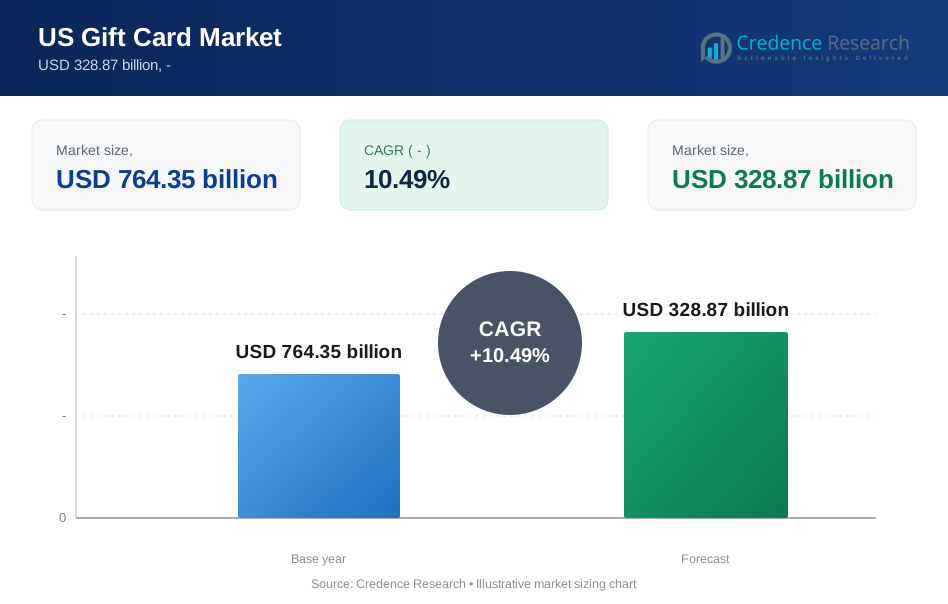
The U.S. gift card market is poised for significant growth, with projections indicating a compound annual growth rate (CAGR) of 10.29%, culminating in a market value of approximately USD 924.84 billion by 2030 from USD 380.25 billion. This sector showcases a dynamic and expanding landscape, characterized by a diverse array of market participants offering a variety of gift card types. Key drivers of this growth include the rising popularity of electronic gift cards (e-gift cards) and the burgeoning development of gift card marketplaces.
This market is systematically categorized based on several criteria: product type, functional attributes, industry verticals, and merchant categories. In terms of product type, it is bifurcated into e-gift cards and physical cards. Consumer types in this market are divided into retail and corporate consumers, addressing different consumer needs and preferences. Furthermore, the distribution channels are segmented into online and offline avenues, catering to varied purchasing behaviors.
Notably, the digital or e-gift card segment has demonstrated robust growth, which is anticipated to persist, underlining its increasing acceptance and preference among U.S. consumers. This growth trajectory underscores the evolving nature of the gift card market in the United States, reflecting both technological advancements and changing consumer behaviors.
A gift card, a gift certificate, gift voucher, or gift token, is a prepaid stored-value money card used as an alternative to cash for purchases within specific stores or related businesses. Typically issued by retailers or banks, these cards are non-redeemable for cash and may be subject to expiry dates or fees. They are a popular choice for employers and organizations to give as rewards or gifts due to their convenience, allowing the recipient to choose their desired item while alleviating the giver from selecting a specific gift. Gift cards, which can be either physical or digital, are also beneficial for controlling spending and avoiding bank overdrafts, making them a versatile financial tool.
U.S. Gift Card Market Growth Drivers and Trends
The United States gift card market is witnessing substantial growth, propelled by several key factors that align with evolving consumer trends and market dynamics. A significant driver of this growth is the increasing demand for gift cards among millennials and Generation Z. These demographic segments are demonstrating a marked preference for the convenience and flexibility of gift cards, both in their physical and digital manifestations. This shift in consumer behavior is particularly notable in the context of the burgeoning e-commerce sector, where digital or e-gift cards are rapidly gaining popularity due to their seamless integration with online shopping platforms.
Further fueling the market's expansion is the rising inclination towards digital gifting options and the strategic use of gift cards as rewards and incentives in various sectors. This trend is underscored by a growing consumer preference for experiential purchases over physical gifts, making gift cards an appealing option due to their inherent flexibility and wide applicability. Additionally, the consistent growth of the global retail industry is playing a crucial role in enhancing sales opportunities for retailers through gift cards, especially in the steadily expanding foodservices sector. These factors collectively highlight the strategic importance of gift cards as a convenient, versatile, and effective tool for both consumers and retailers, thereby significantly contributing to the ongoing growth and diversification of the gift card market in the United States.
U.S. Gift Card Market challenges and Restraints Factors
While demonstrating robust growth, the U.S. gift card market is confronted with several challenges and restraint factors that necessitate strategic attention. Foremost among these is the issue of security. The increasing prevalence of gift card hacking and related fraudulent activities poses a significant threat, particularly in the realm of digital gift cards. This heightened risk of cyber-attacks undermines consumer confidence and serves as a major impediment to market growth. The industry, therefore, faces the urgent need to bolster security measures and develop more secure, fraud-resistant gift card solutions to maintain consumer trust and market stability.
Moreover, the market is also dealing with challenges stemming from exploitative practices and a highly competitive landscape. Practices such as imposing latency and redemption fees have been criticized for eroding the inherent value of gift cards, thereby dissuading consumers from maximizing their utility. This issue is further complicated by the increasing market saturation, with a multitude of companies offering a wide variety of innovative gift card options. This saturation makes it challenging for businesses to distinguish themselves and capture consumer interest. Additionally, evolving consumer preferences, marked by a shift towards personalized and experiential gifts, pose challenges to traditional gift card models, prompting a need for adaptation and innovation.
Interesting Facts about U.S. Gift Card Market
- Significant Market Value: The U.S. gift card market is remarkably substantial, with sales reaching billions of dollars during the holiday season alone, highlighting its major economic impact.
- Widespread Consumer Adoption: A large percentage of Americans engage with gift cards, not only purchasing them for others but also for personal use, indicating their widespread popularity.
- Expiration Dates: Gift cards often have expiration terms and conditions, making it crucial for consumers to be aware of these details to utilize the cards before they expire fully.
- Retail Innovation: Neiman Marcus is the first retail store to sell gift cards, pioneering a trend that has become ubiquitous in the retail industry.
- Collectible Designs: Some gift cards are designed with intricate patterns, holographic effects, or as limited editions, which makes them highly sought after by collectors, adding a unique aspect to their appeal.
Regional Insights
North America stands as the most significant revenue contributor in the U.S. gift card market, exemplifying a CAGR of 14.4%. The robust expansion of the U.S. gift card market can be largely attributed to technological advancements in product offerings and an increasing inclination towards digital gift cards. Within North America, the U.S. dominates the market share, while Canada emerges as the fastest-growing market in the region. The preeminence of North America in the gift card sector is largely due to several key factors. These include government initiatives that promote the adoption of digital payment methods, continuous technological progress in the field, and the escalating popularity of digital gift cards among consumers. This convergence of technological innovation and supportive regulatory frameworks has positioned North America, and the U.S. in particular, at the forefront of the global gift card market.
Competitive Analysis
The U.S. gift card market is very competitive, with many powerful players. Some of the leading market participants and their corresponding market shares are listed below:
- Under Armour, Inc
- TransGate Solutions
- Walgreen Co
- Sephora USA, Inc
- Tele-Pak Inc.
- Alltimeprint.com
- Plastek Card Solutions, Inc.
- eCard Systems
- Blackhawk Network
- Card Isle
- Tango Card. Inc
- InComm Payments,
- Card USA, Inc
- Duracard
- Gyft, Inc
- Givex Corporation.
Recent Developments in U.S. Gift Card Market
In September 2021, Factor4, a major player in the U.S. gift card and loyalty solutions market, announced a strategic partnership with SavorConnect, a prominent provider of cloud-based integration platforms. As a result of this alliance, Factor4 is set to develop omnichannel gift cards for Shopify, enabling consumers to utilize these cards across various channels, including online, in-store, and on mobile devices. In May 2022, New Seasons Market and New Leaf Community Markets, both renowned on the West Coast, broadened their collaboration with Blackhawk Network, a global leader in branded payments. This expansion aims to enhance the online gift card programs of their community-focused grocery stores, reflecting a commitment to elevating the customer experience in the realm of digital payments.Segmentation
US Gift Cards Market – By Material Merchant Type- Restaurants
- Department Stores
- Grocery Stores
- Supermarkets/Hypermarkets
- Discount Stores
- Coffee Shops
- Entertainments
- Salons/Spa
- Book Stores
- Home Décor Stores
- Gas Stations
- Visa/Master Card/American Express Gift Cards
- Others
- Universal Accepted Open Loop
- Restaurant Closed Loop
- Retail Closed Loop
- Miscellaneous Closed Loop
- E-Gifting
- Business
- Individuals
- High (Above 400 US$)
- Medium (200-400 US$)
- Low (0-200 US$)
Request a Free Sample
Fill in your details and we'll send you a free sample report.
- Sample data tables & charts
- Research methodology
Need a Custom Version of This Report?
Tailor the scope, geography, or segments to your exact requirements.
- Custom geography or segment scope
- Direct access to our analyst team
Frequently Asked Questions
What are the key factors driving the growth of the US gift card market?
Why are digital gift cards becoming more popular in the US?
How are gift cards being used in various sectors beyond just gifting?
What role does the global retail industry play in the US gift card market?
Table of Content
Chapter 1. Report Introduction
- 1.1 Report Description & Purpose
- 1.1.1 Report Title & Market Definition
- 1.1.2 Unique Selling Propositions (USP) & Key Differentiators
- 1.1.3 Value Proposition for Stakeholders
- 1.2 Research Objectives
- 1.2.1 Market Sizing Objectives (Volume & Revenue) (Volume Where Applicable)
- 1.2.2 Segmentation Objectives
- 1.2.3 Competitive Intelligence Objectives
- 1.2.4 Forecast & Scenario Objectives
- 1.3 Report Scope
- 1.3.1 US Gift Card Scope – Segments & Subsegments Covered
- 1.3.2 Geographic Scope – Selected Country & Subnational Markets Covered
- 1.3.3 Historical Period, Base Year & Forecast Period (2030; forecast to the forecast period)
- 1.3.4 Inclusions & Exclusions
- 1.4 Industry Classification & Applicable Codes
- 1.5 Currency, Measurement Units & Valuation Basis
- 1.6 Target Stakeholders
- 1.7 Limitations & Assumptions
Chapter 2. Executive Summary
- 2.1 US Gift Card Snapshot
- 2.1.1 Market Size – Historical (2030) & Forecast (the forecast period) (2030: USD 764.35 billion → forecast year: USD 328.87 billion)
- 2.1.2 Volume & Revenue – National Totals (Volume Where Applicable)
- 2.1.3 Key Market Highlights – Top Five Facts
- 2.2 US Gift Card Segmentation Snapshot
- 2.2.1 Market Split by Subnational Area – 2030 vs.
- 2.3 Competitive Snapshot
- 2.3.1 Top 10 Players by Revenue Share – 2030
- 2.3.2 Top 10 Players by Volume Share – 2030 (Volume Where Applicable)
- 2.3.3 Recent Strategic Developments (18-Month Summary)
- 2.4 Key Investment Highlights & Strategic Conclusions
Chapter 3. US Gift Card Dynamics & Industry Analysis
- 3.1 Market Overview & Context
- 3.1.1 US Gift Card Position in the Broader Industry Value Chain
- 3.1.2 Demand Structure & Purchasing Dynamics
- 3.1.3 Market Maturity & Development Stage Across Domestic Markets
- 3.2 US Gift Card Drivers
- 3.3 US Gift Card Restraints & Challenges
- 3.4 US Gift Card Opportunities
- 3.5 Porter's Five Forces Analysis
- 3.5.1 Threat of New Entrants
- 3.5.2 Bargaining Power of Suppliers
- 3.5.3 Bargaining Power of Buyers
- 3.5.4 Threat of Substitutes
- 3.5.5 Competitive Rivalry – Intensity Assessment
- 3.6 US Gift Card Value Chain Analysis
- 3.6.1 Upstream – Key Inputs, Resources & Suppliers
- 3.6.1.1 Key Input/Resource 1
- 3.6.1.2 Key Input/Resource 2
- 3.6.1.3 Key Input/Resource 3
- 3.6.2 Midstream – Core Operations & Value Creation
- 3.6.2.1 Operating Model & Process Overview
- 3.6.2.2 Key Operating Locations & Capabilities by Company
- 3.6.3 Downstream – Market Channels & End Users
- 3.6.3.1 Direct Sales & Customer Engagement Channels
- 3.6.3.2 Indirect Sales, Intermediaries & Partner Channels
- 3.6.4 Value Chain Profitability Analysis
- 3.6.1 Upstream – Key Inputs, Resources & Suppliers
- 3.7 PESTEL Analysis
- 3.7.1 Political Factors
- 3.7.2 Economic Factors
- 3.7.3 Social Factors
- 3.7.4 Technological Factors
- 3.7.5 Environmental Factors
- 3.7.6 Legal Factors
- 3.8 US Gift Card Supply Chain Analysis
- 3.8.1 Critical Input & Resource Availability Risk Assessment
- 3.8.2 Supplier & Operational Concentration Risk (Geographic Exposure)
- 3.8.3 Supply & Service Disruption Impact Analysis
- 3.9 National & Subnational Regulatory Landscape
Note: The regulatory and policy landscape section covers regulations based on their applicability to the market, US Gift Card category, geography, and scope of the study. Only regulatory frameworks with a material impact on operations, compliance, trade, sustainability, or market access are analyzed in detail.
Chapter 4. Key Investment Pockets & Opportunity Analysis
- 4.1 US Gift Card Attractiveness Analysis
- 4.1.1 By Subnational Area – Investment Attractiveness Matrix (Market Size × CAGR)
- 4.2 Absolute Revenue Growth Opportunity
- 4.2.1 By Subnational Area – Absolute Revenue Growth Through the forecast period
- 4.3 Incremental Demand Opportunity
- 4.3.1 By Subnational Area – Incremental Demand Through the forecast period
- 4.3.2 Segment – Incremental Demand
- 4.4 Emerging Submarket Opportunity Deep Dive (Subject to Applicability)
- 4.5 Priority Domestic Market Opportunity Scorecards
- 4.5.1 Priority Domestic Market 1
- 4.5.2 Priority Domestic Market 2
- 4.5.3 Priority Domestic Market 3
- 4.5.4 Priority Domestic Market 4
Note: Domestic market scorecards cover relevant states, provinces, territories, cities, or economic zones within the selected country. Numbered entries are populated with market names suited to the national administrative structure and research scope. Geographic share tables use one consistent, nonoverlapping set of areas.
Chapter 5. US Gift Card Cross-Border Trade & Market Access Analysis
- 5.1 National Trade & International Partner Overview
- 5.1.1 Export Value by Destination Country (2030)
- 5.1.2 Export Volume by Destination Country (2030) (Where Applicable)
- 5.1.3 Import Value by Source Country (2030)
- 5.1.4 Import Volume by Source Country (2030) (Where Applicable)
- 5.1.5 National & Partner-Country Trade Balances (2030)
- 5.2 Export Analysis – Segment
- 5.2.1 Category 1 (Applicable Classification Code)
- 5.2.2 Category 2 (Applicable Classification Code)
- 5.2.3 Category 3 (Applicable Classification Code)
- 5.2.4 Category 4 (Applicable Classification Code)
- 5.2.5 Category 5 (Applicable Classification Code)
- 5.3 Import Analysis – Segment
- 5.3.1 Category 1 (Applicable Classification Code)
- 5.3.2 Category 2 (Applicable Classification Code)
- 5.3.3 Category 3 (Applicable Classification Code)
- 5.3.4 Category 4 (Applicable Classification Code)
- 5.3.5 Category 5 (Applicable Classification Code)
- 5.4 Cross-Border Pricing & Transaction Benchmarks
- 5.4.1 Export Pricing – Segment & Destination Country
- 5.4.2 Import Pricing – Segment & Source Country
- 5.4.3 Price Trends (2030)
- 5.5 Key Cross-Border Trade & Delivery Routes
- 5.5.1 Cross-Border Trade/Delivery Route 1
- 5.5.2 Cross-Border Trade/Delivery Route 2
- 5.5.3 Cross-Border Trade/Delivery Route 3
- 5.5.4 Cross-Border Trade/Delivery Route 4
- 5.5.5 Cross-Border Trade/Delivery Route 5
- 5.6 Trade Policy & Market Access Impact Assessment
- 5.6.1 Tariff & Non-Tariff Barriers
- 5.6.2 National Participation in Regional Trade & Economic Frameworks
- 5.6.3 Bilateral & Multilateral Trade Agreements
- 5.6.4 Cross-Border Operating, Licensing & Localization Requirements
Note: This chapter covers international trade relevant to US Gift Card in the selected country. Exports are analyzed by destination and imports by source. Domestic interregional flows are excluded from international trade totals. Goods, services, and digital offerings use applicable classifications; volume and route analyses apply only where meaningful.
Chapter 6. Competitive Landscape & Company Benchmarking
- 6.1 US Gift Card Concentration & Structure
- 6.1.1 Herfindahl-Hirschman Index (HHI) – vs. 2030
- 6.1.2 Leading, Mid-Sized & Emerging Player Structure
- 6.1.3 Multinational, National & Local Player Dynamics
- 6.2 US Gift Card Share Analysis – 2030
- 6.2.1 National Revenue Share by Company
- 6.2.2 National Volume Share by Company (Volume Where Applicable)
- 6.2.3 Company Revenue Share by Subnational Area
- 6.2.4 Market Share Evolution ( vs. 2030)
- 6.2.5 Company Market Share by Key Segment
- 6.2.6 Company Market Share by Customer Group
- 6.3 Operating Scale, Capacity & Infrastructure Analysis
- 6.3.1 National Operating Scale & Supply Capacity
- 6.3.2 Resource Utilization & Operating Efficiency
- 6.3.3 Output, Service Delivery & Activity Metrics
- 6.3.4 Operating Footprint & Infrastructure Map
- 6.3.5 Planned Operational & Capacity Expansion
- 6.4 US Gift Card Competitive Benchmarking Matrix
- 6.4.1 Revenue, Growth, Profitability & Operating Metric Comparison
- 6.4.2 Channel Revenue Mix
- 6.4.3 Revenue Exposure Across Domestic Markets
- 6.4.4 R&D Intensity
- 6.4.5 Sustainability Maturity
- 6.5 Strategic Developments in US Gift Card (Last 24 Months)
- 6.5.1 Mergers, Acquisitions & Divestments
- 6.5.2 New Products, Services & Solutions in US Gift Card
- 6.5.3 Operational & Infrastructure Expansions
- 6.5.4 Strategic Alliances, Joint Ventures & Partnerships
- 6.5.5 Distribution Expansion & Market Entry
- 6.5.6 Sustainability & ESG Initiatives
- 6.6 Competitive Strategy Mapping
- 6.6.1 Leader, Challenger, Follower & Niche Classification
- 6.6.2 Pricing Strategy Comparison
- 6.6.3 Channel Strategy Matrix
Note: Strategic developments are included based on their materiality and the availability of reliable information.
Chapter 7. US Gift Card – By Sales & Delivery Channel
- 7.1 Segment Overview
- 7.1.1 Volume & Revenue Split by Channel (2030 & ) (Volume Where Applicable)
- 7.1.2 Channel Mix Evolution (the forecast period)
Chapter 8. Subnational Market Analysis – Country Overview
- 8.1 Domestic Geographic Market Overview
- 8.1.1 Subnational Volume Share (Where Applicable)
- 8.1.2 Subnational Revenue Share
- 8.1.3 Market Volume by Subnational Area (Where Applicable)
- 8.1.4 Market Revenue by Subnational Area
- 8.1.5 Subnational Forecasts Through the forecast period
- 8.2 Cross-Area Segment Analysis Within the Country
- 8.2.1 By Sales & Delivery Channel
- 8.2.2 By Competitive Positioning & Price Tier
Chapter 9. US Gift Card – Priority Domestic Market 1
Chapter 10. US Gift Card – Priority Domestic Market 2
Chapter 11. US Gift Card – Priority Domestic Market 3
Chapter 12. US Gift Card – Priority Domestic Market 4
Chapter 13. US Gift Card Company Profiles
- 13.1 [Company 01]
- 13.1.1 Company Overview
- 13.1.2 Key Management Personnel
- 13.1.3 Products & Services Portfolio
- 13.1.4 Financial Performance
- 13.1.5 Domestic Market Focus & Local Operating Presence
- 13.1.6 Recent Developments & Strategic Initiatives
Note: The company profile list is preliminary and may change based on research findings, market developments, data availability, and client requirements.
Chapter 14. Appendices
- Appendix A – List of Abbreviations & Acronyms
- Appendix B – Industry Classification Code Reference – Full Series
- Appendix C – Supply, Output & Operating Capacity Data Tables
- Appendix D – End-Use & Demand Base Tables
- Appendix E – Demand, Adoption & Usage Assumptions
- Appendix F – Pricing & Revenue Metric Reference Tables
- Appendix G – Company Operations & Infrastructure Database
- Appendix H – Cross-Border Trade & Activity Data Tables (Where Applicable)
- Appendix I – Regulatory Summary Tables
- Appendix J – Primary Research Participant List (Anonymized)
- Appendix K – Primary Research Questionnaire Framework
- Appendix L – Data Sources & Bibliography
- Appendix M – Market Size Divergence & Source Comparison
Chapter 15. Research Methodology
- 15.1 Research Framework & Philosophy
- 15.2 Secondary Research – Sources, Hierarchy & Data Extraction
- 15.3 Data Modeling – National Market Sizing & Subnational Allocation
- 15.4 Primary Research – Stakeholder Framework, LOI & Sample Sizes
- 15.5 Forecast Methodology – Regression, Scenario & Sensitivity Analysis
- 15.6 Quality Control – Four-Layer Validation Framework
- 15.7 Limitations & Standard Assumptions
- 15.8 Disclaimer
