
| REPORT ATTRIBUTE | DETAILS |
|---|---|
| Historical Period | 2020-2023 |
| Base Year | 2024 |
| Forecast Period | 2025-2032 |
| UAE Industrial Catalyst Market Size 2024 | USD 69.21 million |
| UAE Industrial Catalyst Market, CAGR | 3.81% |
| UAE Industrial Catalyst Market Size 2032 | USD 93.3 million |
Market Overview:
The UAE Industrial Catalyst Market is projected to grow from USD 69.21 million in 2024 to an estimated USD 93.3 million by 2032, with a compound annual growth rate (CAGR) of 3.81% from 2024 to 2032.
Several factors are propelling the demand for industrial catalysts in the UAE. The nation's commitment to diversifying its economy has led to substantial investments in petrochemical and refining capacities. Industrial catalysts are crucial in enhancing the efficiency and output of chemical reactions in these industries. Additionally, the global shift towards cleaner energy and sustainable practices has heightened the need for advanced catalysts that facilitate environmentally friendly processes. Technological advancements in catalyst design, focusing on improved performance and durability, further contribute to market growth. Increased emphasis on energy efficiency and waste minimization across industrial processes is also fueling catalyst innovation. According to insights from Verified Market Research, Mobility Foresights, and Credence Research, the industrial catalyst segment is expected to witness robust growth due to rising application across refining, chemical synthesis, and emission control sectors.
Regionally, the UAE stands as a pivotal player in the Middle East's industrial catalyst market. Its strategic location and state-of-the-art infrastructure position it as a central hub for petrochemical and refining activities in the region. The government's proactive policies aimed at attracting foreign investment and fostering industrial growth have solidified the UAE's role in the regional market. Moreover, collaborations with international entities and a focus on research and development are expected to bolster the UAE's position in the global industrial catalyst landscape. The presence of major free zones and industrial clusters, such as Jebel Ali Free Zone and Khalifa Industrial Zone Abu Dhabi (KIZAD), further supports market expansion. In addition, regional demand from neighboring GCC countries often channels through the UAE, enhancing its strategic importance in catalyst trade and distribution.
Market Insights:
- The UAE industrial catalyst market is projected to grow from USD 69.21 million in 2024 to USD 93.3 million by 2032, registering a CAGR of 3.81%.
- The global industrial catalyst market is projected to grow from USD 31.56 billion in 2024 to USD 51.15 billion by 2032, with a CAGR of 6.22% from 2024 to 2032.
- Robust expansion in petrochemical and refining industries, especially in Abu Dhabi, is a primary growth driver for catalyst demand.
- Government-led sustainability initiatives and the 2050 net-zero emissions target are increasing the use of eco-friendly catalyst technologies.
- Technological advancements, including nanocatalysts and hybrid materials, are boosting efficiency, selectivity, and process customization.
- High production costs and reliance on rare earth metals pose significant challenges for local catalyst manufacturing.
- Dependency on imported catalysts leaves the market vulnerable to global supply chain disruptions and price fluctuations.
- Strategic locations such as KIZAD and Jebel Ali Free Zone enhance the UAE’s role as a regional hub for catalyst trade and distribution.
Report scope
This report segments the UAE Industrial Catalyst Market as follow;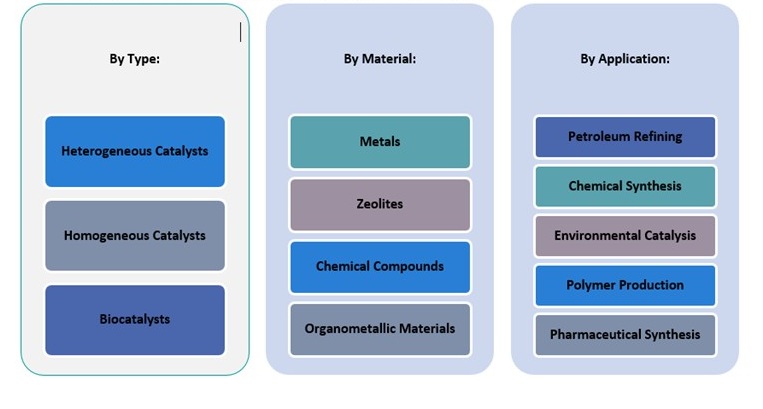
Market Drivers:
Growing Petrochemical and Refining Industry
One of the primary drivers of the UAE industrial catalyst market is the robust expansion of the petrochemical and refining sector. As part of its economic diversification strategy under the UAE Vision 2030, the government has invested heavily in downstream oil and gas infrastructure. For instance, the Fujairah Oil Refinery plays a pivotal role in refining operations, leveraging advanced technologies to enhance production efficiency and meet growing global demand for refined petroleum products. Industrial catalysts play a vital role in refining processes such as hydrocracking, catalytic reforming, and desulfurization, which are essential for producing cleaner fuels and higher-value chemicals. The increasing demand for these advanced refining processes, both for domestic use and export, continues to boost the need for efficient and high-performance catalysts across facilities in Abu Dhabi, Dubai, and Sharjah.
Push Towards Sustainable and Clean Technologies
Environmental sustainability has become a core focus for industrial development in the UAE. In line with its net-zero emissions target by 2050, the country is actively incorporating technologies that minimize environmental impact. Catalysts that enable low-emission production, waste reduction, and cleaner energy conversion are witnessing increasing demand. These catalysts are particularly crucial in controlling emissions from industrial operations and facilitating chemical reactions under milder conditions, thereby reducing energy consumption. As the UAE accelerates its adoption of green manufacturing practices and renewable energy integration, the role of eco-friendly catalyst technologies is expected to gain even more prominence in industrial applications.
Advancements in Catalyst Technology and R&D
Technological innovations in catalyst design and formulation significantly contribute to market growth. With a focus on enhancing catalyst efficiency, selectivity, and durability, research and development activities are being ramped up by both local and international players operating in the UAE. The introduction of nanocatalysts, bio-catalysts, and hybrid materials has enabled industries to achieve higher yields with lower raw material input, which directly supports operational efficiency and cost reduction. For example, biocatalysts are gaining traction due to their ability to operate under mild conditions, reducing toxic waste and energy consumption. Moreover, the development of customized catalysts tailored to specific processes further strengthens demand, particularly in the chemical, oil refining, and polymer production segments. Government initiatives promoting advanced manufacturing and R&D partnerships with global firms are expected to further support this technological evolution.
Favorable Government Policies and Industrial Investment
Supportive regulatory frameworks and strategic investment policies also play a key role in accelerating the growth of the industrial catalyst market in the UAE. The government continues to foster a business-friendly environment through tax incentives, reduced import duties on industrial equipment, and long-term leases in industrial zones. Special economic zones such as KIZAD and Jebel Ali Free Zone provide advanced infrastructure and connectivity, encouraging local production and foreign direct investment in catalyst manufacturing and application industries. These favorable conditions attract leading international catalyst providers to establish regional bases, making the UAE a critical node in the Middle East’s industrial catalyst supply chain.
Market Trends:
Rising Demand for Specialty Catalysts
The UAE industrial catalyst market is witnessing a notable shift towards the use of specialty catalysts, particularly in niche applications such as polymerization, alkylation, and selective hydrogenation. These catalysts are tailored for specific processes and are increasingly preferred in sectors such as pharmaceuticals, agrochemicals, and fine chemicals. This shift aligns with the UAE’s broader strategy of diversifying its industrial base beyond oil and gas. The rising investments in specialty chemical manufacturing facilities across the country reflect a growing demand for high-efficiency, application-specific catalysts that offer better yields and process selectivity. For example, AquaChemie has invested $25 million in a state-of-the-art manufacturing facility at Khalifa Economic Zone Abu Dhabi (KEZAD). This facility aims to localize production of specialty chemicals, particularly for the oil and gas sector, thereby reducing reliance on imports and improving supply chain resilience. As a result, manufacturers are scaling up their capabilities to meet this trend, supported by partnerships with global technology providers.
Integration of Digital Technologies in Catalyst Monitoring
A growing trend in the UAE industrial catalyst market is the integration of digital technologies for catalyst performance monitoring and process optimization. Industrial operators are increasingly adopting smart sensors, predictive analytics, and artificial intelligence (AI) tools to assess catalyst behavior in real-time. This digital shift allows companies to maximize catalyst lifespan, reduce downtime, and enhance overall operational efficiency. Leading players in the UAE are collaborating with global automation and software firms to implement these solutions, especially in high-value sectors like petrochemical refining. The trend towards Industry 4.0 integration not only improves productivity but also contributes to long-term cost savings and sustainable operations.
Growth in Domestic Manufacturing and Localization
Driven by the UAE’s push for industrial self-reliance, there is a rising trend toward the localization of catalyst manufacturing. While the country has traditionally depended on imported catalysts, recent years have seen a gradual emergence of domestic production capabilities. The government’s "Make it in the Emirates" initiative has incentivized local and joint-venture manufacturing, with support through technology transfer agreements and R&D collaborations. This trend is particularly evident in catalyst support materials and base metal catalysts, where local firms are beginning to establish a foothold. Enhanced domestic production capacity also ensures supply chain resilience, reducing vulnerability to global disruptions.
Strategic Collaborations and Technological Partnerships
Strategic collaborations between UAE-based industrial firms and international catalyst technology providers are increasingly shaping the market landscape. These partnerships focus on co-developing next-generation catalysts, optimizing existing processes, and exploring new industrial applications. Major players are forming joint ventures to leverage advanced catalyst formulations, particularly in emissions reduction and process intensification. For instance, ADNOC and ADQ have formed the TA'ZIZ joint venture to develop advanced chemical production facilities at the Ruwais Derivatives Park. This collaboration aims to enhance the UAE's industrial sector by producing a range of chemicals locally, supporting economic diversification and technological advancement. The trend reflects a strong commitment by UAE stakeholders to remain competitive on the global stage while ensuring knowledge transfer and capability building within the domestic market. As these collaborations continue to expand, they are expected to accelerate innovation and set new standards in catalyst performance across various industrial domains.
Market Challenges Analysis:
High Production and Operational Costs
One of the primary restraints affecting the UAE industrial catalyst market is the high cost associated with catalyst production and operational integration. Manufacturing advanced catalysts requires complex processes, expensive raw materials such as rare earth metals, and strict quality control, all of which contribute to elevated costs. For instance, catalysts used in ammonia synthesis, like the KM 111 developed by Topsoe, are designed to optimize performance under high-concentration conditions but require substantial investment in research, development, and production infrastructure. For many local firms, setting up full-scale production facilities remains financially demanding, especially when attempting to match the precision and scale of international producers. Additionally, the operational deployment of catalysts in industrial settings involves regular replacement, performance monitoring, and regeneration-factors that add to ongoing expenditure and deter smaller operators from adoption.
Dependency on Imports and Supply Chain Vulnerabilities
Despite recent efforts to boost domestic manufacturing, the UAE remains reliant on imports for a significant share of its catalyst needs. This dependence exposes the market to global supply chain disruptions, particularly in sourcing specialized catalysts and raw materials. Volatility in international trade, logistical delays, and fluctuating commodity prices can directly impact availability and cost-efficiency. These uncertainties pose a strategic challenge for industrial players who rely on a consistent and timely supply of catalysts to maintain uninterrupted operations.
Technical Complexity and Limited Skilled Workforce
Catalyst deployment often requires specialized technical knowledge to ensure correct application and optimal performance. In the UAE, there is a growing demand for skilled professionals capable of managing the complexities of catalyst design, testing, and integration within high-precision industrial environments. However, the domestic talent pool remains limited, creating a skills gap that can impede innovation and slow market adoption. This challenge is further compounded by the rapid pace of technological advancement, which necessitates continuous training and development of engineering and process personnel.
Market Opportunities:
The UAE industrial catalyst market presents substantial growth opportunities driven by the country’s strategic push toward industrial diversification and sustainability. As the nation expands its downstream oil and gas infrastructure, alongside chemical manufacturing and green energy initiatives, demand for high-performance catalysts is expected to rise steadily. The UAE’s commitment to transitioning into a knowledge-based economy has led to increasing investments in clean technologies, including catalysts that enable energy-efficient and low-emission processes. These developments align with the UAE Net Zero by 2050 strategic initiative, creating a robust market for eco-friendly catalyst solutions across refining, petrochemicals, and industrial manufacturing. Moreover, the integration of circular economy principles into industrial practices offers additional opportunities for catalysts used in recycling, waste-to-energy conversion, and emission control applications.
Another key area of opportunity lies in the localization of catalyst production and the development of regional R&D capabilities. Government initiatives such as the “Operation 300bn” strategy and the “Make it in the Emirates” campaign are actively encouraging domestic manufacturing and technology transfer in high-value sectors. This shift presents potential for local enterprises and foreign investors to establish joint ventures, research centers, and production units specializing in catalyst development. In addition, the UAE’s strategic location as a logistics hub between Asia, Europe, and Africa enhances its potential as a regional supplier of catalysts and related technologies. By capitalizing on these trends, stakeholders in the UAE industrial catalyst market can tap into long-term value creation, technological leadership, and enhanced industrial resilience.
Market Segmentation Analysis:
The UAE industrial catalyst market is segmented by type, application, and material, each playing a critical role in shaping the industry’s overall growth trajectory.
By type segments, heterogeneous catalysts hold the largest market share, primarily due to their extensive use in large-scale petrochemical and refining processes. These catalysts offer advantages in separation and reuse, making them ideal for continuous industrial operations. Homogeneous catalysts, while less dominant, are gaining attention in precision-driven chemical processes, whereas biocatalysts are emerging in niche applications aligned with sustainable and green chemistry initiatives.
By application, petroleum refining represents the most prominent segment, accounting for the highest demand for industrial catalysts in the UAE. This is largely driven by the country's expansive downstream oil infrastructure, particularly in Abu Dhabi. Chemical synthesis and environmental catalysis follow closely, supported by the UAE's industrial diversification and increasing regulatory focus on reducing emissions. Polymer production and pharmaceutical synthesis are steadily expanding, backed by rising investments in specialty chemicals and healthcare-related manufacturing.
By material perspective, metals dominate the market, especially in refining and chemical synthesis, due to their high catalytic activity and thermal stability. Zeolites are also widely utilized, particularly in fluid catalytic cracking (FCC) units in refineries. Chemical compounds and organometallic materials are steadily gaining traction in advanced applications, including environmental catalysis and pharmaceutical development. The diversity in catalyst materials and applications reflects the UAE's dynamic industrial landscape and its increasing emphasis on innovation and process efficiency across multiple sectors.
Segmentation:
By Type Segment
- Heterogeneous Catalysts
- Homogeneous Catalysts
- Biocatalysts
By Application Segment
- Petroleum Refining
- Chemical Synthesis
- Environmental Catalysis
- Polymer Production
- Pharmaceutical Synthesis
By Material Segment
- Metals
- Zeolites
- Chemical Compounds
- Organometallic Materials
Regional Analysis:
The industrial catalyst market in the United Arab Emirates (UAE) is intricately linked to the nation's petrochemical and refining sectors, which are predominantly concentrated in key emirates such as Abu Dhabi, Dubai, and Sharjah. While specific market share data for industrial catalysts across these regions is not readily available, an analysis of the industrial landscape provides insight into the regional dynamics influencing catalyst demand.
Abu Dhabi: The Industrial Powerhouse
Abu Dhabi stands as the central hub for the UAE's oil and gas industry, hosting a significant portion of the country's hydrocarbon reserves. The emirate's commitment to expanding its refining and petrochemical capacities is exemplified by initiatives such as the Ruwais Industrial Complex, one of the largest downstream facilities globally. These developments necessitate a substantial demand for industrial catalysts, essential for processes like hydrocracking and catalytic reforming. Furthermore, Abu Dhabi's strategic investments in sustainable energy projects, including blue ammonia and hydrogen production, indicate a future increase in the need for specialized catalysts tailored to these emerging technologies.
Dubai: Diversified Industrial Growth
Dubai's economic landscape is characterized by its diversification efforts, encompassing sectors such as manufacturing, logistics, and free trade zones. The Jebel Ali Free Zone (JAFZA) and Dubai Industrial City are pivotal in attracting a myriad of industries, including chemical manufacturing and processing plants. While Dubai does not possess significant oil reserves like Abu Dhabi, its focus on industrial diversification has led to a growing demand for catalysts in various chemical processes and environmental applications. The emirate's emphasis on sustainability and green technologies further drives the adoption of advanced catalysts that facilitate cleaner production methods.
Sharjah: Emerging Industrial Contributor
Sharjah is progressively enhancing its industrial footprint, particularly in sectors like petrochemicals, plastics, and manufacturing. The establishment of industrial zones such as the Hamriyah Free Zone and Sharjah Airport International Free Zone (SAIF Zone) has attracted numerous enterprises requiring catalytic processes. Although smaller in scale compared to Abu Dhabi and Dubai, Sharjah's strategic initiatives to bolster its industrial base contribute to a steady increase in catalyst consumption, especially in small to medium-sized enterprises focusing on specialized chemical production.
Key Player Analysis:
- SABIC
- Arkema Group
- Johnson Matthey
- BASF SE
- Haldor Topsoe A/S
- Qatar Petroleum
- Evonik Industries AG
- PetroSA
- Dow Inc.
- Chevron Phillips Chemical Company
Competitive Analysis:
The UAE industrial catalyst market is moderately competitive, with a mix of global catalyst manufacturers and regional suppliers shaping the competitive landscape. Leading international players such as BASF SE, W. R. Grace & Co., Clariant AG, and Johnson Matthey Plc maintain a strong presence in the country, primarily through strategic partnerships, distribution networks, and technical support services. These companies leverage advanced R&D capabilities and a broad portfolio to cater to the UAE’s expanding refining and chemical sectors. Local and regional firms are gradually entering the market, focusing on niche applications and customization to meet specific industrial needs. Government initiatives promoting domestic manufacturing and technology transfer are fostering an environment conducive to new entrants. Competitive dynamics are increasingly influenced by innovation, cost-effectiveness, and sustainability performance, with companies investing in next-generation catalysts that enhance efficiency and reduce environmental impact. As demand grows, collaboration and localization strategies are becoming essential for long-term market positioning.
Recent Developments:
- In November 2024, Clariant launched its Plus series syngas catalysts, including ReforMax LDP Plus, ShiftMax 217 Plus, and AmoMax 10 Plus. These advanced catalysts were designed as drop-in solutions to enhance plant economics and reduce carbon emissions in hydrogen, ammonia, and methanol production.
- In April 2022, SABIC completed the acquisition of Clariant’s 50% stake in Scientific Design, granting SABIC full ownership of this catalyst leader. This move strengthens SABIC’s position in high-performance process technologies and catalysts, enabling it to meet growing catalyst demands and drive innovation in the sector.
- On February 26, 2025, Johnson Matthey launched state-of-the-art Advanced Cracking Evaluation (ACE) units for catalyst testing in fluid catalytic cracking (FCC) additives. This investment enhances JM’s innovation capabilities by enabling faster development timelines and higher precision in catalyst optimization for renewable feedstock processing.
Market Concentration & Characteristics:
The UAE industrial catalyst market is characterized by a moderate level of concentration, with a blend of global leaders and emerging regional players. International corporations such as BASF SE, Clariant AG, and Johnson Matthey Plc have established a significant presence, leveraging their advanced research and development capabilities to cater to the UAE's expanding petrochemical and refining sectors. These companies often engage in strategic partnerships and joint ventures with local firms to enhance their market footprint and align with the UAE's industrial diversification initiatives. The market is distinguished by a strong emphasis on technological innovation and sustainability. There is a growing demand for catalysts that not only improve process efficiency but also adhere to stringent environmental regulations. This trend has led to increased investments in the development of eco-friendly and energy-efficient catalytic solutions. Additionally, the UAE's strategic location as a trade hub facilitates the import and distribution of specialized catalysts, further shaping the market's competitive dynamics.
Report Coverage:
The research report offers an in-depth analysis based on Type Segment, Application Segment and Material Segment. It details leading market players, providing an overview of their business, product offerings, investments, revenue streams, and key applications. Additionally, the report includes insights into the competitive environment, SWOT analysis, current market trends, as well as the primary drivers and constraints. Furthermore, it discusses various factors that have driven market expansion in recent years. The report also explores market dynamics, regulatory scenarios, and technological advancements that are shaping the industry. It assesses the impact of external factors and global economic changes on market growth. Lastly, it provides strategic recommendations for new entrants and established companies to navigate the complexities of the market.
Future Outlook:
- The UAE industrial catalyst market is expected to witness steady growth driven by expanding downstream oil and gas activities.
- Rising adoption of clean technologies will increase demand for eco-efficient and low-emission catalyst solutions.
- Localization of catalyst manufacturing is anticipated to reduce import dependence and strengthen supply chain resilience.
- Growing investment in specialty chemical and pharmaceutical sectors will drive demand for tailored catalyst formulations.
- Advancements in nanotechnology and catalyst engineering will enhance performance and application diversity.
- Strategic public-private partnerships will foster innovation and accelerate technology transfer in catalyst development.
- Integration of digital tools for catalyst monitoring and optimization will improve operational efficiency.
- Government sustainability targets will encourage greater use of catalysts in emissions control and waste reduction processes.
- Regional collaboration within the GCC may enhance trade opportunities and joint R&D initiatives in catalyst technologies.
- Increased foreign direct investment, supported by industrial policies, will attract global catalyst providers to establish a stronger local presence.

Request a Free Sample
Fill in your details and we'll send you a free sample report.
- Sample data tables & charts
- Research methodology
Market Dynamics
Expansion of Petrochemical and Refining Industries
The UAE's significant investments in downstream oil and gas infrastructure, particularly in Abu Dhabi, are driving demand for industrial catalysts essential for refining, hydrocracking, and catalytic reforming processes.
Push Towards Sustainable and Clean Technologies
Government-led sustainability initiatives and the 2050 net-zero emissions target are increasing the adoption of eco-friendly catalyst technologies that enable low-emission production and energy-efficient processes.
Advancements in Catalyst Technology and R&D
Ongoing innovation in catalyst design, including nanocatalysts and hybrid materials, is enhancing efficiency, selectivity, and durability, supporting higher yields and operational cost reduction across UAE industries.
Favorable Government Policies and Industrial Investment
Supportive regulatory frameworks, tax incentives, and the development of industrial zones like KIZAD and Jebel Ali Free Zone are attracting foreign investment and encouraging local catalyst manufacturing.
Growth in Specialty Chemicals and Diversification
The UAE's strategy to diversify its industrial base beyond oil and gas, with rising investments in specialty chemicals, pharmaceuticals, and advanced manufacturing, is fueling demand for tailored and high-performance catalyst solutions.
Need a Custom Version of This Report?
Tailor the scope, geography, or segments to your exact requirements.
- Custom geography or segment scope
- Direct access to our analyst team
Frequently Asked Questions
What is the current size of the UAE Industrial Catalyst Market?
What factors are driving the growth of the UAE Industrial Catalyst Market?
What are the key segments within the UAE Industrial Catalyst Market?
What are some challenges faced by the UAE Industrial Catalyst Market?
Table of Content
Chapter 1 Market Segmentation
- 1.1 Segmentation Framework
- 1.1.1 Product and Service Classification
- 1.1.2 Application and End-Use Classification
- 1.1.3 Technology and Solution Classification
- 1.1.4 Customer and Distribution Channel Classification
- 1.1.5 Geographic Segmentation
- 1.1.6 Market Segment Definitions and Boundaries
- 1.2 By Type
- 1.2.1 Heterogeneous Catalysts
- 1.2.2 Homogeneous Catalysts
- 1.2.3 Biocatalysts
- 1.3 By Material
- 1.3.1 Metals
- 1.3.2 Zeolites
- 1.3.3 Chemical Compounds
- 1.3.4 Organometallic Materials
- 1.4 By Application
- 1.4.1 Petroleum Refining
- 1.4.2 Chemical Synthesis
- 1.4.3 Environmental Catalysis
- 1.4.4 Polymer Production
- 1.4.5 Pharmaceutical Synthesis
- 1.5 By End-User Industry
- 1.5.1 Oil & Gas
- 1.5.2 Chemicals & Petrochemicals
- 1.5.3 Pharmaceuticals
- 1.5.4 Plastics & Polymers
- 1.5.5 Environmental & Emissions Control
Chapter 2 Introduction
- 2.1 Report Objectives and Scope
- 2.2 Product Definition and Industry Terminology
- 2.3 Market Inclusions and Exclusions
- 2.4 Research Process
- 2.4.1 Primary Research and Expert Interviews
- 2.4.2 Secondary Research and Source Review
- 2.4.3 Top-Down and Bottom-Up Estimation
- 2.4.4 Data Triangulation and Verification
- 2.5 Market Size Measurement Basis
- 2.5.1 2024: USD 69.21 million → 2032: USD 93.3 million
- 2.6 Historical and Forecast Reference Periods
- 2.6.1 Base Year: 2024
- 2.6.2 Forecast Period: 2024-2032
- 2.7 Research Assumptions and Limitations
Chapter 3 Executive Summary
- 3.1 Market Snapshot and Key Findings
- 3.2 Base-Year Market Size, 2024
- 3.3 Forecast Market Size, 2032
- 3.4 Revenue and Volume Growth Outlook
- 3.5 Key Demand and Supply Indicators
- 3.6 Leading Market Segments
- 3.7 Fastest-Growing Market Opportunities
- 3.8 Regional Performance Highlights
- 3.9 Technology and Industry Transformation
- 3.10 Competitive Landscape Summary
- 3.11 Analyst View and Strategic Implications
Chapter 4 UAE Industrial Catalyst Market Trends and Developments
- 4.1 Historical Industry Development
- 4.2 Recent Market Trends and Developments
- 4.3 Demand and Customer Behavior Trends
- 4.4 Technology and Product Innovation
- 4.5 Artificial Intelligence, Automation and Digitalization
- 4.6 Local Manufacturing and Supply Chain Realignment
- 4.7 Industry Partnerships, Mergers and Acquisitions
- 4.8 Sustainability and Circular Economy Developments
- 4.9 Government and Private Sector Investment Trends
- 4.10 Emerging Business Models and Commercialization
- 4.11 Industry Developments and Announcements
Chapter 5 UAE Industrial Catalyst Market Production, Supply and Demand Analysis
- 5.1 Demand Trend and Consumption Analysis
- 5.2 Demand Forecast, 2024-2032
- 5.3 Production and Output Trend
- 5.4 Production and Output Forecast, 2024-2032
- 5.5 Installed Capacity and Capacity Utilization
- 5.6 Company-Wise Production Plants and Statistics
- 5.6.1 Installed Production Capacity
- 5.6.2 Actual Production
- 5.6.3 Planned Capacity and Expansion Targets
- 5.7 Supply Chain Structure and Procurement Trends
- 5.8 Supply-Demand Gap and Bottlenecks
- 5.9 Import Dependence and Sourcing Structure
- 5.10 Contract Manufacturing and Outsourcing
- 5.11 Regional Supply and Demand Concentration
Chapter 6 UAE Industrial Catalyst Market Pricing Analysis
- 6.1 Pricing Structure and Measurement
- 6.2 Historical Pricing Trends
- 6.3 Pricing Outlook, 2024-2032
- 6.4 Average Selling Price and Unit Economics
- 6.5 Pricing by Product and Market Segment
- 6.6 Geographic Pricing Differences
- 6.7 Key Input, Energy, Labor and Logistics Costs
- 6.8 Contract Pricing and Purchasing Models
- 6.9 Pricing Sensitivity and Competitive Positioning
- 6.10 Price, Margin and Profitability Implications
Chapter 7 UAE Industrial Catalyst Market Dynamics
- 7.1 Market Growth Drivers
- 7.1.1 Demand-Side Drivers
- 7.1.2 Technology and Innovation Drivers
- 7.1.3 Infrastructure and Investment Drivers
- 7.1.4 Regulatory and Policy Drivers
- 7.2 Market Restraints
- 7.2.1 Cost and Affordability Constraints
- 7.2.2 Technology and Adoption Barriers
- 7.2.3 Supply Chain and Operational Constraints
- 7.3 Market Challenges
- 7.3.1 Competitive Pressure and Margin Erosion
- 7.3.2 Skills, Infrastructure and Implementation Gaps
- 7.4 Emerging Market Opportunities
- 7.5 Market Dynamics Impact and Time-Horizon Assessment
Chapter 8 UAE Industrial Catalyst Value Chain Analysis
- 8.1 Industry Value Chain Overview
- 8.2 Upstream Suppliers and Critical Inputs
- 8.3 Technology and Component Providers
- 8.4 Manufacturing or Service Delivery
- 8.5 Distribution, Channel Partners and Integrators
- 8.6 Downstream Applications and End Users
- 8.7 Value Addition and Profit Pools
- 8.8 Vertical Integration and Outsourcing
- 8.9 Supplier Concentration and Risk
- 8.10 Supply Chain Localization and Resilience
Chapter 9 UAE Industrial Catalyst Market Regulations and Policies
- 9.1 Relevant Laws, Standards and Compliance Frameworks
- 9.2 Product, Service, Safety and Quality Requirements
- 9.3 Government Policies, Incentives and Subsidies
- 9.4 Imports, Exports and Trade Barriers
- 9.5 Public Procurement and Local Content Requirements
- 9.6 Environmental and Sustainability Compliance
- 9.7 Upcoming Policy Changes and Market Implications
Chapter 10 UAE Industrial Catalyst Market Hotspots and Opportunities
- 10.1 Market Opportunity Mapping and Growth Hotspots
- 10.2 High-Growth Applications and Customer Groups
- 10.3 Underserved Markets and White-Space Opportunities
- 10.4 Emerging Technology and Product Opportunities
- 10.5 New Capacity and Investment Hotspots
- 10.6 Market Entry and Expansion Opportunities
- 10.7 Distribution and Partnership Opportunities
- 10.8 Near-Term and Long-Term Commercial Potential
- 10.9 Opportunity Attractiveness and Execution Risks
Chapter 11 UAE Industrial Catalyst Market Outlook, 2024-2032
- 11.1 Market Size and Analysis
- 11.1.1 Revenue (Market Measurement: 2024: USD 69.21 million → 2032: USD 93.3 million)
- 11.1.2 Market Volume and Quantity Sold
- 11.1.3 Historical Market Size
- 11.1.4 Base-Year Market Size, 2024
- 11.2 Market Forecast, 2024-2032
- 11.2.1 Revenue Forecast to 2032
- 11.2.2 Volume Forecast to 2032
- 11.2.3 CAGR and Year-on-Year Growth
- 11.2.4 Incremental Revenue Opportunity
- 11.3 Forecast Assumptions and Scenario Analysis
- 11.3.1 Base-Case Forecast
- 11.3.2 Optimistic and Conservative Scenarios
- 11.3.3 Technology, Pricing and Policy Sensitivities
- 11.4 Market Attractiveness and Growth Outlook
Chapter 12 UAE Industrial Catalyst Market Segmentation and Outlook
- 12.1 Segmentation Summary and Market Shares, 2024
- 12.2 Largest and Fastest-Growing Segments
- 12.3 By Type - Market Size and Forecast, 2024-2032
- 12.3.1 Segment Definition and Scope
- 12.3.2 Historical Market Size
- 12.3.3 Revenue Forecast, 2024-2032
- 12.3.4 Volume Forecast, 2024-2032
- 12.3.5 Base-Year Market Share, 2024
- 12.3.6 Segment CAGR and Growth Drivers
- 12.3.7 Subsegment Market Size and Forecast
- 12.3.7.1 Heterogeneous Catalysts
- 12.3.7.2 Homogeneous Catalysts
- 12.3.7.3 Biocatalysts
- 12.3.8 Subsegment Pricing and Adoption Trends
- 12.3.9 Leading Suppliers and Competition
- 12.3.10 Regional Demand and Opportunities
- 12.4 By Material - Market Size and Forecast, 2024-2032
- 12.4.1 Segment Definition and Scope
- 12.4.2 Historical Market Size
- 12.4.3 Revenue Forecast, 2024-2032
- 12.4.4 Volume Forecast, 2024-2032
- 12.4.5 Base-Year Market Share, 2024
- 12.4.6 Segment CAGR and Growth Drivers
- 12.4.7 Subsegment Market Size and Forecast
- 12.4.7.1 Metals
- 12.4.7.2 Zeolites
- 12.4.7.3 Chemical Compounds
- 12.4.7.4 Organometallic Materials
- 12.4.8 Subsegment Pricing and Adoption Trends
- 12.4.9 Leading Suppliers and Competition
- 12.4.10 Regional Demand and Opportunities
- 12.5 By Application - Market Size and Forecast, 2024-2032
- 12.5.1 Segment Definition and Scope
- 12.5.2 Historical Market Size
- 12.5.3 Revenue Forecast, 2024-2032
- 12.5.4 Volume Forecast, 2024-2032
- 12.5.5 Base-Year Market Share, 2024
- 12.5.6 Segment CAGR and Growth Drivers
- 12.5.7 Subsegment Market Size and Forecast
- 12.5.7.1 Petroleum Refining
- 12.5.7.2 Chemical Synthesis
- 12.5.7.3 Environmental Catalysis
- 12.5.7.4 Polymer Production
- 12.5.7.5 Pharmaceutical Synthesis
- 12.5.8 Subsegment Pricing and Adoption Trends
- 12.5.9 Leading Suppliers and Competition
- 12.5.10 Regional Demand and Opportunities
- 12.6 By End-User Industry - Market Size and Forecast, 2024-2032
- 12.6.1 Segment Definition and Scope
- 12.6.2 Historical Market Size
- 12.6.3 Revenue Forecast, 2024-2032
- 12.6.4 Volume Forecast, 2024-2032
- 12.6.5 Base-Year Market Share, 2024
- 12.6.6 Segment CAGR and Growth Drivers
- 12.6.7 Subsegment Market Size and Forecast
- 12.6.7.1 Oil & Gas
- 12.6.7.2 Chemicals & Petrochemicals
- 12.6.7.3 Pharmaceuticals
- 12.6.7.4 Plastics & Polymers
- 12.6.7.5 Environmental & Emissions Control
- 12.6.8 Subsegment Pricing and Adoption Trends
- 12.6.9 Leading Suppliers and Competition
- 12.6.10 Regional Demand and Opportunities
- 12.7 Segment Growth Comparison
- 12.8 Segment Attractiveness and Priority Matrix
Chapter 13 UAE Industrial Catalyst End-Use and Application Market Outlook
- 13.1 End-Use Industry and Customer Demand Structure
- 13.2 Leading Applications and Customer Groups
- 13.3 End-Use Market Size, Share and Forecast
- 13.4 Major End-Use Industry Deep Dives
- 13.4.1 Customer Requirements and Use Cases
- 13.4.2 Demand and Replacement Cycles
- 13.4.3 Technical and Regulatory Considerations
- 13.4.4 Purchasing and Procurement Models
- 13.4.5 Leading Vendors and Distribution Channels
- 13.4.6 Forecast and Commercial Opportunities
- 13.5 Emerging Applications and Cross-Segment Demand
- 13.6 End-Use Industry Investment Priorities
Chapter 14 UAE Industrial Catalyst Geographic Market Outlook, 2024-2032
- 14.1 Domestic Market Distribution and Demand Clusters
- 14.2 State- or Province-Wise Market Size and Forecast, 2024-2032
- 14.3 City and Metropolitan Market Outlook
- 14.4 Industrial, Manufacturing and Commercial Clusters
- 14.5 Geographic Concentration of Key End Users
- 14.6 Local Pricing and Purchasing Differences
- 14.7 Domestic Production Facilities and Capacity Map
- 14.8 Local Infrastructure and Project Pipeline
- 14.9 State-Level Policy and Incentive Differences
- 14.10 Subnational Investment Hotspots and Opportunities
- 14.11 Distribution and Logistics Networks
- 14.12 Domestic Competitive Footprint
Chapter 15 UAE Industrial Catalyst Technology, Innovation and Sustainability Outlook
- 15.1 Technology Landscape and Maturity
- 15.2 Product, Process and Service Innovation
- 15.3 AI, Automation and Digital Tools in the Industry
- 15.4 Technology Adoption and Performance Benchmarking
- 15.5 Innovation Pipeline and R&D Investment
- 15.6 Patent and Intellectual Property Trends
- 15.7 Energy Efficiency and Resource Management
- 15.8 Sustainability, Recycling and Circularity
- 15.9 Technology Roadmap, 2024-2032
- 15.10 Risks of Obsolescence and Technology Substitution
Chapter 16 UAE Industrial Catalyst Market Key Strategic Imperatives
- 16.1 Growth and Market Entry Priorities
- 16.2 High-Return Products and Segments
- 16.3 Pricing, Profitability and Cost Optimization
- 16.4 Technology Investment and Product Differentiation
- 16.5 Supply Chain Localization and Resilience
- 16.6 Distribution and Customer Acquisition
- 16.7 Partnership, Acquisition and Capacity Strategy
- 16.8 Regional Expansion Priorities
- 16.9 Short-, Medium- and Long-Term Actions
Chapter 17 Competition Outlook
- 17.1 Industry Competition Characteristics
- 17.2 Market Structure and Concentration
- 17.3 Market Share and Competitive Positioning, 2024
- 17.4 Company-Wise Revenue and Product Benchmarking
- 17.5 Production and Service Capacity Benchmarking
- 17.6 Technology, Pricing and Differentiation
- 17.7 Regional Footprint and Distribution Strength
- 17.8 Mergers, Acquisitions and Strategic Alliances
- 17.9 New Entrants and Competitive Threats
- 17.10 Porter's Five Forces and Industry Attractiveness
- 17.11 Competitive Outlook, 2024-2032
Chapter 18 Company Profiles
- 18.1 Company Coverage and Selection Criteria
- 18.2 SABIC
- 18.2.1 Business Description
- 18.2.2 Company Ownership and Geographic Presence
- 18.2.3 Product and Service Portfolio
- 18.2.4 Manufacturing and Operating Footprint
- 18.2.5 Production Capacity and Expansion Plans
- 18.2.6 Financial Performance and Investment
- 18.2.7 Market Share and Competitive Position
- 18.2.8 Technology and Innovation Capabilities
- 18.2.9 Strategic Alliances or Partnerships
- 18.2.10 Recent Developments
- 18.2.11 Growth Strategy and Outlook
- 18.3 Arkema Group
- 18.4 Johnson Matthey
- 18.5 BASF SE
- 18.6 Haldor Topsoe A/S
- 18.7 Qatar Petroleum
- 18.8 Evonik Industries AG
- 18.9 PetroSA
- 18.10 Dow Inc.
- 18.11 Chevron Phillips Chemical Company
- 18.12 Other Relevant Market Participants
Note: Every listed company is profiled on the structure shown under the first company. The company list is preliminary and may change based on research findings, market developments, data availability and client requirements.
Chapter 19 Disclaimer
- 19.1 Research and Forecast Disclaimer
- 19.2 Data Source and Estimation Limitations
Note: The depth of individual sections depends on data availability for this market. Volume, capacity, trade and other unit-based metrics are included where applicable.

