
| REPORT ATTRIBUTE | DETAILS |
|---|---|
| Historical Period | 2019-2022 |
| Base Year | 2023 |
| Forecast Period | 2024-2032 |
| US Mobile Phone Protective Cases Market Size 2023 | USD 5,043.21 million |
| US Mobile Phone Protective Cases Market, CAGR | 8.57% |
| US Mobile Phone Protective Cases Market Size 2032 | USD 10,722.84 million |
Market Overview
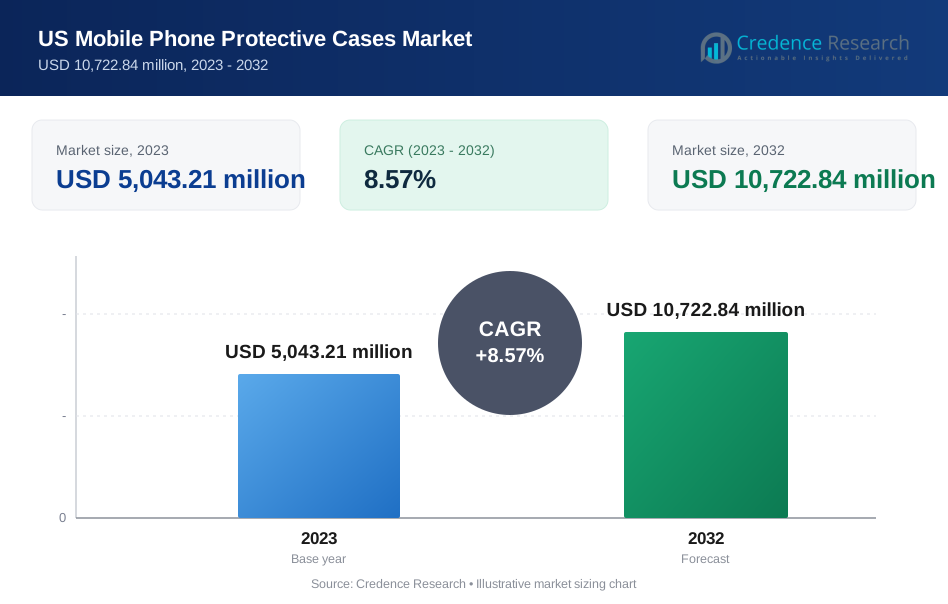
The US Mobile Phone Protective Cases Market is projected to grow from USD 5,043.21 million in 2023 to an estimated USD 10,722.84 million by 2032, with a compound annual growth rate (CAGR) of 8.57% from 2024 to 2032. This growth is driven by the increasing adoption of smartphones, a rising focus on device protection, and consumers' desire for personalized and stylish cases.
Key market drivers include the growing awareness of the need for device protection due to the rising cost of smartphones, the continuous innovation in case materials offering enhanced protection, and the trend of using phone cases as a fashion statement. Additionally, the availability of a wide variety of designs and customization options is further boosting the market's growth.
Geographically, North America dominates the US Mobile Phone Protective Cases Market, driven by high smartphone penetration and strong consumer spending power. Key players in the market include OtterBox, Incipio, Spigen, Inc., and Urban Armor Gear, Inc., who are continuously innovating to meet the evolving consumer demands. Other notable companies such as Griffin Technology and Case-Mate are also contributing to the market's growth through strategic product launches and expansions.
Market Drivers
Rising Smartphone Adoption and Penetration
The US Mobile Phone Protective Cases Market is experiencing significant growth, driven primarily by the increasing adoption and penetration of smartphones. As smartphones have become essential devices for daily life, the demand for protective cases has surged correspondingly. This trend is fueled by factors such as the growing affordability of smartphones, the introduction of new models with enhanced features, and the increasing reliance on mobile devices for both personal and professional tasks. Consumers are increasingly recognizing the need to protect their valuable devices from accidental damage, scratches, and other potential hazards. For instance, a substantial percentage of smartphone users in the US consider protective cases as a necessary accessory. The rapid pace of technological advancements in smartphones and frequent model launches by leading brands have further propelled consumers to invest in protective cases that not only safeguard their devices but also reflect their personal style. Additionally, the rising disposable income among consumers has contributed to increased sales of premium and designer cases, further boosting overall market growth.
Increasing Awareness of Device Protection and Durability
The growing awareness of the importance of device protection and durability is a crucial driver of the US Mobile Phone Protective Cases Market. As smartphones become more advanced and expensive, consumers are increasingly cognizant of the need to protect their investments. Modern smartphones, equipped with high-resolution displays, sophisticated cameras, and delicate internal components, are more vulnerable to damage than ever before. A government consumer protection agency report highlighted that the cost of repairing or replacing damaged smartphones has risen significantly in recent years, making protective cases an attractive and cost-effective solution for many consumers. In response to this demand, manufacturers are developing cases made from durable materials such as polycarbonate, thermoplastic polyurethane (TPU), and silicone, which offer superior protection against physical damage. For instance, a leading case manufacturer reported a substantial increase in sales of their shock-absorbing and impact-resistant cases over the past year. Additionally, there is a growing trend towards cases that offer additional functionalities, such as water resistance, dust protection, and built-in screen protectors, further enhancing the durability of smartphones and driving market growth.
Fashion and Personalization Trends
The intersection of technology and fashion has emerged as a significant driver of the US Mobile Phone Protective Cases Market. Today's consumers are not just seeking protection for their devices; they also want cases that reflect their personal style and preferences. This trend has led to the emergence of protective cases as fashion accessories, with consumers frequently updating their cases to match their outfits, moods, or the latest trends. A survey conducted by a prominent fashion magazine revealed that a significant portion of smartphone users consider their phone cases as important fashion statements. The desire for personalization has driven the demand for customizable cases, where consumers can choose the color, material, design, and even add their initials or custom graphics. This trend is particularly prominent among younger demographics, who view their smartphones as extensions of their identity. In response, manufacturers and brands are offering a wide range of options, from sleek and minimalist designs to vibrant and artistic patterns. Collaborations between case manufacturers and fashion designers, celebrities, or popular brands have also become common, further fueling the market. A recent industry report highlighted that sales of limited-edition designer phone cases have seen a substantial increase in the past year.
Technological Innovations and Material Advancements
Technological innovations and advancements in materials have been pivotal in driving the growth of the US Mobile Phone Protective Cases Market. As consumer expectations evolve, manufacturers are continually pushing the boundaries to develop cases that offer enhanced protection without compromising on style and usability. One of the key areas of innovation has been the development of lightweight yet durable materials that provide superior protection against drops and impacts. Materials such as carbon fiber, aramid fiber, and advanced polymers are increasingly being used to create cases that are not only strong but also lightweight and slim, catering to consumers who prefer minimalistic designs. Additionally, the integration of new technologies such as wireless charging compatibility has become a crucial factor for consumers, as more smartphones are equipped with this feature. Protective cases are now being designed to ensure that they do not interfere with wireless charging, providing a seamless user experience. Another area of innovation is the development of eco-friendly cases made from biodegradable or recycled materials, responding to the growing consumer demand for sustainable products. These technological and material advancements are not only enhancing the protective capabilities of cases but are also driving consumer interest and demand, contributing to the market's growth.
Market Trends
Sustainable and Eco-Friendly Materials
The demand for sustainable and eco-friendly mobile phone protective cases is on the rise in the US market. Consumers are increasingly gravitating towards products that align with their environmental values. For instance, a survey conducted by the Sustainable Packaging Coalition found that 74% of consumers are willing to pay more for sustainable packaging. This sentiment is reflected in the mobile phone case market, where manufacturers are introducing cases made from biodegradable materials, recycled plastics, and natural substances like cork and bamboo. The trend is particularly strong among younger demographics. According to a study by Nielsen, 73% of millennials are willing to pay more for sustainable goods. This has led to a surge in eco-friendly case options, with brands like Pela Case reporting a 3,000% increase in sales of their compostable phone cases over a three-year period. The emphasis on sustainability extends beyond materials, with companies adopting environmentally friendly manufacturing processes. For example, Incipio has committed to making 100% of its product packaging recyclable, reusable, or compostable by 2025.
Integration of Advanced Technology and Features
The US Mobile Phone Protective Cases Market is witnessing a significant trend towards the integration of advanced technology and features. Consumers are seeking cases that offer more than just physical protection, driving innovation in the industry. For instance, cases with antimicrobial properties have seen a surge in demand, with a 25% increase in sales during the COVID-19 pandemic. Wireless charging compatibility has become a crucial feature, 60% of smartphone users consider it an important factor when choosing a phone case. Multi-functional cases are also gaining popularity. A survey by Case-Mate found that 45% of consumers prefer cases with built-in stands or cardholders. The integration of battery packs into cases has also seen growth, with ZDNet reporting a 30% increase in sales of battery cases over the past year. These advanced features are particularly appealing to tech-savvy consumers, with a study by Technavio indicating that 68% of millennials prefer cases with additional functionalities.
Market Restraints and Challenges
Market Saturation and Intense Competition
The US Mobile Phone Protective Cases Market faces significant challenges due to market saturation and intense competition. With widespread smartphone adoption, numerous players have entered the market, from established brands to small, local manufacturers. This high level of competition has led to market fragmentation, presenting consumers with a vast array of options at varying price points. Many brands struggle to differentiate themselves, leading to pricing pressures and reduced profit margins. The proliferation of low-cost, generic cases, particularly from overseas manufacturers, further intensifies this challenge, appealing to price-sensitive consumers who prioritize affordability over brand loyalty or quality. According to a recent industry survey, over 70% of consumers consider price as the primary factor when purchasing a phone case. This saturation makes it increasingly difficult for companies to maintain market share and grow their businesses. For instance, a government report on consumer electronics trends indicates that the average consumer owns three phone cases, with 60% of them purchased from low-cost retailers. The challenge of standing out in a crowded market continues to be a significant restraint on the overall growth potential of the industry, with established brands reporting a decline in brand loyalty among younger consumers.
Dependence on Smartphone Sales and Technological Evolution
Another critical challenge in the US Mobile Phone Protective Cases Market is its strong dependence on smartphone sales and the rapid pace of technological evolution. The demand for protective cases is closely tied to the lifecycle of smartphones, which can be unpredictable due to fluctuating consumer purchasing behavior and economic factors. A recent industry analysis revealed that case sales typically surge within the first three months of a new smartphone model release, followed by a gradual decline. Additionally, the rapid evolution of smartphone designs, such as changes in form factor, materials, and features like foldable screens, presents a challenge for case manufacturers to keep up with production and design adaptations. A survey of leading case manufacturers found that 85% of them cited keeping up with smartphone design changes as their biggest challenge. The need to constantly update product lines to align with new smartphone models can be resource-intensive and may lead to inefficiencies if certain models fail to gain widespread adoption. Government data on e-waste indicates a growing concern over the environmental impact of frequently discarded phone cases, with an estimated 50 million cases ending up in landfills annually. This dependence on external factors makes the market vulnerable to disruptions and adds a layer of uncertainty to its growth trajectory.
Market Segmentation Analysis
By Product
Body gloves provide comprehensive protection for smartphones, covering both front and back with materials like silicone, TPU, or polycarbonate. Phone skins offer aesthetic customization with minimal protection. Hybrid cases combine hard polycarbonate backs with flexible TPU bumpers for balanced durability and shock absorption. Pouches protect devices during storage but require removal for use. The "Others" category includes specialized cases like wallet cases and waterproof designs. For instance, a survey by a leading mobile accessory manufacturer found that body gloves and hybrid cases account for over 60% of protective case sales in the US market, with consumers citing durability and style as key factors in their purchasing decisions.
By Distribution channel
The online distribution channel has grown significantly due to convenience and accessibility, offering a wide selection of protective cases through e-commerce platforms and brand websites. Consumers appreciate the ability to compare prices and read reviews online. Offline distribution remains important, with physical retail stores catering to consumers who prefer in-person shopping experiences. For example, a government consumer behavior study revealed that while online sales of mobile phone cases have increased by 35% in the past five years, brick-and-mortar stores still account for a substantial portion of sales, particularly among older demographics who value hands-on product demonstrations and immediate availability.
Segments
Based on Product
- Body Gloves
- Phone Skin
- Hybrid Cases
- Pouch
- Others
Based on Distribution Channel
- Online
- Offline
Based on Region
- Northeast
- West
- Midwest
- South
Regional Analysis
Northeast Region (25%):
The Northeast region, encompassing states like New York, New Jersey, and Massachusetts, is a key player in the US Mobile Phone Protective Cases Market. This area's dominance is attributed to its high concentration of urban centers and tech-savvy consumers. The region's market is driven by professionals and students who prioritize device protection and personalization. For instance, urban professionals in the Northeast are more likely to invest in premium protective cases compared to other regions. The presence of numerous retail outlets and a strong e-commerce ecosystem further supports market growth in this region.
Midwest Region (20%):
The Midwest region, including states such as Illinois, Ohio, and Michigan, represents a significant segment of the US Mobile Phone Protective Cases Market. The region's market growth is fueled by a diverse consumer base and a balance between urban and rural areas. For example, government data shows that smartphone penetration in Midwest urban centers is on par with national averages, driving demand for protective cases. In rural areas, there is a notable preference for practical and cost-effective solutions. The Midwest's retail landscape is characterized by a mix of physical stores and online platforms, catering to varied regional preferences and contributing to the market's expansion.
Key players
- Otter Products LLC
- CG Mobile
- Incipio LLC
- Griffin Technology
- Amzer
- Belkin International Inc
- Spigen Inc.
- Urban Armor Gear LLC
- Reiko Wireless Inc.
- Moshi Group
Competitive Analysis
The US Mobile Phone Protective Cases Market is characterized by intense competition among several key players, each striving to differentiate itself through innovation and product offerings. Otter Products LLC and Urban Armor Gear LLC are notable for their rugged and high-protection cases, targeting consumers needing durability in extreme conditions. Spigen Inc. and Incipio LLC focus on a blend of style and functionality, offering a wide range of cases that cater to different aesthetic preferences and protective needs. Belkin International Inc and Griffin Technology leverage their established brand presence and extensive retail networks to capture a broad market segment. CG Mobile and Reiko Wireless Inc. are recognized for their diverse product lines and competitive pricing, appealing to budget-conscious consumers. Amzer and Moshi Group emphasize unique design and premium materials, catering to niche markets seeking high-end, stylish options.
Recent Developments
- In March 2024, OtterBox launched a new line of eco-friendly phone cases made from 50% recycled materials. The company has been focusing on sustainability initiatives in recent years.
- In January 2024, Belkin introduced its first MagSafe-compatible power bank for iPhones [2]. This product allows for wireless charging of compatible iPhone models.
- In November 2023, Spigen released a new series of cases designed specifically for foldable smartphones, addressing the growing market for these devices.
- In February 2024, UAG expanded its product line with a range of rugged laptop cases and sleeves, broadening its focus beyond just smartphone protection.
Market Concentration and Characteristics
The US Mobile Phone Protective Cases Market exhibits moderate to high market concentration, with a few dominant players commanding significant market share while numerous smaller and niche companies contribute to a fragmented landscape. Leading brands such as Otter Products LLC, Spigen Inc., and Incipio LLC hold substantial shares due to their established reputations, extensive product ranges, and innovative designs. These major players invest heavily in R&D to differentiate their offerings with advanced features and materials. Conversely, smaller companies and new entrants often focus on specific segments or unique design elements to carve out niche markets. The market's characteristics include a high degree of competition, rapid technological advancements, and diverse consumer preferences, driving continuous innovation and price competition among key players. This dynamic environment reflects a balance between established brands' dominance and emerging players' agility.
Report Coverage
The research report offers an in-depth analysis based on Product, Distribution Channel and Region. It details leading market players, providing an overview of their business, product offerings, investments, revenue streams, and key applications. Additionally, the report includes insights into the competitive environment, SWOT analysis, current market trends, as well as the primary drivers and constraints. Furthermore, it discusses various factors that have driven market expansion in recent years. The report also explores market dynamics, regulatory scenarios, and technological advancements that are shaping the industry. It assesses the impact of external factors and global economic changes on market growth. Lastly, it provides strategic recommendations for new entrants and established companies to navigate the complexities of the market.
Future Outlook
- The US Mobile Phone Protective Cases Market is expected to sustain robust growth, driven by increasing smartphone adoption and rising consumer awareness about device protection. The market's expansion will likely continue as new smartphone models and features drive demand for compatible cases.
- Advances in materials and technology will lead to the development of more durable, functional, and aesthetically appealing protective cases. Innovations such as enhanced shock absorption, antimicrobial coatings, and integration with wireless charging will gain prominence.
- A growing emphasis on environmental responsibility will drive the adoption of eco-friendly materials and sustainable manufacturing practices. Consumers' preference for biodegradable and recyclable cases will shape the market's future landscape.
- Personalized and customizable protective cases will become increasingly popular, as consumers seek products that reflect their individual styles and preferences. This trend will be supported by advancements in printing and design technologies.
- Online retail channels will continue to dominate, offering convenience and a wide range of options. The growth of e-commerce platforms will drive increased sales and provide opportunities for brands to reach a broader audience.
- The market will face heightened competition as new players enter and existing brands expand their product lines. Companies will need to innovate continuously and differentiate themselves to maintain market share.
- Future protective cases will increasingly integrate with emerging smartphone technologies, such as foldable screens and advanced camera systems, to offer enhanced protection and functionality.
- Multifunctional cases that combine protection with additional features, such as cardholders or built-in stands, will gain traction. Consumers will seek cases that offer both utility and style.
- Market dynamics will vary across regions, with areas experiencing rapid population growth and high smartphone penetration driving higher demand for protective cases. Regional preferences will influence product offerings and marketing strategies.
- The demand for high-end, premium protective cases will rise as consumers increasingly seek quality and design. Brands offering luxury materials and exclusive designs will capture a growing segment of the market.
Request a Free Sample
Fill in your details and we'll send you a free sample report.
- Sample data tables & charts
- Research methodology
Need a Custom Version of This Report?
Tailor the scope, geography, or segments to your exact requirements.
- Custom geography or segment scope
- Direct access to our analyst team
Frequently Asked Questions
What is the projected growth of the US Mobile Phone Protective Cases Market?
What are the main drivers of market growth?
Which regions dominate the US Mobile Phone Protective Cases Market?
Who are the major players in the US Mobile Phone Protective Cases Market?
How does the rising smartphone adoption affect the demand for protective cases?
Table of Content
Chapter 1. Report Introduction
- 1.1 Report Description & Purpose
- 1.1.1 Report Title & Market Definition
- 1.1.2 Unique Selling Propositions (USP) & Key Differentiators
- 1.1.3 Value Proposition for Stakeholders
- 1.2 Research Objectives
- 1.2.1 Market Sizing Objectives (Volume & Revenue) (Volume Where Applicable)
- 1.2.2 Segmentation Objectives
- 1.2.3 Competitive Intelligence Objectives
- 1.2.4 Forecast & Scenario Objectives
- 1.3 Report Scope
- 1.3.1 US Mobile Phone Protective Cases Scope – Segments & Subsegments Covered
- 1.3.2 Geographic Scope – Selected Country & Subnational Markets Covered
- 1.3.3 Historical Period, Base Year & Forecast Period (2023; forecast to 2032)
- 1.3.4 Inclusions & Exclusions
- 1.4 Industry Classification & Applicable Codes
- 1.5 Currency, Measurement Units & Valuation Basis
- 1.6 Target Stakeholders
- 1.7 Limitations & Assumptions
Chapter 2. Executive Summary
- 2.1 US Mobile Phone Protective Cases Snapshot
- 2.1.1 Market Size – Historical (2023) & Forecast (2023-2032) (2023: USD 5,043.21 million → 2032: USD 10,722.84 million)
- 2.1.2 Volume & Revenue – National Totals (Volume Where Applicable)
- 2.1.3 Key Market Highlights – Top Five Facts
- 2.2 US Mobile Phone Protective Cases Segmentation Snapshot
- 2.2.1 Market Split by Subnational Area – 2023 vs. 2032
- 2.3 Competitive Snapshot
- 2.3.1 Top 10 Players by Revenue Share – 2023
- 2.3.2 Top 10 Players by Volume Share – 2023 (Volume Where Applicable)
- 2.3.3 Recent Strategic Developments (18-Month Summary)
- 2.4 Key Investment Highlights & Strategic Conclusions
Chapter 3. US Mobile Phone Protective Cases Dynamics & Industry Analysis
- 3.1 Market Overview & Context
- 3.1.1 US Mobile Phone Protective Cases Position in the Broader Industry Value Chain
- 3.1.2 Demand Structure & Purchasing Dynamics
- 3.1.3 Market Maturity & Development Stage Across Domestic Markets
- 3.2 US Mobile Phone Protective Cases Drivers
- 3.3 US Mobile Phone Protective Cases Restraints & Challenges
- 3.4 US Mobile Phone Protective Cases Opportunities
- 3.5 Porter's Five Forces Analysis
- 3.5.1 Threat of New Entrants
- 3.5.2 Bargaining Power of Suppliers
- 3.5.3 Bargaining Power of Buyers
- 3.5.4 Threat of Substitutes
- 3.5.5 Competitive Rivalry – Intensity Assessment
- 3.6 US Mobile Phone Protective Cases Value Chain Analysis
- 3.6.1 Upstream – Key Inputs, Resources & Suppliers
- 3.6.1.1 Key Input/Resource 1
- 3.6.1.2 Key Input/Resource 2
- 3.6.1.3 Key Input/Resource 3
- 3.6.2 Midstream – Core Operations & Value Creation
- 3.6.2.1 Operating Model & Process Overview
- 3.6.2.2 Key Operating Locations & Capabilities by Company
- 3.6.3 Downstream – Market Channels & End Users
- 3.6.3.1 Direct Sales & Customer Engagement Channels
- 3.6.3.2 Indirect Sales, Intermediaries & Partner Channels
- 3.6.4 Value Chain Profitability Analysis
- 3.6.1 Upstream – Key Inputs, Resources & Suppliers
- 3.7 PESTEL Analysis
- 3.7.1 Political Factors
- 3.7.2 Economic Factors
- 3.7.3 Social Factors
- 3.7.4 Technological Factors
- 3.7.5 Environmental Factors
- 3.7.6 Legal Factors
- 3.8 US Mobile Phone Protective Cases Supply Chain Analysis
- 3.8.1 Critical Input & Resource Availability Risk Assessment
- 3.8.2 Supplier & Operational Concentration Risk (Geographic Exposure)
- 3.8.3 Supply & Service Disruption Impact Analysis
- 3.9 National & Subnational Regulatory Landscape
Note: The regulatory and policy landscape section covers regulations based on their applicability to the market, US Mobile Phone Protective Cases category, geography, and scope of the study. Only regulatory frameworks with a material impact on operations, compliance, trade, sustainability, or market access are analyzed in detail.
Chapter 4. Key Investment Pockets & Opportunity Analysis
- 4.1 US Mobile Phone Protective Cases Attractiveness Analysis
- 4.1.1 By Subnational Area – Investment Attractiveness Matrix (Market Size × CAGR)
- 4.2 Absolute Revenue Growth Opportunity
- 4.2.1 By Subnational Area – Absolute Revenue Growth Through 2032
- 4.3 Incremental Demand Opportunity
- 4.3.1 By Subnational Area – Incremental Demand Through 2032
- 4.3.2 Segment – Incremental Demand
- 4.4 Emerging Submarket Opportunity Deep Dive (Subject to Applicability)
- 4.5 Priority Domestic Market Opportunity Scorecards
- 4.5.1 Priority Domestic Market 1
- 4.5.2 Priority Domestic Market 2
- 4.5.3 Priority Domestic Market 3
- 4.5.4 Priority Domestic Market 4
Note: Domestic market scorecards cover relevant states, provinces, territories, cities, or economic zones within the selected country. Numbered entries are populated with market names suited to the national administrative structure and research scope. Geographic share tables use one consistent, nonoverlapping set of areas.
Chapter 5. US Mobile Phone Protective Cases Cross-Border Trade & Market Access Analysis
- 5.1 National Trade & International Partner Overview
- 5.1.1 Export Value by Destination Country (2023)
- 5.1.2 Export Volume by Destination Country (2023) (Where Applicable)
- 5.1.3 Import Value by Source Country (2023)
- 5.1.4 Import Volume by Source Country (2023) (Where Applicable)
- 5.1.5 National & Partner-Country Trade Balances (2023)
- 5.2 Export Analysis – Segment
- 5.2.1 Category 1 (Applicable Classification Code)
- 5.2.2 Category 2 (Applicable Classification Code)
- 5.2.3 Category 3 (Applicable Classification Code)
- 5.2.4 Category 4 (Applicable Classification Code)
- 5.2.5 Category 5 (Applicable Classification Code)
- 5.3 Import Analysis – Segment
- 5.3.1 Category 1 (Applicable Classification Code)
- 5.3.2 Category 2 (Applicable Classification Code)
- 5.3.3 Category 3 (Applicable Classification Code)
- 5.3.4 Category 4 (Applicable Classification Code)
- 5.3.5 Category 5 (Applicable Classification Code)
- 5.4 Cross-Border Pricing & Transaction Benchmarks
- 5.4.1 Export Pricing – Segment & Destination Country
- 5.4.2 Import Pricing – Segment & Source Country
- 5.4.3 Price Trends (2023)
- 5.5 Key Cross-Border Trade & Delivery Routes
- 5.5.1 Cross-Border Trade/Delivery Route 1
- 5.5.2 Cross-Border Trade/Delivery Route 2
- 5.5.3 Cross-Border Trade/Delivery Route 3
- 5.5.4 Cross-Border Trade/Delivery Route 4
- 5.5.5 Cross-Border Trade/Delivery Route 5
- 5.6 Trade Policy & Market Access Impact Assessment
- 5.6.1 Tariff & Non-Tariff Barriers
- 5.6.2 National Participation in Regional Trade & Economic Frameworks
- 5.6.3 Bilateral & Multilateral Trade Agreements
- 5.6.4 Cross-Border Operating, Licensing & Localization Requirements
Note: This chapter covers international trade relevant to US Mobile Phone Protective Cases in the selected country. Exports are analyzed by destination and imports by source. Domestic interregional flows are excluded from international trade totals. Goods, services, and digital offerings use applicable classifications; volume and route analyses apply only where meaningful.
Chapter 6. Competitive Landscape & Company Benchmarking
- 6.1 US Mobile Phone Protective Cases Concentration & Structure
- 6.1.1 Herfindahl-Hirschman Index (HHI) – the historical period vs. 2023
- 6.1.2 Leading, Mid-Sized & Emerging Player Structure
- 6.1.3 Multinational, National & Local Player Dynamics
- 6.2 US Mobile Phone Protective Cases Share Analysis – 2023
- 6.2.1 National Revenue Share by Company
- 6.2.2 National Volume Share by Company (Volume Where Applicable)
- 6.2.3 Company Revenue Share by Subnational Area
- 6.2.4 Market Share Evolution (the historical period vs. 2023)
- 6.2.5 Company Market Share by Key Segment
- 6.2.6 Company Market Share by Customer Group
- 6.3 Operating Scale, Capacity & Infrastructure Analysis
- 6.3.1 National Operating Scale & Supply Capacity
- 6.3.2 Resource Utilization & Operating Efficiency
- 6.3.3 Output, Service Delivery & Activity Metrics
- 6.3.4 Operating Footprint & Infrastructure Map
- 6.3.5 Planned Operational & Capacity Expansion
- 6.4 US Mobile Phone Protective Cases Competitive Benchmarking Matrix
- 6.4.1 Revenue, Growth, Profitability & Operating Metric Comparison
- 6.4.2 Channel Revenue Mix
- 6.4.3 Revenue Exposure Across Domestic Markets
- 6.4.4 R&D Intensity
- 6.4.5 Sustainability Maturity
- 6.5 Strategic Developments in US Mobile Phone Protective Cases (Last 24 Months)
- 6.5.1 Mergers, Acquisitions & Divestments
- 6.5.2 New Products, Services & Solutions in US Mobile Phone Protective Cases
- 6.5.3 Operational & Infrastructure Expansions
- 6.5.4 Strategic Alliances, Joint Ventures & Partnerships
- 6.5.5 Distribution Expansion & Market Entry
- 6.5.6 Sustainability & ESG Initiatives
- 6.6 Competitive Strategy Mapping
- 6.6.1 Leader, Challenger, Follower & Niche Classification
- 6.6.2 Pricing Strategy Comparison
- 6.6.3 Channel Strategy Matrix
Note: Strategic developments are included based on their materiality and the availability of reliable information.
Chapter 7. US Mobile Phone Protective Cases – By Sales & Delivery Channel
- 7.1 Segment Overview
- 7.1.1 Volume & Revenue Split by Channel (2023 & 2032) (Volume Where Applicable)
- 7.1.2 Channel Mix Evolution (2023-2032)
Chapter 8. Subnational Market Analysis – Country Overview
- 8.1 Domestic Geographic Market Overview
- 8.1.1 Subnational Volume Share (Where Applicable)
- 8.1.2 Subnational Revenue Share
- 8.1.3 Market Volume by Subnational Area (Where Applicable)
- 8.1.4 Market Revenue by Subnational Area
- 8.1.5 Subnational Forecasts Through 2032
- 8.2 Cross-Area Segment Analysis Within the Country
- 8.2.1 By Sales & Delivery Channel
- 8.2.2 By Competitive Positioning & Price Tier
Chapter 9. US Mobile Phone Protective Cases – Priority Domestic Market 1
Chapter 10. US Mobile Phone Protective Cases – Priority Domestic Market 2
Chapter 11. US Mobile Phone Protective Cases – Priority Domestic Market 3
Chapter 12. US Mobile Phone Protective Cases – Priority Domestic Market 4
Chapter 13. US Mobile Phone Protective Cases Company Profiles
- 13.1 [Company 01]
- 13.1.1 Company Overview
- 13.1.2 Key Management Personnel
- 13.1.3 Products & Services Portfolio
- 13.1.4 Financial Performance
- 13.1.5 Domestic Market Focus & Local Operating Presence
- 13.1.6 Recent Developments & Strategic Initiatives
Note: The company profile list is preliminary and may change based on research findings, market developments, data availability, and client requirements.
Chapter 14. Appendices
- Appendix A – List of Abbreviations & Acronyms
- Appendix B – Industry Classification Code Reference – Full Series
- Appendix C – Supply, Output & Operating Capacity Data Tables
- Appendix D – End-Use & Demand Base Tables
- Appendix E – Demand, Adoption & Usage Assumptions
- Appendix F – Pricing & Revenue Metric Reference Tables
- Appendix G – Company Operations & Infrastructure Database
- Appendix H – Cross-Border Trade & Activity Data Tables (Where Applicable)
- Appendix I – Regulatory Summary Tables
- Appendix J – Primary Research Participant List (Anonymized)
- Appendix K – Primary Research Questionnaire Framework
- Appendix L – Data Sources & Bibliography
- Appendix M – Market Size Divergence & Source Comparison
Chapter 15. Research Methodology
- 15.1 Research Framework & Philosophy
- 15.2 Secondary Research – Sources, Hierarchy & Data Extraction
- 15.3 Data Modeling – National Market Sizing & Subnational Allocation
- 15.4 Primary Research – Stakeholder Framework, LOI & Sample Sizes
- 15.5 Forecast Methodology – Regression, Scenario & Sensitivity Analysis
- 15.6 Quality Control – Four-Layer Validation Framework
- 15.7 Limitations & Standard Assumptions
- 15.8 Disclaimer
