Market Overview
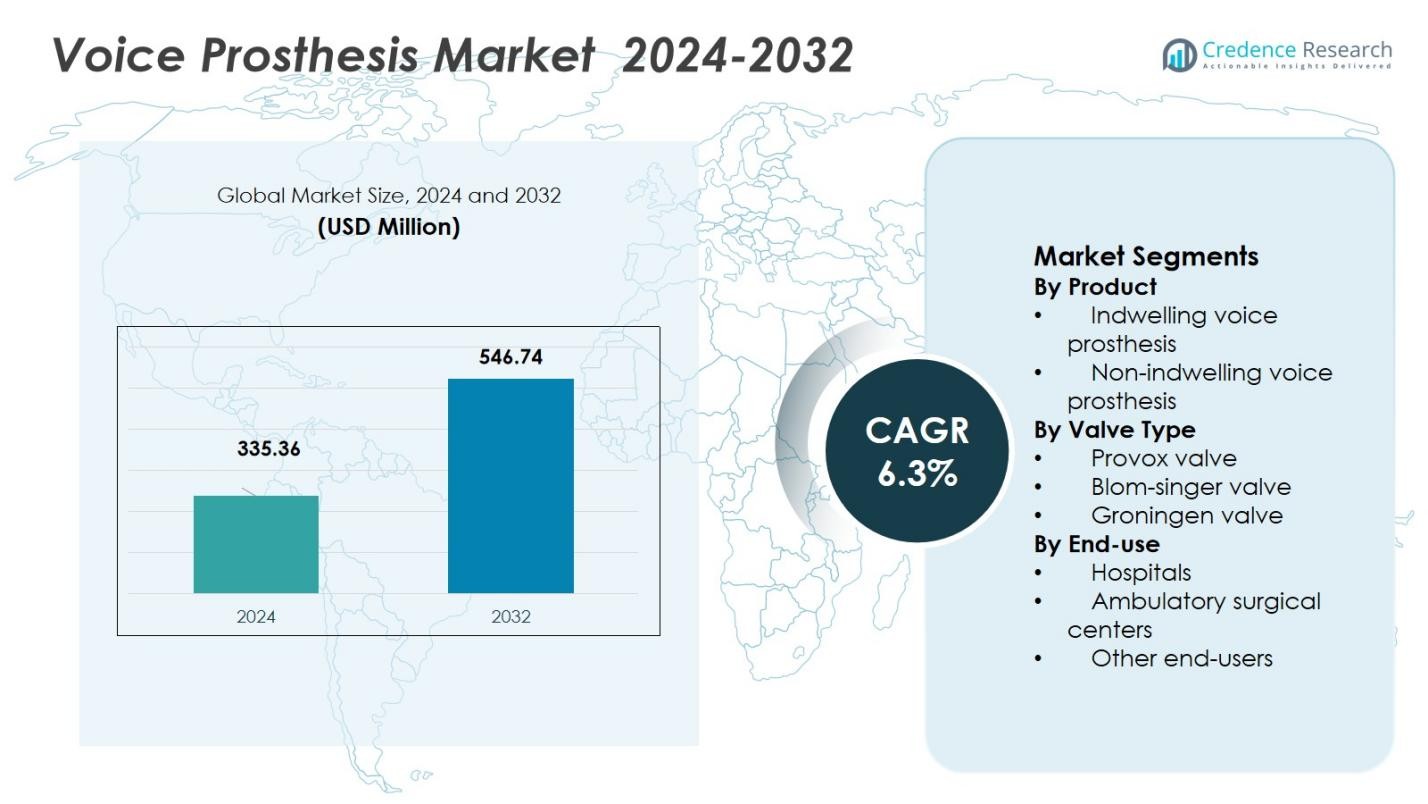
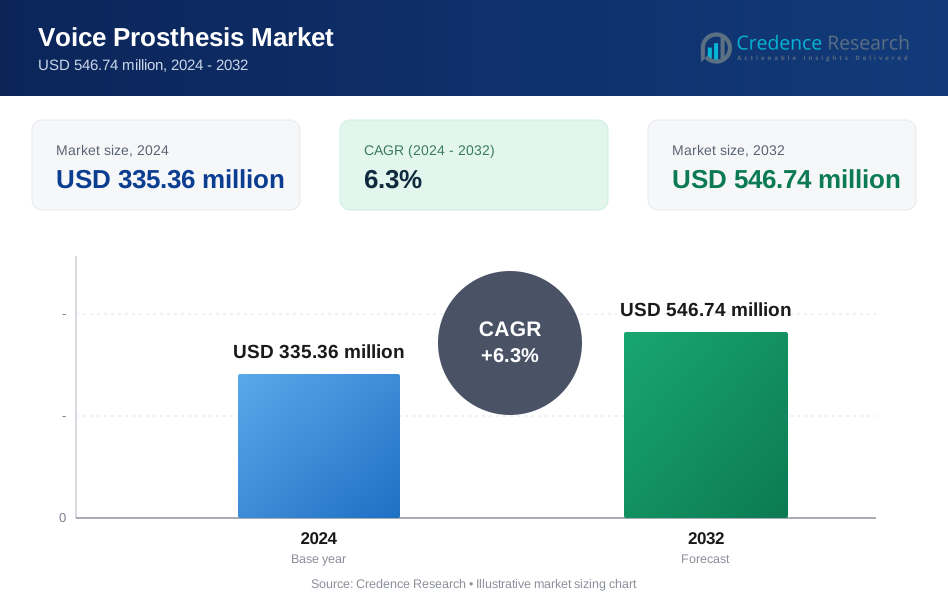
Voice Prosthesis Market size was valued at USD 335.36 million in 2024 and is anticipated to reach USD 546.74 million by 2032, at a CAGR of 6.3% during the forecast period.
| REPORT ATTRIBUTE | DETAILS |
|---|---|
| Historical Period | 2020-2023 |
| Base Year | 2024 |
| Forecast Period | 2025-2032 |
| Voice Prosthesis Market Size 2024 | USD 335.36 Million |
| Voice Prosthesis Market, CAGR | 6.3% |
| Voice Prosthesis Market Size 2032 | USD 546.74 Million |
Voice Prosthesis Market sits at the forefront of vocal rehabilitation, with top players such as Atos Medical, InHealth Technologies, Hood Laboratories, ICU Medical, Inc., HEIMOMED Heinze GmbH & Co. KG, Andreas Fahl Medizintechnik‑Vertrieb GmbH, Innaumation Medical Devices Private Limited, Luminaud, Inc., Servona GmbH and Teleflex Incorporated spearheading product innovation, distribution and global outreach. The market gains its strongest regional foothold in North America, which holds a 41.33 % share of global revenues in 2024. Europe follows with 28.15 %, while Asia‑Pacific captures 17.52 % and is poised for rapid growth as healthcare access expands. Smaller but significant shares lie in Latin America (6.12 %) and Middle East & Africa (6.88 %), signalling broad global penetration. These leading companies and regions collectively shape the market trajectory for voice restoration solutions.
Market Insights
- The Voice Prosthesis Market size was valued at USD 335.36 million in 2024 and is projected to reach USD 546.74 million by 2032, growing at a CAGR of 6.3% during the forecast period.
- Rising prevalence of laryngeal cancer and advancements in medical technology, such as improved prosthesis designs and valve mechanisms, are key drivers for market growth.
- The growing shift toward patient‑centric and personalized prosthesis solutions, along with increased awareness of voice restoration options, will further drive adoption in developed and emerging regions.
- Major players like Atos Medical, InHealth Technologies, and ICU Medical, Inc. lead the market, focusing on innovation, expanding product portfolios, and strengthening their regional presence.
- North America dominates the market with a 41.33% share, followed by Europe at 28.15%, Asia‑Pacific at 17.52%, Latin America at 6.12%, and the Middle East & Africa at 6.88%, showing varied regional demand.
 Market Segmentation Analysis:
By Product
In the product-based segmentation of the voice prosthesis market, the indwelling voice prosthesis sub‑segment held a dominant share of 73.75 % in 2024. This dominance is driven by the superior stability, longevity, and lower maintenance burden of indwelling devices, which are replaced only by medical professionals, ensuring better fit and reduced patient intervention. The growing global incidence of laryngeal cancer and rising number of total laryngectomies directly support sustained demand for long-term, clinically managed solutions reinforcing indwelling devices as the backbone of revenues in this segment.
- For instance, Atos Medical’s Provox Vega is designed for ease of maintenance, better voice quality, and durability, with clinical data showing average device life extending beyond 200 days, which supports sustained speaking ability and reduces the frequency of replacement procedures.
By Valve Type
Within valve‑type segmentation, the Provox valve led the market with a 62.30 % revenue share in 2024. Provox’s technical edge manifested in low resistance to airflow, reduced leakage incidents, and a broad range of size/configuration options enabling tailored fit for individual anatomies makes it the preferred choice among clinicians and patients, especially in high-volume oncology centers. Its established clinical performance and widespread clinician familiarity further cement its leadership in valve-type market revenues.
- For instance, the Provox Vega voice prosthesis is recognized for its low speaking effort and ease of maintenance, improving voice quality post-laryngectomy.
By End‑Use
For the end-use segmentation, the hospital sub-segment accounted for 58.31 % of market share in 2024. Hospitals remain the primary settings for initial laryngectomy procedures, postoperative care, and voice‑prosthesis implantation services requiring multidisciplinary surgical, oncological, and rehabilitative capabilities. The concentration of specialized ENT and oncology departments in hospitals, along with the availability of trained professionals to manage prosthesis fitting and follow‑up care, drives this segment’s dominance.
Key Growth Driver
Rising prevalence of laryngeal cancer and related conditions
The increasing global incidence of laryngeal cancer is a primary driver expanding demand for voice prosthesis devices. As more patients undergo laryngectomy or other glottic/laryngeal surgeries, the need for post‑surgical voice restoration grows steadily. This elevated demand directly translates into higher adoption of voice prostheses to restore speech, thereby enlarging the overall market base. As head and neck cancer cases rise owing to risk factors like smoking, alcohol use, and environmental exposure, the voice prosthesis market continues to expand.
- For instance, InHealth Technologies, through its Blom-Singer® brand, pioneered the silicone valved voice prosthesis that has become the international standard for voice restoration, serving thousands of patients diagnosed with laryngeal cancer.
Advances in medical technology and voice rehabilitation innovation
Continuous improvements in prosthesis design, valve mechanisms, and materials, such as silicone-based implants and refined valve systems enhance device reliability, comfort, and voice quality, making adoption increasingly attractive. Innovations allow prostheses to better mimic natural speech and reduce complications, which improves patient outcomes and satisfaction. Concurrently, the trend toward minimally invasive ENT procedures and advanced tracheoesophageal puncture techniques supports broader use of voice prostheses. These technological developments reinforce clinician and patient confidence, driving market growth.
- For instance, Johns Hopkins surgeons have advanced minimally invasive tracheoesophageal puncture techniques that shorten procedure time and reduce postoperative complications.
Rising patient awareness and expanding healthcare infrastructure
Growing awareness among patients, caregivers, and healthcare professionals about voice restoration options after laryngectomy or voice‑box removal is increasing adoption rates. Educational efforts, advocacy, and improved information flow on rehabilitation outcomes encourage earlier and wider use of voice prostheses. Simultaneously, expansion of healthcare infrastructure globally particularly in developing regions and better access to ENT and oncology services increases the availability of voice prosthesis solutions. These combined factors broaden the potential user base, fueling overall market expansion.
Key Trend & Opportunity
Growing demand for personalized and patient‑centric prosthesis solutions
The market is witnessing a shift toward more customized and patient‑specific voice prosthesis solutions, including tailored valve types, sizes, and material choices to match individual anatomy and clinical needs. This patient‑centric approach enables better comfort, improved voice quality, and reduced complication rates, creating a strong value proposition for clinicians and patients alike. As personalized medicine gains prominence in ENT and oncology care, manufacturers offering tailored prostheses are well positioned to capture increased demand presenting a significant growth opportunity.
- For instance, HP partnered with the Limb Kind Foundation to deliver custom 3D-printed pediatric prosthetic sockets to children in underserved regions like Kenya and Sri Lanka, using anatomical scans and advanced Multi Jet Fusion technology to create tailored fits with rapid production and delivery times.
Strategic collaborations, product bundling and emerging market expansion
Collaborations between manufacturers, healthcare institutions, and research entities are enabling the integration of advanced features (e.g., anti-reflux valves, bioengineered materials) and bundled solutions (prosthesis plus surgical kits or accessories). Such alliances accelerate innovation and widen product offerings, making adoption easier and more cost‑effective for providers. Meanwhile, rising demand in emerging markets, spurred by growing incidence of throat cancers, improving healthcare access, and increasing affordability provides significant expansion potential beyond traditional developed‑market strongholds.
- For instance, NIH’s National Institute of Dental and Craniofacial Research expanding partnerships through the Accelerating Medicines Partnership® Program to drive biomedical innovation and new product development with industry and academic collaborators.
Key Challenge
High cost and economic barriers to device adoption
Voice prosthesis devices and associated surgical procedures remain expensive for many patients, particularly in regions with limited reimbursement or lower per‑capita income. High upfront and maintenance costs (for replacement, follow‑up care, or regular cleaning in non‑indwelling devices) can deter adoption or lead patients to forgo prosthesis altogether. This economic barrier constrains market penetration especially in price‑sensitive or under‑insured populations and may slow growth in certain geographies.
Device longevity, complications and need for frequent replacements
Voice prostheses are subject to wear, leakage, microbial/biofilm formation, and valve failure over time, often necessitating frequent replacement or maintenance. Such limitations can reduce patient compliance and satisfaction, impacting overall adoption. Additional complications - such as leakage of saliva or aspiration raise clinical risk and discourage both patients and clinicians, especially where follow‑up care or maintenance support is insufficient. These reliability and durability challenges pose a significant restraint to sustained market growth.
Regional Analysis
North America
North America commanded a leading position in the voice prosthesis market, capturing 41.33% of global revenues in 2024. The region’s dominance stems from its advanced healthcare infrastructure, widespread availability of high‑quality ENT and oncology care, and robust reimbursement mechanisms that facilitate access to voice prosthesis devices. High incidence of laryngeal cancer and a large number of total laryngectomy procedures further reinforce demand. Clinicians and patients benefit from early access to next‑generation prostheses, driving steady uptake of indwelling and advanced valve‑type devices in major hospitals and specialty centers.
Europe
In Europe, the voice prosthesis market holds a substantial share of 28.15%, supported by well‑established healthcare services, standardized post‑laryngectomy care pathways, and growing awareness of voice rehabilitation benefits. Widespread adoption of established valve solutions and prosthesis devices across Western and Northern European countries continues to generate stable demand. European clinicians increasingly emphasize postoperative quality of life, promoting long‑term use of voice prostheses. The presence of leading manufacturers and growing ENT surgical volumes further underpin the region’s significance in the global landscape.
Asia‑Pacific
The Asia‑Pacific region is emerging as the fastest‑growing market segment, driven by rising incidence of laryngeal cancer, expanding healthcare access, and increasing adoption of reconstructive ENT procedures. The region captured 17.52% of the global market in 2024. As patients in countries such as China, India, Japan, and South Korea gain improved access to voice restoration solutions, demand is projected to accelerate. Lower‑cost prosthesis options, increasing awareness of post‑surgical rehabilitation, and expanding hospital and clinical infrastructure are central to growth. This region is poised to progressively widen its share of global voice prosthesis market revenues over the forecast period.
Latin America
Latin America occupies a modest but growing portion of the global voice prosthesis market, with a share of 6.12% in 2024. Supported by increasing prevalence of laryngeal disorders and gradually improving ENT healthcare infrastructure, demand for voice prostheses is slowly rising. Although economic constraints and limited reimbursement in certain countries remain challenges, growing patient awareness and gradual infrastructure investments are enabling incremental uptake of prosthetic devices, particularly in urban centers.
Middle East & Africa
The Middle East & Africa region currently represents 6.88% of the global voice prosthesis market but shows potential for growth as healthcare systems evolve and investments in oncology and ENT care increase. Rising incidence of head and neck cancers, improved diagnostic capabilities, and gradual expansion of hospital-based voice rehabilitation services contribute to a slowly growing demand. Challenges remain related to affordability, access to trained specialists, and regional disparities in care quality, which temper rapid market growth in the near term.
Market Segmentations:
By Product
- Indwelling voice prosthesis
- Non-indwelling voice prosthesis
By Valve Type
- Provox valve
- Blom-singer valve
- Groningen valve
By End-use
- Hospitals
- Ambulatory surgical centers
- Other end-users
By Geography
- North America
- U.S.
- Canada
- Mexico
- Europe
- Germany
- France
- U.K.
- Italy
- Spain
- Rest of Europe
- Asia Pacific
- China
- Japan
- India
- South Korea
- South-east Asia
- Rest of Asia Pacific
- Latin America
- Brazil
- Argentina
- Rest of Latin America
- Middle East & Africa
- GCC Countries
- South Africa
- Rest of the Middle East and Africa
Competitive Landscape
The global voice prosthesis market is highly competitive, with key players such as Atos Medical, InHealth Technologies, Andreas Fahl Medizintechnik‑Vertrieb GmbH, Hood Laboratories, ICU Medical, Inc., HEIMOMED Heinze GmbH & Co. KG, Innaumation Medical Devices Private Limited, Luminaud, Inc., Servona GmbH, and Teleflex Incorporated driving the market forward. These companies lead the market by focusing on product innovation, reliability, and expanding their distribution networks. Competitive differentiation is achieved through advancements in valve technology, such as the development of indwelling and non‑indwelling prostheses, improved materials for durability and biofilm resistance, and complementary products like cleaning kits. Strategic initiatives, including mergers, acquisitions, and global expansion, further intensify competition, with large players strengthening their presence in both developed and emerging markets. Smaller or niche companies often focus on cost‑effective solutions or unique prosthesis designs, ensuring the market caters to a wide range of patient needs and preferences.
Key Player Analysis
- InHealth Technologies
- Andreas Fahl Medizintechnik‑Vertrieb GmbH
- HEIMOMED Heinze GmbH & Co. KG
- Innaumation Medical Devices Private Limited
- Atos Medical
- Hood Laboratories
- Luminaud, Inc.
- ICU Medical, Inc.
- Servona GmbH
- Teleflex Incorporated
Recent Developments
- In September 2025, Boston Medical Products introduced a new indwelling voice prosthesis designed for greater durability and enhanced patient comfort, targeting outpatient rehabilitation settings.
- In October 2025, Medtronic acquired a startup focused on smart‑sensor integration for voice prostheses a move aimed at enhancing device functionality and enabling real‑time patient monitoring.
- In August 2022, InHealth Technologies announced the commercial release of the Blom-Singer Day&Night HME, a unique device for patients who have undergone total laryngectomy.
Report Coverage
The research report offers an in-depth analysis based on Product, Valve Type, End Use and Geography. It details leading market players, providing an overview of their business, product offerings, investments, revenue streams, and key applications. Additionally, the report includes insights into the competitive environment, SWOT analysis, current market trends, as well as the primary drivers and constraints. Furthermore, it discusses various factors that have driven market expansion in recent years. The report also explores market dynamics, regulatory scenarios, and technological advancements that are shaping the industry. It assesses the impact of external factors and global economic changes on market growth. Lastly, it provides strategic recommendations for new entrants and established companies to navigate the complexities of the market.
Future Outlook
- Global demand for voice prostheses will grow as the incidence of laryngeal and head-neck cancers continues rising, leading to more laryngectomy procedures and increased need for voice restoration.
- Advances in materials science and prosthesis design will yield more durable, biofilm-resistant, and user-friendly devices, improving patient comfort and reducing maintenance needs, thereby enhancing adoption rates.
- Growing emphasis on quality of life and rehabilitation after laryngectomy will drive integration of voice prostheses into standard post-operative and long-term care protocols.
- Expansion of healthcare infrastructure and ENT/oncology services in emerging markets will open new regional demand pools, extending access to voice prosthesis devices beyond traditional markets.
- Rising awareness among patients, caregivers, and clinicians about voice restoration options will boost acceptance and encourage early adoption of prostheses after voice-box removal.
- Growing geriatric populations in many countries will lead to increased incidence of diseases and surgical interventions affecting voice, expanding the potential patient base for prosthesis devices.
- Integration of voice prostheses with rehabilitation services, including speech therapy and post-surgical follow-up, will improve long-term outcomes and patient satisfaction, driving repeat business and referrals.
- Development of lower-cost, accessible, and simpler-to-use non-indwelling or self-managed prosthesis variants will make voice restoration more feasible in resource-constrained settings, broadening market reach.
- Telehealth and remote rehabilitation services may facilitate follow-up care and device maintenance for voice prosthesis users, increasing compliance and improving long-term device success.
- Manufacturers and healthcare providers may collaborate to offer bundled surgical + rehabilitation + device packages, making voice restoration more standardized and integrated which will accelerate overall market growth.
Request a Free Sample
Fill in your details and we'll send you a free sample report.
- Sample data tables & charts
- Research methodology
Market Dynamics
Rising prevalence of laryngeal cancer and related conditions
The increasing global incidence of laryngeal cancer and related head and neck cancers is leading to more laryngectomy procedures, directly expanding the patient pool requiring voice prosthesis devices for post-surgical voice restoration.
Advancements in prosthesis design and medical technology
Continuous innovation in prosthesis materials, valve mechanisms, and device design - such as silicone-based implants and improved valve systems - enhances device reliability, comfort, and voice quality, making adoption more attractive for both clinicians and patients.
Growing patient awareness and expanding healthcare infrastructure
Educational initiatives and advocacy are increasing awareness of voice restoration options among patients and healthcare providers, while expanding healthcare infrastructure, especially in emerging markets, is improving access to ENT and oncology services and thus to voice prosthesis solutions.
Shift toward personalized and patient-centric solutions
There is a growing demand for customized voice prostheses tailored to individual anatomical and clinical needs, which improves patient comfort, voice quality, and reduces complication rates, driving higher adoption rates among both clinicians and patients.
Integration of voice prosthesis with rehabilitation and bundled care
The integration of voice prosthesis devices with comprehensive rehabilitation services, including speech therapy and bundled surgical packages, is improving long-term outcomes and patient satisfaction, encouraging repeat business and broader market penetration.
Need a Custom Version of This Report?
Tailor the scope, geography, or segments to your exact requirements.
- Custom geography or segment scope
- Direct access to our analyst team
Frequently Asked Questions
What is the current market size for Voice Prosthesis Market, and what is its projected size in 2032?
At what Compound Annual Growth Rate is the Voice Prosthesis Market projected to grow between 2025 and 2032?
Which Voice Prosthesis Market segment held the largest share in 2024?
What are the primary factors fueling the growth of the Voice Prosthesis Market?
Who are the leading companies in the Voice Prosthesis Market?
Which region commanded the largest share of the Voice Prosthesis Market in 2024?
Table of Content
Chapter 1 Market Segmentation
- 1.1 Segmentation Framework
- 1.1.1 Product and Service Classification
- 1.1.2 Application and End-Use Classification
- 1.1.3 Technology and Solution Classification
- 1.1.4 Customer and Distribution Channel Classification
- 1.1.5 Geographic Segmentation
- 1.1.6 Market Segment Definitions and Boundaries
- 1.2 By End-use
- 1.2.1 Hospitals
- 1.2.2 Ambulatory surgical centers
- 1.2.3 Other end-users
- 1.3 By Product
- 1.3.1 Indwelling voice prosthesis
- 1.3.2 Non-indwelling voice prosthesis
- 1.4 By Valve Type
- 1.4.1 Provox valve
- 1.4.2 Blom-singer valve
- 1.4.3 Groningen valve
Chapter 2 Introduction
- 2.1 Report Objectives and Scope
- 2.2 Product Definition and Industry Terminology
- 2.3 Market Inclusions and Exclusions
- 2.4 Research Process
- 2.4.1 Primary Research and Expert Interviews
- 2.4.2 Secondary Research and Source Review
- 2.4.3 Top-Down and Bottom-Up Estimation
- 2.4.4 Data Triangulation and Verification
- 2.5 Market Size Measurement Basis
- 2.5.1 2024: USD 335.36 million → 2032: USD 546.74 million
- 2.6 Historical and Forecast Reference Periods
- 2.6.1 Base Year: 2024
- 2.6.2 Forecast Period: 2024-2032
- 2.7 Research Assumptions and Limitations
Chapter 3 Executive Summary
- 3.1 Market Snapshot and Key Findings
- 3.2 Base-Year Market Size, 2024
- 3.3 Forecast Market Size, 2032
- 3.4 Revenue and Volume Growth Outlook
- 3.5 Key Demand and Supply Indicators
- 3.6 Leading Market Segments
- 3.7 Fastest-Growing Market Opportunities
- 3.8 Regional Performance Highlights
- 3.9 Technology and Industry Transformation
- 3.10 Competitive Landscape Summary
- 3.11 Analyst View and Strategic Implications
Chapter 4 Global Voice Prosthesis Market Trends and Developments
- 4.1 Historical Industry Development
- 4.2 Recent Market Trends and Developments
- 4.3 Demand and Customer Behavior Trends
- 4.4 Technology and Product Innovation
- 4.5 Artificial Intelligence, Automation and Digitalization
- 4.6 Local Manufacturing and Supply Chain Realignment
- 4.7 Industry Partnerships, Mergers and Acquisitions
- 4.8 Sustainability and Circular Economy Developments
- 4.9 Government and Private Sector Investment Trends
- 4.10 Emerging Business Models and Commercialization
- 4.11 Industry Developments and Announcements
Chapter 5 Global Voice Prosthesis Market Production, Supply and Demand Analysis
- 5.1 Demand Trend and Consumption Analysis
- 5.2 Demand Forecast, 2024-2032
- 5.3 Production and Output Trend
- 5.4 Production and Output Forecast, 2024-2032
- 5.5 Installed Capacity and Capacity Utilization
- 5.6 Company-Wise Production Plants and Statistics
- 5.6.1 Installed Production Capacity
- 5.6.2 Actual Production
- 5.6.3 Planned Capacity and Expansion Targets
- 5.7 Supply Chain Structure and Procurement Trends
- 5.8 Supply-Demand Gap and Bottlenecks
- 5.9 Import Dependence and Sourcing Structure
- 5.10 Contract Manufacturing and Outsourcing
- 5.11 Regional Supply and Demand Concentration
Chapter 6 Global Voice Prosthesis Market Pricing Analysis
- 6.1 Pricing Structure and Measurement
- 6.2 Historical Pricing Trends
- 6.3 Pricing Outlook, 2024-2032
- 6.4 Average Selling Price and Unit Economics
- 6.5 Pricing by Product and Market Segment
- 6.6 Geographic Pricing Differences
- 6.7 Key Input, Energy, Labor and Logistics Costs
- 6.8 Contract Pricing and Purchasing Models
- 6.9 Pricing Sensitivity and Competitive Positioning
- 6.10 Price, Margin and Profitability Implications
Chapter 7 Global Voice Prosthesis Market Dynamics
- 7.1 Market Growth Drivers
- 7.1.1 Demand-Side Drivers
- 7.1.2 Technology and Innovation Drivers
- 7.1.3 Infrastructure and Investment Drivers
- 7.1.4 Regulatory and Policy Drivers
- 7.2 Market Restraints
- 7.2.1 Cost and Affordability Constraints
- 7.2.2 Technology and Adoption Barriers
- 7.2.3 Supply Chain and Operational Constraints
- 7.3 Market Challenges
- 7.3.1 Competitive Pressure and Margin Erosion
- 7.3.2 Skills, Infrastructure and Implementation Gaps
- 7.4 Emerging Market Opportunities
- 7.5 Market Dynamics Impact and Time-Horizon Assessment
Chapter 8 Global Voice Prosthesis Value Chain Analysis
- 8.1 Industry Value Chain Overview
- 8.2 Upstream Suppliers and Critical Inputs
- 8.3 Technology and Component Providers
- 8.4 Manufacturing or Service Delivery
- 8.5 Distribution, Channel Partners and Integrators
- 8.6 Downstream Applications and End Users
- 8.7 Value Addition and Profit Pools
- 8.8 Vertical Integration and Outsourcing
- 8.9 Supplier Concentration and Risk
- 8.10 Supply Chain Localization and Resilience
Chapter 9 Global Voice Prosthesis Market Regulations and Policies
- 9.1 Relevant Laws, Standards and Compliance Frameworks
- 9.2 Product, Service, Safety and Quality Requirements
- 9.3 Government Policies, Incentives and Subsidies
- 9.4 Imports, Exports and Trade Barriers
- 9.5 Public Procurement and Local Content Requirements
- 9.6 Environmental and Sustainability Compliance
- 9.7 Upcoming Policy Changes and Market Implications
Chapter 10 Global Voice Prosthesis Market Hotspots and Opportunities
- 10.1 Market Opportunity Mapping and Growth Hotspots
- 10.2 High-Growth Applications and Customer Groups
- 10.3 Underserved Markets and White-Space Opportunities
- 10.4 Emerging Technology and Product Opportunities
- 10.5 New Capacity and Investment Hotspots
- 10.6 Market Entry and Expansion Opportunities
- 10.7 Distribution and Partnership Opportunities
- 10.8 Near-Term and Long-Term Commercial Potential
- 10.9 Opportunity Attractiveness and Execution Risks
Chapter 11 Global Voice Prosthesis Market Outlook, 2024-2032
- 11.1 Market Size and Analysis
- 11.1.1 Revenue (Market Measurement: 2024: USD 335.36 million → 2032: USD 546.74 million)
- 11.1.2 Market Volume and Quantity Sold
- 11.1.3 Historical Market Size
- 11.1.4 Base-Year Market Size, 2024
- 11.2 Market Forecast, 2024-2032
- 11.2.1 Revenue Forecast to 2032
- 11.2.2 Volume Forecast to 2032
- 11.2.3 CAGR and Year-on-Year Growth
- 11.2.4 Incremental Revenue Opportunity
- 11.3 Forecast Assumptions and Scenario Analysis
- 11.3.1 Base-Case Forecast
- 11.3.2 Optimistic and Conservative Scenarios
- 11.3.3 Technology, Pricing and Policy Sensitivities
- 11.4 Market Attractiveness and Growth Outlook
Chapter 12 Global Voice Prosthesis Market Segmentation and Outlook
- 12.1 Segmentation Summary and Market Shares, 2024
- 12.2 Largest and Fastest-Growing Segments
- 12.3 By End-use - Market Size and Forecast, 2024-2032
- 12.3.1 Segment Definition and Scope
- 12.3.2 Historical Market Size
- 12.3.3 Revenue Forecast, 2024-2032
- 12.3.4 Volume Forecast, 2024-2032
- 12.3.5 Base-Year Market Share, 2024
- 12.3.6 Segment CAGR and Growth Drivers
- 12.3.7 Subsegment Market Size and Forecast
- 12.3.7.1 Hospitals
- 12.3.7.2 Ambulatory surgical centers
- 12.3.7.3 Other end-users
- 12.3.8 Subsegment Pricing and Adoption Trends
- 12.3.9 Leading Suppliers and Competition
- 12.3.10 Regional Demand and Opportunities
- 12.4 By Product - Market Size and Forecast, 2024-2032
- 12.4.1 Segment Definition and Scope
- 12.4.2 Historical Market Size
- 12.4.3 Revenue Forecast, 2024-2032
- 12.4.4 Volume Forecast, 2024-2032
- 12.4.5 Base-Year Market Share, 2024
- 12.4.6 Segment CAGR and Growth Drivers
- 12.4.7 Subsegment Market Size and Forecast
- 12.4.7.1 Indwelling voice prosthesis
- 12.4.7.2 Non-indwelling voice prosthesis
- 12.4.8 Subsegment Pricing and Adoption Trends
- 12.4.9 Leading Suppliers and Competition
- 12.4.10 Regional Demand and Opportunities
- 12.5 By Valve Type - Market Size and Forecast, 2024-2032
- 12.5.1 Segment Definition and Scope
- 12.5.2 Historical Market Size
- 12.5.3 Revenue Forecast, 2024-2032
- 12.5.4 Volume Forecast, 2024-2032
- 12.5.5 Base-Year Market Share, 2024
- 12.5.6 Segment CAGR and Growth Drivers
- 12.5.7 Subsegment Market Size and Forecast
- 12.5.7.1 Provox valve
- 12.5.7.2 Blom-singer valve
- 12.5.7.3 Groningen valve
- 12.5.8 Subsegment Pricing and Adoption Trends
- 12.5.9 Leading Suppliers and Competition
- 12.5.10 Regional Demand and Opportunities
- 12.6 Segment Growth Comparison
- 12.7 Segment Attractiveness and Priority Matrix
Chapter 13 Global Voice Prosthesis End-Use and Application Market Outlook
- 13.1 End-Use Industry and Customer Demand Structure
- 13.2 Leading Applications and Customer Groups
- 13.3 End-Use Market Size, Share and Forecast
- 13.4 Major End-Use Industry Deep Dives
- 13.4.1 Customer Requirements and Use Cases
- 13.4.2 Demand and Replacement Cycles
- 13.4.3 Technical and Regulatory Considerations
- 13.4.4 Purchasing and Procurement Models
- 13.4.5 Leading Vendors and Distribution Channels
- 13.4.6 Forecast and Commercial Opportunities
- 13.5 Emerging Applications and Cross-Segment Demand
- 13.6 End-Use Industry Investment Priorities
Chapter 14 Global Voice Prosthesis Geographic Market Outlook, 2024-2032
- 14.1 Regional Market Size and Share, 2024
- 14.2 Regional Market Forecast, 2024-2032
- 14.3 Regional Pricing, Production and Demand Differences
- 14.4 North America
- 14.4.1 United States
- 14.4.2 Canada
- 14.4.3 Mexico
- 14.5 Europe
- 14.5.1 Germany
- 14.5.2 France
- 14.5.3 Italy
- 14.5.4 United Kingdom
- 14.5.5 Spain
- 14.5.6 Poland
- 14.5.7 Russia
- 14.5.8 Netherlands
- 14.5.9 Belgium
- 14.5.10 Sweden
- 14.5.11 Denmark
- 14.5.12 Norway
- 14.5.13 Rest of Europe
- 14.6 Asia Pacific
- 14.6.1 China
- 14.6.2 India
- 14.6.3 Japan
- 14.6.4 South Korea
- 14.6.5 Thailand
- 14.6.6 Indonesia
- 14.6.7 Vietnam
- 14.6.8 Malaysia
- 14.6.9 Australia
- 14.6.10 Rest of Asia Pacific
- 14.7 Latin America
- 14.7.1 Brazil
- 14.7.2 Argentina
- 14.7.3 Colombia
- 14.7.4 Chile
- 14.7.5 Rest of Latin America
- 14.8 Middle East
- 14.8.1 Saudi Arabia
- 14.8.2 United Arab Emirates
- 14.8.3 Turkey
- 14.8.4 Israel
- 14.8.5 Iran
- 14.8.6 Rest of the Middle East
- 14.9 Africa
- 14.9.1 South Africa
- 14.9.2 Egypt
- 14.9.3 Nigeria
- 14.9.4 Morocco
- 14.9.5 Rest of Africa
- 14.10 Regional Investment, Policy and Supply Chain Differences
- 14.11 Regional Competitive Landscape
- 14.12 Geographic Growth Hotspots
Chapter 15 Global Voice Prosthesis Technology, Innovation and Sustainability Outlook
- 15.1 Technology Landscape and Maturity
- 15.2 Product, Process and Service Innovation
- 15.3 AI, Automation and Digital Tools in the Industry
- 15.4 Technology Adoption and Performance Benchmarking
- 15.5 Innovation Pipeline and R&D Investment
- 15.6 Patent and Intellectual Property Trends
- 15.7 Energy Efficiency and Resource Management
- 15.8 Sustainability, Recycling and Circularity
- 15.9 Technology Roadmap, 2024-2032
- 15.10 Risks of Obsolescence and Technology Substitution
Chapter 16 Global Voice Prosthesis Market Key Strategic Imperatives
- 16.1 Growth and Market Entry Priorities
- 16.2 High-Return Products and Segments
- 16.3 Pricing, Profitability and Cost Optimization
- 16.4 Technology Investment and Product Differentiation
- 16.5 Supply Chain Localization and Resilience
- 16.6 Distribution and Customer Acquisition
- 16.7 Partnership, Acquisition and Capacity Strategy
- 16.8 Regional Expansion Priorities
- 16.9 Short-, Medium- and Long-Term Actions
Chapter 17 Competition Outlook
- 17.1 Industry Competition Characteristics
- 17.2 Market Structure and Concentration
- 17.3 Market Share and Competitive Positioning, 2024
- 17.4 Company-Wise Revenue and Product Benchmarking
- 17.5 Production and Service Capacity Benchmarking
- 17.6 Technology, Pricing and Differentiation
- 17.7 Regional Footprint and Distribution Strength
- 17.8 Mergers, Acquisitions and Strategic Alliances
- 17.9 New Entrants and Competitive Threats
- 17.10 Porter's Five Forces and Industry Attractiveness
- 17.11 Competitive Outlook, 2024-2032
Chapter 18 Company Profiles
- 18.1 Company Coverage and Selection Criteria
- 18.2 Atos Medical
- 18.2.1 Business Description
- 18.2.2 Company Ownership and Geographic Presence
- 18.2.3 Product and Service Portfolio
- 18.2.4 Manufacturing and Operating Footprint
- 18.2.5 Production Capacity and Expansion Plans
- 18.2.6 Financial Performance and Investment
- 18.2.7 Market Share and Competitive Position
- 18.2.8 Technology and Innovation Capabilities
- 18.2.9 Strategic Alliances or Partnerships
- 18.2.10 Recent Developments
- 18.2.11 Growth Strategy and Outlook
- 18.3 InHealth Technologies
- 18.4 Hood Laboratories
- 18.5 ICU Medical, Inc.
- 18.6 HEIMOMED Heinze GmbH & Co. KG
- 18.7 Andreas Fahl Medizintechnik‑Vertrieb GmbH
- 18.8 Innaumation Medical Devices Private Limited
- 18.9 Luminaud, Inc.
- 18.10 Servona GmbH
- 18.11 Teleflex Incorporated
- 18.12 Other Relevant Market Participants
Note: Every listed company is profiled on the structure shown under the first company. The company list is preliminary and may change based on research findings, market developments, data availability and client requirements.
Chapter 19 Disclaimer
- 19.1 Research and Forecast Disclaimer
- 19.2 Data Source and Estimation Limitations
Note: The depth of individual sections depends on data availability for this market. Volume, capacity, trade and other unit-based metrics are included where applicable.