
Market Overview
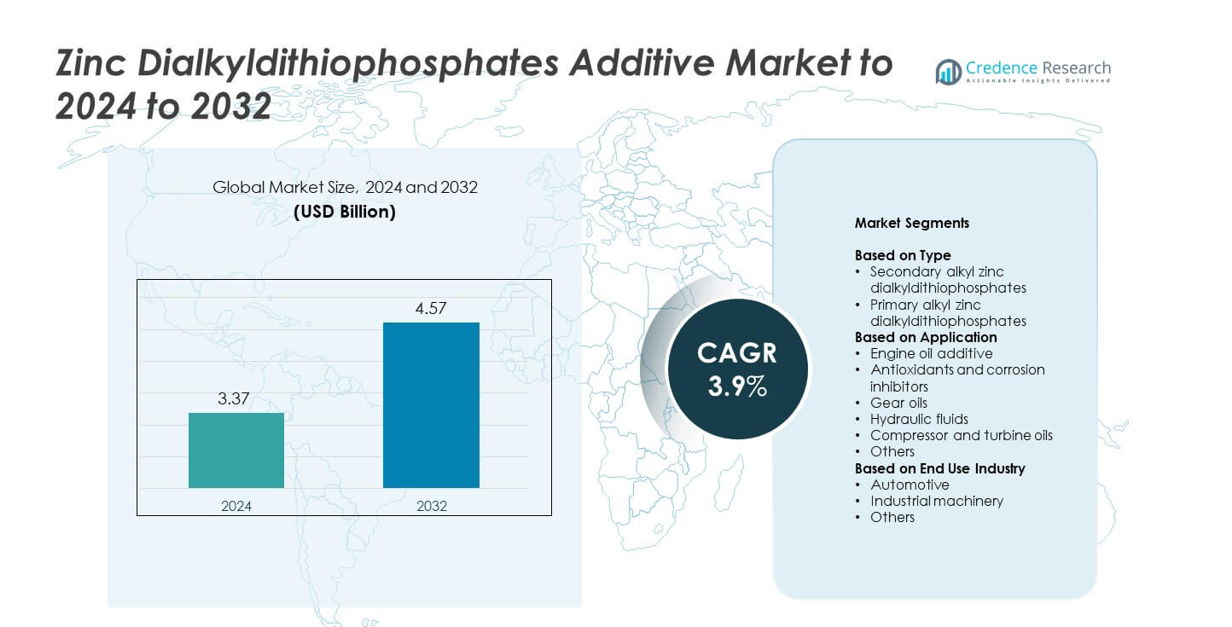
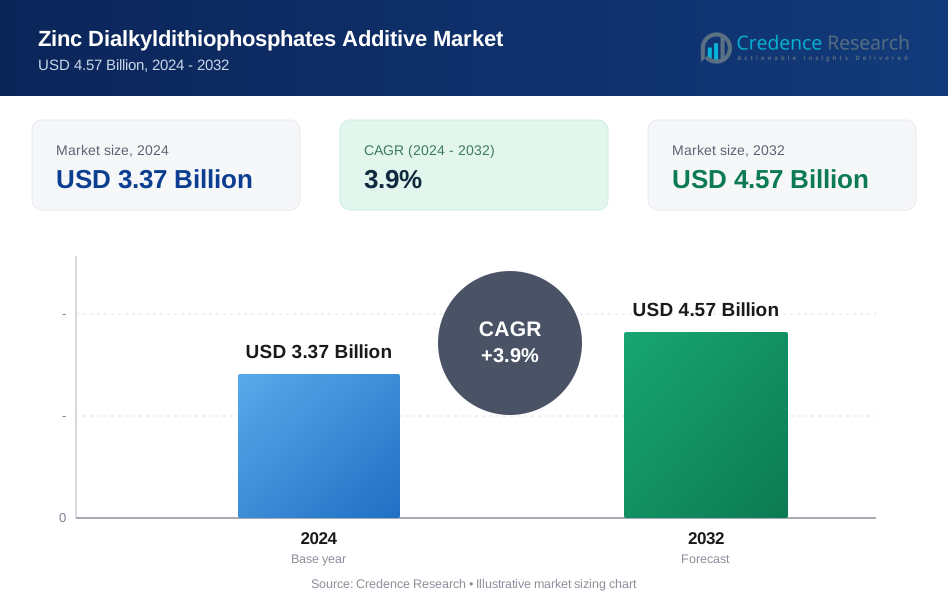
Zinc Dialkyldithiophosphates Additive Market size was valued at USD 3.37 Billion in 2024 and is anticipated to reach USD 4.57 Billion by 2032, at a CAGR of 3.9% during the forecast period.
| REPORT ATTRIBUTE | DETAILS |
|---|---|
| Historical Period | 2020-2023 |
| Base Year | 2024 |
| Forecast Period | 2025-2032 |
| Zinc Dialkyldithiophosphates Additive Market Size 2024 | USD 3.37 Billion |
| Zinc Dialkyldithiophosphates Additive Market, CAGR | 3.9% |
| Zinc Dialkyldithiophosphates Additive Market Size 2032 | USD 4.57 Billion |
The Zinc Dialkyldithiophosphates Additive Market is led by major players such as Infineum, Ganesh Benzoplast, Afton Chemical, Yasho Industries, Chevron Oronite, Gbl Chemical, Ruhani Lubricants, RB Products, Lubrizol, Addilex, and Chetas Biochem. These companies compete through advanced additive technologies that enhance wear protection, thermal stability, and lubricant durability for automotive and industrial applications. Their focus on performance-driven formulations and compliance with evolving emission standards strengthens market positioning across global lubricant manufacturers. North America emerged as the leading region in 2024 with about 34% share, supported by strong vehicle maintenance demand and high adoption of premium engine oils.
Market Insights
- The Zinc Dialkyldithiophosphates Additive Market was valued at USD 3.37 Billion in 2024 and will reach USD 4.57 Billion by 2032 at a CAGR of 3.9%. • Higher demand for strong anti-wear protection in engines drives market growth, led by secondary alkyl ZDDP with about 62% share and engine oil additives with nearly 48% share in 2024. • Key trends include rising use of synthetic oils, longer drain intervals, and growing need for thermal stability in hybrid and downsized engines across major markets. • Competition stays active as producers focus on better additive blends, regulatory-ready formulations, and improved performance for both automotive and industrial users. • North America led the market with about 34% share, followed by Europe at 28%, Asia Pacific at 30%, Latin America at 5%, and Middle East and Africa at 3%, supported by strong lubricant consumption and expanding machinery use.
Market Segmentation Analysis:
By Type
Secondary alkyl zinc dialkyldithiophosphates held the dominant position in 2024 with about 62% share of the Zinc Dialkyldithiophosphates Additive Market. This grade remained the preferred choice because secondary alkyl ZDDP provides stronger anti-wear protection and better thermal stability in high-load engines. Demand increased as OEMs focused on longer drain intervals and improved engine durability. Primary alkyl ZDDP continued to serve niche applications where lower volatility and cleaner performance were required, but the broader shift toward advanced lubrication pushed secondary alkyl variants ahead in overall consumption.
- For instance, Biosynthetic Technologies reported that while typical conventional base oil formulations achieve Sequence IIIH weighted piston deposit ratings around 4.7 (Group III) to 4.9 (Group II) merits, its own BT4 base-stock formulations achieved superior ratings of 5.5 and 5.8 merits, indicating significantly cleaner engine operation.
By Application
Engine oil additives led the application segment in 2024 with nearly 48% share of the Zinc Dialkyldithiophosphates Additive Market. Automakers and lubricant producers relied on ZDDP for strong wear control, oxidation resistance, and stable performance under high temperature. Growth stayed steady due to rising vehicle parc, increased use of synthetic oils, and the need to protect metal-to-metal contact surfaces in modern engines. Antioxidants and corrosion inhibitors, gear oils, and hydraulic fluids also recorded solid demand as industries sought reliability in high-stress machinery environments.
- For instance, Intertek’s engine-oil overview lists Sequence IIIH running 90 hours at 3900 rpm with an oil-block temperature target near 151 degrees Celsius.
By End Use Industry
Automotive emerged as the leading end-use industry in 2024 with around 58% share of the Zinc Dialkyldithiophosphates Additive Market. Rising production of passenger and commercial vehicles supported the wider use of ZDDP-based formulations in engine oils and driveline lubricants. The shift toward higher-performance engines and longer service intervals also raised demand for strong anti-wear chemistry. Industrial machinery followed with stable growth as manufacturers adopted ZDDP-containing oils to maintain component life and reduce downtime in heavy-duty operations.
Key Growth Drivers
Rising Demand for High-Performance Engine Oils
Growing use of high-performance engine oils remains a major growth driver in the Zinc Dialkyldithiophosphates Additive Market. Vehicle manufacturers focus on better wear protection and longer oil drain intervals, which pushes lubricant formulators to rely on ZDDP chemistry. Modern engines generate higher thermal stress, raising the need for additives that prevent metal-to-metal contact. Expanding vehicle fleets in Asia-Pacific and increasing adoption of synthetic lubricants further support demand. These factors keep ZDDP essential in meeting durability, stability, and anti-wear requirements across passenger and commercial vehicles.
- For instance, Shell states that Helix Ultra with PurePlus Technology delivers up to three times faster oil flow at minus 40 degrees Celsius compared with the API SN reference oil.
Expansion of Industrial Machinery and Equipment Use
Rapid industrial development drives higher consumption of lubricants containing ZDDP across manufacturing, mining, and heavy engineering. Industrial machinery operates under heavy loads and extreme temperatures, creating strong demand for additives that deliver oxidation stability and wear resistance. Growing installation of hydraulic systems, compressors, and turbines increases reliance on robust anti-wear formulations. Emerging economies continue to expand industrial output, which lifts lubricant requirements across factories and construction fleets. This broad industrial growth strengthens the long-term need for ZDDP-based additive blends.
- For instance, Afton Chemical’s HiTEC 11100 data sheet lists the physical properties of the concentrated additive package itself, showing a kinematic viscosity of about 89 square millimeters per second at 100 degrees Celsius and a total base number (TBN) near 78 milligrams KOH per gram.
Continuous Upgrades in Lubrication Technology
Ongoing improvements in lubricant technology act as a key growth driver for the market. Lubricant producers work toward advanced formulations that enhance engine efficiency, reduce friction, and meet tougher equipment standards. ZDDP remains vital due to its balanced anti-wear and antioxidant properties, supporting compatibility with both mineral and synthetic base oils. New blending techniques and better additive synergies raise the effectiveness of ZDDP even in modern low-viscosity oils. These advancements reinforce the importance of ZDDP in next-generation lubrication systems.
Key Trends and Opportunities
Shift Toward Longer Drain Intervals and High-Temperature Stability
A key trend involves the growing shift toward lubricants that support extended drain intervals and improved thermal stability. Fleets and vehicle owners prefer oils that reduce maintenance frequency and deliver consistent performance. ZDDP additives help maintain film strength at high temperatures, supporting this trend. As synthetic oils gain popularity due to efficiency benefits, the opportunity for ZDDP-integrated formulations increases. This creates new potential across automotive workshops, commercial fleets, and heavy-duty equipment operators seeking durability and cost savings.
- For instance, Southwest Research Institute’s Sequence VH documentation describes a 216 hour test made of 54 cycles, each cycle combining stages at 1200, 2900, and 700 revolutions per minute.
Increased Focus on Hybrid and Downsized Engines
The rise of hybrid and downsized engines creates new opportunities for ZDDP-based additives. These engines place harsher demands on lubricants due to frequent start-stop cycles and fluctuating temperatures. ZDDP provides critical wear protection for valve trains and metal contact surfaces, supporting stable performance. As automakers continue launching compact, fuel-efficient engines, the need for strong anti-wear chemistry expands. This trend enhances adoption across OEM-approved lubricant specifications and opens growth prospects in premium oil formulations.
- For instance, Infineum’s description of Ford’s Sequence IX test notes a 2.0 liter turbo engine running four iterations of 175000 cycles, with a limit of five low-speed pre-ignition events overall.
Key Challenges
Regulatory Pressure on Phosphorus and Sulfur Limits
A key challenge arises from global regulations restricting phosphorus and sulfur content in lubricants. These limits aim to protect catalytic converters and reduce emissions, but they directly affect traditional ZDDP formulations. Lubricant producers must balance compliance with performance requirements, often reducing ZDDP concentrations. This creates difficulties in maintaining the same level of anti-wear protection. Regulatory tightening in North America, Europe, and parts of Asia pushes manufacturers toward optimized blends or partial ZDDP replacements.
Competition from Emerging Anti-Wear Additives
Competitive pressure from alternative anti-wear technologies challenges market expansion. New ashless additives, organic molybdenum compounds, and advanced phosphorus-free formulations gain attention as equipment makers look for cleaner solutions. These alternatives aim to meet emission standards and improve compatibility with modern after-treatment systems. Their rising adoption in premium synthetic oils may limit ZDDP growth in certain applications. The need to prove long-term durability and cost-effectiveness further increases pressure on traditional ZDDP chemistry
Regional Analysis
North America
North America led the Zinc Dialkyldithiophosphates Additive Market in 2024 with about 34% share. The region maintained strong demand due to high vehicle ownership, steady production of light trucks and SUVs, and widespread use of premium engine oils. Growth also came from industrial users that relied on ZDDP-based lubricants for machinery protection. Rising adoption of synthetic oils supported higher consumption across automotive workshops and fleet services. Regulatory pressure encouraged optimized formulations, but ZDDP remained essential for wear control in engines and gear systems. Stable automotive maintenance spending further reinforced market dominance.
Europe
Europe held nearly 28% share of the Zinc Dialkyldithiophosphosphates Additive Market in 2024. Demand stayed stable as the region focused on high-quality lubricants that meet strict emission and performance standards. Automotive manufacturers relied on ZDDP for valve-train protection, especially in older and high-mileage vehicles. Industrial sectors such as manufacturing, heavy engineering, and energy generation added steady consumption. Adoption of synthetic and low-viscosity oils drove interest in optimized ZDDP blends. Ongoing technical upgrades in machinery and strong maintenance culture supported lubricant demand despite tightening phosphorus and sulfur regulations.
Asia Pacific
Asia Pacific accounted for about 30% share in 2024, driven by large vehicle parc, rapid urban growth, and expanding industrial activity. China, India, and Southeast Asia showed strong use of ZDDP-enhanced lubricants in both passenger cars and commercial fleets. Rising production of two-wheelers and light vehicles supported wider adoption of engine oils containing ZDDP. Growing industrial machinery installations in manufacturing, construction, and mining also boosted demand. The region’s increasing preference for synthetic oils advanced the use of improved anti-wear additives. Expanding automotive aftermarket networks further strengthened overall consumption.
Latin America
Latin America captured nearly 5% share of the Zinc Dialkyldithiophosphates Additive Market in 2024. Demand remained supported by steady vehicle servicing activities and reliance on cost-effective lubricant formulations. Countries such as Brazil and Mexico used ZDDP-based engine oils widely due to the need for strong wear protection in older and high-mileage vehicles. Industrial operations in mining, agriculture, and manufacturing also contributed to additive consumption. Limited penetration of synthetic oils slowed premium growth, but the aftermarket’s consistent lubricant turnover sustained market stability. Gradual economic recovery offered moderate improvement in lubricant demand.
Middle East and Africa
Middle East and Africa held around 3% share in 2024, supported by the region’s dependence on heavy-duty vehicles, power equipment, and industrial machinery. Demand for ZDDP additives grew in markets with expanding construction and mining activity. Engine oils with strong anti-wear properties remained essential under high-temperature operating conditions. Countries in the Gulf maintained stable consumption through regular vehicle maintenance and industrial lubrication needs. Limited automotive production reduced growth potential, but aftermarket servicing ensured continued demand. Increasing adoption of synthetic and semi-synthetic oils provided gradual opportunities for advanced ZDDP formulations.
Market Segmentations:
By Type
- Secondary alkyl zinc dialkyldithiophosphates
- Primary alkyl zinc dialkyldithiophosphates
By Application
- Engine oil additive
- Antioxidants and corrosion inhibitors
- Gear oils
- Hydraulic fluids
- Compressor and turbine oils
- Others
By End Use Industry
- Automotive
- Industrial machinery
- Others
By Geography
- North America
- U.S.
- Canada
- Mexico
- Europe
- Germany
- France
- U.K.
- Italy
- Spain
- Rest of Europe
- Asia Pacific
- China
- Japan
- India
- South Korea
- South-east Asia
- Rest of Asia Pacific
- Latin America
- Brazil
- Argentina
- Rest of Latin America
- Middle East & Africa
- GCC Countries
- South Africa
- Rest of the Middle East and Africa
Competitive Landscape
The competitive landscape of the Zinc Dialkyldithiophosphates Additive Market is shaped by leading companies such as Infineum, Ganesh Benzoplast, Afton Chemical, Yasho Industries, Chevron Oronite, Gbl Chemical, Ruhani Lubricants, RB Products, Lubrizol, Addilex, and Chetas Biochem. Market participants focus on delivering high-performance additive formulations that enhance wear protection, oxidation stability, and long-term engine durability. Many producers invest in research to create cleaner blends that meet evolving phosphorus and sulfur regulations while maintaining strong lubrication performance. Companies also strengthen their supply chains to support rising demand across automotive and industrial sectors. Strategic collaborations with lubricant manufacturers help broaden product reach, while advancements in synthetic oil formulations encourage development of optimized ZDDP additives. Ongoing innovation, regulatory alignment, and competitive pricing continue to influence positioning across global and regional markets.
Key Player Analysis
- Infineum
- Ganesh Benzoplast
- Afton Chemical
- Yasho Industries
- Chevron Oronite
- Gbl Chemical
- Ruhani Lubricants
- RB Products
- Lubrizol
- Addilex
- Chetas Biochem
Recent Developments
- In 2025, the niche lubricant additive supplier Addilex Co. published marketing material on its website promoting its ZDDP component ADDILEX C-340.
- In 2024, Afton Chemical Corporation Continued investment in R&D to provide technology platforms allowing customers to meet future OEM specifications and enhance fuel economy.
- In 2024, Chevron Oronite made the final investment decision to proceed with the second phase of expansion for its lubricant additive facility in Ningbo, China.
Report Coverage
The research report offers an in-depth analysis based on Type, Application, End Use Industry and Geography. It details leading market players, providing an overview of their business, product offerings, investments, revenue streams, and key applications. Additionally, the report includes insights into the competitive environment, SWOT analysis, current market trends, as well as the primary drivers and constraints. Furthermore, it discusses various factors that have driven market expansion in recent years. The report also explores market dynamics, regulatory scenarios, and technological advancements that are shaping the industry. It assesses the impact of external factors and global economic changes on market growth. Lastly, it provides strategic recommendations for new entrants and established companies to navigate the complexities of the market.
Future Outlook
- The market will see steady growth as demand for high-performance lubricants increases.
- Automotive engines will need stronger anti-wear chemistry, supporting continued use of ZDDP additives.
- Industrial machinery expansion will drive higher consumption across heavy-duty applications.
- Synthetic and semi-synthetic oils will boost adoption of optimized ZDDP formulations.
- Regulatory limits on phosphorus and sulfur will push manufacturers toward improved and cleaner blends.
- Hybrid and downsized engines will raise the need for additives that handle thermal stress.
- Advancements in lubricant technology will enhance the compatibility of ZDDP with low-viscosity oils.
- Additive producers will invest in research to balance performance with emission compliance.
- Growth in emerging markets will create new opportunities for lubricant manufacturers.
- Competition from alternative anti-wear additives will shape future product development strategies.
Request a Free Sample
Fill in your details and we'll send you a free sample report.
- Sample data tables & charts
- Research methodology
Need a Custom Version of This Report?
Tailor the scope, geography, or segments to your exact requirements.
- Custom geography or segment scope
- Direct access to our analyst team
Frequently Asked Questions
What is the current market size for Zinc Dialkyldithiophosphates Additive Market, and what is its projected size in 2032?
At what Compound Annual Growth Rate is the Zinc Dialkyldithiophosphates Additive Market projected to grow between 2025 and 2032?
Who are the major players in the global Zinc Dialkyldithiophosphates Additive Market?
What are the major market drivers of the Zinc Dialkyldithiophosphates Additive industry?
What are the major market restraints of the Zinc Dialkyldithiophosphates Additive industry?
What are the major market opportunities of the Zinc Dialkyldithiophosphates Additive industry?
Who are the leading companies in the Zinc Dialkyldithiophosphates Additive Market?
Table of Content
Chapter 1. Report Introduction
- 1.1 Report Description & Purpose
- 1.1.1 Report Title & Market Definition
- 1.1.2 Unique Selling Propositions (USP) & Key Differentiators
- 1.1.3 Value Proposition for Stakeholders
- 1.2 Research Objectives
- 1.2.1 Market Sizing Objectives (Volume & Revenue) (Volume Where Applicable)
- 1.2.2 Segmentation Objectives
- 1.2.3 Competitive Intelligence Objectives
- 1.2.4 Forecast & Scenario Objectives
- 1.3 Report Scope
- 1.3.1 Zinc Dialkyldithiophosphates Additive Scope – Segments & Subsegments Covered
- 1.3.2 Geographic Scope – Regions & Countries Covered
- 1.3.3 Historical Period, Base Year & Forecast Period (2024; forecast to 2032)
- 1.3.4 Inclusions & Exclusions
- 1.4 Industry Classification & Applicable Codes
- 1.5 Currency, Measurement Units & Valuation Basis
- 1.6 Target Stakeholders
- 1.7 Limitations & Assumptions
Chapter 2. Executive Summary
- 2.1 Global Zinc Dialkyldithiophosphates Additive Market Snapshot
- 2.1.1 Market Size – Historical (2024) & Forecast (2024-2032) (2024: USD 3.37 Billion → 2032: USD 4.57 Billion)
- 2.1.2 Volume & Revenue – Global Totals (Volume Where Applicable)
- 2.1.3 Key Market Highlights – Top Five Facts
- 2.2 Zinc Dialkyldithiophosphates Additive Market Segmentation Snapshot
- 2.2.1 Market Split by Region – 2024 vs. 2032
- 2.3 Competitive Snapshot
- 2.3.1 Top 10 Players by Revenue Share – 2024
- 2.3.2 Top 10 Players by Volume Share – 2024 (Volume Where Applicable)
- 2.3.3 Recent Strategic Developments (18-Month Summary)
- 2.4 Key Investment Highlights & Strategic Conclusions
Chapter 3. Zinc Dialkyldithiophosphates Additive Market Dynamics & Industry Analysis
- 3.1 Market Overview & Context
- 3.1.1 Zinc Dialkyldithiophosphates Additive Market Position in the Broader Industry Value Chain
- 3.1.2 Demand Structure & Purchasing Dynamics
- 3.1.3 Market Maturity & Development Stage by Region
- 3.2 Zinc Dialkyldithiophosphates Additive Market Drivers
- 3.3 Zinc Dialkyldithiophosphates Additive Market Restraints & Challenges
- 3.4 Zinc Dialkyldithiophosphates Additive Market Opportunities
- 3.5 Porter's Five Forces Analysis
- 3.5.1 Threat of New Entrants
- 3.5.2 Bargaining Power of Suppliers
- 3.5.3 Bargaining Power of Buyers
- 3.5.4 Threat of Substitutes
- 3.5.5 Competitive Rivalry – Intensity Assessment
- 3.6 Zinc Dialkyldithiophosphates Additive Value Chain Analysis
- 3.6.1 Upstream – Key Inputs, Resources & Suppliers
- 3.6.1.1 Key Input/Resource 1
- 3.6.1.2 Key Input/Resource 2
- 3.6.1.3 Key Input/Resource 3
- 3.6.2 Midstream – Core Operations & Value Creation
- 3.6.2.1 Operating Model & Process Overview
- 3.6.2.2 Key Operating Locations & Capabilities by Company
- 3.6.3 Downstream – Market Channels & End Users
- 3.6.3.1 Direct Sales & Customer Engagement Channels
- 3.6.3.2 Indirect Sales, Intermediaries & Partner Channels
- 3.6.4 Value Chain Profitability Analysis
- 3.6.1 Upstream – Key Inputs, Resources & Suppliers
- 3.7 PESTEL Analysis
- 3.7.1 Political Factors
- 3.7.2 Economic Factors
- 3.7.3 Social Factors
- 3.7.4 Technological Factors
- 3.7.5 Environmental Factors
- 3.7.6 Legal Factors
- 3.8 Zinc Dialkyldithiophosphates Additive Supply Chain Analysis
- 3.8.1 Critical Input & Resource Availability Risk Assessment
- 3.8.2 Supplier & Operational Concentration Risk (Geographic Exposure)
- 3.8.3 Supply & Service Disruption Impact Analysis
- 3.9 Regulatory & Policy Landscape
Note: The regulatory and policy landscape section covers regulations based on their applicability to the market, Zinc Dialkyldithiophosphates Additive category, geography, and scope of the study. Only regulatory frameworks with a material impact on operations, compliance, trade, sustainability, or market access are analyzed in detail.
Chapter 4. Key Investment Pockets & Opportunity Analysis
- 4.1 Zinc Dialkyldithiophosphates Additive Market Attractiveness Analysis
- 4.1.1 By Region – Investment Attractiveness Matrix (Market Size × CAGR)
- 4.2 Absolute Revenue Growth Opportunity
- 4.2.1 By Region – Absolute Revenue Growth Through 2032
- 4.3 Incremental Demand Opportunity
- 4.3.1 By Region – Incremental Demand Through 2032
- 4.3.2 Segment – Incremental Demand
- 4.4 Emerging Submarket Opportunity Deep Dive (Subject to Applicability)
- 4.5 Priority Market Opportunity Scorecards
- 4.5.1 United States
- 4.5.2 Europe
- 4.5.3 Asia
- 4.5.4 Middle East & Africa
Note: Priority market opportunity scorecards reflect the geographic scope and strategic relevance of the study. Listed markets are indicative and may be adapted to the industry.
Chapter 5. Zinc Dialkyldithiophosphates Additive Cross-Border Trade & Market Access Analysis
- 5.1 International Trade & Cross-Border Activity Overview
- 5.1.1 Global Export Value by Country (2024)
- 5.1.2 Global Export Volume by Country (2024) (Volume Where Applicable)
- 5.1.3 Global Import Value by Country (2024)
- 5.1.4 Global Import Volume by Country (2024) (Volume Where Applicable)
- 5.1.5 Net Trade Balance by Country (2024)
- 5.2 Export Analysis – Segment
- 5.2.1 Category 1 (Applicable Classification Code)
- 5.2.2 Category 2 (Applicable Classification Code)
- 5.2.3 Category 3 (Applicable Classification Code)
- 5.2.4 Category 4 (Applicable Classification Code)
- 5.2.5 Category 5 (Applicable Classification Code)
- 5.3 Import Analysis – Segment
- 5.3.1 Category 1 (Applicable Classification Code)
- 5.3.2 Category 2 (Applicable Classification Code)
- 5.3.3 Category 3 (Applicable Classification Code)
- 5.3.4 Category 4 (Applicable Classification Code)
- 5.3.5 Category 5 (Applicable Classification Code)
- 5.4 Cross-Border Pricing & Transaction Benchmarks
- 5.4.1 Export Pricing – Segment & Country
- 5.4.2 Import Pricing – Segment & Source Country
- 5.4.3 Price Trends (2024)
- 5.5 Key Cross-Border Trade & Delivery Routes
- 5.5.1 Cross-Border Trade/Delivery Route 1
- 5.5.2 Cross-Border Trade/Delivery Route 2
- 5.5.3 Cross-Border Trade/Delivery Route 3
- 5.5.4 Cross-Border Trade/Delivery Route 4
- 5.5.5 Cross-Border Trade/Delivery Route 5
- 5.6 Trade Policy & Market Access Impact Assessment
- 5.6.1 Tariff & Non-Tariff Barriers
- 5.6.2 Regional Trade & Economic Integration Frameworks
- 5.6.3 Bilateral & Multilateral Trade Agreements
- 5.6.4 Cross-Border Operating, Licensing & Localization Requirements
Note: This chapter applies where cross-border trade or delivery is relevant to Zinc Dialkyldithiophosphates Additive. Goods, services, and digital offerings are assessed using applicable classifications and transaction measures. Import-export volumes, trade balances, and route analyses are included only where meaningful to the market.
Chapter 6. Competitive Landscape & Company Benchmarking
- 6.1 Zinc Dialkyldithiophosphates Additive Market Concentration & Structure
- 6.1.1 Herfindahl-Hirschman Index (HHI) – vs. 2024
- 6.1.2 Leading, Mid-Sized & Emerging Player Structure
- 6.1.3 Global, Regional & Local Player Dynamics
- 6.2 Zinc Dialkyldithiophosphates Additive Market Share Analysis – 2024
- 6.2.1 Global Revenue Share by Company
- 6.2.2 Global Volume Share by Company (Volume Where Applicable)
- 6.2.3 Regional Revenue Share
- 6.2.4 Market Share Evolution ( vs. 2024)
- 6.2.5 Company Market Share by Key Segment
- 6.2.6 Company Market Share by Customer Group
- 6.3 Operating Scale, Capacity & Infrastructure Analysis
- 6.3.1 Global Operating Scale & Supply Capacity
- 6.3.2 Resource Utilization & Operating Efficiency
- 6.3.3 Output, Service Delivery & Activity Metrics
- 6.3.4 Operating Footprint & Infrastructure Map
- 6.3.5 Planned Operational & Capacity Expansion
- 6.4 Zinc Dialkyldithiophosphates Additive Competitive Benchmarking Matrix
- 6.4.1 Revenue, Growth, Profitability & Operating Metric Comparison
- 6.4.2 Channel Revenue Mix
- 6.4.3 Geographic Revenue Exposure
- 6.4.4 R&D Intensity
- 6.4.5 Sustainability Maturity
- 6.5 Strategic Developments in Zinc Dialkyldithiophosphates Additive (Last 24 Months)
- 6.5.1 Mergers, Acquisitions & Divestments
- 6.5.2 New Products, Services & Solutions in Zinc Dialkyldithiophosphates Additive
- 6.5.3 Operational & Infrastructure Expansions
- 6.5.4 Strategic Alliances, Joint Ventures & Partnerships
- 6.5.5 Distribution Expansion & Market Entry
- 6.5.6 Sustainability & ESG Initiatives
- 6.6 Competitive Strategy Mapping
- 6.6.1 Leader, Challenger, Follower & Niche Classification
- 6.6.2 Pricing Strategy Comparison
- 6.6.3 Channel Strategy Matrix
Note: Strategic developments are included based on their materiality and the availability of reliable information.
Chapter 7. Global Zinc Dialkyldithiophosphates Additive Market – By Sales & Delivery Channel
- 7.1 Segment Overview
- 7.1.1 Volume & Revenue Split by Channel (2024 & 2032) (Volume Where Applicable)
- 7.1.2 Channel Mix Evolution (2024-2032)
Chapter 8. Regional Market Analysis – Global Overview
- 8.1 Global Regional Overview
- 8.1.1 Regional Volume Share (Volume Where Applicable)
- 8.1.2 Regional Revenue Share
- 8.1.3 Regional Volume by Region (Volume Where Applicable)
- 8.1.4 Regional Revenue by Region
- 8.1.5 Regional Forecast Through 2032
- 8.2 Cross-Regional Segment Analysis
- 8.2.1 By Sales & Delivery Channel
- 8.2.2 By Competitive Positioning & Price Tier
Chapter 9. North America Zinc Dialkyldithiophosphates Additive Market
- 9.1 United States
- 9.2 Canada
- 9.3 Mexico
Chapter 10. Europe Zinc Dialkyldithiophosphates Additive Market
- 10.1 Germany
- 10.2 France
- 10.3 Italy
- 10.4 United Kingdom
- 10.5 Spain
- 10.6 Poland
- 10.7 Russia
- 10.8 Netherlands
- 10.9 Belgium
- 10.10 Sweden
- 10.11 Denmark
- 10.12 Norway
- 10.13 Rest of Europe
Chapter 11. Asia Pacific Zinc Dialkyldithiophosphates Additive Market
- 11.1 China
- 11.2 India
- 11.3 Japan
- 11.4 South Korea
- 11.5 Thailand
- 11.6 Indonesia
- 11.7 Vietnam
- 11.8 Malaysia
- 11.9 Australia
- 11.10 Rest of Asia Pacific
Chapter 12. Latin America Zinc Dialkyldithiophosphates Additive Market
- 12.1 Brazil
- 12.2 Argentina
- 12.3 Colombia
- 12.4 Chile
- 12.5 Rest of Latin America
Chapter 13. Middle East Zinc Dialkyldithiophosphates Additive Market
- 13.1 Saudi Arabia
- 13.2 United Arab Emirates
- 13.3 Turkey
- 13.4 Israel
- 13.5 Iran
- 13.6 Rest of the Middle East
Chapter 14. Africa Zinc Dialkyldithiophosphates Additive Market
- 14.1 South Africa
- 14.2 Egypt
- 14.3 Nigeria
- 14.4 Morocco
- 14.5 Rest of Africa
Chapter 15. Zinc Dialkyldithiophosphates Additive Company Profiles
- 15.1 [Company 01]
- 15.1.1 Company Overview
- 15.1.2 Key Management Personnel
- 15.1.3 Products & Services Portfolio
- 15.1.4 Financial Performance
- 15.1.5 Key Market Focus & Geographic Presence
- 15.1.6 Recent Developments & Strategic Initiatives
Note: The company profile list is preliminary and may change based on research findings, market developments, data availability, and client requirements.
Chapter 16. Appendices
- Appendix A – List of Abbreviations & Acronyms
- Appendix B – Industry Classification Code Reference – Full Series
- Appendix C – Supply, Output & Operating Capacity Data Tables
- Appendix D – End-Use & Demand Base Tables
- Appendix E – Demand, Adoption & Usage Assumptions
- Appendix F – Pricing & Revenue Metric Reference Tables
- Appendix G – Company Operations & Infrastructure Database
- Appendix H – Cross-Border Trade & Activity Data Tables (Where Applicable)
- Appendix I – Regulatory Summary Tables
- Appendix J – Primary Research Participant List (Anonymized)
- Appendix K – Primary Research Questionnaire Framework
- Appendix L – Data Sources & Bibliography
- Appendix M – Market Size Divergence & Source Comparison
Chapter 17. Research Methodology
- 17.1 Research Framework & Philosophy
- 17.2 Secondary Research – Sources, Hierarchy & Data Extraction
- 17.3 Data Modeling – Bottom-Up & Top-Down Market Sizing
- 17.4 Primary Research – Stakeholder Framework, LOI & Sample Sizes
- 17.5 Forecast Methodology – Regression, Scenario & Sensitivity Analysis
- 17.6 Quality Control – Four-Layer Validation Framework
- 17.7 Limitations & Standard Assumptions
- 17.8 Disclaimer
