
Market Overview:
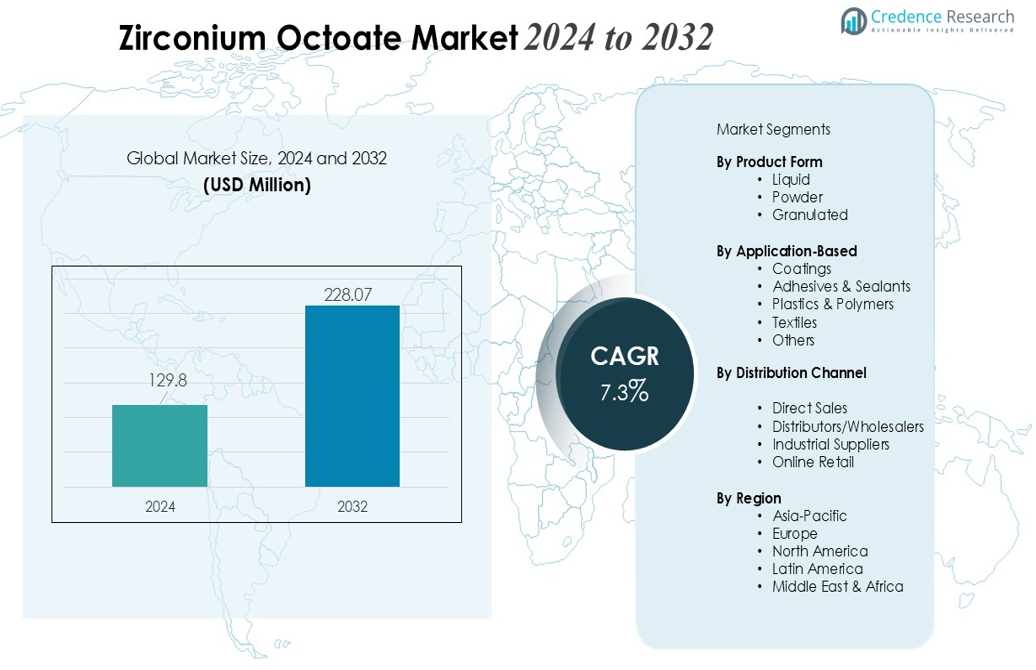
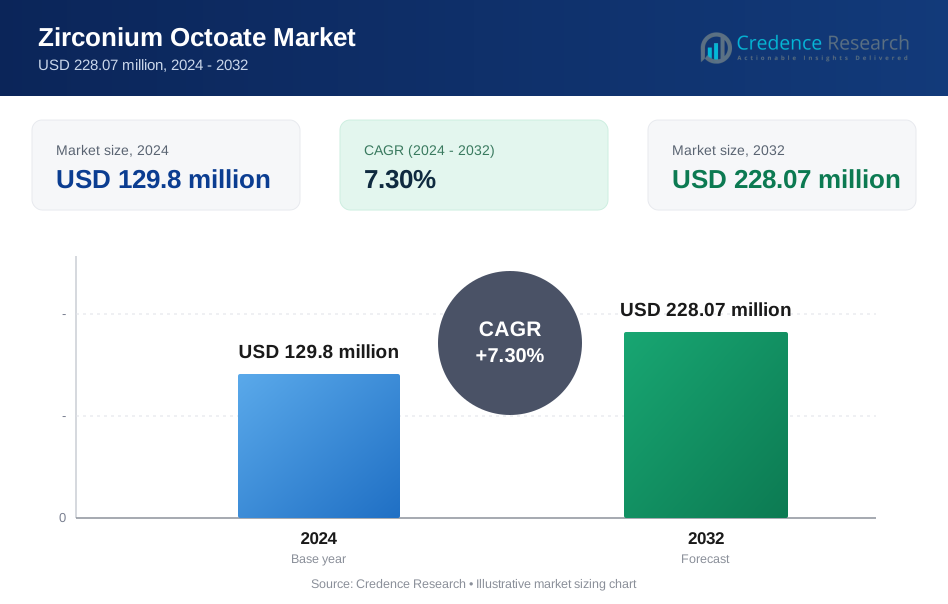
The Zirconium Octoate Market size was valued at USD 129.8 million in 2024 and is anticipated to reach USD 228.07 million by 2032, at a CAGR of 7.3% during the forecast period (2024-2032).
| REPORT ATTRIBUTE | DETAILS |
|---|---|
| Historical Period | 2020-2023 |
| Base Year | 2024 |
| Forecast Period | 2025-2032 |
| Zirconium Octoate Market Size 2024 | USD 129.8 million |
| Zirconium Octoate Market, CAGR | 7.3% |
| Zirconium Octoate Market Size 2032 | USD 228.07 million |
Market growth is primarily fueled by the strong demand for Zirconium Octoate as an efficient auxiliary drier in paints and coatings. It enhances drying performance, water resistance, and durability, making it essential for architectural, automotive, and industrial coatings. The rising focus on low-VOC and environmentally friendly coatings, coupled with increased infrastructure development, further propels the adoption of Zirconium Octoate.
Regionally, Asia-Pacific dominates the market due to rapid industrialization, increasing construction activities, and high demand from emerging economies such as China and India. North America and Europe represent mature markets with stable demand, driven by stringent environmental regulations and the need for sustainable coating solutions. Overall, the market benefits from a combination of strong demand in both emerging and developed regions, ensuring consistent growth and investment opportunities.
Market Insights:
- The Zirconium Octoate Market was valued at USD 129.8 million in 2024 and is projected to reach USD 228.07 million by 2032, driven by strong demand in paints and coatings.
- Growth is fueled by its role as an efficient auxiliary drier that enhances drying performance, water resistance, and durability across architectural, automotive, and industrial coatings.
- Rising demand for high-performance coatings in automotive and industrial sectors boosts adoption due to improved film hardness, gloss retention, and abrasion resistance.
- Regulatory pressure and preference for eco-friendly, low-VOC, and lead-free drier systems encourage formulators to adopt safer alternatives, enhancing worker safety and compliance with environmental standards.
- Rapid urbanization and infrastructure development, particularly in emerging economies, increase demand for architectural and protective coatings with reliable drying and weather resistance.
- Zirconium Octoate’s compatibility with a wide range of coating systems, including alkyd-based paints, varnishes, enamels, and primers, drives broader application across decorative, industrial, and protective segments.
- Challenges such as raw material price volatility and formulation complexity exist, but regional consumption remains strong, with Asia-Pacific leading at 46%, Europe contributing 28%, and North America, Latin America, and Middle East & Africa collectively accounting for 26%.
Market Drivers:
Rising Demand for High‑Performance Coatings in Automotive and Industrial Sectors
Growth in the automotive, industrial equipment, and heavy‑machinery sectors fuels demand for durable and high-performance coatings. Zirconium Octoate improves film hardness, gloss retention, abrasion resistance, and durability in protective, machinery, and automotive coatings. It ensures the coated surface withstands harsh conditions, including abrasion, moisture, and chemical exposure, while maintaining aesthetic appeal. Strong performance in demanding applications drives its adoption across industrial and automotive coatings.
- For Instance, Incorporating Zirconium Octoate into waterborne coatings as an auxiliary drier can improve film properties by functioning as a strong cross-linking agent.
Shift Toward Eco‑Friendly, Low‑VOC and Lead-Free Drier Systems
Regulatory pressure and market preference for environmentally friendly coatings encourage formulators to use safer alternatives. Zirconium Octoate reduces toxicity hazards compared to lead-based or cobalt-based driers and avoids issues such as yellowing in light-colored paints. It enhances worker safety in manufacturing environments and supports compliance with increasingly strict environmental standards.
- For instance, Chemelyne Specialities utilizes Zirconium Octoate solutions to eliminate lead toxicity risks in coatings production lines, substantially boosting workplace safety benchmarks.
Surge in Construction and Infrastructure Projects, Particularly in Emerging Economies
Rapid urbanization and large-scale infrastructure initiatives drive demand for architectural and protective coatings. Markets experiencing intense construction and renovation require coatings that dry reliably, resist weathering, and maintain appearance over time. Zirconium Octoate improves drying performance, film integrity, and weather resistance, making it a preferred additive in architectural and industrial paints for these projects.
Broad Application Versatility Across Multiple Coating Systems
Zirconium Octoate is compatible with a wide range of coating formulations, including alkyd-based paints, varnishes, enamels, primers, and protective coatings on metal. It works effectively as an auxiliary drier or in combination with primary driers to optimize drying profiles. It enhances through-drying, reduces film defects, and ensures stable gloss and color retention, increasing its adoption across decorative, industrial, and protective coatings.
Market Trends:
Growing Preference for Eco‑Friendly, Low‑VOC and Cobalt‑Free Formulations
The coatings industry shifts toward sustainability and regulatory compliance, prompting formulators to favor non‑toxic, low‑VOC solutions. Zirconium octoate emerges as a strong alternative to traditional cobalt- or lead-based driers, enabling safer and more compliant coatings. It supports waterborne and high‑solid coating systems that reduce hazardous emissions while maintaining performance. This trend expands zirconium octoate adoption, especially in regions with strict environmental standards such as North America and Europe.
- For Instance, Zirconium octoate is widely recognized in the coatings industry as an efficient auxiliary drier used in eco-friendly waterborne and solvent-borne formulations, typically in combination with a primary drier like cobalt or manganese.
Advances in Drier Chemistry and Broadening Application Spectrum
Manufacturers invest in improved metal carboxylate chemistry, optimizing zirconium octoate’s catalytic efficiency and resin compatibility. Enhanced formulations deliver faster drying, better through‑drying, stronger film hardness, and improved resistance to moisture and chemicals. These innovations increase its suitability across diverse segments — from architectural and industrial coatings to automotive, marine, wood, and maintenance paints. As coating requirements evolve toward durability, weather resistance, and uniform film quality, demand for zirconium octoate rises in parallel.
- For Instance, Patcham's product information, Patcham (FZC) offers zirconium octoate driers that are utilized as effective through driers in architectural and industrial coatings to enhance film hardness and support the drying process.
Market Challenges Analysis:
Raw Material Price Volatility and Supply‑Chain Constraints
The cost of producing zirconium octoate depends heavily on underlying chemicals such as zirconium compounds and associated organic acids. Fluctuations in global raw‑material prices and supply disruptions raise production costs and squeeze profit margins for manufacturers. Some regions face difficulties sourcing required feedstocks, which can lead to periodic shortages or supply delays. These constraints hinder stable supply and limit widespread adoption, especially in cost-sensitive markets.
Formulation Complexity and Performance Limitations Across Systems
The compound exhibits limited solubility and stability in certain solvent systems—particularly waterborne or polar formulations—making it less suitable for modern low‑VOC coatings in some cases. Formulators often need to blend zirconium octoate with secondary driers to achieve acceptable drying performance. Incorrect dosage or poor compatibility can lead to slower curing, film defects, or inconsistent coating quality. This technical complexity raises barrier for new entrants and increases development cost for manufacturers relying on zirconium octoate.
Market Opportunities:
Rising Demand in Low‑VOC and Lead‑Free Coating Systems Drives Adoption
Growing regulatory and consumer pressure on chemicals used in paints and coatings creates strong demand for non‑toxic, low‑VOC, lead‑free alternatives. Zirconium Octoate provides comparable performance to traditional heavy metal driers without the toxicity or yellowing risk — making it especially attractive for formulators targeting environmentally compliant architectural and industrial coatings. It enables water‑based and high‑solid coating systems that meet stringent emission standards. This regulatory-driven demand opens an expanding market window, particularly in regions tightening environmental norms.
Expansion into Specialized Coatings and Diverse End-Use Applications Creates New Segments
Developments in coating technology pave the way for Zirconium Octoate to penetrate beyond conventional decorative paints into specialty sectors — including industrial maintenance, marine coatings, protective coatings for metal structures, and automotive refinishing. It improves film hardness, moisture resistance, adhesion, and corrosion resistance, making it suitable for demanding environments. Growing infrastructure, marine, and automotive sectors in emerging economies present significant growth potential. Manufacturers that develop tailored zirconium‑based formulations can capture niche markets requiring high durability and performance.
Market Segmentation Analysis:
By Product Form
The market divides product forms of Zirconium Octoate into liquid, powder, and granulated forms. The liquid form commands the largest share owing to its ease of integration in coating and adhesive formulas and proven stability in solvent-based systems. Liquid Zirconium Octoate enables smooth dispersion and consistent catalytic performance, making it the preferred choice in paints, coatings, and sealants. Powder and granulated forms serve niche or specialized applications that require precise dosing, extended shelf life, or ease of transport and storage. Powder form finds favor in settings where formulators require controlled addition and flexibility over batch sizes; granulated form offers logistical advantages for bulk supply and industrial users.
- For Instance, Liquid Zirconium Octoate is commercially produced by various manufacturers with standard zirconium content variants, typically including 12% and 18%.
By Application‑Based Segmentation
Zirconium Octoate finds its primary application in coatings, adhesives and sealants, plastics and polymers, textiles, and miscellaneous uses. The coatings segment remains dominant, driven by strong demand for durable, water‑resistant paints and high‑performance industrial and automotive coatings. Adhesives and sealants segment offers growth potential where the compound enhances bond strength and longevity under exposure to moisture or chemicals. Plastics and polymer applications leverage its catalytic or stabilizing properties to improve final product resilience or performance. Textile and other niche applications provide additional, albeit smaller, pockets of demand, expanding the overall market reach.
- For example, some textile finishers using zirconium octoate enhanced fabric durability and moisture resistance, significantly improving product longevity and performance in rigorous use cases.
By Distribution Channel
The market channels include direct sales, distributors/wholesalers, industrial suppliers, and online retail. Direct sales link producers directly with large-scale industrial consumers—such as automotive manufacturers, major coating producers, and infrastructure contractors—ensuring consistent supply and tailored bulk contracts. Distributors and wholesalers help reach medium- and small-sized formulators and regional end‑users, broadening geographic coverage. Industrial suppliers support specialized or custom applications, offering technical support along with product delivery. Online retail emerges as a growing channel for smaller buyers or niche users who require smaller volumes or faster procurement cycles.
Segmentations:
- By Product Form
- Liquid
- Powder
- Granulated
- By Application-Based
- Coatings
- Adhesives & Sealants
- Plastics & Polymers
- Textiles
- Others
- By Distribution Channel
- Direct Sales
- Distributors/Wholesalers
- Industrial Suppliers
- Online Retail
- By Region
- North America
- U.S.
- Canada
- Mexico
- Europe
- Germany
- France
- U.K.
- Italy
- Spain
- Rest of Europe
- Asia Pacific
- China
- Japan
- India
- South Korea
- South-east Asia
- Rest of Asia Pacific
- Latin America
- Brazil
- Argentina
- Rest of Latin America
- Middle East & Africa
- GCC Countries
- South Africa
- Rest of the Middle East and Africa
- North America
Regional Analysis:
Asia‑Pacific Leads Global Consumption
Asia‑Pacific holds 46% of the global Zirconium Octoate Market and remains the largest regional consumer. Rapid industrialization in China and India drives strong demand in coatings, polymers, and construction-related segments. It supports extensive use in architectural paints, industrial coatings, and polymer formulations. Growth in automotive, infrastructure, and manufacturing sectors reinforces consumption. The region’s cost-effective manufacturing base and rising preference for low‑VOC coatings favor zirconium-based additives.
Europe Maintains Significant Demand
Europe contributes 28% of the global Zirconium Octoate Market, driven by stringent environmental regulations promoting low‑VOC and non-toxic coating solutions. Leading economies such as Germany and France push demand through advanced automotive coatings, industrial applications, and sustainable construction materials. It sustains stable growth despite higher production costs. High regulatory compliance and emphasis on durability and performance ensure consistent consumption across architectural and industrial segments.
North America, Latin America, and Middle East & Africa Show Steady Growth
North America accounts for 18% of the global market, led by demand in industrial coatings, infrastructure projects, and sustainable building initiatives. The United States drives regional consumption with large-scale infrastructure investments and the need for water-resistant, durable coatings. Latin America contributes 5%, with growth in automotive refinishing and construction coatings tempered by slower industrialization and limited regulation. Middle East & Africa holds 3% of the market, supported by emerging infrastructure and marine-industry developments, though overall scale remains smaller.
Key Player Analysis:
- Patcham (FZC)
- Ege Kimya
- Maldeep Catalysts
- Borchers (Milliken)
- Chemelyne Specialities
- DIC Corporation
- Casal de Rey & Cia
- Comar Chemicals
- Ambani Organics
- OPTICHEM
- Venator
- Bira Chemicals
Competitive Analysis:
The competitive landscape of the Zirconium Octoate Market features a combination of global leaders and regional players competing on production scale, innovation, and geographic reach. Major companies such as Patcham (FZC) and Borchers (Milliken) hold significant market positions through large-scale manufacturing, stringent quality control, and reliable global supply networks that serve coatings and industrial clients. Regional players like Ege Kimya and DIC Corporation focus on cost-effective and regulatory-compliant variants to capture demand in Asia-Pacific and emerging markets. Smaller manufacturers address local and niche requirements, offering flexibility and specialized solutions. The market remains fragmented, and all players prioritize product quality, regulatory compliance, and consistent supply to maintain competitiveness and expand their presence across key applications and regions.
Recent Developments:
- In September 2025, Patcham FZC announced Lintech International as its distribution partner for specialty additives across the Northeast, Southeast, and Southwest U.S., effective February 1, 2025.
Report Coverage:
The research report offers an in-depth analysis based on Product Form, Application-Based, Distribution Channel and Region. It details leading market players, providing an overview of their business, product offerings, investments, revenue streams, and key applications. Additionally, the report includes insights into the competitive environment, SWOT analysis, current market trends, as well as the primary drivers and constraints. Furthermore, it discusses various factors that have driven market expansion in recent years. The report also explores market dynamics, regulatory scenarios, and technological advancements that are shaping the industry. It assesses the impact of external factors and ITALY economic changes on market growth. Lastly, it provides strategic recommendations for new entrants and established companies to navigate the complexities of the market.
Future Outlook:
- Demand for Zirconium Octoate will continue to grow due to the rising need for durable and high-performance coatings in automotive, industrial, and construction sectors.
- Adoption of low-VOC and environmentally friendly coatings will drive increased use of zirconium-based driers.
- Expansion in infrastructure and urban development projects in emerging economies will create significant consumption opportunities.
- Formulators will increasingly rely on Zirconium Octoate to enhance drying efficiency, film hardness, and moisture resistance in coatings.
- Growth in specialized applications, including marine, wood, and protective coatings, will broaden its market presence.
- Technological innovations in drier chemistry will improve solubility, compatibility, and performance across diverse resin systems.
- Manufacturers will invest in regional production and distribution capabilities to meet localized demand efficiently.
- Regulatory compliance and sustainability trends will push companies to develop advanced zirconium-based formulations.
- Increasing demand for industrial adhesives, sealants, and polymer applications will provide additional growth avenues.
- Competitive pressures and innovation by key players will foster development of high-quality, performance-driven products, ensuring continued market expansion.
Request a Free Sample
Fill in your details and we'll send you a free sample report.
- Sample data tables & charts
- Research methodology
Need a Custom Version of This Report?
Tailor the scope, geography, or segments to your exact requirements.
- Custom geography or segment scope
- Direct access to our analyst team
Frequently Asked Questions
What is the current market size of the Zirconium Octoate Market, and what is its projected growth?
What is driving the growth of the Zirconium Octoate Market?
Which is the leading market for Zirconium Octoate?
What are the critical drivers for the growth of the Zirconium Octoate market?
Who are the key players in the Zirconium Octoate Market?
Table of Content
Chapter 1. Report Introduction
- 1.1 Report Description & Purpose
- 1.1.1 Report Title & Market Definition
- 1.1.2 Unique Selling Propositions (USP) & Key Differentiators
- 1.1.3 Value Proposition for Stakeholders
- 1.2 Research Objectives
- 1.2.1 Market Sizing Objectives (Volume & Revenue)
- 1.2.2 Segmentation Objectives
- 1.2.3 Competitive Intelligence Objectives
- 1.2.4 Forecast & Scenario Objectives
- 1.3 Report Scope
- 1.3.1 Zirconium Octoate Scope – Types & Subtypes Covered
- 1.3.2 Geographic Scope – Regions & Countries Covered
- 1.3.3 Historical Period, Base Year & Forecast Period (2024; forecast to 2032)
- 1.3.4 Inclusions & Exclusions
- 1.4 HS Code & Classification Framework
- 1.5 Currency, Units & Pricing Basis
- 1.6 Target Stakeholders
- 1.7 Limitations & Assumptions
Chapter 2. Executive Summary
- 2.1 Global Zirconium Octoate Market Snapshot
- 2.1.1 Market Size – Historical (2024) & Forecast (2024-2032) (2024: USD 129.8 million → 2032: USD 228.07 million)
- 2.1.2 Volume & Revenue – Global Totals
- 2.1.3 Key Market Highlights – Top Five Facts
- 2.2 Zirconium Octoate Market Segmentation Snapshot
- 2.2.1 Market Split by Region – 2024 vs. 2032
- 2.3 Competitive Snapshot
- 2.3.1 Top 10 Players by Revenue Share – 2024
- 2.3.2 Top 10 Players by Volume Share – 2024
- 2.3.3 Recent Strategic Developments (18-Month Summary)
- 2.4 Key Investment Highlights & Strategic Conclusions
Chapter 3. Zirconium Octoate Market Dynamics & Industry Analysis
- 3.1 Market Overview & Context
- 3.1.1 Zirconium Octoate Market Position in the Broader Automotive Value Chain
- 3.1.2 OEM vs. Replacement Market Dynamics
- 3.1.3 Market Maturity & Development Stage by Region
- 3.2 Zirconium Octoate Market Drivers
- 3.3 Zirconium Octoate Market Restraints & Challenges
- 3.4 Zirconium Octoate Market Opportunities
- 3.5 Porter's Five Forces Analysis
- 3.5.1 Threat of New Entrants
- 3.5.2 Bargaining Power of Suppliers
- 3.5.3 Bargaining Power of Buyers
- 3.5.4 Threat of Substitutes
- 3.5.5 Competitive Rivalry – Intensity Assessment
- 3.6 Zirconium Octoate Value Chain Analysis
- 3.6.1 Upstream – Raw Material/Input Suppliers
- 3.6.1.1 Raw Material/Input 1
- 3.6.1.2 Raw Material/Input 2
- 3.6.1.3 Raw Material/Input 3
- 3.6.2 Midstream – Production/Manufacturing/Service Delivery
- 3.6.2.1 Production/Process Overview
- 3.6.2.2 Key Facility Locations & Capacity by Manufacturer
- 3.6.3 Downstream – Distribution & End Consumer
- 3.6.3.1 Primary Channel – B2B/OEM
- 3.6.3.2 Secondary Channels – Dealer, Retail, Online, Direct
- 3.6.4 Value Chain Profitability Analysis
- 3.6.1 Upstream – Raw Material/Input Suppliers
- 3.7 PESTEL Analysis
- 3.7.1 Political Factors
- 3.7.2 Economic Factors
- 3.7.3 Social Factors
- 3.7.4 Technological Factors
- 3.7.5 Environmental Factors
- 3.7.6 Legal Factors
- 3.8 Zirconium Octoate Supply Chain Analysis
- 3.8.1 Raw Material/Input Supply Risk Assessment
- 3.8.2 Manufacturing Concentration Risk (Geographic Exposure)
- 3.8.3 Trade Disruption Impact Analysis
- 3.9 Regulatory & Policy Landscape
Note: The regulatory and policy landscape section covers regulations based on their applicability to the market, Zirconium Octoate category, geography, and scope of the study. Only regulatory frameworks with a material impact on operations, compliance, trade, sustainability, or market access are analyzed in detail.
Chapter 4. Key Investment Pockets & Opportunity Analysis
- 4.1 Zirconium Octoate Market Attractiveness Analysis
- 4.1.1 By Region – Investment Attractiveness Matrix (Volume × CAGR)
- 4.2 Absolute Revenue Growth Opportunity
- 4.2.1 By Region – Absolute USD Growth Through 2032
- 4.3 Incremental Volume Opportunity
- 4.3.1 By Region – Incremental Volume Through 2032
- 4.3.2 Segment – Incremental Volume
- 4.4 Emerging Submarket Opportunity Deep Dive (Subject to Applicability)
- 4.5 Emerging Market Opportunity Scorecards
- 4.5.1 United States
- 4.5.2 Europe
- 4.5.3 Asia
- 4.5.4 Middle East & Africa
Note: Emerging Market Opportunity Scorecards will be included based on relevance and strategic importance. Regions listed are indicative and may vary depending on data availability and market dynamics.
Chapter 5. Zirconium Octoate Import-Export Analysis & Trade Flows
- 5.1 Global Trade Overview
- 5.1.1 Global Export Value by Country (2024)
- 5.1.2 Global Export Volume by Country (2024)
- 5.1.3 Global Import Value by Country (2024)
- 5.1.4 Global Import Volume by Country (2024)
- 5.1.5 Net Trade Balance by Country (2024)
- 5.2 Export Analysis – Segment
- 5.2.1 Type 1 (HS Code)
- 5.2.2 Type 2 (HS Code)
- 5.2.3 Type 3 (HS Code)
- 5.2.4 Type 4 (HS Code)
- 5.2.5 Type 5 (HS Code)
- 5.3 Import Analysis – Segment
- 5.3.1 Type 1 (HS Code)
- 5.3.2 Type 2 (HS Code)
- 5.3.3 Type 3 (HS Code)
- 5.3.4 Type 4 (HS Code)
- 5.3.5 Type 5 (HS Code)
- 5.4 Average Unit Trade Prices
- 5.4.1 Average Export Price – Segment & Country
- 5.4.2 Average Import Price – Segment & Source Country
- 5.4.3 Price Trends (2024)
- 5.5 Key Trade Route Analysis
- 5.5.1 Trade Route 1
- 5.5.2 Trade Route 2
- 5.5.3 Trade Route 3
- 5.5.4 Trade Route 4
- 5.5.5 Trade Route 5
- 5.6 Trade Policy Impact Assessment
- 5.6.1 US Anti-Dumping & Section 301 Tariffs
- 5.6.2 EU Customs Union Impact
- 5.6.3 Major Free Trade Agreements
- 5.6.4 USMCA Rules of Origin
Note: Trade policy analysis will be included only where relevant to the Zirconium Octoate market.
Chapter 6. Competitive Landscape & Company Benchmarking
- 6.1 Zirconium Octoate Market Concentration & Structure
- 6.1.1 Herfindahl-Hirschman Index (HHI) – vs. 2024
- 6.1.2 Tier 1, Tier 2 & Tier 3 Market Structure
- 6.1.3 Global, Regional & Local Player Dynamics
- 6.2 Zirconium Octoate Market Share Analysis – 2024
- 6.2.1 Global Revenue Share by Company
- 6.2.2 Global Volume Share by Company
- 6.2.3 Regional Revenue Share
- 6.2.4 Market Share Evolution ( vs. 2024)
- 6.2.5 OEM Segment Share by Company
- 6.2.6 Replacement Segment Share by Company
- 6.3 Production/Delivery Capacity & Facility Analysis
- 6.3.1 Global Installed Capacity
- 6.3.2 Capacity Utilization Rates
- 6.3.3 Production/Output Volume
- 6.3.4 Facility Locations & Capacity Map
- 6.3.5 Planned Capacity Additions
- 6.4 Zirconium Octoate Competitive Benchmarking Matrix
- 6.4.1 Revenue, Volume, CAGR & Profitability Comparison
- 6.4.2 Channel Revenue Mix
- 6.4.3 Geographic Revenue Exposure
- 6.4.4 R&D Intensity
- 6.4.5 Sustainability Maturity
- 6.5 Strategic Developments in Zirconium Octoate (Last 24 Months)
- 6.5.1 Mergers, Acquisitions & Divestments
- 6.5.2 New Zirconium Octoate Launches
- 6.5.3 Facility Expansions
- 6.5.4 Strategic Alliances, Joint Ventures & Partnerships
- 6.5.5 Distribution Expansion & Market Entry
- 6.5.6 Sustainability & ESG Initiatives
- 6.6 Competitive Strategy Mapping
- 6.6.1 Leader, Challenger, Follower & Niche Classification
- 6.6.2 Pricing Strategy Comparison
- 6.6.3 Channel Strategy Matrix
Note: Strategic developments are included based on their materiality and the availability of reliable information.
Chapter 7. Global Zirconium Octoate Market – By Distribution Channel
- 7.1 Segment Overview
- 7.1.1 Volume & Revenue Split by Channel (2024 & 2032)
- 7.1.2 Channel Mix Evolution (2024-2032)
Chapter 8. Regional Market Analysis – Global Overview
- 8.1 Global Regional Overview
- 8.1.1 Regional Volume Share
- 8.1.2 Regional Revenue Share
- 8.1.3 Regional Volume by Region
- 8.1.4 Regional Revenue by Region
- 8.1.5 Regional Forecast Through 2032
- 8.2 Cross-Regional Segment Analysis
- 8.2.1 By Distribution Channel
- 8.2.2 By Brand/Price Tier
Chapter 9. North America Zirconium Octoate Market
- 9.1 United States
- 9.2 Canada
- 9.3 Mexico
Chapter 10. Europe Zirconium Octoate Market
- 10.1 Germany
- 10.2 France
- 10.3 Italy
- 10.4 United Kingdom
- 10.5 Spain
- 10.6 Poland
- 10.7 Russia
- 10.8 Netherlands
- 10.9 Belgium
- 10.10 Sweden
- 10.11 Denmark
- 10.12 Norway
- 10.13 Rest of Europe
Chapter 11. Asia Pacific Zirconium Octoate Market
- 11.1 China
- 11.2 India
- 11.3 Japan
- 11.4 South Korea
- 11.5 Thailand
- 11.6 Indonesia
- 11.7 Vietnam
- 11.8 Malaysia
- 11.9 Australia
- 11.10 Rest of Asia Pacific
Chapter 12. Latin America Zirconium Octoate Market
- 12.1 Brazil
- 12.2 Argentina
- 12.3 Colombia
- 12.4 Chile
- 12.5 Rest of Latin America
Chapter 13. Middle East Zirconium Octoate Market
- 13.1 Saudi Arabia
- 13.2 United Arab Emirates
- 13.3 Turkey
- 13.4 Israel
- 13.5 Iran
- 13.6 Rest of the Middle East
Chapter 14. Africa Zirconium Octoate Market
- 14.1 South Africa
- 14.2 Egypt
- 14.3 Nigeria
- 14.4 Morocco
- 14.5 Rest of Africa
Chapter 15. Zirconium Octoate Company Profiles
- 15.1 [Company 01]
- 15.1.1 Company Overview
- 15.1.2 Key Management Personnel
- 15.1.3 Products & Services Portfolio
- 15.1.4 Financial Performance
- 15.1.5 Key Market Focus & Geographic Presence
- 15.1.6 Recent Developments & Strategic Initiatives
Note: The company profile list is preliminary and may change based on research findings, market developments, data availability, and client requirements.
Chapter 16. Appendices
- Appendix A – List of Abbreviations & Acronyms
- Appendix B – Industry Classification Code Reference – Full Series
- Appendix C – Production & Capacity Data Tables
- Appendix D – End-Use & Demand Base Tables
- Appendix E – Consumption & Replacement Rate Assumptions
- Appendix F – ASP Reference Tables
- Appendix G – Manufacturing & Facility Database
- Appendix H – Import-Export Data Tables
- Appendix I – Regulatory Summary Tables
- Appendix J – Primary Research Participant List (Anonymized)
- Appendix K – Primary Research Questionnaire Framework
- Appendix L – Data Sources & Bibliography
- Appendix M – Market Size Divergence & Source Comparison
Chapter 17. Research Methodology
- 17.1 Research Framework & Philosophy
- 17.2 Secondary Research – Sources, Hierarchy & Data Extraction
- 17.3 Data Modeling – Bottom-Up & Top-Down Market Sizing
- 17.4 Primary Research – Stakeholder Framework, LOI & Sample Sizes
- 17.5 Forecast Methodology – Regression, Scenario & Sensitivity Analysis
- 17.6 Quality Control – Four-Layer Validation Framework
- 17.7 Limitations & Standard Assumptions
- 17.8 Disclaimer
