| REPORT ATTRIBUTE |
DETAILS |
| Historical Period |
2020-2023 |
| Base Year |
2024 |
| Forecast Period |
2025-2032 |
| Isophorone Market Size 2024 |
USD 1,122.97 Million |
| Isophorone Market, CAGR |
6.44% |
| Isophorone Market Size 2032 |
USD 1,839.67 Million |
Market Overview
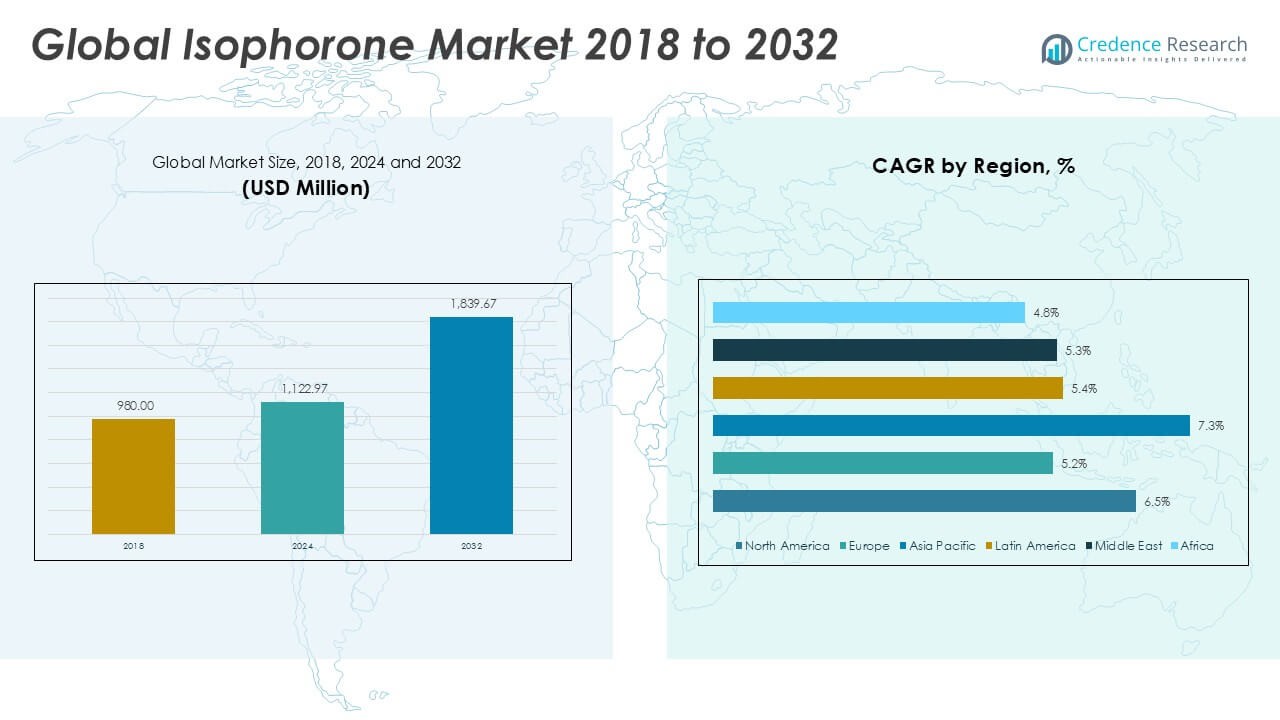
The Global Isophorone Market is projected to grow from USD 1,122.97 million in 2024 to an estimated USD 1,839.67 million by 2032, with a compound annual growth rate (CAGR) of 6.44% from 2025 to 2032.
The isophorone market is primarily driven by the growing construction and automotive industries, where it is widely used in paints, coatings, and sealants. Rising demand for high-performance coatings with enhanced resistance to chemicals and abrasion fuels the market growth. Additionally, increasing environmental awareness has led to a shift towards eco-friendly and bio-based products, creating opportunities for bio-based isophorone. Technological advancements and the introduction of innovative production processes are also influencing market trends, enhancing product efficiency and sustainability.
Geographically, the Asia Pacific region dominates the global isophorone market, driven by rapid industrialization, infrastructure development, and the growing automotive sector in countries like China and India. North America and Europe follow, supported by strong demand in construction, paints, and coatings industries. Key players operating in the global isophorone market include Evonik Industries AG, BASF SE, Arkema Group, Dow Chemical Company, and Mitsui Chemicals, Inc., who are actively focusing on capacity expansions, strategic partnerships, and the development of bio-based alternatives to strengthen their market position.
Access crucial information at unmatched prices!
Request your sample report today & start making informed decisions powered by Credence Research Inc.!
Download Sample
Market Insights
- The Global Isophorone Market is projected to grow from USD 1,122.97 million in 2024 to USD 1,839.67 million by 2032, at a CAGR of 6.44%.
- Rising demand in construction and automotive sectors drives market growth due to isophorone’s superior chemical resistance and durability.
- Increasing environmental regulations and health concerns related to chemical exposure restrain market expansion.
- The shift toward bio-based and eco-friendly isophorone products creates new growth opportunities.
- Asia Pacific dominates the market, driven by rapid industrialization and infrastructure development in China and India.
- North America holds the largest regional market share, supported by established industries and high consumption in paints and coatings.
- Europe focuses on sustainable product development under stringent environmental norms, supporting steady market growth.
Market Drivers
Rising Demand from the Construction and Automotive Industries
The Global Isophorone Market is strongly supported by the increasing use of isophorone in the construction and automotive sectors. It is widely applied in high-performance coatings, adhesives, and sealants that improve durability and chemical resistance. Growing urbanization and infrastructure projects have raised the need for protective coatings in residential and commercial buildings. The automotive industry favors isophorone-based coatings for their superior abrasion resistance and longevity. Expanding vehicle production, especially in Asia Pacific, continues to drive demand. The market benefits from the rising focus on maintaining structural integrity and surface protection in both industries.
- For instance, according to the International Organization of Motor Vehicle Manufacturers (OICA), over 26,000,000 vehicles were produced in China alone in 2023, driving significant demand for isophorone-based coatings and adhesives used in automotive manufacturing.
Expanding Applications in Chemical Intermediates and Polymers
The Global Isophorone Market is gaining momentum from its extensive use as a chemical intermediate in the production of isophorone diisocyanate and other specialty chemicals. It supports the manufacturing of polymers, which are essential in paints, coatings, and plastics. The versatility of isophorone enables it to meet diverse industry needs ranging from agriculture to textiles. Industries seek isophorone for its effectiveness in enhancing product stability and performance. Increased polymer consumption across packaging, automotive, and construction sectors is providing sustained market support. The rising application of isophorone in specialty resins and elastomers further strengthens its market presence.
- For instance, Evonik Industries reported that in 2023, its isophorone-based intermediates were supplied to more than 1,200 polymer manufacturing facilities worldwide, reflecting the broad industrial adoption of isophorone in specialty chemical and plastics production.
Growing Shift Toward Bio-based and Sustainable Solutions
The Global Isophorone Market is experiencing strong demand due to the increasing shift towards bio-based and environmentally friendly products. It is witnessing steady investment in sustainable manufacturing processes and green technologies. Companies are prioritizing the development of bio-based isophorone to align with tightening environmental regulations. Consumer preference for low-VOC (volatile organic compound) coatings is encouraging producers to offer greener alternatives. Regulatory bodies in Europe and North America are promoting sustainable raw materials, which is boosting bio-based isophorone adoption. This shift is setting a long-term direction for innovation and capacity expansion.
Technological Advancements and Process Improvements
The Global Isophorone Market benefits from continuous advancements in production technologies and process optimization. It is becoming more efficient through the adoption of energy-saving and cost-effective manufacturing methods. Innovations in catalytic processes and purification techniques are improving product quality and yield. Key manufacturers are focusing on enhancing operational efficiency to reduce waste and lower emissions. The introduction of advanced technologies enables producers to meet rising quality and sustainability standards. These improvements are supporting the market’s ability to serve high-performance and environmentally conscious applications.
Market Trends
Increasing Adoption of Bio-based Isophorone in Industrial Applications
The Global Isophorone Market is witnessing a steady rise in the adoption of bio-based isophorone across multiple industries. It is gaining traction as companies focus on reducing their environmental footprint and meeting stricter regulatory requirements. Bio-based isophorone offers a sustainable alternative to petroleum-based products, supporting the global push towards greener solutions. The shift toward bio-based materials is creating new growth opportunities for manufacturers. Consumer awareness regarding eco-friendly coatings and adhesives is contributing to this trend. The demand for bio-based isophorone is expected to grow steadily in paints, coatings, and polymer applications.
- For instance, Arkema reported in 2023 that its bio-based isophorone production capacity reached 15,000 metric tons per year, supplying major clients in the coatings, adhesives, and plastics industries seeking sustainable raw materials.
Expansion of High-Performance Coating Solutions
The Global Isophorone Market is expanding its footprint through the growing preference for high-performance coatings in construction, automotive, and marine sectors. It is playing a critical role in the production of coatings that offer superior chemical resistance, durability, and surface protection. Industries are adopting isophorone-based coatings to improve the lifespan of assets and reduce maintenance costs. High-performance coatings are in demand for their ability to withstand harsh environmental conditions and mechanical stress. This trend is reinforcing the need for advanced chemical intermediates like isophorone. Manufacturers are focusing on developing coatings that balance environmental safety and high performance.
- For instance, according to the European Council of the Paint, Printing Ink and Artists’ Colours Industry (CEPE), more than 2,300,000 metric tons of high-performance coatings containing isophorone derivatives were used in Europe’s construction and automotive sectors in 2023, highlighting the scale of adoption for advanced protective solutions.
Strong Focus on Capacity Expansion by Key Players
The Global Isophorone Market is experiencing strong investment from key players to expand their production capacities and geographical reach. It is seeing significant developments in new plant constructions and facility upgrades. Major companies are increasing output to meet the rising global demand and to address regional supply gaps. Firms are building partnerships and strengthening distribution networks to ensure reliable product availability. The competitive landscape is evolving with companies focusing on securing long-term supply contracts. These strategic moves are supporting market growth and improving supply chain stability.
Advancements in Sustainable Production Technologies
The Global Isophorone Market is progressing through the integration of advanced and sustainable production technologies. It is becoming more efficient with the development of energy-saving processes and improved catalyst systems. Industry leaders are implementing cleaner production methods to comply with environmental regulations and reduce operational costs. Improved purification techniques are enhancing product quality and minimizing by-products. Manufacturers are aligning their operations with global sustainability targets to maintain competitiveness. These technological advancements are shaping the market’s future direction and supporting the transition towards more responsible chemical manufacturing.
Market Challenges
Stringent Environmental Regulations and Health Concerns Restrain Market Growth
The Global Isophorone Market faces significant challenges from strict environmental regulations and health-related concerns. It is under pressure due to the potential toxicity and volatility of isophorone, which raise safety issues for workers and end-users. Regulatory agencies in Europe and North America are tightening controls on chemical emissions and solvent usage, impacting production practices. Companies must invest in advanced safety measures and comply with complex environmental standards, increasing operational costs. The market is also limited by growing consumer preference for safer, low-emission alternatives. These regulatory and health concerns continue to restrict the market’s growth potential in sensitive regions.
- For instance, the U.S. Agency for Toxic Substances and Disease Registry (ATSDR) lists isophorone as a hazardous substance and includes it in toxicological profiles due to its potential to cause skin and eye irritation and respiratory issues, prompting stricter occupational health and safety regulations and higher compliance costs for manufacturers
Fluctuating Raw Material Prices and Supply Chain Disruptions Impact Profitability
The Global Isophorone Market is challenged by volatile raw material prices and unpredictable supply chain dynamics. It depends heavily on petrochemical derivatives, making it vulnerable to fluctuations in crude oil prices. Frequent shifts in raw material costs strain manufacturers’ profit margins and create pricing uncertainties for buyers. Disruptions in the global supply chain, driven by geopolitical tensions and transportation bottlenecks, further complicate timely product availability. Companies need to manage inventory carefully and build strong supplier relationships to mitigate these risks. These supply-side challenges continue to impact the market’s operational stability and profitability.
Market Opportunities
Growing Demand for Bio-based Isophorone Creates New Market Space
The Global Isophorone Market is well-positioned to benefit from the rising demand for bio-based and environmentally friendly alternatives. It offers opportunities for manufacturers to develop sustainable products that meet strict environmental standards. Industries are shifting toward green chemicals, creating a strong need for bio-based isophorone in coatings, adhesives, and polymers. Companies investing in bio-based production methods can capture growing market share and build long-term customer loyalty. Consumer preference for low-VOC and non-toxic products supports this shift toward safer materials. This transition creates space for innovation and product diversification across multiple end-use industries.
Expanding Applications in Emerging Economies Support Market Growth
The Global Isophorone Market has significant growth potential in emerging economies where rapid industrialization and infrastructure development continue to expand. It can gain market share in countries like China, India, Brazil, and Indonesia, where demand for high-performance coatings and adhesives is rising. Growing automotive, construction, and manufacturing activities in these regions provide opportunities for large-scale product adoption. Companies entering these markets can benefit from rising local consumption and increasing production capacities. Local governments are supporting industrial growth, which enhances market accessibility. Expanding distribution networks in these regions can further strengthen market penetration and revenue potential.
Market Segmentation Analysis
By Application
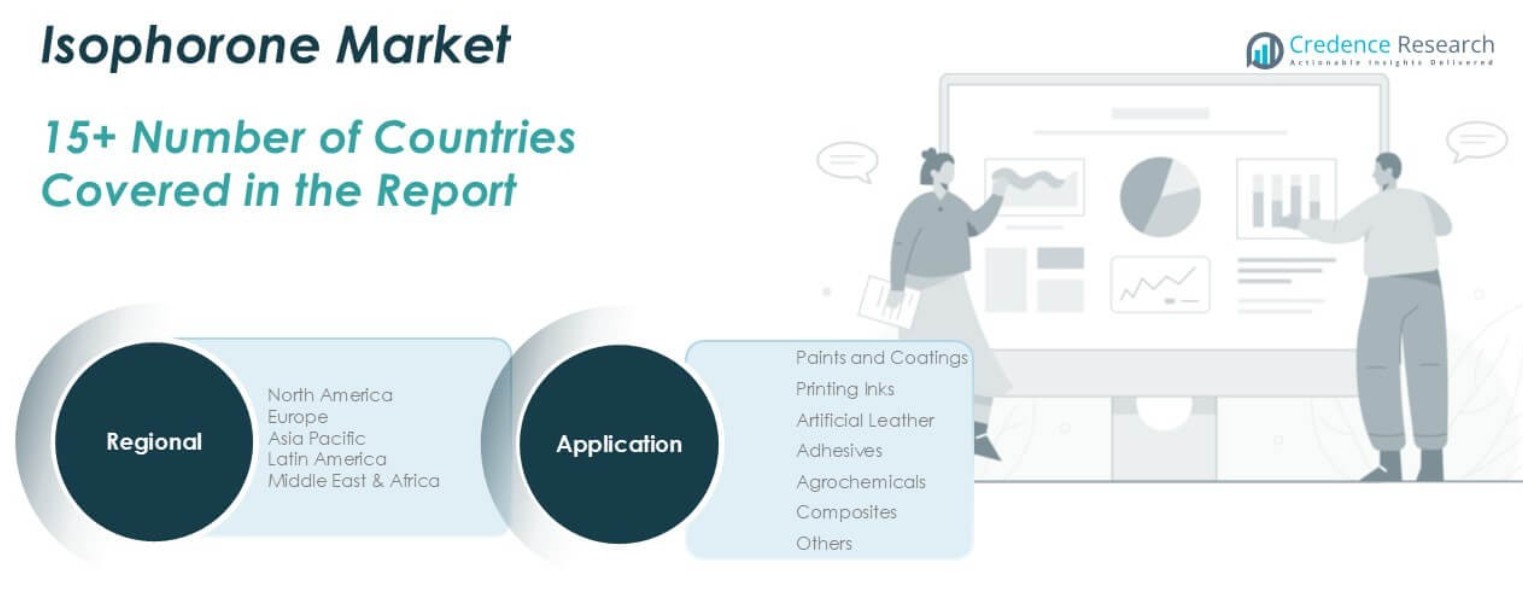
The Global Isophorone Market is segmented by application into paints and coatings, printing inks, artificial leather, adhesives, agrochemicals, composites, and others. Paints and coatings hold the largest revenue share due to their extensive use in construction, automotive, and industrial sectors where isophorone enhances chemical resistance and durability. It is widely applied in printing inks to improve drying speed and surface quality, supporting the growing packaging industry. The artificial leather segment is expanding with increasing demand from furniture, footwear, and automotive upholstery. Adhesives represent another key segment where isophorone improves bonding strength and flexibility across multiple materials. Agrochemicals are using isophorone as an effective solvent, particularly in herbicide formulations. Composites benefit from isophorone’s role in enhancing structural performance and processing efficiency. Other niche applications continue to emerge, driving further diversification within the market. The diverse use of isophorone across these segments supports steady growth and broadens the market’s commercial reach.
- For instance, according to the European Chemicals Agency (ECHA), more than 18,000 metric tons of isophorone were used in the European paints and coatings industry alone in 2023, with additional consumption reported in adhesives, inks, and artificial leather manufacturing.
Segments
Based on Application
- Paints and Coatings
- Printing Inks
- Artificial Leather
- Adhesives
- Agrochemicals
- Composites
- Others
Based on Region
- North America
- Europe
- UK
- France
- Germany
- Italy
- Spain
- Russia
- Belgium
- Netherlands
- Austria
- Sweden
- Poland
- Denmark
- Switzerland
- Rest of Europe
- Asia Pacific
- China
- Japan
- South Korea
- India
- Australia
- Thailand
- Indonesia
- Vietnam
- Malaysia
- Philippines
- Taiwan
- Rest of Asia Pacific
- Latin America
- Brazil
- Argentina
- Peru
- Chile
- Colombia
- Rest of Latin America
- Middle East
- UAE
- KSA
- Israel
- Turkey
- Iran
- Rest of Middle East
- Africa
- Egypt
- Nigeria
- Algeria
- Morocco
- Rest of Africa
Regional Analysis
North America Isophorone Market
The North America Isophorone Market is projected to grow from USD 416.87 million in 2024 to USD 686.30 million by 2032, with a CAGR of 6.5% during the forecast period. It holds the largest regional market share at approximately 37.1% in 2024. Strong demand from the construction and automotive industries continues to drive the need for high-performance coatings, adhesives, and sealants. The region benefits from established industrial infrastructure and advanced manufacturing capabilities. The United States leads the North America Isophorone Market due to its high consumption in paints, coatings, and printing inks. Steady growth in building renovation and vehicle production further supports the market’s expansion.
Europe Isophorone Market
The Europe Isophorone Market is expected to grow from USD 206.37 million in 2024 to USD 308.65 million by 2032, registering a CAGR of 5.2%. It holds a regional market share of approximately 18.4% in 2024. It is driven by the region’s focus on sustainable and bio-based chemical production. Germany, France, and Italy remain key consumers of isophorone in coatings, artificial leather, and adhesives. Strong regulatory support for green technologies is encouraging the shift toward bio-based isophorone solutions. The automotive and packaging industries continue to create solid demand across European countries.
Asia Pacific Isophorone Market
The Asia Pacific Isophorone Market is projected to grow from USD 377.14 million in 2024 to USD 662.13 million by 2032, recording the fastest CAGR of 7.3%. It holds a significant regional market share of approximately 33.3% in 2024. China, India, and Japan are driving the region’s growth with high demand in construction, automotive, and agrochemical sectors. Expanding manufacturing bases and infrastructure development are key market drivers. It benefits from cost-effective production, large consumer bases, and favorable investment climates. The rapid industrialization in Asia Pacific continues to provide strong growth opportunities for manufacturers.
Latin America Isophorone Market
The Latin America Isophorone Market is estimated to increase from USD 56.59 million in 2024 to USD 85.31 million by 2032, growing at a CAGR of 5.4%. It holds a smaller but stable regional market share of approximately 5.0% in 2024. Brazil and Mexico are the leading contributors, supported by growing construction and automotive sectors. Demand for isophorone in adhesives and printing inks is strengthening in this region. The market benefits from expanding local manufacturing and rising investments in infrastructure projects. Increasing application of isophorone in artificial leather production is also supporting market growth.
Middle East Isophorone Market
The Middle East Isophorone Market is forecasted to grow from USD 38.85 million in 2024 to USD 58.12 million by 2032, with a CAGR of 5.3%. It holds a regional market share of approximately 3.4% in 2024. Demand in the Middle East is supported by ongoing construction projects and the need for high-performance coatings in extreme climates. Countries like the UAE and Saudi Arabia are leading market growth with large-scale infrastructure developments. Printing inks and adhesives also contribute to the market’s stability in the region. The Middle East Isophorone Market remains focused on meeting growing domestic industrial requirements.
Africa Isophorone Market
The Africa Isophorone Market is expected to grow from USD 27.15 million in 2024 to USD 39.17 million by 2032, registering a CAGR of 4.8%. It holds the smallest regional market share at approximately 2.4% in 2024. Growth in the region is driven by gradual expansion in the construction and manufacturing sectors. South Africa leads in demand, supported by rising infrastructure investments. The market is also finding applications in adhesives and agrochemicals, addressing local industrial needs. Limited production facilities and supply chain constraints continue to restrict faster growth in the African Isophorone Market.
Key players
- Arkema Group
- CHAIN FONG
- Evonik Industries
- Jiangsu Huanxin High Tech Materials Co. Ltd
- Prasol Chemicals Pvt Ltd
- SI Group Inc.
- BASF SE
- Covestro AG
- Krasiklal
- DHALOP CHEMICALS
- Indian Organic Corporation
Competitive Analysis
The Global Isophorone Market is highly competitive with the presence of key multinational and regional players focusing on capacity expansion, innovation, and bio-based solutions. It is driven by companies like Arkema Group, Evonik Industries, and BASF SE that dominate with strong product portfolios, technological advancements, and global reach. CHAIN FONG, Jiangsu Huanxin High Tech Materials Co. Ltd, and Prasol Chemicals Pvt Ltd strengthen their positions by targeting regional demand and offering tailored solutions. SI Group Inc. and Covestro AG continue to invest in sustainable production and product differentiation. Local players such as Krasiklal, DHALOP CHEMICALS, and Indian Organic Corporation contribute to price competitiveness and flexible supply chains. Companies in the Global Isophorone Market focus on strategic partnerships, acquisitions, and research to address growing demand and environmental regulations while building market resilience.
Recent Developments
- In 2023, Evonik launched a series of isophorone-based products, branded as VESTASOL IP eCO, VESTAMIN IPD eCO, and VESTANAT IPDI eCO, which are made using 100% renewable acetone. These products are designed to have a significantly lower carbon footprint compared to their fossil-based counterparts, across all stages of the isophorone production chain. This initiative is part of Evonik’s broader strategy to reduce its reliance on fossil-based raw materials and promote more sustainable chemical production.
Market Concentration and Characteristics
The Global Isophorone Market is moderately concentrated with a mix of large international companies and regional players competing across key markets. It is characterized by steady technological advancement, strong demand from end-use industries, and growing interest in bio-based alternatives. The market shows high entry barriers due to strict environmental regulations and significant capital investment requirements. Leading companies focus on product quality, sustainability, and supply chain efficiency to maintain competitive positions. It continues to evolve with rising customer preference for low-VOC and eco-friendly solutions. The Global Isophorone Market emphasizes long-term partnerships, diversified product portfolios, and capacity expansions to meet global demand and regulatory expectations.
Shape Your Report to Specific Countries or Regions & Enjoy 30% Off!
Report Coverage
The research report offers an in-depth analysis based on Application and Region. It details leading market players, providing an overview of their business, product offerings, investments, revenue streams, and key applications. Additionally, the report includes insights into the competitive environment, SWOT analysis, current market trends, as well as the primary drivers and constraints. Furthermore, it discusses various factors that have driven market expansion in recent years. The report also explores market dynamics, regulatory scenarios, and technological advancements that are shaping the industry. It assesses the impact of external factors and global economic changes on market growth. Lastly, it provides strategic recommendations for new entrants and established companies to navigate the complexities of the market.
Future Outlook
- The Global Isophorone Market will experience consistent growth driven by rising demand in paints, coatings, and adhesives sectors across developing and developed regions.
- Expansion in bio-based isophorone production will gain momentum, meeting increasing regulatory pressure and consumer demand for sustainable products.
- Asia Pacific will remain the fastest-growing market due to rapid industrialization, urbanization, and infrastructure development in countries like China and India.
- Technological advancements in manufacturing processes will improve product quality, reduce production costs, and lower environmental impact.
- Growing automotive and construction industries worldwide will continue to fuel demand for high-performance coatings containing isophorone.
- Manufacturers will invest more in research and development to innovate low-VOC and environmentally friendly isophorone derivatives.
- The market will face ongoing challenges from fluctuating raw material prices and supply chain disruptions, encouraging diversification of supply sources.
- Strategic collaborations, mergers, and acquisitions among key players will strengthen market positions and facilitate global expansion.
- Emerging economies in Latin America and Africa will present new opportunities due to increasing infrastructure investments and industrial growth.
- Regulatory frameworks will tighten further, pushing companies to adopt cleaner technologies and sustainable raw materials to maintain market compliance.



