
Market Overview:
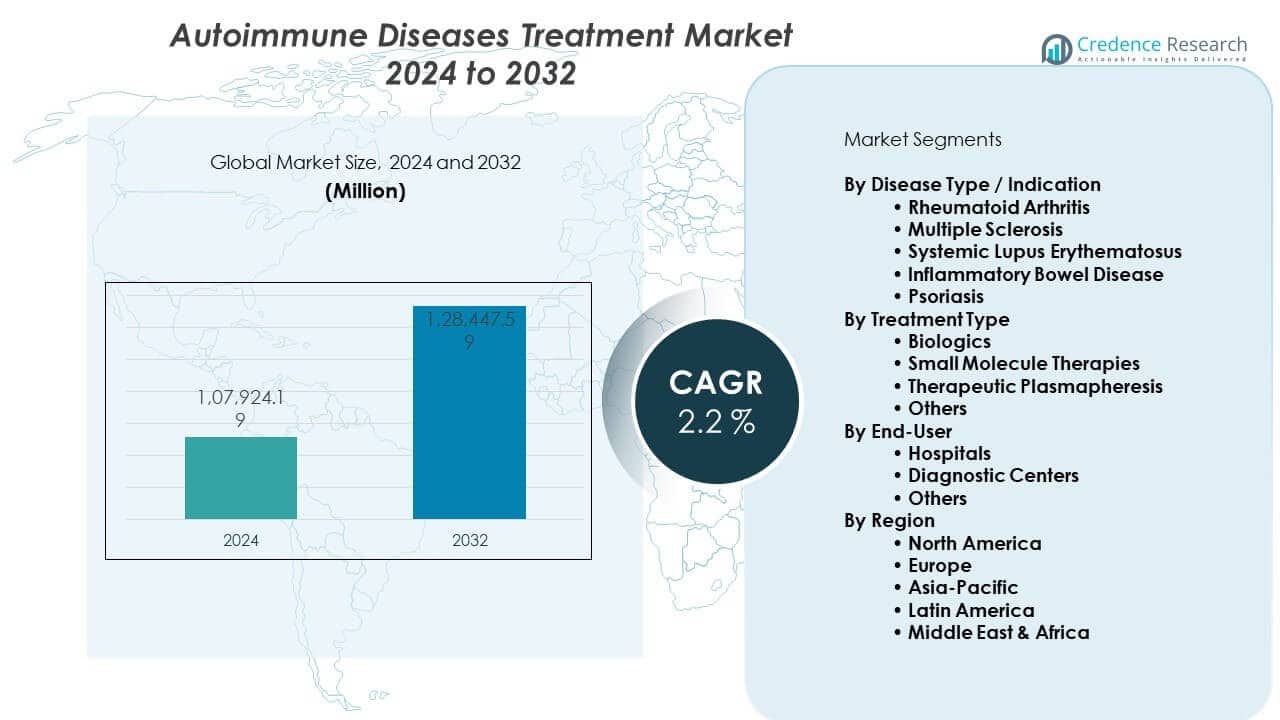
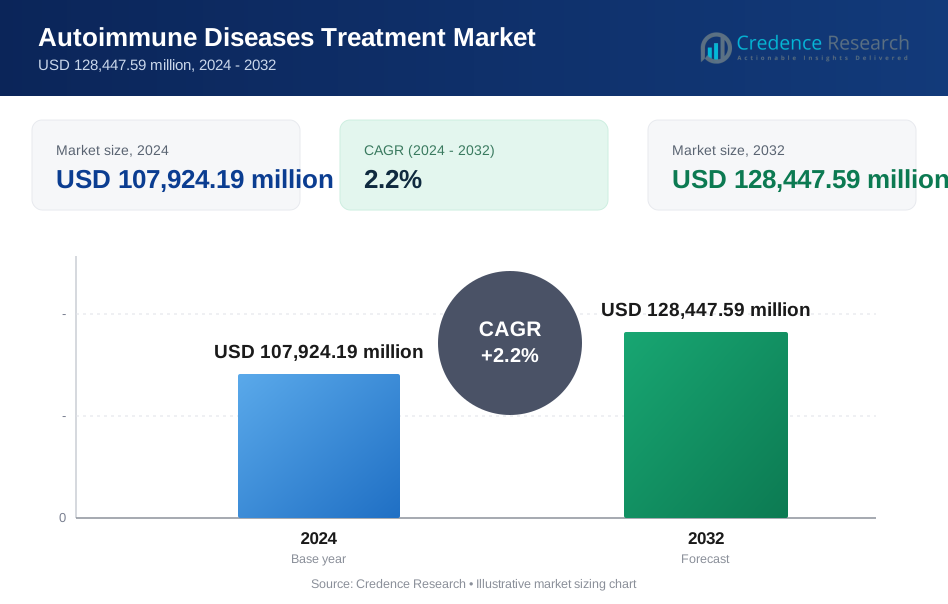
The Autoimmune Diseases Treatment Market is projected to grow from USD 107,924.19 million in 2024 to an estimated USD 128,447.59 million by 2032, with a compound annual growth rate (CAGR) of 2.2% from 2024 to 2032.
| REPORT ATTRIBUTE | DETAILS |
|---|---|
| Historical Period | 2020-2023 |
| Base Year | 2024 |
| Forecast Period | 2025-2032 |
| Autoimmune Diseases Treatment Market Size 2024 | USD 107,924.19 Million |
| Autoimmune Diseases Treatment Market, CAGR | 2.2% |
| Autoimmune Diseases Treatment Market Size 2032 | USD 128,447.59 Million |
Demand rises due to higher diagnosis rates and better awareness across major care systems. New biologics and targeted therapies improve long-term control, which supports strong adoption. Patients prefer advanced options that offer fewer flare-ups and better symptom relief. Drug makers invest in R&D to expand treatment classes for chronic immune disorders. Early identification through improved screening drives faster intervention. Hospitals upgrade treatment pathways to reduce relapse frequency. Rising penetration of specialty drugs pushes further uptake. Growing use of combination regimens strengthens clinical effectiveness across severe cases.
North America leads due to strong access to specialty care and wide biologic adoption in large patient groups. Europe follows with a high treatment rate and steady uptake of novel immune-modulating drugs. Asia Pacific emerges as a fast-growing region driven by expanding healthcare systems and rising diagnosis levels. Japan, China, and India show strong growth as more patients gain access to rheumatology and immunology care. Latin America and the Middle East improve adoption through policy support and wider distribution networks. Africa remains in a developing stage but shows growing interest in essential therapies.
Market Insights:
- The Autoimmune diseases treatment market is valued at USD 107,924.19 million in 2024 and is projected to reach USD 128,447.59 million by 2032, advancing at a 2.2% CAGR during the forecast period.
- North America (38%), Europe (30%), and Asia-Pacific (22%) dominate due to strong specialty care access, structured reimbursement systems, and expanding diagnostic capabilities.
- Asia-Pacific (22%) is the fastest-growing region, driven by rising diagnosis rates, expanding immunology infrastructure, and increasing adoption of biologics across major countries.
- Biologics hold the largest segment share, supported by high treatment effectiveness and strong uptake in hospitals and specialty clinics.
- Hospitals account for the highest end-user share, driven by advanced diagnostic capability, infusion services, and multi-disciplinary autoimmune care pathways.
Market Drivers:
Growing Adoption of Advanced Therapeutics
The Autoimmune diseases treatment market benefits from rising use of biologics across major care settings. Demand grows due to the strong ability of these drugs to control chronic flare cycles. Patients prefer options that offer sustained relief and fewer adverse effects. It supports a strong shift toward targeted pathways that improve long-term outcomes. Healthcare systems invest in advanced treatment lines to reduce relapse frequency. Wider availability of specialty clinics raises access to optimized care programs. Early diagnosis improves treatment timing across several immune disorders. R&D pipelines expand with new immune-modulating classes that focus on precision therapy.
- For instance, long-term data show adalimumab achieved ACR20, ACR50, and ACR70 responses in about 66%, 45%, and 28% of rheumatoid arthritis patients in routine practice, confirming durable benefit for many users.
Rise in Autoimmune Disease Prevalence Worldwide
The Autoimmune diseases treatment market gains momentum due to higher detection rates in developed and emerging regions. Growing awareness leads more individuals to seek specialist evaluation at early stages. Hospitals track increased cases linked to lifestyle shifts and environmental triggers. It encourages wider screening efforts across urban and semi-urban areas. Clinical teams adopt stronger monitoring tools that guide accurate treatment planning. Patients show increasing readiness to use long-term medication plans. Expanded national registries highlight rising need for advanced therapy support. Stronger diagnostic guidelines enable consistent identification across diverse care ecosystems.
- For instance, in a pivotal phase 3 trial, natalizumab monotherapy reduced the annualized relapse rate in relapsing-remitting multiple sclerosis by 68% versus placebo and lowered sustained disability progression by 42%, demonstrating strong value for newly identified patients.
Improved Access to Specialty Care Networks
The Autoimmune diseases treatment market benefits from better access to rheumatology, dermatology, and immunology centers. Health systems improve referral pathways that direct patients to specialist teams faster. Infrastructure upgrades in large hospitals support advanced therapy management. It strengthens continuity of care for individuals with chronic immune disorders. Governments expand insurance coverage for high-cost biologics and immune modulators. More clinics adopt integrated treatment models that shorten waiting times. Digital tools improve care coordination across multi-disciplinary teams. Rising collaborations between hospitals and research institutions support faster adoption of innovation.
Rapid Advancements in Clinical Research and Biomarker Development
The Autoimmune diseases treatment market gains strength from continuous research in immune-dysregulation pathways. New biomarkers guide precise treatment matching for complex autoimmune profiles. It improves prediction of drug response across diverse patient groups. Advanced trials test next-generation therapies designed for targeted immune control. Research institutions expand focus on combination regimens that deliver stronger outcomes. Diagnostic developers build platforms that detect disease activity earlier. Clinical studies support wider adoption of personalized therapy models. Global funding increases for chronic immune disorder investigation and therapy innovation.
Market Trends:
Shift Toward Personalized and Precision Therapy Models
The Autoimmune diseases treatment market sees strong movement toward personalized care strategies. Clinicians rely on genetic and molecular data to refine treatment selection. Patients benefit from tailored regimens that target specific immune pathways. It improves response rates across complex autoimmune profiles. Pharmaceutical firms invest in precision-focused clinical programs to expand targeted options. Hospitals adopt algorithms that support individualized dosing approaches. Biomarker-based stratification becomes more common in advanced treatment planning. Growth in precision tools encourages wider acceptance of customized care.
- For instance, a clinical decision-support tool for ustekinumab in Crohn’s disease showed week-20 clinical remission in 75% of high-probability responders versus 25% of low-probability responders, highlighting how predictive models sharpen treatment choice.
Expansion of Digital Therapeutics and Remote Monitoring Tools
The Autoimmune diseases treatment market experiences rising use of digital platforms for continuous patient tracking. Remote tools help clinicians assess flare activity more accurately. It reduces gaps in treatment follow-up for chronic cases. Mobile apps help patients record symptoms and medication adherence trends. Hospitals integrate digital dashboards to support decision-making. Telehealth expands access to specialist care for remote populations. Digital ecosystems improve communication between patients and clinicians. Rising acceptance of home-based monitoring supports long-term disease control.
- For instance, rheumatology and related specialties reported a 63-fold increase in telehealth visits from 2019 to 2020, while remote monitoring programs in inflammatory disease care reduced in-person visits by nearly one visit per patient per year without loss of disease control.
Growing Use of Combination Therapy Frameworks
The Autoimmune diseases treatment market moves toward combination regimens that enhance treatment stability. Clinicians combine biologics with supportive therapies to reduce flare cycles. It supports stronger control across severe disease groups. Patients gain better symptom management through multi-pathway intervention. Hospitals establish treatment protocols that favor dual-mode action. Research shows higher effectiveness when combining targeted and conventional approaches. Pharmaceutical developers explore new pairing methods in pipeline programs. Wider adoption of combination plans strengthens outcomes across complex cases.
Emergence of Next-Generation Oral Immunomodulators
The Autoimmune diseases treatment market sees rising interest in advanced oral drugs. Therapies with targeted action improve adherence in long-term patients. It reduces dependency on injectable routes in several segments. Oral formulations provide ease of use for growing patient populations. Drug makers expand development pipelines focused on selective immune modulation. Clinics adopt new oral options to diversify treatment portfolios. Patients show strong preference for convenient drug formats. Next-generation oral classes gain momentum across high-growth regions.
Market Challenges Analysis:
High Treatment Costs and Limited Affordability Gaps
The Autoimmune diseases treatment market faces strong pressure due to high prices of biologics and immune modulators. Patients experience financial strain when long-term therapy is required. It affects adherence levels across low-income populations. Health systems struggle to subsidize advanced therapy lines consistently. Complex production processes raise costs across biologic categories. Insurance coverage varies widely and restricts access for many patients. High consultation and diagnostic charges add extra burden. Limited affordability slows treatment uptake across developing healthcare ecosystems.
Lack of Standardized Diagnosis and Variation in Care Quality
The Autoimmune diseases treatment market encounters challenges linked to inconsistent diagnostic accuracy across regions. Early symptoms often overlap with unrelated disorders and delay evaluation. It complicates assessment for primary care workers with limited training. Many facilities lack advanced biomarker and imaging tools. Regional disparities restrict access to trained immunology specialists. Delayed treatment increases severity risk across several patient groups. Uneven care quality limits outcome stability. Limited awareness in rural areas leads to late-stage detection.
Market Opportunities:
Rising Scope for Novel Immune-Targeting Therapeutics
The Autoimmune diseases treatment market holds strong opportunity in emerging immune-targeting drug classes. New selective modulators improve precision for patients who respond poorly to older therapies. It supports stronger symptom control across complex disease groups. Companies invest in next-generation biologics designed for higher safety. Growing research activity speeds development timelines for innovative molecules. Developers explore advanced delivery routes that improve adherence. Expanding clinical evidence encourages broader adoption across global care systems.
Growth of Healthcare Infrastructure in Emerging Regions
The Autoimmune diseases treatment market gains opportunity from rising investment in specialty care infrastructure. New hospitals add immunology units that support early detection and guided therapy. It builds strong access to structured treatment pathways in high-growth economies. Governments expand programs that improve chronic disease management. Insurance coverage grows in major cities and boosts therapy uptake. Digital health networks help remote regions connect with specialists. Awareness programs promote early reporting and long-term disease monitoring.
Market Segmentation Analysis:
By Disease Type / Indication
The Autoimmune diseases treatment market shows strong demand across major indications such as rheumatoid arthritis, multiple sclerosis, systemic lupus erythematosus, inflammatory bowel disease, and psoriasis. Rheumatoid arthritis leads due to high prevalence and significant biologic adoption in advanced care settings. Multiple sclerosis maintains steady growth driven by continuous launch of targeted therapies. Systemic lupus erythematosus gains attention through expanding research in B-cell and complement pathways. Inflammatory bowel disease sees rising adoption of advanced biologics for long-term disease management. Psoriasis benefits from wider access to targeted immune-modulating drugs.
- For instance, secukinumab achieved PASI75 responses of about 69–79% at week 12 in phase 3 plaque psoriasis trials, while infliximab induced clinical response in roughly 69% of moderate-to-severe ulcerative colitis patients at week 8 in the ACT 1 study, underlining strong efficacy across distinct autoimmune indications.
By Treatment Type
Biologics dominate due to their strong effectiveness in controlling immune dysregulation across complex cases. It supports higher patient preference for targeted action and improved quality of life. Small molecule therapies maintain relevance through wider accessibility and oral administration. Therapeutic plasmapheresis holds niche demand for severe cases requiring rapid immune modulation. The “others” segment includes emerging agents that focus on new pathways and treatment mechanisms.
- For instance, in rheumatoid arthritis, tofacitinib achieved ACR20 responses in about 51–53% of patients at six months, while ustekinumab maintenance therapy in Crohn’s disease delivered clinical remission in roughly 42% of treated patients compared with 27% on placebo, demonstrating the complementary role of advanced small molecules and biologics.
By End-User
Hospitals lead due to their role in advanced diagnosis, infusion therapy delivery, and specialist-based care pathways. Diagnostic centers expand their presence by offering biomarker testing and early-stage disease detection. Others, including specialty clinics, continue to gain relevance through improved access to long-term monitoring and tailored treatment programs.
Segmentation:
By Disease Type / Indication
- Rheumatoid Arthritis
- Multiple Sclerosis
- Systemic Lupus Erythematosus
- Inflammatory Bowel Disease
- Psoriasis
By Treatment Type
- Biologics
- Small Molecule Therapies
- Therapeutic Plasmapheresis
- Others
By End-User
- Hospitals
- Diagnostic Centers
- Others
By Region
- North America
- U.S.
- Canada
- Mexico
- Europe
- Germany
- France
- U.K.
- Italy
- Spain
- Rest of Europe
- Asia Pacific
- China
- Japan
- India
- South Korea
- South-east Asia
- Rest of Asia Pacific
- Latin America
- Brazil
- Argentina
- Rest of Latin America
- Middle East & Africa
- GCC Countries
- South Africa
- Rest of the Middle East and Africa
Regional Analysis:
North America
The Autoimmune diseases treatment market records the largest share in North America at around 38%. Strong access to specialty care drives high biologic adoption among diverse patient groups. Healthcare systems support advanced diagnosis through integrated rheumatology and immunology centers. It benefits from strong insurance coverage that improves access to targeted therapies. Pharmaceutical companies expand clinical programs to address rising autoimmune prevalence. Hospitals upgrade infusion facilities to manage long-term treatment cycles. Growing awareness encourages early screening across major population clusters.
Europe
Europe holds nearly 30% share supported by structured healthcare networks and strong specialist availability. Countries in Western Europe lead due to robust reimbursement systems that promote biologic usage. It gains momentum from extensive clinical research focused on chronic immune disorders. Expanded diagnostic standards improve identification of multiple sclerosis, lupus, and inflammatory bowel disease. Hospitals adopt advanced therapy protocols that improve patient outcomes. Strong emphasis on early detection strengthens treatment pathways. Rising access in Eastern Europe expands regional participation.
Asia-Pacific
Asia-Pacific captures about 22% share and stands out as the fastest-growing region. Growth accelerates due to rising diagnosis rates in China, Japan, India, and South Korea. It benefits from expanding healthcare infrastructure and wider adoption of immunology services. Increasing investment in specialty hospitals improves access to biologic and small molecule therapies. Governments support chronic disease programs that increase patient engagement. Growing middle-class populations seek advanced treatment options. Strong expansion in biomarker testing supports earlier intervention across major countries.
Key Player Analysis:
- AbbVie Inc. • Pfizer Inc. • Johnson & Johnson (Janssen) • Eli Lilly & Co. • Amgen Inc. • AstraZeneca plc • Bristol-Myers Squibb Company • Biogen Inc. • GlaxoSmithKline plc (GSK) • Roche (F. Hoffmann-La Roche Ltd) • Merck & Co., Inc. • Sanofi S.A. • Takeda Pharmaceutical Co., Ltd. • Lupin Limited • Thermo Fisher Scientific Inc. • Bayer AG • Chugai Pharmaceutical Co., Ltd.
Competitive Analysis:
The Autoimmune diseases treatment market shows strong competition driven by a concentrated group of global pharmaceutical leaders. Companies focus on advanced biologics, selective small molecule therapies, and combination regimens that strengthen long-term disease control. It benefits from continuous R&D investment targeting immune pathways linked to rheumatoid arthritis, lupus, multiple sclerosis, and inflammatory bowel disease. Leading firms expand pipelines through clinical trials that test next-generation monoclonal antibodies and oral immunomodulators. Strategic mergers support wider access to specialty care networks and enhance commercial reach. Partnerships with diagnostic developers help integrate biomarker-based treatment models. Strong manufacturing capability gives major players an advantage in supplying high-demand therapies.
Recent Developments:
- In AbbVie Inc. , a key update in 2025 was the acquisition of Capstan Therapeutics announced in June and completed in August. This deal, valued at up to $2.1 billion in cash, enhances AbbVie’s pipeline with Capstan’s innovative in vivo CAR-T technology platform focused on RNA delivery for autoimmune diseases. Capstan's lead candidate CPTX2309, a Phase 1 anti-CD19 CAR-T therapy for B cell-mediated autoimmune diseases, represents a potential first-in-class treatment modality expected to reshape autoimmune care. This acquisition strengthens AbbVie's commitment to transforming patient care with next-generation cellular and gene therapies.
- In Pfizer Inc. , 2025 updates include continued progress and launches of novel immunology therapies particularly expanding the label indications of its established drugs for autoimmune conditions, sustaining its leadership in the biologics segment. Pfizer has also pursued partnerships to enhance its AI-driven drug discovery platforms aimed at autoimmune and inflammatory disorders.
Report Coverage:
The research report offers an in-depth analysis based on By Disease Type/Indication, By Treatment Type, By End-User, and By Region. It details leading market players, providing an overview of their business, product offerings, investments, revenue streams, and key applications. Additionally, the report includes insights into the competitive environment, SWOT analysis, current market trends, as well as the primary drivers and constraints. Furthermore, it discusses various factors that have driven market expansion in recent years. The report also explores market dynamics, regulatory scenarios, and technological advancements that are shaping the industry. It assesses the impact of external factors and global economic changes on market growth. Lastly, it provides strategic recommendations for new entrants and established companies to navigate the complexities of the market.
Future Outlook:
- Rising demand for targeted therapies strengthens long-term adoption across major indications.
- New immune-pathway research supports development of advanced biologics and small-molecule agents.
- Growth in biomarker-based diagnostics improves treatment matching across patient groups.
- Hospitals expand infusion and specialty care facilities to meet growing therapy needs.
- Wider acceptance of personalized therapy models enhances clinical outcomes in chronic cases.
- Digital platforms support remote monitoring and tighter disease-management control.
- Emerging countries increase investment in immunology infrastructure and advanced care access.
- Strategic collaborations accelerate development of next-generation immune-modulating drugs.
- Improved treatment adherence drives stronger uptake of oral immunomodulators.
- Expanded clinical pipelines broaden therapeutic options across complex autoimmune disorders.
Request a Free Sample
Fill in your details and we'll send you a free sample report.
- Sample data tables & charts
- Research methodology
Need a Custom Version of This Report?
Tailor the scope, geography, or segments to your exact requirements.
- Custom geography or segment scope
- Direct access to our analyst team
Frequently Asked Questions
What is the current market size for the Autoimmune diseases treatment market, and what is its projected size in 2032?
At what Compound Annual Growth Rate is the Autoimmune diseases treatment market projected to grow between 2024 and 2032?
Which Autoimmune diseases treatment market segment held the largest share in 2024?
What are the primary factors fueling the growth of the Autoimmune diseases treatment market?
Who are the leading companies in the Autoimmune diseases treatment market?
Which region commanded the largest share of the Autoimmune diseases treatment market in 2024?
Table of Content
Chapter 1. Report Introduction
- 1.1 Report Description & Purpose
- 1.1.1 Report Title & Market Definition
- 1.1.2 Unique Selling Propositions (USP) & Key Differentiators
- 1.1.3 Value Proposition for Stakeholders
- 1.2 Research Objectives
- 1.2.1 Market Sizing Objectives (Volume & Revenue)
- 1.2.2 Segmentation Objectives
- 1.2.3 Competitive Intelligence Objectives
- 1.2.4 Forecast & Scenario Objectives
- 1.3 Report Scope
- 1.3.1 Autoimmune Diseases Treatment Scope – Types & Subtypes Covered
- 1.3.2 Geographic Scope – Regions & Countries Covered
- 1.3.3 Historical Period, Base Year & Forecast Period (2024; forecast to 2032)
- 1.3.4 Inclusions & Exclusions
- 1.4 HS Code & Classification Framework
- 1.5 Currency, Units & Pricing Basis
- 1.6 Target Stakeholders
- 1.7 Limitations & Assumptions
Chapter 2. Executive Summary
- 2.1 Global Autoimmune Diseases Treatment Market Snapshot
- 2.1.1 Market Size – Historical (2024) & Forecast (2024-2032) (2024: USD 107,924.19 million → 2032: USD 128,447.59 million)
- 2.1.2 Volume & Revenue – Global Totals
- 2.1.3 Key Market Highlights – Top Five Facts
- 2.2 Autoimmune Diseases Treatment Market Segmentation Snapshot
- 2.2.1 Market Split by Region – 2024 vs. 2032
- 2.3 Competitive Snapshot
- 2.3.1 Top 10 Players by Revenue Share – 2024
- 2.3.2 Top 10 Players by Volume Share – 2024
- 2.3.3 Recent Strategic Developments (18-Month Summary)
- 2.4 Key Investment Highlights & Strategic Conclusions
Chapter 3. Autoimmune Diseases Treatment Market Dynamics & Industry Analysis
- 3.1 Market Overview & Context
- 3.1.1 Autoimmune Diseases Treatment Market Position in the Broader Automotive Value Chain
- 3.1.2 OEM vs. Replacement Market Dynamics
- 3.1.3 Market Maturity & Development Stage by Region
- 3.2 Autoimmune Diseases Treatment Market Drivers
- 3.3 Autoimmune Diseases Treatment Market Restraints & Challenges
- 3.4 Autoimmune Diseases Treatment Market Opportunities
- 3.5 Porter's Five Forces Analysis
- 3.5.1 Threat of New Entrants
- 3.5.2 Bargaining Power of Suppliers
- 3.5.3 Bargaining Power of Buyers
- 3.5.4 Threat of Substitutes
- 3.5.5 Competitive Rivalry – Intensity Assessment
- 3.6 Autoimmune Diseases Treatment Value Chain Analysis
- 3.6.1 Upstream – Raw Material/Input Suppliers
- 3.6.1.1 Raw Material/Input 1
- 3.6.1.2 Raw Material/Input 2
- 3.6.1.3 Raw Material/Input 3
- 3.6.2 Midstream – Production/Manufacturing/Service Delivery
- 3.6.2.1 Production/Process Overview
- 3.6.2.2 Key Facility Locations & Capacity by Manufacturer
- 3.6.3 Downstream – Distribution & End Consumer
- 3.6.3.1 Primary Channel – B2B/OEM
- 3.6.3.2 Secondary Channels – Dealer, Retail, Online, Direct
- 3.6.4 Value Chain Profitability Analysis
- 3.6.1 Upstream – Raw Material/Input Suppliers
- 3.7 PESTEL Analysis
- 3.7.1 Political Factors
- 3.7.2 Economic Factors
- 3.7.3 Social Factors
- 3.7.4 Technological Factors
- 3.7.5 Environmental Factors
- 3.7.6 Legal Factors
- 3.8 Autoimmune Diseases Treatment Supply Chain Analysis
- 3.8.1 Raw Material/Input Supply Risk Assessment
- 3.8.2 Manufacturing Concentration Risk (Geographic Exposure)
- 3.8.3 Trade Disruption Impact Analysis
- 3.9 Regulatory & Policy Landscape
Note: The regulatory and policy landscape section covers regulations based on their applicability to the market, Autoimmune Diseases Treatment category, geography, and scope of the study. Only regulatory frameworks with a material impact on operations, compliance, trade, sustainability, or market access are analyzed in detail.
Chapter 4. Key Investment Pockets & Opportunity Analysis
- 4.1 Autoimmune Diseases Treatment Market Attractiveness Analysis
- 4.1.1 By Region – Investment Attractiveness Matrix (Volume × CAGR)
- 4.2 Absolute Revenue Growth Opportunity
- 4.2.1 By Region – Absolute USD Growth Through 2032
- 4.3 Incremental Volume Opportunity
- 4.3.1 By Region – Incremental Volume Through 2032
- 4.3.2 Segment – Incremental Volume
- 4.4 Emerging Submarket Opportunity Deep Dive (Subject to Applicability)
- 4.5 Emerging Market Opportunity Scorecards
- 4.5.1 United States
- 4.5.2 Europe
- 4.5.3 Asia
- 4.5.4 Middle East & Africa
Note: Emerging Market Opportunity Scorecards will be included based on relevance and strategic importance. Regions listed are indicative and may vary depending on data availability and market dynamics.
Chapter 5. Autoimmune Diseases Treatment Import-Export Analysis & Trade Flows
- 5.1 Global Trade Overview
- 5.1.1 Global Export Value by Country (2024)
- 5.1.2 Global Export Volume by Country (2024)
- 5.1.3 Global Import Value by Country (2024)
- 5.1.4 Global Import Volume by Country (2024)
- 5.1.5 Net Trade Balance by Country (2024)
- 5.2 Export Analysis – Segment
- 5.2.1 Type 1 (HS Code)
- 5.2.2 Type 2 (HS Code)
- 5.2.3 Type 3 (HS Code)
- 5.2.4 Type 4 (HS Code)
- 5.2.5 Type 5 (HS Code)
- 5.3 Import Analysis – Segment
- 5.3.1 Type 1 (HS Code)
- 5.3.2 Type 2 (HS Code)
- 5.3.3 Type 3 (HS Code)
- 5.3.4 Type 4 (HS Code)
- 5.3.5 Type 5 (HS Code)
- 5.4 Average Unit Trade Prices
- 5.4.1 Average Export Price – Segment & Country
- 5.4.2 Average Import Price – Segment & Source Country
- 5.4.3 Price Trends (2024)
- 5.5 Key Trade Route Analysis
- 5.5.1 Trade Route 1
- 5.5.2 Trade Route 2
- 5.5.3 Trade Route 3
- 5.5.4 Trade Route 4
- 5.5.5 Trade Route 5
- 5.6 Trade Policy Impact Assessment
- 5.6.1 US Anti-Dumping & Section 301 Tariffs
- 5.6.2 EU Customs Union Impact
- 5.6.3 Major Free Trade Agreements
- 5.6.4 USMCA Rules of Origin
Note: Trade policy analysis will be included only where relevant to the Autoimmune Diseases Treatment market.
Chapter 6. Competitive Landscape & Company Benchmarking
- 6.1 Autoimmune Diseases Treatment Market Concentration & Structure
- 6.1.1 Herfindahl-Hirschman Index (HHI) – vs. 2024
- 6.1.2 Tier 1, Tier 2 & Tier 3 Market Structure
- 6.1.3 Global, Regional & Local Player Dynamics
- 6.2 Autoimmune Diseases Treatment Market Share Analysis – 2024
- 6.2.1 Global Revenue Share by Company
- 6.2.2 Global Volume Share by Company
- 6.2.3 Regional Revenue Share
- 6.2.4 Market Share Evolution ( vs. 2024)
- 6.2.5 OEM Segment Share by Company
- 6.2.6 Replacement Segment Share by Company
- 6.3 Production/Delivery Capacity & Facility Analysis
- 6.3.1 Global Installed Capacity
- 6.3.2 Capacity Utilization Rates
- 6.3.3 Production/Output Volume
- 6.3.4 Facility Locations & Capacity Map
- 6.3.5 Planned Capacity Additions
- 6.4 Autoimmune Diseases Treatment Competitive Benchmarking Matrix
- 6.4.1 Revenue, Volume, CAGR & Profitability Comparison
- 6.4.2 Channel Revenue Mix
- 6.4.3 Geographic Revenue Exposure
- 6.4.4 R&D Intensity
- 6.4.5 Sustainability Maturity
- 6.5 Strategic Developments in Autoimmune Diseases Treatment (Last 24 Months)
- 6.5.1 Mergers, Acquisitions & Divestments
- 6.5.2 New Autoimmune Diseases Treatment Launches
- 6.5.3 Facility Expansions
- 6.5.4 Strategic Alliances, Joint Ventures & Partnerships
- 6.5.5 Distribution Expansion & Market Entry
- 6.5.6 Sustainability & ESG Initiatives
- 6.6 Competitive Strategy Mapping
- 6.6.1 Leader, Challenger, Follower & Niche Classification
- 6.6.2 Pricing Strategy Comparison
- 6.6.3 Channel Strategy Matrix
Note: Strategic developments are included based on their materiality and the availability of reliable information.
Chapter 7. Global Autoimmune Diseases Treatment Market – By Distribution Channel
- 7.1 Segment Overview
- 7.1.1 Volume & Revenue Split by Channel (2024 & 2032)
- 7.1.2 Channel Mix Evolution (2024-2032)
Chapter 8. Regional Market Analysis – Global Overview
- 8.1 Global Regional Overview
- 8.1.1 Regional Volume Share
- 8.1.2 Regional Revenue Share
- 8.1.3 Regional Volume by Region
- 8.1.4 Regional Revenue by Region
- 8.1.5 Regional Forecast Through 2032
- 8.2 Cross-Regional Segment Analysis
- 8.2.1 By Distribution Channel
- 8.2.2 By Brand/Price Tier
Chapter 9. North America Autoimmune Diseases Treatment Market
- 9.1 United States
- 9.2 Canada
- 9.3 Mexico
Chapter 10. Europe Autoimmune Diseases Treatment Market
- 10.1 Germany
- 10.2 France
- 10.3 Italy
- 10.4 United Kingdom
- 10.5 Spain
- 10.6 Poland
- 10.7 Russia
- 10.8 Netherlands
- 10.9 Belgium
- 10.10 Sweden
- 10.11 Denmark
- 10.12 Norway
- 10.13 Rest of Europe
Chapter 11. Asia Pacific Autoimmune Diseases Treatment Market
- 11.1 China
- 11.2 India
- 11.3 Japan
- 11.4 South Korea
- 11.5 Thailand
- 11.6 Indonesia
- 11.7 Vietnam
- 11.8 Malaysia
- 11.9 Australia
- 11.10 Rest of Asia Pacific
Chapter 12. Latin America Autoimmune Diseases Treatment Market
- 12.1 Brazil
- 12.2 Argentina
- 12.3 Colombia
- 12.4 Chile
- 12.5 Rest of Latin America
Chapter 13. Middle East Autoimmune Diseases Treatment Market
- 13.1 Saudi Arabia
- 13.2 United Arab Emirates
- 13.3 Turkey
- 13.4 Israel
- 13.5 Iran
- 13.6 Rest of the Middle East
Chapter 14. Africa Autoimmune Diseases Treatment Market
- 14.1 South Africa
- 14.2 Egypt
- 14.3 Nigeria
- 14.4 Morocco
- 14.5 Rest of Africa
Chapter 15. Autoimmune Diseases Treatment Company Profiles
- 15.1 [Company 01]
- 15.1.1 Company Overview
- 15.1.2 Key Management Personnel
- 15.1.3 Products & Services Portfolio
- 15.1.4 Financial Performance
- 15.1.5 Key Market Focus & Geographic Presence
- 15.1.6 Recent Developments & Strategic Initiatives
Note: The company profile list is preliminary and may change based on research findings, market developments, data availability, and client requirements.
Chapter 16. Appendices
- Appendix A – List of Abbreviations & Acronyms
- Appendix B – Industry Classification Code Reference – Full Series
- Appendix C – Production & Capacity Data Tables
- Appendix D – End-Use & Demand Base Tables
- Appendix E – Consumption & Replacement Rate Assumptions
- Appendix F – ASP Reference Tables
- Appendix G – Manufacturing & Facility Database
- Appendix H – Import-Export Data Tables
- Appendix I – Regulatory Summary Tables
- Appendix J – Primary Research Participant List (Anonymized)
- Appendix K – Primary Research Questionnaire Framework
- Appendix L – Data Sources & Bibliography
- Appendix M – Market Size Divergence & Source Comparison
Chapter 17. Research Methodology
- 17.1 Research Framework & Philosophy
- 17.2 Secondary Research – Sources, Hierarchy & Data Extraction
- 17.3 Data Modeling – Bottom-Up & Top-Down Market Sizing
- 17.4 Primary Research – Stakeholder Framework, LOI & Sample Sizes
- 17.5 Forecast Methodology – Regression, Scenario & Sensitivity Analysis
- 17.6 Quality Control – Four-Layer Validation Framework
- 17.7 Limitations & Standard Assumptions
- 17.8 Disclaimer
