
| REPORT ATTRIBUTE | DETAILS |
|---|---|
| Historical Period | 2019-2022 |
| Base Year | 2023 |
| Forecast Period | 2024-2032 |
| Emu Oils Market Size 2023 | USD 298.2 Million |
| Emu Oils Market, CAGR | 6.00% |
| Emu Oils Market Size 2032 | USD 503.8 Million |
Market Insights
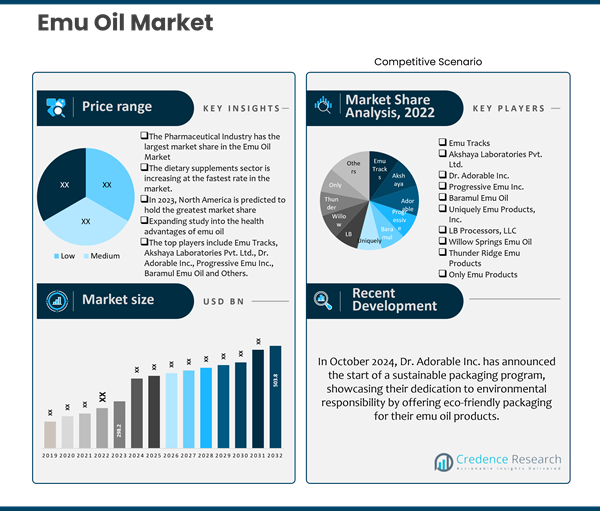
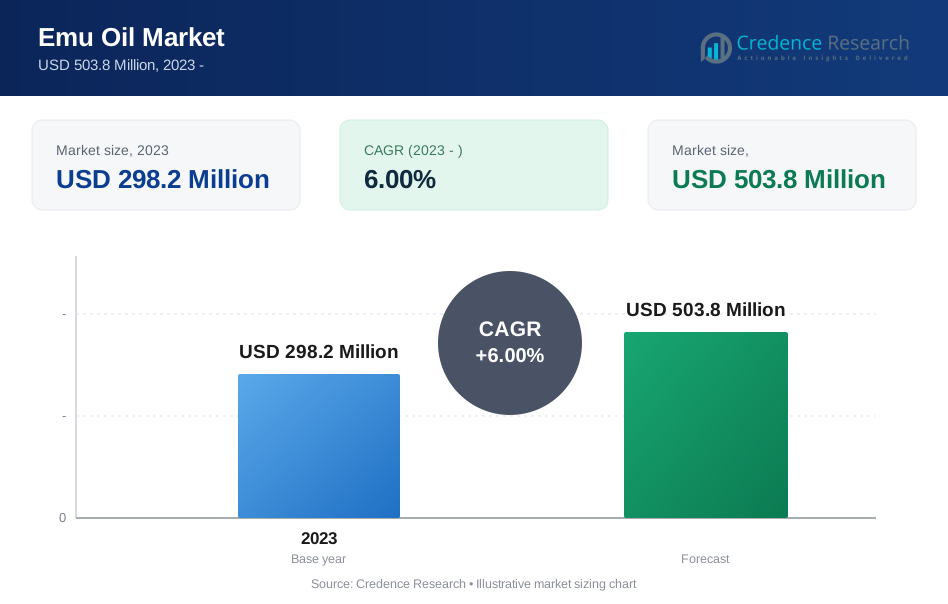
- The global demand for Emu Oils was valued at USD 298.2 Million in 2023 and is expected to reach USD 503.8 Million in 2032, growing at a CAGR of 6.00% between 2024 and 2032.
- In 2023, refined emu oil will lead the emu oil market, while unrefined emu oil will also play a significant role.
- Emu Oil is popular in the beauty and cosmetics business, and the dietary supplements sector is increasing at the fastest rate in the market.
- The Pharmaceutical Industry has the largest market share in the Emu Oil Market. At the same time, the Cosmetic Industry is in high demand, and the Health and Wellness Industry is the industry's third most popular sector.
- In 2023, North America is predicted to hold the greatest market share, and Asia Pacific is the fastest-growing segment in the Emu Oil Market.
- Consumers' choice of natural skincare drives the Emu Oil Market expansion.
- Limited availability of emus and farming issues impede Emu Oil Market expansion.
Executive Summary
Market Definition
Emu Oil Market refers to the industry that manufactures, distributes, and sells emu oil. This is a natural oil derived primarily from the fat of emu birds. Emu oil has some health benefits and skincare advantages due to its hydrating, anti-inflammatory, and, in some cases, pain-relieving properties. Emu oil-based goods are widely available on the market, including skincare creams & lotions, soaps, and dietary supplements. Emu oil products have become increasingly popular as people prefer natural chemicals and plant extracts in personal care and wellness goods. The emu oil market is influenced by customer perceptions of the benefits of emu oil, product innovation, changing regulatory standards, and manufacturer-seller competition.
Market Overview
The global Emu Oil market has witnessed steady growth in recent years and is expected to grow at a CAGR of 6.00% between 2024 and 2032. The market was valued at USD 298.2 million in 2023 and is expected to reach USD 503.8 million in 2032.
Emu oil is a developing market because people are increasingly interested in natural beauty and health products. There are numerous emu oil-based products on the market, many of which include moisturizing and anti-inflammatory characteristics that organic consumers value. Market trends showing such growth drivers include rising demand for natural components, emu oil's efficacy in skin care, and potential health advantages.
Nonetheless, the Emu Oil Market has certain growth constraints, such as restricted emu oil supply due to the nature of the source, regulatory labeling and product-related claims issues, and tough competition from a variety of other natural oils on the market. Nonetheless, rising consumer demand for natural skin and healthcare products has kept the industry growing.
Segmentation by Grade
- In 2023, Refined Emu Oil will dominate the Emu Oil Market due to its better purity levels and longer shelf life, which make it more popular among consumers.
- Unrefined Emu Oil also plays an important role in the market, appealing to consumers seeking a more natural and minimally processed product. Unrefined emu oil preserves more of its natural characteristics, making it popular among those looking for a more natural skincare solution.
Segmentation by Applications
- Emu Oil is popular in the skincare and cosmetics market because of its moisturizing and anti-inflammatory characteristics, which are utilized in creams, lotions, and serums.
- The Dietary Supplements sector is growing at the quickest rate in the market, owing to rising consumer interest in natural health supplements and the widely acknowledged benefits of emu oil for internal health and wellness.
Segmentation by End User
- The Pharmaceutical Industry has the biggest market share in the Emu Oil Market, with the oil used for a variety of medicinal and therapeutic reasons.
- The Cosmetic Industry is in high demand in the Emu Oil Market due to its widespread use in skincare and cosmetic goods.
- The Health and Wellness Industry is the market's third most popular sector, driven by rising consumer interest in natural health treatments and supplements.
Segmentation by Region
- In 2023, North America is expected to have the biggest market share.
- Asia Pacific is the fastest-growing segment in the Emu Oil Market.
- The rest of the world, including Latin America, the Middle East, and Africa, supplies the remaining demand for Emu Oil.
North America is the dominant region in the emu oil market. This region already has a market for natural and organic products, making emu oil easy to include into cosmetics, medicines, and wellness products. Furthermore, prominent beauty and healthcare companies in North America have made a concerted effort to incorporate emu oil into their product lines. Furthermore, the region's high consumer awareness and demand for natural medicines contribute to the domination. Furthermore, strong research and development skills across North America enable ongoing innovation and product diversity, hence fueling the expansion of the emu oil market.
Moreover, Several major factors make the Asia Pacific the fastest-growing segment of the Emu Oil Market. The regional trend toward natural and organic products, combined with increased knowledge of the projected benefits of emu oil, is driving market expansion. These countries, particularly India and China, have a vast population, creating a sizable consumer market for emu oil. Growing discretionary incomes in the region, which may be linked to enhanced purchasing power, are driving up sales of high-end beauty and wellness goods, like emu oil.
Key Highlights of the Report
The global Emu Oil market is segmented by Grade, Applications, End Users, and region. In 2023, refined emu oil will dominate the emu oil market, which is popular in the skincare and cosmetics industries. In addition, the Dietary Supplements industry is developing at the fastest rate in the market, while the Cosmetics Industry is in high demand. Also, Unrefined Emu Oil plays a significant part in the industry, with North America leading the market growth.
The Emu Oil Market is largely driven by rising consumer demand for natural skincare products, increased knowledge of emu oil's advantages, and the growing popularity of organic ingredients in wellness goods. Furthermore, Challenges in the Emu Oil Market include restricted supply of emu oil, regulatory barriers to labeling and claims, and the competitive landscape posed by other natural oils in the market. Furthermore, there are numerous prospects in the Emu Oil Market, including expanding into new markets and regions, investing in product innovation and diversification, and creating strategic alliances with cosmetic and pharmaceutical firms to improve market presence and product offerings.
Nonetheless, North America dominates the emu oil market. This region already has a market for natural and organic products, making it simple to use emu oil into cosmetics, medications, and health items. Furthermore, several important reasons contribute to Asia Pacific being the fastest-growing section of the Emu Oil Market. The regional trend toward natural and organic products, combined with growing awareness of emu oil's potential benefits, is propelling market growth.
What Are The Main Drivers Of The Global Emu Oil Market?
The Emu Oil Market is largely driven by rising consumer demand for natural skincare products, increased knowledge of emu oil's advantages, and the growing popularity of organic ingredients in wellness goods.
What Are The Major Challenges Faced By The Global Emu Oil Market?
The Emu Oil Market has several challenges, including restricted availability of emu oil, regulatory difficulties over labeling and claims, and the competitive landscape posed by other natural oils in the market.
What Are The Growth Opportunities In The Global Emu Oil Market?
The Emu Oil Market offers a variety of opportunities, including expansion into new countries and regions, product innovation and diversification, and strategic alliances with cosmetic and pharmaceutical firms to improve market presence and product offerings.
Market Drivers
Consumer preference for natural skincare drives Emu Oil Market growth
The growing customer preference for natural and organic beauty and health products is projected to be a major development factor for the emu oil market. Emu oil is becoming increasingly popular among consumers, particularly those looking for effective and long-term solutions, due to its natural moisturizing, anti-inflammatory, and healing capabilities. The market is growing as people become more aware of the benefits of emu oil in cosmetics, pharmaceuticals, and wellness products. The growing trend towards eco-friendly and cruelty-free products increases demand for emu oil, propelling its growth trajectory.
Market Restraints
Limited availability of emus and challenges in farming hinder Emu Oil Market growth
The limited supply of emus and the difficulty of emu farming are the most major impediments to the growth of the Emu Oil business. Emu are primarily found in certain places, limiting the supply of emu oil on a big scale. Emus breeding and rearing for oil extraction necessitates unique circumstances and care, making the process time-consuming and costly. This may cause fluctuations in emu oil supplies, affecting market stability and pricing. Due to these restrictions, the limited supply of emu oil has hampered market expansion and satisfying the growing demand for emu oil across various industries, stifling overall market growth.
Opportunities
Growing demand for natural and sustainable products like emu oil in beauty and wellness sectors
The trend towards natural products and sustainability in the beauty and wellness sectors presents a significant opportunity in the Emu Oil Market. Emu oil's natural composition and beneficial benefits make it a popular ingredient among environmentally conscious consumers looking for organic and cruelty-free alternatives. Rising awareness of emu oil's benefits for skin moisturization, anti-inflammation, and healing creates a substantial possibility for market expansion. As customers become more aware of the chemicals in their skincare, medicines, and health goods, the demand for emu oil will increase. This development thus creates opportunities for product innovation, the development of new applications, and market penetration in a wide range of industries where emu oil will become an ultra-sought ingredient within the natural products marketplace—capitalizing on such an opportunity as a path to further the growth and success of the Emu Oil Market.
Competitive Landscape
Key Players
The global Emu Oil market is highly competitive, with several key players. Some of the major players in the market and their market share are as follows:
- Emu Tracks
- Akshaya Laboratories Pvt. Ltd.
- Dr. Adorable Inc.
- Progressive Emu Inc.
- Baramul Emu Oil
- Uniquely Emu Products, Inc.
- LB Processors, LLC
- Willow Springs Emu Oil
- Thunder Ridge Emu Products
- Only Emu Products
- Songline Enterprises LLC
- Others
These organizations prioritize product innovation, distribution channel expansion, and mergers and acquisitions to stay competitive.
The global Emu Oil market's key players continually seek to stay ahead by offering new products and developments.
In January 2023, Emu Tracks launched a new line of emu oil-based skincare products, concentrating on natural ingredients and sophisticated formulas to meet changing consumer demands.
In November 2022, Akshaya Laboratories Pvt. Ltd. introduced a pioneering emu oil extraction technology that improved the quality and purity of their emu oil products and established a new industry standard.
How are Companies Performing in the Emu Oil Market?
Companies operating in the Emu Oil Market are performing somewhat differently. Startups are introducing new products and changing market dynamics with radical product offerings aimed at narrow consumer categories. New advances in the sector have included collaborations with academic institutions to explore further applications for emu oil. After demonstrating possibilities beyond skincare, the scope of further study might be enormous. Much attention is being paid to sustainability, ethical emu oil sourcing, and corporate conservation. Some organizations lower their carbon footprint by implementing environmental policies that address climate change through ecological processes.
Summary of Key Findings
- Growing demand for natural and sustainable products like emu oil in beauty and wellness sectors offers market expansion opportunities
- Market segmented by Grade, Applications, End Users, Industry Vertical, and region.
- The Pharmaceutical Industry has the largest market share in the Emu Oil Market
- The Dietary Supplements sector is developing at the fastest rate in the market.
- North America is leading market growth; the market is highly competitive with key players including Emu Tracks, Akshaya Laboratories Pvt. Ltd., Dr. Adorable Inc., Progressive Emu Inc., Baramul Emu Oil and Others.
Future Outlook
- Consumer preferences for natural skincare products continue to fuel growth.
- Expanding study into the health advantages of emu oil.
- Expanding into new applications outside of skincare.
- Promoting sustainable sourcing practices
- Implementation of modern extraction and processing methods.
- Possibilities for collaboration with beauty and wellness brands
How CXOs Can Benefit from the Credence Research Emu Oil Market Report
The Credence Research Emu Oil Market Report provides CXOs with a comprehensive overview of the market, including:
- Market size and growth forecast:The report provides detailed estimates of the global Emu Oil market size, segmented by Grade, Application, End User, and region. It also includes forecasts for the market through 2032 based on key trends and drivers.
- Market segmentation:The report segments the Emu Oil market by Grade, Application, End User, and region. This segmentation provides CXOs with a granular understanding of the market and the opportunities in each segment.
- Competitive Landscape:The report profiles the key players in the Emu Oil market and provides insights into their strategies, product offerings, and financial performance. This information can help CXOs to identify and assess their competition.
- Key trends and drivers:The report identifies and analyzes the key trends and drivers that are shaping the Emu Oil market. This information can help CXOs to make informed decisions about their investments and strategies.
CXOs can use the insights from the Credence Research Emu Oil Market Report to:
- Identify growth opportunities:The report can help CXOs identify new growth opportunities in the Emu Oil market. For example, the report may shed light on the increasing demand for natural and sustainable products globally, emphasizing the potential for emu oil in various industries.
- Make informed investment decisions:The report can help CXOs make informed investment decisions about Emu Oil. For example, the report may highlight the increasing adoption of Emu Oils in various industries, the projected market growth rate, key players in the market, and regulatory factors affecting the industry
- Develop competitive strategies:The report can help CXOs develop competitive strategies for their Emu Oil businesses. For example, the report may offer information on innovative use cases for Emu Oils, potential partnerships or collaborations with other industry players, and strategies to differentiate products or services in the market.
- Track market developments:The report can help CXOs track market developments and stay ahead of the curve. For example, the report provides insights into the latest trends and innovations in the Emu Oil market.
Overall, the Credence Research Emu Oil Market Report is a valuable resource for CXOs who are looking to gain a deeper understanding of the market and identify opportunities for growth.
Segmentation
-
Grade:
- Refined Emu Oil
- Unrefined Emu Oil
-
Application:
- Skincare and Cosmetics
- Pharmaceuticals
- Dietary Supplements
-
End User:
- Consumer
- Cosmetic Industry
- Pharmaceutical Industry
- Health and Wellness Industry
- Veterinary and Animal Care
-
By Region
- North America
- US
- Canada
- Mexico
- Europe
- Germany
- France
- UK
- Italy
- Spain
- Rest of Europe
- Asia Pacific
- China
- Japan
- India
- South Korea
- South-east Asia
- Rest of Asia Pacific
- Latin America
- Brazil
- Argentina
- Rest of Latin America
- Middle East & Africa
- GCC Countries
- South Africa
- Rest of Middle East and Africa
- North America
Adjacent Markets
In the Emu Oil market, there are several adjacent markets which has high revenue growth opportunities. The key adjacent markets for Emu Oil market -
Adjacent Markets |
||
| Argan Oil Market | Almond Oil Market | Rosehip Oil Market |
| Jojoba Oil Market | Tea Tree Oil Market | Aloe Vera-based Products Market |
| Coconut Oil Market | Lavender Oil Market | Shea Butter Market |
Request a Free Sample
Fill in your details and we'll send you a free sample report.
- Sample data tables & charts
- Research methodology
Need a Custom Version of This Report?
Tailor the scope, geography, or segments to your exact requirements.
- Custom geography or segment scope
- Direct access to our analyst team
Frequently Asked Questions
What is the current size of the global Emu Oil market?
What is the expected growth rate of the Emu Oil market between 2024 and 2032?
Which segment is leading the market share in terms of Grade?
Which End User segment governs the demand for Emu Oils in the world?
Which Application segment is expected to post the fastest growth rate during the forecast period?
Which region is fueling the growth of the Emu Oil industry?
Who are the major players in the global Emu Oil market?
What are the major market drivers of the Emu Oil industry?
What are the major market restraints of the Emu Oil industry?
What are the major market opportunities of the Emu Oil industry?
Table of Content
Chapter 1. Report Introduction
- 1.1 Report Description & Purpose
- 1.1.1 Report Title & Market Definition
- 1.1.2 Unique Selling Propositions (USP) & Key Differentiators
- 1.1.3 Value Proposition for Stakeholders
- 1.2 Research Objectives
- 1.2.1 Market Sizing Objectives (Volume & Revenue)
- 1.2.2 Segmentation Objectives
- 1.2.3 Competitive Intelligence Objectives
- 1.2.4 Forecast & Scenario Objectives
- 1.3 Report Scope
- 1.3.1 Emu Oil Scope – Types & Subtypes Covered
- 1.3.2 Geographic Scope – Regions & Countries Covered
- 1.3.3 Historical Period, Base Year & Forecast Period (2023; forecast to the forecast period)
- 1.3.4 Inclusions & Exclusions
- 1.4 HS Code & Classification Framework
- 1.5 Currency, Units & Pricing Basis
- 1.6 Target Stakeholders
- 1.7 Limitations & Assumptions
Chapter 2. Executive Summary
- 2.1 Global Emu Oil Market Snapshot
- 2.1.1 Market Size – Historical (2023) & Forecast (the forecast period) (2023: USD 298.2 Million → forecast year: USD 503.8 Million)
- 2.1.2 Volume & Revenue – Global Totals
- 2.1.3 Key Market Highlights – Top Five Facts
- 2.2 Emu Oil Market Segmentation Snapshot
- 2.2.1 Market Split by Region – 2023 vs.
- 2.3 Competitive Snapshot
- 2.3.1 Top 10 Players by Revenue Share – 2023
- 2.3.2 Top 10 Players by Volume Share – 2023
- 2.3.3 Recent Strategic Developments (18-Month Summary)
- 2.4 Key Investment Highlights & Strategic Conclusions
Chapter 3. Emu Oil Market Dynamics & Industry Analysis
- 3.1 Market Overview & Context
- 3.1.1 Emu Oil Market Position in the Broader Automotive Value Chain
- 3.1.2 OEM vs. Replacement Market Dynamics
- 3.1.3 Market Maturity & Development Stage by Region
- 3.2 Emu Oil Market Drivers
- 3.3 Emu Oil Market Restraints & Challenges
- 3.4 Emu Oil Market Opportunities
- 3.5 Porter's Five Forces Analysis
- 3.5.1 Threat of New Entrants
- 3.5.2 Bargaining Power of Suppliers
- 3.5.3 Bargaining Power of Buyers
- 3.5.4 Threat of Substitutes
- 3.5.5 Competitive Rivalry – Intensity Assessment
- 3.6 Emu Oil Value Chain Analysis
- 3.6.1 Upstream – Raw Material/Input Suppliers
- 3.6.1.1 Raw Material/Input 1
- 3.6.1.2 Raw Material/Input 2
- 3.6.1.3 Raw Material/Input 3
- 3.6.2 Midstream – Production/Manufacturing/Service Delivery
- 3.6.2.1 Production/Process Overview
- 3.6.2.2 Key Facility Locations & Capacity by Manufacturer
- 3.6.3 Downstream – Distribution & End Consumer
- 3.6.3.1 Primary Channel – B2B/OEM
- 3.6.3.2 Secondary Channels – Dealer, Retail, Online, Direct
- 3.6.4 Value Chain Profitability Analysis
- 3.6.1 Upstream – Raw Material/Input Suppliers
- 3.7 PESTEL Analysis
- 3.7.1 Political Factors
- 3.7.2 Economic Factors
- 3.7.3 Social Factors
- 3.7.4 Technological Factors
- 3.7.5 Environmental Factors
- 3.7.6 Legal Factors
- 3.8 Emu Oil Supply Chain Analysis
- 3.8.1 Raw Material/Input Supply Risk Assessment
- 3.8.2 Manufacturing Concentration Risk (Geographic Exposure)
- 3.8.3 Trade Disruption Impact Analysis
- 3.9 Regulatory & Policy Landscape
Note: The regulatory and policy landscape section covers regulations based on their applicability to the market, Emu Oil category, geography, and scope of the study. Only regulatory frameworks with a material impact on operations, compliance, trade, sustainability, or market access are analyzed in detail.
Chapter 4. Key Investment Pockets & Opportunity Analysis
- 4.1 Emu Oil Market Attractiveness Analysis
- 4.1.1 By Region – Investment Attractiveness Matrix (Volume × CAGR)
- 4.2 Absolute Revenue Growth Opportunity
- 4.2.1 By Region – Absolute USD Growth Through the forecast period
- 4.3 Incremental Volume Opportunity
- 4.3.1 By Region – Incremental Volume Through the forecast period
- 4.3.2 Segment – Incremental Volume
- 4.4 Emerging Submarket Opportunity Deep Dive (Subject to Applicability)
- 4.5 Emerging Market Opportunity Scorecards
- 4.5.1 United States
- 4.5.2 Europe
- 4.5.3 Asia
- 4.5.4 Middle East & Africa
Note: Emerging Market Opportunity Scorecards will be included based on relevance and strategic importance. Regions listed are indicative and may vary depending on data availability and market dynamics.
Chapter 5. Emu Oil Import-Export Analysis & Trade Flows
- 5.1 Global Trade Overview
- 5.1.1 Global Export Value by Country (2023)
- 5.1.2 Global Export Volume by Country (2023)
- 5.1.3 Global Import Value by Country (2023)
- 5.1.4 Global Import Volume by Country (2023)
- 5.1.5 Net Trade Balance by Country (2023)
- 5.2 Export Analysis – Segment
- 5.2.1 Type 1 (HS Code)
- 5.2.2 Type 2 (HS Code)
- 5.2.3 Type 3 (HS Code)
- 5.2.4 Type 4 (HS Code)
- 5.2.5 Type 5 (HS Code)
- 5.3 Import Analysis – Segment
- 5.3.1 Type 1 (HS Code)
- 5.3.2 Type 2 (HS Code)
- 5.3.3 Type 3 (HS Code)
- 5.3.4 Type 4 (HS Code)
- 5.3.5 Type 5 (HS Code)
- 5.4 Average Unit Trade Prices
- 5.4.1 Average Export Price – Segment & Country
- 5.4.2 Average Import Price – Segment & Source Country
- 5.4.3 Price Trends (2023)
- 5.5 Key Trade Route Analysis
- 5.5.1 Trade Route 1
- 5.5.2 Trade Route 2
- 5.5.3 Trade Route 3
- 5.5.4 Trade Route 4
- 5.5.5 Trade Route 5
- 5.6 Trade Policy Impact Assessment
- 5.6.1 US Anti-Dumping & Section 301 Tariffs
- 5.6.2 EU Customs Union Impact
- 5.6.3 Major Free Trade Agreements
- 5.6.4 USMCA Rules of Origin
Note: Trade policy analysis will be included only where relevant to the Emu Oil market.
Chapter 6. Competitive Landscape & Company Benchmarking
- 6.1 Emu Oil Market Concentration & Structure
- 6.1.1 Herfindahl-Hirschman Index (HHI) – vs. 2023
- 6.1.2 Tier 1, Tier 2 & Tier 3 Market Structure
- 6.1.3 Global, Regional & Local Player Dynamics
- 6.2 Emu Oil Market Share Analysis – 2023
- 6.2.1 Global Revenue Share by Company
- 6.2.2 Global Volume Share by Company
- 6.2.3 Regional Revenue Share
- 6.2.4 Market Share Evolution ( vs. 2023)
- 6.2.5 OEM Segment Share by Company
- 6.2.6 Replacement Segment Share by Company
- 6.3 Production/Delivery Capacity & Facility Analysis
- 6.3.1 Global Installed Capacity
- 6.3.2 Capacity Utilization Rates
- 6.3.3 Production/Output Volume
- 6.3.4 Facility Locations & Capacity Map
- 6.3.5 Planned Capacity Additions
- 6.4 Emu Oil Competitive Benchmarking Matrix
- 6.4.1 Revenue, Volume, CAGR & Profitability Comparison
- 6.4.2 Channel Revenue Mix
- 6.4.3 Geographic Revenue Exposure
- 6.4.4 R&D Intensity
- 6.4.5 Sustainability Maturity
- 6.5 Strategic Developments in Emu Oil (Last 24 Months)
- 6.5.1 Mergers, Acquisitions & Divestments
- 6.5.2 New Emu Oil Launches
- 6.5.3 Facility Expansions
- 6.5.4 Strategic Alliances, Joint Ventures & Partnerships
- 6.5.5 Distribution Expansion & Market Entry
- 6.5.6 Sustainability & ESG Initiatives
- 6.6 Competitive Strategy Mapping
- 6.6.1 Leader, Challenger, Follower & Niche Classification
- 6.6.2 Pricing Strategy Comparison
- 6.6.3 Channel Strategy Matrix
Note: Strategic developments are included based on their materiality and the availability of reliable information.
Chapter 7. Global Emu Oil Market – By Distribution Channel
- 7.1 Segment Overview
- 7.1.1 Volume & Revenue Split by Channel (2023 & )
- 7.1.2 Channel Mix Evolution (the forecast period)
Chapter 8. Regional Market Analysis – Global Overview
- 8.1 Global Regional Overview
- 8.1.1 Regional Volume Share
- 8.1.2 Regional Revenue Share
- 8.1.3 Regional Volume by Region
- 8.1.4 Regional Revenue by Region
- 8.1.5 Regional Forecast Through the forecast period
- 8.2 Cross-Regional Segment Analysis
- 8.2.1 By Distribution Channel
- 8.2.2 By Brand/Price Tier
Chapter 9. North America Emu Oil Market
- 9.1 United States
- 9.2 Canada
- 9.3 Mexico
Chapter 10. Europe Emu Oil Market
- 10.1 Germany
- 10.2 France
- 10.3 Italy
- 10.4 United Kingdom
- 10.5 Spain
- 10.6 Poland
- 10.7 Russia
- 10.8 Netherlands
- 10.9 Belgium
- 10.10 Sweden
- 10.11 Denmark
- 10.12 Norway
- 10.13 Rest of Europe
Chapter 11. Asia Pacific Emu Oil Market
- 11.1 China
- 11.2 India
- 11.3 Japan
- 11.4 South Korea
- 11.5 Thailand
- 11.6 Indonesia
- 11.7 Vietnam
- 11.8 Malaysia
- 11.9 Australia
- 11.10 Rest of Asia Pacific
Chapter 12. Latin America Emu Oil Market
- 12.1 Brazil
- 12.2 Argentina
- 12.3 Colombia
- 12.4 Chile
- 12.5 Rest of Latin America
Chapter 13. Middle East Emu Oil Market
- 13.1 Saudi Arabia
- 13.2 United Arab Emirates
- 13.3 Turkey
- 13.4 Israel
- 13.5 Iran
- 13.6 Rest of the Middle East
Chapter 14. Africa Emu Oil Market
- 14.1 South Africa
- 14.2 Egypt
- 14.3 Nigeria
- 14.4 Morocco
- 14.5 Rest of Africa
Chapter 15. Emu Oil Company Profiles
- 15.1 [Company 01]
- 15.1.1 Company Overview
- 15.1.2 Key Management Personnel
- 15.1.3 Products & Services Portfolio
- 15.1.4 Financial Performance
- 15.1.5 Key Market Focus & Geographic Presence
- 15.1.6 Recent Developments & Strategic Initiatives
Note: The company profile list is preliminary and may change based on research findings, market developments, data availability, and client requirements.
Chapter 16. Appendices
- Appendix A – List of Abbreviations & Acronyms
- Appendix B – Industry Classification Code Reference – Full Series
- Appendix C – Production & Capacity Data Tables
- Appendix D – End-Use & Demand Base Tables
- Appendix E – Consumption & Replacement Rate Assumptions
- Appendix F – ASP Reference Tables
- Appendix G – Manufacturing & Facility Database
- Appendix H – Import-Export Data Tables
- Appendix I – Regulatory Summary Tables
- Appendix J – Primary Research Participant List (Anonymized)
- Appendix K – Primary Research Questionnaire Framework
- Appendix L – Data Sources & Bibliography
- Appendix M – Market Size Divergence & Source Comparison
Chapter 17. Research Methodology
- 17.1 Research Framework & Philosophy
- 17.2 Secondary Research – Sources, Hierarchy & Data Extraction
- 17.3 Data Modeling – Bottom-Up & Top-Down Market Sizing
- 17.4 Primary Research – Stakeholder Framework, LOI & Sample Sizes
- 17.5 Forecast Methodology – Regression, Scenario & Sensitivity Analysis
- 17.6 Quality Control – Four-Layer Validation Framework
- 17.7 Limitations & Standard Assumptions
- 17.8 Disclaimer
