
| REPORT ATTRIBUTE | DETAILS |
|---|---|
| Historical Period | 2019-2022 |
| Base Year | 2023 |
| Forecast Period | 2024-2032 |
| HDPE Pipes Market Size 2023 | USD 17518.2 million |
| HDPE Pipes Market, CAGR | 6.50% |
| HDPE Pipes Market Size 2032 | USD 30877.06 million |
Market Insights
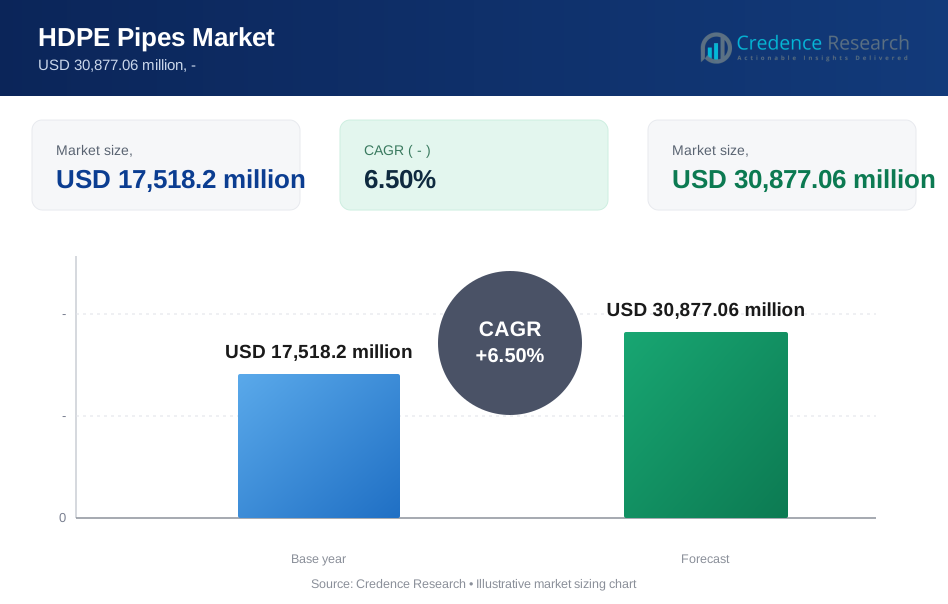
- Between 2024 and 2032, the global market for HDPE pipes is projected to expand at a compound annual growth rate (CAGR) of 6.50%, from an estimated USD 17518.2 million in 2023 to USD 30877.06 million in 2032.
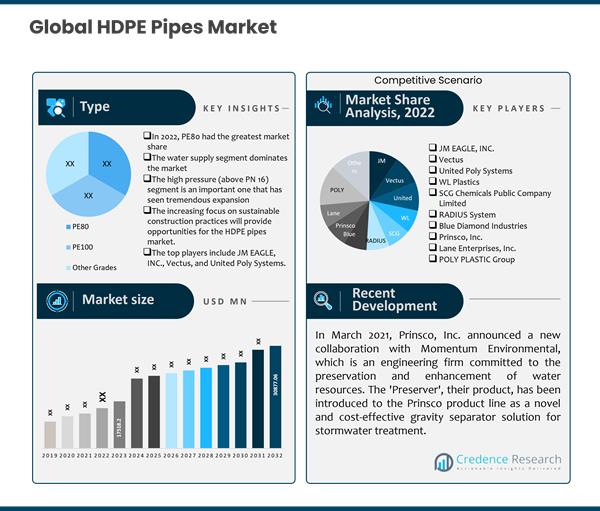
- The largest category is PE80. PE100, on the other hand, is expected to grow at a strong CAGR.
- The water supply category will expand rapidly.
- Throughout the projected period, the CAGR for medium-diameter pipes is anticipated to be the highest.
- Throughout the projection period, the high-pressure (above PN 16) rating category should have the largest compound annual growth rate.
- Asia Pacific controlled the HDPE pipes market.
- Regarding the market share of HDPE pipes, Europe is expected to come second.
- North America is expected to experience the fastest growth in the HDPE pipes industry.
- The stricter environmental regulations and policies and rising construction activities are driving the expansion of the global market.
- The market for HDPE pipes may benefit from growth in gas distribution networks, the expanding healthcare and pharmaceutical industries, and the increasing use of HDPE pipes in marine applications.
Executive Summary
Market Definition
The manufacturing, distribution, and retail of High-Density Polyethylene (HDPE) pipes constitute the global industry known as the HDPE Pipes Market. These pipes are preferred because of their strength, adaptability, and corrosion resistance, which makes them perfect for a range of uses, such as industrial processes, gas distribution, sewage systems, and water delivery. Growing infrastructure development and the need for dependable, reasonably priced piping systems are the main drivers of market expansion.
Market Overview
It is predicted that the HDPE pipes industry will continue its upward trajectory between 2024 and 2032, growing at a compound annual growth rate (CAGR) of 6.50%. From its projected USD 17518.2 million in 2023 to USD 30877.06 million in 2032, the market will continue to grow.
The expanding use of these flexible, chemical-resistant pipes in surface water removal (SWR) drainage systems is anticipated to support the growth of the global HDPE pipes market. The removal and management of stormwater is referred to as this procedure. Waterlogging is avoided, and excess rainwater is managed during periods of high rainfall using the ancillary infrastructure for SWR drainage. Severe climatic variations and unpredictable weather are products of the rapid industrial and urbanization processes.
Moreover, one of the most important environmental issues affecting countries all over the world is global warming. The quantity and intensity of rainfall are two of the most important effects of global warming. The frequency of excessive rainfall, flooding, and waterlogging is rising quickly each year. For example, according to numerous government records, the year 2022 was among the most difficult for US inhabitants due to the climate, as the area had heat waves, drought, and frequent, strong storms and floods. It is anticipated that the increasing number of SWR drainage projects utilizing HDPE pipes will boost revenue for the industry participants.
Segmentation by Type
- PE80 is the market leader in terms of type. Because PE80 pipes are safe, non-toxic, and meet drinking water regulations, they are widely utilized in water distribution systems. They guarantee secure and pure water transportation. Additionally, because PE80 pipes are resistant to corrosion and can handle a variety of chemical effluents, they are utilized in both municipal and industrial sewage and drainage systems.
- The PE100 category will exhibit a sizable CAGR during the projected period. PE100 pipes are used to transfer slurries, harsh chemicals, and other industrial fluids in the mining, oil and gas, and chemical processing sectors. They are appropriate for these applications because of their strong resistance to corrosion and chemical assault.
- Other types, including other grades, also support the need for HDPE pipes.
Segmentation by Application
- Water supply is considered the best category for application, depending on the operating circumstances. HDPE pipes have a 50–100-year lifespan, making them extremely robust. Their ability to withstand scaling, corrosion, and biological growth makes them perfect for systems that use potable water. Even in difficult terrain, HDPE pipes' flexibility makes installation simple. Because they are flexible, there is less need for joints and fittings, which could potentially leak.
- The gas distribution category will likely register a significant CAGR during forecasting. HDPE pipes are lighter than metal pipes, which simplifies and lowers the cost of installation and shipping. This speeds up the installation process and reduces labor expenditures. The high impact resistance and flexibility of HDPE pipes guarantee a safer gas distribution network by reducing the likelihood of damage during installation and operation.
- Other applications, such as agriculture, sewage systems, industrial applications, mining, communication, and other applications, further enhance the need for HDPE pipes.
Segmentation by Diameter
- The medium-diameter pipes category is projected to grow faster over the projection period. The need for medium-diameter HDPE pipes is rising due to the growth of infrastructure, especially in the areas of sewage and water supply systems and urbanization. They are essential for industrial applications, agricultural irrigation systems, and effective gas distribution networks. Durability, flexibility, and chemical and corrosion resistance are some of their advantages. These qualities make them appropriate for a wide range of applications where longevity and dependable performance are crucial, and they also align with strict regulatory norms and sustainability objectives in different parts of the world.
- Other diameters, including small-diameter pipes and large-diameter pipes, also influence the need for HDPE pipes.
Segmentation by Pressure Rating
- The high-pressure (above PN 16) category is likely to have the greatest CAGR throughout the forecast period. High-pressure HDPE pipes (above PN 16) are becoming increasingly in demand in sectors including mining, oil and gas, and industrial fluid transportation. These pipes are incredibly strong, resilient to abrasion and corrosion, and durable. They are essential for applications that need dependable performance in extreme environments and under strain, which is why important infrastructure projects all around the world are using them.
- Other pressure ratings, such as low pressure (up to PN 6) and medium pressure (PN 6 to PN 16), also contribute to the demand for HDPE pipes.
Segmentation by Region
- Asia Pacific leads the HDPE pipes industry. This is due to the rising demand for HDPE pipes from the Asia Pacific countries such as China, India, Australia, and other countries.
- Europe is estimated to rank second in the HDPE pipe market size.
- It is anticipated that the HDPE pipes market in North America will grow quickly.
- Regions, including Latin America, the Middle East, and Africa, meet the remaining need for HDPE pipes.
The market for HDPE pipes is expanding due to the rise in mining activity. In addition, the mining industry's growing need for HDPE pipes is driven by its intrinsic benefits, which include remarkable durability, corrosion resistance, and lightweight nature. Due to these characteristics, HDPE pipes are especially well-suited for usage in the mining sector, where they can tolerate the abrasive minerals and extreme environmental conditions encountered throughout the extraction and transportation processes.
It is anticipated that HDPE pipe sales in Asia Pacific will surpass those in the entire world. Rapid industrialization, urbanization, and infrastructural development, particularly in nations like China and India, are the main drivers of the industry in this region. The Asia Pacific HDPE pipe market is expanding because of the growing demand for these pipes in a variety of applications, including irrigation, mining, gas distribution, and water delivery. Its dominance in the global market is further aided by supportive government programs that encourage the use of HDPE pipes and the presence of significant manufacturers in the area.
It is projected that the HDPE pipes market will develop at the fastest rate in the North American region. This market is being driven by factors such as the growing need to replace aging water infrastructure and the increasing use of HDPE pipes in a variety of applications, including mining, oil and gas, and municipal water delivery. In addition, the market for HDPE pipes is expanding in North America due to strict laws governing the usage of eco-friendly materials and growing expenditures for infrastructure construction.
Key Highlights of the Report
The global HDPE pipes market is segmented by type, application, diameter, pressure rating, and region. As far as the product type is concerned, PE80 is the market spearhead. Water supply is the top application category. Throughout the forecast period, the category of medium-diameter pipes is expected to grow at the greatest CAGR. During the predicted period, the category with the highest CAGR will be the high pressure (above PN 16) rating. Asia Pacific is seeing the most growth in the HDPE pipes market.
The expansion of the oil and gas sector mostly drives the market for HDPE pipes. In this industry, HDPE pipes are used because of their superior resistance to chemicals, corrosion, and environmental stress, which makes them perfect for moving fluids such as gas and oil. Exploration, production, and distribution activities require strong and dependable piping systems due to the industry's growth, especially in growing countries. Furthermore, HDPE pipes are more attractive since they provide strong and affordable substitutes for conventional materials. HDPE pipes are anticipated to become more in demand as the oil and gas industry expands, assisting in the development of infrastructure and improving operational effectiveness.
It is anticipated that Asia Pacific will hold the biggest global market share for HDPE pipes. Due to the increasing industrialization, urbanization, and infrastructure developments occurring in nations like China and India, the Asia Pacific region is expected to propel the expansion of the HDPE pipes market. The need for HDPE pipes is increasing as a result of large investments in gas distribution, sewage systems, and water supply. Further factors supporting market expansion include improvements in agricultural irrigation and rising construction activity. Asia Pacific's growing infrastructure investments and government initiatives make it a major growth driver for the HDPE pipes market. In addition, it is projected that the market in North America will grow at the quickest rate. The market for HDPE pipes is anticipated to grow most rapidly in North America because of the region's strong infrastructure development, rising investments in water and wastewater treatment, and growing gas distribution networks. North America is a major growing area for the HDPE pipe market because of the region's emphasis on sustainable construction and the restoration of aged infrastructure. This increases demand for long-lasting, reasonably priced HDPE pipes.
Which Key Factors Are Driving The Global HDPE Pipes Market?
The demand for HDPE pipes is being driven by the rise of modern irrigation systems in agriculture, growing urbanization and infrastructure development, and water conservation efforts.
What Are The Main Challenges Confronting The Global HDPE Pipes Market?
The biggest challenges affecting the HDPE pipes industry are competition from alternative materials, fluctuating raw material prices, and high initial expenditure.
What Market Opportunities Exist For HDPE Pipes Globally?
Increasing government initiatives for water supply and sanitation, rising renewable energy projects, and expansion in industrial activities are some of the reasons for the growth of the HDPE pipes market.
Market Drivers
Growing Numbers of HDPE Pipe-Producing Plants are Being Constructed and Expanded
The HDPE pipe market is expected to gain momentum over the projected period as a result of the increasing rate of investments in the building of new units and the expansion of existing HDPE pipe manufacturing facilities. Another part of this is using state-of-the-art production technologies to speed up manufacturing without compromising product quality. For instance, in February 2022, Encoma Ltd., a new HDPE pipe maker with a 63,000-square-foot plant in Canada, installed KraussMaffei, the first QuickSwitch line in North America. The company has already placed orders for two more production lines. The production line consists of a three-layer QuickSwitch line that covers the whole manufacturing process.
Market Restraints
The Increasing Demand for Alternative Pipe Materials May constrain Market Expansion
The increasing need for and use of alternative materials for both small- and large-scale pipeline systems is anticipated to limit the expansion of the HDPE pipe business. Cross-linked polyethylene, polyvinyl chloride, ductile iron tapes, concrete pipes, chlorinated polyvinyl chloride (PVC), and steel pipes are a few of the most popular alternative materials employed by end-user verticals. The heightened need for these materials due to their distinct benefits could impede the market for HDPE pipes.
Opportunities
HDPE Pipes' Superior Performance in Agricultural Applications Could Lead to Expansion Potential
The growing use of these pipelines in agricultural settings will present the HDPE pipe sector with significant growth prospects. The performance of the pipe is mostly determined by its durability and adaptability. For example, HDPE pipes are resistant to high temperatures, UV rays, and chemical exposure to extreme weather conditions that most agricultural implements encounter. The extended lifespan of HDPE material has demonstrated its superior durability when compared to other pipes, such as those composed of PVC. These pipes also don't respond negatively to chemical pesticides or fertilizers and are resistant to corrosion.
The installation and upkeep of HDPE pipes are not expensive. They don't lose items throughout long-distance transportation and may be handled with ease. Because HDPE pipes contain corrosion-resistant, leak-proof connections, downtime, and repair costs are significantly reduced. High-density polyethylene has an incredibly smooth interior surface that facilitates the easy flow of liquids, including water, thereby lowering the energy consumption of pipes and the possibility of blockages or clogs. Due to their longer lifespan and recyclability, studies have proved that HDPE pipes work flawlessly with ecologically friendly farming practices. The need to develop effective instruments to support agriculture and the growing global agriculture industry may open up new growth opportunities for HDPE pipes.
Competitive Landscape
Key Players
A number of significant players dominate the highly competitive global market for HDPE pipes. A handful of the top market players are shown below, together with their respective market shares:
- JM EAGLE, INC.
- Vectus
- United Poly Systems
- WL Plastics
- SCG Chemicals Public Company Limited
- RADIUS System
- Blue Diamond Industries
- Prinsco, Inc.
- Lane Enterprises, Inc.
- POLY PLASTIC Group
- Others
In order to stay competitive, these organizations give priority to product innovation, expansion of their distribution channels, and mergers and acquisitions.
By creating cutting-edge ideas and goods, the foremost manufacturers in the global market for HDPE pipes consistently strive to stay one step ahead of the competition.
In June 2022, United Poly Systems was acquired by Atkore Inc. with the goal of increasing production capacity and satisfying client demands.
In January 2021, ADS, which offers a wide range of sustainable infrastructure solutions, recently acquired Infiltrator Water Technologies, a leading supplier of alternative wastewater collection systems.
In May 2020, Mexichem, one of the biggest manufacturers of PVC resins and a global leader in plastic piping, announced that it had acquired Wavin, a top producer of HDPE pipes and other plastic pipe systems, to bolster its position in the European market.
How are Companies Performing in the HDPE pipes Market?
Due to a number of significant factors, companies in the HDPE pipes sector are performing well. Companies in the HDPE pipes market are competing based on the caliber of the products they supply. Large companies in this industry concentrate on growing their R&D expenditures, manufacturing sites, and infrastructure, as well as taking advantage of integration opportunities throughout the value chain. By implementing these tactics, HDPE pipe firms are able to meet the growing demand, maintain competitiveness, create cutting-edge products and technologies, lower manufacturing costs, and increase their clientele.
In order to expand their market share in the HDPE pipe industry, companies are introducing new products. For example, a new type of HDPE pipe specifically made for the oil and gas sector was introduced in 2021 by Performance Pipe, a branch of Chevron Phillips Chemical Company LP. High pressure and temperature are just two of the harsh environments that this unique pipe is designed to withstand during oil and gas production and exploration. Operations in the sector should be greatly improved by such a breakthrough.
Furthermore, Dura-Line Holdings, Inc. announced in 2021 that it was expanding its production capacity by opening a new manufacturing plant in Georgia, USA. By strategically expanding, the company hopes to strengthen its position in the market and efficiently meet the region's increasing demand for HDPE pipes.
Companies that specialize in HDPE pipes are making significant investments in research and development to innovate and improve their product offerings. For example, they are working to develop HDPE pipes that are more environmentally friendly and resistant to pressure. Companies frequently engage in strategic alliances and acquisitions to increase their capabilities and market reach. To accommodate the increasing demand, industry giants like WL Plastics and JM Eagle, for instance, have been strengthening their distribution networks and production capabilities.
Summary of Key Findings
- Expansion in the oil and gas industry, as well as flexibility and ease of installation, influence the demand for HDPE pipes.
- The market is segmented by type, application, diameter, pressure rating, and region.
- In the market, the most prevalent type is PE80.
- Water supply is the foremost application category.
- Medium-diameter pipes are expected to grow fastest in terms of CAGR during the forecast period.
- During the predicted period, high pressure (above PN 16) rating is likely to have the greatest CAGR.
- In terms of market development, Asia Pacific is a leader; the market is highly competitive with key players including JM EAGLE, INC., Vectus, United Poly Systems, WL Plastics, SCG Chemicals Public Company Limited, RADIUS System, Blue Diamond Industries, Prinsco, Inc., Lane Enterprises, Inc., POLY PLASTIC Group, and Others.
Future Outlook
- The HDPE pipes industry is expected to increase significantly in Asia Pacific, and its outlook is positive worldwide.
- The market will continue to expand due to several factors, including the expanding wastewater treatment.
- HDPE pipe installation and maintenance require expert personnel, and a lack of qualified workers may impede market expansion.
- Developing new products, reaching a wider market, and maintaining competitive prices are all necessary for major businesses to stay ahead of the competition.
How the Credence Research HDPE Pipes Market Report Can Help CXOs
The Credence Research HDPE Pipes Market Report provides CXOs with an extensive market overview and comprises the following:
- Market size and growth forecast: The study offers comprehensive market estimations for HDPE pipes globally, broken down by type, application, diameter, pressure rating, and region. Furthermore, the report includes market forecasts through 2032, derived from key drivers and trends.
- Market segmentation: The HDPE pipes market is divided into segments by type, application, diameter, pressure rating, and region in the research report. This segmentation helps CXOs understand the market and the opportunities inside each area in great depth.
- Competitive landscape: The study report provides a thorough analysis of the leading businesses in the HDPE pipes sector, together with details on their revenue streams, product lines, and business strategies. With this information, CXOs can assess and identify their competitors.
- Key trends and drivers: The study report analyzes and highlights the key developments and elements driving the market for HDPE pipes. CXOs can utilize this information to make well-informed choices regarding their plans and investments.
The Credence Research HDPE Pipes Market Report provides CXOs with insights that they may utilize to:
- Identify growth opportunities: This analysis is likely to help CXOs find fresh growth prospects in the HDPE pipes sector. For example, the research recognizes the increasing requirement for HDPE pipes from the water supply and oil and gas sectors as a crucial opportunity.
- Make informed investment decisions: The study aids CXOs in making informed decisions about HDPE pipes. For example, it delivers information on the key variables to consider while picking HDPE pipe solutions and evaluating suppliers.
- Develop competitive strategies: CXOs can utilize the research report to establish competitive strategies for their HDPE pipes firms. The study paper explores the primary tactics employed by HDPE pipe providers to set themselves apart from their rivals.
- Track market developments: By tracking market advancements, this research report could assist CXOs in remaining ahead of the curve. For example, it provides information about the latest advancements and patterns in the HDPE pipes industry.
The Credence Research HDPE Pipes Market Report is helpful for CXOs who want to learn more about the market and identify potential opportunities.
Segmentation
-
By Type
- PE80
- PE100
- Other Grades
-
By Application
- Water Supply
- Agriculture
- Gas Distribution
- Sewage Systems
- Industrial Applications
- Mining
- Communication
- Other Applications
-
By Diameter
- Small Diameter Pipes
- Medium Diameter Pipes
- Large Diameter Pipes
-
By Pressure Rating
- Low Pressure (up to PN 6)
- Medium Pressure (PN 6 to PN 16)
- High Pressure (above PN 16)
-
By Region
- North America
- U.S
- Canada
- Mexico
- Europe
- Germany
- France
- UK
- Italy
- Spain
- Rest of Europe
- Asia Pacific
- China
- Japan
- India
- South Korea
- South-east Asia
- Rest of Asia Pacific
- Latin America
- Brazil
- Argentina
- Rest of Latin America
- Middle East & Africa
- GCC Countries
- South Africa
- The Rest of the Middle East and Africa
- North America
Adjacent Markets
Several adjacent markets in the HDPE pipes market have high revenue growth opportunities. The key adjacent markets for the HDPE pipes market -
Adjacent Markets |
||
| PVC Pipes Market | Copper Pipes Market | Water Treatment Equipment Market |
| Steel Pipes Market | Flexible Hose Market | Drip Irrigation Systems Market |
| Concrete Pipes Market | Plastic Fittings and Valves Market | Mining and Slurry Transportation Market |
Request a Free Sample
Fill in your details and we'll send you a free sample report.
- Sample data tables & charts
- Research methodology
Need a Custom Version of This Report?
Tailor the scope, geography, or segments to your exact requirements.
- Custom geography or segment scope
- Direct access to our analyst team
Frequently Asked Questions
How much does the global market currently hold for HDPE pipes?
What is the HDPE pipes market's projected growth rate between 2024 and 2032?
In terms of the type, which market category is leading?
Regarding the application, which market category is in the lead?
Which pressure rating category is anticipated to grow at the fastest rate throughout the projected period?
In which region is the market for HDPE pipes expanding?
Who are the main players in the global HDPE pipes industry?
Which market factors are the primary drivers of the HDPE pipes industry?
What main market challenges prevent the growth of the HDPE pipes sector?
What are the main market opportunities for the HDPE pipes sector?
Table of Content
Chapter 1. Report Introduction
- 1.1 Report Description & Purpose
- 1.1.1 Report Title & Market Definition
- 1.1.2 Unique Selling Propositions (USP) & Key Differentiators
- 1.1.3 Value Proposition for Stakeholders
- 1.2 Research Objectives
- 1.2.1 Market Sizing Objectives (Volume & Revenue)
- 1.2.2 Segmentation Objectives
- 1.2.3 Competitive Intelligence Objectives
- 1.2.4 Forecast & Scenario Objectives
- 1.3 Report Scope
- 1.3.1 HDPE Pipes Scope – Types & Subtypes Covered
- 1.3.2 Geographic Scope – Regions & Countries Covered
- 1.3.3 Historical Period, Base Year & Forecast Period (the historical period; forecast to the forecast period)
- 1.3.4 Inclusions & Exclusions
- 1.4 HS Code & Classification Framework
- 1.5 Currency, Units & Pricing Basis
- 1.6 Target Stakeholders
- 1.7 Limitations & Assumptions
Chapter 2. Executive Summary
- 2.1 Global HDPE Pipes Market Snapshot
- 2.1.1 Market Size – Historical (the historical period) & Forecast (the forecast period) (base year: USD 17,518.2 million → forecast year: USD 30,877.06 million)
- 2.1.2 Volume & Revenue – Global Totals
- 2.1.3 Key Market Highlights – Top Five Facts
- 2.2 HDPE Pipes Market Segmentation Snapshot
- 2.2.1 Market Split by Region – vs.
- 2.3 Competitive Snapshot
- 2.3.1 Top 10 Players by Revenue Share –
- 2.3.2 Top 10 Players by Volume Share –
- 2.3.3 Recent Strategic Developments (18-Month Summary)
- 2.4 Key Investment Highlights & Strategic Conclusions
Chapter 3. HDPE Pipes Market Dynamics & Industry Analysis
- 3.1 Market Overview & Context
- 3.1.1 HDPE Pipes Market Position in the Broader Automotive Value Chain
- 3.1.2 OEM vs. Replacement Market Dynamics
- 3.1.3 Market Maturity & Development Stage by Region
- 3.2 HDPE Pipes Market Drivers
- 3.3 HDPE Pipes Market Restraints & Challenges
- 3.4 HDPE Pipes Market Opportunities
- 3.5 Porter's Five Forces Analysis
- 3.5.1 Threat of New Entrants
- 3.5.2 Bargaining Power of Suppliers
- 3.5.3 Bargaining Power of Buyers
- 3.5.4 Threat of Substitutes
- 3.5.5 Competitive Rivalry – Intensity Assessment
- 3.6 HDPE Pipes Value Chain Analysis
- 3.6.1 Upstream – Raw Material/Input Suppliers
- 3.6.1.1 Raw Material/Input 1
- 3.6.1.2 Raw Material/Input 2
- 3.6.1.3 Raw Material/Input 3
- 3.6.2 Midstream – Production/Manufacturing/Service Delivery
- 3.6.2.1 Production/Process Overview
- 3.6.2.2 Key Facility Locations & Capacity by Manufacturer
- 3.6.3 Downstream – Distribution & End Consumer
- 3.6.3.1 Primary Channel – B2B/OEM
- 3.6.3.2 Secondary Channels – Dealer, Retail, Online, Direct
- 3.6.4 Value Chain Profitability Analysis
- 3.6.1 Upstream – Raw Material/Input Suppliers
- 3.7 PESTEL Analysis
- 3.7.1 Political Factors
- 3.7.2 Economic Factors
- 3.7.3 Social Factors
- 3.7.4 Technological Factors
- 3.7.5 Environmental Factors
- 3.7.6 Legal Factors
- 3.8 HDPE Pipes Supply Chain Analysis
- 3.8.1 Raw Material/Input Supply Risk Assessment
- 3.8.2 Manufacturing Concentration Risk (Geographic Exposure)
- 3.8.3 Trade Disruption Impact Analysis
- 3.9 Regulatory & Policy Landscape
Note: The regulatory and policy landscape section covers regulations based on their applicability to the market, HDPE Pipes category, geography, and scope of the study. Only regulatory frameworks with a material impact on operations, compliance, trade, sustainability, or market access are analyzed in detail.
Chapter 4. Key Investment Pockets & Opportunity Analysis
- 4.1 HDPE Pipes Market Attractiveness Analysis
- 4.1.1 By Region – Investment Attractiveness Matrix (Volume × CAGR)
- 4.2 Absolute Revenue Growth Opportunity
- 4.2.1 By Region – Absolute USD Growth Through the forecast period
- 4.3 Incremental Volume Opportunity
- 4.3.1 By Region – Incremental Volume Through the forecast period
- 4.3.2 Segment – Incremental Volume
- 4.4 Emerging Submarket Opportunity Deep Dive (Subject to Applicability)
- 4.5 Emerging Market Opportunity Scorecards
- 4.5.1 United States
- 4.5.2 Europe
- 4.5.3 Asia
- 4.5.4 Middle East & Africa
Note: Emerging Market Opportunity Scorecards will be included based on relevance and strategic importance. Regions listed are indicative and may vary depending on data availability and market dynamics.
Chapter 5. HDPE Pipes Import-Export Analysis & Trade Flows
- 5.1 Global Trade Overview
- 5.1.1 Global Export Value by Country (the historical period)
- 5.1.2 Global Export Volume by Country (the historical period)
- 5.1.3 Global Import Value by Country (the historical period)
- 5.1.4 Global Import Volume by Country (the historical period)
- 5.1.5 Net Trade Balance by Country (the historical period)
- 5.2 Export Analysis – Segment
- 5.2.1 Type 1 (HS Code)
- 5.2.2 Type 2 (HS Code)
- 5.2.3 Type 3 (HS Code)
- 5.2.4 Type 4 (HS Code)
- 5.2.5 Type 5 (HS Code)
- 5.3 Import Analysis – Segment
- 5.3.1 Type 1 (HS Code)
- 5.3.2 Type 2 (HS Code)
- 5.3.3 Type 3 (HS Code)
- 5.3.4 Type 4 (HS Code)
- 5.3.5 Type 5 (HS Code)
- 5.4 Average Unit Trade Prices
- 5.4.1 Average Export Price – Segment & Country
- 5.4.2 Average Import Price – Segment & Source Country
- 5.4.3 Price Trends (the historical period)
- 5.5 Key Trade Route Analysis
- 5.5.1 Trade Route 1
- 5.5.2 Trade Route 2
- 5.5.3 Trade Route 3
- 5.5.4 Trade Route 4
- 5.5.5 Trade Route 5
- 5.6 Trade Policy Impact Assessment
- 5.6.1 US Anti-Dumping & Section 301 Tariffs
- 5.6.2 EU Customs Union Impact
- 5.6.3 Major Free Trade Agreements
- 5.6.4 USMCA Rules of Origin
Note: Trade policy analysis will be included only where relevant to the HDPE Pipes market.
Chapter 6. Competitive Landscape & Company Benchmarking
- 6.1 HDPE Pipes Market Concentration & Structure
- 6.1.1 Herfindahl-Hirschman Index (HHI) – vs.
- 6.1.2 Tier 1, Tier 2 & Tier 3 Market Structure
- 6.1.3 Global, Regional & Local Player Dynamics
- 6.2 HDPE Pipes Market Share Analysis –
- 6.2.1 Global Revenue Share by Company
- 6.2.2 Global Volume Share by Company
- 6.2.3 Regional Revenue Share
- 6.2.4 Market Share Evolution ( vs. )
- 6.2.5 OEM Segment Share by Company
- 6.2.6 Replacement Segment Share by Company
- 6.3 Production/Delivery Capacity & Facility Analysis
- 6.3.1 Global Installed Capacity
- 6.3.2 Capacity Utilization Rates
- 6.3.3 Production/Output Volume
- 6.3.4 Facility Locations & Capacity Map
- 6.3.5 Planned Capacity Additions
- 6.4 HDPE Pipes Competitive Benchmarking Matrix
- 6.4.1 Revenue, Volume, CAGR & Profitability Comparison
- 6.4.2 Channel Revenue Mix
- 6.4.3 Geographic Revenue Exposure
- 6.4.4 R&D Intensity
- 6.4.5 Sustainability Maturity
- 6.5 Strategic Developments in HDPE Pipes (Last 24 Months)
- 6.5.1 Mergers, Acquisitions & Divestments
- 6.5.2 New HDPE Pipes Launches
- 6.5.3 Facility Expansions
- 6.5.4 Strategic Alliances, Joint Ventures & Partnerships
- 6.5.5 Distribution Expansion & Market Entry
- 6.5.6 Sustainability & ESG Initiatives
- 6.6 Competitive Strategy Mapping
- 6.6.1 Leader, Challenger, Follower & Niche Classification
- 6.6.2 Pricing Strategy Comparison
- 6.6.3 Channel Strategy Matrix
Note: Strategic developments are included based on their materiality and the availability of reliable information.
Chapter 7. Global HDPE Pipes Market – By Distribution Channel
- 7.1 Segment Overview
- 7.1.1 Volume & Revenue Split by Channel ( & )
- 7.1.2 Channel Mix Evolution (the forecast period)
Chapter 8. Regional Market Analysis – Global Overview
- 8.1 Global Regional Overview
- 8.1.1 Regional Volume Share
- 8.1.2 Regional Revenue Share
- 8.1.3 Regional Volume by Region
- 8.1.4 Regional Revenue by Region
- 8.1.5 Regional Forecast Through the forecast period
- 8.2 Cross-Regional Segment Analysis
- 8.2.1 By Distribution Channel
- 8.2.2 By Brand/Price Tier
Chapter 9. North America HDPE Pipes Market
- 9.1 United States
- 9.2 Canada
- 9.3 Mexico
Chapter 10. Europe HDPE Pipes Market
- 10.1 Germany
- 10.2 France
- 10.3 Italy
- 10.4 United Kingdom
- 10.5 Spain
- 10.6 Poland
- 10.7 Russia
- 10.8 Netherlands
- 10.9 Belgium
- 10.10 Sweden
- 10.11 Denmark
- 10.12 Norway
- 10.13 Rest of Europe
Chapter 11. Asia Pacific HDPE Pipes Market
- 11.1 China
- 11.2 India
- 11.3 Japan
- 11.4 South Korea
- 11.5 Thailand
- 11.6 Indonesia
- 11.7 Vietnam
- 11.8 Malaysia
- 11.9 Australia
- 11.10 Rest of Asia Pacific
Chapter 12. Latin America HDPE Pipes Market
- 12.1 Brazil
- 12.2 Argentina
- 12.3 Colombia
- 12.4 Chile
- 12.5 Rest of Latin America
Chapter 13. Middle East HDPE Pipes Market
- 13.1 Saudi Arabia
- 13.2 United Arab Emirates
- 13.3 Turkey
- 13.4 Israel
- 13.5 Iran
- 13.6 Rest of the Middle East
Chapter 14. Africa HDPE Pipes Market
- 14.1 South Africa
- 14.2 Egypt
- 14.3 Nigeria
- 14.4 Morocco
- 14.5 Rest of Africa
Chapter 15. HDPE Pipes Company Profiles
- 15.1 [Company 01]
- 15.1.1 Company Overview
- 15.1.2 Key Management Personnel
- 15.1.3 Products & Services Portfolio
- 15.1.4 Financial Performance
- 15.1.5 Key Market Focus & Geographic Presence
- 15.1.6 Recent Developments & Strategic Initiatives
Note: The company profile list is preliminary and may change based on research findings, market developments, data availability, and client requirements.
Chapter 16. Appendices
- Appendix A – List of Abbreviations & Acronyms
- Appendix B – Industry Classification Code Reference – Full Series
- Appendix C – Production & Capacity Data Tables
- Appendix D – End-Use & Demand Base Tables
- Appendix E – Consumption & Replacement Rate Assumptions
- Appendix F – ASP Reference Tables
- Appendix G – Manufacturing & Facility Database
- Appendix H – Import-Export Data Tables
- Appendix I – Regulatory Summary Tables
- Appendix J – Primary Research Participant List (Anonymized)
- Appendix K – Primary Research Questionnaire Framework
- Appendix L – Data Sources & Bibliography
- Appendix M – Market Size Divergence & Source Comparison
Chapter 17. Research Methodology
- 17.1 Research Framework & Philosophy
- 17.2 Secondary Research – Sources, Hierarchy & Data Extraction
- 17.3 Data Modeling – Bottom-Up & Top-Down Market Sizing
- 17.4 Primary Research – Stakeholder Framework, LOI & Sample Sizes
- 17.5 Forecast Methodology – Regression, Scenario & Sensitivity Analysis
- 17.6 Quality Control – Four-Layer Validation Framework
- 17.7 Limitations & Standard Assumptions
- 17.8 Disclaimer
