
| REPORT ATTRIBUTE | DETAILS |
|---|---|
| Historical Period | 2019-2022 |
| Base Year | 2023 |
| Forecast Period | 2024-2032 |
| Healthcare IT Systems Interoperability Market Size 2023 | USD 3658.50 Million |
| Healthcare IT Systems Interoperability Market, CAGR | 12.5% |
| Healthcare IT Systems Interoperability Market Size 2032 | USD 10560.29 Million |
Market Insights
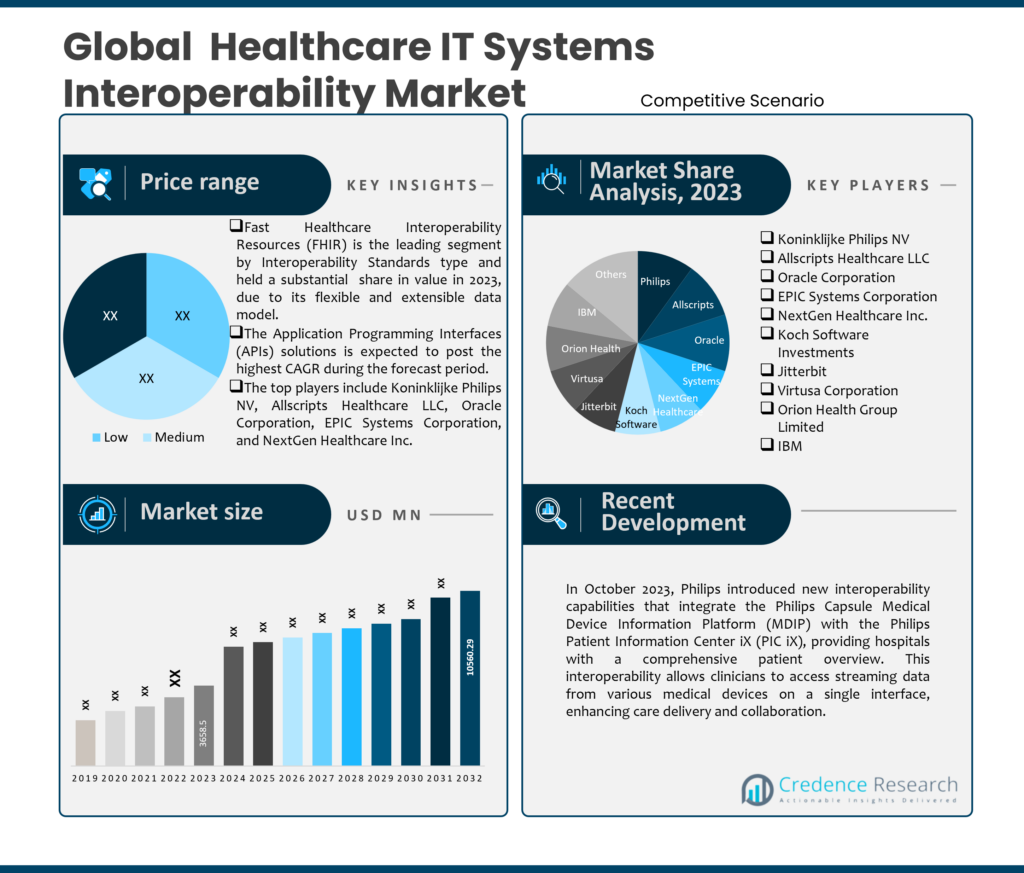
- The global demand for healthcare IT systems interoperability was valued at USD 3658.50 Million in 2023 and is expected to reach USD 10560.29 Million in 2032, growing at a CAGR of 12.5% between 2024 and 2032.
- The Fast Healthcare Interoperability Resources (FHIR) sector is the market leader by interoperability standards type, accounting for the largest value in 2023, while the Health Level Seven International (HL7) and Integrating the Healthcare Enterprise (IHE) segments are expected to grow rapidly throughout the forecast period.
- The Semantic Interoperability segment dominates the global demand in the interoperability models type, accounting for the highest share in 2023, and is predicted to expand at a high CAGR.
- The Application Programming Interfaces (APIs) sector is predicted to grow fastest over the projection period, while the interoperability platforms segment holds the largest market share in 2023.
- Over the projection period, the medical device interoperability segment is expected to expand at the highest rate, while the Electronic Health Record (EHR) Interoperability category dominates the market in 2023 with the largest market share.
- North America is fueling the growth of the healthcare IT systems interoperability industry with the highest share in 2023, while Asia Pacific is expected to grow at the highest rate during the projected period.
- The global healthcare IT systems interoperability sector is experiencing rapid growth, fueled by the expanding digitization of healthcare, investments in healthcare IT infrastructure, regulatory mandates, and the trend toward patient-centered care.
Executive Summary
Market Definition
Healthcare IT Systems Interoperability refers to the ability of different information technology systems and software applications within the healthcare industry to exchange, interpret, and use data securely. Interoperability allows various systems, such as electronic health records (EHRs), laboratory information systems, imaging systems, and others, to seamlessly communicate with each other, regardless of the vendor or platform. This exchange of data enables healthcare providers, patients, and other stakeholders to access and share crucial health information efficiently, leading to better coordination of care, improved patient outcomes, and enhanced operational efficiency.
Market Overview
The global Healthcare IT Systems Interoperability Market has witnessed steady growth in recent years and is expected to grow at a CAGR of 12.5% between 2024 and 2032. The market was valued at USD 3658.50 million in 2023 and is expected to reach USD 10560.29 million in 2032.
The key driver boosting the growth rate of the healthcare IT systems interoperability market is the rising adoption of digital healthcare solutions by healthcare providers worldwide. These solutions, ranging from electronic health records (EHRs) to telemedicine platforms, are integral to modernizing healthcare delivery and improving patient care. Interoperability solutions play a critical role in integrating these different systems, enabling seamless data exchange and access to comprehensive patient information across healthcare settings.
Furthermore, growing investment in healthcare IT infrastructure further accelerates the adoption of interoperability solutions. Governments, healthcare organizations, and technology vendors are allocating resources to bolster healthcare IT capabilities, recognizing its potential to transform care delivery and improve outcomes. Initiatives such as funding programs from regulatory bodies incentivize innovation and standards adoption, fostering interoperability across the healthcare ecosystem.
In addition, regulatory bodies worldwide are mandating interoperability standards and requirements to promote data exchange and improve healthcare quality and patient outcomes. Compliance with regulations such as the Health Insurance Portability and Accountability Act (HIPAA) in the United States and the European Union's General Data Protection Regulation (GDPR) incentivizes healthcare organizations to invest in interoperability solutions to ensure data security and privacy while facilitating seamless data exchange.
Segmentation by Interoperability Standards
- Fast Healthcare Interoperability Resources (FHIR) is the leading segment by Interoperability Standards type and held a substantial share in value in 2023, attributable to the FHIR's flexible and extensible data model, which allows for seamless communication and integration between different healthcare systems and applications.
- The Health Level Seven International (HL7) facilitates seamless interoperability among disparate systems and applications as healthcare organizations strive to improve care coordination, patient engagement, and data analytics capabilities.
- The Integrating the Healthcare Enterprise (IHE) segment significantly contributes to the demand for the healthcare IT systems interoperability industry.
Segmentation by Interoperability Models
- The Semantic Interoperability segment boasts the dominating position in the Healthcare IT Systems Interoperability market holding a significant share in 2023, and is also expected to grow at a rapid CAGR. This is due to its critical role in enabling meaningful and accurately interpreted exchange of healthcare data.
- The structural interoperability and syntactic interoperability segment contributes to the demand for healthcare IT systems interoperability models.
Segmentation by Health Information Exchange (HIE)
- The Regional Health Information Organizations (RHIOs) segment significantly contributes to the healthcare IT systems interoperability market. RHIOs play a crucial role in supporting population health management initiatives by aggregating and analyzing health data to identify trends, patterns, and areas for intervention within local communities.
- Direct messaging offers a secure and standardized method for healthcare providers to exchange clinical information, such as lab results, imaging reports, and care summaries, electronically.
- Federated query systems contribute to the healthcare IT systems interoperability market by enabling healthcare providers to access and query patient data stored across multiple participating health information exchange (HIE) networks or organizations.
Segmentation by Interoperability Solutions
- The Application Programming Interfaces (APIs) solution is expected to post the highest CAGR during the forecast period. The increasing adoption of cloud-based and mobile healthcare solutions fuels the demand for APIs, as they enable easy integration with these platforms and support agile development and deployment of interoperable solutions.
- Interoperability platforms hold the largest share of the market due to their comprehensive nature. They provide customizable and scalable solutions that cater to the specific needs of healthcare providers, payers, and other stakeholders, driving their widespread adoption and market dominance.
- Data integration tools contribute to the growth of the healthcare IT systems interoperability market.
Segmentation by Use Cases
- Electronic Health Record (EHR) Interoperability by use case types holds the largest share in the market in 2023 due to its central role in facilitating seamless exchange of patient health information. EHR interoperability enables healthcare professionals to access comprehensive patient records, including medical history, diagnoses, medications, and treatment plans, regardless of the EHR system used.
- Clinical Decision Support (CDS) and Medical device interoperability contribute to the growing demand for the healthcare IT systems interoperability market.
Segmentation by Region
- In 2023, the North American region will command a substantial portion of the healthcare IT systems interoperability market due to heightened investments in healthcare infrastructure digitization, rising healthcare expenditures, and the introduction of innovative products.
- The Asia Pacific market is expected to grow at the highest rate during the forecasted period.
- The rest of the world, including Latin America, the Middle East, and Africa, supplies the remaining demand for healthcare IT systems interoperability solutions.
The market for healthcare IT systems interoperability is driven by the escalating adoption of digital healthcare solutions such as electronic health records (EHRs), telemedicine platforms, and health information exchange (HIE) systems among healthcare providers globally.
North America is a leader in embracing healthcare infrastructure, contributing to the growth of Healthcare IT Systems. Significant investments in the digitalization of healthcare infrastructure boost the expansion of interoperability solutions in the region. For instance, in 2022, the Healthcare Information and Management Systems Society (HIMSS) recommends a substantial investment of approximately USD 36.7 billion to modernize and interoperate public health data infrastructure in the U.S., with a specific focus on enhancing interoperability and sustainability efforts within the sector.
Moreover, the increasing adoption of Electronic Health Record (EHR) systems across healthcare organizations in the region plays a pivotal role in driving market growth. According to the report of the National Coordinator for Health Information Technology in 2021, nearly 78% of office-based physicians and about 96% of non-federal acute care hospitals in the U.S. have adopted certified EHR systems. This significant adoption rate marks substantial progress over the past decade, considering that in 2011, only 28% of hospitals and 34% of physicians had adopted an EHR.
Furthermore, the presence of key market players in North America, along with business expansion initiatives such as product launches, mergers & acquisitions, and collaborations, further bolster market growth. For instance, Embratel's launch of the Embratel Saúde Interoperabilidade solution in April 2022 addresses the need for clinical connectivity, information integration, and medical records sharing, providing a comprehensive healthcare view for both public and private institutions.
The Asia Pacific region is witnessing significant growth due to government investments and initiatives aimed at promoting eHealth and digital healthcare solutions. Reports from McKinsey and Company indicate that digital health impacts over a billion lives in the Asia Pacific, with estimates suggesting that the sector could collectively generate up to USD 100 billion in value by 2025, a substantial increase from USD 37 billion in 2020. Moreover, the rise of medical tourism in countries such as Japan, Thailand, Malaysia, and Singapore has further fueled the demand for interoperable healthcare systems. With an increasing number of international patients seeking medical treatment in these countries, there is a growing need for seamless care delivery facilitated by interoperable healthcare IT systems.
Additionally, advancements in technology and the proliferation of digital health solutions are driving the adoption of interoperable healthcare systems across the Asia Pacific region. As healthcare providers strive to leverage technology to improve patient outcomes and optimize operational efficiency, interoperability becomes a critical component in integrating disparate systems and enabling seamless data exchange.
Key Highlights of the Report
The global healthcare IT systems interoperability market is segmented by interoperability standards, interoperability models, health information exchange (HIE), interoperability solutions, use cases, and region. Fast Healthcare Interoperability Resources (FHIR) are the most popular interoperability standards, while semantic interoperability model is the primary segment. In addition, the interoperability platforms are the largest solutions, with the North American region leading the global market share.
One of the main factors propelling the global market for Healthcare IT Systems Interoperability widespread adoption of EHR systems by healthcare providers. Governments worldwide are increasingly investing in digital health infrastructure and promoting interoperability initiatives to enhance healthcare delivery and patient outcomes, further driving their market demand.
Nonetheless, North America is anticipated to have the greatest share of the worldwide Healthcare IT Systems Interoperability market owing to the increasing number of advancements to improve Healthcare IT Systems Interoperability solutions and the region's growing healthcare infrastructure. Furthermore, the market is anticipated to expand at the highest rate in the Asia-Pacific (APAC) region due to the growing initiatives in promoting eHealth in the region and the expansion of medical tourism.
What Are The Main Drivers Of The Global Healthcare IT Systems Interoperability Market?
Increasing adoption of digital healthcare solutions worldwide, alongside growing investment in healthcare IT infrastructure and regulatory mandates promoting interoperability standards, significantly propels the growth of the Healthcare IT Systems Interoperability market. Additionally, the industry is also anticipated to benefit from the globalization of healthcare, including medical tourism and cross-border care delivery, that necessitates interoperable IT systems to ensure continuity of care and data exchange across international borders.
What Are The Major Challenges Faced By The Global Healthcare IT Systems Interoperability Market?
The lack of comprehensive interoperability standards and inconsistent implementation across healthcare organizations contribute to interoperability challenges. While several interoperability standards exist, such as HL7 and FHIR, their adoption varies, leading to fragmentation in data exchange practices. Varying standards and protocols make it difficult to achieve seamless integration between different systems, resulting in interoperability gaps and data silos within healthcare ecosystems.
What Are The Growth Opportunities In The Global Healthcare IT Systems Interoperability Market?
The integration of Artificial Intelligence (AI) and Machine Learning (ML) presents significant opportunities for healthcare interoperability by enhancing data analytics. Predictive analytics enabled by AI can anticipate patient health trends, requiring seamless interoperability between data sources for proactive interventions.
Market Drivers
Rising Adoption of Digital Healthcare Solutions
The rising adoption of digital healthcare solutions is a significant driver of growth for the healthcare IT systems interoperability market. Healthcare providers globally are embracing electronic health records (EHRs) and telemedicine platforms to modernize healthcare delivery and enhance patient care. Interoperability solutions play a crucial role in integrating these diverse systems, enabling seamless data exchange and access to comprehensive patient information across healthcare settings. Additionally, initiatives by organizations including the Pan American Health Organization and the World Health Organization, such as the IS4H initiative, further drive market growth by promoting the development of digital health services. These initiatives encourage the adoption of electronic health records, telehealth, mobile health applications, AI solutions, and other innovative technologies to improve healthcare delivery and empower individuals to manage their health effectively.
Market Restraints
Lack of Comprehensive Interoperability Standards
The absence of data standardization presents a formidable obstacle to the expansion of the Healthcare IT Systems Interoperability Market. The diverse range of data formats and standards utilized across healthcare systems creates interoperability challenges. This fragmentation hampers the seamless integration of different systems and impedes the smooth exchange of patient information. Healthcare organizations encounter difficulties in achieving comprehensive data sharing, resulting in inefficiencies and suboptimal patient care outcomes. This lack of standardization impedes seamless integration and hinders the efficient sharing of patient information, thereby impeding market growth.
Opportunities
Integration of Artificial Intelligence and Machine Learning
Artificial Intelligence (AI) and Machine Learning (ML) present significant opportunities for the Healthcare IT Systems Interoperability Market in the future. These technologies are revolutionizing healthcare interoperability by enhancing data analytics capabilities. AI and ML facilitate the extraction of meaningful insights from vast datasets, improving decision-making processes in patient care and healthcare management.
Predictive analytics, enabled by AI, can anticipate patient health trends and potential crises, allowing for proactive healthcare interventions. This level of predictive capability requires seamless interoperability between various data sources and analytical tools. As AI and ML continue to advance, healthcare organizations will increasingly rely on interoperable IT systems to leverage the full potential of these technologies in improving patient outcomes and operational efficiency.
Competitive Landscape
Key Players
The global healthcare IT systems interoperability market is highly competitive, with several key players. Some of the major players in the market and their market share are as follows:
- Koninklijke Philips NV
- Allscripts Healthcare LLC
- Oracle Corporation (Cerner Corporation)
- EPIC Systems Corporation
- NextGen Healthcare Inc.
- Koch Software Investments (Infor Inc.)
- Jitterbit
- Virtusa Corporation
- Orion Health Group Limited
- International Business Machines Corporation (IBM)
- Others
These organizations prioritize product innovation to stay competitive.
The global healthcare IT systems interoperability market's key players continually seek to stay ahead by offering new products and developments.
In October 2023, Philips introduced new interoperability capabilities that integrate the Philips Capsule Medical Device Information Platform (MDIP) with the Philips Patient Information Center iX (PIC iX), providing hospitals with a comprehensive patient overview. This interoperability allows clinicians to access streaming data from various medical devices on a single interface, enhancing care delivery and collaboration.
In September 2023, Oracle Corporation introduced its Clinical Digital Assistant technology. This innovative solution harnesses generative AI to enhance the electronic health record (EHR) experience for clinicians, enabling providers to provide more attentive and efficient care to patients.
In November 2022, Nextgen Healthcare acquired TSI Healthcare, a leading provider of healthcare IT systems interoperability solutions, aiming to broaden its market presence and strengthen its position in key specialties such as rheumatology, pulmonology, and cardiology.
How are Companies Performing in the Healthcare IT Systems Interoperability Market?
The global healthcare IT systems interoperability market is highly competitive, with several key players.
Startups are making significant contributions to the Healthcare IT Systems Interoperability market by introducing innovative solutions that address interoperability challenges and enhance healthcare delivery. These startups leverage emerging technologies and novel approaches to streamline data exchange, improve care coordination, and empower patients. For example, startups, including Redox and Diameter Health, focus on building interoperability platforms that enable seamless integration between different healthcare systems and applications. By providing standardized APIs and data normalization services, these startups facilitate the exchange of health information across disparate systems, promoting interoperability and data liquidity.
Furthermore, startups such as Innovaccer and Bridge Connector offer advanced data integration and analytics solutions to healthcare organizations. These platforms enable healthcare providers to aggregate and analyze data from various sources, including EHRs, wearables, and IoT devices, to derive actionable insights and improve clinical decision-making. By harnessing the power of artificial intelligence and machine learning, these startups help healthcare organizations unlock the value of their data and drive better patient outcomes.
Summary of Key Findings
- The demand for healthcare IT systems interoperability solutions are increasing due to the growing adoption of digital healthcare services, government investments in healthcare infrastructure and patient centric data management.
- Market is segmented by interoperability standards, interoperability models, health information exchange (HIE), interoperability solutions, use cases and region.
- Fast Healthcare Interoperability Resources (FHIR) dominates the market, owing to the to the FHIR's flexible and extensible data model, which allows for seamless communication and integration between different healthcare systems and applications.
- The Semantic Interoperability segment boasts the dominating position in the healthcare IT systems interoperability market due to its critical role in enabling meaningful and accurately interpreted exchange of healthcare data.
- The Application Programming Interfaces (APIs) solutions are expected to post the highest CAGR during the forecast period due to the increasing adoption of cloud-based and mobile healthcare solutions.
- North America is leading market share; the market is highly competitive with key players including Koninklijke Philips NV, Allscripts Healthcare LLC, Oracle Corporation (Cerner Corporation), EPIC Systems Corporation, NextGen Healthcare Inc., Koch Software Investments (Infor Inc.), Jitterbit, Virtusa Corporation, Orion Health Group Limited, International Business Machines Corporation (IBM), and Others.
Future Outlook
- Positive outlook for the global Healthcare IT Systems Interoperability market with significant growth potential in the Asia Pacific region.
- One of the main factors promoting the market's expansion is the increasing adoption of digital healthcare solutions, including EHRs and telemedicine platforms, to modernize healthcare delivery and enhance patient care.
- During the forecast period, the absence of comprehensive interoperability standards and concerns related to data security are expected to act as significant factors restraining the growth of the healthcare IT systems interoperability market
- To stay competitive, key firms in the healthcare IT systems interoperability market should prioritize collaboration among healthcare organizations, technology vendors, and other stakeholders, expand their market presence, and offer competitive healthcare technologies.
How CXOs Can Benefit from the Credence Research Healthcare IT Systems Interoperability Market Report
The Credence Research Healthcare IT Systems Interoperability Market Report provides CXOs with a comprehensive overview of the market, including:
- Market size and growth forecast:The report provides detailed estimates of the global Healthcare IT Systems Interoperability Market size, segmented by interoperability standards, interoperability models, health information exchange (HIE), interoperability solutions, use cases, and region. It also includes forecasts for the market through 2032 based on key trends and drivers.
- Market segmentation:The report segments the Healthcare IT Systems Interoperability Market by interoperability standards, interoperability models, health information exchange (HIE), interoperability solutions, use cases, and region. This segmentation provides CXOs with a granular understanding of the market and the opportunities in each segment.
- Competitive Landscape:The report profiles the key players in the Healthcare IT Systems Interoperability Market and provides insights into their strategies, product offerings, and financial performance. This information can help CXOs to identify and assess their competition.
- Key trends and drivers:The report identifies and analyzes the key trends and drivers that are shaping the Healthcare IT Systems Interoperability Market. This information can help CXOs to make informed decisions about their investments and strategies.
CXOs can use the insights from the Credence Research Healthcare IT Systems Interoperability Market Report to:
- Identify growth opportunities:The report can help CXOs to identify new growth opportunities in the Healthcare IT Systems Interoperability Market. For example, the report identifies the growing demand for healthcare IT systems interoperability solutions from emerging markets such as Asia-Pacific and Latin America as a key opportunity.
- Make informed investment decisions:The report can help CXOs to make informed investment decisions about healthcare IT systems interoperability solutions. For example, the report provides insights into the key factors to consider when evaluating healthcare IT systems interoperability solution providers and selecting healthcare IT systems interoperability solutions.
- Develop competitive strategies:The report can help CXOs to develop competitive strategies for their healthcare IT systems interoperability solution businesses. For example, the report identifies the key strategies that healthcare IT systems interoperability solution providers are using to differentiate themselves from their competitors.
- Track market developments:The report can help CXOs track market developments and stay ahead of the curve. For example, the report provides insights into the latest trends and innovations in the healthcare IT systems interoperability Market.
Overall, the Credence Research Healthcare IT Systems Interoperability Market Report is a valuable resource for CXOs who are looking to gain a deeper understanding of the market and identify opportunities for growth.
Segmentation
-
By Interoperability Standards
- Health Level Seven International (HL7)
- Fast Healthcare Interoperability Resources (FHIR)
- Integrating the Healthcare Enterprise (IHE)
-
By Interoperability Models
- Semantic Interoperability
- Structural Interoperability
- Syntactic Interoperability
-
By Health Information Exchange (HIE)
- Regional Health Information Organizations (RHIOs)
- Direct Messaging
- Federated Query Systems
-
By Interoperability Solutions
- Interoperability Platforms
- Application Programming Interfaces (APIs)
- Data Integration Tools
-
By Use Cases
- Electronic Health Record (EHR) Interoperability
- Clinical Decision Support (CDS) Interoperability
- Medical Device Interoperability
-
By Region
- North America
- US
- Canada
- Mexico
- Europe
- Germany
- France
- UK.
- Italy
- Spain
- Rest of Europe
- Asia Pacific
- China
- Japan
- India
- South Korea
- South-east Asia
- Rest of Asia Pacific
- Latin America
- Brazil
- Argentina
- Rest of Latin America
- Middle East & Africa
- GCC Countries
- South Africa
- Rest of the Middle East and Africa
- North America

Request a Free Sample
Fill in your details and we'll send you a free sample report.
- Sample data tables & charts
- Research methodology
Market Dynamics
Rising Adoption of Digital Healthcare Solutions
Healthcare providers globally are increasingly implementing electronic health records (EHRs), telemedicine, and other digital platforms, which require robust interoperability solutions to ensure seamless data exchange and coordinated patient care.
Growing Investment in Healthcare IT Infrastructure
Governments and healthcare organizations are allocating significant resources to modernize IT systems, driving demand for interoperability platforms that can integrate diverse healthcare applications and support scalable, secure data sharing.
Regulatory Mandates for Interoperability Standards
Regulations such as HIPAA in the US and GDPR in Europe are compelling healthcare organizations to adopt standardized interoperability frameworks, accelerating the implementation of solutions that enable secure and compliant data exchange.
Expansion of Medical Tourism and Cross-Border Care
The globalization of healthcare, particularly in regions like Asia Pacific, is increasing the need for interoperable IT systems that can support continuity of care and data sharing for international patients.
Integration of Artificial Intelligence and Machine Learning
The adoption of AI and ML in healthcare analytics requires interoperable systems to aggregate and analyze data from multiple sources, enhancing clinical decision-making and operational efficiency.
Need a Custom Version of This Report?
Tailor the scope, geography, or segments to your exact requirements.
- Custom geography or segment scope
- Direct access to our analyst team
Frequently Asked Questions
What is the current size of the global healthcare IT systems interoperability market?
What is the expected growth rate of the healthcare IT systems interoperability market between 2024 and 2032?
Which segment is leading the market share in terms of interoperability standards?
Which segment is leading the market share in terms of interoperability models?
Which device segment is expected to post the highest CAGR during the forecast period in terms of interoperability solutions?
Which region is fueling the growth of the healthcare IT systems interoperability industry?
Who are the major players in the global healthcare IT systems interoperability market?
What are the major market drivers of the global healthcare IT systems interoperability industry?
What are the major market restraints of the healthcare IT systems interoperability market?
What are the major market opportunities of the global healthcare IT systems interoperability industry?
Table of Content
Chapter 1 Market Segmentation
- 1.1 Segmentation Framework
- 1.1.1 Product and Service Classification
- 1.1.2 Application and End-Use Classification
- 1.1.3 Technology and Solution Classification
- 1.1.4 Customer and Distribution Channel Classification
- 1.1.5 Geographic Segmentation
- 1.1.6 Market Segment Definitions and Boundaries
- 1.2 By Use Cases
- 1.2.1 Electronic Health Record (EHR) Interoperability
- 1.2.2 Clinical Decision Support (CDS) Interoperability
- 1.2.3 Medical Device Interoperability
- 1.3 By Interoperability Models
- 1.3.1 Semantic Interoperability
- 1.3.2 Structural Interoperability
- 1.3.3 Syntactic Interoperability
- 1.4 By Interoperability Solutions
- 1.4.1 Interoperability Platforms
- 1.4.2 Application Programming Interfaces (APIs)
- 1.4.3 Data Integration Tools
- 1.5 By Interoperability Standards
- 1.5.1 Health Level Seven International (HL7)
- 1.5.2 Fast Healthcare Interoperability Resources (FHIR)
- 1.5.3 Integrating the Healthcare Enterprise (IHE)
Chapter 2 Introduction
- 2.1 Report Objectives and Scope
- 2.2 Product Definition and Industry Terminology
- 2.3 Market Inclusions and Exclusions
- 2.4 Research Process
- 2.4.1 Primary Research and Expert Interviews
- 2.4.2 Secondary Research and Source Review
- 2.4.3 Top-Down and Bottom-Up Estimation
- 2.4.4 Data Triangulation and Verification
- 2.5 Market Size Measurement Basis
- 2.5.1 2023: USD 3658.50 Million → 2032: USD 10,560.29 Million
- 2.6 Historical and Forecast Reference Periods
- 2.6.1 Base Year: 2023
- 2.6.2 Forecast Period: 2023-2032
- 2.7 Research Assumptions and Limitations
Chapter 3 Executive Summary
- 3.1 Market Snapshot and Key Findings
- 3.2 Base-Year Market Size, 2023
- 3.3 Forecast Market Size, 2032
- 3.4 Revenue and Volume Growth Outlook
- 3.5 Key Demand and Supply Indicators
- 3.6 Leading Market Segments
- 3.7 Fastest-Growing Market Opportunities
- 3.8 Regional Performance Highlights
- 3.9 Technology and Industry Transformation
- 3.10 Competitive Landscape Summary
- 3.11 Analyst View and Strategic Implications
Chapter 4 Global Healthcare IT Systems Interoperability Market Trends and Developments
- 4.1 Historical Industry Development
- 4.2 Recent Market Trends and Developments
- 4.3 Demand and Customer Behavior Trends
- 4.4 Technology and Product Innovation
- 4.5 Artificial Intelligence, Automation and Digitalization
- 4.6 Local Manufacturing and Supply Chain Realignment
- 4.7 Industry Partnerships, Mergers and Acquisitions
- 4.8 Sustainability and Circular Economy Developments
- 4.9 Government and Private Sector Investment Trends
- 4.10 Emerging Business Models and Commercialization
- 4.11 Industry Developments and Announcements
Chapter 5 Global Healthcare IT Systems Interoperability Market Production, Supply and Demand Analysis
- 5.1 Demand Trend and Consumption Analysis
- 5.2 Demand Forecast, 2023-2032
- 5.3 Production and Output Trend
- 5.4 Production and Output Forecast, 2023-2032
- 5.5 Installed Capacity and Capacity Utilization
- 5.6 Company-Wise Production Plants and Statistics
- 5.6.1 Installed Production Capacity
- 5.6.2 Actual Production
- 5.6.3 Planned Capacity and Expansion Targets
- 5.7 Supply Chain Structure and Procurement Trends
- 5.8 Supply-Demand Gap and Bottlenecks
- 5.9 Import Dependence and Sourcing Structure
- 5.10 Contract Manufacturing and Outsourcing
- 5.11 Regional Supply and Demand Concentration
Chapter 6 Global Healthcare IT Systems Interoperability Market Pricing Analysis
- 6.1 Pricing Structure and Measurement
- 6.2 Historical Pricing Trends
- 6.3 Pricing Outlook, 2023-2032
- 6.4 Average Selling Price and Unit Economics
- 6.5 Pricing by Product and Market Segment
- 6.6 Geographic Pricing Differences
- 6.7 Key Input, Energy, Labor and Logistics Costs
- 6.8 Contract Pricing and Purchasing Models
- 6.9 Pricing Sensitivity and Competitive Positioning
- 6.10 Price, Margin and Profitability Implications
Chapter 7 Global Healthcare IT Systems Interoperability Market Dynamics
- 7.1 Market Growth Drivers
- 7.1.1 Demand-Side Drivers
- 7.1.2 Technology and Innovation Drivers
- 7.1.3 Infrastructure and Investment Drivers
- 7.1.4 Regulatory and Policy Drivers
- 7.2 Market Restraints
- 7.2.1 Cost and Affordability Constraints
- 7.2.2 Technology and Adoption Barriers
- 7.2.3 Supply Chain and Operational Constraints
- 7.3 Market Challenges
- 7.3.1 Competitive Pressure and Margin Erosion
- 7.3.2 Skills, Infrastructure and Implementation Gaps
- 7.4 Emerging Market Opportunities
- 7.5 Market Dynamics Impact and Time-Horizon Assessment
Chapter 8 Global Healthcare IT Systems Interoperability Value Chain Analysis
- 8.1 Industry Value Chain Overview
- 8.2 Upstream Suppliers and Critical Inputs
- 8.3 Technology and Component Providers
- 8.4 Manufacturing or Service Delivery
- 8.5 Distribution, Channel Partners and Integrators
- 8.6 Downstream Applications and End Users
- 8.7 Value Addition and Profit Pools
- 8.8 Vertical Integration and Outsourcing
- 8.9 Supplier Concentration and Risk
- 8.10 Supply Chain Localization and Resilience
Chapter 9 Global Healthcare IT Systems Interoperability Market Regulations and Policies
- 9.1 Relevant Laws, Standards and Compliance Frameworks
- 9.2 Product, Service, Safety and Quality Requirements
- 9.3 Government Policies, Incentives and Subsidies
- 9.4 Imports, Exports and Trade Barriers
- 9.5 Public Procurement and Local Content Requirements
- 9.6 Environmental and Sustainability Compliance
- 9.7 Data Protection, AI and Cybersecurity Compliance
- 9.8 Upcoming Policy Changes and Market Implications
Chapter 10 Global Healthcare IT Systems Interoperability Market Hotspots and Opportunities
- 10.1 Market Opportunity Mapping and Growth Hotspots
- 10.2 High-Growth Applications and Customer Groups
- 10.3 Underserved Markets and White-Space Opportunities
- 10.4 Emerging Technology and Product Opportunities
- 10.5 New Capacity and Investment Hotspots
- 10.6 Market Entry and Expansion Opportunities
- 10.7 Distribution and Partnership Opportunities
- 10.8 Near-Term and Long-Term Commercial Potential
- 10.9 Opportunity Attractiveness and Execution Risks
Chapter 11 Global Healthcare IT Systems Interoperability Market Outlook, 2023-2032
- 11.1 Market Size and Analysis
- 11.1.1 Revenue (Market Measurement: 2023: USD 3658.50 Million → 2032: USD 10,560.29 Million)
- 11.1.2 Market Volume and Quantity Sold
- 11.1.3 Historical Market Size
- 11.1.4 Base-Year Market Size, 2023
- 11.2 Market Forecast, 2023-2032
- 11.2.1 Revenue Forecast to 2032
- 11.2.2 Volume Forecast to 2032
- 11.2.3 CAGR and Year-on-Year Growth
- 11.2.4 Incremental Revenue Opportunity
- 11.3 Forecast Assumptions and Scenario Analysis
- 11.3.1 Base-Case Forecast
- 11.3.2 Optimistic and Conservative Scenarios
- 11.3.3 Technology, Pricing and Policy Sensitivities
- 11.4 Market Attractiveness and Growth Outlook
Chapter 12 Global Healthcare IT Systems Interoperability Market Segmentation and Outlook
- 12.1 Segmentation Summary and Market Shares, 2023
- 12.2 Largest and Fastest-Growing Segments
- 12.3 By Use Cases - Market Size and Forecast, 2023-2032
- 12.3.1 Segment Definition and Scope
- 12.3.2 Historical Market Size
- 12.3.3 Revenue Forecast, 2023-2032
- 12.3.4 Volume Forecast, 2023-2032
- 12.3.5 Base-Year Market Share, 2023
- 12.3.6 Segment CAGR and Growth Drivers
- 12.3.7 Subsegment Market Size and Forecast
- 12.3.7.1 Electronic Health Record (EHR) Interoperability
- 12.3.7.2 Clinical Decision Support (CDS) Interoperability
- 12.3.7.3 Medical Device Interoperability
- 12.3.8 Subsegment Pricing and Adoption Trends
- 12.3.9 Leading Suppliers and Competition
- 12.3.10 Regional Demand and Opportunities
- 12.4 By Interoperability Models - Market Size and Forecast, 2023-2032
- 12.4.1 Segment Definition and Scope
- 12.4.2 Historical Market Size
- 12.4.3 Revenue Forecast, 2023-2032
- 12.4.4 Volume Forecast, 2023-2032
- 12.4.5 Base-Year Market Share, 2023
- 12.4.6 Segment CAGR and Growth Drivers
- 12.4.7 Subsegment Market Size and Forecast
- 12.4.7.1 Semantic Interoperability
- 12.4.7.2 Structural Interoperability
- 12.4.7.3 Syntactic Interoperability
- 12.4.8 Subsegment Pricing and Adoption Trends
- 12.4.9 Leading Suppliers and Competition
- 12.4.10 Regional Demand and Opportunities
- 12.5 By Interoperability Solutions - Market Size and Forecast, 2023-2032
- 12.5.1 Segment Definition and Scope
- 12.5.2 Historical Market Size
- 12.5.3 Revenue Forecast, 2023-2032
- 12.5.4 Volume Forecast, 2023-2032
- 12.5.5 Base-Year Market Share, 2023
- 12.5.6 Segment CAGR and Growth Drivers
- 12.5.7 Subsegment Market Size and Forecast
- 12.5.7.1 Interoperability Platforms
- 12.5.7.2 Application Programming Interfaces (APIs)
- 12.5.7.3 Data Integration Tools
- 12.5.8 Subsegment Pricing and Adoption Trends
- 12.5.9 Leading Suppliers and Competition
- 12.5.10 Regional Demand and Opportunities
- 12.6 By Interoperability Standards - Market Size and Forecast, 2023-2032
- 12.6.1 Segment Definition and Scope
- 12.6.2 Historical Market Size
- 12.6.3 Revenue Forecast, 2023-2032
- 12.6.4 Volume Forecast, 2023-2032
- 12.6.5 Base-Year Market Share, 2023
- 12.6.6 Segment CAGR and Growth Drivers
- 12.6.7 Subsegment Market Size and Forecast
- 12.6.7.1 Health Level Seven International (HL7)
- 12.6.7.2 Fast Healthcare Interoperability Resources (FHIR)
- 12.6.7.3 Integrating the Healthcare Enterprise (IHE)
- 12.6.8 Subsegment Pricing and Adoption Trends
- 12.6.9 Leading Suppliers and Competition
- 12.6.10 Regional Demand and Opportunities
- 12.7 Segment Growth Comparison
- 12.8 Segment Attractiveness and Priority Matrix
Chapter 13 Global Healthcare IT Systems Interoperability Geographic Market Outlook, 2023-2032
- 13.1 Regional Market Size and Share, 2023
- 13.2 Regional Market Forecast, 2023-2032
- 13.3 Regional Pricing, Production and Demand Differences
- 13.4 North America
- 13.4.1 United States
- 13.4.2 Canada
- 13.4.3 Mexico
- 13.5 Europe
- 13.5.1 Germany
- 13.5.2 France
- 13.5.3 Italy
- 13.5.4 United Kingdom
- 13.5.5 Spain
- 13.5.6 Poland
- 13.5.7 Russia
- 13.5.8 Netherlands
- 13.5.9 Belgium
- 13.5.10 Sweden
- 13.5.11 Denmark
- 13.5.12 Norway
- 13.5.13 Rest of Europe
- 13.6 Asia Pacific
- 13.6.1 China
- 13.6.2 India
- 13.6.3 Japan
- 13.6.4 South Korea
- 13.6.5 Thailand
- 13.6.6 Indonesia
- 13.6.7 Vietnam
- 13.6.8 Malaysia
- 13.6.9 Australia
- 13.6.10 Rest of Asia Pacific
- 13.7 Latin America
- 13.7.1 Brazil
- 13.7.2 Argentina
- 13.7.3 Colombia
- 13.7.4 Chile
- 13.7.5 Rest of Latin America
- 13.8 Middle East
- 13.8.1 Saudi Arabia
- 13.8.2 United Arab Emirates
- 13.8.3 Turkey
- 13.8.4 Israel
- 13.8.5 Iran
- 13.8.6 Rest of the Middle East
- 13.9 Africa
- 13.9.1 South Africa
- 13.9.2 Egypt
- 13.9.3 Nigeria
- 13.9.4 Morocco
- 13.9.5 Rest of Africa
- 13.10 Regional Investment, Policy and Supply Chain Differences
- 13.11 Regional Competitive Landscape
- 13.12 Geographic Growth Hotspots
Chapter 14 Global Healthcare IT Systems Interoperability Technology, Innovation and Sustainability Outlook
- 14.1 Technology Landscape and Maturity
- 14.2 Product, Process and Service Innovation
- 14.3 AI, Automation and Digital Tools in the Industry
- 14.4 Technology Adoption and Performance Benchmarking
- 14.5 Innovation Pipeline and R&D Investment
- 14.6 Patent and Intellectual Property Trends
- 14.7 Energy Efficiency and Resource Management
- 14.8 Sustainability, Recycling and Circularity
- 14.9 Technology Roadmap, 2023-2032
- 14.10 Risks of Obsolescence and Technology Substitution
Chapter 15 Global Healthcare IT Systems Interoperability Market Key Strategic Imperatives
- 15.1 Growth and Market Entry Priorities
- 15.2 High-Return Products and Segments
- 15.3 Pricing, Profitability and Cost Optimization
- 15.4 Technology Investment and Product Differentiation
- 15.5 Supply Chain Localization and Resilience
- 15.6 Distribution and Customer Acquisition
- 15.7 Partnership, Acquisition and Capacity Strategy
- 15.8 Regional Expansion Priorities
- 15.9 Short-, Medium- and Long-Term Actions
Chapter 16 Competition Outlook
- 16.1 Industry Competition Characteristics
- 16.2 Market Structure and Concentration
- 16.3 Market Share and Competitive Positioning, 2023
- 16.4 Company-Wise Revenue and Product Benchmarking
- 16.5 Production and Service Capacity Benchmarking
- 16.6 Technology, Pricing and Differentiation
- 16.7 Regional Footprint and Distribution Strength
- 16.8 Mergers, Acquisitions and Strategic Alliances
- 16.9 New Entrants and Competitive Threats
- 16.10 Porter's Five Forces and Industry Attractiveness
- 16.11 Competitive Outlook, 2023-2032
Chapter 17 Company Profiles
- 17.1 Company Coverage and Selection Criteria
- 17.2 Koninklijke Philips NV
- 17.2.1 Business Description
- 17.2.2 Company Ownership and Geographic Presence
- 17.2.3 Product and Service Portfolio
- 17.2.4 Manufacturing and Operating Footprint
- 17.2.5 Production Capacity and Expansion Plans
- 17.2.6 Financial Performance and Investment
- 17.2.7 Market Share and Competitive Position
- 17.2.8 Technology and Innovation Capabilities
- 17.2.9 Strategic Alliances or Partnerships
- 17.2.10 Recent Developments
- 17.2.11 Growth Strategy and Outlook
- 17.3 Allscripts Healthcare LLC
- 17.4 Oracle Corporation (Cerner Corporation)
- 17.5 EPIC Systems Corporation
- 17.6 NextGen Healthcare Inc.
- 17.7 Infor Inc.
- 17.8 Jitterbit
- 17.9 Virtusa Corporation
- 17.10 Orion Health Group Limited
- 17.11 International Business Machines Corporation (IBM)
- 17.12 Other Relevant Market Participants
Note: Every listed company is profiled on the structure shown under the first company. The company list is preliminary and may change based on research findings, market developments, data availability and client requirements.
Chapter 18 Disclaimer
- 18.1 Research and Forecast Disclaimer
- 18.2 Data Source and Estimation Limitations
Note: The depth of individual sections depends on data availability for this market. Volume, capacity, trade and other unit-based metrics are included where applicable.

