
| REPORT ATTRIBUTE | DETAILS |
|---|---|
| Historical Period | 2019-2022 |
| Base Year | 2023 |
| Forecast Period | 2024-2032 |
| Naphtha Market Size 2023 | USD 171884.20 Million |
| Naphtha Market, CAGR | 4.30% |
| Naphtha Market Size 2032 | USD 251069.95 Million |
Market Insights
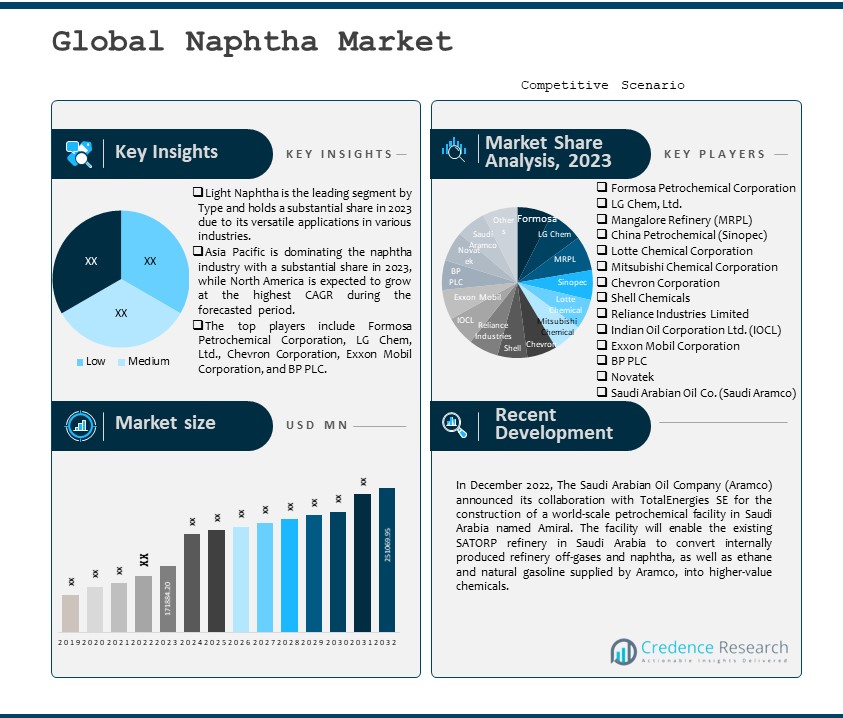
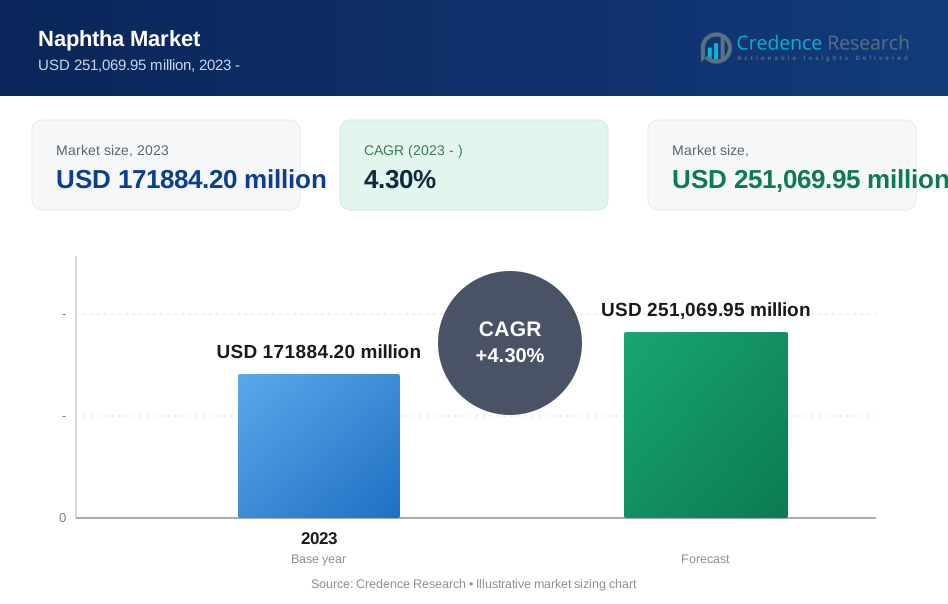
- The global demand for naphtha was valued at USD 171884.20 million in 2023 and is expected to reach USD 251069.95 million in 2032, growing at a CAGR of 4.30% between 2024 and 2032.
- In 2023, Light Naphtha segment was the market leader by type, accounting for the highest share in value, also this segment is expected to grow rapidly throughout the forecast period.
- The petrochemicals industry dominates the global need for naphtha, accounting for a significant share in 2023, and is predicted to expand at a moderate CAGR. While the solvents and chemicals segment is expected to grow with the highest CAGR
- Asia Pacific is dominating the Naphtha industry currently, with over one-third of the market in 2023.
- The market's primary possibilities include significant technological advancements, shift towards green naphtha and increased focus on maximizing resource efficiency and minimizing waste in naphtha production and utilization.
Executive Summary
Market Definition
Naphtha refers to a variety of highly volatile, flammable liquid hydrocarbon mixtures. These mixtures are derived from petroleum or coal tar and are used primarily as solvents, fuels, or as raw materials in the petrochemical industry.
Naphtha is classified into light and heavy naphtha based on its boiling range and composition. Light naphtha is typically used in the production of high-octane gasoline, while heavy naphtha is utilized in chemical manufacturing processes, including the production of olefins in steam crackers. Its applications extend to the production of plastics, synthetic fibers, and industrial chemicals.
Market Overview
The global naphtha market has witnessed steady growth in recent years and is expected to grow at a CAGR of 4.30% between 2024 and 2032. The market was valued at USD 171884.20 million in 2023 and is expected to reach USD 251069.95 million in 2032.
The increasing demand for petrochemical products is a significant factor propelling the expansion of the naphtha market. Naphtha is a critical feedstock in the production of ethylene, propylene, and other olefins, which are essential building blocks for a wide array of chemicals, plastics, and synthetic materials. As industries such as automotive, construction, and consumer goods continue to expand, the need for these petrochemical derivatives rises, consequently boosting the demand for naphtha.
Additionally, technological advancements in refining and petrochemical processes are also playing a pivotal role. Modern catalytic cracking and reforming technologies have improved the efficiency and yield of naphtha production, making it more cost-effective and environmentally friendly. Also, recent developments in refining technologies are centered on enhancing energy efficiency and minimizing emissions. For instance, the adoption of hydroprocessing methods and innovative catalysts has resulted in the production of cleaner fuels characterized by reduced sulfur content. This concurs with environmental standards and responds to market preferences for cleaner energy options. These advancements also help to meet stringent environmental regulations, thereby supporting market expansion.
Moreover, the expansion of the transportation sector is increasing the demand for naphtha. Naphtha is a vital component in gasoline blending, where it is used to enhance the octane rating of fuels. With the global increase in vehicle ownership, especially in emerging economies, the demand for high-quality gasoline is escalating. This surge in fuel consumption is directly contributing to the growth of the naphtha market.
Segmentation by Type
- Light Naphtha is the leading segment by type and held the dominant share in value in 2023. This is primarily due to its versatile applications in various industries. Light naphtha is extensively used as a feedstock in the petrochemical industry, particularly for producing ethylene and propylene through steam cracking. Additionally, it is a crucial component in the blending of gasoline, which ensures a steady demand from the transportation sector. The high demand for petrochemical products and gasoline significantly contributes to the dominance of light naphtha in the market.
- Light Naphtha is also anticipated to be the fastest-growing segment within the global naphtha market. The rapid industrialization and urbanization in emerging economies are driving the growth of the petrochemical and automotive industries. As a result, the demand for light naphtha as a feedstock and blending agent is increasing at a robust pace. Moreover, the shift towards cleaner fuels and stricter environmental regulations are encouraging the use of light naphtha over heavier alternatives, further boosting its growth.
Segmentation by End-Use Industry
- The petrochemical industry holds the largest share in the naphtha market. This dominance is driven by the extensive use of naphtha as a feedstock in the production of various chemicals, including ethylene and propylene, which are essential for manufacturing plastics, synthetic rubber, and other chemical products. The significant demand for petrochemicals in industries such as packaging, automotive, and construction underpins the substantial share of this segment.
- The solvents and chemicals segment is expected to be the fastest-growing segment during the forecasted period. This growth is driven by the increasing demand for industrial solvents in various applications, including paints, coatings, and adhesives. Additionally, the rise in construction activities and automotive production has spurred the demand for cleaning agents and industrial chemicals formulated with naphtha. Technological advancements and the development of high-quality naphtha grades have further enhanced its use in the chemical industry.
- Refining and Fuel segments are anticipated to grow at a moderate CAGR and hold a lower share compared to the petrochemical segment.
Segmentation by Region
- Asia Pacific dominates the Naphtha industry value share in 2023, fueled by rapid industrialization and urbanization, which result in heightened energy and petrochemical consumption. Moreover, the emergence of the Asia Pacific as a manufacturing hub for various industries, including automotive, electronics, and textiles, necessitates extensive energy and raw materials, thereby driving market segments.
- North America is anticipated to showcase the highest growth rate during the forecasted period due to t surge in gasoline consumption, spurred by economic growth and increased industrial activity.
- The rest of the world, including Latin America, the Middle East, and Africa, supplies the remaining demand for Naphtha.
Asia Pacific is poised to lead the Naphtha Market over the forecast period, primarily due to the rapid industrialization and urbanization, which result in heightened energy and petrochemical consumption, propelling market expansion. This increased demand leads to the expansion of the petrochemical industry in the region. For instance, in September 2023, Dushanzi Petrochemical Corp, a subsidiary of China's state-owned energy giant PetroChina, announced the commencement of construction for a substantial petrochemical complex in Xinjiang, with a total investment of USD 3.00 billion. This ambitious project is poised to catalyze significant advancements in the petrochemical industry and foster economic development in the region.
Moreover, the emergence of the Asia Pacific as a manufacturing hub for various industries, including automotive, electronics, and textiles, necessitates extensive energy and raw materials, thereby driving market segments. Additionally, strategic policies and investments by governments in the region to promote energy security and sustainable development further fuel market growth. Furthermore, an increasing focus on environmental conservation, adherence to international emissions standards, and the development of eco-friendly technologies are influential factors shaping market trends in the Asia Pacific region.
On the other hand, North America boasts the highest growth in the naphtha market throughout the forecast period. This growth is propelled by the significant surge in gasoline consumption, spurred by economic growth and increased industrial activity. According to the U.S. Energy Information Administration, Americans utilized approximately 135.73 billion gallons of gasoline in 2022, with motor gasoline being one of the most consumed fuels in the United States. This robust demand for gasoline serves as a factor for growth in the petrochemical sector.
Moreover, expansion of the chemicals industry and the construction of the chemical facilities in the region is also driving market growth. For instance, in September 2023, ExxonMobil announced the startup of two new chemical production units at its Baytown, Texas, manufacturing facility. The USD 2 billion expansion is part of ExxonMobil’s long-term growth plans to deliver higher-value products from its U.S. Gulf Coast refining and chemical facilities.
The new linear alpha olefins unit will produce 350,000 tons per year of Elevexx-branded products, marking ExxonMobil’s entry into the market. Linear alpha olefins are used in plastic packaging, high-performing engine and industrial oils, and other applications. This facility is one of the largest integrated and most technologically advanced refining and petrochemical complexes in the world. With its strategic advantages and continued emphasis on innovation and sustainability, North America remains poised to play a pivotal role in shaping the future trajectory of the naphtha industry.
Key Highlights of the Report
The global Naphtha Market is segmented by type, end-use industry, and region. Light Naphtha dominates the market in 2023, holding the largest value share. The petrochemicals industry remains the primary end user industry, with Asia Pacific region leading the market share.
The global naphtha market is growing rapidly, driven by the rising demand for petrochemicals, crucial in various industries and the expanding transportation sector, especially in emerging economies, that increases the need for high-octane gasoline. Additionally, technological advancements in refining processes have made production more efficient and cost-effective, driving market expansion.
Nonetheless, while Asia Pacific is expected to hold the largest market share due to rapid industrialization and urbanization, which result in heightened energy and petrochemical consumption, Asia Pacific is anticipated to see the fastest growth driven by significant surge in gasoline consumption, spurred by economic growth and increased industrial activity.
What Are The Main Drivers Of The Global Naphtha Market?
The global naphtha market is growing rapidly, driven by rising demand for petrochemicals, essential in various industries, that is substantially boosting naphtha consumption. Additionally, the expanding transportation sector, particularly in emerging economies, is increasing the need for high-octane gasoline, further driving naphtha demand. Moreover, technological advancements in refining processes have made production more efficient and cost-effective.
What are The Major Challenges Faced By The Global Naphtha Market?
The volatility in crude oil prices present a significant challenge to market growth. Fluctuations in oil prices that directly impact its cost, creating uncertainty and potential financial risks for manufacturers and end-users. Moreover, the growing competition from alternative feedstocks impedes the market growth. The rise of shale gas and the increased availability of natural gas liquids (NGLs) have provided the petrochemical industry with cost-effective alternatives to naphtha, further declining the demand for naphtha industry.
What Are The Growth Opportunities In The Global Naphtha Market?
The escalating focus on sustainability in the petrochemical industry presents compelling opportunities for the naphtha market in the foreseeable period. Companies are innovating to develop eco-friendly naphtha variants and integrate circular economy principles. By aligning with sustainability goals, naphtha producers are expected to foster long-term growth, navigate regulatory challenges, and drive technological innovation, positioning themselves as leaders in a rapidly evolving industry.
Market Drivers
Several factors drive the global Naphtha Market. The following are the key drivers of the global Naphtha Market:
Expansion of the Petrochemical Industry
The expansion of the petrochemical industry is a major driver of growth in the naphtha market. Naphtha serves as a crucial feedstock for producing aromatics and olefins, including benzene, butadiene, ethylene, toluene, and propylene. The continuous growth of the petrochemical sector significantly fuels the demand for naphtha. Olefin-rich naphtha is particularly valuable for producing cost-effective high-octane diesel, meeting the increasing global demand for affordable fuel driven by rapid urbanization and population growth.
In rapidly developing regions the consumption and production of naphtha are on the rise. For example, in November 2023, the board of Oil and Natural Gas Corp. Ltd. (ONGC) approved an investment exceeding USD 1 billion to construct two new petrochemical complexes in India. This strategic move, owing to the declining demand for crude-oil-based transportation fuels, includes plans to invest around USD 1.2 billion by 2028 or 2030 to enhance ONGC’s petrochemical production capacity from approximately 3.4 million tonnes per year (tpy) to between 8.5 and 9 million tpy by 2030. Such significant investments and the strategic expansion of petrochemical infrastructure underscore the industry's proactive measures to meet the rising demand for petrochemical products.
Market Restraints
The global Naphtha Market faces some challenges that may hinder its growth. These include the following:
Growing Competition from Alternative Feedstocks
The increasing competition from alternative feedstocks derived from shale gas is restraining the growth of the naphtha market. The burgeoning shale gas production in recent years, particularly in North America, has unlocked vast reserves, leading to a concomitant rise in the availability of Natural Gas Liquids (NGLs) such as ethane, propane, and butane. These NGLs are posing a serious challenge to naphtha's dominance as a key petrochemical feedstock.
The primary factor driving this shift is economic competitiveness. Ethane, for instance, possesses a simpler molecular structure than naphtha. This characteristic translates to a lower energy requirement during the cracking process to produce ethylene, the fundamental building block for a wide range of plastics and other petrochemicals. This translates to significant cost savings for petrochemical companies, incentivizing them to migrate strategically toward NGLs.
Moreover, the versatility of NGLs presents an additional strategic consideration. Propane can be dehydrogenated to produce propylene, another crucial petrochemical feedstock. Butane offers further possibilities, finding application in gasoline blending and butadiene production, thus expanding the product portfolio achievable with NGLs. This adaptability grants petrochemical companies greater flexibility in their feedstock selection, impeding the demand for naphtha market.
Opportunities
The global Naphtha Market offers significant growth opportunities. These include the following:
Growing Emphasis on Sustainable Practices
The burgeoning focus on sustainable practices within the petrochemical industry heralds promising opportunities for the naphtha market. As environmental concerns mount, companies are intensifying their efforts to develop naphtha variants that boast a smaller ecological footprint. This commitment extends beyond mere product refinement to embrace the holistic principles of the circular economy. By integrating these principles into their operations, companies are maximizing resource efficiency. These sustainable initiatives resonate deeply with eco-conscious investors and consumers who are increasingly prioritizing environmentally responsible practices. Moreover, as regulatory frameworks evolve to emphasize environmental stewardship, companies that embrace sustainable naphtha production are better positioned to navigate compliance challenges and mitigate regulatory risks.
Furthermore, the adoption of sustainable practices fosters innovation and drives technological advancement within the naphtha industry. This creates a ripple effect, catalyzing the development of novel processes and solutions that further optimize naphtha production while reducing its environmental impact. By staying at the forefront of sustainable innovation, naphtha manufacturers can pioneer transformative change within the broader petrochemical landscape.
Competitive Landscape
Key Players
The global Naphtha Market is highly competitive, with several key players. Some of the major players in the market and their market share are as follows:
- Formosa Petrochemical Corporation
- LG Chem, Ltd.
- Mangalore Refinery and Petrochemicals Limited (MRPL)
- China Petrochemical Corporation (Sinopec)
- Lotte Chemical Corporation
- Mitsubishi Chemical Corporation
- Chevron Corporation
- Shell Chemicals
- Reliance Industries Limited
- Indian Oil Corporation Ltd. (IOCL)
- Exxon Mobil Corporation
- BP PLC (British Petroleum)
- Novatek
- Saudi Arabian Oil Co. (Saudi Aramco)
- Others
These organizations prioritize product innovation, distribution channel expansion, and mergers and acquisitions to stay competitive.
The global naphtha market's key players continually seek to stay ahead by collaboration.
In December 2022, The Saudi Arabian Oil Company (Aramco) announced its collaboration with TotalEnergies SE for the construction of a world-scale petrochemical facility in Saudi Arabia named Amiral. The facility will enable the existing SATORP refinery in Saudi Arabia to convert internally produced refinery off-gases and naphtha, as well as ethane and natural gasoline supplied by Aramco, into higher-value chemicals.
In May 2022, BP plc signed a 10-year offtake agreement with Clean Planet Energy, a UK-based company developing facilities to convert hard-to-recycle waste plastics into circular petrochemical feedstocks and ultra-low sulfur diesel (ULSD). Under the agreement, BP will initially receive output from Clean Planet Energy’s first facility, the Teesside facility, designed to process 20,000 tonnes per year of waste plastics into naphtha and ULSD.
How are Companies Performing in the Naphtha Market?
The global Naphtha Market is highly competitive, with several key players.
Startups are playing a significant role in driving innovation and growth in the naphtha industry. These emerging companies are leveraging new technologies, business models, and sustainability practices to make notable contributions to the industry. Startups are making an impact through the development of novel naphtha conversion technologies. For example, Siluria Technologies, a California-based startup, has developed a proprietary process that converts natural gas into ethylene, propylene, and other valuable chemicals, bypassing the need for traditional naphtha cracking. By optimizing naphtha utilization, these startups are increasing the value derived from this feedstock while reducing waste and emissions.
Additionally, startups are exploring alternative sources of naphtha beyond traditional petroleum-based feedstocks. For instance, Anellotech, a New York-based startup, is pioneering the use of renewable feedstocks, such as biomass, to produce bio-based aromatics and olefins, including naphtha. By tapping into sustainable sources, these startups are contributing to the industry's efforts to reduce its reliance on fossil fuels and minimize its environmental impact.
Moreover, startups are driving sustainability initiatives within the naphtha industry. For example, Enerkem, a Canadian startup, has developed a proprietary thermochemical process that converts non-recyclable waste into biofuels and chemicals, including naphtha. By prioritizing sustainability, startups including Enerkem are meeting the growing demand for environmentally responsible products and positioning themselves as leaders in a rapidly evolving industry. Startups are bringing fresh ideas, agility, and innovation to the naphtha industry, driving progress, addressing industry challenges, and shaping the future of the market in a sustainable and inclusive manner.
Summary of Key Findings
- The global naphtha market is expanding rapidly, fueled by the increasing demand for petrochemicals, which are crucial across various industries. Additionally, the growing transportation sector, especially in emerging economies, is driving the need for high-octane gasoline, further enhancing naphtha demand. Technological advancements in refining processes have made production more efficient and cost-effective.
- Market segmented by type, end user industry, and region.
- Light Naphtha are the most popular, with the petrochemicals industry remaining the primary end user industry.
- Asia Pacific is leading market growth; the market is highly competitive, with key players including Formosa Petrochemical Corporation, LG Chem, Ltd., Mangalore Refinery and Petrochemicals Limited (MRPL), China Petrochemical Corporation (Sinopec), Lotte Chemical Corporation, Mitsubishi Chemical Corporation, Chevron Corporation, Shell Chemicals, Reliance Industries Limited, Indian Oil Corporation Ltd. (IOCL), Exxon Mobil Corporation, BP PLC (British Petroleum), Novatek, and Saudi Arabian Oil Co. (Saudi Aramco).
Future Outlook
- Positive outlook for the global naphtha market with significant growth potential in the North American region.
- The key drivers accelerating the growth of the Naphtha Market include the rising demand for petrochemicals and the expanding transportation sector, particularly in emerging economies.
- During the forecast period, volatility in crude oil prices and the growing competition from alternative feedstocks is expected to significantly restrain the growth of the Naphtha Market.
- Key firms must focus on product innovation, growing market reach, and maintaining competitive pricing to keep ahead of the competition.
How CXOs Can Benefit from the Credence Research Naphtha Market Report
The Credence Research Naphtha Market Report provides CXOs with a comprehensive overview of the market, including:
- Market size and growth forecast: The report provides detailed estimates of the global Naphtha Market size, segmented by type, end user industry, and region. It also includes forecasts for the market through 2032 based on key trends and drivers.
- Market segmentation: The report segments the Naphtha Market by type, end user industry, and region. This segmentation provides CXOs with a granular understanding of the market and the opportunities in each segment.
- Competitive Landscape: The report profiles the key players in the Naphtha Market and provides insights into their strategies, product offerings, and financial performance. This information can help CXOs to identify and assess their competition.
- Key trends and drivers: The report identifies and analyzes the key trends and drivers shaping the Naphtha Market. This information can help CXOs make informed decisions about their investments and strategies.
CXOs can use the insights from the Credence Research Naphtha Market Report to:
- Identify growth opportunities: The report can help CXOs identify new growth opportunities in the Naphtha Market. For example, it identifies the growing demand for Naphtha for specific applications such petrochemicals and refining industry along with growing demand in transportation sector.
- Make informed investment decisions: The report can help CXOs make informed investment decisions about Naphtha. For example, the report provides insights into the key factors to consider when evaluating Naphtha providers.
- Develop competitive strategies: The report can help CXOs develop competitive strategies for their Naphtha businesses. For example, the report identifies the key strategies that naphtha providers are using to differentiate themselves from their competitors.
- Track market developments: The report can help CXOs monitor market developments and stay ahead of the curve. For example, it provides insights into the latest trends and innovations in the Naphtha Market.
Overall, the Credence Research Naphtha Market Report is a valuable resource for CXOs who are looking to gain a deeper understanding of the market and identify opportunities for growth.
Segmentation
- By Type
- Light Naphtha
- Heavy Naphtha
- By End User Industry
- Petrochemicals
- Refining
- Solvents & Chemicals
- Fuel
- By Region
- North America
- The U.S.
- Canada
- Mexico
- Europe
- Germany
- France
- The U.K.
- Italy
- Spain
- Rest of Europe
- Asia Pacific
- China
- Japan
- India
- South Korea
- South-east Asia
- Rest of Asia Pacific
- Latin America
- Brazil
- Argentina
- Rest of Latin America
- Middle East & Africa
- GCC Countries
- South Africa
- Rest of the Middle East and Africa
- North America
Adjacent Markets
In the Naphtha Market, several adjacent markets have high revenue growth opportunities. The key adjacent markets for the Naphtha Market -
Adjacent Markets |
||
| Petrochemicals market | Gasoline market | Paints and Coatings Market |
| Plastics market | Fertilizer market | Renewable naphtha market |
| Naphthalene derivatives market | Renewable methanol market | Low-boiling Naphtha Market |
Request a Free Sample
Fill in your details and we'll send you a free sample report.
- Sample data tables & charts
- Research methodology
Need a Custom Version of This Report?
Tailor the scope, geography, or segments to your exact requirements.
- Custom geography or segment scope
- Direct access to our analyst team
Frequently Asked Questions
What is the current size of the global naphtha market?
What is the expected growth rate of the naphtha market between 2024 and 2032?
Which segment is leading the market share in terms of type?
Which end user industry governs the demand for Naphtha globally?
Which region is expected to post the highest CAGR during the forecast period?
Which region is dominating the Naphtha industry share?
Who are the major players in the global Naphtha Market?
What are the major market drivers of the Naphtha industry?
What are the major market restraints of the Naphtha industry?
What are the major market opportunities of the Naphtha industry?
Table of Content
Chapter 1. Report Introduction
- 1.1 Report Description & Purpose
- 1.1.1 Report Title & Market Definition
- 1.1.2 Unique Selling Propositions (USP) & Key Differentiators
- 1.1.3 Value Proposition for Stakeholders
- 1.2 Research Objectives
- 1.2.1 Market Sizing Objectives (Volume & Revenue)
- 1.2.2 Segmentation Objectives
- 1.2.3 Competitive Intelligence Objectives
- 1.2.4 Forecast & Scenario Objectives
- 1.3 Report Scope
- 1.3.1 Naphtha Scope – Types & Subtypes Covered
- 1.3.2 Geographic Scope – Regions & Countries Covered
- 1.3.3 Historical Period, Base Year & Forecast Period (2023; forecast to the forecast period)
- 1.3.4 Inclusions & Exclusions
- 1.4 HS Code & Classification Framework
- 1.5 Currency, Units & Pricing Basis
- 1.6 Target Stakeholders
- 1.7 Limitations & Assumptions
Chapter 2. Executive Summary
- 2.1 Global Naphtha Market Snapshot
- 2.1.1 Market Size – Historical (2023) & Forecast (the forecast period) (2023: USD 171884.20 million → forecast year: USD 251,069.95 million)
- 2.1.2 Volume & Revenue – Global Totals
- 2.1.3 Key Market Highlights – Top Five Facts
- 2.2 Naphtha Market Segmentation Snapshot
- 2.2.1 Market Split by Region – 2023 vs.
- 2.3 Competitive Snapshot
- 2.3.1 Top 10 Players by Revenue Share – 2023
- 2.3.2 Top 10 Players by Volume Share – 2023
- 2.3.3 Recent Strategic Developments (18-Month Summary)
- 2.4 Key Investment Highlights & Strategic Conclusions
Chapter 3. Naphtha Market Dynamics & Industry Analysis
- 3.1 Market Overview & Context
- 3.1.1 Naphtha Market Position in the Broader Automotive Value Chain
- 3.1.2 OEM vs. Replacement Market Dynamics
- 3.1.3 Market Maturity & Development Stage by Region
- 3.2 Naphtha Market Drivers
- 3.3 Naphtha Market Restraints & Challenges
- 3.4 Naphtha Market Opportunities
- 3.5 Porter's Five Forces Analysis
- 3.5.1 Threat of New Entrants
- 3.5.2 Bargaining Power of Suppliers
- 3.5.3 Bargaining Power of Buyers
- 3.5.4 Threat of Substitutes
- 3.5.5 Competitive Rivalry – Intensity Assessment
- 3.6 Naphtha Value Chain Analysis
- 3.6.1 Upstream – Raw Material/Input Suppliers
- 3.6.1.1 Raw Material/Input 1
- 3.6.1.2 Raw Material/Input 2
- 3.6.1.3 Raw Material/Input 3
- 3.6.2 Midstream – Production/Manufacturing/Service Delivery
- 3.6.2.1 Production/Process Overview
- 3.6.2.2 Key Facility Locations & Capacity by Manufacturer
- 3.6.3 Downstream – Distribution & End Consumer
- 3.6.3.1 Primary Channel – B2B/OEM
- 3.6.3.2 Secondary Channels – Dealer, Retail, Online, Direct
- 3.6.4 Value Chain Profitability Analysis
- 3.6.1 Upstream – Raw Material/Input Suppliers
- 3.7 PESTEL Analysis
- 3.7.1 Political Factors
- 3.7.2 Economic Factors
- 3.7.3 Social Factors
- 3.7.4 Technological Factors
- 3.7.5 Environmental Factors
- 3.7.6 Legal Factors
- 3.8 Naphtha Supply Chain Analysis
- 3.8.1 Raw Material/Input Supply Risk Assessment
- 3.8.2 Manufacturing Concentration Risk (Geographic Exposure)
- 3.8.3 Trade Disruption Impact Analysis
- 3.9 Regulatory & Policy Landscape
Note: The regulatory and policy landscape section covers regulations based on their applicability to the market, Naphtha category, geography, and scope of the study. Only regulatory frameworks with a material impact on operations, compliance, trade, sustainability, or market access are analyzed in detail.
Chapter 4. Key Investment Pockets & Opportunity Analysis
- 4.1 Naphtha Market Attractiveness Analysis
- 4.1.1 By Region – Investment Attractiveness Matrix (Volume × CAGR)
- 4.2 Absolute Revenue Growth Opportunity
- 4.2.1 By Region – Absolute USD Growth Through the forecast period
- 4.3 Incremental Volume Opportunity
- 4.3.1 By Region – Incremental Volume Through the forecast period
- 4.3.2 Segment – Incremental Volume
- 4.4 Emerging Submarket Opportunity Deep Dive (Subject to Applicability)
- 4.5 Emerging Market Opportunity Scorecards
- 4.5.1 United States
- 4.5.2 Europe
- 4.5.3 Asia
- 4.5.4 Middle East & Africa
Note: Emerging Market Opportunity Scorecards will be included based on relevance and strategic importance. Regions listed are indicative and may vary depending on data availability and market dynamics.
Chapter 5. Naphtha Import-Export Analysis & Trade Flows
- 5.1 Global Trade Overview
- 5.1.1 Global Export Value by Country (2023)
- 5.1.2 Global Export Volume by Country (2023)
- 5.1.3 Global Import Value by Country (2023)
- 5.1.4 Global Import Volume by Country (2023)
- 5.1.5 Net Trade Balance by Country (2023)
- 5.2 Export Analysis – Segment
- 5.2.1 Type 1 (HS Code)
- 5.2.2 Type 2 (HS Code)
- 5.2.3 Type 3 (HS Code)
- 5.2.4 Type 4 (HS Code)
- 5.2.5 Type 5 (HS Code)
- 5.3 Import Analysis – Segment
- 5.3.1 Type 1 (HS Code)
- 5.3.2 Type 2 (HS Code)
- 5.3.3 Type 3 (HS Code)
- 5.3.4 Type 4 (HS Code)
- 5.3.5 Type 5 (HS Code)
- 5.4 Average Unit Trade Prices
- 5.4.1 Average Export Price – Segment & Country
- 5.4.2 Average Import Price – Segment & Source Country
- 5.4.3 Price Trends (2023)
- 5.5 Key Trade Route Analysis
- 5.5.1 Trade Route 1
- 5.5.2 Trade Route 2
- 5.5.3 Trade Route 3
- 5.5.4 Trade Route 4
- 5.5.5 Trade Route 5
- 5.6 Trade Policy Impact Assessment
- 5.6.1 US Anti-Dumping & Section 301 Tariffs
- 5.6.2 EU Customs Union Impact
- 5.6.3 Major Free Trade Agreements
- 5.6.4 USMCA Rules of Origin
Note: Trade policy analysis will be included only where relevant to the Naphtha market.
Chapter 6. Competitive Landscape & Company Benchmarking
- 6.1 Naphtha Market Concentration & Structure
- 6.1.1 Herfindahl-Hirschman Index (HHI) – vs. 2023
- 6.1.2 Tier 1, Tier 2 & Tier 3 Market Structure
- 6.1.3 Global, Regional & Local Player Dynamics
- 6.2 Naphtha Market Share Analysis – 2023
- 6.2.1 Global Revenue Share by Company
- 6.2.2 Global Volume Share by Company
- 6.2.3 Regional Revenue Share
- 6.2.4 Market Share Evolution ( vs. 2023)
- 6.2.5 OEM Segment Share by Company
- 6.2.6 Replacement Segment Share by Company
- 6.3 Production/Delivery Capacity & Facility Analysis
- 6.3.1 Global Installed Capacity
- 6.3.2 Capacity Utilization Rates
- 6.3.3 Production/Output Volume
- 6.3.4 Facility Locations & Capacity Map
- 6.3.5 Planned Capacity Additions
- 6.4 Naphtha Competitive Benchmarking Matrix
- 6.4.1 Revenue, Volume, CAGR & Profitability Comparison
- 6.4.2 Channel Revenue Mix
- 6.4.3 Geographic Revenue Exposure
- 6.4.4 R&D Intensity
- 6.4.5 Sustainability Maturity
- 6.5 Strategic Developments in Naphtha (Last 24 Months)
- 6.5.1 Mergers, Acquisitions & Divestments
- 6.5.2 New Naphtha Launches
- 6.5.3 Facility Expansions
- 6.5.4 Strategic Alliances, Joint Ventures & Partnerships
- 6.5.5 Distribution Expansion & Market Entry
- 6.5.6 Sustainability & ESG Initiatives
- 6.6 Competitive Strategy Mapping
- 6.6.1 Leader, Challenger, Follower & Niche Classification
- 6.6.2 Pricing Strategy Comparison
- 6.6.3 Channel Strategy Matrix
Note: Strategic developments are included based on their materiality and the availability of reliable information.
Chapter 7. Global Naphtha Market – By Distribution Channel
- 7.1 Segment Overview
- 7.1.1 Volume & Revenue Split by Channel (2023 & )
- 7.1.2 Channel Mix Evolution (the forecast period)
Chapter 8. Regional Market Analysis – Global Overview
- 8.1 Global Regional Overview
- 8.1.1 Regional Volume Share
- 8.1.2 Regional Revenue Share
- 8.1.3 Regional Volume by Region
- 8.1.4 Regional Revenue by Region
- 8.1.5 Regional Forecast Through the forecast period
- 8.2 Cross-Regional Segment Analysis
- 8.2.1 By Distribution Channel
- 8.2.2 By Brand/Price Tier
Chapter 9. North America Naphtha Market
- 9.1 United States
- 9.2 Canada
- 9.3 Mexico
Chapter 10. Europe Naphtha Market
- 10.1 Germany
- 10.2 France
- 10.3 Italy
- 10.4 United Kingdom
- 10.5 Spain
- 10.6 Poland
- 10.7 Russia
- 10.8 Netherlands
- 10.9 Belgium
- 10.10 Sweden
- 10.11 Denmark
- 10.12 Norway
- 10.13 Rest of Europe
Chapter 11. Asia Pacific Naphtha Market
- 11.1 China
- 11.2 India
- 11.3 Japan
- 11.4 South Korea
- 11.5 Thailand
- 11.6 Indonesia
- 11.7 Vietnam
- 11.8 Malaysia
- 11.9 Australia
- 11.10 Rest of Asia Pacific
Chapter 12. Latin America Naphtha Market
- 12.1 Brazil
- 12.2 Argentina
- 12.3 Colombia
- 12.4 Chile
- 12.5 Rest of Latin America
Chapter 13. Middle East Naphtha Market
- 13.1 Saudi Arabia
- 13.2 United Arab Emirates
- 13.3 Turkey
- 13.4 Israel
- 13.5 Iran
- 13.6 Rest of the Middle East
Chapter 14. Africa Naphtha Market
- 14.1 South Africa
- 14.2 Egypt
- 14.3 Nigeria
- 14.4 Morocco
- 14.5 Rest of Africa
Chapter 15. Naphtha Company Profiles
- 15.1 [Company 01]
- 15.1.1 Company Overview
- 15.1.2 Key Management Personnel
- 15.1.3 Products & Services Portfolio
- 15.1.4 Financial Performance
- 15.1.5 Key Market Focus & Geographic Presence
- 15.1.6 Recent Developments & Strategic Initiatives
Note: The company profile list is preliminary and may change based on research findings, market developments, data availability, and client requirements.
Chapter 16. Appendices
- Appendix A – List of Abbreviations & Acronyms
- Appendix B – Industry Classification Code Reference – Full Series
- Appendix C – Production & Capacity Data Tables
- Appendix D – End-Use & Demand Base Tables
- Appendix E – Consumption & Replacement Rate Assumptions
- Appendix F – ASP Reference Tables
- Appendix G – Manufacturing & Facility Database
- Appendix H – Import-Export Data Tables
- Appendix I – Regulatory Summary Tables
- Appendix J – Primary Research Participant List (Anonymized)
- Appendix K – Primary Research Questionnaire Framework
- Appendix L – Data Sources & Bibliography
- Appendix M – Market Size Divergence & Source Comparison
Chapter 17. Research Methodology
- 17.1 Research Framework & Philosophy
- 17.2 Secondary Research – Sources, Hierarchy & Data Extraction
- 17.3 Data Modeling – Bottom-Up & Top-Down Market Sizing
- 17.4 Primary Research – Stakeholder Framework, LOI & Sample Sizes
- 17.5 Forecast Methodology – Regression, Scenario & Sensitivity Analysis
- 17.6 Quality Control – Four-Layer Validation Framework
- 17.7 Limitations & Standard Assumptions
- 17.8 Disclaimer
