
Market Overview
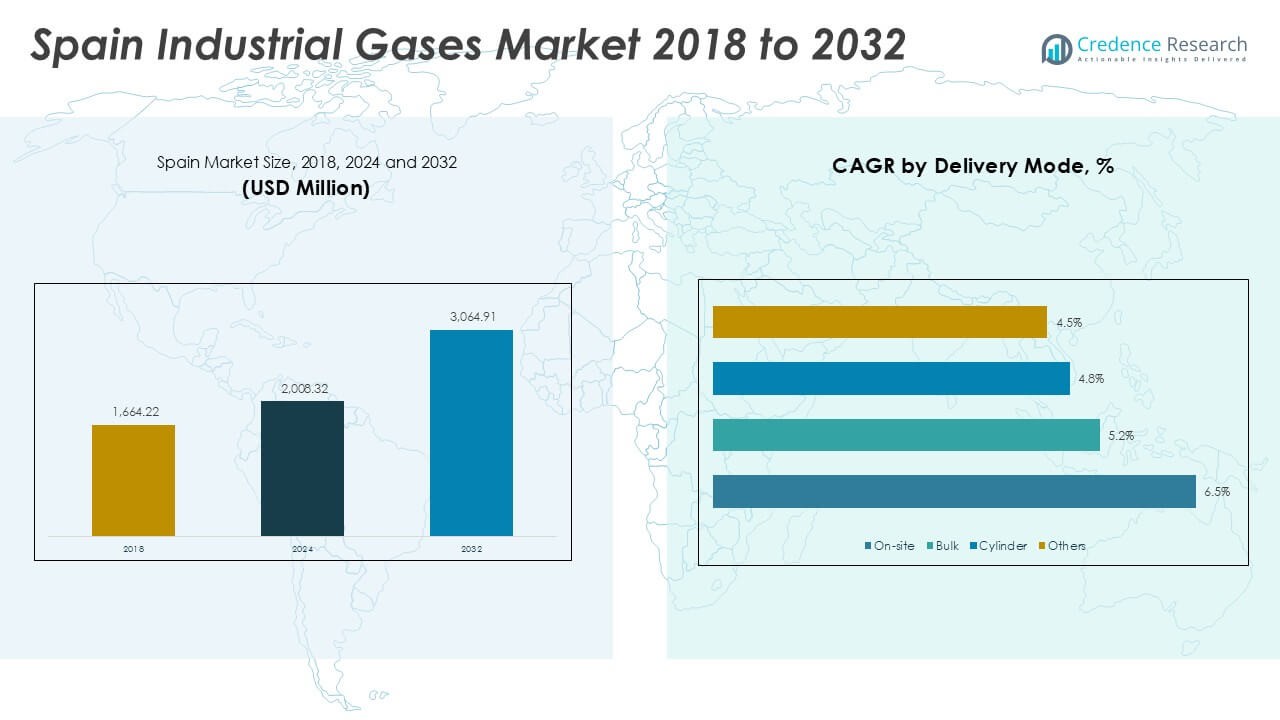
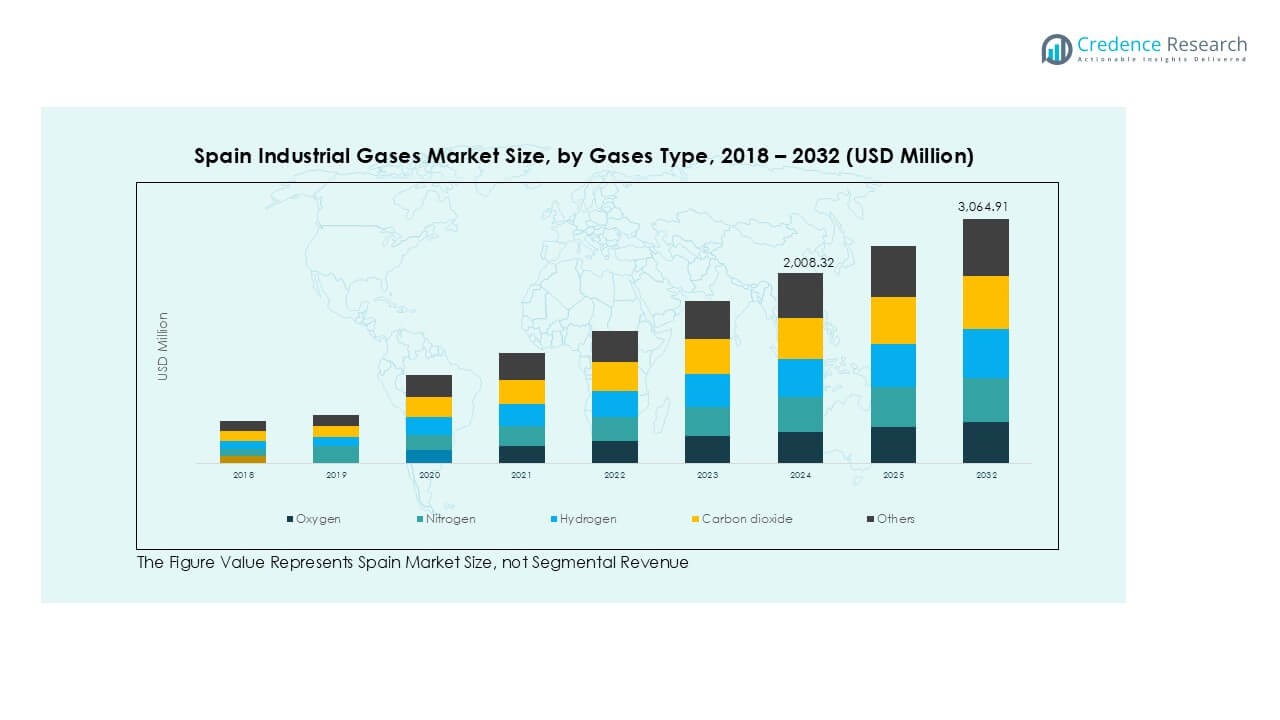
Spain Industrial Gases market size was valued at USD 1,664.22 million in 2018, grew to USD 2,008.32 million in 2024, and is anticipated to reach USD 3,064.91 million by 2032, at a CAGR of 5.43% during the forecast period.
| REPORT ATTRIBUTE | DETAILS |
|---|---|
| Historical Period | 2020-2023 |
| Base Year | 2024 |
| Forecast Period | 2025-2032 |
| Spain Industrial Gases Market Size 2024 | USD 2,008.32 Million |
| Spain Industrial Gases Market, CAGR | 5.43% |
| Spain Industrial Gases Market Size 2032 | USD 3,064.91 Million |
The Spain industrial gases market is led by Carburos Metálicos S.A., Air Liquide España, Linde Gas España (via Praxair/Linde Group), Messer Ibérica de Gases S.A., and SOL España (SOL Group), together accounting for a significant majority of the national supply. These players maintain robust production facilities, advanced distribution networks, and strong customer bases across key industries including healthcare, manufacturing, and food & beverage. Urban centers such as Madrid and Barcelona dominate with a 45% market share in 2024, supported by dense hospital networks, pharmaceutical plants, and automotive manufacturing hubs. Coastal regions contribute 25%, driven by LNG terminals and shipbuilding demand, while rural areas hold 30% due to agriculture and food processing activity.
Market Insights
- The Spain industrial gases market was valued at USD 2,008.32 million in 2024 and is projected to reach USD 3,064.91 million by 2032, growing at a CAGR of 5.43% during the forecast period.
- Growing demand from healthcare and pharmaceutical sectors is driving oxygen and nitrogen consumption, supported by rising hospital capacity and vaccine production facilities.
- Key trends include expansion of green hydrogen projects such as Hydrogen Valley of Catalonia and increasing adoption of cryogenic applications in LNG terminals, biobanking, and space research.
- The market is moderately consolidated with major players like Carburos Metálicos, Air Liquide España, Linde Gas España, Messer Ibérica, and SOL España focusing on capacity expansion, long-term contracts, and digital gas monitoring solutions.
- Urban centers hold 45% share, rural areas contribute 30%, and coastal regions account for 25%; oxygen leads by gas type with 35% share, followed by nitrogen and carbon dioxide.
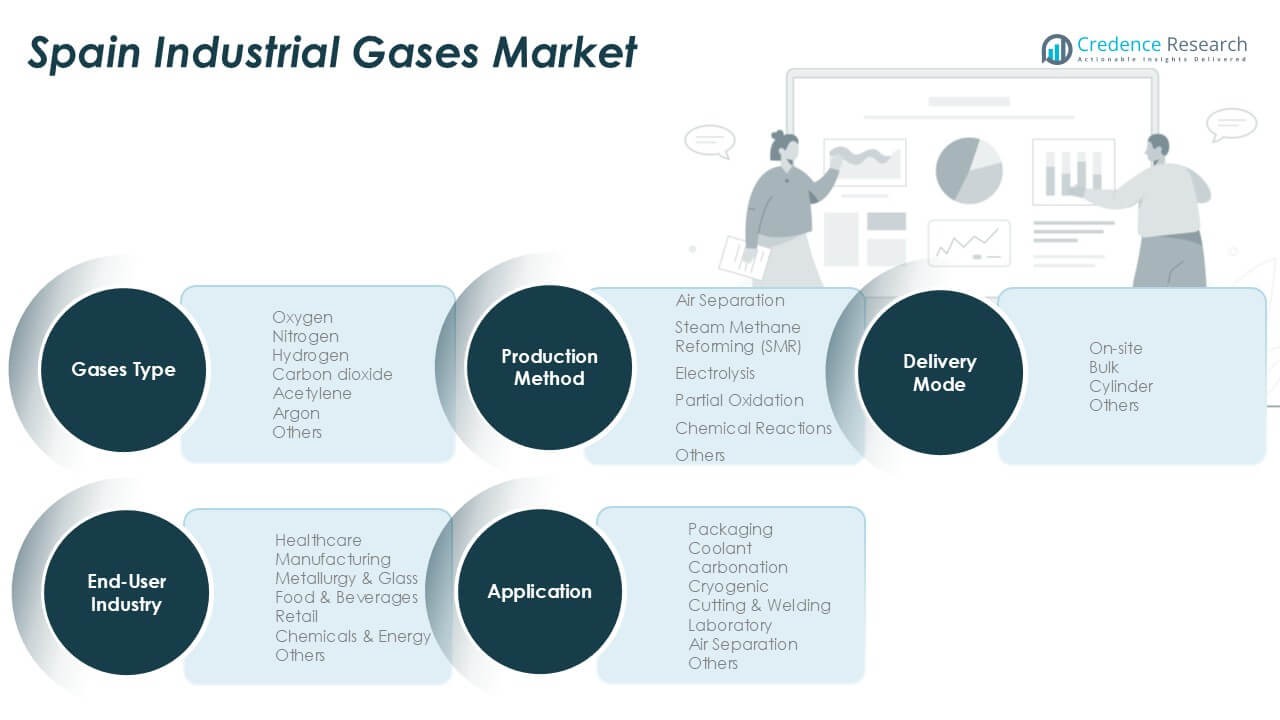
Market Segmentation Analysis:
By Gases Type
Oxygen held the dominant share of over 35% in 2024, driven by its critical use in healthcare, metal fabrication, and wastewater treatment. Spain’s strong healthcare sector and rising surgical procedures have boosted oxygen demand in hospitals and clinics. Nitrogen followed closely due to its role in food packaging and preservation, supporting Spain’s large food and beverage industry. Hydrogen demand is growing with the country’s green hydrogen projects under its decarbonization roadmap, while carbon dioxide remains key for carbonation and refrigeration applications. Argon and acetylene maintain steady consumption in welding and metal cutting operations.
- For instance, Air Liquide operates in Spain, where it supplies gases, equipment, and services to a variety of industries, including the metal industry and major hospitals, through its Healthcare division.
By Application
Cutting & welding applications accounted for the largest market share at nearly 30% in 2024, supported by Spain’s robust manufacturing and automotive sectors. The demand is fueled by infrastructure development, shipbuilding, and metal fabrication industries that require precision welding and cutting processes. Carbonation and packaging applications are expanding as the beverage industry grows, particularly in soft drinks and beer production. Cryogenic applications are seeing growth with rising use of liquefied gases in healthcare and energy sectors. Laboratory and air separation applications continue steady demand from research, testing, and chemical production facilities.
- For instance, Navantia's Ferrol and Cádiz shipyards conduct extensive welding operations for naval ship construction projects, which consume large quantities of oxygen and argon as shielding gases.
By End-User Industry
The manufacturing sector dominated with over 40% share in 2024, supported by Spain’s automotive, machinery, and electronics production base. Industrial gases are widely used for welding, cutting, heat treatment, and protective atmospheres in manufacturing plants. The healthcare industry is a major growth driver due to high oxygen and nitrogen demand in hospitals, diagnostic centers, and pharmaceutical manufacturing. Food and beverage players contribute significantly through carbonation, freezing, and packaging processes. Metallurgy and glass industries consume gases for smelting, refining, and forming operations, while chemicals and energy sectors rely on hydrogen and nitrogen for process efficiency.
Key Growth Drivers
Expanding Healthcare and Pharmaceutical Sector
Spain’s growing healthcare infrastructure is driving strong demand for medical-grade oxygen, nitrogen, and other specialty gases. Rising surgical volumes, ICU capacity, and pharmaceutical production facilities are increasing gas consumption. The expansion of biologics and vaccine manufacturing also requires controlled atmospheres using nitrogen. Government investments in healthcare modernization and EU-funded programs are further boosting infrastructure growth, ensuring sustained demand for industrial gases. This driver continues to play a vital role in supporting consistent supply agreements with hospitals, clinics, and life sciences companies across Catalonia, Madrid, and other major urban centers.
- For instance, Spain performed approximately 3.5 million surgical procedures in 2023, a figure that continues to drive oxygen demand in operating theaters.
Manufacturing and Metal Fabrication Growth
The manufacturing sector remains a cornerstone of Spain’s economy, fueling demand for welding and cutting gases like oxygen, acetylene, and argon. The automotive, shipbuilding, and machinery industries are key consumers, requiring gases for precision fabrication and thermal treatments. Increasing investments in automation and Industry 4.0 technologies are also encouraging the adoption of advanced gas delivery systems. Industrial clusters in Catalonia, Basque Country, and Andalusia are leading this demand. Infrastructure development projects and construction activities further enhance the requirement for industrial gases, driving steady growth in production and distribution capacity across Spain.
- For example, Spain produced over 2.4 million vehicles in 2023, with welding stations consuming large volumes of oxygen and argon daily in assembly plants.
Green Hydrogen and Energy Transition Initiatives
Spain is positioning itself as a European leader in green hydrogen production under its energy transition strategy. Government-backed projects such as Hydrogen Valley of Catalonia and hydrogen corridors are increasing hydrogen consumption for industrial use and mobility applications. Industrial gas suppliers are investing in electrolyzer capacity and distribution networks to meet future demand. These developments create a major growth opportunity for hydrogen supply, storage, and distribution solutions. This shift not only supports Spain’s decarbonization targets but also drives innovation in gas infrastructure, offering long-term growth prospects for market players.
Key Trends & Opportunities
Rising Adoption of Cryogenic Applications
Cryogenic gases are gaining traction in healthcare, energy, and research sectors. Liquid nitrogen and oxygen are increasingly used for medical freezing, biobanking, and advanced research applications. The rise of LNG infrastructure also boosts cryogenic technology adoption. Spain’s growing investment in space research and biotech supports steady demand for high-purity cryogenic gases. Industrial gas producers are focusing on expanding cryogenic storage and transport solutions to meet this rising need. This trend provides suppliers with opportunities to offer specialized delivery systems and improve service reliability for critical applications.
- For instance, Spain’s national biobank network stores over 15 million biological samples, relying on cryogenic liquid nitrogen systems to maintain −196 °C storage conditions.
Food and Beverage Sector Expansion
Spain’s strong position in food exports is driving demand for nitrogen and carbon dioxide for packaging and carbonation. Modified atmosphere packaging (MAP) ensures extended shelf life for meat, seafood, and produce, which is key for export markets. Increasing domestic consumption of soft drinks and beer also contributes to CO₂ demand. Growth in quick-service restaurants and frozen food chains further supports gas consumption. This sector presents opportunities for gas suppliers to offer customized packaging solutions and supply agreements with food processors and beverage producers across Valencia, Andalusia, and Catalonia.
- For example, Spain exported over €70 billion worth of agri-food products in 2023, much of which relied on MAP technology to maintain quality.
Digitalization and Smart Gas Monitoring
Industrial gas suppliers are adopting digital platforms for gas distribution, tracking, and monitoring. IoT-enabled gas cylinders and remote monitoring systems are improving efficiency and reducing downtime for end users. Predictive analytics are helping optimize refilling schedules, enhancing customer service. This digital transformation trend allows suppliers to differentiate themselves by offering value-added services. Spanish industries adopting Industry 4.0 are increasingly open to these smart solutions, creating opportunities for providers to integrate automation and monitoring tools into their gas supply contracts and strengthen long-term client relationships.
Key Challenges
Price Volatility and Supply Chain Disruptions
Fluctuating raw material costs and energy prices affect the production cost of industrial gases. Spain’s reliance on imports for certain gas feedstocks makes the market vulnerable to international supply chain disruptions. Transportation constraints and rising fuel costs can increase distribution expenses, impacting profitability. Companies are adopting long-term contracts and local sourcing strategies to mitigate these risks. However, balancing competitive pricing with profitability remains a challenge for suppliers, especially in a market where demand is highly sensitive to economic cycles and energy price fluctuations.
Regulatory Compliance and Carbon Emission Targets
Spain’s commitment to EU climate goals is pushing industries to reduce greenhouse gas emissions, creating compliance challenges for gas producers. Regulations on CO₂ emissions and stricter safety standards for gas storage and transport require continuous investment in technology upgrades. Smaller players may face difficulty meeting these compliance costs, leading to market consolidation. Additionally, the pressure to transition to low-carbon solutions such as green hydrogen may increase capital expenditure. Meeting these regulatory requirements while maintaining competitive operations is a key challenge for market participants.
Regional Analysis
Urban Centers (Madrid, Barcelona)
Urban centers such as Madrid and Barcelona dominated the Spain industrial gases market with a 45% share in 2024, driven by their concentration of hospitals, pharmaceutical plants, and advanced manufacturing facilities. Medical-grade oxygen and nitrogen consumption is high due to the large number of healthcare institutions and research laboratories. Barcelona’s strong automotive and chemical industries further drive demand for cutting, welding, and process gases. Rapid infrastructure development, logistics networks, and higher adoption of green hydrogen projects in these cities are also supporting market expansion, making urban centers the primary growth engines for the industrial gases sector.
Rural Areas
Rural areas accounted for 30% of the market share in 2024, driven by strong agricultural and food-processing activities that require nitrogen and carbon dioxide for modified atmosphere packaging and cold chain applications. Smaller manufacturing hubs and local workshops contribute to oxygen and acetylene demand for welding and metal fabrication. Rural regions are also witnessing increased adoption of industrial gases in renewable energy projects, particularly for hydrogen production in solar- and wind-rich zones. However, distribution costs remain higher compared to urban centers, pushing suppliers to invest in localized storage and efficient delivery infrastructure to support steady supply.
Coastal Regions
Coastal regions represented 25% of the Spain industrial gases market share in 2024, supported by shipbuilding, port operations, and LNG infrastructure development. Ports such as Valencia, Bilbao, and Algeciras create significant demand for oxygen and acetylene in ship repair and maintenance, as well as for cryogenic applications in LNG terminals. Coastal areas are also at the forefront of Spain’s green hydrogen initiatives, particularly in hydrogen corridor projects linking maritime hubs. Access to import terminals ensures consistent gas availability, making coastal regions a strategic growth area for suppliers expanding into marine, energy, and industrial applications.
Market Segmentations:
By Gases Type
- Oxygen
- Nitrogen
- Hydrogen
- Carbon Dioxide
- Acetylene
- Argon
- Others
By Application
- Packaging
- Coolant
- Carbonation
- Cryogenic
- Cutting & Welding
- Laboratory
- Air Separation
- Others
By End-User Industry
- Healthcare
- Manufacturing
- Metallurgy & Glass
- Food & Beverages
- Retail
- Chemicals & Energy
- Others
By Production Method
- Air Separation
- Steam Methane Reforming (SMR)
- Electrolysis
- Partial Oxidation
- Chemical Reactions
- Others
By Delivery Mode
- On-site
- Bulk
- Cylinder
- Others
By Geography
- Urban Centers (Madrid, Barcelona)
- Rural Areas
- Coastal regions
Competitive Landscape
The Spain industrial gases market is moderately consolidated, with major players such as Carburos Metálicos S.A., Air Liquide España, Linde Gas España (via Praxair/Linde Group), Messer Ibérica de Gases S.A., and SOL España (SOL Group) holding a dominant share. These companies operate extensive production facilities, distribution networks, and cylinder filling stations across key regions, ensuring reliable supply to healthcare, manufacturing, and food industries. Strategic investments are focused on expanding hydrogen production capacity, cryogenic infrastructure, and digital gas management solutions. Players are actively engaging in partnerships with renewable energy developers to support Spain’s green hydrogen roadmap. Continuous innovation in gas purification, storage, and delivery systems enables them to meet evolving industry standards and regulatory requirements. Competition is primarily based on pricing, supply reliability, and the ability to offer value-added services, with leading companies strengthening long-term contracts with hospitals, industrial clusters, and research institutions to secure market position.
Key Player Analysis
- Carburos Metálicos S.A
- Air Liquide España
- Linde Gas España (via Praxair / Linde Group)
- Messer Ibérica de Gases S.A.
- SOL España (SOL Group)
Recent Developments
- In October 2024, Air Liquide announced to supply oxygen to LG Chem for their electric vehicle battery plant in the U.S. Supplying oxygen to LG Chem’s future cathode active material plant, the Group will be supporting the growth of the battery ecosystem in the U.S. This investment will increase the Group’s footprint in a key region and support the development of its industrial merchant market.
- In October 2024, Linde announced an agreement with Tata Steel to obtain and manage two additional Air Separation Units (ASUs) and enhance industrial gas supply to Tata Steel in Odisha, India. This arrangement will more than double Linde's on-site capacity at Tata Steel's Kalinganagar facility, where it presently runs two plants. The new ASUs, anticipated to be operational by 2025, will deliver oxygen, nitrogen, and argon to aid Tata Steel's expansion project and cater to the local merchant market. Linde has additionally acquired renewable energy agreements to lower its scope emissions, in line with its 2035 GHG reduction goals.
- In July 2024, Air Liquide announced an investment of USD 104.914 million to support Aurubis AG, a major global provider of non-ferrous metals and one of the largest recyclers of copper worldwide, in Bulgaria and Germany. This investment will finance a new Air Separation Unit (ASU) in Bulgaria and the upgrading of four existing units in Germany. Besides supplying substantial amounts of oxygen and nitrogen for the rising copper and other metal production by Aurubis, these facilities will also assist in the growth of industrial merchant markets in both areas.
- In January 2024, Air Products, a company in industrial gases and clean hydrogen projects, announced the opening of its expanded Project Delivery Centre in Vadodara, India.
- In July 2023, Nippon Sanso Holdings Corporation announced that Matheson Tri-Gas, Inc, NSHD’s U. S. operating entity, has entered into a gas supply contract with PointFive to deliver oxygen for the carbon capture, utilization, and sequestration company’s inaugural Direct Air Capture (DAC*) facility in Texas. MATHESON will invest in and set up an Air Separation Unit to provide oxygen to “Stratos,” PointFive’s DAC facility currently under construction in Ector County, Texas. The oxygen is utilized in the DAC process to generate a pure stream of CO2, which is subsequently securely sequestered in geological reservoirs.
Report Coverage
The research report offers an in-depth analysis based on Gases Type, Application, End-User Industry, Production Method, Delivery Mode and Geography. It details leading market players, providing an overview of their business, product offerings, investments, revenue streams, and key applications. Additionally, the report includes insights into the competitive environment, SWOT analysis, current market trends, as well as the primary drivers and constraints. Furthermore, it discusses various factors that have driven market expansion in recent years. The report also explores market dynamics, regulatory scenarios, and technological advancements that are shaping the industry. It assesses the impact of external factors and global economic changes on market growth. Lastly, it provides strategic recommendations for new entrants and established companies to navigate the complexities of the market.
Future Outlook
- The market will see steady growth supported by rising demand from healthcare and manufacturing sectors.
- Green hydrogen projects will boost hydrogen production and distribution capacity across key regions.
- Cryogenic gas applications will expand with increasing adoption in biotech, LNG, and research facilities.
- Industrial automation will drive demand for high-purity gases and advanced gas delivery systems.
- Food and beverage processing will continue to fuel nitrogen and carbon dioxide consumption.
- Companies will invest in digital gas monitoring and IoT-enabled distribution networks for efficiency.
- Strategic partnerships with renewable energy developers will support decarbonization initiatives.
- Regional demand will grow fastest in Catalonia and coastal regions due to industrial activity.
- Long-term supply contracts with hospitals and industrial clusters will secure revenue streams.
- Market consolidation may increase as smaller players face regulatory and cost challenges.

Request a Free Sample
Fill in your details and we'll send you a free sample report.
- Sample data tables & charts
- Research methodology
Market Dynamics
Expanding Healthcare and Pharmaceutical Sector
Spain’s growing healthcare infrastructure and rising surgical volumes are driving strong demand for medical-grade oxygen and nitrogen, especially in hospitals and pharmaceutical manufacturing. Government investments and EU-funded programs are further boosting infrastructure, ensuring sustained demand for industrial gases.
Manufacturing and Metal Fabrication Growth
The robust manufacturing sector, including automotive, shipbuilding, and machinery industries, requires large volumes of welding and cutting gases such as oxygen, acetylene, and argon. Ongoing investments in automation and infrastructure development further increase the need for industrial gases across Spain.
Green Hydrogen and Energy Transition Initiatives
Spain’s commitment to decarbonization and its leadership in green hydrogen projects, such as the Hydrogen Valley of Catalonia, are rapidly increasing hydrogen consumption for industrial and mobility applications. This is driving investments in electrolyzer capacity and gas distribution networks.
Food and Beverage Sector Expansion
Spain’s significant food export industry and growing domestic consumption of packaged and carbonated products are fueling demand for nitrogen and carbon dioxide. Modified atmosphere packaging and carbonation processes are essential for maintaining product quality and shelf life.
Rising Adoption of Cryogenic Applications
The increasing use of cryogenic gases in healthcare (biobanking, medical freezing), LNG infrastructure, and advanced research is boosting demand for high-purity liquid gases. Investments in cryogenic storage and transport solutions are supporting this trend.
Need a Custom Version of This Report?
Tailor the scope, geography, or segments to your exact requirements.
- Custom geography or segment scope
- Direct access to our analyst team
Frequently Asked Questions
What is the current market size for Spain Industrial Gases market, and what is its projected size in 2032?
At what Compound Annual Growth Rate is the Spain Industrial Gases market projected to grow between 2025 and 2032?
Which Spain Industrial Gases market segment held the largest share in 2024?
What are the primary factors fueling the growth of the Spain Industrial Gases market?
Who are the leading companies in the Spain Industrial Gases market?
Which region commanded the largest share of the Spain Industrial Gases market in 2024?
Table of Content
Chapter 1 Market Segmentation
- 1.1 Segmentation Framework
- 1.1.1 Product and Service Classification
- 1.1.2 Application and End-Use Classification
- 1.1.3 Technology and Solution Classification
- 1.1.4 Customer and Distribution Channel Classification
- 1.1.5 Geographic Segmentation
- 1.1.6 Market Segment Definitions and Boundaries
- 1.2 By Gases Type
- 1.2.1 Oxygen
- 1.2.2 Nitrogen
- 1.2.3 Hydrogen
- 1.2.4 Carbon Dioxide
- 1.2.5 Acetylene
- 1.2.6 Argon
- 1.2.7 Others
- 1.3 By Application
- 1.3.1 Cutting & Welding
- 1.3.2 Packaging
- 1.3.3 Cryogenic
- 1.3.4 Carbonation
- 1.3.5 Laboratory
- 1.3.6 Air Separation
- 1.3.7 Others
- 1.4 By End-User Industry
- 1.4.1 Manufacturing
- 1.4.2 Healthcare
- 1.4.3 Food & Beverages
- 1.4.4 Metallurgy & Glass
- 1.4.5 Chemicals & Energy
- 1.4.6 Retail
- 1.4.7 Others
Chapter 2 Introduction
- 2.1 Report Objectives and Scope
- 2.2 Product Definition and Industry Terminology
- 2.3 Market Inclusions and Exclusions
- 2.4 Research Process
- 2.4.1 Primary Research and Expert Interviews
- 2.4.2 Secondary Research and Source Review
- 2.4.3 Top-Down and Bottom-Up Estimation
- 2.4.4 Data Triangulation and Verification
- 2.5 Market Size Measurement Basis
- 2.5.1 2024: USD 2,008.32 million → 2032: USD 3,064.91 million
- 2.6 Historical and Forecast Reference Periods
- 2.6.1 Base Year: 2024
- 2.6.2 Forecast Period: 2024-2032
- 2.7 Research Assumptions and Limitations
Chapter 3 Executive Summary
- 3.1 Market Snapshot and Key Findings
- 3.2 Base-Year Market Size, 2024
- 3.3 Forecast Market Size, 2032
- 3.4 Revenue and Volume Growth Outlook
- 3.5 Key Demand and Supply Indicators
- 3.6 Leading Market Segments
- 3.7 Fastest-Growing Market Opportunities
- 3.8 Regional Performance Highlights
- 3.9 Technology and Industry Transformation
- 3.10 Competitive Landscape Summary
- 3.11 Analyst View and Strategic Implications
Chapter 4 Spain Industrial Gases Market Trends and Developments
- 4.1 Historical Industry Development
- 4.2 Recent Market Trends and Developments
- 4.3 Demand and Customer Behavior Trends
- 4.4 Technology and Product Innovation
- 4.5 Artificial Intelligence, Automation and Digitalization
- 4.6 Local Manufacturing and Supply Chain Realignment
- 4.7 Industry Partnerships, Mergers and Acquisitions
- 4.8 Sustainability and Circular Economy Developments
- 4.9 Government and Private Sector Investment Trends
- 4.10 Emerging Business Models and Commercialization
- 4.11 Industry Developments and Announcements
Chapter 5 Spain Industrial Gases Market Production, Supply and Demand Analysis
- 5.1 Demand Trend and Consumption Analysis
- 5.2 Demand Forecast, 2024-2032
- 5.3 Production and Output Trend
- 5.4 Production and Output Forecast, 2024-2032
- 5.5 Installed Capacity and Capacity Utilization
- 5.6 Company-Wise Production Plants and Statistics
- 5.6.1 Installed Production Capacity
- 5.6.2 Actual Production
- 5.6.3 Planned Capacity and Expansion Targets
- 5.7 Supply Chain Structure and Procurement Trends
- 5.8 Supply-Demand Gap and Bottlenecks
- 5.9 Import Dependence and Sourcing Structure
- 5.10 Contract Manufacturing and Outsourcing
- 5.11 Regional Supply and Demand Concentration
Chapter 6 Spain Industrial Gases Market Pricing Analysis
- 6.1 Pricing Structure and Measurement
- 6.2 Historical Pricing Trends
- 6.3 Pricing Outlook, 2024-2032
- 6.4 Average Selling Price and Unit Economics
- 6.5 Pricing by Product and Market Segment
- 6.6 Geographic Pricing Differences
- 6.7 Key Input, Energy, Labor and Logistics Costs
- 6.8 Contract Pricing and Purchasing Models
- 6.9 Pricing Sensitivity and Competitive Positioning
- 6.10 Price, Margin and Profitability Implications
Chapter 7 Spain Industrial Gases Market Dynamics
- 7.1 Market Growth Drivers
- 7.1.1 Demand-Side Drivers
- 7.1.2 Technology and Innovation Drivers
- 7.1.3 Infrastructure and Investment Drivers
- 7.1.4 Regulatory and Policy Drivers
- 7.2 Market Restraints
- 7.2.1 Cost and Affordability Constraints
- 7.2.2 Technology and Adoption Barriers
- 7.2.3 Supply Chain and Operational Constraints
- 7.3 Market Challenges
- 7.3.1 Competitive Pressure and Margin Erosion
- 7.3.2 Skills, Infrastructure and Implementation Gaps
- 7.4 Emerging Market Opportunities
- 7.5 Market Dynamics Impact and Time-Horizon Assessment
Chapter 8 Spain Industrial Gases Value Chain Analysis
- 8.1 Industry Value Chain Overview
- 8.2 Upstream Suppliers and Critical Inputs
- 8.3 Technology and Component Providers
- 8.4 Manufacturing or Service Delivery
- 8.5 Distribution, Channel Partners and Integrators
- 8.6 Downstream Applications and End Users
- 8.7 Value Addition and Profit Pools
- 8.8 Vertical Integration and Outsourcing
- 8.9 Supplier Concentration and Risk
- 8.10 Supply Chain Localization and Resilience
Chapter 9 Spain Industrial Gases Market Regulations and Policies
- 9.1 Relevant Laws, Standards and Compliance Frameworks
- 9.2 Product, Service, Safety and Quality Requirements
- 9.3 Government Policies, Incentives and Subsidies
- 9.4 Imports, Exports and Trade Barriers
- 9.5 Public Procurement and Local Content Requirements
- 9.6 Environmental and Sustainability Compliance
- 9.7 Upcoming Policy Changes and Market Implications
Chapter 10 Spain Industrial Gases Market Hotspots and Opportunities
- 10.1 Market Opportunity Mapping and Growth Hotspots
- 10.2 High-Growth Applications and Customer Groups
- 10.3 Underserved Markets and White-Space Opportunities
- 10.4 Emerging Technology and Product Opportunities
- 10.5 New Capacity and Investment Hotspots
- 10.6 Market Entry and Expansion Opportunities
- 10.7 Distribution and Partnership Opportunities
- 10.8 Near-Term and Long-Term Commercial Potential
- 10.9 Opportunity Attractiveness and Execution Risks
Chapter 11 Spain Industrial Gases Market Outlook, 2024-2032
- 11.1 Market Size and Analysis
- 11.1.1 Revenue (Market Measurement: 2024: USD 2,008.32 million → 2032: USD 3,064.91 million)
- 11.1.2 Market Volume and Quantity Sold
- 11.1.3 Historical Market Size
- 11.1.4 Base-Year Market Size, 2024
- 11.2 Market Forecast, 2024-2032
- 11.2.1 Revenue Forecast to 2032
- 11.2.2 Volume Forecast to 2032
- 11.2.3 CAGR and Year-on-Year Growth
- 11.2.4 Incremental Revenue Opportunity
- 11.3 Forecast Assumptions and Scenario Analysis
- 11.3.1 Base-Case Forecast
- 11.3.2 Optimistic and Conservative Scenarios
- 11.3.3 Technology, Pricing and Policy Sensitivities
- 11.4 Market Attractiveness and Growth Outlook
Chapter 12 Spain Industrial Gases Market Segmentation and Outlook
- 12.1 Segmentation Summary and Market Shares, 2024
- 12.2 Largest and Fastest-Growing Segments
- 12.3 By Gases Type - Market Size and Forecast, 2024-2032
- 12.3.1 Segment Definition and Scope
- 12.3.2 Historical Market Size
- 12.3.3 Revenue Forecast, 2024-2032
- 12.3.4 Volume Forecast, 2024-2032
- 12.3.5 Base-Year Market Share, 2024
- 12.3.6 Segment CAGR and Growth Drivers
- 12.3.7 Subsegment Market Size and Forecast
- 12.3.7.1 Oxygen
- 12.3.7.2 Nitrogen
- 12.3.7.3 Hydrogen
- 12.3.7.4 Carbon Dioxide
- 12.3.7.5 Acetylene
- 12.3.7.6 Argon
- 12.3.7.7 Others
- 12.3.8 Subsegment Pricing and Adoption Trends
- 12.3.9 Leading Suppliers and Competition
- 12.3.10 Regional Demand and Opportunities
- 12.4 By Application - Market Size and Forecast, 2024-2032
- 12.4.1 Segment Definition and Scope
- 12.4.2 Historical Market Size
- 12.4.3 Revenue Forecast, 2024-2032
- 12.4.4 Volume Forecast, 2024-2032
- 12.4.5 Base-Year Market Share, 2024
- 12.4.6 Segment CAGR and Growth Drivers
- 12.4.7 Subsegment Market Size and Forecast
- 12.4.7.1 Cutting & Welding
- 12.4.7.2 Packaging
- 12.4.7.3 Cryogenic
- 12.4.7.4 Carbonation
- 12.4.7.5 Laboratory
- 12.4.7.6 Air Separation
- 12.4.7.7 Others
- 12.4.8 Subsegment Pricing and Adoption Trends
- 12.4.9 Leading Suppliers and Competition
- 12.4.10 Regional Demand and Opportunities
- 12.5 By End-User Industry - Market Size and Forecast, 2024-2032
- 12.5.1 Segment Definition and Scope
- 12.5.2 Historical Market Size
- 12.5.3 Revenue Forecast, 2024-2032
- 12.5.4 Volume Forecast, 2024-2032
- 12.5.5 Base-Year Market Share, 2024
- 12.5.6 Segment CAGR and Growth Drivers
- 12.5.7 Subsegment Market Size and Forecast
- 12.5.7.1 Manufacturing
- 12.5.7.2 Healthcare
- 12.5.7.3 Food & Beverages
- 12.5.7.4 Metallurgy & Glass
- 12.5.7.5 Chemicals & Energy
- 12.5.7.6 Retail
- 12.5.7.7 Others
- 12.5.8 Subsegment Pricing and Adoption Trends
- 12.5.9 Leading Suppliers and Competition
- 12.5.10 Regional Demand and Opportunities
- 12.6 Segment Growth Comparison
- 12.7 Segment Attractiveness and Priority Matrix
Chapter 13 Spain Industrial Gases End-Use and Application Market Outlook
- 13.1 End-Use Industry and Customer Demand Structure
- 13.2 Leading Applications and Customer Groups
- 13.3 End-Use Market Size, Share and Forecast
- 13.4 Major End-Use Industry Deep Dives
- 13.4.1 Customer Requirements and Use Cases
- 13.4.2 Demand and Replacement Cycles
- 13.4.3 Technical and Regulatory Considerations
- 13.4.4 Purchasing and Procurement Models
- 13.4.5 Leading Vendors and Distribution Channels
- 13.4.6 Forecast and Commercial Opportunities
- 13.5 Emerging Applications and Cross-Segment Demand
- 13.6 End-Use Industry Investment Priorities
Chapter 14 Spain Industrial Gases Geographic Market Outlook, 2024-2032
- 14.1 Domestic Market Distribution and Demand Clusters
- 14.2 State- or Province-Wise Market Size and Forecast, 2024-2032
- 14.3 City and Metropolitan Market Outlook
- 14.4 Industrial, Manufacturing and Commercial Clusters
- 14.5 Geographic Concentration of Key End Users
- 14.6 Local Pricing and Purchasing Differences
- 14.7 Domestic Production Facilities and Capacity Map
- 14.8 Local Infrastructure and Project Pipeline
- 14.9 State-Level Policy and Incentive Differences
- 14.10 Subnational Investment Hotspots and Opportunities
- 14.11 Distribution and Logistics Networks
- 14.12 Domestic Competitive Footprint
Chapter 15 Spain Industrial Gases Technology, Innovation and Sustainability Outlook
- 15.1 Technology Landscape and Maturity
- 15.2 Product, Process and Service Innovation
- 15.3 AI, Automation and Digital Tools in the Industry
- 15.4 Technology Adoption and Performance Benchmarking
- 15.5 Innovation Pipeline and R&D Investment
- 15.6 Patent and Intellectual Property Trends
- 15.7 Energy Efficiency and Resource Management
- 15.8 Sustainability, Recycling and Circularity
- 15.9 Technology Roadmap, 2024-2032
- 15.10 Risks of Obsolescence and Technology Substitution
Chapter 16 Spain Industrial Gases Market Key Strategic Imperatives
- 16.1 Growth and Market Entry Priorities
- 16.2 High-Return Products and Segments
- 16.3 Pricing, Profitability and Cost Optimization
- 16.4 Technology Investment and Product Differentiation
- 16.5 Supply Chain Localization and Resilience
- 16.6 Distribution and Customer Acquisition
- 16.7 Partnership, Acquisition and Capacity Strategy
- 16.8 Regional Expansion Priorities
- 16.9 Short-, Medium- and Long-Term Actions
Chapter 17 Competition Outlook
- 17.1 Industry Competition Characteristics
- 17.2 Market Structure and Concentration
- 17.3 Market Share and Competitive Positioning, 2024
- 17.4 Company-Wise Revenue and Product Benchmarking
- 17.5 Production and Service Capacity Benchmarking
- 17.6 Technology, Pricing and Differentiation
- 17.7 Regional Footprint and Distribution Strength
- 17.8 Mergers, Acquisitions and Strategic Alliances
- 17.9 New Entrants and Competitive Threats
- 17.10 Porter's Five Forces and Industry Attractiveness
- 17.11 Competitive Outlook, 2024-2032
Chapter 18 Company Profiles
- 18.1 Company Coverage and Selection Criteria
- 18.2 Carburos Metálicos S.A.
- 18.2.1 Business Description
- 18.2.2 Company Ownership and Geographic Presence
- 18.2.3 Product and Service Portfolio
- 18.2.4 Manufacturing and Operating Footprint
- 18.2.5 Production Capacity and Expansion Plans
- 18.2.6 Financial Performance and Investment
- 18.2.7 Market Share and Competitive Position
- 18.2.8 Technology and Innovation Capabilities
- 18.2.9 Strategic Alliances or Partnerships
- 18.2.10 Recent Developments
- 18.2.11 Growth Strategy and Outlook
- 18.3 Air Liquide España
- 18.4 Linde Gas España (Praxair/Linde Group)
- 18.5 Messer Ibérica de Gases S.A.
- 18.6 SOL España (SOL Group)
- 18.7 Air Products
- 18.8 Nippon Gases España
- 18.9 SIAD Spain
- 18.10 Praxair
- 18.11 Gases Oxinorte
- 18.12 Other Relevant Market Participants
Note: Every listed company is profiled on the structure shown under the first company. The company list is preliminary and may change based on research findings, market developments, data availability and client requirements.
Chapter 19 Disclaimer
- 19.1 Research and Forecast Disclaimer
- 19.2 Data Source and Estimation Limitations
Note: The depth of individual sections depends on data availability for this market. Volume, capacity, trade and other unit-based metrics are included where applicable.

