
Market Overview
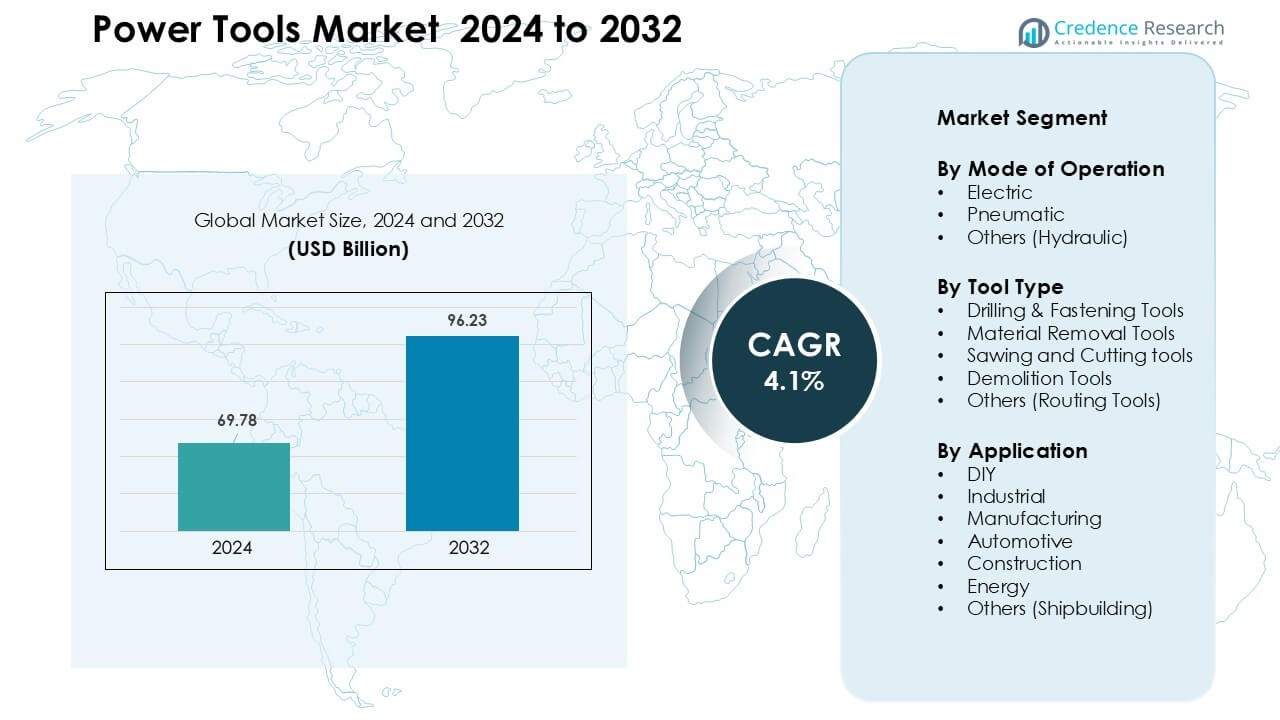
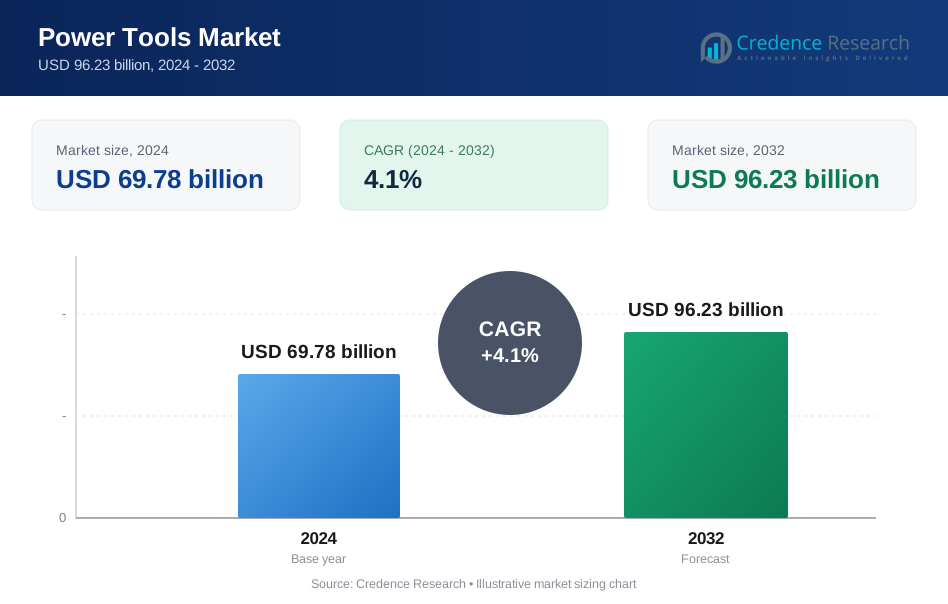
Power Tools Market was valued at USD 69.78 billion in 2024 and is anticipated to reach USD 96.23 billion by 2032, growing at a CAGR of 4.1 % during the forecast period.
| REPORT ATTRIBUTE | DETAILS |
|---|---|
| Historical Period | 2020-2023 |
| Base Year | 2024 |
| Forecast Period | 2025-2032 |
| Power Tools Market Size 2024 | USD 69.78 Billion |
| Power Tools Market, CAGR | 4.1 % |
| Power Tools Market Size 2032 | USD 96.23 Billion |
The power tools market is shaped by strong global players such as Makita Corporation, Tectronic Industries Co. Ltd., Stanley Black & Decker Inc., Hilti Corporation, Emerson Electric Co., Robert Bosch GmbH, Koki Holdings Co. Ltd., Ingersoll Rand, Enerpac Tool Group, and Atlas Copco AB. These companies compete through broad cordless portfolios, advanced brushless motor systems, and strong after-sales networks. Their focus on durability, safety, and ergonomic design supports high adoption across construction, manufacturing, automotive, and DIY segments. North America emerged as the leading region in 2024 with 34% share, driven by high renovation activity, wider professional uptake, and strong retail distribution.
Market Insights
- The power tools market was valued at USD 69.78 billion in 2024 and is expected to reach USD 96.23 billion by 2032, growing at a 4.1% CAGR.
- Rising construction activity and strong demand for cordless systems drive wider adoption across professional and DIY applications.
- Smart, connected tools and brushless motor technology shape key trends as buyers prefer higher efficiency, longer battery life, and safer operation.
- Leading players compete through advanced cordless platforms, ergonomic designs, and stronger distribution networks, increasing pressure on smaller regional brands.
- North America led the market with 34% share, while electric tools dominated by mode of operation with 67% share; construction remained the top application segment with 36% share, supporting overall regional and global growth.
Market Segmentation Analysis:
By Mode of Operation
Electric power tools held the leading position in 2024 with about 67% share, driven by strong use in residential projects, light commercial jobs, and growing preference for corded and cordless systems. Buyers selected electric tools for steady power delivery, longer runtime with advanced batteries, and lower upkeep when compared with pneumatic or hydraulic versions. Pneumatic tools stayed important in heavy-duty industrial tasks that need high torque and continuous operation, while hydraulic tools remained a small niche used in demanding repair and maintenance work.
- For instance, Bosch launched its Expert 18V battery range with capacities of 4.0 Ah, 5.5 Ah, 8.0 Ah and 15.0 Ah, enabling models like the EXBA18V-150 (15.0 Ah) to deliver up to 2,400 W of temporary maximum power.
By Tool Type
Drilling and fastening tools dominated the tool type segment in 2024 with around 41% share, supported by broad use across construction, renovation, automotive repair, and factory assembly lines. These tools gained traction because they improve task speed, enhance accuracy, and suit a wide range of DIY and professional needs. Material removal tools advanced due to rising metal fabrication work, while sawing and cutting tools expanded with steady growth in woodworking and infrastructure projects. Demolition tools remained vital in structural repair jobs, and routing tools served specialized finishing tasks.
- For instance, the Bosch GSB 450 Professional Impact Drill from Bosch offers a power consumption of 450 W and supports drilling diameters up to 8 mm in steel.
By Application
Construction applications led the market in 2024 with close to 36% share, driven by rapid urban projects, wider adoption of cordless equipment, and strong demand for tools that speed up on-site workflows. Industrial and manufacturing units increased purchases to support automation, reduce downtime, and meet tighter production cycles. Automotive workshops relied on high-torque systems for engine repair and assembly jobs. DIY users showed rising interest as households invested in small maintenance and improvement tasks. Energy and shipbuilding segments continued steady use for repair, installation, and heavy-material work.
Key Growth Drivers
Rapid Expansion of Construction and Infrastructure Projects
The construction sector continues to push strong demand for power tools as countries invest in roads, housing, commercial buildings, and industrial corridors. Contractors prefer high-performance cordless drills, demolition tools, and sawing systems that reduce task time and improve labor productivity. Urban upgrades, smart-city projects, and public infrastructure spending create a steady need for tools that support concrete cutting, steel fixing, and finishing work. Growth in residential renovation also increases sales of compact electric tools used for drilling, fastening, and material shaping. As regulatory bodies enforce higher safety and quality standards, builders adopt advanced tools with better control, torque, and battery efficiency. This steady pipeline of new construction and refurbishment activity acts as a major engine for market growth.
- For instance, Bosch GSB 120‑Li Cordless Kit offers an 12 V system that enables drilling in masonry, metal and wood supporting versatility needed for mixed residential-commercial renovation jobs.
Rising Shift Toward Cordless and Battery-Powered Tools
Cordless tools have grown sharply due to longer battery life, improved motor efficiency, and wider compatibility across tool families. Lithium-ion and brushless motor technologies give higher runtime, faster charging, and lower maintenance, making cordless tools suitable for heavy-duty and all-day field operations. Professionals prefer these systems because they remove dependence on power outlets and air compressors, allowing work in remote or confined job sites. Tool makers continue expanding their cordless ecosystems, enabling workers to use one battery platform for drills, grinders, saws, and fastening tools. This shift supports productivity gains, reduces total ownership cost, and strengthens demand across industrial, construction, and DIY applications.
- For instance, the INGCO 20 V Brushless Cordless Impact Drill & Wrench Combo Kit delivers up to 66 Nm in the drill mode and 400 Nm (up to 550 Nm nut-busting) in the wrench mode using its 20 V lithium-ion battery platform – underscoring how the newer cordless systems are matching even traditionally cord-powered performance.
Growing Industrial Automation and Manufacturing Activities
Industries such as automotive, electronics, metal fabrication, and machinery production are adopting precision tools to support faster production cycles. Power tools help factories lower downtime, speed assembly, and maintain uniform quality during repetitive manufacturing tasks. The rise of automated and semi-automated lines increases the need for fastening tools, torque-controlled systems, and specialized cutting and grinding equipment. Manufacturers focus on tools that offer sensor integration, torque feedback, and reduced vibration to improve worker safety and product consistency. As global production expands and factories aim for leaner workflows, advanced power tools become essential for meeting tight delivery schedules and quality standards.
Key Trend & Opportunity
Integration of Smart, Connected, and Sensor-Enabled Tools
Smart power tools are gaining traction as companies introduce Bluetooth-enabled and app-linked systems that track usage, battery health, and performance. These connected tools help teams monitor tool conditions, prevent unplanned downtime, and improve asset management on job sites. Features such as digital torque control, geofencing, and auto-shutdown enhance safety and reduce misuse. For fleet operators, smart platforms offer analytics that optimize tool deployment across multiple projects. This digital shift opens new opportunities for subscription-based software, cloud diagnostics, and predictive maintenance, creating value for both manufacturers and end-users as industrial operations move toward IoT-driven ecosystems.
- For instance, the Milwaukee ONE-KEY™ platform supports over 120 connected smart tools and devices, offering capabilities such as remote tool-lock, usage-tracking and location alerts via Bluetooth tags (signal range up to 90+ m).
Strong Adoption of Lightweight, Ergonomic, and Low-Vibration Tools
Workforce safety rules and rising ergonomic awareness are driving interest in lighter and low-vibration power tools. Manufacturers design compact drills, grinders, and impact drivers that reduce operator fatigue and improve precision during long shifts. Anti-kickback systems, advanced grip materials, and noise-reducing features support safer working conditions in construction, shipbuilding, and manufacturing plants. As job sites grow more regulated, demand rises for tools that balance high torque with user comfort. This trend creates an opportunity for companies to differentiate through improved design, better weight distribution, and modular accessories that enhance user productivity without compromising safety.
- For instance, Bosch’s GEX 185-LI random orbit sander weighs at a compact size (compatible with 18 V batteries), and features a vibration emission value (ah) of 2.2 m/s² in its ergonomic design.
Growth of DIY Culture and E-Commerce Expansion
Homeowners are buying more power tools for small repairs, décor upgrades, and hobby-based work. E-commerce marketplaces boost this trend by offering wide product choices, transparent pricing, and easy access to tool kits for new users. Influencer-driven tutorials and online learning channels encourage beginners to take on projects that earlier required professionals. Brands use digital platforms to launch exclusive cordless ranges, bundle starter kits, and provide virtual demos that attract inexperienced buyers. This broader DIY movement expands market reach and supports steady year-round sales, especially for drills, sanders, compact saws, and multi-function tools.
Key Challenge
Safety Risks and Rising Workplace Regulations
Power tools pose risks such as kickbacks, cuts, noise exposure, and hand-arm vibration, making safety compliance a major challenge. Industries must follow strict rules on tool handling, protective gear, and operator training, increasing operational effort and cost. Frequent updates to global safety standards require manufacturers to redesign products with enhanced safeguards, which extends development time and raises production expenses. Many small contractors struggle to adopt advanced tools with embedded safety features due to higher upfront prices. Balancing innovation with compliance remains a constant challenge as regulators enforce stricter norms across construction and manufacturing sites.
Volatility in Raw Material Prices and Supply Chain Disruptions
Power tool manufacturing depends on steel, aluminum, copper, lithium-ion cells, and electronic components, all susceptible to price swings. Global shortages of semiconductors and battery materials disrupt production schedules and raise costs for tool makers. Freight delays, trade restrictions, and geopolitical tensions further strain supply chains, leading to longer lead times and limited product availability. Smaller brands face difficulty securing stable supply compared to large multinational players. These disruptions increase final product prices and slow market expansion, forcing companies to redesign sourcing strategies, diversify suppliers, and improve local manufacturing capabilities to maintain competitiveness.
Regional Analysis
North America
North America held the largest share in 2024 at about 34%, supported by strong construction activity, high DIY participation, and rapid adoption of cordless tools. The U.S. led demand due to frequent home renovation projects, established industrial facilities, and ongoing infrastructure upgrades. Contractors preferred advanced electric and battery-powered tools that reduce labor time and improve precision. Canada contributed steady growth through residential repair work and rising interest in ergonomic tools. Major brands expanded retail penetration and service networks, which helped strengthen long-term market stability across the region.
Europe
Europe accounted for nearly 27% share in 2024, driven by strict workplace safety rules and strong use of advanced power tools across manufacturing, automotive, and construction industries. Germany, the U.K., and France remained key markets with high adoption of cordless systems that support faster and cleaner job-site operations. Renovation activities in aging residential structures further boosted electric drilling, fastening, and cutting tools. EU-led sustainability goals encouraged demand for energy-efficient designs and lower-emission pneumatic systems. Growing preference for ergonomic and low-vibration tools also shaped purchasing behavior in professional and DIY segments.
Asia Pacific
Asia Pacific held the fastest-growing position with around 29% share in 2024, fueled by rapid urbanization, large-scale infrastructure development, and expanding manufacturing bases in China, India, and Southeast Asia. Construction contractors increasingly selected cordless and brushless-motor tools to improve productivity on dense job sites. Rising middle-class income boosted DIY adoption and demand for compact, lower-cost models. Industrial growth in electronics, automotive, and metal fabrication further increased tool consumption. Strong distribution expansion through online channels and global brand entry supported wider market penetration across both urban and semi-urban regions.
Latin America
Latin America captured about 6% share in 2024, supported by recovering construction investment and growth in automotive repair and small-scale manufacturing. Brazil and Mexico led demand with rising adoption of electric drilling, grinding, and demolition tools used in both residential and commercial projects. Economic fluctuations slowed large capital projects, but DIY sales and renovation activities maintained steady tool demand. Regional buyers leaned toward affordable cordless systems with long battery life and lower maintenance needs. Expanding retail chains and online marketplaces also improved access to global and regional brands.
Middle East & Africa
The Middle East & Africa held nearly 4% share in 2024, driven by ongoing infrastructure expansion, industrial diversification efforts, and steady construction of commercial and residential projects. GCC countries adopted high-performance tools for large development projects, while African markets relied on cost-effective electric and pneumatic tools for small-scale construction and repair. Energy-sector maintenance activities supported demand for heavy-duty cutting and fastening tools. Import reliance and price sensitivity remained key challenges, yet wider availability through distributors and e-commerce improved market access across emerging cities and industrial zones.
Market Segmentations:
By Mode of Operation
- Electric
- Pneumatic
- Others (Hydraulic)
By Tool Type
- Drilling & Fastening Tools
- Material Removal Tools
- Sawing and Cutting tools
- Demolition Tools
- Others (Routing Tools)
By Application
- DIY
- Industrial
- Manufacturing
- Automotive
- Construction
- Energy
- Others (Shipbuilding)
By Geography
- North America
- U.S.
- Canada
- Mexico
- Europe
- Germany
- France
- U.K.
- Italy
- Spain
- Rest of Europe
- Asia Pacific
- China
- Japan
- India
- South Korea
- South-east Asia
- Rest of Asia Pacific
- Latin America
- Brazil
- Argentina
- Rest of Latin America
- Middle East & Africa
- GCC Countries
- South Africa
- Rest of the Middle East and Africa
Competitive Landscape
The competitive landscape of the power tools market features strong global participation led by companies such as Makita Corporation, Tectronic Industries Co. Ltd., Stanley Black & Decker Inc., Hilti Corporation, Emerson Electric Co., Robert Bosch GmbH, Koki Holdings Co. Ltd., Ingersoll Rand, Enerpac Tool Group, and Atlas Copco AB. These companies compete through wide product portfolios, continuous innovation in cordless and brushless motor technology, and strong service networks across major regions. Most players invest heavily in battery platforms that support multiple tool categories, improving user efficiency and long-term value. Manufacturers also focus on ergonomic design, vibration control, and smart connectivity features to meet safety rules and enhance precision. Partnerships with distributors, expansion of e-commerce channels, and targeted launches for professional and DIY users help strengthen brand visibility. Rising demand for durable and energy-efficient tools pushes companies to refine materials, advance motor systems, and expand manufacturing capabilities to maintain competitiveness in a fast-evolving market.
Key Player Analysis
- Makita Corporation (Japan)
- Tectronic Industries Co. Ltd. (China)
- Stanley Black & Decker Inc. (U.S.)
- Hilti Corporation (Liechtenstein)
- Emerson Electric Co. (U.S.)
- Robert Bosch GmBH (Germany)
- Koki Holdings Co. Ltd. (Japan)
- Ingersoll Rand (U.S.)
- Enerpac Tool Group (U.S.)
- Atlas Copco AB (Sweden)
Recent Developments
- In February 2025, Ingersoll Rand (U.S.) Introduced the G4911 IQV20™ 20V Cordless Tire Buffer (marketed as the world first 20V tire buffer). Product page/announcement (features, battery runtime, dual-speed for reaming/buffing).
- In February 2025, Ingersoll Rand (U.S.) Several Ingersoll Rand tools (including the W7153 IQV20™ impact wrench and H3111 20V heat gun) were recognized in Popular Mechanics’ 2025 tool awards positive product recognition that can boost market visibility.
- In September 2024, Enerpac Tool Group (U.S.) Acquired DTA (specialist in automated on-site horizontal movement products) to expand its Heavy Lifting Technology (HLT) portfolio and automation/solutions capability across rail, wind, infrastructure, aerospace and nuclear markets. This acquisition is part of Enerpac’s push toward broader, automated industrial-tools solutions.
Report Coverage
The research report offers an in-depth analysis based on Mode of Operation, Tool Type, Application and Geography. It details leading market players, providing an overview of their business, product offerings, investments, revenue streams, and key applications. Additionally, the report includes insights into the competitive environment, SWOT analysis, current market trends, as well as the primary drivers and constraints. Furthermore, it discusses various factors that have driven market expansion in recent years. The report also explores market dynamics, regulatory scenarios, and technological advancements that are shaping the industry. It assesses the impact of external factors and global economic changes on market growth. Lastly, it provides strategic recommendations for new entrants and established companies to navigate the complexities of the market.
Future Outlook
- Demand for cordless power tools will rise as batteries gain longer runtime and faster charging.
- Smart and connected tools will expand with wider adoption of sensors and app-based control.
- Brushless motors will become the standard due to higher efficiency and reduced maintenance.
- Construction and infrastructure growth will continue to drive strong tool consumption worldwide.
- DIY adoption will increase as consumers invest more in home improvement and repair projects.
- Manufacturers will focus on lighter, ergonomic designs to improve worker safety and comfort.
- E-commerce sales will grow as buyers prefer online comparisons, bundles, and faster delivery.
- Industrial automation will boost demand for precision fastening and material-removal tools.
- Sustainability goals will push brands to develop energy-efficient tools and recyclable battery systems.
- Emerging markets in Asia Pacific and Latin America will offer new growth opportunities through rapid urbanization and manufacturing expansion.
Request a Free Sample
Fill in your details and we'll send you a free sample report.
- Sample data tables & charts
- Research methodology
Need a Custom Version of This Report?
Tailor the scope, geography, or segments to your exact requirements.
- Custom geography or segment scope
- Direct access to our analyst team
Frequently Asked Questions
What is the current market size for Power Tools Market, and what is its projected size in 2032?
At what Compound Annual Growth Rate is Power Tools Market projected to grow between 2025 and 2032?
Which Power Tools Market segment held the largest share in 2024?
What are the primary factors fueling the growth of Power Tools Market?
Who are the leading companies in Power Tools Market?
Which region commanded the largest share of Power Tools Market?
Table of Content
Chapter 1. Report Introduction
- 1.1 Report Description & Purpose
- 1.1.1 Report Title & Market Definition
- 1.1.2 Unique Selling Propositions (USP) & Key Differentiators
- 1.1.3 Value Proposition for Stakeholders
- 1.2 Research Objectives
- 1.2.1 Market Sizing Objectives (Volume & Revenue)
- 1.2.2 Segmentation Objectives
- 1.2.3 Competitive Intelligence Objectives
- 1.2.4 Forecast & Scenario Objectives
- 1.3 Report Scope
- 1.3.1 Power Tools Scope – Types & Subtypes Covered
- 1.3.2 Geographic Scope – Regions & Countries Covered
- 1.3.3 Historical Period, Base Year & Forecast Period (2024; forecast to 2032)
- 1.3.4 Inclusions & Exclusions
- 1.4 HS Code & Classification Framework
- 1.5 Currency, Units & Pricing Basis
- 1.6 Target Stakeholders
- 1.7 Limitations & Assumptions
Chapter 2. Executive Summary
- 2.1 Global Power Tools Market Snapshot
- 2.1.1 Market Size – Historical (2024) & Forecast (2024-2032) (2024: USD 69.78 billion → 2032: USD 96.23 billion)
- 2.1.2 Volume & Revenue – Global Totals
- 2.1.3 Key Market Highlights – Top Five Facts
- 2.2 Power Tools Market Segmentation Snapshot
- 2.2.1 Market Split by Region – 2024 vs. 2032
- 2.3 Competitive Snapshot
- 2.3.1 Top 10 Players by Revenue Share – 2024
- 2.3.2 Top 10 Players by Volume Share – 2024
- 2.3.3 Recent Strategic Developments (18-Month Summary)
- 2.4 Key Investment Highlights & Strategic Conclusions
Chapter 3. Power Tools Market Dynamics & Industry Analysis
- 3.1 Market Overview & Context
- 3.1.1 Power Tools Market Position in the Broader Automotive Value Chain
- 3.1.2 OEM vs. Replacement Market Dynamics
- 3.1.3 Market Maturity & Development Stage by Region
- 3.2 Power Tools Market Drivers
- 3.3 Power Tools Market Restraints & Challenges
- 3.4 Power Tools Market Opportunities
- 3.5 Porter's Five Forces Analysis
- 3.5.1 Threat of New Entrants
- 3.5.2 Bargaining Power of Suppliers
- 3.5.3 Bargaining Power of Buyers
- 3.5.4 Threat of Substitutes
- 3.5.5 Competitive Rivalry – Intensity Assessment
- 3.6 Power Tools Value Chain Analysis
- 3.6.1 Upstream – Raw Material/Input Suppliers
- 3.6.1.1 Raw Material/Input 1
- 3.6.1.2 Raw Material/Input 2
- 3.6.1.3 Raw Material/Input 3
- 3.6.2 Midstream – Production/Manufacturing/Service Delivery
- 3.6.2.1 Production/Process Overview
- 3.6.2.2 Key Facility Locations & Capacity by Manufacturer
- 3.6.3 Downstream – Distribution & End Consumer
- 3.6.3.1 Primary Channel – B2B/OEM
- 3.6.3.2 Secondary Channels – Dealer, Retail, Online, Direct
- 3.6.4 Value Chain Profitability Analysis
- 3.6.1 Upstream – Raw Material/Input Suppliers
- 3.7 PESTEL Analysis
- 3.7.1 Political Factors
- 3.7.2 Economic Factors
- 3.7.3 Social Factors
- 3.7.4 Technological Factors
- 3.7.5 Environmental Factors
- 3.7.6 Legal Factors
- 3.8 Power Tools Supply Chain Analysis
- 3.8.1 Raw Material/Input Supply Risk Assessment
- 3.8.2 Manufacturing Concentration Risk (Geographic Exposure)
- 3.8.3 Trade Disruption Impact Analysis
- 3.9 Regulatory & Policy Landscape
Note: The regulatory and policy landscape section covers regulations based on their applicability to the market, Power Tools category, geography, and scope of the study. Only regulatory frameworks with a material impact on operations, compliance, trade, sustainability, or market access are analyzed in detail.
Chapter 4. Key Investment Pockets & Opportunity Analysis
- 4.1 Power Tools Market Attractiveness Analysis
- 4.1.1 By Region – Investment Attractiveness Matrix (Volume × CAGR)
- 4.2 Absolute Revenue Growth Opportunity
- 4.2.1 By Region – Absolute USD Growth Through 2032
- 4.3 Incremental Volume Opportunity
- 4.3.1 By Region – Incremental Volume Through 2032
- 4.3.2 Segment – Incremental Volume
- 4.4 Emerging Submarket Opportunity Deep Dive (Subject to Applicability)
- 4.5 Emerging Market Opportunity Scorecards
- 4.5.1 United States
- 4.5.2 Europe
- 4.5.3 Asia
- 4.5.4 Middle East & Africa
Note: Emerging Market Opportunity Scorecards will be included based on relevance and strategic importance. Regions listed are indicative and may vary depending on data availability and market dynamics.
Chapter 5. Power Tools Import-Export Analysis & Trade Flows
- 5.1 Global Trade Overview
- 5.1.1 Global Export Value by Country (2024)
- 5.1.2 Global Export Volume by Country (2024)
- 5.1.3 Global Import Value by Country (2024)
- 5.1.4 Global Import Volume by Country (2024)
- 5.1.5 Net Trade Balance by Country (2024)
- 5.2 Export Analysis – Segment
- 5.2.1 Type 1 (HS Code)
- 5.2.2 Type 2 (HS Code)
- 5.2.3 Type 3 (HS Code)
- 5.2.4 Type 4 (HS Code)
- 5.2.5 Type 5 (HS Code)
- 5.3 Import Analysis – Segment
- 5.3.1 Type 1 (HS Code)
- 5.3.2 Type 2 (HS Code)
- 5.3.3 Type 3 (HS Code)
- 5.3.4 Type 4 (HS Code)
- 5.3.5 Type 5 (HS Code)
- 5.4 Average Unit Trade Prices
- 5.4.1 Average Export Price – Segment & Country
- 5.4.2 Average Import Price – Segment & Source Country
- 5.4.3 Price Trends (2024)
- 5.5 Key Trade Route Analysis
- 5.5.1 Trade Route 1
- 5.5.2 Trade Route 2
- 5.5.3 Trade Route 3
- 5.5.4 Trade Route 4
- 5.5.5 Trade Route 5
- 5.6 Trade Policy Impact Assessment
- 5.6.1 US Anti-Dumping & Section 301 Tariffs
- 5.6.2 EU Customs Union Impact
- 5.6.3 Major Free Trade Agreements
- 5.6.4 USMCA Rules of Origin
Note: Trade policy analysis will be included only where relevant to the Power Tools market.
Chapter 6. Competitive Landscape & Company Benchmarking
- 6.1 Power Tools Market Concentration & Structure
- 6.1.1 Herfindahl-Hirschman Index (HHI) – vs. 2024
- 6.1.2 Tier 1, Tier 2 & Tier 3 Market Structure
- 6.1.3 Global, Regional & Local Player Dynamics
- 6.2 Power Tools Market Share Analysis – 2024
- 6.2.1 Global Revenue Share by Company
- 6.2.2 Global Volume Share by Company
- 6.2.3 Regional Revenue Share
- 6.2.4 Market Share Evolution ( vs. 2024)
- 6.2.5 OEM Segment Share by Company
- 6.2.6 Replacement Segment Share by Company
- 6.3 Production/Delivery Capacity & Facility Analysis
- 6.3.1 Global Installed Capacity
- 6.3.2 Capacity Utilization Rates
- 6.3.3 Production/Output Volume
- 6.3.4 Facility Locations & Capacity Map
- 6.3.5 Planned Capacity Additions
- 6.4 Power Tools Competitive Benchmarking Matrix
- 6.4.1 Revenue, Volume, CAGR & Profitability Comparison
- 6.4.2 Channel Revenue Mix
- 6.4.3 Geographic Revenue Exposure
- 6.4.4 R&D Intensity
- 6.4.5 Sustainability Maturity
- 6.5 Strategic Developments in Power Tools (Last 24 Months)
- 6.5.1 Mergers, Acquisitions & Divestments
- 6.5.2 New Power Tools Launches
- 6.5.3 Facility Expansions
- 6.5.4 Strategic Alliances, Joint Ventures & Partnerships
- 6.5.5 Distribution Expansion & Market Entry
- 6.5.6 Sustainability & ESG Initiatives
- 6.6 Competitive Strategy Mapping
- 6.6.1 Leader, Challenger, Follower & Niche Classification
- 6.6.2 Pricing Strategy Comparison
- 6.6.3 Channel Strategy Matrix
Note: Strategic developments are included based on their materiality and the availability of reliable information.
Chapter 7. Global Power Tools Market – By Distribution Channel
- 7.1 Segment Overview
- 7.1.1 Volume & Revenue Split by Channel (2024 & 2032)
- 7.1.2 Channel Mix Evolution (2024-2032)
Chapter 8. Regional Market Analysis – Global Overview
- 8.1 Global Regional Overview
- 8.1.1 Regional Volume Share
- 8.1.2 Regional Revenue Share
- 8.1.3 Regional Volume by Region
- 8.1.4 Regional Revenue by Region
- 8.1.5 Regional Forecast Through 2032
- 8.2 Cross-Regional Segment Analysis
- 8.2.1 By Distribution Channel
- 8.2.2 By Brand/Price Tier
Chapter 9. North America Power Tools Market
- 9.1 United States
- 9.2 Canada
- 9.3 Mexico
Chapter 10. Europe Power Tools Market
- 10.1 Germany
- 10.2 France
- 10.3 Italy
- 10.4 United Kingdom
- 10.5 Spain
- 10.6 Poland
- 10.7 Russia
- 10.8 Netherlands
- 10.9 Belgium
- 10.10 Sweden
- 10.11 Denmark
- 10.12 Norway
- 10.13 Rest of Europe
Chapter 11. Asia Pacific Power Tools Market
- 11.1 China
- 11.2 India
- 11.3 Japan
- 11.4 South Korea
- 11.5 Thailand
- 11.6 Indonesia
- 11.7 Vietnam
- 11.8 Malaysia
- 11.9 Australia
- 11.10 Rest of Asia Pacific
Chapter 12. Latin America Power Tools Market
- 12.1 Brazil
- 12.2 Argentina
- 12.3 Colombia
- 12.4 Chile
- 12.5 Rest of Latin America
Chapter 13. Middle East Power Tools Market
- 13.1 Saudi Arabia
- 13.2 United Arab Emirates
- 13.3 Turkey
- 13.4 Israel
- 13.5 Iran
- 13.6 Rest of the Middle East
Chapter 14. Africa Power Tools Market
- 14.1 South Africa
- 14.2 Egypt
- 14.3 Nigeria
- 14.4 Morocco
- 14.5 Rest of Africa
Chapter 15. Power Tools Company Profiles
- 15.1 [Company 01]
- 15.1.1 Company Overview
- 15.1.2 Key Management Personnel
- 15.1.3 Products & Services Portfolio
- 15.1.4 Financial Performance
- 15.1.5 Key Market Focus & Geographic Presence
- 15.1.6 Recent Developments & Strategic Initiatives
Note: The company profile list is preliminary and may change based on research findings, market developments, data availability, and client requirements.
Chapter 16. Appendices
- Appendix A – List of Abbreviations & Acronyms
- Appendix B – Industry Classification Code Reference – Full Series
- Appendix C – Production & Capacity Data Tables
- Appendix D – End-Use & Demand Base Tables
- Appendix E – Consumption & Replacement Rate Assumptions
- Appendix F – ASP Reference Tables
- Appendix G – Manufacturing & Facility Database
- Appendix H – Import-Export Data Tables
- Appendix I – Regulatory Summary Tables
- Appendix J – Primary Research Participant List (Anonymized)
- Appendix K – Primary Research Questionnaire Framework
- Appendix L – Data Sources & Bibliography
- Appendix M – Market Size Divergence & Source Comparison
Chapter 17. Research Methodology
- 17.1 Research Framework & Philosophy
- 17.2 Secondary Research – Sources, Hierarchy & Data Extraction
- 17.3 Data Modeling – Bottom-Up & Top-Down Market Sizing
- 17.4 Primary Research – Stakeholder Framework, LOI & Sample Sizes
- 17.5 Forecast Methodology – Regression, Scenario & Sensitivity Analysis
- 17.6 Quality Control – Four-Layer Validation Framework
- 17.7 Limitations & Standard Assumptions
- 17.8 Disclaimer
