
| REPORT ATTRIBUTE | DETAILS |
|---|---|
| Historical Period | 2019-2022 |
| Base Year | 2023 |
| Forecast Period | 2024-2032 |
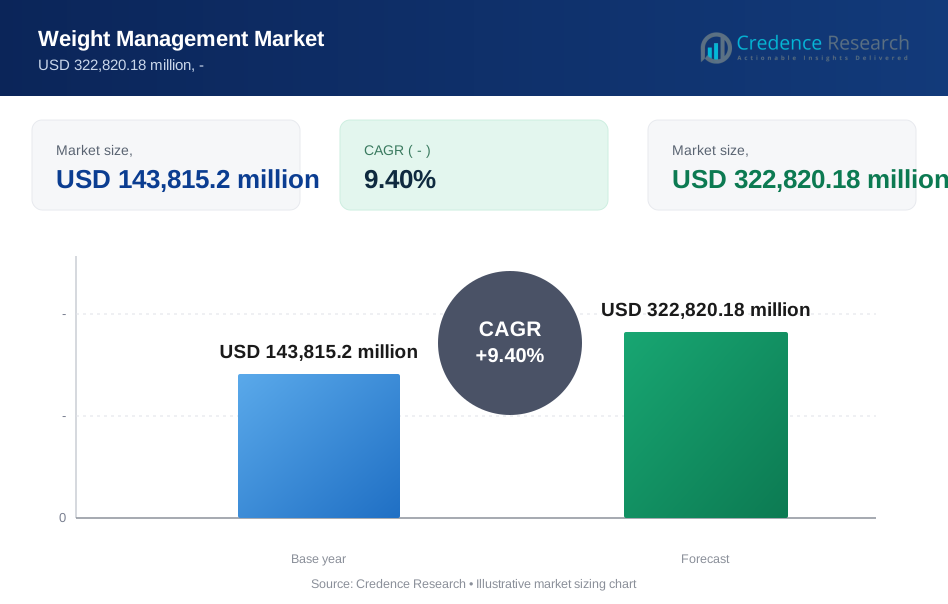
| Weight Management Market Size 2023 | USD 143815.2 Million |
| Weight Management Market, CAGR | 9.40% |
| Weight Management Market Size 2032 | USD 322820.18 Million |
Market Insights
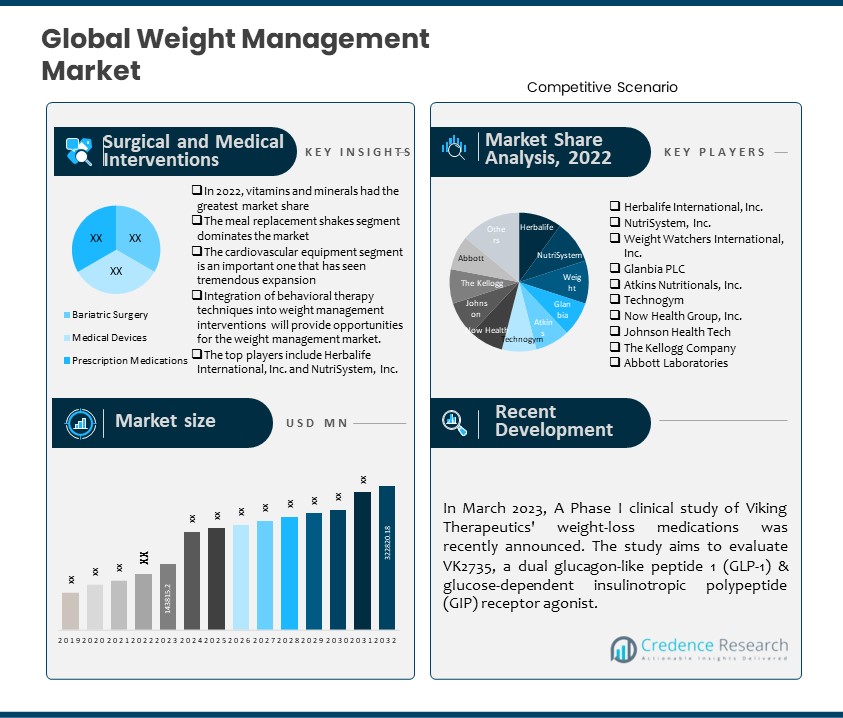
- The global market for weight management is expected to grow from its estimated USD 143815.2 million in 2023 to USD 322820.18 million in 2032 at a compound annual growth rate (CAGR) of 9.40% between 2024 and 2032.
- The significant category is vitamins and minerals. Herbal and botanical supplements, on the other hand, are expected to grow at a strong CAGR.
- The leading meal replacement products segment is meal replacement shakes.
- The CAGR for cardiovascular equipment is expected to be the highest during the projection period.
- The commercial weight loss programs segment will have the highest CAGR throughout the prediction period.
- Bariatric surgery is estimated to have the greatest CAGR during the forecast period.
- Retail pharmacies and health stores are predicted to grow faster over the projection period.
- Asia Pacific dominated the weight management market.
- Regarding the weight management market share, Europe is expected to come second.
- North America is anticipated to grow fastest in the weight management market.
- The primary drivers of the market are wearables, mobile applications, sedentary lifestyles, unhealthy eating habits, and growing interest in health and wellness and digital health technologies.
- The market for weight management is being driven by several factors, including the growing popularity of corporate wellness programs, the need for customized nutrition plans, and the growing interest in holistic health.
Executive Summary
Market Definition
The process of making good dietary and lifestyle choices in order to maintain a healthy body weight is known as weight management. It encourages the adoption of regular physical activity and healthy eating practices based on an individual's height, gender, and age. Depending on the body mass index, it also helps in gaining the optimal weight.
Market Overview
The weight management sector is estimated to develop at a 9.40% compound annual growth rate (CAGR) between 2024 and 2032, maintaining its current upward trend. The market will continue to develop, rising from its estimated value of USD 143815.2 million in 2023 to USD 322820.18 million in 2032.
The obesity epidemic is one of the main factors propelling the weight-management sector's growth. Effective weight control solutions are in greater demand as the number of obese persons rises. Obesity sufferers look for goods, services, and initiatives that will enable them to reduce their weight and lead healthier lives. Numerous health problems, such as diabetes, heart disease, stroke, and some forms of cancer, are linked to obesity. People are more likely to spend money on weight management goods and services as awareness of these health hazards increases in an effort to enhance their general wellbeing and lower their chance of contracting chronic illnesses.
Technological advancements have facilitated the creation of novel approaches to weight management, including calorie-tracking mobile apps, wearable fitness trackers, and online coaching programs. The industry is growing because of these technological advancements that make it easier for people to access and use weight management tools. Companies in the weight management sector are increasing the range of services they offer and allocating resources to research and development in order to create more efficient goods and services in response to the growing demand. This reaction encourages the industry's growth even more.
Segmentation by Dietary Supplements
- Vitamins and minerals dominated the market. The body requires trace amounts of these vital nutrients for a number of physiological processes. Certain vitamins and minerals are important when it comes to managing weight. While minerals like calcium and magnesium may be connected to weight regulation, B vitamins are frequently linked to energy metabolism.
- The herbal and botanical supplements category will exhibit a sizable CAGR during the projected period. Natural ingredients like bitter orange, guarana, forskolin, hoodia gordonii, green tea extract, and garcinia cambogia are frequently found in herbal and botanical supplements. These ingredients are thought to have qualities that can aid in attempts to lose weight or manage weight.
- Other dietary supplements, such as fiber supplements, protein supplements, conjugated linoleic acid (CLA), and omega-3 fatty acids, additionally support the need for weight management.
Segmentation by Meal Replacement Products
- The main meal replacement products are meal replacement shakes. A lot of people have hectic schedules and find it difficult to find time to cook wholesome meals. Shakes that serve as meal replacements are an easy and quick solution for people who are pressed for time or don't have time to prepare meals.
- The meal replacement bars category will likely register a significant CAGR during forecasting. A practical substitute for traditional meals is meal replacement bars. For those with hectic schedules who might not have time to prepare or sit down for a full meal, they are perfect because they are portable and can be consumed on the go.
- Other meal-replacement products, such as meal-replacement soups and snacks, also contribute to the demand for weight management.
Segmentation by Fitness and Exercise Equipment
- The cardiovascular equipment category is projected to grow at the fastest rate over the projection period. Due to its ability to facilitate aerobic activity, which is essential for weight loss, calorie burning, and cardiovascular health enhancement, cardiovascular equipment is a leading segment in the weight management market.
- Other fitness and exercise equipment, including strength training equipment, fitness trackers and wearables, and home gym equipment, influence the need for weight management.
Segmentation by Weight Loss Programs and Services
- The commercial weight loss programs segment will likely have the highest CAGR during the projection period. Commercial weight loss programs commonly feature exercise recommendations or workout plans customized to participants' fitness levels and weight loss objectives. These could be strength training, aerobic workouts, or other physical activities that promote calorie burning and raise general fitness levels.
- Other weight loss programs and services, such as medical weight loss programs, online and digital weight loss platforms, behavioral counseling and therapy, nutritional counseling and dietitian services, and fitness classes and personal training, also contribute to the demand for weight management.
Segmentation by Surgical and Medical Interventions
- Bariatric surgery is expected to have the foremost CAGR during the prediction period. It is frequently considered when all other weight loss strategies have been exhausted and when obesity presents serious health risks. Those with a body mass index (BMI) of 40 or higher, or those with a BMI of 35 or higher and health issues related to obesity, may choose to pursue it.
- Other surgical and medical interventions, such as medical devices and prescription medications, also contribute to the demand for weight management.
Segmentation by Market Channels and Distribution
- Retail pharmacies and health stores are expected to have the foremost CAGR during the prediction period. Consumer trends, advertising campaigns, and the efficacy of the medications themselves are some of the variables that might affect the demand for weight management products in both retail pharmacies and health stores. The availability of items to help with weight management and awareness efforts on the need to keep a healthy weight can lead to an increase in demand.
- Other end-use industries, such as the pharmaceuticals, cosmetics and personal care, and household products industries, also contribute to the demand for weight management.
Segmentation by Region
- Asia Pacific leads the weight management market. The rising number of overweight and obese people, as well as the rising prevalence of diabetes and hypertension, have been attributed to the market's expansion.
- Europe is estimated to rank second in weight management market size.
- North America will witness the most rapid growth in the weight management market.
- Regions such as Africa, the Middle East, and Latin America cover the remaining requirement for weight management.
As chronic diseases like diabetes, hypertension, and orthopedic disorders become more common, the market is predicted to expand faster. Growing public knowledge of various weight-management options, including diet foods, drinks & supplements, exercise, and surgical procedures, is one of the key factors propelling the global market's expansion.
The Asia Pacific region holds a dominant position in the weight management market. A region's population's growing consumption of junk food and unhealthy lifestyle choices can have a number of negative impacts on people's health and well-being as well as on the larger community. Junk food typically lacks vital nutrients and is heavy in calories, unhealthy fats, and sugars. Frequent consumption has been linked to type 2 diabetes, obesity, heart disease, and other chronic illnesses. Poor lifestyle decisions, like not exercising enough, make these health problems worse and raise the incidence of diseases linked to an unhealthy lifestyle. Sedentary lifestyles and poor diets can also have a detrimental impact on mental health. Studies indicate a connection between eating disorders and mental health issues like anxiety and depression. Additionally, stress and mood disorders can be exacerbated by inactivity. These factors are anticipated to drive the growth of the Asia Pacific weight management market.
Throughout the forecast, North America's weight management market is anticipated to expand fastest. The significance of maintaining a healthy body weight has been actively promoted by governments, non-profit organizations, and healthcare providers. These advertisements frequently draw attention to the hazards of obesity, including diabetes, heart disease, and some forms of cancer. A shift in culture has occurred where a greater emphasis is placed on wellness and health, and many people now understand how crucial it is to maintain a healthy weight for overall well-being. The media's portrayals of ideal body types and its growing emphasis on fitness and healthy living are frequently the main causes of this change. These factors support the development of the North American weight management market.
Key Highlights of the Report
The global weight management market is segmented by dietary supplements, meal replacement products, fitness and exercise equipment, weight loss programs and services, surgical and medical interventions, market channels and distribution, and region. Vitamins and minerals are the market spearhead. Meal replacement shakes are the top category. The cardiovascular equipment category is anticipated to increase at the highest CAGR throughout the projection period. The commercial weight loss programs segment will experience the highest CAGR during the forecast period. The weight management market is expanding mostly in Asia Pacific.
The rising percentage of bariatric surgeries and the increasing acceptance of online weight loss and management programs are expected to drive positive growth in the market throughout the projected period. Around the world, 30% of people are obese, according to the Institute of Health Metric and Evaluation. In both industrialized and developing nations, obesity is a serious health issue. People are being encouraged to choose diet meals by the increasing popularity of individualized and customized diet plans based on a patient's health status. Protein mixes, pills, capsules, and powdered herbs are examples of supplements. Throughout the projection period, the industry growth is expected to be supported by accessibility.
The Asia Pacific is expected to account for the largest portion of the global weight management market. Unhealthy lifestyle behaviors have the potential to be passed on to subsequent generations, which might accelerate the health trend. Children who grow up in environments where eating junk food and being sedentary are commonplace are more likely to develop these habits as adults, which exacerbates the issue. The North American region is also assumed to have the market's sharpest growth. The North American weight management market is anticipated to be driven by rising demand for a health-promoting preventive intervention.
Which Key Factors Are Driving The Global Weight Management Market?
The market for weight management is driven by a number of factors, such as the need for convenient, healthful food options and the growing interest in holistic health approaches, such as mind-body practices and alternative therapies.
What Are The Main Challenges Confronting The Weight Management Market Globally?
The weight management industry is facing several challenges that are hindering its expansion, including constraints related to affordability and insufficient coverage for weight management interventions by healthcare insurance.
What Market Opportunities Exist For Weight Management Globally?
The implementation of weight management and nutrition education programs in schools and the integration of weight management services into primary care settings are creating opportunities for the weight management market.
Market Drivers
Multiple factors propel the weight management industry across the globe. The primary factors propelling the global weight management market are as follows:
Growing Concerns Regarding Obesity
Globally, the prevalence of obesity has been increasing for several decades. This is due to a variety of causes, such as a lack of physical activity, unhealthy eating patterns, and genetic predispositions. Being overweight puts one at serious risk for a number of chronic conditions, including diabetes, heart disease, and some cancers. It is not only a cosmetic issue. People's awareness of the health hazards linked to obesity is growing as a result of the widespread dissemination of information through the media, the internet, and healthcare initiatives. The importance of controlling weight for general health and well-being is becoming increasingly clear; it's not just about appearance. The expenses of providing healthcare for illnesses linked to obesity are significant and keep rising. Prevention and weight management interventions are becoming more and more important, according to governments, healthcare providers, and individuals. Significant technological advancements have brought about the development of novel products and services in the weight management market, including wearable fitness trackers, smartphone apps for tracking diet and exercise, personalized nutrition plans, and minimally invasive surgical weight loss procedures. Customers now have easier access to and convenience with weight management due to these developments.
Market Restraints
There are several obstacles that the global weight management market must overcome to continue growing. Among them are the following:
Competition from Alternative Solutions
The weight management market's growth is constrained by competition from other alternatives. For the main purpose of controlling their weight, many people would rather make lifestyle modifications like eating better and exercising more. Many people believe that these adjustments are safer, more long-lasting, and less dependent on outside aid or goods. To reach their weight management objectives, consumers may choose to make dietary changes, such as adhering to particular diets (such as low-carb, Mediterranean, or plant-based) or meal plans. With this method, people can adjust their eating habits to suit their nutritional requirements and tastes. Customers may choose non-pharmacological or non-commercial methods of managing their weight if they believe these methods to be more sustainable, safer, or more reasonably priced. These factors restrain the growth of the global market.
Opportunities
There are plenty of potential prospects in the global weight management industry. Among these are the following:
Increase in Bariatric Treatments
In earlier times, bariatric procedures, often known as weight reduction surgeries, were thought to be the final resort for weight loss when diets, physical activity, and other medically prescribed regimens had failed. However, due to technological developments, bariatric procedures are now less uncomfortable for patients. Because of this, the medical world is beginning to recognize these surgeries as a reliable and long-term substitute for conventional weight loss methods. This aspect, along with the world's fast-rising obesity rates, has caused a sharp rise in the percentage of bariatric procedures performed worldwide. For example, the total number of bariatric procedures conducted in the United States rose from 158,000 in 2011 to 196,000 in 2015. Similarly, the Australian Institute of Health and Welfare reports that from roughly 9,300 in 2005–06 to 22,713 in 2014–15, Australia saw a total of 9,300 bariatric procedures. It is anticipated that the demand for bariatric surgical equipment and other items necessary for these procedures will rise in response to the growing number of bariatric surgeries performed in key global markets.
Competitive Landscape
Key Players
There are several major competitors in the fiercely competitive global weight management market. The following are a few of the leading market participants and their market shares:
- Herbalife International, Inc.
- NutriSystem, Inc.
- Weight Watchers International, Inc.
- Glanbia PLC
- Atkins Nutritionals, Inc.
- Technogym
- Now Health Group, Inc.
- Johnson Health Tech
- The Kellogg Company
- Nestle SA
- Abbott Laboratories
- Amer Sports
- GNC Holdings, Inc.
- Alticor Corporation
- Others
These companies prioritize product innovation, distribution channel expansion, mergers, and acquisitions to remain competitive.
The largest suppliers in the global weight management market continuously work to keep one step ahead of the competition by developing innovative concepts and products.
In July 2022, Fat Release was a supplement that Herbalife Nutrition Company introduced to assist customers who might overindulge during the week in reaching and maintaining their lifestyle and health objectives. Fat Release is made with a patented cactus fiber ingredient called litramine, which is derived from prickly pears and helps reduce the amount of fat in food. The new product can be consumed straight out of the package or combined with cold water. It comes in the form of a powdered stick.
In May 2022, KaraMD introduced Pure Health Apple Cider Vinegar Gummies, a vegan gummy that supports increased energy levels, weight management, digestion regulation, and the body's transition to ketosis.
In February 2022, SlimPlus, a vegan weight-management supplement with SlimBiome, was introduced by ZeoNutra. ZeoNutra's website, Amazon, Flipkart, and healthcare websites like PharmEasy and NetMeds all sell the product.
Summary of Key Findings
- During the projected period, the expansion of healthy meal delivery services is expected to boost market expansion.
- The market is segmented by dietary supplements, meal replacement products, fitness and exercise equipment, weight loss programs and services, surgical and medical interventions, market channels and distribution, and region.
- The most popular dietary supplements in the market are vitamins and minerals.
- Meal replacement shakes are the foremost category.
- Regarding CAGR, cardiovascular equipment is expected to grow fastest during the forecast period.
- The category for bariatric surgery will likely see the highest CAGR during the anticipated time frame.
- Asia Pacific is leading market development; the market is highly competitive with key players including Herbalife International, Inc., NutriSystem, Inc., Weight Watchers International, Inc., Glanbia PLC, Atkins Nutritionals, Inc., Technogym, Now Health Group, Inc., Johnson Health Tech, The Kellogg Company, Nestle SA, Abbott Laboratories, Amer Sports, GNC Holdings, Inc., Alticor Corporation, and Others.
Future Outlook
- The weight management industry is expected to increase significantly in Asia Pacific and has a positive outlook worldwide.
- The development of remote body composition and weight monitoring devices is expected to propel the weight management market's expansion.
- The cost of weight management programs, supplements, and surgeries are anticipated to be the major obstacles impeding the growth of the weight management market during the forecast period.
- To stay ahead of the competition, key enterprises must develop new products, expand their market reach, and keep their prices competitive.
How CXOs Can Benefit from the Credence Research Weight Management Market Report
CXOs may get a detailed picture of the market in the Credence Research Weight Management Market Report, which includes:
- Market size and growth forecast: The report provides detailed estimates of the global weight management market size, segmented by dietary supplements, meal replacement products, fitness and exercise equipment, weight loss programs and services, surgical and medical interventions, market channels and distribution, and region. It also includes forecasts for the market through 2032 based on key trends and drivers.
- Market segmentation: The research report breaks down the market for weight management into segments based on the dietary supplements, meal replacement products, fitness and exercise equipment, weight loss programs and services, surgical and medical interventions, market channels and distribution, and region. This segmentation provides CXOs with a granular understanding of the market and the opportunities in each segment.
- Competitive landscape: The research report offers a detailed analysis of the major companies in the weight management industry, including information on their business plans, product lines, and earnings. CXOs can use this information to evaluate and identify their competitors.
- Key trends and drivers: The research report identifies and evaluates the main trends and factors influencing the weight management market. CXOs can use this information to make well-informed choices regarding their plans and investments.
CXOs can use the insights from the Credence Research Weight Management Market Report to:
- Identify growth opportunities: This analysis may help CXOs identify new growth opportunities in the weight management sector. For example, the report identifies the growing demand for weight management from men, women, and senior citizens as a key opportunity.
- Make informed investment decisions: The report helps CXOs choose weight management wisely. For example, the research study provides information on the critical factors to consider while selecting weight management solutions and evaluating weight management suppliers.
- Develop competitive strategies: CXOs can use the research report to develop competitive strategies for their weight management businesses. For example, the research paper outlines the main strategies suppliers utilize to differentiate themselves from competitors.
- Track market developments: This research report may help CXOs stay ahead of the curve by tracking market developments. For instance, it offers insights into the most recent developments and trends in the weight management market.
In general, CXOs seeking to expand their industry knowledge and spot growth prospects will find the Credence Research Weight Management Market Report useful.
Segmentation
- By Dietary Supplements
- Vitamins and Minerals
- Herbal and Botanical Supplements
- Fiber Supplements
- Protein Supplements
- Conjugated Linoleic Acid (CLA)
- Omega-3 Fatty Acids
- By Meal Replacement Products
- Meal Replacement Shakes
- Meal Replacement Bars
- Meal Replacement Soups and Snacks
- By Fitness and Exercise Equipment
- Cardiovascular Equipment
- Strength Training Equipment
- Fitness Trackers and Wearables
- Home Gym Equipment
- By Weight Loss Programs and Services
- Commercial Weight Loss Programs
- Medical Weight Loss Programs
- Online and Digital Weight Loss Platforms
- Behavioral Counseling and Therapy
- Nutritional Counseling and Dietitian Services
- Fitness Classes and Personal Training
- By Surgical and Medical Interventions
- Bariatric Surgery
- Medical Devices
- Prescription Medications
- By Market Channels and Distribution
- Retail Pharmacies and Health Stores
- Online Retailers
- Specialty Weight Loss Clinics
- Healthcare Providers and Hospitals
- Fitness Centers and Gyms
- Direct Sales and Multi-Level Marketing (MLM)
- By Region
- North America
- The U.S.
- Canada
- Mexico
- Europe
- Germany
- France
- The U.K.
- Italy
- Spain
- Rest of Europe
- Asia Pacific
- China
- Japan
- India
- South Korea
- South-east Asia
- Rest of Asia Pacific
- Latin America
- Brazil
- Argentina
- Rest of Latin America
- Middle East & Africa
- GCC Countries
- South Africa
- Rest of Middle East and Africa
- North America
Request a Free Sample
Fill in your details and we'll send you a free sample report.
- Sample data tables & charts
- Research methodology
Need a Custom Version of This Report?
Tailor the scope, geography, or segments to your exact requirements.
- Custom geography or segment scope
- Direct access to our analyst team
Frequently Asked Questions
How much does the global market currently hold for weight management?
What is the projected growth rate of the weight management market between 2024 and 2032?
In terms of dietary supplements, which market category is leading?
Regarding meal replacement products, which market category is in the lead?
Who are the main players in the global weight management industry?
Table of Content
Chapter 1. Report Introduction
- 1.1 Report Description & Purpose
- 1.1.1 Report Title & Market Definition
- 1.1.2 Unique Selling Propositions (USP) & Key Differentiators
- 1.1.3 Value Proposition for Stakeholders
- 1.2 Research Objectives
- 1.2.1 Market Sizing Objectives (Volume & Revenue)
- 1.2.2 Segmentation Objectives
- 1.2.3 Competitive Intelligence Objectives
- 1.2.4 Forecast & Scenario Objectives
- 1.3 Report Scope
- 1.3.1 Weight Management Scope – Types & Subtypes Covered
- 1.3.2 Geographic Scope – Regions & Countries Covered
- 1.3.3 Historical Period, Base Year & Forecast Period (the historical period; forecast to the forecast period)
- 1.3.4 Inclusions & Exclusions
- 1.4 HS Code & Classification Framework
- 1.5 Currency, Units & Pricing Basis
- 1.6 Target Stakeholders
- 1.7 Limitations & Assumptions
Chapter 2. Executive Summary
- 2.1 Global Weight Management Market Snapshot
- 2.1.1 Market Size – Historical (the historical period) & Forecast (the forecast period) (base year: USD 143,815.2 million → forecast year: USD 322,820.18 million)
- 2.1.2 Volume & Revenue – Global Totals
- 2.1.3 Key Market Highlights – Top Five Facts
- 2.2 Weight Management Market Segmentation Snapshot
- 2.2.1 Market Split by Region – vs.
- 2.3 Competitive Snapshot
- 2.3.1 Top 10 Players by Revenue Share –
- 2.3.2 Top 10 Players by Volume Share –
- 2.3.3 Recent Strategic Developments (18-Month Summary)
- 2.4 Key Investment Highlights & Strategic Conclusions
Chapter 3. Weight Management Market Dynamics & Industry Analysis
- 3.1 Market Overview & Context
- 3.1.1 Weight Management Market Position in the Broader Automotive Value Chain
- 3.1.2 OEM vs. Replacement Market Dynamics
- 3.1.3 Market Maturity & Development Stage by Region
- 3.2 Weight Management Market Drivers
- 3.3 Weight Management Market Restraints & Challenges
- 3.4 Weight Management Market Opportunities
- 3.5 Porter's Five Forces Analysis
- 3.5.1 Threat of New Entrants
- 3.5.2 Bargaining Power of Suppliers
- 3.5.3 Bargaining Power of Buyers
- 3.5.4 Threat of Substitutes
- 3.5.5 Competitive Rivalry – Intensity Assessment
- 3.6 Weight Management Value Chain Analysis
- 3.6.1 Upstream – Raw Material/Input Suppliers
- 3.6.1.1 Raw Material/Input 1
- 3.6.1.2 Raw Material/Input 2
- 3.6.1.3 Raw Material/Input 3
- 3.6.2 Midstream – Production/Manufacturing/Service Delivery
- 3.6.2.1 Production/Process Overview
- 3.6.2.2 Key Facility Locations & Capacity by Manufacturer
- 3.6.3 Downstream – Distribution & End Consumer
- 3.6.3.1 Primary Channel – B2B/OEM
- 3.6.3.2 Secondary Channels – Dealer, Retail, Online, Direct
- 3.6.4 Value Chain Profitability Analysis
- 3.6.1 Upstream – Raw Material/Input Suppliers
- 3.7 PESTEL Analysis
- 3.7.1 Political Factors
- 3.7.2 Economic Factors
- 3.7.3 Social Factors
- 3.7.4 Technological Factors
- 3.7.5 Environmental Factors
- 3.7.6 Legal Factors
- 3.8 Weight Management Supply Chain Analysis
- 3.8.1 Raw Material/Input Supply Risk Assessment
- 3.8.2 Manufacturing Concentration Risk (Geographic Exposure)
- 3.8.3 Trade Disruption Impact Analysis
- 3.9 Regulatory & Policy Landscape
Note: The regulatory and policy landscape section covers regulations based on their applicability to the market, Weight Management category, geography, and scope of the study. Only regulatory frameworks with a material impact on operations, compliance, trade, sustainability, or market access are analyzed in detail.
Chapter 4. Key Investment Pockets & Opportunity Analysis
- 4.1 Weight Management Market Attractiveness Analysis
- 4.1.1 By Region – Investment Attractiveness Matrix (Volume × CAGR)
- 4.2 Absolute Revenue Growth Opportunity
- 4.2.1 By Region – Absolute USD Growth Through the forecast period
- 4.3 Incremental Volume Opportunity
- 4.3.1 By Region – Incremental Volume Through the forecast period
- 4.3.2 Segment – Incremental Volume
- 4.4 Emerging Submarket Opportunity Deep Dive (Subject to Applicability)
- 4.5 Emerging Market Opportunity Scorecards
- 4.5.1 United States
- 4.5.2 Europe
- 4.5.3 Asia
- 4.5.4 Middle East & Africa
Note: Emerging Market Opportunity Scorecards will be included based on relevance and strategic importance. Regions listed are indicative and may vary depending on data availability and market dynamics.
Chapter 5. Weight Management Import-Export Analysis & Trade Flows
- 5.1 Global Trade Overview
- 5.1.1 Global Export Value by Country (the historical period)
- 5.1.2 Global Export Volume by Country (the historical period)
- 5.1.3 Global Import Value by Country (the historical period)
- 5.1.4 Global Import Volume by Country (the historical period)
- 5.1.5 Net Trade Balance by Country (the historical period)
- 5.2 Export Analysis – Segment
- 5.2.1 Type 1 (HS Code)
- 5.2.2 Type 2 (HS Code)
- 5.2.3 Type 3 (HS Code)
- 5.2.4 Type 4 (HS Code)
- 5.2.5 Type 5 (HS Code)
- 5.3 Import Analysis – Segment
- 5.3.1 Type 1 (HS Code)
- 5.3.2 Type 2 (HS Code)
- 5.3.3 Type 3 (HS Code)
- 5.3.4 Type 4 (HS Code)
- 5.3.5 Type 5 (HS Code)
- 5.4 Average Unit Trade Prices
- 5.4.1 Average Export Price – Segment & Country
- 5.4.2 Average Import Price – Segment & Source Country
- 5.4.3 Price Trends (the historical period)
- 5.5 Key Trade Route Analysis
- 5.5.1 Trade Route 1
- 5.5.2 Trade Route 2
- 5.5.3 Trade Route 3
- 5.5.4 Trade Route 4
- 5.5.5 Trade Route 5
- 5.6 Trade Policy Impact Assessment
- 5.6.1 US Anti-Dumping & Section 301 Tariffs
- 5.6.2 EU Customs Union Impact
- 5.6.3 Major Free Trade Agreements
- 5.6.4 USMCA Rules of Origin
Note: Trade policy analysis will be included only where relevant to the Weight Management market.
Chapter 6. Competitive Landscape & Company Benchmarking
- 6.1 Weight Management Market Concentration & Structure
- 6.1.1 Herfindahl-Hirschman Index (HHI) – vs.
- 6.1.2 Tier 1, Tier 2 & Tier 3 Market Structure
- 6.1.3 Global, Regional & Local Player Dynamics
- 6.2 Weight Management Market Share Analysis –
- 6.2.1 Global Revenue Share by Company
- 6.2.2 Global Volume Share by Company
- 6.2.3 Regional Revenue Share
- 6.2.4 Market Share Evolution ( vs. )
- 6.2.5 OEM Segment Share by Company
- 6.2.6 Replacement Segment Share by Company
- 6.3 Production/Delivery Capacity & Facility Analysis
- 6.3.1 Global Installed Capacity
- 6.3.2 Capacity Utilization Rates
- 6.3.3 Production/Output Volume
- 6.3.4 Facility Locations & Capacity Map
- 6.3.5 Planned Capacity Additions
- 6.4 Weight Management Competitive Benchmarking Matrix
- 6.4.1 Revenue, Volume, CAGR & Profitability Comparison
- 6.4.2 Channel Revenue Mix
- 6.4.3 Geographic Revenue Exposure
- 6.4.4 R&D Intensity
- 6.4.5 Sustainability Maturity
- 6.5 Strategic Developments in Weight Management (Last 24 Months)
- 6.5.1 Mergers, Acquisitions & Divestments
- 6.5.2 New Weight Management Launches
- 6.5.3 Facility Expansions
- 6.5.4 Strategic Alliances, Joint Ventures & Partnerships
- 6.5.5 Distribution Expansion & Market Entry
- 6.5.6 Sustainability & ESG Initiatives
- 6.6 Competitive Strategy Mapping
- 6.6.1 Leader, Challenger, Follower & Niche Classification
- 6.6.2 Pricing Strategy Comparison
- 6.6.3 Channel Strategy Matrix
Note: Strategic developments are included based on their materiality and the availability of reliable information.
Chapter 7. Global Weight Management Market – By Distribution Channel
- 7.1 Segment Overview
- 7.1.1 Volume & Revenue Split by Channel ( & )
- 7.1.2 Channel Mix Evolution (the forecast period)
Chapter 8. Regional Market Analysis – Global Overview
- 8.1 Global Regional Overview
- 8.1.1 Regional Volume Share
- 8.1.2 Regional Revenue Share
- 8.1.3 Regional Volume by Region
- 8.1.4 Regional Revenue by Region
- 8.1.5 Regional Forecast Through the forecast period
- 8.2 Cross-Regional Segment Analysis
- 8.2.1 By Distribution Channel
- 8.2.2 By Brand/Price Tier
Chapter 9. North America Weight Management Market
- 9.1 United States
- 9.2 Canada
- 9.3 Mexico
Chapter 10. Europe Weight Management Market
- 10.1 Germany
- 10.2 France
- 10.3 Italy
- 10.4 United Kingdom
- 10.5 Spain
- 10.6 Poland
- 10.7 Russia
- 10.8 Netherlands
- 10.9 Belgium
- 10.10 Sweden
- 10.11 Denmark
- 10.12 Norway
- 10.13 Rest of Europe
Chapter 11. Asia Pacific Weight Management Market
- 11.1 China
- 11.2 India
- 11.3 Japan
- 11.4 South Korea
- 11.5 Thailand
- 11.6 Indonesia
- 11.7 Vietnam
- 11.8 Malaysia
- 11.9 Australia
- 11.10 Rest of Asia Pacific
Chapter 12. Latin America Weight Management Market
- 12.1 Brazil
- 12.2 Argentina
- 12.3 Colombia
- 12.4 Chile
- 12.5 Rest of Latin America
Chapter 13. Middle East Weight Management Market
- 13.1 Saudi Arabia
- 13.2 United Arab Emirates
- 13.3 Turkey
- 13.4 Israel
- 13.5 Iran
- 13.6 Rest of the Middle East
Chapter 14. Africa Weight Management Market
- 14.1 South Africa
- 14.2 Egypt
- 14.3 Nigeria
- 14.4 Morocco
- 14.5 Rest of Africa
Chapter 15. Weight Management Company Profiles
- 15.1 [Company 01]
- 15.1.1 Company Overview
- 15.1.2 Key Management Personnel
- 15.1.3 Products & Services Portfolio
- 15.1.4 Financial Performance
- 15.1.5 Key Market Focus & Geographic Presence
- 15.1.6 Recent Developments & Strategic Initiatives
Note: The company profile list is preliminary and may change based on research findings, market developments, data availability, and client requirements.
Chapter 16. Appendices
- Appendix A – List of Abbreviations & Acronyms
- Appendix B – Industry Classification Code Reference – Full Series
- Appendix C – Production & Capacity Data Tables
- Appendix D – End-Use & Demand Base Tables
- Appendix E – Consumption & Replacement Rate Assumptions
- Appendix F – ASP Reference Tables
- Appendix G – Manufacturing & Facility Database
- Appendix H – Import-Export Data Tables
- Appendix I – Regulatory Summary Tables
- Appendix J – Primary Research Participant List (Anonymized)
- Appendix K – Primary Research Questionnaire Framework
- Appendix L – Data Sources & Bibliography
- Appendix M – Market Size Divergence & Source Comparison
Chapter 17. Research Methodology
- 17.1 Research Framework & Philosophy
- 17.2 Secondary Research – Sources, Hierarchy & Data Extraction
- 17.3 Data Modeling – Bottom-Up & Top-Down Market Sizing
- 17.4 Primary Research – Stakeholder Framework, LOI & Sample Sizes
- 17.5 Forecast Methodology – Regression, Scenario & Sensitivity Analysis
- 17.6 Quality Control – Four-Layer Validation Framework
- 17.7 Limitations & Standard Assumptions
- 17.8 Disclaimer
