Home » Agriculture » Smart Plantation Management Systems Market

Smart Plantation Management Systems Market By Type (Irrigation Systems, Plant Growth Monitoring Systems, Harvesting Systems); By Crop (Coffee, Oilseeds, Sugarcane, Cotton, Fruits, Others); By Component (Hardware, Software) – Growth, Share, Opportunities & Competitive Analysis, 2024 – 2032

Report ID: 10296 | Report Format : Excel, PDF

Market Overview

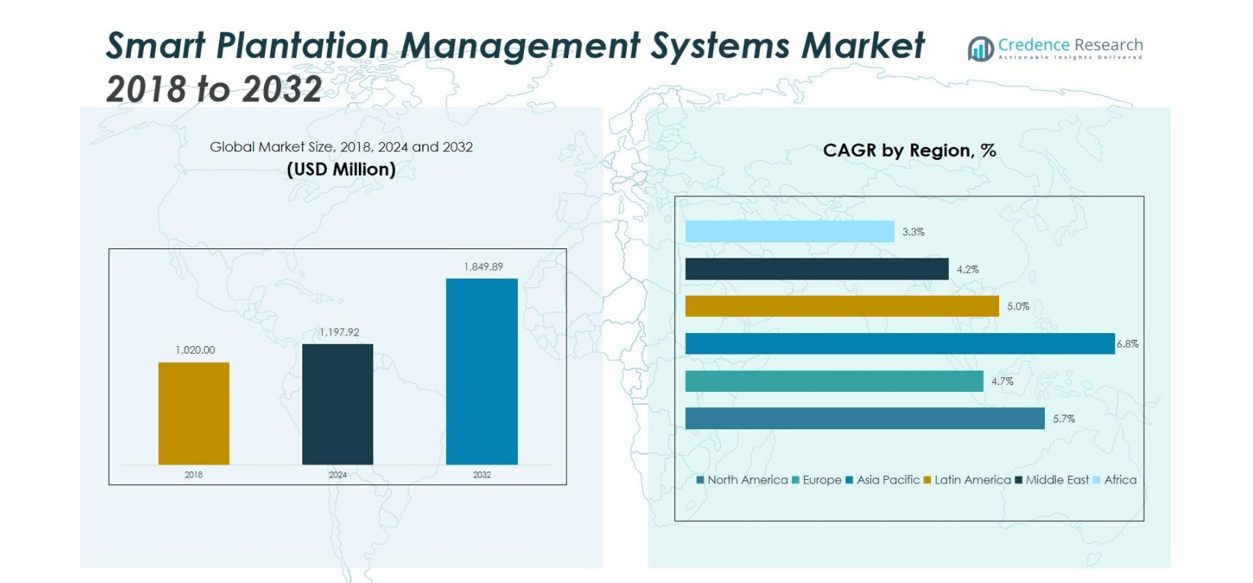
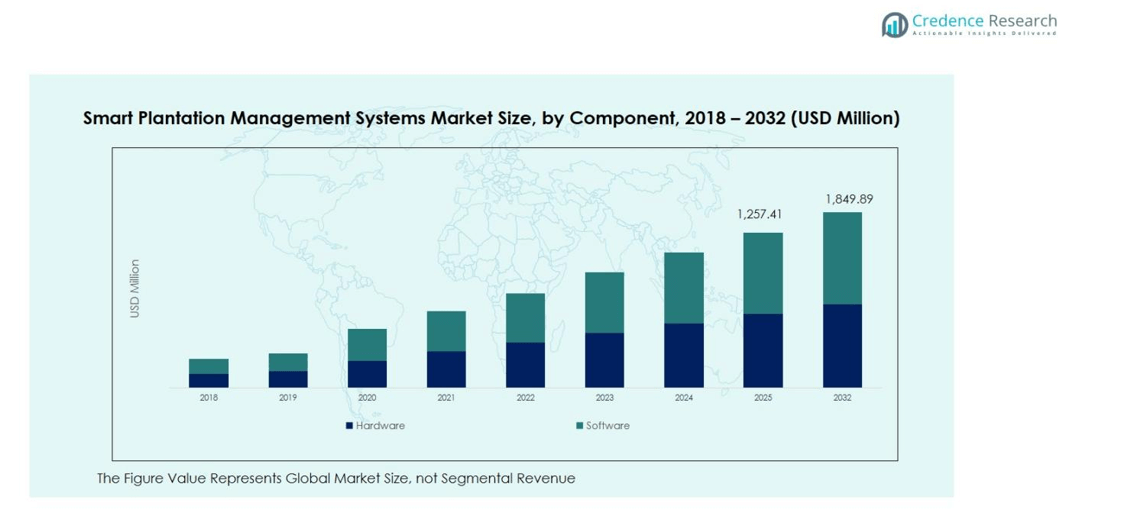
The Global Smart Plantation Management Systems Market size was valued at USD 1,020.0 million in 2018, reaching USD 1,197.9 million in 2024, and is anticipated to attain USD 1,849.9 million by 2032, expanding at a CAGR of 5.67% during the forecast period.

REPORT ATTRIBUTE DETAILS
Historical Period 2020-2023
Base Year 2024
Forecast Period 2025-2032
Smart Plantation Management Systems Market Size 2024 USD 1,197.9 million
Smart Plantation Management Systems Market, CAGR 5.67%
Smart Plantation Management Systems Market Size 2032 USD 1,849.9 million


The Smart Plantation Management Systems Market is led by major players including Robert Bosch GmbH, Deere & Company, Netafim Ltd., Synelixis Solutions S.A., DTN LLC, SemiosBio Technologies Inc., WaterBit Inc., Phytech Ltd., and Tevatronics Ltd. These companies dominate through advanced IoT-based irrigation, monitoring, and automation solutions that optimize plantation efficiency and resource management. North America leads the global market with a 36.4% share in 2024, driven by high technology adoption and government-backed digital agriculture programs. Asia Pacific follows with a 29.8% share, supported by expanding smart farming initiatives and large-scale plantation operations in China and India.

Smart Plantation Management Systems Market size

Market Insights

  • The Global Smart Plantation Management Systems Market was valued at USD 1,197.9 million in 2024 and is expected to reach USD 1,849.9 million by 2032, expanding at a CAGR of 5.67% during the forecast period.
  • Rising demand for precision agriculture and sustainable farming practices drives market growth, supported by growing adoption of automated irrigation and plant growth monitoring systems across large plantations.
  • The market trend shows strong integration of IoT, AI, and cloud technologies that enable predictive analytics and real-time crop management, improving yield efficiency and reducing resource waste.
  • Key players such as Robert Bosch GmbH, Deere & Company, and Netafim Ltd. dominate the market through technological innovations, partnerships, and global expansion strategies, increasing competitive intensity.
  • Regionally, North America leads with 4% share, followed by Asia Pacific with 29.8%, while the irrigation systems segment holds the largest 48% share across all product types.

Access crucial information at unmatched prices!

Request your sample report today & start making informed decisions powered by Credence Research Inc.!

Download Sample

Market Segmentation Analysis:

By Type

The Smart Plantation Management Systems Market by type is dominated by Irrigation Systems, accounting for around 48% of the total market share in 2024. This segment leads due to its vital role in ensuring precise water delivery and optimizing resource efficiency across large plantations. The integration of sensors, weather forecasting, and automated control systems has improved water utilization and crop yield. Growing concerns over water scarcity and the adoption of smart drip and sprinkler technologies further strengthen this segment’s position, while plant growth monitoring and harvesting systems continue to gain gradual traction.

  • For instance, Netafim’s drip irrigation technology offers sophisticated digital farming tools that enable precise water and nutrient delivery, significantly reducing water wastage

By Crop

Within the crop segment, coffee plantations hold the largest share of approximately 35% in 2024, supported by strong adoption of IoT-enabled moisture and nutrient monitoring systems. Coffee growers rely heavily on automation to maintain soil consistency and improve bean quality in varying climatic conditions. The demand for optimized water and fertilizer management, combined with export-driven production in regions like Latin America and Asia-Pacific, accelerates the use of smart systems. Other crops such as sugarcane and fruits are emerging segments, showing steady adoption of automation for yield tracking and pest management.

  • For instance, Amyra Farms in Karnataka, India, utilized IoT soil sensors to monitor real-time nutrient status and optimize soil management, achieving precise soil parameter control for sustainable coffee production during a three-month study in early 2024.

By Component

The component segment is led by hardware, representing 62% of the market share in 2024, driven by rising deployment of sensors, controllers, and weather stations in modern plantations. Hardware components serve as the backbone of data collection and process automation, offering real-time insights for farm optimization. Increased investment in precision agriculture infrastructure and advancements in sensor miniaturization enhance reliability and scalability. The software segment, although smaller, is expanding rapidly with growing demand for cloud-based analytics, mobile monitoring platforms, and AI-integrated decision-support systems.

Key Growth Drivers

Rising Adoption of Precision Agriculture

The increasing demand for efficient resource utilization and higher productivity has accelerated the adoption of precision agriculture technologies. Smart plantation management systems enable real-time monitoring of soil moisture, weather, and crop health, allowing farmers to make data-driven decisions. The ability to reduce water waste, optimize fertilizer usage, and enhance yield quality encourages large-scale integration across plantations. Governments and agritech firms are also promoting smart irrigation and monitoring infrastructure, further driving adoption among both commercial and small-scale growers.

  • For instance, Farmonaut provides satellite-based moisture analytics and irrigation scheduling tools that help farmers precisely manage water usage, reducing waste and improving irrigation efficiency in drought-prone areas.

Increasing Focus on Sustainability and Water Conservation

Sustainability goals are a major growth driver for smart plantation management systems. With growing pressure on global water resources, plantation owners are turning to automated irrigation and soil monitoring technologies that minimize waste. These systems ensure optimal water use, preventing over-irrigation and supporting long-term soil health. The use of renewable-powered systems and AI-based water scheduling further enhances their appeal. This sustainability-driven transformation aligns with environmental regulations and corporate sustainability initiatives across major agricultural regions.

Government Support and Digital Transformation in Agriculture

Government initiatives promoting smart farming and digital agriculture infrastructure are significantly boosting market growth. Subsidies, training programs, and public–private partnerships have accelerated the use of connected devices and IoT-based monitoring systems in plantations. Many countries, particularly in Asia-Pacific and Europe, are investing in agricultural modernization projects to enhance food security and productivity. The rapid expansion of rural connectivity and access to affordable sensors is encouraging farmers to adopt advanced plantation management solutions at scale.

  • For instance, India’s Digital Agriculture Mission (2021–2025) actively promotes IoT, AI, and blockchain technologies to enhance precision farming, backed by substantial government funding and initiatives like the Sub-Mission on Agricultural Mechanization for deploying kisan drones and micro-irrigation systems.

Smart Plantation Management Systems Market share

Key Trends and Opportunities

Integration of IoT and AI for Predictive Farming

The integration of Internet of Things (IoT) and Artificial Intelligence (AI) is transforming plantation operations. Smart systems now collect data through sensors and analyze it using AI algorithms to predict irrigation needs, detect plant stress, and forecast yield. This shift toward predictive farming reduces manual intervention and enhances efficiency. The growing availability of cloud platforms and edge analytics creates opportunities for real-time decision-making and precision-based resource control across large plantation areas.

  • For instance, John Deere’s AI-powered autonomous tractors equipped with IoT sensors that optimize planting and harvesting processes with real-time obstacle detection and yield monitoring.

Expansion of Cloud-Based and Mobile Platforms

Cloud-based management platforms are becoming increasingly popular for data integration and remote access in plantations. These systems allow seamless synchronization of irrigation, crop monitoring, and harvesting functions across multiple sites. Mobile-based dashboards provide real-time updates and alerts, improving operational flexibility. The growing demand for accessible, subscription-based solutions among small and medium-scale farmers presents strong opportunities for software vendors offering affordable, user-friendly interfaces and scalable digital tools.

  • For instance, Netafim offers its GrowSphere™ OS, which combines over 50 years of agronomic and hydraulic data with IoT, cloud analytics and mobile control for irrigation and fertigation.

Key Challenges

High Initial Investment and Infrastructure Constraints

The high cost of sensors, control systems, and communication infrastructure remains a significant challenge. Many farmers in developing regions face financial constraints that limit adoption of fully automated plantation systems. Inadequate internet connectivity and lack of technical knowledge further hinder market penetration. To overcome this, manufacturers and governments are exploring affordable leasing models, shared service platforms, and training programs to make smart plantation solutions more accessible and economically viable.

Data Management and Integration Issues

Managing and integrating data from various sensors, drones, and software platforms poses another major challenge. Discrepancies in data formats and lack of standardization complicate analysis and decision-making. Farmers often struggle to interpret large data sets without specialized tools or expertise. Additionally, concerns about data security and ownership slow adoption of cloud-based systems. Addressing these integration and privacy issues through standardized protocols and secure data-sharing frameworks is critical for long-term market expansion.

Regional Analysis

North America

North America dominates the Smart Plantation Management Systems Market with a 36.4% market share in 2024. The regional market was valued at USD 375.36 million in 2018 and is expected to reach USD 671.7 million by 2032, expanding at a CAGR of 5.7%. Strong technological infrastructure, early adoption of IoT in agriculture, and large-scale plantation farms in the U.S. and Canada support growth. Favorable government initiatives for precision agriculture and sustainable water management further strengthen demand for smart irrigation and monitoring systems across the region.

Europe

Europe holds a 19.5% share of the Smart Plantation Management Systems Market in 2024. Valued at USD 208.9 million in 2018, it is projected to reach USD 334.0 million by 2032, growing at a CAGR of 4.7%. The region benefits from strict environmental regulations and sustainability goals that encourage the adoption of smart irrigation and climate-monitoring technologies. Countries such as Germany, France, and the Netherlands lead due to advancements in agri-tech research, government support for digital farming, and rising awareness about resource-efficient agricultural practices.

Asia Pacific

Asia Pacific is the fastest-growing region, accounting for a 29.8% market share in 2024. The regional market size was USD 293.25 million in 2018 and is forecasted to reach USD 600.85 million by 2032, registering a CAGR of 6.8%. Rapid digital transformation, large-scale adoption of smart irrigation, and government-backed modernization of agriculture drive growth. Countries like China, India, and Japan are leading adopters of IoT-based farm systems. Expanding population, growing food demand, and strong R&D investments in agri-automation further propel market expansion.

Latin America

Latin America represents a 8.3% market share in 2024, with the market valued at USD 85.68 million in 2018 and anticipated to reach USD 145.9 million by 2032, growing at a CAGR of 5.0%. Brazil and Argentina are the key markets, driven by large coffee, sugarcane, and soybean plantations adopting precision irrigation and data-driven monitoring systems. Increasing awareness of sustainable farming practices and expanding government support for agricultural innovation enhance the market potential, especially among medium and large-scale farms.

Middle East

The Middle East accounts for a 3.5% share of the Smart Plantation Management Systems Market in 2024. The region’s market stood at USD 34.68 million in 2018 and is expected to reach USD 51.99 million by 2032, at a CAGR of 4.2%. Limited arable land and water scarcity issues are accelerating investments in smart irrigation and soil monitoring technologies. GCC countries, led by the UAE and Saudi Arabia, are investing in digital agriculture to improve food security. Smart plantation solutions are increasingly used in controlled environments and desert farming projects.

Africa

Africa holds a 2.5% market share in 2024, with the market valued at USD 22.13 million in 2018 and projected to reach USD 45.45 million by 2032, growing at a CAGR of 3.3%. Rising demand for sustainable farming and improving digital connectivity in countries such as South Africa and Kenya are supporting market development. However, limited funding, technical expertise, and infrastructure continue to restrict widespread adoption. International aid programs and private partnerships promoting smart irrigation and monitoring technologies are gradually expanding the regional footprint.

Smart Plantation Management Systems Market segmentation

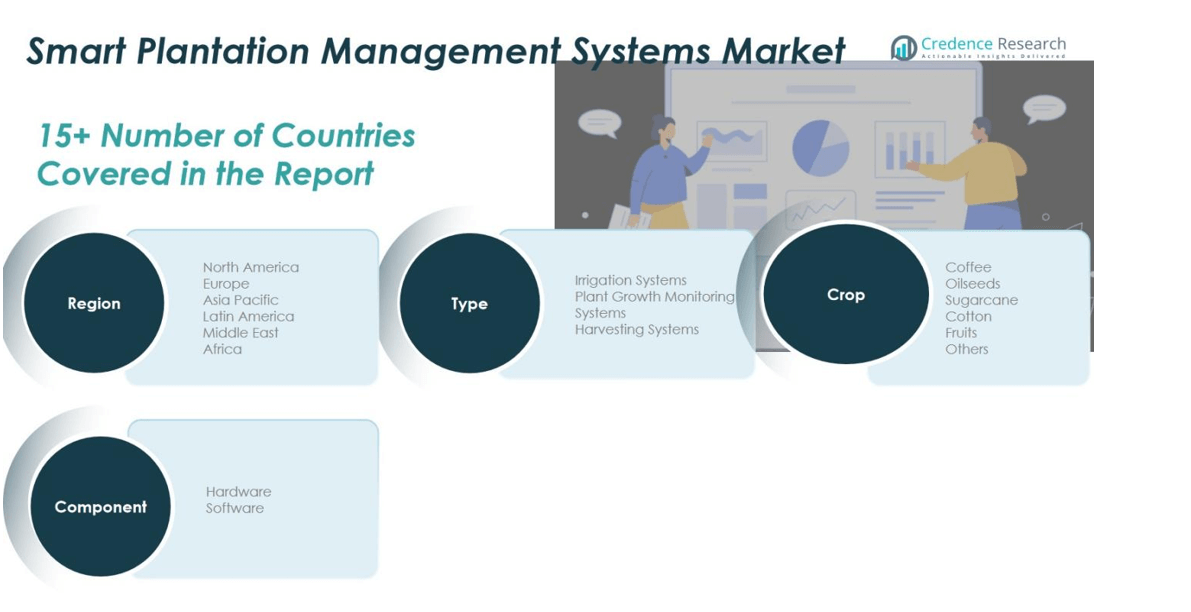
Market Segmentations:

By Type

  • Irrigation Systems
  • Plant Growth Monitoring Systems
  • Harvesting Systems

By Crop

  • Coffee
  • Oilseeds
  • Sugarcane
  • Cotton
  • Fruits
  • Others

By Component

  • Hardware
  • Software

 By Region

  • North America
    • U.S.
    • Canada
    • Mexico
  • Europe
    • Germany
    • France
    • U.K.
    • Italy
    • Spain
    • Rest of Europe
  • Asia Pacific
    • China
    • Japan
    • India
    • South Korea
    • South-east Asia
    • Rest of Asia Pacific
  • Latin America
    • Brazil
    • Argentina
    • Rest of Latin America
  • Middle East & Africa
    • GCC Countries
    • South Africa
    • Rest of the Middle East and Africa

Competitive Landscape

The competitive landscape of the Smart Plantation Management Systems Market features key players such as Robert Bosch GmbH, Deere & Company, Netafim Ltd., Synelixis Solutions S.A., DTN LLC, AgroWebLab Co. Ltd., SemiosBio Technologies Inc., WaterBit Inc., Phytech Ltd., and Tevatronics Ltd. These companies focus on innovation, strategic partnerships, and product diversification to strengthen their global presence. Market leaders emphasize integrated IoT platforms, precision irrigation, and data analytics to enhance crop productivity and sustainability. Continuous investment in R&D enables the development of AI-based monitoring tools and cloud-enabled management systems. Collaborations between agritech firms and government bodies are expanding system accessibility in emerging markets. Furthermore, competition is intensifying as startups introduce affordable, modular solutions targeting small and medium plantations. Companies are also engaging in mergers and acquisitions to broaden their technological portfolios, optimize service offerings, and expand regional footprints across Asia-Pacific, Europe, and Latin America.

Shape Your Report to Specific Countries or Regions & Enjoy 30% Off!

Key Player Analysis

  • Robert Bosch GmbH
  • Deere & Company
  • Netafim Ltd.
  • Synelixis Solutions S.A.
  • DTN, LLC
  • AgroWebLab Co., Ltd.
  • SemiosBio Technologies Inc.
  • WaterBit, Inc.
  • Phytech Ltd.
  • Tevatronics Ltd.

Recent Developments

  • In August 2025, Kubota Corporation introduced a smart plantation management solution incorporating IoT sensors for soil and crop monitoring, aimed at improving resource efficiency on large-scale plantations.
  • In April 2025, Orbia Netafim partnered with Treetoscope to integrate direct plant-sensing technology into its GrowSphere digital farming platform, enhancing real-time irrigation management.
  • In September 2024, Orbia Netafim launched GrowSphere, an all-in-one irrigation and fertigation operating system aimed at streamlining smart plantation control and data-driven farming.

Report Coverage

The research report offers an in-depth analysis based on Type, Crop, Component and Region. It details leading market players, providing an overview of their business, product offerings, investments, revenue streams, and key applications. Additionally, the report includes insights into the competitive environment, SWOT analysis, current market trends, as well as the primary drivers and constraints. Furthermore, it discusses various factors that have driven market expansion in recent years. The report also explores market dynamics, regulatory scenarios, and technological advancements that are shaping the industry. It assesses the impact of external factors and global economic changes on market growth. Lastly, it provides strategic recommendations for new entrants and established companies to navigate the complexities of the market.

Future Outlook

  1. The market will continue expanding due to rising adoption of IoT and AI in agriculture.
  2. Smart irrigation systems will remain the dominant segment, supported by increasing water conservation needs.
  3. Integration of drones and satellite imaging will improve monitoring accuracy and decision-making.
  4. Cloud-based analytics platforms will gain popularity for real-time data access and automation.
  5. Government initiatives promoting smart farming will accelerate adoption across developing regions.
  6. Partnerships between agritech firms and equipment manufacturers will enhance product reach and innovation.
  7. Demand for energy-efficient and solar-powered plantation systems will increase steadily.
  8. Small and medium-scale farmers will adopt affordable modular smart farming solutions.
  9. Data-driven predictive farming will reduce resource wastage and boost productivity.
  10. Asia Pacific will emerge as the fastest-growing regional market due to expanding agricultural modernization.

CHAPTER NO. 1 :   GENESIS OF THE MARKET


1.1 Market Prelude – Introduction & Scope

1.2 The Big Picture – Objectives & Vision

1.3 Strategic Edge – Unique Value Proposition

1.4 Stakeholder Compass – Key Beneficiaries      

CHAPTER NO. 2 :   EXECUTIVE LENS

2.1 Pulse of the Industry – Market Snapshot

2.2 Growth Arc – Revenue Projections (USD Million)      

2.3. Premium Insights – Based on Primary Interviews     

CHAPTER NO. 3 :   SMART PLANTATION MANAGEMENT SYSTEMS MARKET FORCES & INDUSTRY PULSE        

3.1 Foundations of Change – Market Overview
3.2 Catalysts of Expansion – Key Market Drivers
3.2.1 Momentum Boosters – Growth Triggers
3.2.2 Innovation Fuel – Disruptive Technologies
3.3 Headwinds & Crosswinds – Market Restraints
3.3.1 Regulatory Tides – Compliance Challenges
3.3.2 Economic Frictions – Inflationary Pressures
3.4 Untapped Horizons – Growth Potential & Opportunities
3.5 Strategic Navigation – Industry Frameworks
3.5.1 Market Equilibrium – Porter’s Five Forces
3.5.2 Ecosystem Dynamics – Value Chain Analysis
3.5.3 Macro Forces – PESTEL Breakdown

3.6 Price Trend Analysis

    3.6.1 Regional Price Trend
3.6.2 Price Trend by product

CHAPTER NO. 4 :   KEY INVESTMENT EPICENTER           

4.1 Regional Goldmines – High-Growth Geographies

4.2 Product Frontiers – Lucrative Product Categories

4.3 Crop Sweet Spots – Emerging Demand Segments         

CHAPTER NO. 5: REVENUE TRAJECTORY & WEALTH MAPPING

5.1 Momentum Metrics – Forecast & Growth Curves

5.2 Regional Revenue Footprint – Market Share Insights

5.3 Segmental Wealth Flow – Type & Crop Revenue

CHAPTER NO. 6 :   TRADE & COMMERCE ANALYSIS      

6.1.      Import Analysis by Region   

6.1.1.   Global Smart Plantation Management Systems Market Import Revenue By Region

6.2.      Export Analysis by Region   

6.2.1.   Global Smart Plantation Management Systems Market Export Revenue By Region

CHAPTER NO. 7 :   COMPETITION ANALYSIS         

7.1.      Company Market Share Analysis      

7.1.1.   Global Smart Plantation Management Systems Market: Company Market Share

7.2.      Global Smart Plantation Management Systems Market Company Revenue Market Share

7.3.      Strategic Developments        

7.3.1.   Acquisitions & Mergers        

7.3.2.   New Product Launch

7.3.3.   Regional Expansion

7.4.      Competitive Dashboard

7.5.    Company Assessment Metrics, 2024

CHAPTER NO. 8 :   SMART PLANTATION MANAGEMENT SYSTEMS MARKET – BY TYPE SEGMENT ANALYSIS  

8.1.      Smart Plantation Management Systems Market Overview by Type Segment

8.1.1.   Smart Plantation Management Systems Market Revenue Share By Type

8.2.      Irrigation Systems

8.3.      Plant Growth Monitoring Systems

8.4.      Harvesting Systems

CHAPTER NO. 9 :   SMART PLANTATION MANAGEMENT SYSTEMS MARKET – BY CROP SEGMENT ANALYSIS 

9.1.      Smart Plantation Management Systems Market Overview by Crop Segment

9.1.1.   Smart Plantation Management Systems Market Revenue Share By Crop

9.2.      Coffee

9.3.      Oilseeds

9.4.      Sugarcane

9.5.      Cotton

9.6.      Fruits

9.7.      Others

CHAPTER NO. 10 : SMART PLANTATION MANAGEMENT SYSTEMS MARKET – BY COMPONENT SEGMENT ANALYSIS

10.1.    Smart Plantation Management Systems Market Overview by Component Segment

10.1.1. Smart Plantation Management Systems Market Revenue Share By Component

10.2.    Hardware

10.3.    Software

CHAPTER NO. 11 : SMART PLANTATION MANAGEMENT SYSTEMS MARKET – REGIONAL ANALYSIS      

11.1.    Smart Plantation Management Systems Market Overview by Region Segment           

11.1.1. Global Smart Plantation Management Systems Market Revenue Share By Region

11.1.3. Regions          

11.1.4. Global Smart Plantation Management Systems Market Revenue By Region            

.1.6.     Type   

11.1.7. Global Smart Plantation Management Systems Market Revenue By Type

11.1.9. Crop   

11.1.10.           Global Smart Plantation Management Systems Market Revenue By Crop

11.1.12.           Component    

11.1.13.           Global Smart Plantation Management Systems Market Revenue By Component

CHAPTER NO. 12 : NORTH AMERICA SMART PLANTATION MANAGEMENT SYSTEMS MARKET – COUNTRY ANALYSIS     

12.1.    North America Smart Plantation Management Systems Market Overview by Country Segment       

12.1.1. North America Smart Plantation Management Systems Market Revenue Share By Region      

12.2.    North America           

12.2.1. North America Smart Plantation Management Systems Market Revenue By Country

12.2.2. Type   

12.2.3. North America Smart Plantation Management Systems Market Revenue By Type   

12.2.4. Crop   

12.2.5. North America Smart Plantation Management Systems Market Revenue By Crop   

2.2.6.   Component    

12.2.7. North America Smart Plantation Management Systems Market Revenue By Component

12.3.    U.S.    

12.4.    Canada           

12.5.    Mexico           

CHAPTER NO. 13 : EUROPE SMART PLANTATION MANAGEMENT SYSTEMS MARKET – COUNTRY ANALYSIS

13.1.    Europe Smart Plantation Management Systems Market Overview by Country Segment

13.1.1. Europe Smart Plantation Management Systems Market Revenue Share By Region

13.2.    Europe

13.2.1. Europe Smart Plantation Management Systems Market Revenue By Country            

13.2.2. Type   

13.2.3. Europe Smart Plantation Management Systems Market Revenue By Type

13.2.4. Crop   

13.2.5. Europe Smart Plantation Management Systems Market Revenue By Crop

13.2.6. Component    

13.2.7. Europe Smart Plantation Management Systems Market Revenue By Component

13.3.    UK     

13.4.    France

13.5.    Germany        

13.6.    Italy    

13.7.    Spain  

13.8.    Russia

13.9.   Rest of Europe

CHAPTER NO. 14 : ASIA PACIFIC SMART PLANTATION MANAGEMENT SYSTEMS MARKET – COUNTRY ANALYSIS

14.1.    Asia Pacific Smart Plantation Management Systems Market Overview by Country Segment       

14.1.1. Asia Pacific Smart Plantation Management Systems Market Revenue Share By Region

14.2.    Asia Pacific   

14.2.1. Asia Pacific Smart Plantation Management Systems Market Revenue By Country

14.2.2. Type   

14.2.3. Asia Pacific Smart Plantation Management Systems Market Revenue By Type            

14.2.4. Crop   

14.2.5. Asia Pacific Smart Plantation Management Systems Market Revenue By Crop

14.2.5. Component    

14.2.7. Asia Pacific Smart Plantation Management Systems Market Revenue By Component

14.3.    China 

14.4.    Japan  

14.5.    South Korea   

14.6.    India   

14.7.    Australia        

14.8.    Southeast Asia

14.9.    Rest of Asia Pacific

CHAPTER NO. 15 : LATIN AMERICA SMART PLANTATION MANAGEMENT SYSTEMS MARKET – COUNTRY ANALYSIS

15.1.    Latin America Smart Plantation Management Systems Market Overview by Country Segment       

15.1.1. Latin America Smart Plantation Management Systems Market Revenue Share By Region      

15.2.    Latin America

15.2.1. Latin America Smart Plantation Management Systems Market Revenue By Country

15.2.2. Type   

15.2.3. Latin America Smart Plantation Management Systems Market Revenue By Type

15.2.4. Crop   

15.2.5. Latin America Smart Plantation Management Systems Market Revenue By Crop

15.2.6. Component    

15.2.7. Latin America Smart Plantation Management Systems Market Revenue By Component

15.3.    Brazil 

15.4.    Argentina       

15.5.    Rest of Latin America

CHAPTER NO. 16 : MIDDLE EAST SMART PLANTATION MANAGEMENT SYSTEMS MARKET – COUNTRY ANALYSIS

16.1.    Middle East Smart Plantation Management Systems Market Overview by Country Segment       

16.1.1. Middle East Smart Plantation Management Systems Market Revenue Share By Region

16.2.    Middle East   

16.2.1. Middle East Smart Plantation Management Systems Market Revenue By Country

16.2.2. Type   

16.2.3. Middle East Smart Plantation Management Systems Market Revenue By Type            

16.2.4. Crop   

16.2.5. Middle East Smart Plantation Management Systems Market Revenue By Crop

16.2.6. Component

16.2.7. Middle East Smart Plantation Management Systems Market Revenue By Component

16.3.    GCC Countries          

16.4.    Israel

16.5.    Turkey

16.6.    Rest of Middle East   

CHAPTER NO. 17 : AFRICA SMART PLANTATION MANAGEMENT SYSTEMS MARKET – COUNTRY ANALYSIS

17.1.    Africa Smart Plantation Management Systems Market Overview by Country Segment

17.1.1. Africa Smart Plantation Management Systems Market Revenue Share By Region           

17.2.    Africa

17.2.1. Africa Smart Plantation Management Systems Market Revenue By Country            

17.2.2. Type   

17.2.3. Africa Smart Plantation Management Systems Market Revenue By Type  

17.2.4. Crop   

17.2.5. Africa Smart Plantation Management Systems Market Revenue By Crop

17.2.6. Component    

17.2.7. Africa Smart Plantation Management Systems Market Revenue By Component

17.3.    South Africa

17.4.    Egypt 

17.5.    Rest of Africa

CHAPTER NO. 18 : COMPANY PROFILES     

18.1.    Robert Bosch GmbH

18.1.1. Company Overview   

18.1.2. Product Portfolio       

18.1.3. Financial Overview   

18.1.4. Recent Developments

18.1.5. Growth Strategy        

18.1.6. SWOT Analysis        

18.2.    Deere & Company

18.3.    Netafim Ltd.

18.4.    Synelixis Solutions S.A.

18.5.    DTN, LLC

18.6.    AgroWebLab Co., Ltd.

18.7.    SemiosBio Technologies Inc.

18.8.    WaterBit, Inc.

18.9.    Phytech Ltd.

18.10.  Tevatronics Ltd.

Request Free Sample

We prioritize the confidentiality and security of your data. Our promise: your information remains private.

Ready to Transform Data into Decisions?

Request Your Sample Report and Start Your Journey of Informed Choices


Providing the strategic compass for industry titans.

cr-clients-logos

Frequently Asked Questions:

What is the current market size for the Smart Plantation Management Systems Market, and what is its projected size in 2032?

The Smart Plantation Management Systems Market was valued at USD 1,197.9 million in 2024 and is expected to reach USD 1,849.9 million by 2032.

At what Compound Annual Growth Rate is the Smart Plantation Management Systems
Market projected to grow between 2025 and 2032?

The Smart Plantation Management Systems Market is projected to expand at a CAGR of 5.67% during 2025–2032.

Which Smart Plantation Management Systems Market segment held the largest share in 2024?

The irrigation systems segment dominated the Smart Plantation Management Systems Market with a 48% share in 2024.

What are the primary factors fueling the growth of the Smart Plantation Management Systems Market?

Key drivers include growing adoption of precision agriculture, sustainability initiatives, and government-backed digital farming programs.

What are the main drivers of growth in the smart plantation management systems market?

Key drivers include the growing demand for optimized agricultural practices, improved resource utilization, and the adoption of technologies like IoT, AI, and data analytics for better farm management.

Which region commanded the largest share of the Smart Plantation Management Systems Market in 2024?

North America led the Smart Plantation Management Systems Market with a 36.4% share in 2024.

About Author

Shweta Bisht

Shweta Bisht

Healthcare & Biotech Analyst

Shweta is a healthcare and biotech researcher with strong analytical skills in chemical and agri domains.

View Profile

Related Reports

GIS Based Agriculture Market

GIS Based Agriculture Market size was valued at USD 460.6 Million in 2024 and is anticipated to reach USD 1,241.92 Million by 2032, at a CAGR of 13.2% during the forecast period.

Precision Harvesters Market

Precision Harvesters Market size was valued at USD 20.15 billion in 2024 and is anticipated to reach USD 33.35 billion by 2032, at a CAGR of 6.5% during the forecast period.

North America Smart Irrigation Market

North America Smart Irrigation Market size was valued at USD 827.00 Million in 2024 and is anticipated to reach USD 2,137.04 Million by 2032, at a CAGR of 12.6% during the forecast period.

Rice Cultivation Equipment Market

Rice Cultivation Equipment Market size was valued at USD 1178.5 Million in 2024 and is anticipated to reach USD 1600.49 Million by 2032, at a CAGR of 3.9% during the forecast period.

Regenerative Agriculture Market

Regenerative agriculture Market was valued at USD 8.06 billion in 2024 and is anticipated to reach USD 23.4 billion by 2032, growing at a CAGR of 14.25% during the forecast period.

UK Barley Market

The UK  Barley Market size was valued at USD 11,551.97 million in 2018 to USD 11,963.70 million in 2024 and is anticipated to reach USD 15,437.99 million by 2032, at a CAGR of 3.24% during the forecast period.

U.S. Barley Market

The U.S. Barley Market size was valued at USD 26,325.13 million in 2018 to USD 27,045.00 million in 2024 and is anticipated to reach USD 34,437.41 million by 2032, at a CAGR of 3.07% during the forecast period.

North America Barley Market

The North America Barley Market size was valued at USD  29,756.00 million in 2018 to USD 30,521.39 million in 2024 and is anticipated to reach USD   38,378.93 million by 2032, at a CAGR of 2.90% during the forecast period.

Italy Barley Market

The Italy Barley Market size was valued at USD  5,100.87 million in 2018 to USD 5,217.56 million in 2024 and is anticipated to reach USD  5,984.37 million by 2032, at a CAGR of 1.73% during the forecast period.

Germany Barley Market

The Germany Barley Market size was valued at USD   12,077.06 million in 2018 to USD 12,735.82 million in 2024 and is anticipated to reach USD  18,125.71 million by 2032, at a CAGR of 4.51% during the forecast period.

France Barley Market

The France Barley Market size was valued at USD  9,511.62 million in 2018 to USD     9,823.27 million in 2024 and is anticipated to reach USD    12,546.52 million by 2032, at a CAGR of 3.11% during the forecast period.

Europe Barley Market

The Europe Barley Market size was valued at USD 75,012.80 million in 2018 to USD 77,069.81 million in 2024 and is anticipated to reach USD 94,576.97 million by 2032, at a CAGR of 2.60% during the forecast period.

Licence Option

The report comes as a view-only PDF document, optimized for individual clients. This version is recommended for personal digital use and does not allow printing. Use restricted to one purchaser only.
$4999

To meet the needs of modern corporate teams, our report comes in two formats: a printable PDF and a data-rich Excel sheet. This package is optimized for internal analysis. Unlimited users allowed within one corporate location (e.g., regional office).
$6999

The report will be delivered in printable PDF format along with the report’s data Excel sheet. This license offers 100 Free Analyst hours where the client can utilize Credence Research Inc. research team. Permitted for unlimited global use by all users within the purchasing corporation, such as all employees of a single company.
$12999

Report delivery within 24 to 48 hours

Credence Staff 3

WILLIAM, North America

Support Staff at Credence Research

KEITH PHILLIPS, Europe

Lee - CR Sales Staff

LEE VALLANCE, Asia Pacific

Kieran Jameson

KIERAN JAMESON, Australia

Smallform of Sample request
User Review

Thank you for the data! The numbers are exactly what we asked for and what we need to build our business case.

Materials Scientist
(privacy requested)

User Review

The report was an excellent overview of the Industrial Burners market. This report does a great job of breaking everything down into manageable chunks.

Imre Hof
Management Assistant, Bekaert

cr-clients-logos

Request Sample