
Market Overview:
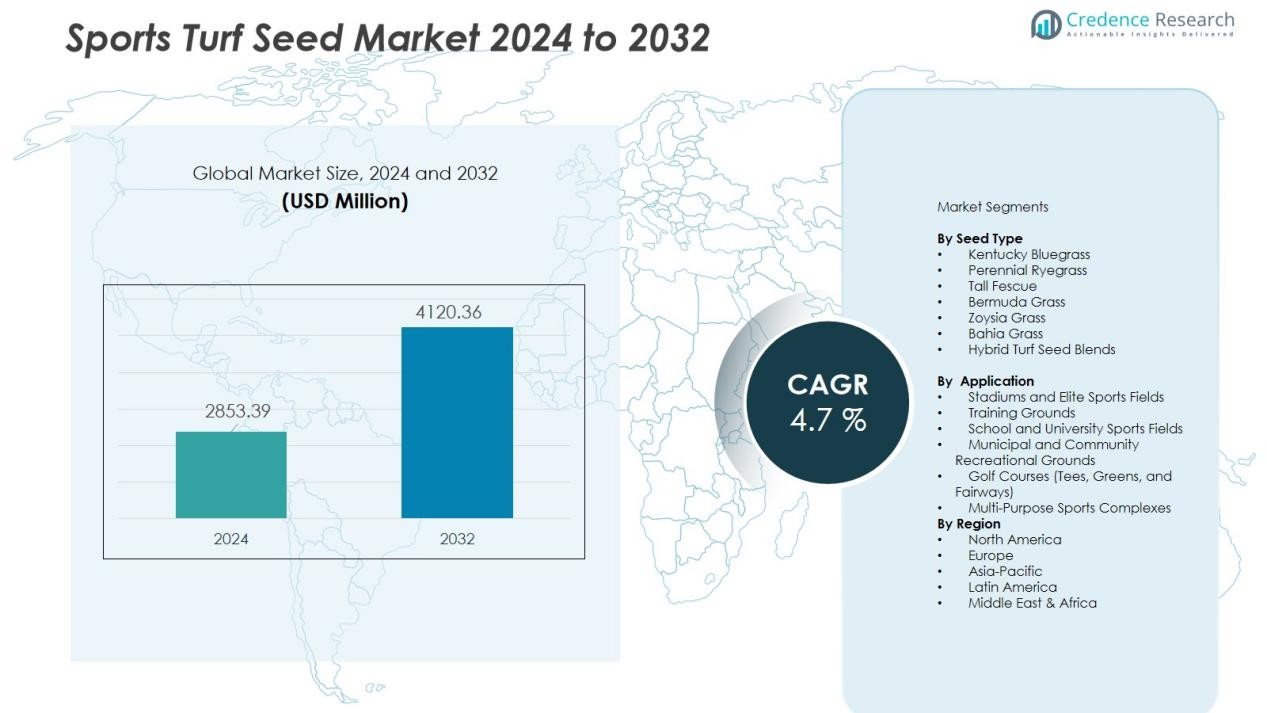
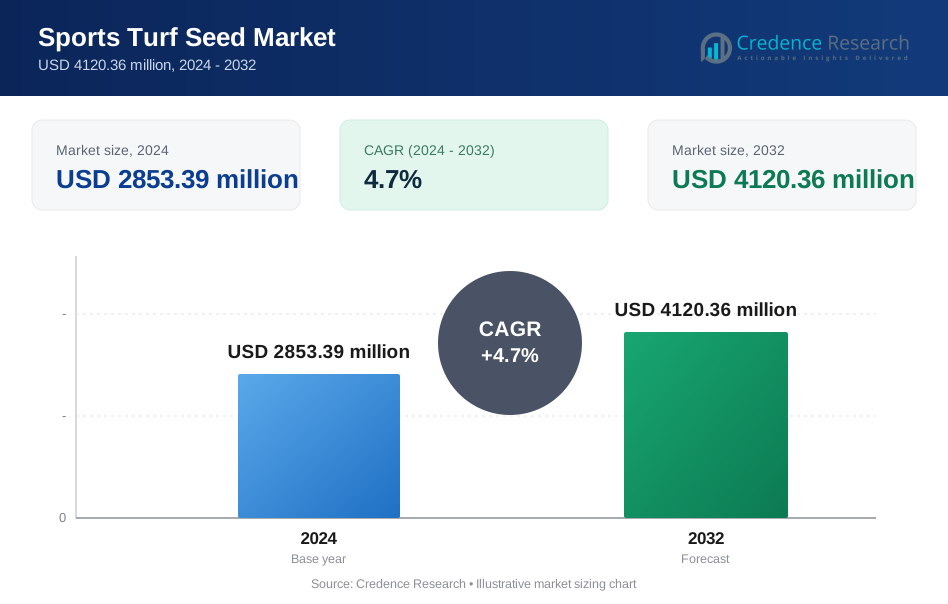
The Sports Turf Seed Market size was valued at USD 2853.39 million in 2024 and is anticipated to reach USD 4120.36 million by 2032, at a CAGR of 4.7 % during the forecast period.
| REPORT ATTRIBUTE | DETAILS |
|---|---|
| Historical Period | 2020-2023 |
| Base Year | 2024 |
| Forecast Period | 2025-2032 |
| Sports Turf Seed Market Size 2024 | USD 2853.39 Million |
| Sports Turf Seed Market, CAGR | 4.7% |
| Sports Turf Seed Market Size 2032 | USD 4120.36 Million |
Market growth is driven by the rising popularity of sports leagues, expanding participation in outdoor sports, and growing preferences for natural turf surfaces due to their playability, aesthetic appeal, and sustainability benefits. Increased focus on surface quality, athlete safety, and shock absorption drives demand for superior-quality turf seeds offering strong root systems, resilience, rapid regeneration, and disease resistance. Government spending on sports infrastructure, coupled with private club investments and modernization of school and college sports grounds, further supports sustained demand. Additionally, innovation in drought-resistant and low-maintenance seed varieties encourages broader market penetration.
Regionally, North America dominates the Sports Turf Seed Market due to extensive sports culture, technological advances in turf management, and large-scale investments in professional sports facilities. Europe follows closely with strong demand from football clubs, golf courses, and community sports fields. Asia-Pacific remains the fastest-growing region, driven by urban development, increasing sporting events, and expanding public sports programs in countries such as India, China, and Australia. Emerging markets in Latin America and the Middle East show rising potential due to increasing interest in global sports and growing infrastructure development.
Market Insights:
- The Sports Turf Seed Market was valued at USD 2,853.39 million in 2024 and is projected to reach USD 4,120.36 million by 2032, growing at a CAGR of 4.7% during the forecast period.
- North America holds the largest regional share at 38.2%, driven by advanced sports infrastructure, professional leagues, and turf science innovations, followed by Europe at 27.4%, supported by football and golf demand, and Asia-Pacific at 21.6% due to public sports initiatives and recreational development.
- Asia-Pacific is the fastest-growing region with a 21.6% market share, driven by rapid urbanization, increasing youth participation in sports, and rising investments in stadium construction and public fitness programs.
- By Application, Sports Arenas dominate with a 42.3% share, reflecting high turf standards for performance and safety in professional facilities.
- By Grass Type, Warm Season Grasses lead with a 56.1% share due to their adaptability to diverse climates and lower maintenance needs.
Market Drivers:
Rising Investments in Sports Infrastructure and Field Modernization
Expanding sports infrastructure plays a decisive role in driving demand for premium turf seeds. Governments and private organizations are building stadiums, multipurpose sports complexes, and training facilities that require durable and high-quality natural turf. The Sports Turf Seed Market gains momentum from field renovation projects in schools, universities, and community grounds that upgrade older surfaces. It benefits from project specifications that emphasize turf varieties with higher endurance and uniformity. Increased allocation of budgets for turf improvement strengthens long-term seed consumption.
- For instance, the Himachal Pradesh government is constructing a Rs 65 crore multi-purpose sports complex in Nadaun, Hamirpur, featuring advanced turf-equipped arenas for wrestling, boxing, and kabaddi to support athlete training.
Growing Preference for Natural Turf Due to Athlete Safety and Playability
Natural turf remains the preferred choice for many sporting facilities because it offers superior playability, traction, and reduced injury risk. Turf seeds engineered for resilience and shock absorption support better athlete performance and minimize surface-related injuries. It remains popular among football, cricket, golf, baseball, and rugby facilities where surface quality directly influences gameplay. The emphasis on cushioning properties and resistance to heavy foot traffic increases demand for advanced seed varieties. Research-driven seed development continues to target improved wear tolerance for high-intensity matches.
- For Instance, Johnsons Sports Seed's J Premier Pitch mix is a high-performance, industry-leading grass seed blend known for its exceptional wear tolerance and use in elite European sports stadiums, often featuring innovative components like 4turf Tetraploid Ryegrass to ensure rapid establishment and durability.
Advancements in Drought-Tolerant and Low-Maintenance Turf Seed Varieties
Seed producers are introducing highly adaptable varieties that reduce irrigation needs and support sustainable field maintenance. These innovations address environmental constraints and rising operational costs across sports facilities. The Sports Turf Seed Market benefits from drought-resistant, disease-tolerant, and fast-regenerating seeds that reduce maintenance frequency. It supports facilities in regions facing climate variability by providing reliable turf establishment. Enhanced genetic breeding ensures turf survival in extreme weather conditions with minimal resource input.
Increasing Sports Participation and Expansion of Recreational Grounds
Higher participation in school sports, community activities, and amateur leagues boosts installation and upkeep of natural turf surfaces. Cities are expanding public parks, playgrounds, and recreational fields that require long-lasting turf solutions. It benefits from rising awareness of outdoor sports and fitness among younger demographics. Growth in youth sports leagues demands consistent turf performance for repeated use. Increased urban development encourages creation of green sports spaces, which expands the customer base for turf seed suppliers.
Market Trends:
Growing Demand for Climate-Resilient and Low-Input Turf Seed Varieties
Seed developers are prioritizing turf varieties that withstand drought, heat stress, and heavy usage with minimal upkeep. The Sports Turf Seed Market experiences rising demand for grass species engineered for lower irrigation, reduced fertilization, and stronger disease resistance. Facilities in both warm and temperate regions seek seeds with faster recovery characteristics to sustain dense turf even under frequent tournaments. It reflects a shift toward sustainable turf management that aligns with budget controls in public sports facilities and private clubs. Breeding programs continue to focus on hybrids with superior wear tolerance and improved root systems. Stadiums and golf courses are adopting climate-resilient species to maintain consistency in play conditions during weather fluctuations. Broader acceptance of these low-input varieties supports long-term operational efficiency.
- For Instance, Certain advanced turfgrass cultivars developed by companies like Scotts, and evaluated in the National Turfgrass Evaluation Program (NTEP) trials, often exhibit superior performance metrics, particularly in disease resistance ratings, where some achieve scores in the 7+ range on the program's 1-9 scale.
Integration of Digital Turf Management and Precision Seed Application Practices
Technological advancements are influencing seed selection and maintenance strategies across modern sports facilities. Precision turf management tools, including remote soil sensors, satellite-based turf health monitoring, and automated irrigation systems, guide the choice of optimal seed mixes. The Sports Turf Seed Market benefits from data-driven practices that recommend specific seed blends according to foot traffic, soil composition, and climate. It enables facility managers to adopt targeted seeding for different zones such as goalmouths, sidelines, and putting greens. Intelligent turf analytics optimize mowing frequency and nutrient application, which enhances overall turf performance. Professional leagues and urban sports complexes are adopting advanced equipment to maintain uniform grass density and speed. The trend expands adoption of specialized seed varieties tailored for data-supported turf care programs.
- For Instance, For large-scale professional turf care, Husqvarna's CEORA robotic mower employs advanced EPOS™ satellite navigation technology for autonomous, systematic operation within virtual boundaries. Depending on the desired turf quality setting (e.g., 'pro sports' vs. 'regular'), the system is capable of covering vast areas, such as multiple football pitches, with a maximum capacity of up to 7.5 hectares (75,000 m²) when mowing less frequently, or up to 2.5 hectares (25,000 m²) for daily 'pro sports quality' cuts.
Market Challenges Analysis:
High Maintenance Costs and Limited Adoption in Budget-Constrained Facilities
Sports facilities often face challenges related to maintenance budgets, which directly affects turf seed adoption. The Sports Turf Seed Market must address cost concerns linked to irrigation, fertilization, mowing, and pest management. Many schools, municipal grounds, and community parks choose lower-quality grass varieties due to limited funding. It becomes difficult to promote premium seed blends when facilities prioritize short-term savings over turf performance. Maintenance requirements also vary by climate, making operational planning more complex for smaller institutions. Higher cost of specialized turf care limits widespread installation, particularly in emerging markets.
Vulnerability to Climate Variability and Surface Performance Risks
Natural turf remains highly sensitive to unpredictable weather conditions, which impacts its reliability during peak sports seasons. Heavy rainfall, drought periods, and temperature fluctuations can damage turf quality, demanding frequent reseeding. The Sports Turf Seed Market must respond to performance concerns when fields fail to recover quickly after intense matches. It becomes challenging to maintain uniformity in heavily used zones such as goalmouths or run-up areas. Poor turf conditions can disrupt sporting schedules and undermine facility reputation. Climate stress increases demand for resilient seeds but delays adoption until proven performance is evident in real field conditions.
Market Opportunities:
Rising Development of Green Sports Infrastructure and Recreational Facilities
Urban development strategies are prioritizing sustainable sports infrastructure, which opens opportunities for advanced turf seed adoption. The Sports Turf Seed Market benefits from increasing investment in community sports parks, school athletic grounds, and multipurpose recreation fields that demand durable and visually appealing turf. Governments are promoting green outdoor spaces to support wellness initiatives and public sports participation. It encourages facility upgrades that require seed varieties with strong wear tolerance and efficient turf regeneration. Growing construction of golf courses, cricket stadiums, and football training academies creates long-term demand for specialized seed mixes. Suppliers can expand into public sports programs that emphasize natural turf over artificial surfaces.
Innovation in Seed Technology and Adoption of Smart Turf Management Systems
Advancements in breeding, genetic improvement, and coating technologies provide opportunities to develop highly resilient turf varieties. Seed companies can offer products with faster establishment, reduced irrigation needs, and higher disease resistance. The Sports Turf Seed Market gains value from digital turf management systems that integrate data analytics into seeding decisions. It enables tailored seed selection based on soil conditions, climate, and usage intensity. Growing demand for precision turf care supports specialized blends designed for specific playing surfaces and sport categories. Collaborations between seed developers, sports institutions, and turf technology providers can create premium market segments focused on performance-based seed solutions.
Market Segmentation Analysis:
By Seed Type
The Sports Turf Seed Market offers a diverse range of seed types that cater to different climatic zones and performance needs across sports facilities. Cool-season grasses, including Kentucky bluegrass, perennial ryegrass, and tall fescue, dominate markets in temperate regions because they provide dense coverage, rapid recovery, and strong foot-traffic tolerance. Warm-season grasses such as Bermuda grass, Zoysia, and Bahia gain significant traction in tropical and subtropical regions due to their heat resistance and lower irrigation needs. It supports both premium sports venues and community grounds seeking durability and lower maintenance. Hybrid seed blends continue to expand demand by offering enhanced disease resistance, deeper rooting, and faster regeneration, making them attractive to high-intensity sports grounds.
- For instance, Husqvarna's CEORA robotic mower employs advanced EPOS satellite navigation and AI-vision technology for autonomous, systematic operation, and is capable of covering up to 2.5 hectares (25,000 m²) daily when maintaining a professional sports quality finish on areas like football pitches. This results in a consistently lush, match-ready turf.
By Application
Sports turf seeds serve varied applications across stadiums, training grounds, recreational fields, golf courses, and multipurpose sports complexes. Stadiums and elite fields prefer specialized blends that ensure uniform texture, superior shock absorption, and fast turf recovery after tournaments. Golf courses use species tailored to tees, greens, and fairways to maintain smooth ball roll and visual appeal. It benefits from growing construction of school and municipal sports facilities that require long-lasting turf solutions for heavy community use. Cricket, football, baseball, and rugby grounds increasingly adopt high-performance turf seeds to manage intense seasonal usage. Demand for customized seed blends strengthens across facilities that emphasize player safety, visual aesthetics, and sustainable turf management.
- For Instance, DLF's 4turf tetraploid perennial ryegrass varieties are incorporated into seed mixtures used for professional sports pitches, including those for major international football (soccer) tournaments and training grounds.
Segmentations:
By Seed Type
- Kentucky Bluegrass
- Perennial Ryegrass
- Tall Fescue
- Bermuda Grass
- Zoysia Grass
- Bahia Grass
- Hybrid Turf Seed Blends
By Application
- Stadiums and Elite Sports Fields
- Training Grounds
- School and University Sports Fields
- Municipal and Community Recreational Grounds
- Golf Courses (Tees, Greens, and Fairways)
- Multi-Purpose Sports Complexes
By Region
- North America
- U.S.
- Canada
- Mexico
- Europe
- Germany
- France
- U.K.
- Italy
- Spain
- Rest of Europe
- Asia Pacific
- China
- Japan
- India
- South Korea
- South-east Asia
- Rest of Asia Pacific
- Latin America
- Brazil
- Argentina
- Rest of Latin America
- Middle East & Africa
- GCC Countries
- South Africa
- Rest of the Middle East and Africa
Regional Analysis:
Strong Market Presence in North America Driven by Large-Scale Sports Infrastructure
North America leads turf seed consumption due to extensive sports culture and well-developed stadium infrastructure. The Sports Turf Seed Market gains momentum from professional leagues in football, baseball, soccer, and golf that demand premium turf performance. Universities and schools in the region maintain dedicated athletic fields, which reinforces continuous turf replacement and renovation cycles. It also benefits from advanced turf science research, digital turf management practices, and eco-focused maintenance regulations. Turf varieties with drought tolerance and fast regeneration receive higher adoption due to increasing climate variability. Growing upgrades of public sports parks and training academies further strengthen seed demand.
Europe Maintains High Demand Supported by Football and Golf Dominance
Europe exhibits strong demand for premium turf seed varieties due to heavy football usage and extensive golf course installations. Countries such as the U.K., Germany, Spain, France, and Italy invest significantly in natural turf maintenance for elite clubs and community leagues. It reflects the region’s preference for turf surfaces that ensure safe play, strong traction, and visual uniformity under intensive match schedules. Demand for hybrid and cool-season grasses remains high, particularly across temperate climates. Sustainability initiatives across European municipalities promote low-input turf varieties that reduce irrigation and fertilizer dependence. The commercial landscape grows alongside renovation of stadium fields and green recreational areas.
Rapid Growth Across Asia-Pacific Due to Expanding Sports Facilities and Urbanization
Asia-Pacific emerges as the fastest-growing regional market due to expanding sports infrastructure, urban recreation projects, and rising participation in school sports. Investment in cricket stadiums, football training centers, and public sports complexes increases demand for durable turf varieties. It supports warm-season and drought-resistant seeds that suit tropical and subtropical climates in India, China, Australia, and Southeast Asia. Government programs promoting public fitness and infrastructure modernization stimulate installations of grass-based playing fields. Turf maintenance companies gain opportunities in supplying resilient seed varieties capable of handling frequent tournaments and heavy community usage. Growth in youth sports leagues and urban green spaces continues to expand long-term consumption across emerging markets.
Key Player Analysis:
- FieldTurf
- Shaw Sports Turf
- AstroTurf
- TenCate Grass
- SIS Pitches
Competitive Analysis:
The Sports Turf Seed Market exhibits a competitive landscape shaped by innovation in resilient grass varieties, regional climate adaptation, and performance-based seed formulations. FieldTurf, Shaw Sports Turf, AstroTurf, TenCate Grass, and SIS Pitches focus on advanced breeding programs and customized seed solutions designed for diverse sports environments. Companies emphasize durability, fast recovery, and disease resistance to meet demands of high-intensity sports venues and multipurpose athletic fields. It creates opportunities for hybrid seed offerings that provide deeper rooting, improved shock absorption, and reduced irrigation needs. Leading suppliers invest in research partnerships with turf scientists and sports organizations to develop seed mixes suitable for heavy tournament schedules and varying soil conditions.
Competitive strategies also center on digital turf management tools that align seed selection with climate data, usage frequency, and maintenance budgets. Firms expand market presence by targeting public sports facilities, professional clubs, and school grounds through performance certifications and tailored seed recommendations. Increasing demand for sustainable turf encourages suppliers to refine seed technologies that support low-input, environmentally responsible field maintenance.
Recent Developments:
- In October 2025, Shaw Sports Turf renewed as the Official Synthetic Turf Provider of the College Football Playoff starting 2026, featuring innovations like NXTPlay shock pads.
- In June 2025, AstroTurf became the Official Synthetic Turf of Major League Baseball through a multi-year partnership, supporting events like the 2025 Speedway Classic.
Report Coverage:
The research report offers an in-depth analysis based on Seed Type, Application and Region. It details leading Market players, providing an overview of their business, product offerings, investments, revenue streams, and key applications. Additionally, the report includes insights into the competitive environment, SWOT analysis, current Market trends, as well as the primary drivers and constraints. Furthermore, it discusses various factors that have driven Market expansion in recent years. The report also explores Market dynamics, regulatory scenarios, and technological advancements that are shaping the industry. It assesses the impact of external factors and global economic changes on Market growth. Lastly, it provides strategic recommendations for new entrants and established companies to navigate the complexities of the Market.
Future Outlook:
- Future demand will favor climate-resilient turf seeds that reduce irrigation needs and maintain surface quality during weather fluctuations.
- Sports facilities will adopt hybrid turf seed blends that offer faster recovery, stronger rooting, and higher wear tolerance for intense gameplay.
- Seed producers will expand collaborations with turf researchers and sports organizations to develop performance-driven, sport-specific seed varieties.
- Digital turf management tools will influence buying decisions, promoting data-based seed selection aligned with soil conditions and usage patterns.
- Growing construction of school, municipal, and recreational sports fields will create consistent demand for durable, low-maintenance grass varieties.
- Urban development will prioritize green sports infrastructure, pushing facilities to prefer natural turf systems over synthetic alternatives.
- Golf course expansion in emerging regions will increase demand for specialized seed varieties designed for greens, fairways, and tees.
- Seed companies will invest in coating technologies that enhance germination, improve disease resistance, and accelerate turf establishment on high-traffic fields.
- Public recreation policies promoting outdoor fitness and community sports programs will expand seed consumption across developing markets.
- Sustainability standards will drive innovations in low-input seeds that support responsible nutrient use and efficient water management in sports turf maintenance.
Request a Free Sample
Fill in your details and we'll send you a free sample report.
- Sample data tables & charts
- Research methodology
Need a Custom Version of This Report?
Tailor the scope, geography, or segments to your exact requirements.
- Custom geography or segment scope
- Direct access to our analyst team
Frequently Asked Questions
What is the current market size for the Sports Turf Seed Market, and what is its projected size in 2032?
At what Compound Annual Growth Rate is the Sports Turf Seed Market projected to grow between 2024 and 2032?
Which segment held the largest share of the Sports Turf Seed Market in 2024?
What are the primary factors fueling the growth of the Sports Turf Seed Market?
Who are the leading companies in the Sports Turf Seed Market?
Which region commanded the largest share of the Sports Turf Seed Market in 2024?
Table of Content
Chapter 1. Report Introduction
- 1.1 Report Description & Purpose
- 1.1.1 Report Title & Market Definition
- 1.1.2 Unique Selling Propositions (USP) & Key Differentiators
- 1.1.3 Value Proposition for Stakeholders
- 1.2 Research Objectives
- 1.2.1 Market Sizing Objectives (Volume & Revenue)
- 1.2.2 Segmentation Objectives
- 1.2.3 Competitive Intelligence Objectives
- 1.2.4 Forecast & Scenario Objectives
- 1.3 Report Scope
- 1.3.1 Sports Turf Seed Scope – Types & Subtypes Covered
- 1.3.2 Geographic Scope – Regions & Countries Covered
- 1.3.3 Historical Period, Base Year & Forecast Period (2024; forecast to 2032)
- 1.3.4 Inclusions & Exclusions
- 1.4 HS Code & Classification Framework
- 1.5 Currency, Units & Pricing Basis
- 1.6 Target Stakeholders
- 1.7 Limitations & Assumptions
Chapter 2. Executive Summary
- 2.1 Global Sports Turf Seed Market Snapshot
- 2.1.1 Market Size – Historical (2024) & Forecast (2024-2032) (2024: USD 2853.39 million → 2032: USD 4120.36 million)
- 2.1.2 Volume & Revenue – Global Totals
- 2.1.3 Key Market Highlights – Top Five Facts
- 2.2 Sports Turf Seed Market Segmentation Snapshot
- 2.2.1 Market Split by Region – 2024 vs. 2032
- 2.3 Competitive Snapshot
- 2.3.1 Top 10 Players by Revenue Share – 2024
- 2.3.2 Top 10 Players by Volume Share – 2024
- 2.3.3 Recent Strategic Developments (18-Month Summary)
- 2.4 Key Investment Highlights & Strategic Conclusions
Chapter 3. Sports Turf Seed Market Dynamics & Industry Analysis
- 3.1 Market Overview & Context
- 3.1.1 Sports Turf Seed Market Position in the Broader Automotive Value Chain
- 3.1.2 OEM vs. Replacement Market Dynamics
- 3.1.3 Market Maturity & Development Stage by Region
- 3.2 Sports Turf Seed Market Drivers
- 3.3 Sports Turf Seed Market Restraints & Challenges
- 3.4 Sports Turf Seed Market Opportunities
- 3.5 Porter's Five Forces Analysis
- 3.5.1 Threat of New Entrants
- 3.5.2 Bargaining Power of Suppliers
- 3.5.3 Bargaining Power of Buyers
- 3.5.4 Threat of Substitutes
- 3.5.5 Competitive Rivalry – Intensity Assessment
- 3.6 Sports Turf Seed Value Chain Analysis
- 3.6.1 Upstream – Raw Material/Input Suppliers
- 3.6.1.1 Raw Material/Input 1
- 3.6.1.2 Raw Material/Input 2
- 3.6.1.3 Raw Material/Input 3
- 3.6.2 Midstream – Production/Manufacturing/Service Delivery
- 3.6.2.1 Production/Process Overview
- 3.6.2.2 Key Facility Locations & Capacity by Manufacturer
- 3.6.3 Downstream – Distribution & End Consumer
- 3.6.3.1 Primary Channel – B2B/OEM
- 3.6.3.2 Secondary Channels – Dealer, Retail, Online, Direct
- 3.6.4 Value Chain Profitability Analysis
- 3.6.1 Upstream – Raw Material/Input Suppliers
- 3.7 PESTEL Analysis
- 3.7.1 Political Factors
- 3.7.2 Economic Factors
- 3.7.3 Social Factors
- 3.7.4 Technological Factors
- 3.7.5 Environmental Factors
- 3.7.6 Legal Factors
- 3.8 Sports Turf Seed Supply Chain Analysis
- 3.8.1 Raw Material/Input Supply Risk Assessment
- 3.8.2 Manufacturing Concentration Risk (Geographic Exposure)
- 3.8.3 Trade Disruption Impact Analysis
- 3.9 Regulatory & Policy Landscape
Note: The regulatory and policy landscape section covers regulations based on their applicability to the market, Sports Turf Seed category, geography, and scope of the study. Only regulatory frameworks with a material impact on operations, compliance, trade, sustainability, or market access are analyzed in detail.
Chapter 4. Key Investment Pockets & Opportunity Analysis
- 4.1 Sports Turf Seed Market Attractiveness Analysis
- 4.1.1 By Region – Investment Attractiveness Matrix (Volume × CAGR)
- 4.2 Absolute Revenue Growth Opportunity
- 4.2.1 By Region – Absolute USD Growth Through 2032
- 4.3 Incremental Volume Opportunity
- 4.3.1 By Region – Incremental Volume Through 2032
- 4.3.2 Segment – Incremental Volume
- 4.4 Emerging Submarket Opportunity Deep Dive (Subject to Applicability)
- 4.5 Emerging Market Opportunity Scorecards
- 4.5.1 United States
- 4.5.2 Europe
- 4.5.3 Asia
- 4.5.4 Middle East & Africa
Note: Emerging Market Opportunity Scorecards will be included based on relevance and strategic importance. Regions listed are indicative and may vary depending on data availability and market dynamics.
Chapter 5. Sports Turf Seed Import-Export Analysis & Trade Flows
- 5.1 Global Trade Overview
- 5.1.1 Global Export Value by Country (2024)
- 5.1.2 Global Export Volume by Country (2024)
- 5.1.3 Global Import Value by Country (2024)
- 5.1.4 Global Import Volume by Country (2024)
- 5.1.5 Net Trade Balance by Country (2024)
- 5.2 Export Analysis – Segment
- 5.2.1 Type 1 (HS Code)
- 5.2.2 Type 2 (HS Code)
- 5.2.3 Type 3 (HS Code)
- 5.2.4 Type 4 (HS Code)
- 5.2.5 Type 5 (HS Code)
- 5.3 Import Analysis – Segment
- 5.3.1 Type 1 (HS Code)
- 5.3.2 Type 2 (HS Code)
- 5.3.3 Type 3 (HS Code)
- 5.3.4 Type 4 (HS Code)
- 5.3.5 Type 5 (HS Code)
- 5.4 Average Unit Trade Prices
- 5.4.1 Average Export Price – Segment & Country
- 5.4.2 Average Import Price – Segment & Source Country
- 5.4.3 Price Trends (2024)
- 5.5 Key Trade Route Analysis
- 5.5.1 Trade Route 1
- 5.5.2 Trade Route 2
- 5.5.3 Trade Route 3
- 5.5.4 Trade Route 4
- 5.5.5 Trade Route 5
- 5.6 Trade Policy Impact Assessment
- 5.6.1 US Anti-Dumping & Section 301 Tariffs
- 5.6.2 EU Customs Union Impact
- 5.6.3 Major Free Trade Agreements
- 5.6.4 USMCA Rules of Origin
Note: Trade policy analysis will be included only where relevant to the Sports Turf Seed market.
Chapter 6. Competitive Landscape & Company Benchmarking
- 6.1 Sports Turf Seed Market Concentration & Structure
- 6.1.1 Herfindahl-Hirschman Index (HHI) – vs. 2024
- 6.1.2 Tier 1, Tier 2 & Tier 3 Market Structure
- 6.1.3 Global, Regional & Local Player Dynamics
- 6.2 Sports Turf Seed Market Share Analysis – 2024
- 6.2.1 Global Revenue Share by Company
- 6.2.2 Global Volume Share by Company
- 6.2.3 Regional Revenue Share
- 6.2.4 Market Share Evolution ( vs. 2024)
- 6.2.5 OEM Segment Share by Company
- 6.2.6 Replacement Segment Share by Company
- 6.3 Production/Delivery Capacity & Facility Analysis
- 6.3.1 Global Installed Capacity
- 6.3.2 Capacity Utilization Rates
- 6.3.3 Production/Output Volume
- 6.3.4 Facility Locations & Capacity Map
- 6.3.5 Planned Capacity Additions
- 6.4 Sports Turf Seed Competitive Benchmarking Matrix
- 6.4.1 Revenue, Volume, CAGR & Profitability Comparison
- 6.4.2 Channel Revenue Mix
- 6.4.3 Geographic Revenue Exposure
- 6.4.4 R&D Intensity
- 6.4.5 Sustainability Maturity
- 6.5 Strategic Developments in Sports Turf Seed (Last 24 Months)
- 6.5.1 Mergers, Acquisitions & Divestments
- 6.5.2 New Sports Turf Seed Launches
- 6.5.3 Facility Expansions
- 6.5.4 Strategic Alliances, Joint Ventures & Partnerships
- 6.5.5 Distribution Expansion & Market Entry
- 6.5.6 Sustainability & ESG Initiatives
- 6.6 Competitive Strategy Mapping
- 6.6.1 Leader, Challenger, Follower & Niche Classification
- 6.6.2 Pricing Strategy Comparison
- 6.6.3 Channel Strategy Matrix
Note: Strategic developments are included based on their materiality and the availability of reliable information.
Chapter 7. Global Sports Turf Seed Market – By Distribution Channel
- 7.1 Segment Overview
- 7.1.1 Volume & Revenue Split by Channel (2024 & 2032)
- 7.1.2 Channel Mix Evolution (2024-2032)
Chapter 8. Regional Market Analysis – Global Overview
- 8.1 Global Regional Overview
- 8.1.1 Regional Volume Share
- 8.1.2 Regional Revenue Share
- 8.1.3 Regional Volume by Region
- 8.1.4 Regional Revenue by Region
- 8.1.5 Regional Forecast Through 2032
- 8.2 Cross-Regional Segment Analysis
- 8.2.1 By Distribution Channel
- 8.2.2 By Brand/Price Tier
Chapter 9. North America Sports Turf Seed Market
- 9.1 United States
- 9.2 Canada
- 9.3 Mexico
Chapter 10. Europe Sports Turf Seed Market
- 10.1 Germany
- 10.2 France
- 10.3 Italy
- 10.4 United Kingdom
- 10.5 Spain
- 10.6 Poland
- 10.7 Russia
- 10.8 Netherlands
- 10.9 Belgium
- 10.10 Sweden
- 10.11 Denmark
- 10.12 Norway
- 10.13 Rest of Europe
Chapter 11. Asia Pacific Sports Turf Seed Market
- 11.1 China
- 11.2 India
- 11.3 Japan
- 11.4 South Korea
- 11.5 Thailand
- 11.6 Indonesia
- 11.7 Vietnam
- 11.8 Malaysia
- 11.9 Australia
- 11.10 Rest of Asia Pacific
Chapter 12. Latin America Sports Turf Seed Market
- 12.1 Brazil
- 12.2 Argentina
- 12.3 Colombia
- 12.4 Chile
- 12.5 Rest of Latin America
Chapter 13. Middle East Sports Turf Seed Market
- 13.1 Saudi Arabia
- 13.2 United Arab Emirates
- 13.3 Turkey
- 13.4 Israel
- 13.5 Iran
- 13.6 Rest of the Middle East
Chapter 14. Africa Sports Turf Seed Market
- 14.1 South Africa
- 14.2 Egypt
- 14.3 Nigeria
- 14.4 Morocco
- 14.5 Rest of Africa
Chapter 15. Sports Turf Seed Company Profiles
- 15.1 [Company 01]
- 15.1.1 Company Overview
- 15.1.2 Key Management Personnel
- 15.1.3 Products & Services Portfolio
- 15.1.4 Financial Performance
- 15.1.5 Key Market Focus & Geographic Presence
- 15.1.6 Recent Developments & Strategic Initiatives
Note: The company profile list is preliminary and may change based on research findings, market developments, data availability, and client requirements.
Chapter 16. Appendices
- Appendix A – List of Abbreviations & Acronyms
- Appendix B – Industry Classification Code Reference – Full Series
- Appendix C – Production & Capacity Data Tables
- Appendix D – End-Use & Demand Base Tables
- Appendix E – Consumption & Replacement Rate Assumptions
- Appendix F – ASP Reference Tables
- Appendix G – Manufacturing & Facility Database
- Appendix H – Import-Export Data Tables
- Appendix I – Regulatory Summary Tables
- Appendix J – Primary Research Participant List (Anonymized)
- Appendix K – Primary Research Questionnaire Framework
- Appendix L – Data Sources & Bibliography
- Appendix M – Market Size Divergence & Source Comparison
Chapter 17. Research Methodology
- 17.1 Research Framework & Philosophy
- 17.2 Secondary Research – Sources, Hierarchy & Data Extraction
- 17.3 Data Modeling – Bottom-Up & Top-Down Market Sizing
- 17.4 Primary Research – Stakeholder Framework, LOI & Sample Sizes
- 17.5 Forecast Methodology – Regression, Scenario & Sensitivity Analysis
- 17.6 Quality Control – Four-Layer Validation Framework
- 17.7 Limitations & Standard Assumptions
- 17.8 Disclaimer
