
Market Overview
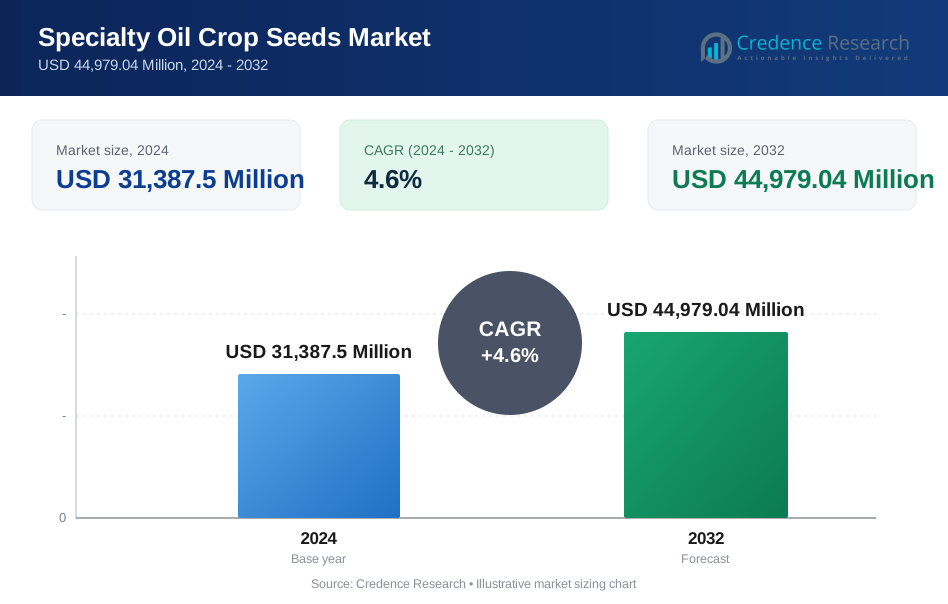
Specialty Oil Crop Seeds Market size was valued USD 31,387.5 Million in 2024 and is anticipated to reach USD 44,979.04 Million by 2032, at a CAGR of 4.6% during the forecast period.
| REPORT ATTRIBUTE | DETAILS |
|---|---|
| Historical Period | 2020-2023 |
| Base Year | 2024 |
| Forecast Period | 2025-2032 |
| Specialty Oil Crop Seeds Market Size 2024 | USD 31,387.5 Million |
| Specialty Oil Crop Seeds Market, CAGR | 4.6% |
| Specialty Oil Crop Seeds Market Size 2032 | USD 44,979.04 Million |
Specialty Oil Crop Seeds Market is shaped by prominent players including Smart Earth Seeds, KWS SAAT SE, ZeaKal Inc., BASF SE, Syngenta AG, Nuseed, Limagrain, Corteva Agriscience, Sakata Seed Corporation, and Bayer Crop Science (Monsanto), all of which focus on advancing high-oleic, nutrient-rich, and climate-resilient seed varieties. These companies invest in genetic enhancement, hybrid development, and sustainable cultivation practices to meet rising demand across food processing, biofuels, personal care, and nutraceutical applications. North America leads the Specialty Oil Crop Seeds Market with a 34.2% share in 2024, supported by strong seed innovation, extensive oilseed farming, and robust processing infrastructure.
Market Insights
- The Specialty Oil Crop Seeds Market reached USD 31,387.5 Million in 2024 and is growing at a CAGR of 4.6%, driven by expanding demand across food, biofuel, and wellness industries.
- Market growth is fueled by rising use of high-oleic sunflower and canola seeds, with sunflower seeds holding 6% share in 2024 due to high oil yield and versatility across applications.
- Advancements in hybrid breeding, genomic selection, and value-added oil extraction are shaping product innovation, supporting demand for omega-rich, cold-pressed, and functional oil varieties.
- Key players strengthen their positions through R&D investments, partnerships with growers, and expansion into specialty seed meals and proteins, enhancing their global presence.
- North America leads the market with 2% share in 2024, followed by Europe at 29.7%, supported by strong cultivation systems and rising demand for premium edible oils, sustainable fuel feedstocks, and natural cosmetic ingredients.
 Market Segmentation Analysis:
By Crop Type:
The Specialty Oil Crop Seeds Market is led by sunflower seeds, which captured 41.6% share in 2024, driven by their high oil yield, strong global demand, and suitability for both food-grade and industrial applications. Canola/rapeseed specialty varieties continue to expand due to rising preference for low-saturated-fat oils, while camelina gains traction in biofuel and sustainable aviation fuel production. Other specialty oilseeds contribute to niche functional applications. Increasing adoption of high-oleic and climate-resilient hybrids further strengthens the dominance of sunflower seeds within the crop type segment.
- For instance, Global Clean Energy contracted about 65,000 acres of camelina in 2023 to supply renewable diesel and SAF production, demonstrating rapid scale-up from pilot to commercial acreage.
By Form:
Within the form segment, seed oils dominated the Specialty Oil Crop Seeds Market with a 48.3% share in 2024, supported by their extensive use in culinary, industrial, cosmetic, and biofuel applications. Whole seeds remain essential for direct consumption and food processing, while seed meals and proteins gain momentum in plant-based nutrition and animal feed. Value-added products, including specialty oleic and omega-rich extracts, benefit from growing demand for functional ingredients. The dominance of seed oils is driven by rising consumption of high-quality edible oils and expanding applications in clean-energy industries.
- For instance, Nuseed (Nufarm) offers high oleic sunflower hybrids exceeding 90% oleic acid content, providing a stable, trans-fat-free oil for food manufacturing and plant-based products.
By Application:
The application segment is primarily led by food and beverages, accounting for 37.4% share in 2024, fueled by rising consumer demand for healthier cooking oils, clean-label ingredients, and plant-based nutrition. Biofuels and energy remain a rapidly developing segment due to increased adoption of renewable fuels, particularly high-oleic and low-carbon feedstocks. Cosmetics and personal care leverage specialty oils for natural emollients, while pharmaceuticals and nutraceuticals utilize omega-rich oils for therapeutic formulations. Animal feed and nutrition continue to support market growth through protein-rich seed meals. The food and beverages segment maintains leadership due to broad usage across global dietary applications.
Key Growth Drivers
Rising Demand for High-Oleic and Nutrient-Rich Oils
The Specialty Oil Crop Seeds Market is experiencing strong growth due to increasing global demand for high-oleic, omega-rich, and low-saturated-fat oils. Food processors and consumers prefer healthier oil varieties, driving adoption of specialty sunflower, canola, and camelina seeds. Nutritional awareness, clean-label trends, and expanding applications in functional foods are further accelerating demand. Manufacturers invest in seed genetics to enhance oil stability, nutritional value, and processing efficiency, positioning specialty oils as premium alternatives in both household and industrial food applications.
- For instance, Cargill’s IngreVita High Oleic Sunflower and EPA/DHA Omega‑3 Oil uses conventionally bred high‑oleic sunflower seeds combined with fish oil and antioxidants to help food brands add long‑chain omega‑3s for heart and brain health in baked goods, beverages, and dairy-style products.
Expansion of Biofuels and Sustainable Energy Applications
Growth is significantly supported by the rising use of specialty oilseeds in biofuels, renewable diesel, and sustainable aviation fuel production. Camelina, high-oleic sunflower, and canola varieties offer favorable oil profiles and low-carbon characteristics, aligning with global decarbonization goals. Government incentives, renewable energy mandates, and investment in climate-resilient crops encourage large-scale cultivation. As industries transition toward cleaner fuels, specialty oil crops emerge as key feedstocks, strengthening their role in energy security and sustainability-driven markets.
- For instance, Pacific Biodiesel in Hawaii has expanded regenerative farming of sunflowers and other oilseed cover crops, and in June 2025 delivered its first biodiesel batch produced with sunflower oil from its Kauaʻi operations to Hawaiian Electric’s 50‑megawatt Schofield Generating Station.
Increasing Use in Personal Care, Cosmetics, and Nutraceuticals
The escalating demand for natural, plant-derived ingredients in cosmetics and nutraceuticals is a major driver for specialty oil crop seeds. Oils extracted from sunflower, canola, and other specialty seeds are widely used for skin-conditioning, antioxidant, and therapeutic benefits. The clean-beauty movement and preference for bio-based formulations are boosting adoption in premium skincare, haircare, and supplements. Continuous innovation in cold-pressed and functional oil extraction enhances product purity and value, creating high-growth opportunities for specialty oil producers targeting the wellness and personal care sectors.
Key Trends & Opportunities
Advancement in Seed Breeding and Genomic Innovations
A major trend shaping the Specialty Oil Crop Seeds Market is the rapid advancement in seed breeding technologies, including CRISPR, hybrid development, and molecular marker-assisted selection. These innovations enable production of high-yield, pest-resistant, and climate-resilient varieties with enhanced oil composition. Companies are increasingly developing specialty seeds with tailored fatty acid profiles for specific industrial and food applications. Improved agronomic performance and predictable output create new opportunities for growers, processors, and energy producers seeking high-value, sustainable feedstocks.
- For instance, BASF’s InVigor Health high oleic canola hybrids produce specialty oil with elevated oleic acid content and greater heat stability, supporting food manufacturers that require more stable frying and processing oils.
Growing Market Potential for Value-Added and Functional Oil Products
Rising demand for value-added oils such as omega-enriched, cold-pressed, and high-oleic formulations creates significant commercial opportunities. Manufacturers are expanding into specialty seed meals, proteins, and bioactive extracts to meet growing demand in plant-based nutrition, animal health, and wellness markets. Functional ingredients derived from specialty oil crops attract interest from nutraceutical, pharmaceutical, and clean-label food industries. This shift toward premium, multifunctional oil products enhances revenue potential and encourages diversification across the value chain.
- For instance, Cargill's Radipure™ pea protein, derived from peas, features high solubility, mild flavor, and non-GMO status for use in dairy alternatives, beverages, and meat substitutes.
Key Challenges
Fluctuating Crop Yields and Climate Vulnerability
Climate-related risks pose a significant challenge to the Specialty Oil Crop Seeds Market, as extreme weather, drought, and soil degradation affect crop productivity and quality. Specialty oilseeds, especially sunflower and canola, are sensitive to temperature fluctuations and rainfall variability. Unpredictable yields increase production costs and disrupt supply stability for processors and end-use industries. Despite advancements in resilient seed varieties, growers continue to face uncertainty, forcing companies to invest in climate-smart agriculture and adaptive farming practices.
High Production Costs and Limited Infrastructure in Emerging Regions
The market faces challenges due to high cultivation, processing, and storage costs associated with specialty oil crops. Advanced seed varieties, precision farming, and specialized extraction facilities require substantial capital investment, which limits adoption in developing regions. Inadequate storage, logistics, and quality-control infrastructure further constrain supply chain efficiency. Small and medium farmers struggle to compete with large producers, slowing market penetration. Addressing cost barriers and improving regional processing capabilities remain essential for unlocking full market potential.
Regional Analysis
North America
North America leads the Specialty Oil Crop Seeds Market with a 34.2% share in 2024, driven by strong demand for high-oleic sunflower, canola, and camelina varieties. The region benefits from advanced seed breeding technologies, large-scale cultivation, and well-established processing infrastructure. Growing applications in biofuels, nutraceuticals, and clean-label food ingredients further strengthen market expansion. Supportive regulatory frameworks promoting renewable diesel and sustainable aviation fuel production enhance adoption of specialty oil crops. The presence of major agritech companies and ongoing investment in drought-resilient hybrids continue to reinforce North America’s leadership.
Europe
Europe accounted for a 29.7% share in 2024, supported by strong demand for premium edible oils, sustainable cosmetics, and plant-based nutrition products. The region’s stringent environmental regulations and focus on carbon reduction accelerate the cultivation of high-oleic and low-saturated-fat oilseed varieties. Countries such as France, Germany, and the Netherlands lead in specialty sunflower and rapeseed production. Expanding biofuel policies, particularly under the Renewable Energy Directive (RED II), promote increased use of specialty oil crops. Robust innovation in specialty seed breeding and sustainable farming practices further enhances Europe’s market position.
Asia-Pacific
Asia-Pacific held a 22.8% share in 2024, fueled by rising consumption of edible oils, expanding food processing industries, and growing demand for plant-based health products. Countries such as China, India, and Australia are strengthening production capacity for sunflower, canola, and emerging specialty oilseeds. Rapid urbanization and increasing disposable incomes support higher adoption of premium oil products. Government initiatives promoting oilseed self-sufficiency and technological improvements in hybrid and drought-tolerant varieties drive market expansion. The increasing use of specialty seed meals in livestock and aquaculture also contributes to regional growth.
Latin America
Latin America captured a 7.6% share in 2024, supported by growing cultivation of sunflower, canola, and niche specialty crops across Argentina, Brazil, and Chile. Favorable climatic conditions and abundant arable land enhance production efficiency. Rising food and industrial oil demand, coupled with expanding biofuel programs, strengthens market prospects. The region is increasingly adopting improved hybrid seeds and precision agriculture techniques to boost oil yield and crop resilience. Growing export opportunities and investment in processing infrastructure further position Latin America as an emerging contributor to specialty oilseed supply.
Middle East & Africa
The Middle East & Africa region accounted for a 5.7% share in 2024, driven by expanding agricultural development programs and increasing adoption of drought-tolerant specialty oilseeds such as sunflower and sesame. Rising demand for edible oils, cosmetics, and nutraceutical products supports market growth. Countries in North Africa strengthen cultivation due to favorable climate and government support for oilseed self-sufficiency. Limited processing infrastructure and water scarcity remain key challenges, but ongoing investments in modern farming practices and seed innovation gradually improve production capabilities across the region.
Market Segmentations:
By Crop Type
- Sunflower seeds
- Canola/rapeseed specialty varieties
- Camelina (false flax)
- Other specialty oilseeds
By Form
- Whole seeds
- Seed oils
- Seed meals and proteins
- Value-added products
By Application
- Food and beverages
- Biofuels and energy
- Cosmetics and personal care
- Pharmaceuticals and nutraceuticals
- Animal feed and nutrition
By Geography
- North America
- U.S.
- Canada
- Mexico
- Europe
- Germany
- France
- U.K.
- Italy
- Spain
- Rest of Europe
- Asia Pacific
- China
- Japan
- India
- South Korea
- South-east Asia
- Rest of Asia Pacific
- Latin America
- Brazil
- Argentina
- Rest of Latin America
- Middle East & Africa
- GCC Countries
- South Africa
- Rest of the Middle East and Africa
Competitive Landscape
Competitive landscape in the Specialty Oil Crop Seeds Market is shaped by leading companies such as Smart Earth Seeds, KWS SAAT SE, ZeaKal Inc., BASF SE, Syngenta AG, Nuseed (Nufarm), Limagrain, Corteva Agriscience, Sakata Seed Corporation, and Bayer Crop Science (Monsanto). These players focus on developing high-oleic, high-yield, and climate-resilient seed varieties to meet rising demand across food, biofuel, nutraceutical, and personal care industries. Strategic investments in advanced breeding technologies, molecular genetics, and sustainable farming solutions strengthen their market positioning. Several companies expand collaboration with growers and research institutions to accelerate innovation in specialty oilseed traits. Product portfolio expansion into omega-rich oils, specialty meals, and value-added extracts further enhances competitiveness. Geographic expansion in high-growth regions and targeted partnerships with biofuel producers support long-term growth. Continuous R&D and enhanced supply chain integration remain central to strengthening leadership in this evolving market.
Key Player Analysis
- Smart Earth Seeds
- KWS SAAT SE
- ZeaKal Inc.
- BASF SE
- Syngenta AG
- Nuseed (Nufarm)
- Limagrain
- Corteva Agriscience
- Sakata Seed Corporation
- Bayer Crop Science (Monsanto)
Recent Developments
- In 2025, Syngenta opened a new biologicals manufacturing facility in Orangeburg, South Carolina, capable of producing 16,000 tons of biostimulants annually to support crop-resilience efforts.
- In March 2024, Syngenta Vegetable Seeds inaugurated a new Seed Health Lab in Hyderabad, India, enhancing seed-quality control and supporting healthier, disease-free seed supply for markets in Asia-Pacific and beyond.
- In September 2023, Nuseed announced the pre‑launch of its new high‑oleic, Express‑tolerant sunflower hybrid N4H490 E for the 2024 season, adding a product with advanced downy mildew resistance and high oil content to its specialty oilseed portfolio.
Report Coverage
The research report offers an in-depth analysis based on Crop Type, Form, Application, End User and Geography. It details leading market players, providing an overview of their business, product offerings, investments, revenue streams, and key applications. Additionally, the report includes insights into the competitive environment, SWOT analysis, current market trends, as well as the primary drivers and constraints. Furthermore, it discusses various factors that have driven market expansion in recent years. The report also explores market dynamics, regulatory scenarios, and technological advancements that are shaping the industry. It assesses the impact of external factors and global economic changes on market growth. Lastly, it provides strategic recommendations for new entrants and established companies to navigate the complexities of the market.
Future Outlook
- The market will expand as demand increases for high-oleic and nutrient-rich specialty oils across food, health, and industrial sectors.
- Biofuel and sustainable aviation fuel production will strengthen the role of specialty oil crops as preferred low-carbon feedstocks.
- Seed breeders will accelerate development of climate-resilient, high-yield varieties to meet global production challenges.
- Functional and value-added oil products will gain traction in nutraceutical, pharmaceutical, and beauty applications.
- Adoption of precision agriculture and advanced genomic tools will enhance crop performance and oil quality.
- Emerging regions will witness higher cultivation driven by supportive agricultural policies and rising processing capacities.
- Sustainability initiatives will push manufacturers toward eco-friendly seeds with improved environmental footprints.
- Partnerships between seed companies, growers, and biofuel producers will become more prominent.
- Demand for plant-based ingredients will encourage diversification into specialty seed proteins and meals.
- Supply chain modernization and improved storage infrastructure will support stable availability and global distribution.
Request a Free Sample
Fill in your details and we'll send you a free sample report.
- Sample data tables & charts
- Research methodology
Need a Custom Version of This Report?
Tailor the scope, geography, or segments to your exact requirements.
- Custom geography or segment scope
- Direct access to our analyst team
Frequently Asked Questions
What is the current market size for Specialty Oil Crop Seeds Market, and what is its projected size in 2032?
At what Compound Annual Growth Rate is the Specialty Oil Crop Seeds Market projected to grow between 2024 and 2032?
Which Specialty Oil Crop Seeds Market segment held the largest share in 2024?
What are the primary factors fueling the growth of the Specialty Oil Crop Seeds Market?
Who are the leading companies in the Specialty Oil Crop Seeds Market?
Which region commanded the largest share of the Specialty Oil Crop Seeds Market in 2024?
Table of Content
Chapter 1. Report Introduction
- 1.1 Report Description & Purpose
- 1.1.1 Report Title & Market Definition
- 1.1.2 Unique Selling Propositions (USP) & Key Differentiators
- 1.1.3 Value Proposition for Stakeholders
- 1.2 Research Objectives
- 1.2.1 Market Sizing Objectives (Volume & Revenue)
- 1.2.2 Segmentation Objectives
- 1.2.3 Competitive Intelligence Objectives
- 1.2.4 Forecast & Scenario Objectives
- 1.3 Report Scope
- 1.3.1 Specialty Oil Crop Seeds Scope – Types & Subtypes Covered
- 1.3.2 Geographic Scope – Regions & Countries Covered
- 1.3.3 Historical Period, Base Year & Forecast Period (2024; forecast to 2032)
- 1.3.4 Inclusions & Exclusions
- 1.4 HS Code & Classification Framework
- 1.5 Currency, Units & Pricing Basis
- 1.6 Target Stakeholders
- 1.7 Limitations & Assumptions
Chapter 2. Executive Summary
- 2.1 Global Specialty Oil Crop Seeds Market Snapshot
- 2.1.1 Market Size – Historical (2024) & Forecast (2024-2032) (2024: USD 31,387.5 Million → 2032: USD 44,979.04 Million)
- 2.1.2 Volume & Revenue – Global Totals
- 2.1.3 Key Market Highlights – Top Five Facts
- 2.2 Specialty Oil Crop Seeds Market Segmentation Snapshot
- 2.2.1 Market Split by Region – 2024 vs. 2032
- 2.3 Competitive Snapshot
- 2.3.1 Top 10 Players by Revenue Share – 2024
- 2.3.2 Top 10 Players by Volume Share – 2024
- 2.3.3 Recent Strategic Developments (18-Month Summary)
- 2.4 Key Investment Highlights & Strategic Conclusions
Chapter 3. Specialty Oil Crop Seeds Market Dynamics & Industry Analysis
- 3.1 Market Overview & Context
- 3.1.1 Specialty Oil Crop Seeds Market Position in the Broader Automotive Value Chain
- 3.1.2 OEM vs. Replacement Market Dynamics
- 3.1.3 Market Maturity & Development Stage by Region
- 3.2 Specialty Oil Crop Seeds Market Drivers
- 3.3 Specialty Oil Crop Seeds Market Restraints & Challenges
- 3.4 Specialty Oil Crop Seeds Market Opportunities
- 3.5 Porter's Five Forces Analysis
- 3.5.1 Threat of New Entrants
- 3.5.2 Bargaining Power of Suppliers
- 3.5.3 Bargaining Power of Buyers
- 3.5.4 Threat of Substitutes
- 3.5.5 Competitive Rivalry – Intensity Assessment
- 3.6 Specialty Oil Crop Seeds Value Chain Analysis
- 3.6.1 Upstream – Raw Material/Input Suppliers
- 3.6.1.1 Raw Material/Input 1
- 3.6.1.2 Raw Material/Input 2
- 3.6.1.3 Raw Material/Input 3
- 3.6.2 Midstream – Production/Manufacturing/Service Delivery
- 3.6.2.1 Production/Process Overview
- 3.6.2.2 Key Facility Locations & Capacity by Manufacturer
- 3.6.3 Downstream – Distribution & End Consumer
- 3.6.3.1 Primary Channel – B2B/OEM
- 3.6.3.2 Secondary Channels – Dealer, Retail, Online, Direct
- 3.6.4 Value Chain Profitability Analysis
- 3.6.1 Upstream – Raw Material/Input Suppliers
- 3.7 PESTEL Analysis
- 3.7.1 Political Factors
- 3.7.2 Economic Factors
- 3.7.3 Social Factors
- 3.7.4 Technological Factors
- 3.7.5 Environmental Factors
- 3.7.6 Legal Factors
- 3.8 Specialty Oil Crop Seeds Supply Chain Analysis
- 3.8.1 Raw Material/Input Supply Risk Assessment
- 3.8.2 Manufacturing Concentration Risk (Geographic Exposure)
- 3.8.3 Trade Disruption Impact Analysis
- 3.9 Regulatory & Policy Landscape
Note: The regulatory and policy landscape section covers regulations based on their applicability to the market, Specialty Oil Crop Seeds category, geography, and scope of the study. Only regulatory frameworks with a material impact on operations, compliance, trade, sustainability, or market access are analyzed in detail.
Chapter 4. Key Investment Pockets & Opportunity Analysis
- 4.1 Specialty Oil Crop Seeds Market Attractiveness Analysis
- 4.1.1 By Region – Investment Attractiveness Matrix (Volume × CAGR)
- 4.2 Absolute Revenue Growth Opportunity
- 4.2.1 By Region – Absolute USD Growth Through 2032
- 4.3 Incremental Volume Opportunity
- 4.3.1 By Region – Incremental Volume Through 2032
- 4.3.2 Segment – Incremental Volume
- 4.4 Emerging Submarket Opportunity Deep Dive (Subject to Applicability)
- 4.5 Emerging Market Opportunity Scorecards
- 4.5.1 United States
- 4.5.2 Europe
- 4.5.3 Asia
- 4.5.4 Middle East & Africa
Note: Emerging Market Opportunity Scorecards will be included based on relevance and strategic importance. Regions listed are indicative and may vary depending on data availability and market dynamics.
Chapter 5. Specialty Oil Crop Seeds Import-Export Analysis & Trade Flows
- 5.1 Global Trade Overview
- 5.1.1 Global Export Value by Country (2024)
- 5.1.2 Global Export Volume by Country (2024)
- 5.1.3 Global Import Value by Country (2024)
- 5.1.4 Global Import Volume by Country (2024)
- 5.1.5 Net Trade Balance by Country (2024)
- 5.2 Export Analysis – Segment
- 5.2.1 Type 1 (HS Code)
- 5.2.2 Type 2 (HS Code)
- 5.2.3 Type 3 (HS Code)
- 5.2.4 Type 4 (HS Code)
- 5.2.5 Type 5 (HS Code)
- 5.3 Import Analysis – Segment
- 5.3.1 Type 1 (HS Code)
- 5.3.2 Type 2 (HS Code)
- 5.3.3 Type 3 (HS Code)
- 5.3.4 Type 4 (HS Code)
- 5.3.5 Type 5 (HS Code)
- 5.4 Average Unit Trade Prices
- 5.4.1 Average Export Price – Segment & Country
- 5.4.2 Average Import Price – Segment & Source Country
- 5.4.3 Price Trends (2024)
- 5.5 Key Trade Route Analysis
- 5.5.1 Trade Route 1
- 5.5.2 Trade Route 2
- 5.5.3 Trade Route 3
- 5.5.4 Trade Route 4
- 5.5.5 Trade Route 5
- 5.6 Trade Policy Impact Assessment
- 5.6.1 US Anti-Dumping & Section 301 Tariffs
- 5.6.2 EU Customs Union Impact
- 5.6.3 Major Free Trade Agreements
- 5.6.4 USMCA Rules of Origin
Note: Trade policy analysis will be included only where relevant to the Specialty Oil Crop Seeds market.
Chapter 6. Competitive Landscape & Company Benchmarking
- 6.1 Specialty Oil Crop Seeds Market Concentration & Structure
- 6.1.1 Herfindahl-Hirschman Index (HHI) – vs. 2024
- 6.1.2 Tier 1, Tier 2 & Tier 3 Market Structure
- 6.1.3 Global, Regional & Local Player Dynamics
- 6.2 Specialty Oil Crop Seeds Market Share Analysis – 2024
- 6.2.1 Global Revenue Share by Company
- 6.2.2 Global Volume Share by Company
- 6.2.3 Regional Revenue Share
- 6.2.4 Market Share Evolution ( vs. 2024)
- 6.2.5 OEM Segment Share by Company
- 6.2.6 Replacement Segment Share by Company
- 6.3 Production/Delivery Capacity & Facility Analysis
- 6.3.1 Global Installed Capacity
- 6.3.2 Capacity Utilization Rates
- 6.3.3 Production/Output Volume
- 6.3.4 Facility Locations & Capacity Map
- 6.3.5 Planned Capacity Additions
- 6.4 Specialty Oil Crop Seeds Competitive Benchmarking Matrix
- 6.4.1 Revenue, Volume, CAGR & Profitability Comparison
- 6.4.2 Channel Revenue Mix
- 6.4.3 Geographic Revenue Exposure
- 6.4.4 R&D Intensity
- 6.4.5 Sustainability Maturity
- 6.5 Strategic Developments in Specialty Oil Crop Seeds (Last 24 Months)
- 6.5.1 Mergers, Acquisitions & Divestments
- 6.5.2 New Specialty Oil Crop Seeds Launches
- 6.5.3 Facility Expansions
- 6.5.4 Strategic Alliances, Joint Ventures & Partnerships
- 6.5.5 Distribution Expansion & Market Entry
- 6.5.6 Sustainability & ESG Initiatives
- 6.6 Competitive Strategy Mapping
- 6.6.1 Leader, Challenger, Follower & Niche Classification
- 6.6.2 Pricing Strategy Comparison
- 6.6.3 Channel Strategy Matrix
Note: Strategic developments are included based on their materiality and the availability of reliable information.
Chapter 7. Global Specialty Oil Crop Seeds Market – By Distribution Channel
- 7.1 Segment Overview
- 7.1.1 Volume & Revenue Split by Channel (2024 & 2032)
- 7.1.2 Channel Mix Evolution (2024-2032)
Chapter 8. Regional Market Analysis – Global Overview
- 8.1 Global Regional Overview
- 8.1.1 Regional Volume Share
- 8.1.2 Regional Revenue Share
- 8.1.3 Regional Volume by Region
- 8.1.4 Regional Revenue by Region
- 8.1.5 Regional Forecast Through 2032
- 8.2 Cross-Regional Segment Analysis
- 8.2.1 By Distribution Channel
- 8.2.2 By Brand/Price Tier
Chapter 9. North America Specialty Oil Crop Seeds Market
- 9.1 United States
- 9.2 Canada
- 9.3 Mexico
Chapter 10. Europe Specialty Oil Crop Seeds Market
- 10.1 Germany
- 10.2 France
- 10.3 Italy
- 10.4 United Kingdom
- 10.5 Spain
- 10.6 Poland
- 10.7 Russia
- 10.8 Netherlands
- 10.9 Belgium
- 10.10 Sweden
- 10.11 Denmark
- 10.12 Norway
- 10.13 Rest of Europe
Chapter 11. Asia Pacific Specialty Oil Crop Seeds Market
- 11.1 China
- 11.2 India
- 11.3 Japan
- 11.4 South Korea
- 11.5 Thailand
- 11.6 Indonesia
- 11.7 Vietnam
- 11.8 Malaysia
- 11.9 Australia
- 11.10 Rest of Asia Pacific
Chapter 12. Latin America Specialty Oil Crop Seeds Market
- 12.1 Brazil
- 12.2 Argentina
- 12.3 Colombia
- 12.4 Chile
- 12.5 Rest of Latin America
Chapter 13. Middle East Specialty Oil Crop Seeds Market
- 13.1 Saudi Arabia
- 13.2 United Arab Emirates
- 13.3 Turkey
- 13.4 Israel
- 13.5 Iran
- 13.6 Rest of the Middle East
Chapter 14. Africa Specialty Oil Crop Seeds Market
- 14.1 South Africa
- 14.2 Egypt
- 14.3 Nigeria
- 14.4 Morocco
- 14.5 Rest of Africa
Chapter 15. Specialty Oil Crop Seeds Company Profiles
- 15.1 [Company 01]
- 15.1.1 Company Overview
- 15.1.2 Key Management Personnel
- 15.1.3 Products & Services Portfolio
- 15.1.4 Financial Performance
- 15.1.5 Key Market Focus & Geographic Presence
- 15.1.6 Recent Developments & Strategic Initiatives
Note: The company profile list is preliminary and may change based on research findings, market developments, data availability, and client requirements.
Chapter 16. Appendices
- Appendix A – List of Abbreviations & Acronyms
- Appendix B – Industry Classification Code Reference – Full Series
- Appendix C – Production & Capacity Data Tables
- Appendix D – End-Use & Demand Base Tables
- Appendix E – Consumption & Replacement Rate Assumptions
- Appendix F – ASP Reference Tables
- Appendix G – Manufacturing & Facility Database
- Appendix H – Import-Export Data Tables
- Appendix I – Regulatory Summary Tables
- Appendix J – Primary Research Participant List (Anonymized)
- Appendix K – Primary Research Questionnaire Framework
- Appendix L – Data Sources & Bibliography
- Appendix M – Market Size Divergence & Source Comparison
Chapter 17. Research Methodology
- 17.1 Research Framework & Philosophy
- 17.2 Secondary Research – Sources, Hierarchy & Data Extraction
- 17.3 Data Modeling – Bottom-Up & Top-Down Market Sizing
- 17.4 Primary Research – Stakeholder Framework, LOI & Sample Sizes
- 17.5 Forecast Methodology – Regression, Scenario & Sensitivity Analysis
- 17.6 Quality Control – Four-Layer Validation Framework
- 17.7 Limitations & Standard Assumptions
- 17.8 Disclaimer
