Market Overview:
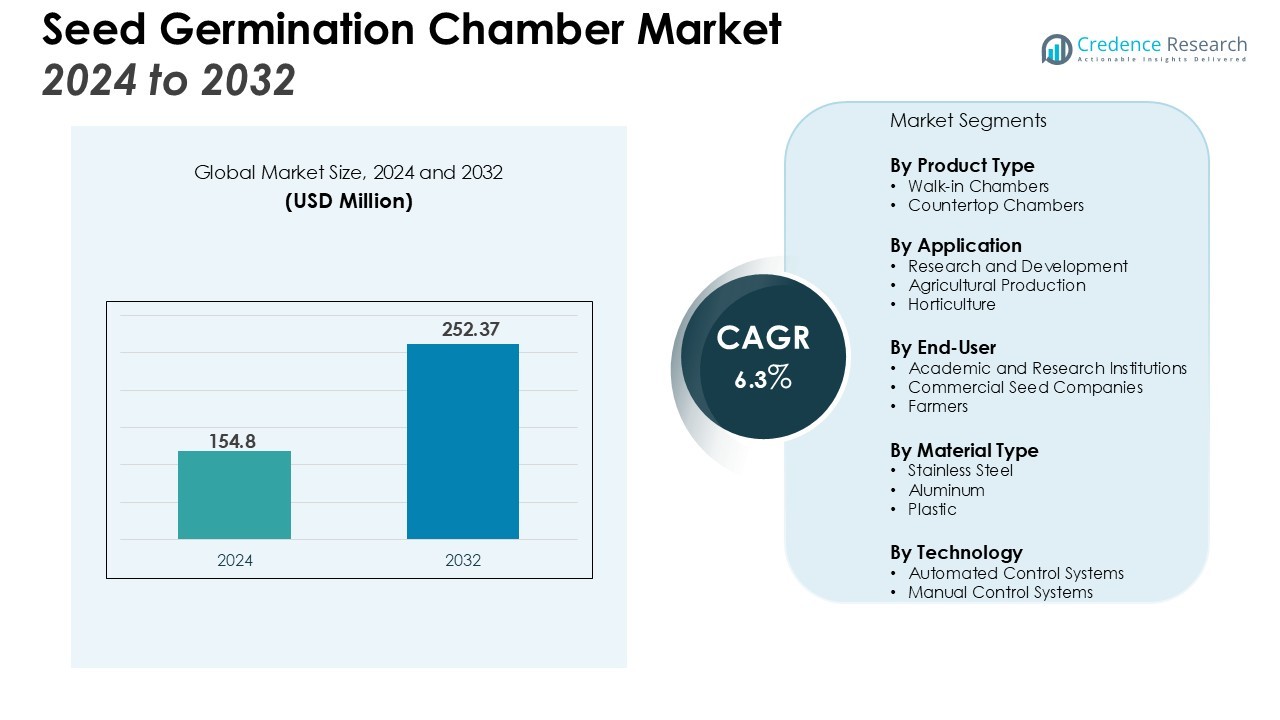
The Seed Germination Chamber Market size was valued at USD 154.8 million in 2024 and is anticipated to reach USD 252.37 million by 2032, at a CAGR of 6.3 % during the forecast period (2024-2032).
| REPORT ATTRIBUTE |
DETAILS |
| Historical Period |
2020-2023 |
| Base Year |
2024 |
| Forecast Period |
2025-2032 |
| Seed Germination Chamber Market Size 2024 |
USD 154.8 Million |
| Seed Germination Chamber Market, CAGR |
6.3 % |
| Seed Germination Chamber Market Size 2032 |
USD 252.37 Million |
Key drivers of market growth include the rising global need for food security, which demands high-quality seeds for improved crop yields. The increasing focus on agricultural research and development and the growing trend of urban farming and vertical agriculture are also fueling market expansion. Furthermore, the development of eco-friendly and energy-efficient seed germination chambers is attracting attention from both commercial and research sectors, contributing to sustainable farming practices.
Regionally, North America holds the largest share in the Seed Germination Chamber market, driven by advancements in agricultural technology and strong research and development activities. Europe follows with substantial demand for these chambers, especially in agricultural research. The Asia-Pacific region is expected to witness the highest growth, attributed to the rising agricultural practices in countries like China and India, which are investing heavily in modern farming technologies.
Access crucial information at unmatched prices!
Request your sample report today & start making informed decisions powered by Credence Research Inc.!
Download Sample
Market Insights:
- The Seed Germination Chamber market size was valued at USD 154.8 million in 2024 and is expected to reach USD 252.37 million by 2032, growing at a CAGR of 6.3%.
- The growing demand for high-quality seeds to improve crop yields is driving the market’s expansion, as chambers ensure consistent and efficient seed germination.
- Agricultural research and technological advancements significantly boost the demand for seed germination chambers to improve seed resilience and crop genetics.
- The rise of urban farming and sustainable agriculture is increasing the adoption of seed germination chambers for efficient food production in urban environments.
- Government initiatives and funding for agricultural innovation are fostering market growth, especially in developing regions aiming to modernize farming techniques.
- High initial investment and operational costs remain a challenge, particularly for small-scale farmers and regions with limited access to capital.
- North America leads the market with a 30% share, followed by Europe at 25%, and the Asia Pacific region is witnessing significant growth with a 20% share.
Market Drivers:
Increasing Global Demand for High-Quality Seeds for Enhanced Crop Yields
The growing need for high-quality seeds to improve agricultural productivity is a primary driver for the Seed Germination Chamber market. These chambers provide controlled environments that optimize seed growth, ensuring better quality seeds that can withstand varying environmental conditions. As the global population rises, the demand for efficient and high-yield crops is escalating, prompting the adoption of advanced technologies like seed germination chambers. These technologies ensure uniform germination rates, which are critical for maximizing crop productivity.
- For instance, Thermo Fisher Scientific’s Model 846 Plant Growth Chamber provides a 396-liter capacity for botanical research and seed germination studies.
Focus on Agricultural Research and Technological Advancements
The expansion of agricultural research and development significantly impacts the Seed Germination Chamber market. With the increasing emphasis on improving crop genetics and resilience, controlled seed germination environments play a crucial role in experimentation. Research institutions and universities rely on seed germination chambers to replicate various environmental conditions, enhancing the development of seeds that are resistant to pests, diseases, and extreme climates. Innovations in chamber technologies, such as automation and precision controls, further drive the demand for these chambers.
- For instance, Conviron’s GEN1000-GE seed germinator offers a 781-liter capacity for high-throughput research applications.
Rise of Urban Farming and Sustainable Agriculture Practices
Urban farming and the growing interest in sustainable agriculture are also contributing to the market’s growth. Seed germination chambers are becoming essential for urban farmers who lack traditional soil-based cultivation methods. These chambers facilitate the indoor cultivation of seeds in a controlled environment, supporting local food production in urban areas. The increasing focus on sustainable farming practices encourages the adoption of energy-efficient and eco-friendly seed germination technologies, thereby boosting the market demand.
Government Initiatives Supporting Agricultural Innovation
Governments worldwide are investing in agricultural innovation to ensure food security and enhance farming efficiency. Various policies and initiatives, such as subsidies and funding for research projects, promote the adoption of advanced agricultural technologies, including seed germination chambers. These initiatives encourage the use of technology-driven solutions that improve crop production and farming sustainability. The support from government bodies accelerates the market growth, especially in developing regions where agricultural modernization is underway.
Market Trends:
Technological Advancements and Integration of Automation in Seed Germination Chambers
The Seed Germination Chamber market is experiencing significant technological advancements, particularly in automation and digitalization. Chambers now feature automated temperature, humidity, and light control systems that offer precise regulation of environmental conditions, improving seed germination consistency. The integration of IoT (Internet of Things) technologies allows real-time monitoring and remote control of these parameters, enhancing operational efficiency. These innovations contribute to better energy efficiency and lower operational costs, appealing to commercial growers and research institutions looking to optimize resources. With advanced sensors and automated systems, these chambers also ensure reproducibility in experiments, supporting breakthroughs in agricultural research and development.
- For instance, a new automatic monitoring system for seed germination tests, based on deep learning, was designed to improve breeding efficiency and can deliver detection results at a frame rate of not less than 10 frames per second.
Shift Towards Energy-Efficient and Sustainable Solutions in Seed Germination Chambers
Energy efficiency and sustainability are key trends shaping the Seed Germination Chamber market. Manufacturers are increasingly focusing on developing eco-friendly and energy-efficient chambers to align with the growing demand for sustainable agriculture practices. These chambers are designed to reduce energy consumption while maintaining optimal conditions for seed growth. The use of renewable energy sources, such as solar-powered systems, is gaining traction in these products, further promoting sustainability in agriculture. As environmental regulations become stricter and the global push for green technologies strengthens, demand for these energy-efficient seed germination chambers continues to rise.
- For instance, Conviron’s GEN1000-ECO model is engineered for energy efficiency and rejects only 2,824 BTU/hr of heat into the surrounding room, which lessens the strain on a facility’s air conditioning system.
Market Challenges Analysis:
High Initial Investment and Operational Costs
One of the primary challenges in the Seed Germination Chamber market is the high initial investment required for purchasing and setting up these systems. While the technology offers significant benefits in seed quality and yield, the upfront costs can be prohibitive for small-scale farmers and research institutions. The operational costs associated with maintaining optimal conditions, such as electricity consumption for temperature control and lighting, also add to the financial burden. These costs can deter potential buyers from adopting seed germination chambers, especially in developing regions where access to capital is limited. The market’s growth could be constrained by this financial barrier.
Lack of Awareness and Limited Access in Emerging Markets
In emerging markets, limited awareness about the benefits of seed germination chambers poses a significant challenge. Many farmers in these regions continue to rely on traditional farming methods, unaware of the advantages that controlled seed germination can offer. The lack of proper education, training, and access to modern agricultural technologies hampers market adoption. Furthermore, limited access to suppliers and service providers in these regions can make it difficult for potential users to invest in these systems, slowing the market’s expansion in these key areas.
Market Opportunities:
Growing Adoption of Urban Farming and Controlled Agriculture
The Seed Germination Chamber market has significant growth potential due to the increasing adoption of urban farming and controlled agriculture. As cities grow and available agricultural land decreases, urban farming has emerged as a viable solution for local food production. Seed germination chambers are integral to urban farms, providing the ideal environment for seed growth in limited spaces. These chambers allow urban farmers to grow crops efficiently indoors, making them a key component of sustainable food systems. The expansion of urban farming in cities worldwide presents a substantial opportunity for the seed germination chamber market, especially as consumers demand fresh, locally grown produce.
Rising Demand for Sustainable and Eco-Friendly Farming Solutions
Sustainable farming practices are gaining traction globally, offering new opportunities for the Seed Germination Chamber market. The increasing emphasis on environmentally friendly agriculture and eco-conscious practices has led to a greater demand for energy-efficient and sustainable farming technologies. Seed germination chambers that use renewable energy sources or employ energy-saving designs are in high demand. These systems support environmentally sustainable farming while enhancing seed germination rates, making them attractive to growers and research institutions aiming to reduce their environmental footprint. This trend towards sustainability presents a significant opportunity for the market to cater to a growing base of environmentally conscious consumers.
Market Segmentation Analysis:
By Product Type
The Seed Germination Chamber market is primarily segmented into walk-in chambers and countertop chambers. Walk-in chambers dominate the market due to their ability to accommodate larger seed quantities and provide controlled environments for diverse applications. Countertop chambers are gaining traction in research and educational sectors for their compact design and cost-effectiveness, catering to smaller-scale operations.
By Application
Key applications of seed germination chambers include research and development, agricultural production, and horticulture. Research and development hold the largest share, as these chambers are essential for testing seeds, studying genetics, and advancing agricultural technologies. Agricultural production uses seed germination chambers to enhance seed quality, ensuring higher crop yields. Horticulture also plays a significant role, as these chambers support seedling growth and plant propagation in controlled environments.
- For instance, for high-throughput research applications, Conviron’s GEN1000-GE chamber can be equipped with up to 15 total shelves to maximize seed testing capacity.
By End-User
End-users in the Seed Germination Chamber market include academic and research institutions, commercial seed companies, and farmers. Research institutions are the largest consumers, utilizing these chambers for extensive studies on seed behavior and growth. Commercial seed companies rely on seed germination chambers to improve seed quality and productivity. Increasingly, farmers, particularly those involved in urban and vertical farming, are adopting these chambers to optimize crop production in limited spaces.
- For instance, Neversink Tools offers a tabletop germination chamber with an 8-gallon water reservoir, which is designed for professional gardeners and small-scale commercial growers.
Segmentations:
By Product Type
- Walk-in Chambers
- Countertop Chambers
By Application
- Research and Development
- Agricultural Production
- Horticulture
By End-User
- Academic and Research Institutions
- Commercial Seed Companies
- Farmers
By Material Type
- Stainless Steel
- Aluminum
- Plastic
By Technology
- Automated Control Systems
- Manual Control Systems
By Region
- North America
- Europe
- Germany
- France
- U.K.
- Italy
- Spain
- Rest of Europe
- Asia Pacific
- China
- Japan
- India
- South Korea
- South-east Asia
- Rest of Asia Pacific
- Latin America
- Brazil
- Argentina
- Rest of Latin America
- Middle East & Africa
- GCC Countries
- South Africa
- Rest of the Middle East and Africa
Regional Analysis:
North America: Market Leadership and Technological Advancements
North America holds the largest share of the Seed Germination Chamber market, accounting for 30%. The United States and Canada are key contributors, driven by advanced agricultural practices and strong research infrastructure. Numerous research institutions and commercial seed companies utilize seed germination chambers to enhance seed quality and crop yields. The region’s focus on sustainable agriculture and technological innovation further supports market growth.
Europe: Strong Research Infrastructure and Adoption
Europe commands a significant portion of the Seed Germination Chamber market, contributing 25%. Countries like Germany, France, and the Netherlands are at the forefront, with robust agricultural research facilities and a high adoption rate of advanced agricultural technologies. The region’s emphasis on sustainability and precision agriculture drives the demand for controlled-environment solutions like seed germination chambers.
Asia Pacific: Emerging Market with High Growth Potential
The Asia Pacific region holds a growing share of the Seed Germination Chamber market, with 20%. Countries such as China and India are investing heavily in agricultural innovation to meet the demands of their large populations. The increasing focus on food security, climate-resilient crops, and sustainable farming practices contributes to the rising adoption of seed germination chambers in the region.
Shape Your Report to Specific Countries or Regions & Enjoy 30% Off!
Key Player Analysis:
- Phytotronics
- LEEC Limited
- Percival Scientific
- Conviron
- Biochambers
- Mech Air Industries
- Amax Scientific Instruments
- CARON Products
- Bionics Scientific
- Acmas Technologies
- Percival Scientific
Competitive Analysis:
The Seed Germination Chamber market is highly competitive, with key players like Conviron, Thermo Fisher Scientific, Percival Scientific, BINDER GmbH, and Weiss Technik leading the charge. These companies focus on product innovation, incorporating advanced features such as automated environmental controls, energy-efficient systems, and smart technology for real-time monitoring. To maintain competitive positioning, these firms pursue strategies like mergers, acquisitions, and technology integration, offering solutions that cater to the growing demand for sustainable and precise agricultural research. North America leads the market due to its strong research infrastructure, while the Asia-Pacific region is rapidly growing, driven by increased investments in modern farming technologies. Companies must adapt to these regional dynamics and technological trends to strengthen their presence in the evolving market.
Recent Developments:
- In April 2025, LEEC Limited launched its new Eco Drying Cabinets, which feature a 5-inch color touchscreen display.
- In June 2025, Bioness Medical, Inc. announced its acquisition of the assets and business of Harmonic Bionics, Inc., a move intended to enhance its portfolio of neuro-rehabilitation robotics.
Report Coverage:
The research report offers an in-depth analysis based on Product Type, Application, End-User, Material Type, Technology and Region. It details leading market players, providing an overview of their business, product offerings, investments, revenue streams, and key applications. Additionally, the report includes insights into the competitive environment, SWOT analysis, current market trends, as well as the primary drivers and constraints. Furthermore, it discusses various factors that have driven market expansion in recent years. The report also explores market dynamics, regulatory scenarios, and technological advancements that are shaping the industry. It assesses the impact of external factors and global economic changes on market growth. Lastly, it provides strategic recommendations for new entrants and established companies to navigate the complexities of the market.
Future Outlook:
- The demand for seed germination chambers is expected to increase as the global focus on food security intensifies.
- Advancements in automation and smart technologies will drive the development of more efficient and user-friendly seed germination chambers.
- Increasing adoption of vertical and urban farming practices will further fuel the need for compact and energy-efficient chambers.
- Growing awareness about sustainable farming practices will lead to higher demand for eco-friendly and energy-efficient solutions.
- The agricultural sector’s push toward climate-resilient crops will increase the need for controlled-environment solutions for seed germination.
- Research institutions will continue to be major end-users, as they require precise conditions for seed testing and genetic studies.
- Commercial seed companies will increasingly adopt these chambers to enhance seed quality and productivity across diverse crops.
- The expansion of agriculture in emerging markets, particularly in Asia Pacific, will contribute to significant market growth.
- Government support for agricultural innovation will create a favorable environment for the adoption of seed germination chambers in developing regions.
- Continued investments in technology, such as IoT integration and automated systems, will make seed germination chambers more affordable and accessible for small-scale farmers.



