Market Overview:
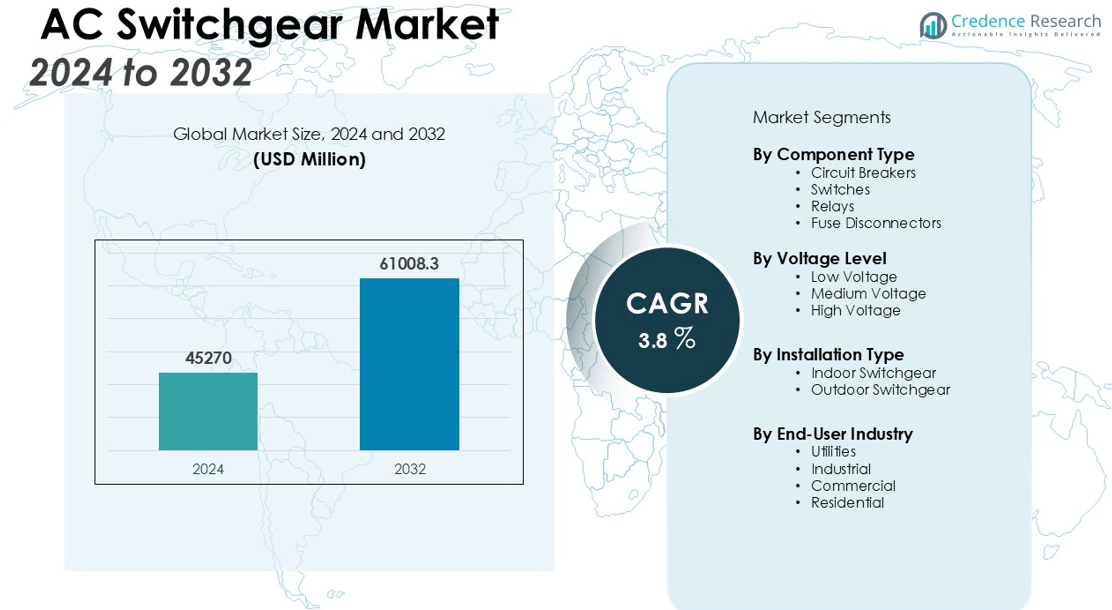
The AC Switchgear Market size was valued at USD 45270 million in 2024 and is anticipated to reach USD 61008.3 million by 2032, at a CAGR of 3.8% during the forecast period (2024-2032).
| REPORT ATTRIBUTE |
DETAILS |
| Historical Period |
2020-2023 |
| Base Year |
2024 |
| Forecast Period |
2025-2032 |
| AC Switchgear Market Size 2024 |
USD 45270 million |
| AC Switchgear Market, CAGR |
3.8% |
| AC Switchgear Market Size 2032 |
USD 61008.3 million |
The primary drivers for the AC Switchgear Market include the increasing need for reliable and efficient electrical distribution systems. As industries and utilities continue to embrace automation and the integration of renewable energy, there is a heightened demand for advanced switchgear solutions that ensure operational safety, energy efficiency, and reduced downtime. Technological advancements, such as the integration of smart grid systems, further drive the adoption of AC switchgear across various sectors. Additionally, the growing focus on reducing carbon emissions and improving grid resilience is further propelling market demand.
Regionally, North America holds the largest share of the AC Switchgear Market, driven by the robust infrastructure and strong demand for energy-efficient solutions. Europe follows closely, supported by stringent regulations and an emphasis on sustainability. The Asia-Pacific region is anticipated to witness the highest growth, driven by rapid urbanization, industrialization, and increased investments in renewable energy infrastructure. Furthermore, ongoing infrastructure developments and government incentives in emerging economies are expected to boost market expansion in the region.
Market Insights:
- The AC Switchgear Market is valued at USD 45,270 million in 2024 and is expected to reach USD 61,008.3 million by 2032, growing at a CAGR of 3.8%.
- The demand for energy-efficient solutions is driving market growth, with utilities adopting smart grid technologies and automation to enhance efficiency.
- The shift to renewable energy sources, such as solar and wind, is increasing the need for advanced AC switchgear to ensure stable power distribution.
- Integration of grid automation and smart technologies allows for better management of electrical networks, improving response times to disruptions.
- North America holds 38% of the market share, driven by advanced infrastructure and demand for energy-efficient solutions.
- Europe accounts for 28% of the market share, supported by stringent regulations and a strong emphasis on sustainability.
- The Asia-Pacific region holds 25% of the market share and is expected to experience the highest growth due to industrialization and renewable energy investments.
Access crucial information at unmatched prices!
Request your sample report today & start making informed decisions powered by Credence Research Inc.!
Download Sample
Market Drivers:
Rising Demand for Energy-Efficient Solutions
The AC Switchgear Market is benefiting from the global push towards energy efficiency. Utilities and industries are increasingly adopting smart grid technologies, which enhance operational efficiency and reduce energy consumption. Switchgear plays a crucial role in ensuring that electrical distribution systems operate at peak efficiency. The growing demand for energy-saving systems, driven by both environmental concerns and economic considerations, is significantly contributing to the market’s growth. These systems are essential for optimizing electricity distribution, reducing losses, and improving overall grid performance.
- For instance, Siemens partnered with Reactive Technologies to implement GridMetrix® technology, enabling National Grid ESO in the UK to measure grid inertia for 2,000MW of renewable generation sources and enhance system stability.
Integration of Renewable Energy Sources
The shift towards renewable energy sources, such as solar and wind, has created a demand for advanced AC switchgear systems. These energy sources require reliable electrical distribution systems to ensure a seamless integration into the existing grids. AC switchgear solutions ensure smooth power transmission and distribution, reducing the risk of power outages and enhancing system reliability. With the increasing share of renewables in the energy mix, the AC Switchgear Market continues to expand in response to the need for systems that can handle intermittent and decentralized power generation.
- For instance, ABB provided a complete switchgear and circuit breaker solution to the Tasiast gold mine in Mauritania, supporting the integration of a 34MW solar power plant and an 18MW battery storage facility into the mine’s energy system.
Advancements in Grid Automation and Smart Technologies
Automation in electrical grids is a major driver for the AC Switchgear Market. The integration of smart technologies, such as remote monitoring and control systems, allows for better management of electrical networks. AC switchgear supports the automation of grid functions, enabling quicker responses to power disruptions, fault detection, and load balancing. The ability to monitor and control power systems remotely enhances operational efficiency and helps utilities maintain stable and reliable service. The growing adoption of automated solutions across industries fuels demand for advanced switchgear.
Increased Focus on Grid Resilience and Safety
Safety and resilience have become top priorities for electrical grid operators, particularly in regions prone to natural disasters. The AC Switchgear Market is experiencing growth as utilities seek solutions that can withstand extreme conditions and prevent catastrophic failures. These systems help protect the grid infrastructure from overloads and short circuits, minimizing the risk of damage and improving system reliability. The increased focus on enhancing grid resilience in the face of changing climate conditions further boosts the adoption of advanced switchgear technologies.
Market Trends:
Adoption of Digital and Smart Technologies in AC Switchgear Systems
The AC Switchgear Market is witnessing a shift towards digitalization and the integration of smart technologies. The incorporation of Internet of Things (IoT) capabilities enables real-time monitoring and remote control of switchgear systems, enhancing operational efficiency and reducing downtime. Smart AC switchgear solutions allow for predictive maintenance by analyzing data trends, identifying potential failures before they occur, and minimizing operational interruptions. These advancements contribute to the improved reliability and safety of electrical distribution networks, attracting significant interest from both utilities and industrial sectors. The growing demand for smarter, more automated systems is accelerating the market’s evolution, leading to the widespread adoption of digital switchgear solutions.
- For instance, Siemens Smart Infrastructure has enabled IoT-connected medium-voltage switchgear installations in over 300 substations globally, supporting real-time remote operation and data-driven asset management.
Growing Focus on Sustainable and Green Energy Solutions
The increasing emphasis on sustainable energy solutions is driving the AC Switchgear Market. The transition to renewable energy sources, such as wind and solar power, necessitates the use of switchgear systems capable of managing decentralized and variable power generation. AC switchgear solutions help optimize power flow and ensure the safe integration of renewable energy into the grid. The growing push for green energy solutions, supported by government incentives and environmental regulations, further accelerates the adoption of advanced switchgear technologies. This trend highlights the industry’s commitment to reducing carbon footprints while enhancing grid stability, positioning the AC Switchgear Market for significant growth in the coming years.
- For instance, GE Vernova has deployed approximately 57,000 wind turbines globally, each integrated with grid-compatible switchgear to support renewable energy generation in 51 countries.
Market Challenges Analysis:
High Initial Investment and Installation Costs
One of the primary challenges in the AC Switchgear Market is the high initial investment and installation costs associated with advanced systems. The installation of smart and automated switchgear technologies requires significant capital expenditure, which may deter some utilities and industries from adopting these solutions. The complexity of installation and integration with existing infrastructure adds to the overall cost. For smaller utilities or regions with limited budgets, the financial burden can hinder the adoption of newer, more efficient switchgear technologies. The market faces pressure to lower costs through innovation and economies of scale to make these systems more accessible to a broader range of customers.
Complex Regulatory Compliance and Standards
The AC Switchgear Market faces challenges related to complex regulatory compliance and evolving industry standards. Different regions have varying regulations concerning safety, efficiency, and environmental impact, making it challenging for manufacturers to meet diverse requirements. Compliance with stringent standards often leads to increased design and production costs, as companies must ensure their switchgear systems meet the necessary criteria. Additionally, frequent changes in regulations can create uncertainty and increase the cost of product updates and certification. These factors contribute to the complexity and time-consuming nature of entering new markets or scaling operations for manufacturers in the AC switchgear sector.
Market Opportunities:
Expansion of Renewable Energy Projects
The ongoing growth of renewable energy projects presents significant opportunities for the AC Switchgear Market. The integration of solar, wind, and other renewable energy sources into the electrical grid requires advanced switchgear systems capable of managing fluctuating power generation. As governments worldwide continue to invest in sustainable energy infrastructure, there is a growing demand for reliable switchgear solutions to ensure seamless power distribution. AC switchgear systems, with their ability to optimize energy flow and provide grid stability, will be essential in the successful integration of renewable energy projects. The increasing shift toward clean energy in both developed and developing regions will drive demand for efficient and automated switchgear solutions.
Growth in Smart Grid and Automation Initiatives
The global transition towards smart grid systems and automation offers significant growth opportunities for the AC Switchgear Market. Smart grids require sophisticated switchgear that can handle remote monitoring, fault detection, and automated system responses. This demand for intelligent and connected systems is expected to expand across utilities and industrial applications. As countries modernize their electrical infrastructure to improve grid efficiency and reliability, the need for advanced AC switchgear solutions will continue to rise. The implementation of these technologies will not only enhance grid performance but also create opportunities for innovation and growth within the AC Switchgear Market.
Market Segmentation Analysis:
By Component Type
The AC switchgear market is primarily divided into circuit breakers, switches, relays, and fuse disconnectors. Circuit breakers hold the largest market share due to their essential role in protecting electrical systems from overloads and short circuits. Switches and relays are also significant, providing operational control and protection in electrical circuits, while fuse disconnectors ensure the safe disconnection of electrical systems during faults. This component-based segmentation highlights the demand for reliable protection and control systems across various industries.
- For instance, Siemens is the first company to successfully receive UL listing for its 120-volt, single pole solid-state circuit breaker, making it suitable for use in standard electrical panels in the U.S. and offering advanced fault interruption using semiconductor technology.
By Voltage Level
The market is segmented into low voltage, medium voltage, and high voltage categories. Low voltage switchgear dominates the market due to its widespread use in residential, commercial, and industrial applications. Medium and high voltage switchgear systems cater to power utilities, large industrial facilities, and renewable energy projects, offering enhanced performance for grid management. The increasing demand for reliable and efficient power distribution drives growth across all voltage levels.
- For instance, Eaton’s Magnum PXR low-voltage switchgear supports continuous main bus currents up to 10,000A and is rated for up to 600V, providing robust protection for data centers and industrial settings.
By Installation Type
The AC switchgear market is also segmented by installation type, including indoor and outdoor switchgear. Indoor switchgear systems dominate due to their application in residential and commercial buildings, where space optimization and safety are critical. Outdoor switchgear is widely used in utility and large-scale industrial applications, where equipment must withstand environmental elements. The demand for both installation types continues to grow as industries prioritize safety, efficiency, and resilience in their electrical systems.
Segmentations:
- By Component Type:
- Circuit Breakers
- Switches
- Relays
- Fuse Disconnectors
- By Voltage Level:
- Low Voltage
- Medium Voltage
- High Voltage
- By Installation Type:
- Indoor Switchgear
- Outdoor Switchgear
- By End-User Industry:
- Utilities
- Industrial
- Commercial
- Residential
- By Region:
- North America
- Europe
- Germany
- France
- U.K.
- Italy
- Spain
- Rest of Europe
- Asia Pacific
- China
- Japan
- India
- South Korea
- South-east Asia
- Rest of Asia Pacific
- Latin America
- Brazil
- Argentina
- Rest of Latin America
- Middle East & Africa
- GCC Countries
- South Africa
- Rest of the Middle East and Africa
Regional Analysis:
North America: Market Leadership in Advanced Infrastructure
North America holds 38% of the AC Switchgear Market share, driven by its advanced infrastructure and high demand for energy-efficient solutions. The region benefits from well-established electrical grid systems, with a strong focus on upgrading and modernizing grid technologies. The increasing adoption of smart grid solutions and automation, alongside the need for reliable and resilient power distribution systems, fuels market growth. North American countries, especially the United States and Canada, prioritize sustainability, renewable energy integration, and grid modernization, all of which drive the demand for advanced switchgear technologies. Government initiatives and regulatory support further contribute to the expansion of the market in this region.
Europe: Growth Driven by Stringent Regulations and Sustainability Efforts
Europe holds 28% of the AC Switchgear Market share, driven by stringent regulations and a strong emphasis on sustainability. The European Union’s commitment to reducing carbon emissions and transitioning to renewable energy sources creates a high demand for efficient power distribution systems. The shift toward smart grid technologies and renewable energy integration drives the adoption of advanced switchgear solutions. Countries like Germany, France, and the UK are leading the way in grid modernization and environmental efforts. Europe’s focus on energy efficiency and the adoption of innovative technologies ensures continued growth in the market.
Asia-Pacific: Rapid Growth Driven by Industrialization and Renewable Energy Expansion
The Asia-Pacific region accounts for 25% of the AC Switchgear Market share, witnessing the highest growth due to rapid industrialization, urbanization, and increasing investments in renewable energy. Countries such as China and India are heavily investing in power grid upgrades, with a strong focus on integrating renewable energy sources into their grids. The expanding infrastructure and growing energy demand in emerging markets create significant opportunities for AC switchgear systems. The rise in smart city projects and government initiatives supporting clean energy adoption further boosts market growth. The region’s growing commitment to energy security and sustainability accelerates the demand for advanced switchgear technologies.
Shape Your Report to Specific Countries or Regions & Enjoy 30% Off!
Key Player Analysis:
- EATON
- ABB
- Hyundai Electric & Energy Systems Co.Ltd.
- Powell Industries
- Chint Group
- Lucy Group Ltd.
- Beijing SOJO Electric Co. Ltd
- Schneider Electric
- Siemens
- Toshiba Corporation
- Hyosung Heavy Industries
- Hitachi Ltd
- Bharat Heavy Electricals Limited
- Mitsubishi Electric Corporation
Competitive Analysis:
The AC Switchgear Market is highly competitive, with key players focusing on product innovation, strategic partnerships, and technological advancements. Leading companies such as Siemens AG, Schneider Electric, ABB Ltd., and General Electric dominate the market, offering a wide range of switchgear solutions. These companies emphasize the development of smart switchgear systems, which are equipped with advanced monitoring and control features to cater to the growing demand for energy-efficient and automated grid solutions. Market leaders are also investing in research and development to enhance the performance, reliability, and safety of their products. Regional players, including Mitsubishi Electric and Eaton Corporation, are gaining ground by expanding their product portfolios and focusing on local market needs. The competitive landscape also sees significant mergers and acquisitions, aimed at strengthening product offerings and expanding market presence. The growing focus on renewable energy integration and grid modernization continues to intensify competition.
Recent Developments:
- In July 2025, ABB launched three new families of factory robots, named Lite+, PoWa, and an advanced IRB1200, specifically designed for mid-sized customers in China.
- In May 2025, ABB announced the acquisition of BrightLoop, a French company specializing in advanced power electronics for electrified vehicles and marine applications, with the deal expected to close in the third quarter of 2025.
- In July 2025, Powell Industries announced an agreement to acquire Remsdaq Ltd., a UK-based developer of automation and SCADA solutions, for £12.2 million ($16.3 million USD), with expected closing in Q4 2025.
Market Concentration & Characteristics:
The AC Switchgear Market is moderately concentrated, with a few global players dominating the industry. Key companies such as Siemens AG, Schneider Electric, ABB Ltd., and General Electric hold significant market share, driving product innovation and technological advancements. These players focus on offering a broad range of switchgear solutions, from low to high voltage systems, catering to diverse industries like utilities, industrial, and commercial sectors. The market is characterized by high competition, driven by the demand for energy-efficient, automated, and reliable solutions. New entrants often face challenges in gaining market share due to the established presence of leading brands and their extensive distribution networks. However, regional players and niche companies are capitalizing on local demand and specific requirements, further enhancing the market’s dynamic and competitive nature. The growing trend towards smart grids and renewable energy integration continues to shape the market’s characteristics.
Report Coverage:
The research report offers an in-depth analysis based on Component, Voltage Level, Installation Type, End-User Industry and Region. It details leading market players, providing an overview of their business, product offerings, investments, revenue streams, and key applications. Additionally, the report includes insights into the competitive environment, SWOT analysis, current market trends, as well as the primary drivers and constraints. Furthermore, it discusses various factors that have driven market expansion in recent years. The report also explores market dynamics, regulatory scenarios, and technological advancements that are shaping the industry. It assesses the impact of external factors and global economic changes on market growth. Lastly, it provides strategic recommendations for new entrants and established companies to navigate the complexities of the market.
Future Outlook:
- Increased demand for smart grid solutions is driving the AC Switchgear Market, incorporating IoT and AI technologies for real-time monitoring and predictive maintenance.
- Environmental concerns are pushing the adoption of SF₆-free switchgear, with alternatives like CO₂ and dry air becoming more popular in high-voltage applications.
- Rapid industrialization and urbanization in emerging economies, such as Asia-Pacific and the Middle East, are leading to higher investments in power infrastructure, boosting switchgear demand.
- The shift to renewable energy sources is driving the need for flexible and reliable switchgear solutions to accommodate variable power generation.
- Gas-insulated switchgear (GIS) is gaining popularity due to its compact design and suitability for urban substations, leading to higher adoption in new installations and retrofits.
- Government investments in grid modernization projects, including replacing aging infrastructure, are increasing the demand for advanced switchgear solutions.
- The increasing frequency of extreme weather events is highlighting the need for resilient and reliable switchgear systems to maintain a continuous power supply.
- Modular switchgear designs are becoming more common, offering scalability and flexibility to meet the evolving needs of power distribution networks.
- Digitalization is enhancing operational efficiency in switchgear systems, enabling remote diagnostics and control.
- Key players in the AC Switchgear Market are forming strategic partnerships and collaborations to leverage complementary strengths and expand their market presence.



