
Agribusiness Market Overview:
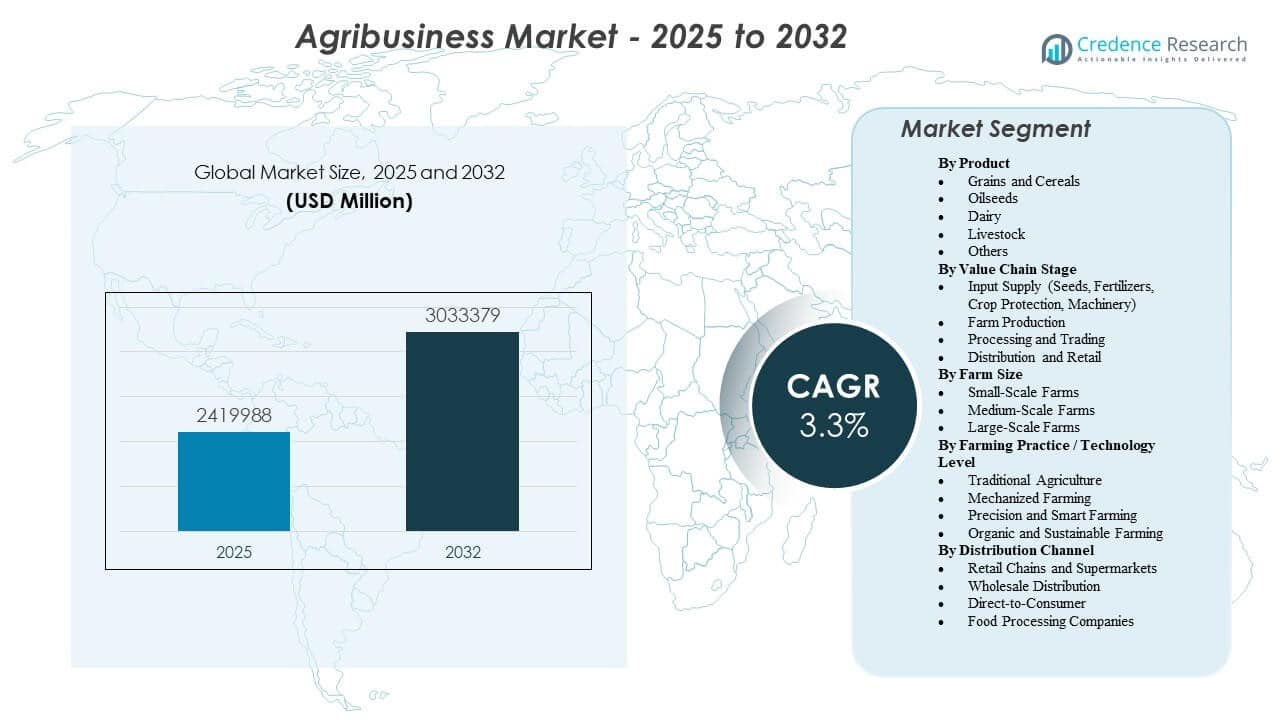
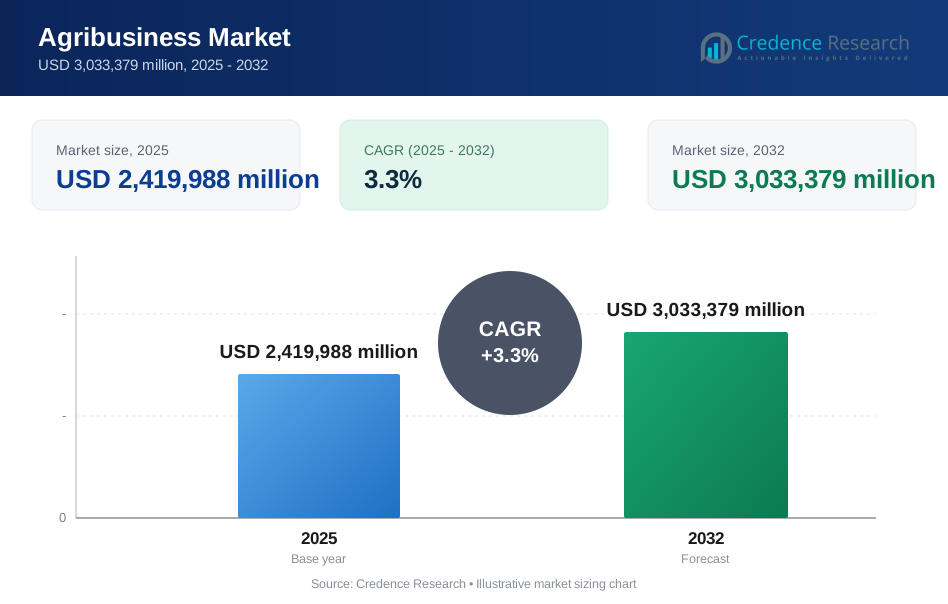
The Market is projected to grow from USD 2,419,988 million in 2025 to an estimated USD 3,033,379 million by 2032, with a compound annual growth rate (CAGR) of 3.3% from 2025 to 2032.
| REPORT ATTRIBUTE | DETAILS |
|---|---|
| Historical Period | 2020-2023 |
| Base Year | 2024 |
| Forecast Period | 2025-2032 |
| Agribusiness Market Size 2024 | USD 2,419,988 million |
| Agribusiness Market, CAGR | 3.3% |
| Agribusiness Market Size 2032 | USD 3,033,379 million |
Rising population and shifting dietary preferences drive steady demand for grains, oilseeds, dairy, and meat products. Governments promote farm modernization through irrigation programs, credit expansion, and technology adoption. Agribusiness firms invest in improved seeds, crop protection solutions, and mechanized equipment to enhance yield and efficiency. Food processors expand capacity to serve urban consumers and export markets. Integrated supply networks improve storage, logistics, and traceability. These factors collectively strengthen production output and operational stability across the value chain.
North America leads due to advanced mechanization, large-scale commercial farming, and strong export systems in the United States and Canada. Europe maintains a strong position through policy support and sustainable farming standards. Asia Pacific emerges rapidly, driven by China and India, where rising consumption and government reforms boost productivity. Latin America, particularly Brazil and Argentina, remains a key exporter of soybeans and livestock. Africa shows gradual expansion through irrigation projects and food security initiatives.
Agribusiness Market Insights:
- The Agribusiness Market is projected to grow from USD 2,419,988 million in 2025 to USD 3,033,379 million by 2032, registering a CAGR of 3.3% during the forecast period.
- Rising global food demand, urban dietary shifts toward protein consumption, and government-backed farm modernization programs are key growth drivers.
- Expansion of food processing capacity and structured supply chain networks is improving efficiency, storage, and export competitiveness.
- Commodity price volatility, climate risks, and regulatory complexities across trade markets act as major restraints for producers and traders.
- North America leads the market, followed by Asia Pacific and Europe, while Latin America remains export-focused and Africa shows gradual growth through food security initiatives.
Agribusiness Market Drivers
Rising Global Food Demand And Structural Shift Toward High-Value Agricultural Commodities Across Urban Economies
Global population growth increases pressure on food production systems. Urban households demand protein-rich diets, packaged foods, and processed products. The Agribusiness Market benefits from higher consumption of grains, oilseeds, meat, and dairy. Export-oriented economies expand acreage and improve yield to meet trade demand. Retail chains push suppliers to ensure steady volumes and consistent quality. Food processors scale operations to supply modern trade channels. Governments support domestic production to reduce import dependence. Strong commodity trade flows sustain large integrated agribusiness firms.
- For instance, Tyson Foods processes approximately 47 million chickens per week across its U.S. operations, highlighting scale expansion to meet rising protein demand.
Government Policy Support, Subsidy Frameworks, And Institutional Credit Expansion For Farm Modernization
Public policy plays a central role in sector growth. National programs support irrigation, seed distribution, and farm credit access. It encourages farmers to adopt certified inputs and mechanized equipment. Subsidized loans improve capital access for small and mid-sized producers. Crop insurance schemes reduce income volatility and strengthen confidence. Export incentives support grain and oilseed shipments from major producing nations. Regulatory reforms improve contract farming and private investment. Stable policy direction supports long-term expansion strategies.
Adoption Of Advanced Seeds, Crop Protection Solutions, And Mechanized Farm Equipment Across Large Holdings
Technological adoption improves yield and resource efficiency. Hybrid and genetically improved seeds enhance output per hectare. It supports better resistance to pests and climatic stress. Crop protection chemicals and biologicals reduce field losses. Farm mechanization reduces labor dependency in large-scale operations. Precision equipment improves planting accuracy and harvest efficiency. Input suppliers expand product portfolios to capture value across segments. Strong technology integration raises farm profitability and output stability.
- For instance, Bayer’s DEKALB corn hybrids demonstrated yield advantages of up to 10 bushels per acre in U.S. field trials compared with leading competitor products.
Expansion Of Food Processing Infrastructure And Structured Supply Chain Networks Across Developing Economies
Processing capacity growth strengthens farm-to-fork linkages. Cold storage and warehousing reduce post-harvest losses. It supports longer shelf life for perishable goods. Integrated logistics networks improve rural connectivity with urban markets. Large retailers demand traceable and quality-certified produce. Food companies invest in contract farming to secure raw materials. Digital platforms connect farmers with institutional buyers. Supply chain upgrades support margin expansion across the value chain.
Agribusiness Market Trends
Rapid Integration Of Digital Platforms And Data Analytics Into Farm Management And Commodity Trading Systems
Digital transformation reshapes farm operations and trade practices. The Agribusiness Market adopts satellite mapping and farm management software. It enables real-time crop monitoring and yield forecasting. Commodity traders use data tools to manage price risk. Mobile platforms connect farmers with buyers and advisory services. Input firms deploy digital channels for product distribution. Blockchain systems enhance transparency in export supply chains. Technology integration improves decision accuracy across the ecosystem.
- For instance, John Deere’s Operations Center connects over 500,000 machines and manages more than 330 million acres globally, enabling data-driven farm decisions at scale.
Growing Focus On Sustainable Sourcing And Climate-Resilient Production Practices Across Global Supply Chains
Sustainability standards influence procurement policies worldwide. Large buyers require traceable and certified raw materials. It promotes responsible fertilizer and water use. Regenerative agriculture practices gain traction in major producing regions. Carbon footprint tracking becomes part of corporate reporting. Financial institutions link credit access with environmental compliance. Agri-input firms expand biological and low-residue product lines. Sustainable sourcing reshapes long-term supplier relationships.
Shift Toward Value-Added Processing And Branded Agricultural Products In Domestic And Export Markets
Producers move beyond raw commodity exports. Food companies invest in branded packaged goods. It captures higher margins across retail channels. Exporters develop processed variants of grains and oilseeds. Private labels gain share in modern trade outlets. Consumer demand favors convenience and ready-to-cook products. Packaging innovation improves product shelf life and appeal. Value addition strengthens competitiveness in international markets.
- For instance, ADM operates more than 300 processing facilities worldwide and processes over 200 million metric tons of agricultural commodities annually, supporting large-scale value-added conversion.
Rising Private Equity And Strategic Investment Activity In Integrated Agri-Food Enterprises
Institutional investors show strong interest in integrated models. The Agribusiness Market attracts capital across processing, storage, and logistics assets. It supports consolidation and operational scale. Mergers improve bargaining power in commodity procurement. Investment funds target digital agri-tech firms with scalable platforms. Joint ventures expand export capacity in emerging economies. Capital inflows support infrastructure upgrades and portfolio diversification. Structured investment enhances resilience against price cycles.
Agribusiness Market Challenges Analysis
Exposure To Commodity Price Volatility And Weather-Linked Production Risks Across Major Producing Regions
Price swings create uncertainty for producers and traders. Extreme weather events disrupt crop output in key regions. It increases supply shocks and margin pressure. Export restrictions intensify volatility in global trade flows. Input cost inflation affects fertilizer and fuel expenses. Currency fluctuations influence export competitiveness. Smallholders face higher risk due to limited hedging access. The Agribusiness Market must manage cyclical downturns and unpredictable harvest outcomes.
Regulatory Complexity, Trade Barriers, And Compliance Costs Across International Agricultural Supply Chains
Cross-border trade faces strict sanitary and phytosanitary rules. Import standards vary across regions and products. It raises compliance and certification costs for exporters. Trade disputes affect tariff structures and quotas. Environmental regulations increase reporting obligations. Food safety standards demand continuous monitoring and testing. Fragmented policy frameworks create operational complexity. Regulatory uncertainty constrains long-term investment planning.
Market Opportunities
Expansion Of Agritech Solutions And Precision Farming Services Across Emerging And Mid-Sized Farm Operations
Technology firms target underserved farm segments. The Agribusiness Market can leverage sensor-based irrigation and crop analytics tools. It improves productivity and resource efficiency. Drone mapping and soil diagnostics gain adoption. Subscription-based advisory models open recurring revenue streams. Governments support digital literacy in rural areas. Partnerships between input suppliers and tech firms expand service reach. Scalable agritech platforms offer strong growth potential.
Growth In Sustainable Exports, Specialty Crops, And High-Value Organic Product Segments Worldwide
Consumer demand shifts toward premium and certified products. Specialty grains, organic fruits, and plant-based inputs gain attention. It enables producers to command price premiums. Export markets seek traceable and ethically sourced goods. Certification programs enhance brand reputation. Niche crop diversification reduces dependency on staple commodities. Processing firms develop dedicated organic supply chains. High-value segments present attractive expansion avenues.
Agribusiness Market Segmentation Analysis:
By Product
Grains and cereals hold a major share due to staple food demand across global markets. Oilseeds support edible oil and feed industries. Dairy benefits from steady urban consumption and processed food growth. Livestock drives protein supply chains and export trade. Others include specialty crops and horticulture products. The Agribusiness Market reflects diversified revenue streams across these categories. It supports both domestic consumption and global trade flows.
- For instance, Corteva Agriscience reported that its Pioneer® brand corn hybrids deliver yield advantages of up to 8 bushels per acre in multi-location U.S. trials, while Arla Foods processes over 14 billion kilograms of milk annually, strengthening dairy supply chains.
By Value Chain Stage
Input supply forms the foundation through seeds, fertilizers, crop protection, and machinery. Farm production converts inputs into marketable commodities. Processing and trading create value through grading, storage, and conversion into finished goods. Distribution and retail connect producers with consumers and institutional buyers. It improves efficiency and margin capture across stages. The Agribusiness Market depends on integration across this structured value chain.
By Farm Size
Small-scale farms dominate in developing regions and focus on staple crops. Medium-scale farms balance commercial output with regional supply. Large-scale farms operate with advanced systems and export orientation. It influences capital intensity and technology adoption. Farm size impacts productivity, bargaining power, and input use. The Agribusiness Market reflects varied operational models across these categories.
- For instance, John Deere reports that its large 9RX tractors offer up to 640 engine horsepower, enabling high-acreage operations to improve field capacity and operational efficiency.
By Farming Practice / Technology Level
Traditional agriculture relies on manual labor and basic tools. Mechanized farming uses tractors and modern equipment for scale efficiency. Precision and smart farming apply data tools and sensors to improve yield control. Organic and sustainable farming focuses on certified and eco-friendly practices. It shapes cost structures and productivity levels. The Agribusiness Market evolves with higher technology penetration.
By Distribution Channel
Retail chains and supermarkets drive branded and packaged sales. Wholesale distribution supports bulk commodity trade. Direct-to-consumer channels expand through digital platforms. Food processing companies secure raw materials through structured contracts. It strengthens supply reliability and quality control. The Agribusiness Market adapts to changing buyer preferences and channel strategies.
Agribusiness Market Segmentation:
By Product
- Grains and Cereals
- Oilseeds
- Dairy
- Livestock
- Others
By Value Chain Stage
- Input Supply (Seeds, Fertilizers, Crop Protection, Machinery)
- Farm Production
- Processing and Trading
- Distribution and Retail
By Farm Size
- Small-Scale Farms
- Medium-Scale Farms
- Large-Scale Farms
By Farming Practice / Technology Level
- Traditional Agriculture
- Mechanized Farming
- Precision and Smart Farming
- Organic and Sustainable Farming
By Distribution Channel
- Retail Chains and Supermarkets
- Wholesale Distribution
- Direct-to-Consumer
- Food Processing Companies
By Region
- North America
- U.S.
- Canada
- Mexico
- Europe
- Germany
- France
- U.K.
- Italy
- Spain
- Rest of Europe
- Asia Pacific
- China
- Japan
- India
- South Korea
- South-east Asia
- Rest of Asia Pacific
- Latin America
- Brazil
- Argentina
- Rest of Latin America
- Middle East & Africa
- GCC Countries
- South Africa
- Rest of the Middle East and Africa
Regional Analysis:
North America accounts for nearly 32% of the global share, led by the United States and Canada. Strong mechanization levels and structured export systems support regional dominance. Europe holds around 24% share, driven by policy support and sustainable farming standards. The Agribusiness Market benefits from advanced seed technology and integrated supply chains across these regions. It maintains high productivity through capital-intensive operations. Stable trade networks strengthen commodity flows to global markets.
Asia Pacific represents approximately 28% of the total share and remains a high-growth region. China and India lead regional production due to large cultivated areas and rising domestic demand. Governments promote irrigation expansion and farm modernization programs. It improves output efficiency and supply chain connectivity. Southeast Asian countries expand oilseed and palm production for export markets. Rising food processing capacity strengthens regional competitiveness.
Latin America holds close to 11% share, supported by Brazil and Argentina in soybean and livestock exports. Strong export orientation drives investment in farm expansion. The Middle East and Africa account for roughly 5% share. These regions focus on food security initiatives and import substitution strategies. It creates gradual demand for irrigation and input solutions. Infrastructure development supports long-term regional growth.
Key Player Analysis:
- Cargill
- ADM (Archer Daniels Midland)
- Bunge
- Louis Dreyfus Company
- Bayer CropScience
- Syngenta Group
- Corteva Agriscience
- Nutrien
- John Deere
- Yara International
Competitive Analysis:
Competition remains intense across inputs, machinery, processing, and commodity trading segments. The Agribusiness Market features large multinational firms with diversified portfolios. It allows players to control multiple stages of the value chain. Companies focus on product innovation in seeds, crop protection, and digital farm tools. Strategic acquisitions expand geographic presence and technology capabilities. Machinery manufacturers compete on automation and precision features. Global traders leverage scale and logistics networks to manage commodity flows. Firms invest in sustainability standards to secure institutional buyers. Competitive advantage depends on integration, cost efficiency, and supply reliability.
Recent Developments:
- In January 2025, Cargill launched a suite of digital tools for its animal nutrition business, including farm management platforms with mobile data capture and dashboards for dairy monitoring, with plans for sensor integration and potential agtech acquisitions.
- In July 2025, the Agribusiness Market, Bunge completed its $34 billion acquisition of Viterra, creating a major global grain trading and processing giant to compete with ADM and Cargill amid challenging market conditions like slumping prices.
- In August 2025, Orbia Netafim launched a new sprinkler technology as part of global AgTech innovations aimed at improving irrigation efficiency. LeafWorks expanded its DNA-based identification services to 75 herbs and fungi in 2025, enhancing adulteration testing with a global genomic library.
Report Coverage:
The research report offers an in-depth analysis based on Product, Value Chain Stage, Farm Size, Farming Practice / Technology Level, and Distribution Channel. It details leading market players, providing an overview of their business, product offerings, investments, revenue streams, and key applications. Additionally, the report includes insights into the competitive environment, SWOT analysis, current market trends, as well as the primary drivers and constraints. Furthermore, it discusses various factors that have driven market expansion in recent years. The report also explores market dynamics, regulatory scenarios, and technological advancements that are shaping the industry. It assesses the impact of external factors and global economic changes on market growth. Lastly, it provides strategic recommendations for new entrants and established companies to navigate the complexities of the market.
Future Outlook:
- Expansion of integrated supply chains will improve coordination between input suppliers, producers, processors, and retailers.
- Adoption of precision tools and digital farm platforms will enhance productivity and reduce resource waste.
- Growth in value-added food processing will increase margin capture beyond raw commodity sales.
- Rising focus on climate-resilient crops will strengthen output stability in volatile weather conditions.
- Sustainable sourcing standards will influence procurement and export strategies worldwide.
- Investment in storage and cold chain networks will reduce post-harvest losses across regions.
- Consolidation among large agribusiness firms will enhance operational scale and bargaining power.
- Expansion of contract farming models will improve raw material security for processors.
- Increased capital inflow from private equity will support modernization across the value chain.
- Diversification into specialty crops and organic produce will create new premium revenue streams.
Request a Free Sample
Fill in your details and we'll send you a free sample report.
- Sample data tables & charts
- Research methodology
Need a Custom Version of This Report?
Tailor the scope, geography, or segments to your exact requirements.
- Custom geography or segment scope
- Direct access to our analyst team
Frequently Asked Questions
What is the current market size for Agribusiness Market, and what is its projected size in 2032?
At what Compound Annual Growth Rate is the Agribusiness Market projected to grow between 2025 and 2032?
Which Agribusiness Market segment held the largest share in 2025?
What are the primary factors fueling the growth of the Agribusiness Market?
Who are the leading companies in the Agribusiness Market?
Which region commanded the largest share of the Agribusiness Market in 2025?
Table of Content
Chapter 1. Report Introduction
- 1.1 Report Description & Purpose
- 1.1.1 Report Title & Market Definition
- 1.1.2 Unique Selling Propositions (USP) & Key Differentiators
- 1.1.3 Value Proposition for Stakeholders
- 1.2 Research Objectives
- 1.2.1 Market Sizing Objectives (Volume & Revenue)
- 1.2.2 Segmentation Objectives
- 1.2.3 Competitive Intelligence Objectives
- 1.2.4 Forecast & Scenario Objectives
- 1.3 Report Scope
- 1.3.1 Agribusiness Scope – Types & Subtypes Covered
- 1.3.2 Geographic Scope – Regions & Countries Covered
- 1.3.3 Historical Period, Base Year & Forecast Period (2025; forecast to 2032)
- 1.3.4 Inclusions & Exclusions
- 1.4 HS Code & Classification Framework
- 1.5 Currency, Units & Pricing Basis
- 1.6 Target Stakeholders
- 1.7 Limitations & Assumptions
Chapter 2. Executive Summary
- 2.1 Global Agribusiness Market Snapshot
- 2.1.1 Market Size – Historical (2025) & Forecast (2025-2032) (2025: USD 2,419,988 million → 2032: USD 3,033,379 million)
- 2.1.2 Volume & Revenue – Global Totals
- 2.1.3 Key Market Highlights – Top Five Facts
- 2.2 Agribusiness Market Segmentation Snapshot
- 2.2.1 Market Split by Region – 2025 vs. 2032
- 2.3 Competitive Snapshot
- 2.3.1 Top 10 Players by Revenue Share – 2025
- 2.3.2 Top 10 Players by Volume Share – 2025
- 2.3.3 Recent Strategic Developments (18-Month Summary)
- 2.4 Key Investment Highlights & Strategic Conclusions
Chapter 3. Agribusiness Market Dynamics & Industry Analysis
- 3.1 Market Overview & Context
- 3.1.1 Agribusiness Market Position in the Broader Automotive Value Chain
- 3.1.2 OEM vs. Replacement Market Dynamics
- 3.1.3 Market Maturity & Development Stage by Region
- 3.2 Agribusiness Market Drivers
- 3.3 Agribusiness Market Restraints & Challenges
- 3.4 Agribusiness Market Opportunities
- 3.5 Porter's Five Forces Analysis
- 3.5.1 Threat of New Entrants
- 3.5.2 Bargaining Power of Suppliers
- 3.5.3 Bargaining Power of Buyers
- 3.5.4 Threat of Substitutes
- 3.5.5 Competitive Rivalry – Intensity Assessment
- 3.6 Agribusiness Value Chain Analysis
- 3.6.1 Upstream – Raw Material/Input Suppliers
- 3.6.1.1 Raw Material/Input 1
- 3.6.1.2 Raw Material/Input 2
- 3.6.1.3 Raw Material/Input 3
- 3.6.2 Midstream – Production/Manufacturing/Service Delivery
- 3.6.2.1 Production/Process Overview
- 3.6.2.2 Key Facility Locations & Capacity by Manufacturer
- 3.6.3 Downstream – Distribution & End Consumer
- 3.6.3.1 Primary Channel – B2B/OEM
- 3.6.3.2 Secondary Channels – Dealer, Retail, Online, Direct
- 3.6.4 Value Chain Profitability Analysis
- 3.6.1 Upstream – Raw Material/Input Suppliers
- 3.7 PESTEL Analysis
- 3.7.1 Political Factors
- 3.7.2 Economic Factors
- 3.7.3 Social Factors
- 3.7.4 Technological Factors
- 3.7.5 Environmental Factors
- 3.7.6 Legal Factors
- 3.8 Agribusiness Supply Chain Analysis
- 3.8.1 Raw Material/Input Supply Risk Assessment
- 3.8.2 Manufacturing Concentration Risk (Geographic Exposure)
- 3.8.3 Trade Disruption Impact Analysis
- 3.9 Regulatory & Policy Landscape
Note: The regulatory and policy landscape section covers regulations based on their applicability to the market, Agribusiness category, geography, and scope of the study. Only regulatory frameworks with a material impact on operations, compliance, trade, sustainability, or market access are analyzed in detail.
Chapter 4. Key Investment Pockets & Opportunity Analysis
- 4.1 Agribusiness Market Attractiveness Analysis
- 4.1.1 By Region – Investment Attractiveness Matrix (Volume × CAGR)
- 4.2 Absolute Revenue Growth Opportunity
- 4.2.1 By Region – Absolute USD Growth Through 2032
- 4.3 Incremental Volume Opportunity
- 4.3.1 By Region – Incremental Volume Through 2032
- 4.3.2 Segment – Incremental Volume
- 4.4 Emerging Submarket Opportunity Deep Dive (Subject to Applicability)
- 4.5 Emerging Market Opportunity Scorecards
- 4.5.1 United States
- 4.5.2 Europe
- 4.5.3 Asia
- 4.5.4 Middle East & Africa
Note: Emerging Market Opportunity Scorecards will be included based on relevance and strategic importance. Regions listed are indicative and may vary depending on data availability and market dynamics.
Chapter 5. Agribusiness Import-Export Analysis & Trade Flows
- 5.1 Global Trade Overview
- 5.1.1 Global Export Value by Country (2025)
- 5.1.2 Global Export Volume by Country (2025)
- 5.1.3 Global Import Value by Country (2025)
- 5.1.4 Global Import Volume by Country (2025)
- 5.1.5 Net Trade Balance by Country (2025)
- 5.2 Export Analysis – Segment
- 5.2.1 Type 1 (HS Code)
- 5.2.2 Type 2 (HS Code)
- 5.2.3 Type 3 (HS Code)
- 5.2.4 Type 4 (HS Code)
- 5.2.5 Type 5 (HS Code)
- 5.3 Import Analysis – Segment
- 5.3.1 Type 1 (HS Code)
- 5.3.2 Type 2 (HS Code)
- 5.3.3 Type 3 (HS Code)
- 5.3.4 Type 4 (HS Code)
- 5.3.5 Type 5 (HS Code)
- 5.4 Average Unit Trade Prices
- 5.4.1 Average Export Price – Segment & Country
- 5.4.2 Average Import Price – Segment & Source Country
- 5.4.3 Price Trends (2025)
- 5.5 Key Trade Route Analysis
- 5.5.1 Trade Route 1
- 5.5.2 Trade Route 2
- 5.5.3 Trade Route 3
- 5.5.4 Trade Route 4
- 5.5.5 Trade Route 5
- 5.6 Trade Policy Impact Assessment
- 5.6.1 US Anti-Dumping & Section 301 Tariffs
- 5.6.2 EU Customs Union Impact
- 5.6.3 Major Free Trade Agreements
- 5.6.4 USMCA Rules of Origin
Note: Trade policy analysis will be included only where relevant to the Agribusiness market.
Chapter 6. Competitive Landscape & Company Benchmarking
- 6.1 Agribusiness Market Concentration & Structure
- 6.1.1 Herfindahl-Hirschman Index (HHI) – vs. 2025
- 6.1.2 Tier 1, Tier 2 & Tier 3 Market Structure
- 6.1.3 Global, Regional & Local Player Dynamics
- 6.2 Agribusiness Market Share Analysis – 2025
- 6.2.1 Global Revenue Share by Company
- 6.2.2 Global Volume Share by Company
- 6.2.3 Regional Revenue Share
- 6.2.4 Market Share Evolution ( vs. 2025)
- 6.2.5 OEM Segment Share by Company
- 6.2.6 Replacement Segment Share by Company
- 6.3 Production/Delivery Capacity & Facility Analysis
- 6.3.1 Global Installed Capacity
- 6.3.2 Capacity Utilization Rates
- 6.3.3 Production/Output Volume
- 6.3.4 Facility Locations & Capacity Map
- 6.3.5 Planned Capacity Additions
- 6.4 Agribusiness Competitive Benchmarking Matrix
- 6.4.1 Revenue, Volume, CAGR & Profitability Comparison
- 6.4.2 Channel Revenue Mix
- 6.4.3 Geographic Revenue Exposure
- 6.4.4 R&D Intensity
- 6.4.5 Sustainability Maturity
- 6.5 Strategic Developments in Agribusiness (Last 24 Months)
- 6.5.1 Mergers, Acquisitions & Divestments
- 6.5.2 New Agribusiness Launches
- 6.5.3 Facility Expansions
- 6.5.4 Strategic Alliances, Joint Ventures & Partnerships
- 6.5.5 Distribution Expansion & Market Entry
- 6.5.6 Sustainability & ESG Initiatives
- 6.6 Competitive Strategy Mapping
- 6.6.1 Leader, Challenger, Follower & Niche Classification
- 6.6.2 Pricing Strategy Comparison
- 6.6.3 Channel Strategy Matrix
Note: Strategic developments are included based on their materiality and the availability of reliable information.
Chapter 7. Global Agribusiness Market – By Distribution Channel
- 7.1 Segment Overview
- 7.1.1 Volume & Revenue Split by Channel (2025 & 2032)
- 7.1.2 Channel Mix Evolution (2025-2032)
Chapter 8. Regional Market Analysis – Global Overview
- 8.1 Global Regional Overview
- 8.1.1 Regional Volume Share
- 8.1.2 Regional Revenue Share
- 8.1.3 Regional Volume by Region
- 8.1.4 Regional Revenue by Region
- 8.1.5 Regional Forecast Through 2032
- 8.2 Cross-Regional Segment Analysis
- 8.2.1 By Distribution Channel
- 8.2.2 By Brand/Price Tier
Chapter 9. North America Agribusiness Market
- 9.1 United States
- 9.2 Canada
- 9.3 Mexico
Chapter 10. Europe Agribusiness Market
- 10.1 Germany
- 10.2 France
- 10.3 Italy
- 10.4 United Kingdom
- 10.5 Spain
- 10.6 Poland
- 10.7 Russia
- 10.8 Netherlands
- 10.9 Belgium
- 10.10 Sweden
- 10.11 Denmark
- 10.12 Norway
- 10.13 Rest of Europe
Chapter 11. Asia Pacific Agribusiness Market
- 11.1 China
- 11.2 India
- 11.3 Japan
- 11.4 South Korea
- 11.5 Thailand
- 11.6 Indonesia
- 11.7 Vietnam
- 11.8 Malaysia
- 11.9 Australia
- 11.10 Rest of Asia Pacific
Chapter 12. Latin America Agribusiness Market
- 12.1 Brazil
- 12.2 Argentina
- 12.3 Colombia
- 12.4 Chile
- 12.5 Rest of Latin America
Chapter 13. Middle East Agribusiness Market
- 13.1 Saudi Arabia
- 13.2 United Arab Emirates
- 13.3 Turkey
- 13.4 Israel
- 13.5 Iran
- 13.6 Rest of the Middle East
Chapter 14. Africa Agribusiness Market
- 14.1 South Africa
- 14.2 Egypt
- 14.3 Nigeria
- 14.4 Morocco
- 14.5 Rest of Africa
Chapter 15. Agribusiness Company Profiles
- 15.1 [Company 01]
- 15.1.1 Company Overview
- 15.1.2 Key Management Personnel
- 15.1.3 Products & Services Portfolio
- 15.1.4 Financial Performance
- 15.1.5 Key Market Focus & Geographic Presence
- 15.1.6 Recent Developments & Strategic Initiatives
Note: The company profile list is preliminary and may change based on research findings, market developments, data availability, and client requirements.
Chapter 16. Appendices
- Appendix A – List of Abbreviations & Acronyms
- Appendix B – Industry Classification Code Reference – Full Series
- Appendix C – Production & Capacity Data Tables
- Appendix D – End-Use & Demand Base Tables
- Appendix E – Consumption & Replacement Rate Assumptions
- Appendix F – ASP Reference Tables
- Appendix G – Manufacturing & Facility Database
- Appendix H – Import-Export Data Tables
- Appendix I – Regulatory Summary Tables
- Appendix J – Primary Research Participant List (Anonymized)
- Appendix K – Primary Research Questionnaire Framework
- Appendix L – Data Sources & Bibliography
- Appendix M – Market Size Divergence & Source Comparison
Chapter 17. Research Methodology
- 17.1 Research Framework & Philosophy
- 17.2 Secondary Research – Sources, Hierarchy & Data Extraction
- 17.3 Data Modeling – Bottom-Up & Top-Down Market Sizing
- 17.4 Primary Research – Stakeholder Framework, LOI & Sample Sizes
- 17.5 Forecast Methodology – Regression, Scenario & Sensitivity Analysis
- 17.6 Quality Control – Four-Layer Validation Framework
- 17.7 Limitations & Standard Assumptions
- 17.8 Disclaimer
