
Market Overview:
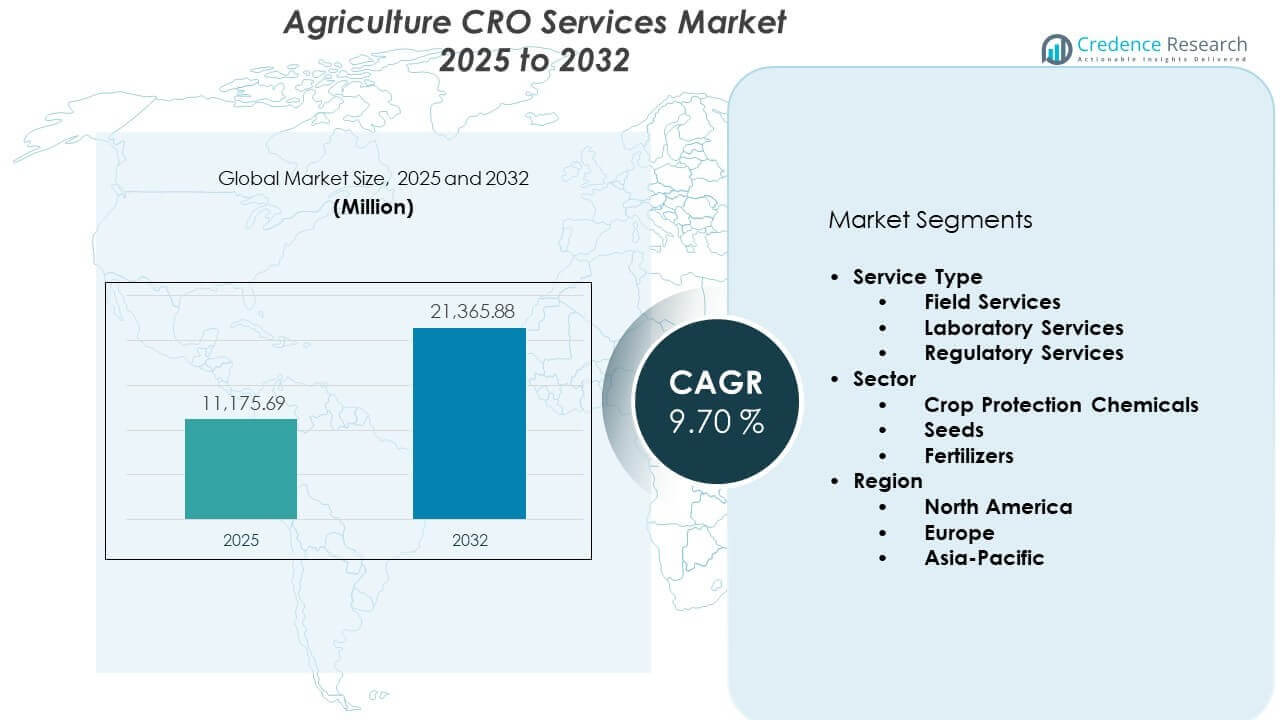
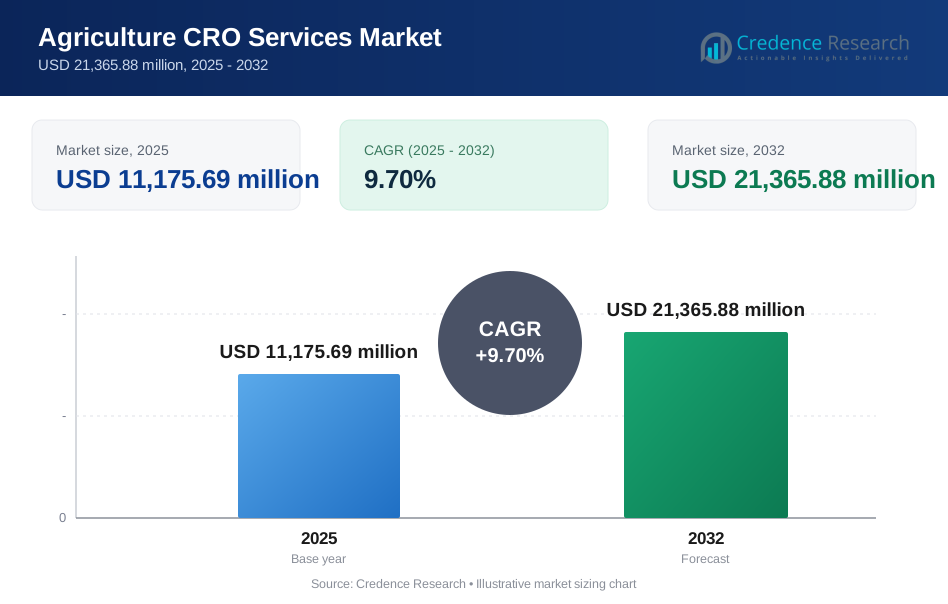
The Agriculture CRO Services Market is projected to grow from USD 11,175.69 million in 2025 to an estimated USD 21,365.88 million by 2032, with a compound annual growth rate (CAGR) of 9.70% from 2025 to 2032.
| REPORT ATTRIBUTE | DETAILS |
|---|---|
| Historical Period | 2020-2023 |
| Base Year | 2024 |
| Forecast Period | 2025-2032 |
| Agriculture CRO Services Market Size 2025 | USD 11,175.69 million |
| Agriculture CRO Services Market, CAGR | 9.70% |
| Agriculture CRO Services Market Size 2032 | USD 21,365.88 million |
Market growth is driven by rising pressure to improve crop yield, pest resistance, and climate tolerance. Agri-input firms outsource trials to reduce cost, shorten development cycles, and access skilled agronomy teams. Stricter environmental and food safety rules increase demand for regulatory and toxicology studies. Growth in genetically modified and bio-based products raises the need for specialized testing. Digital tools, precision farming data, and advanced analytics also strengthen CRO value. Small and mid-sized firms rely on CRO partners to compete with larger players.
North America leads the market due to strong agrochemical R&D spending, advanced farming practices, and clear regulatory frameworks. Europe follows, supported by strict compliance needs and sustainability-focused research. Asia Pacific is the fastest-emerging region, driven by expanding agriculture sectors in China and India. Rising population and food security goals fuel trial activity in these countries. Latin America shows growing adoption due to large-scale farming in Brazil and Argentina. Africa and the Middle East remain early-stage but show long-term potential.
Market Insights:
- The Agriculture CRO Services Market was valued at USD 11,175.69 million in 2024 and is projected to reach USD 21,365.88 million by 2032, expanding at a CAGR of 9.70%, driven by rising outsourced agricultural research needs.
- North America (38%), Europe (30%), and Asia-Pacific (25%) hold the top regional shares due to strong agri-R&D spending, strict regulatory frameworks, and large-scale farming activity.
- Asia-Pacific, with a 25% share, is the fastest-growing region, supported by expanding food demand, rising seed innovation, and cost-efficient field trial capabilities.
- By service type, Field Services account for about 45%, followed by Laboratory Services at nearly 35%, reflecting heavy reliance on on-site trials and analytical testing.
- By sector, Crop Protection Chemicals hold around 40% share, while Seeds contribute nearly 35%, driven by extensive efficacy trials and multi-location variety testing.
Market Drivers:
Rising Demand for External Research Support to Reduce R&D Timelines and Costs
Companies in the agri-input sector face mounting pressure to deliver new products faster. Internal research teams often operate with resource constraints, leading to longer development timelines. The Agriculture CRO Services Market supports these firms by offering specialized research, field trial management, and data analytics. Outsourcing allows firms to access skilled personnel and ready infrastructure without long-term investment. CROs provide seasonal trial execution across multiple regions, which speeds up product validation. This model reduces the cost-per-trial while maintaining high data standards. It enables companies to focus on product innovation and market entry strategies. Faster R&D cycles improve competitive positioning.
- For instance, Charles River Laboratories operates multiple GLP and GEP‑accredited crop trial bases across Europe and North America and has supported hundreds of multi‑site residue and soil dissipation studies reliably.
Strict Global Regulatory Compliance Driving Demand for Specialized Regulatory Services
Agrochemical and seed companies must comply with region-specific safety and environmental regulations. These include residue studies, eco-toxicity reports, and trial data validated under GLP standards. The Agriculture CRO Services Market meets this demand by offering dedicated regulatory services, covering dossier preparation and authority submissions. CROs maintain expert teams familiar with evolving regulations in North America, Europe, and Asia. Sponsors rely on their insights to navigate complex approval paths. Strong documentation and regulatory alignment improve the success rate of new product registrations. This demand strengthens long-term contracts with CROs. It elevates their role as compliance partners in product development.
- For instance, Eurofins Scientific has an international network of over 950 laboratories in 59 countries and more than 200,000 validated analytical methods supporting complex regulatory testing protocols globally.
Growth in Biotech Seeds and Sustainable Input Solutions Increasing Trial Volume
The global shift toward genetically modified crops and bio-based inputs has triggered a rise in complex testing. Biotech traits and microbial products need longer, multi-environment trials to validate efficacy. The Agriculture CRO Services Market enables such research through skilled execution across variable agro-climatic zones. CROs manage trait performance tracking, pest resistance analysis, and plant-soil interaction assessments. This expands the range of studies beyond traditional crop protection. Sponsors benefit from scalable field networks and bio-analytics support. CROs with biotech expertise command high demand from seed firms and start-ups. The market grows as sustainability becomes a core objective in agriculture R&D.
Expanding Global Footprint of CRO Networks Across Emerging Agricultural Hubs
Agri-input companies target emerging markets for high-growth opportunities. Local trial data is often essential for regulatory acceptance. The Agriculture CRO Services Market responds by expanding its site networks in Asia, Latin America, and Africa. CROs develop partnerships with local agronomists and trial stations to meet region-specific crop and soil needs. These regional capabilities help sponsors test under real-use conditions. Trial expansion aligns with the push for tailored fertilizers, seeds, and protection agents. It also supports diversified portfolios across geographies. CRO presence in these zones improves research access, speeds trial deployment, and reduces logistics barriers for global players.
Market Trends:
Wider Use of Digital Technologies for Real-Time Data Collection and Trial Monitoring
Trial execution increasingly integrates digital tools for precision, speed, and data integrity. The Agriculture CRO Services Market embraces technologies like drone imaging, IoT-based soil sensors, and remote crop monitoring platforms. These tools improve accuracy in data collection and reduce manual error. Sponsors can view trial progress in real-time through digital dashboards. This transparency supports faster decision-making across multi-site programs. Digital workflows streamline reporting timelines and enable quicker submissions. CROs investing in agritech platforms gain a competitive edge. Clients favor data-driven service models for large-scale, multi-location studies.
- For instance, precision agritech firms report use of over 100 million connected IoT devices worldwide to capture real‑time environmental and soil data for analytics in crop management.
Rise in Integrated CRO Offerings Across End-to-End Trial and Compliance Cycles
Clients now prefer full-service models covering everything from protocol design to regulatory submission. The Agriculture CRO Services Market shifts toward integrated delivery to offer seamless workflows. CROs combine field operations, lab analytics, and compliance documentation under a single contract. This structure reduces coordination overhead for sponsors. It also ensures consistency in data quality and regulatory alignment. End-to-end services improve operational efficiency and shorten product timelines. Large players expand capabilities through acquisition or partnerships. The trend strengthens service stickiness and long-term engagements.
- For instance, major CROs like Eurofins Scientific and Charles River have expanded multi‑disciplinary capabilities that include comprehensive analytical chemistry and regulatory science services under one roof.
Shift Toward Eco-Friendly Inputs Reshaping Trial Protocols and CRO Focus
Environmental sustainability is driving a surge in biological crop protection and organic fertilizers. These inputs require different testing conditions compared to synthetic chemicals. The Agriculture CRO Services Market adjusts by adopting specialized bioassay methods and longer field durations. Sponsors emphasize environmental impact metrics like residue breakdown and pollinator safety. CROs develop protocols aligned with these objectives. Testing for biodegradable, low-impact products increases in both field and lab segments. This trend expands the CRO role from efficacy validation to environmental risk assessment. It creates new service categories within existing frameworks.
Growing Presence of Regionally Specialized CROs Offering Localized Expertise
Regional CROs are gaining ground through their deep understanding of local crops, seasons, and regulatory bodies. The Agriculture CRO Services Market sees fragmentation in certain zones, where global players collaborate with smaller firms for execution. Local CROs operate more efficiently in familiar environments and provide better cost structures. Sponsors rely on their regional expertise to manage high-volume trials. These firms offer flexibility, faster setup, and culturally aligned field management. The trend promotes decentralized research models with centralized oversight. It balances global consistency with local adaptability in trial execution.
Market Challenges Analysis:
Climatic Uncertainty and Site-Specific Variability Disrupting Trial Consistency
Climate risk is a persistent challenge in agricultural trials. Unpredictable weather conditions drought, excessive rain, or early frost can impact study outcomes or lead to trial failure. The Agriculture CRO Services Market must constantly adapt to these risks through contingency planning. CROs often replicate trials across multiple zones to hedge against local weather events. Still, unexpected climate events delay timelines and raise costs. Sponsors face challenges in standardizing trial data from weather-affected regions. Site variability in soil, pest load, and farming practices adds further complexity. This limits comparability and increases the need for localized protocols.
Shortage of Skilled Agronomists and Regulatory Experts Limits Operational Scale
Finding and retaining qualified field technicians, agronomists, and regulatory professionals remains difficult in many regions. The Agriculture CRO Services Market depends heavily on local talent to manage field execution and compliance reporting. Staff shortages cause scheduling delays and trial backlog. It also affects quality control and timely delivery of results. Training programs often require long lead times and investment. Inexperienced staff may struggle to manage sensitive trial protocols or regulatory formatting. CROs must balance expansion with resource quality. Talent gaps remain a critical barrier to scalability and standardization.
Market Opportunities:
Expansion of CRO Services in Emerging Agricultural Economies to Meet Local Data Requirements
Emerging markets like India, Brazil, and Southeast Asia present strong demand for localized research. Governments often require local field data for agrochemical and seed product approvals. The Agriculture CRO Services Market can grow by building partnerships with regional institutions and farms. CROs can meet sponsor demand for fast trial deployment and regulatory alignment. Local trial stations offer favorable climates and crop diversity. This helps global sponsors validate performance across new geographies. These regions also offer cost advantages for field execution.
Adoption of Precision Agriculture and Smart Tools to Differentiate CRO Capabilities
Precision farming tools offer high-resolution data for crop monitoring and yield tracking. The Agriculture CRO Services Market can integrate smart sensors, GIS mapping, and machine learning to enhance trial quality. These tools attract technology-driven sponsors seeking predictive insights. CROs that build such capabilities stand out in competitive bids. Precision tools reduce trial risk, improve accuracy, and enhance compliance documentation. This creates a service advantage in high-value crop segments and biotech studies. It opens new revenue streams for value-added services.
Market Segmentation Analysis:
By Service Type
Field Services, Laboratory Services, and Regulatory Services form the operational base of this segment. Field Services support on-site trials, crop monitoring, and agronomic data capture across varied climates. Laboratory Services deliver residue analysis, soil testing, and bio-efficacy validation under controlled conditions. Regulatory Services manage compliance, dossier preparation, and authority coordination. The Agriculture CRO Services Market relies on this structure to balance speed, accuracy, and compliance. It helps sponsors reduce internal workload while improving data reliability. Each service type supports a different phase of product development. Strong coordination across services improves trial outcomes.
- For instance, contract testing labs like SGS SA perform tens of thousands of analytical tests yearly, covering complex chemical, biological, and environmental protocols.
By Sector
Crop Protection Chemicals, Seeds, and Fertilizers drive demand across research programs. Crop Protection Chemicals require efficacy and safety validation under diverse field conditions. Seeds demand multi-location trials to assess yield stability and resistance traits. Fertilizers need performance testing across soil types and crop cycles. The Agriculture CRO Services Market supports these sectors through specialized protocols. It enables faster validation across product pipelines. Sector diversity reduces dependency on a single crop category. This balance supports steady service demand.
- For instance, residue and ecotoxicology testing programs by major CROs routinely include multi‑site phytotoxicity assessments across dozens of crop and treatment combinations.
Segmentation:
By Service Type
- Field Services
- Laboratory Services
- Regulatory Services
By Sector
- Crop Protection Chemicals
- Seeds
- Fertilizers
By Region
- North America
- U.S.
- Canada
- Mexico
- Europe
- Germany
- France
- U.K.
- Italy
- Spain
- Rest of Europe
- Asia Pacific
- China
- Japan
- India
- South Korea
- South-east Asia
- Rest of Asia Pacific
- Latin America
- Brazil
- Argentina
- Rest of Latin America
- Middle East & Africa
- GCC Countries
- South Africa
- Rest of the Middle East and Africa
Regional Analysis:
North America
North America holds the largest share of the Agriculture CRO Services Market, accounting for nearly 38% of global demand. The region benefits from strong investment in crop protection and seed research. Large agrochemical firms rely on CRO partners to manage complex field trials. Well-defined regulatory frameworks support consistent research activity. CROs operate extensive trial networks across the United States and Canada. High adoption of advanced agronomy tools improves data quality. It maintains regional leadership through stable R&D spending.
Europe
Europe represents around 30% of the global market share, supported by mature regulatory systems. Strict environmental and safety standards increase reliance on external regulatory services. Agricultural companies outsource trials to meet detailed compliance needs. Countries such as Germany, France, and the UK lead regional activity. CRO providers support multi-country trials across varied climates. Demand remains steady due to ongoing sustainability-focused research. It sustains growth through compliance-driven service demand.
Asia-Pacific
Asia-Pacific accounts for approximately 25% of the global market share and shows the fastest expansion. Rising food demand drives investment in seeds and fertilizers. China and India lead regional trial activity due to large farming bases. Local CRO providers gain contracts from global sponsors. Cost-effective field services attract multinational clients. Expanding agri-input manufacturing supports long-term demand. It strengthens its position through rapid agricultural modernization.
Key Player Analysis:
- Charles River Laboratories
- Eurofins Scientific
- Knoell (Knöll)
- Exponent Inc.
Competitive Analysis:
The Agriculture CRO Services Market shows moderate consolidation, led by global CROs with broad service portfolios and strong regulatory expertise. Large players compete through wide trial networks, advanced laboratories, and multi-region compliance support. Mid-sized firms focus on regional specialization and crop-specific expertise. Competition centers on data quality, turnaround time, and regulatory success rates. Service differentiation relies on digital trial tools and agronomy depth. Strategic partnerships help firms expand geographic reach. It rewards providers that balance scale with local execution strength. Client retention depends on long-term research contracts.
Recent Developments:
- In September 2025, Eurofins Scientific strengthened its agricultural research services by acquiring the Agroscience research division of Cawood Scientific. This strategic move brought together Cawood’s expertise in e-fate and metabolism, ecotoxicology, residue analysis, and field study capabilities with Eurofins’ existing network.
Report Coverage:
The research report offers an in-depth analysis based on Service Type, Sector, and Region. It details leading market players, providing an overview of their business, product offerings, investments, revenue streams, and key applications. Additionally, the report includes insights into the competitive environment, SWOT analysis, current market trends, as well as the primary drivers and constraints. Furthermore, it discusses various factors that have driven market expansion in recent years. The report also explores market dynamics, regulatory scenarios, and technological advancements that are shaping the industry. It assesses the impact of external factors and global economic changes on market growth. Lastly, it provides strategic recommendations for new entrants and established companies to navigate the complexities of the market.
Future Outlook:
- The demand for outsourced field trials will continue to grow as agrochemical and seed companies prioritize faster product development and global scalability.
- Precision agriculture technologies like drones, satellite imaging, and IoT-based soil sensors will become standard tools in CRO operations, improving accuracy and real-time decision-making.
- Integrated service offerings combining field execution, lab analytics, and regulatory consulting will dominate contracts, reducing complexity for sponsors and improving data consistency.
- Asia-Pacific will remain the fastest-growing region due to increasing investments in agri-input R&D, favorable government support, and the emergence of local CRO firms.
- Sustainability trends will drive more trials for bio-stimulants, organic fertilizers, and low-residue crop protection products, expanding the service scope for CROs.
- Regulatory complexity will increase across regions, boosting demand for specialized documentation, dossier management, and local authority coordination.
- Seed trials will grow in both conventional and GM segments, with higher demand for multi-location, multi-year trials to validate performance and trait durability.
- Mid-sized CROs will expand through regional partnerships and digital platforms to compete with global players, creating a more balanced competitive landscape.
- Investment in talent development, particularly in agronomy and regulatory affairs, will become a critical priority to maintain service quality and meet scale.
- Clients will seek more real-world validation through farmer-partnered trials, on-farm demo plots, and hybrid models blending commercial exposure with scientific rigor.
Request a Free Sample
Fill in your details and we'll send you a free sample report.
- Sample data tables & charts
- Research methodology
Need a Custom Version of This Report?
Tailor the scope, geography, or segments to your exact requirements.
- Custom geography or segment scope
- Direct access to our analyst team
Frequently Asked Questions
What is the current market size for Agriculture CRO Services Market, and what is its projected size in 2032?
At what Compound Annual Growth Rate is the Agriculture CRO Services Market projected to grow between 2025 and 2032?
Which Agriculture CRO Services Market segment held the largest share in 2025?
What are the primary factors fueling the growth of the Agriculture CRO Services Market?
Who are the leading companies in the Agriculture CRO Services Market?
Which region commanded the largest share of the Agriculture CRO Services Market in 2025?
Table of Content
Chapter 1. Report Introduction
- 1.1 Report Description & Purpose
- 1.1.1 Report Title & Market Definition
- 1.1.2 Unique Selling Propositions (USP) & Key Differentiators
- 1.1.3 Value Proposition for Stakeholders
- 1.2 Research Objectives
- 1.2.1 Market Sizing Objectives (Volume & Revenue)
- 1.2.2 Segmentation Objectives
- 1.2.3 Competitive Intelligence Objectives
- 1.2.4 Forecast & Scenario Objectives
- 1.3 Report Scope
- 1.3.1 Agriculture CRO Services Scope – Types & Subtypes Covered
- 1.3.2 Geographic Scope – Regions & Countries Covered
- 1.3.3 Historical Period, Base Year & Forecast Period (2025; forecast to 2032)
- 1.3.4 Inclusions & Exclusions
- 1.4 HS Code & Classification Framework
- 1.5 Currency, Units & Pricing Basis
- 1.6 Target Stakeholders
- 1.7 Limitations & Assumptions
Chapter 2. Executive Summary
- 2.1 Global Agriculture CRO Services Market Snapshot
- 2.1.1 Market Size – Historical (2025) & Forecast (2025-2032) (2025: USD 11,175.69 million → 2032: USD 21,365.88 million)
- 2.1.2 Volume & Revenue – Global Totals
- 2.1.3 Key Market Highlights – Top Five Facts
- 2.2 Agriculture CRO Services Market Segmentation Snapshot
- 2.2.1 Market Split by Region – 2025 vs. 2032
- 2.3 Competitive Snapshot
- 2.3.1 Top 10 Players by Revenue Share – 2025
- 2.3.2 Top 10 Players by Volume Share – 2025
- 2.3.3 Recent Strategic Developments (18-Month Summary)
- 2.4 Key Investment Highlights & Strategic Conclusions
Chapter 3. Agriculture CRO Services Market Dynamics & Industry Analysis
- 3.1 Market Overview & Context
- 3.1.1 Agriculture CRO Services Market Position in the Broader Automotive Value Chain
- 3.1.2 OEM vs. Replacement Market Dynamics
- 3.1.3 Market Maturity & Development Stage by Region
- 3.2 Agriculture CRO Services Market Drivers
- 3.3 Agriculture CRO Services Market Restraints & Challenges
- 3.4 Agriculture CRO Services Market Opportunities
- 3.5 Porter's Five Forces Analysis
- 3.5.1 Threat of New Entrants
- 3.5.2 Bargaining Power of Suppliers
- 3.5.3 Bargaining Power of Buyers
- 3.5.4 Threat of Substitutes
- 3.5.5 Competitive Rivalry – Intensity Assessment
- 3.6 Agriculture CRO Services Value Chain Analysis
- 3.6.1 Upstream – Raw Material/Input Suppliers
- 3.6.1.1 Raw Material/Input 1
- 3.6.1.2 Raw Material/Input 2
- 3.6.1.3 Raw Material/Input 3
- 3.6.2 Midstream – Production/Manufacturing/Service Delivery
- 3.6.2.1 Production/Process Overview
- 3.6.2.2 Key Facility Locations & Capacity by Manufacturer
- 3.6.3 Downstream – Distribution & End Consumer
- 3.6.3.1 Primary Channel – B2B/OEM
- 3.6.3.2 Secondary Channels – Dealer, Retail, Online, Direct
- 3.6.4 Value Chain Profitability Analysis
- 3.6.1 Upstream – Raw Material/Input Suppliers
- 3.7 PESTEL Analysis
- 3.7.1 Political Factors
- 3.7.2 Economic Factors
- 3.7.3 Social Factors
- 3.7.4 Technological Factors
- 3.7.5 Environmental Factors
- 3.7.6 Legal Factors
- 3.8 Agriculture CRO Services Supply Chain Analysis
- 3.8.1 Raw Material/Input Supply Risk Assessment
- 3.8.2 Manufacturing Concentration Risk (Geographic Exposure)
- 3.8.3 Trade Disruption Impact Analysis
- 3.9 Regulatory & Policy Landscape
Note: The regulatory and policy landscape section covers regulations based on their applicability to the market, Agriculture CRO Services category, geography, and scope of the study. Only regulatory frameworks with a material impact on operations, compliance, trade, sustainability, or market access are analyzed in detail.
Chapter 4. Key Investment Pockets & Opportunity Analysis
- 4.1 Agriculture CRO Services Market Attractiveness Analysis
- 4.1.1 By Region – Investment Attractiveness Matrix (Volume × CAGR)
- 4.2 Absolute Revenue Growth Opportunity
- 4.2.1 By Region – Absolute USD Growth Through 2032
- 4.3 Incremental Volume Opportunity
- 4.3.1 By Region – Incremental Volume Through 2032
- 4.3.2 Segment – Incremental Volume
- 4.4 Emerging Submarket Opportunity Deep Dive (Subject to Applicability)
- 4.5 Emerging Market Opportunity Scorecards
- 4.5.1 United States
- 4.5.2 Europe
- 4.5.3 Asia
- 4.5.4 Middle East & Africa
Note: Emerging Market Opportunity Scorecards will be included based on relevance and strategic importance. Regions listed are indicative and may vary depending on data availability and market dynamics.
Chapter 5. Agriculture CRO Services Import-Export Analysis & Trade Flows
- 5.1 Global Trade Overview
- 5.1.1 Global Export Value by Country (2025)
- 5.1.2 Global Export Volume by Country (2025)
- 5.1.3 Global Import Value by Country (2025)
- 5.1.4 Global Import Volume by Country (2025)
- 5.1.5 Net Trade Balance by Country (2025)
- 5.2 Export Analysis – Segment
- 5.2.1 Type 1 (HS Code)
- 5.2.2 Type 2 (HS Code)
- 5.2.3 Type 3 (HS Code)
- 5.2.4 Type 4 (HS Code)
- 5.2.5 Type 5 (HS Code)
- 5.3 Import Analysis – Segment
- 5.3.1 Type 1 (HS Code)
- 5.3.2 Type 2 (HS Code)
- 5.3.3 Type 3 (HS Code)
- 5.3.4 Type 4 (HS Code)
- 5.3.5 Type 5 (HS Code)
- 5.4 Average Unit Trade Prices
- 5.4.1 Average Export Price – Segment & Country
- 5.4.2 Average Import Price – Segment & Source Country
- 5.4.3 Price Trends (2025)
- 5.5 Key Trade Route Analysis
- 5.5.1 Trade Route 1
- 5.5.2 Trade Route 2
- 5.5.3 Trade Route 3
- 5.5.4 Trade Route 4
- 5.5.5 Trade Route 5
- 5.6 Trade Policy Impact Assessment
- 5.6.1 US Anti-Dumping & Section 301 Tariffs
- 5.6.2 EU Customs Union Impact
- 5.6.3 Major Free Trade Agreements
- 5.6.4 USMCA Rules of Origin
Note: Trade policy analysis will be included only where relevant to the Agriculture CRO Services market.
Chapter 6. Competitive Landscape & Company Benchmarking
- 6.1 Agriculture CRO Services Market Concentration & Structure
- 6.1.1 Herfindahl-Hirschman Index (HHI) – vs. 2025
- 6.1.2 Tier 1, Tier 2 & Tier 3 Market Structure
- 6.1.3 Global, Regional & Local Player Dynamics
- 6.2 Agriculture CRO Services Market Share Analysis – 2025
- 6.2.1 Global Revenue Share by Company
- 6.2.2 Global Volume Share by Company
- 6.2.3 Regional Revenue Share
- 6.2.4 Market Share Evolution ( vs. 2025)
- 6.2.5 OEM Segment Share by Company
- 6.2.6 Replacement Segment Share by Company
- 6.3 Production/Delivery Capacity & Facility Analysis
- 6.3.1 Global Installed Capacity
- 6.3.2 Capacity Utilization Rates
- 6.3.3 Production/Output Volume
- 6.3.4 Facility Locations & Capacity Map
- 6.3.5 Planned Capacity Additions
- 6.4 Agriculture CRO Services Competitive Benchmarking Matrix
- 6.4.1 Revenue, Volume, CAGR & Profitability Comparison
- 6.4.2 Channel Revenue Mix
- 6.4.3 Geographic Revenue Exposure
- 6.4.4 R&D Intensity
- 6.4.5 Sustainability Maturity
- 6.5 Strategic Developments in Agriculture CRO Services (Last 24 Months)
- 6.5.1 Mergers, Acquisitions & Divestments
- 6.5.2 New Agriculture CRO Services Launches
- 6.5.3 Facility Expansions
- 6.5.4 Strategic Alliances, Joint Ventures & Partnerships
- 6.5.5 Distribution Expansion & Market Entry
- 6.5.6 Sustainability & ESG Initiatives
- 6.6 Competitive Strategy Mapping
- 6.6.1 Leader, Challenger, Follower & Niche Classification
- 6.6.2 Pricing Strategy Comparison
- 6.6.3 Channel Strategy Matrix
Note: Strategic developments are included based on their materiality and the availability of reliable information.
Chapter 7. Global Agriculture CRO Services Market – By Distribution Channel
- 7.1 Segment Overview
- 7.1.1 Volume & Revenue Split by Channel (2025 & 2032)
- 7.1.2 Channel Mix Evolution (2025-2032)
Chapter 8. Regional Market Analysis – Global Overview
- 8.1 Global Regional Overview
- 8.1.1 Regional Volume Share
- 8.1.2 Regional Revenue Share
- 8.1.3 Regional Volume by Region
- 8.1.4 Regional Revenue by Region
- 8.1.5 Regional Forecast Through 2032
- 8.2 Cross-Regional Segment Analysis
- 8.2.1 By Distribution Channel
- 8.2.2 By Brand/Price Tier
Chapter 9. North America Agriculture CRO Services Market
- 9.1 United States
- 9.2 Canada
- 9.3 Mexico
Chapter 10. Europe Agriculture CRO Services Market
- 10.1 Germany
- 10.2 France
- 10.3 Italy
- 10.4 United Kingdom
- 10.5 Spain
- 10.6 Poland
- 10.7 Russia
- 10.8 Netherlands
- 10.9 Belgium
- 10.10 Sweden
- 10.11 Denmark
- 10.12 Norway
- 10.13 Rest of Europe
Chapter 11. Asia Pacific Agriculture CRO Services Market
- 11.1 China
- 11.2 India
- 11.3 Japan
- 11.4 South Korea
- 11.5 Thailand
- 11.6 Indonesia
- 11.7 Vietnam
- 11.8 Malaysia
- 11.9 Australia
- 11.10 Rest of Asia Pacific
Chapter 12. Latin America Agriculture CRO Services Market
- 12.1 Brazil
- 12.2 Argentina
- 12.3 Colombia
- 12.4 Chile
- 12.5 Rest of Latin America
Chapter 13. Middle East Agriculture CRO Services Market
- 13.1 Saudi Arabia
- 13.2 United Arab Emirates
- 13.3 Turkey
- 13.4 Israel
- 13.5 Iran
- 13.6 Rest of the Middle East
Chapter 14. Africa Agriculture CRO Services Market
- 14.1 South Africa
- 14.2 Egypt
- 14.3 Nigeria
- 14.4 Morocco
- 14.5 Rest of Africa
Chapter 15. Agriculture CRO Services Company Profiles
- 15.1 [Company 01]
- 15.1.1 Company Overview
- 15.1.2 Key Management Personnel
- 15.1.3 Products & Services Portfolio
- 15.1.4 Financial Performance
- 15.1.5 Key Market Focus & Geographic Presence
- 15.1.6 Recent Developments & Strategic Initiatives
Note: The company profile list is preliminary and may change based on research findings, market developments, data availability, and client requirements.
Chapter 16. Appendices
- Appendix A – List of Abbreviations & Acronyms
- Appendix B – Industry Classification Code Reference – Full Series
- Appendix C – Production & Capacity Data Tables
- Appendix D – End-Use & Demand Base Tables
- Appendix E – Consumption & Replacement Rate Assumptions
- Appendix F – ASP Reference Tables
- Appendix G – Manufacturing & Facility Database
- Appendix H – Import-Export Data Tables
- Appendix I – Regulatory Summary Tables
- Appendix J – Primary Research Participant List (Anonymized)
- Appendix K – Primary Research Questionnaire Framework
- Appendix L – Data Sources & Bibliography
- Appendix M – Market Size Divergence & Source Comparison
Chapter 17. Research Methodology
- 17.1 Research Framework & Philosophy
- 17.2 Secondary Research – Sources, Hierarchy & Data Extraction
- 17.3 Data Modeling – Bottom-Up & Top-Down Market Sizing
- 17.4 Primary Research – Stakeholder Framework, LOI & Sample Sizes
- 17.5 Forecast Methodology – Regression, Scenario & Sensitivity Analysis
- 17.6 Quality Control – Four-Layer Validation Framework
- 17.7 Limitations & Standard Assumptions
- 17.8 Disclaimer
