
Agricultural Pumps Market Overview:
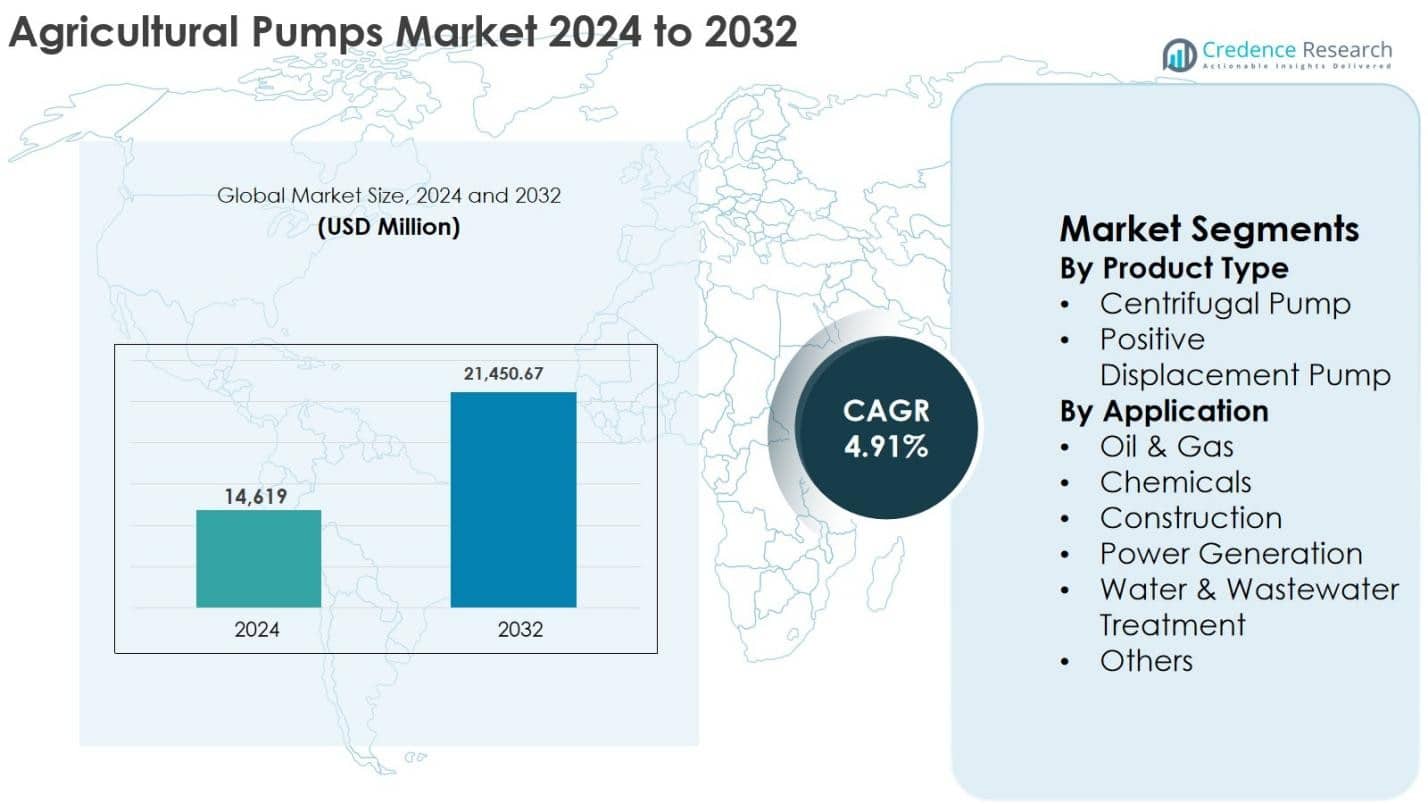
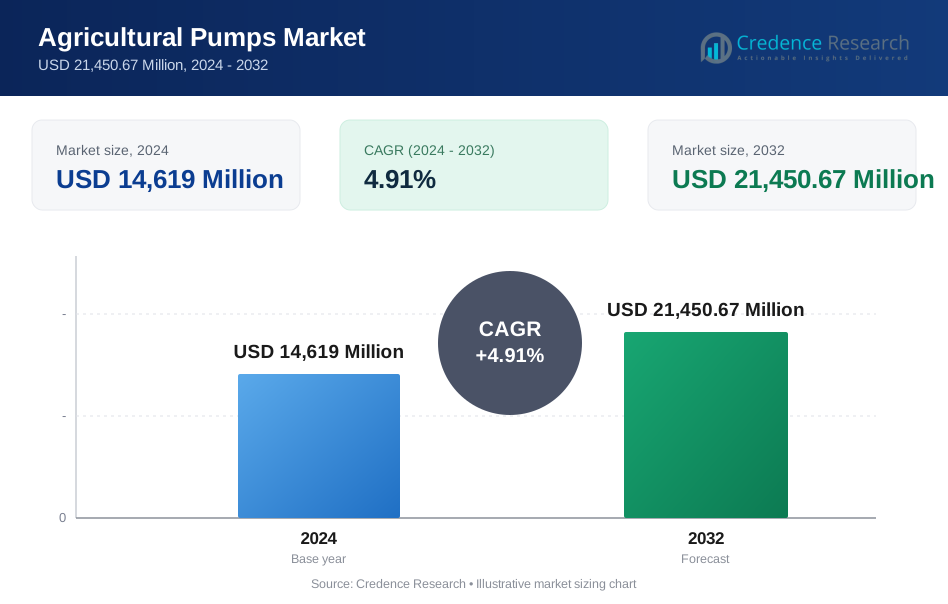
The agricultural pumps market was valued at USD 14,619 million in 2024 and is expected to reach USD 21,450.67 million by 2032, implying a CAGR of 4.91% over the forecast period.
| REPORT ATTRIBUTE | DETAILS |
|---|---|
| Historical Period | 2020-2023 |
| Base Year | 2024 |
| Forecast Period | 2025-2032 |
| Agricultural Pumps Market Size 2024 | USD 14,619 million |
| Agricultural Pumps Market, CAGR | 4.91% |
| Agricultural Pumps Market Size 2032 | USD 21,450.67 million |
The market includes several large, globally recognized manufacturers that compete primarily on irrigation efficiency, energy performance, and reliability in farm water-management applications. Key companies include Grundfos Holding A/S, Flowserve Corporation, Pentair, Sulzer Ltd., ITT Inc., Ingersoll-Rand, EBARA International Corporation, The Weir Group PLC, Schlumberger Limited, and Xylem Inc. These companies typically strengthen their positions through product development, including solar-powered pumping options, and by expanding distribution in rural and agricultural regions.
Asia-Pacific led the market in 2024 with a 38.5% share, supported by extensive irrigated farmland, rural electrification initiatives, and government-backed irrigation infrastructure programs. North America and Europe followed, with growth linked to adoption of precision irrigation practices and upgrades to existing farm water-management systems.
Agricultural Pumps Market Insights
- The agricultural pumps market was valued at USD 14,619 million in 2024 and is projected to reach USD 21,450.67 million by 2032, representing a CAGR of 4.91% over the forecast period.
- Growth is associated with expansion of irrigated farmland, wider use of mechanized and precision irrigation, increased reliance on groundwater pumping in water-stressed areas, and public programs that support rural electrification and subsidize solar pump adoption across smallholder and commercial farms.
- Key trends include increased adoption of solar-powered and energy-efficient pump systems, greater use of smart controllers and automation to improve operating efficiency, and continued demand for submersible and centrifugal pumps for water distribution in irrigation applications.
- Competition is shaped by established manufacturers such as Grundfos, Flowserve, Pentair, Sulzer, Xylem, ITT, EBARA, Ingersoll-Rand, and The Weir Group, which commonly emphasize product development, expansion of rural distribution and service coverage, and after-sales support to retain customers.
- Asia-Pacific led the market in 2024 with a 38.5% share, followed by North America (21.4%) and Europe (19.6%). Centrifugal pumps accounted for a 62.3% share, supported by their fit for higher-volume irrigation and farm water-management requirements.
Agricultural Pumps Market Segmentation Analysis:
By Product Type
In the agricultural pumps market, centrifugal pumps accounted for a 62.3% share in 2024. This position is linked to their efficiency, relatively simple design, and suitability for moving large water volumes for irrigation and drainage. Their use across surface and submersible configurations supports mechanized irrigation, crop watering, and livestock water supply. Demand is also supported by farm mechanization, expansion of irrigated farmland, and wider access to electrification and solar pumping options, which can lower operating constraints in rural areas.
- For instance, Grundfos supplies centrifugal pump ranges such as SQFlex and CR for irrigation applications in off-grid and semi-grid rural settings, including drip and sprinkler systems.
By Application
Within applications, the Water & Wastewater Treatment segment held a 34.6% share in 2024. Demand is associated with irrigation water management needs, groundwater extraction requirements, and handling of farm wastewater and drainage. Pumps are used for circulation, storage, drainage, and distribution, particularly in areas facing water stress and more variable rainfall. Public irrigation programs, upgrades to rural water infrastructure, and adoption of drip and sprinkler irrigation can also increase demand for systems that maintain stable pressure and controlled delivery.
- For instance, Xylem provides pumping and treatment solutions used in agricultural drainage and water reuse projects in the United States and Europe, supporting runoff management and return of treated water to irrigation networks.
Agricultural Pumps Market Key Growth Drivers
Rising Adoption of Mechanized and Precision Irrigation Systems Mechanized and precision irrigation adoption supports demand for pumps that maintain consistent flow and pressure for drip, sprinkler, and micro-irrigation. Expansion of cultivated areas, higher climate variability, and the need to improve productivity are commonly cited factors behind pump installation and replacement. Government support, including subsidies for electric and solar pumps and investments in rural water infrastructure, can further reduce barriers to adoption. Precision agriculture practices also tend to require more controlled water delivery, which increases the relevance of pumps with stable performance and compatibility with control systems. In groundwater-dependent areas, pumps remain central to irrigation continuity, although long-term sustainability can be constrained by declining water tables.
- For instance, Jain Irrigation Systems integrates electric and solar-powered pumps with drip and micro-irrigation systems in markets such as India and parts of Africa to enable controlled, low-pressure delivery for higher-value crops.
Public irrigation development programs and electrification efforts can increase pump demand by improving irrigation access and lowering operating disruptions. Investments in canals, borewell infrastructure, and water-lifting systems are intended to expand irrigated coverage in semi-arid and rainfall-dependent regions. Subsidies for diesel, electric, and solar pumps can reduce ownership costs and encourage replacement of older equipment. Electrification in remote areas can improve reliability relative to manual irrigation or intermittent fuel availability, although outcomes vary by grid quality and local implementation. These programs can expand the installed base and support aftermarket service demand where maintenance networks are available.
- For instance, India’s PM-KUSUM program supports large-scale deployment of solar pumps, which has benefited suppliers such as Shakti Pumps and supported replacement of diesel-powered sets with solar alternatives.
Growing Demand for Water-Efficient and Energy-Efficient Pumping Solutions
Demand for water- and energy-efficient pumping is linked to rising energy costs, resource constraints, and policy pressure to improve efficiency. Farmers and operators may replace older systems with higher-efficiency centrifugal, submersible, or solar-powered models when payback periods are acceptable and financing is available. In water-scarce regions, pumps that enable more controlled irrigation can help reduce wastage, particularly when paired with drip or sprinkler systems. Manufacturers increasingly integrate variable-speed drives, smart controls, and monitoring features to improve performance and reduce lifecycle costs. However, cost and service availability can limit adoption of more advanced configurations in smaller farms and remote areas.
Agricultural Pumps Market Key Trends & Opportunities
Expansion of Solar-Powered and Hybrid Pumping Systems
Solar-powered and hybrid pumping adoption is increasing in areas where grid reliability is low and fuel costs are volatile. Solar pumps can reduce operating costs and maintenance requirements over time, but adoption often depends on subsidies, financing, and local service capability. Hybrid systems combining solar with grid or diesel backup are also used where energy availability fluctuates seasonally. Manufacturers have expanded solar portfolios with integrated controllers, modular PV pump kits, and remote monitoring features. The shift creates opportunities for pump manufacturers and integrators, particularly where program-led procurement and service networks are well developed.
- For instance, Shakti Pumps offers MNRE-approved solar pump sets across surface and submersible categories, with deployments supported by schemes such as PM-KUSUM that promote off-grid solar irrigation for smallholders.
Integration of Smart Monitoring, Automation, and IoT-Enabled Pump Systems Smart monitoring and automation features are increasingly incorporated into pump systems to improve operational control and reduce unplanned downtime. Sensors and digital controllers can track pressure, flow, and energy consumption, supporting irrigation scheduling, fault detection, and maintenance alerts. These capabilities align with precision agriculture adoption, where data-driven irrigation decisions can improve water-use efficiency. Uptake depends on connectivity, farmer familiarity, and the availability of installation and service support. Manufacturers and service providers may also use connected systems to offer aftermarket diagnostics and performance optimization, although value realization varies by farm size and operating complexity.
- For instance, Franklin Electric offers submersible pump systems with connected controls such as FE Connect, supporting remote configuration, performance tracking, and diagnostics for agricultural pump installations.
Agricultural Pumps Market Key Challenges
High Initial Investment and Affordability Constraints for Small Farmers
High upfront costs remain a barrier, especially for small and marginal farmers. While efficient electric and solar pumps can reduce operating costs, purchase and installation expenses can be difficult to finance without subsidies or credit access. Limited awareness of lifecycle savings, uneven financing availability, and short planning horizons can slow upgrades. As a result, low-cost and lower-efficiency pumps often remain in use, extending replacement cycles and limiting adoption of advanced systems. Wider penetration typically depends on improved financing mechanisms, targeted subsidies, and models such as shared or community irrigation infrastructure that reduce individual capital burden.
Operational Challenges Related to Water Availability, Maintenance, and Energy Supply
Operational constraints can reduce pump performance and shorten equipment life. Groundwater depletion and seasonal shortages can increase pumping depth and energy use, raising operating costs and failure risk. In many regions, limited access to skilled technicians and spare parts can extend downtime. Unreliable grid electricity and fuel price variability can disrupt irrigation schedules and increase ownership costs. Sediment-laden water, harsh environments, and improper installation can also contribute to premature failures, particularly where maintenance practices are inconsistent. These factors can reduce the realized benefits of higher-efficiency pumps if system design and service coverage are not adequate.
Agricultural Pumps Market Regional Analysis
Asia-Pacific
Asia-Pacific accounted for 38.5% of the agricultural pumps market in 2024. Demand is supported by large irrigated areas, ongoing mechanization, and government-backed irrigation initiatives in countries including India, China, and parts of Southeast Asia. Increased groundwater extraction, wider adoption of drip and sprinkler irrigation, and growth in solar pump deployments support continued demand. Rural electrification, climate-resilient agriculture programs, and investment in irrigation infrastructure also contribute, although outcomes vary by water availability, subsidy continuity, and service network coverage.
North America
North America represented 21.4% of the market in 2024. Demand is linked to large-scale commercial farming, established irrigation infrastructure, and adoption of high-efficiency centrifugal and submersible pumps. Precision irrigation practices and automated pumping solutions are more common in higher-value crop segments, supporting demand for advanced controls and monitoring. Growth is also associated with modernization of irrigation networks and replacement of older equipment with higher-efficiency systems, including solar-hybrid options in remote areas where economics support adoption.
Europe
Europe accounted for 19.6% of the market in 2024. Demand is influenced by water-efficiency priorities, environmental compliance requirements, and adoption of advanced pumping systems in horticulture, greenhouse cultivation, and precision farming. Regulatory emphasis on energy performance supports replacement of older pumps with higher-efficiency and smart-controlled models. Climate variability and irrigation intensity in certain regions also support investment in modern water-distribution networks, though market growth is typically steadier in mature agricultural systems.
Latin America
Latin America held an 11.2% share in 2024, supported by expansion of irrigated agriculture and export-oriented crop production in countries such as Brazil, Mexico, Argentina, and Chile. Centrifugal and submersible pumps are used for groundwater extraction and field-level irrigation, particularly in semi-arid zones. Government irrigation programs and gradual adoption of energy-efficient and solar pumping solutions support growth, while affordability constraints and uneven rural infrastructure can limit adoption speed, especially among smaller farms.
Middle East & Africa
Middle East & Africa accounted for 9.3% of the market in 2024. Demand is linked to high dependence on groundwater pumping, development of desert and controlled-environment agriculture, and irrigation infrastructure initiatives in Gulf countries and parts of Africa. Solar pumps are also gaining adoption in off-grid agricultural areas. However, water scarcity, harsh operating conditions, and limited maintenance infrastructure can constrain reliability and increase lifecycle costs, making service capability and system design critical to sustained performance.
Agricultural Pumps Market Segmentations:
By Product Type
- Centrifugal Pump
- Positive Displacement Pump
By Application
- Oil & Gas
- Chemicals
- Construction
- Power Generation
- Water & Wastewater Treatment
- Others
By Geography
- North America
- U.S.
- Canada
- Mexico
- Europe
- Germany
- France
- U.K.
- Italy
- Spain
- Rest of Europe
- Asia Pacific
- China
- Japan
- India
- South Korea
- South-east Asia
- Rest of Asia Pacific
- Latin America
- Brazil
- Argentina
- Rest of Latin America
- Middle East & Africa
- GCC Countries
- South Africa
- Rest of the Middle East and Africa
Competitive Landscape
The agricultural pumps market has a diverse and moderately consolidated competitive landscape. Leading manufacturers typically compete on pump efficiency, energy performance, and the ability to support modern irrigation requirements.
Key companies include Grundfos Holding A/S, Flowserve Corporation, Pentair, Sulzer Ltd., ITT Inc., Ingersoll-Rand, EBARA International Corporation, The Weir Group PLC, Schlumberger Limited, and Xylem Inc. Many participants are investing in higher-efficiency centrifugal and submersible pumps, solar-powered irrigation systems, and sensor-enabled controls that support monitoring and more consistent operating performance. These developments are positioned to address constraints such as water scarcity and energy costs, while supporting farm water-management needs.
Companies also use partnerships with agricultural development programs, expansion of rural distribution, and stronger after-sales service to improve market access and retention. Product strategies often emphasize durability, reduced maintenance requirements, and energy efficiency to meet the operating constraints of both smallholder and commercial farms.
Key Player Analysis
- EBARA International Corporation
- Schlumberger Limited
- The Weir Group PLC
- Pentair
- Sulzer Ltd.
- ITT, Inc.
- Ingersoll-Rand
- Flowserve Corporation
- Grundfos Holding A/S
- Xylem Inc.
Recent Developments
- In December 2025, Shakti Pumps (India) Limited showcased its advanced range of agricultural and solar-powered water pumping systems and micro-irrigation solutions at Kisan Mela 2025, reinforcing its focus on sustainable irrigation technologies
- In September 2025, Bearings International (Bi) entered a strategic partnership with Italian pump manufacturer SAER to expand SAER’s submersible and surface pump portfolio in the South African market.
- In July 2025, Kirloskar Brothers Limited launched its latest agricultural pumping solution the JOS Ultra Openwell Submersible Pump, designed to deliver enhanced efficiency and reliability for irrigation and water supply applications.
Report Coverage
The research report offers an in-depth analysis based on Product Type, Application, and Geography. It details leading market players, providing an overview of their business, product offerings, investments, revenue streams, and key applications. Additionally, the report includes insights into the competitive environment, SWOT analysis, current market trends, as well as the primary drivers and constraints. Furthermore, it discusses various factors that have driven market expansion in recent years. The report also explores market dynamics, regulatory scenarios, and technological advancements that are shaping the industry. It assesses the impact of external factors and global economic changes on market growth. Lastly, it provides strategic recommendations for new entrants and established companies to navigate the complexities of the market.
Future Outlook
- The market will experience steady growth as farmers increasingly adopt mechanized and precision irrigation systems to improve productivity and water-use efficiency.
- Solar-powered and hybrid pump systems will gain wider acceptance due to rising energy costs, unreliable grid supply in rural areas, and growing focus on renewable-energy-based irrigation solutions.
- Manufacturers will continue to develop energy-efficient, low-maintenance, and smart-controlled pump models to support sustainable agriculture and reduce operating costs for farmers.
- Government irrigation development programs, subsidy schemes, and rural electrification initiatives will play a major role in accelerating pump deployment across emerging economies.
- Demand for submersible and centrifugal pumps will remain strong as groundwater extraction and field-level irrigation needs continue to expand in semi-arid and drought-prone regions.
- Integration of IoT-enabled monitoring, remote diagnostics, and automated irrigation controls will enhance pump performance, reliability, and lifecycle management.
- Replacement demand will strengthen as aging and inefficient pump systems are upgraded to modern, energy-efficient alternatives.
- Market opportunities will expand in off-grid and remote agricultural regions where solar and battery-supported pumping systems offer cost-effective irrigation solutions.
- Collaboration between pump manufacturers, agricultural development agencies, and micro-financing institutions will improve product accessibility for small and marginal farmers.
- Environmental sustainability regulations and growing awareness of water conservation will encourage adoption of pumps that support controlled irrigation and optimized resource utilization.
Request a Free Sample
Fill in your details and we'll send you a free sample report.
- Sample data tables & charts
- Research methodology
Need a Custom Version of This Report?
Tailor the scope, geography, or segments to your exact requirements.
- Custom geography or segment scope
- Direct access to our analyst team
Frequently Asked Questions
What is the current market size for the Agricultural Pumps Market, and what is its projected size in 2032?
At what Compound Annual Growth Rate is the Agricultural Pumps Market projected to grow between 2024 and 2032?
Which Agricultural Pumps Market segment held the largest share in 2024?
What are the primary factors fueling the growth of the Agricultural Pumps Market?
Who are the leading companies in the Agricultural Pumps Market?
Which region commanded the largest share of the Agricultural Pumps Market in 2024?
Table of Content
Chapter 1. Report Introduction
- 1.1 Report Description & Purpose
- 1.1.1 Report Title & Market Definition
- 1.1.2 Unique Selling Propositions (USP) & Key Differentiators
- 1.1.3 Value Proposition for Stakeholders
- 1.2 Research Objectives
- 1.2.1 Market Sizing Objectives (Volume & Revenue)
- 1.2.2 Segmentation Objectives
- 1.2.3 Competitive Intelligence Objectives
- 1.2.4 Forecast & Scenario Objectives
- 1.3 Report Scope
- 1.3.1 Agricultural Pumps Scope – Types & Subtypes Covered
- 1.3.2 Geographic Scope – Regions & Countries Covered
- 1.3.3 Historical Period, Base Year & Forecast Period (2024; forecast to 2032)
- 1.3.4 Inclusions & Exclusions
- 1.4 HS Code & Classification Framework
- 1.5 Currency, Units & Pricing Basis
- 1.6 Target Stakeholders
- 1.7 Limitations & Assumptions
Chapter 2. Executive Summary
- 2.1 Global Agricultural Pumps Market Snapshot
- 2.1.1 Market Size – Historical (2024) & Forecast (2024-2032) (2024: USD 14,619 Million → 2032: USD 21,450.67 Million)
- 2.1.2 Volume & Revenue – Global Totals
- 2.1.3 Key Market Highlights – Top Five Facts
- 2.2 Agricultural Pumps Market Segmentation Snapshot
- 2.2.1 Market Split by Region – 2024 vs. 2032
- 2.3 Competitive Snapshot
- 2.3.1 Top 10 Players by Revenue Share – 2024
- 2.3.2 Top 10 Players by Volume Share – 2024
- 2.3.3 Recent Strategic Developments (18-Month Summary)
- 2.4 Key Investment Highlights & Strategic Conclusions
Chapter 3. Agricultural Pumps Market Dynamics & Industry Analysis
- 3.1 Market Overview & Context
- 3.1.1 Agricultural Pumps Market Position in the Broader Automotive Value Chain
- 3.1.2 OEM vs. Replacement Market Dynamics
- 3.1.3 Market Maturity & Development Stage by Region
- 3.2 Agricultural Pumps Market Drivers
- 3.3 Agricultural Pumps Market Restraints & Challenges
- 3.4 Agricultural Pumps Market Opportunities
- 3.5 Porter's Five Forces Analysis
- 3.5.1 Threat of New Entrants
- 3.5.2 Bargaining Power of Suppliers
- 3.5.3 Bargaining Power of Buyers
- 3.5.4 Threat of Substitutes
- 3.5.5 Competitive Rivalry – Intensity Assessment
- 3.6 Agricultural Pumps Value Chain Analysis
- 3.6.1 Upstream – Raw Material/Input Suppliers
- 3.6.1.1 Raw Material/Input 1
- 3.6.1.2 Raw Material/Input 2
- 3.6.1.3 Raw Material/Input 3
- 3.6.2 Midstream – Production/Manufacturing/Service Delivery
- 3.6.2.1 Production/Process Overview
- 3.6.2.2 Key Facility Locations & Capacity by Manufacturer
- 3.6.3 Downstream – Distribution & End Consumer
- 3.6.3.1 Primary Channel – B2B/OEM
- 3.6.3.2 Secondary Channels – Dealer, Retail, Online, Direct
- 3.6.4 Value Chain Profitability Analysis
- 3.6.1 Upstream – Raw Material/Input Suppliers
- 3.7 PESTEL Analysis
- 3.7.1 Political Factors
- 3.7.2 Economic Factors
- 3.7.3 Social Factors
- 3.7.4 Technological Factors
- 3.7.5 Environmental Factors
- 3.7.6 Legal Factors
- 3.8 Agricultural Pumps Supply Chain Analysis
- 3.8.1 Raw Material/Input Supply Risk Assessment
- 3.8.2 Manufacturing Concentration Risk (Geographic Exposure)
- 3.8.3 Trade Disruption Impact Analysis
- 3.9 Regulatory & Policy Landscape
Note: The regulatory and policy landscape section covers regulations based on their applicability to the market, Agricultural Pumps category, geography, and scope of the study. Only regulatory frameworks with a material impact on operations, compliance, trade, sustainability, or market access are analyzed in detail.
Chapter 4. Key Investment Pockets & Opportunity Analysis
- 4.1 Agricultural Pumps Market Attractiveness Analysis
- 4.1.1 By Region – Investment Attractiveness Matrix (Volume × CAGR)
- 4.2 Absolute Revenue Growth Opportunity
- 4.2.1 By Region – Absolute USD Growth Through 2032
- 4.3 Incremental Volume Opportunity
- 4.3.1 By Region – Incremental Volume Through 2032
- 4.3.2 Segment – Incremental Volume
- 4.4 Emerging Submarket Opportunity Deep Dive (Subject to Applicability)
- 4.5 Emerging Market Opportunity Scorecards
- 4.5.1 United States
- 4.5.2 Europe
- 4.5.3 Asia
- 4.5.4 Middle East & Africa
Note: Emerging Market Opportunity Scorecards will be included based on relevance and strategic importance. Regions listed are indicative and may vary depending on data availability and market dynamics.
Chapter 5. Agricultural Pumps Import-Export Analysis & Trade Flows
- 5.1 Global Trade Overview
- 5.1.1 Global Export Value by Country (2024)
- 5.1.2 Global Export Volume by Country (2024)
- 5.1.3 Global Import Value by Country (2024)
- 5.1.4 Global Import Volume by Country (2024)
- 5.1.5 Net Trade Balance by Country (2024)
- 5.2 Export Analysis – Segment
- 5.2.1 Type 1 (HS Code)
- 5.2.2 Type 2 (HS Code)
- 5.2.3 Type 3 (HS Code)
- 5.2.4 Type 4 (HS Code)
- 5.2.5 Type 5 (HS Code)
- 5.3 Import Analysis – Segment
- 5.3.1 Type 1 (HS Code)
- 5.3.2 Type 2 (HS Code)
- 5.3.3 Type 3 (HS Code)
- 5.3.4 Type 4 (HS Code)
- 5.3.5 Type 5 (HS Code)
- 5.4 Average Unit Trade Prices
- 5.4.1 Average Export Price – Segment & Country
- 5.4.2 Average Import Price – Segment & Source Country
- 5.4.3 Price Trends (2024)
- 5.5 Key Trade Route Analysis
- 5.5.1 Trade Route 1
- 5.5.2 Trade Route 2
- 5.5.3 Trade Route 3
- 5.5.4 Trade Route 4
- 5.5.5 Trade Route 5
- 5.6 Trade Policy Impact Assessment
- 5.6.1 US Anti-Dumping & Section 301 Tariffs
- 5.6.2 EU Customs Union Impact
- 5.6.3 Major Free Trade Agreements
- 5.6.4 USMCA Rules of Origin
Note: Trade policy analysis will be included only where relevant to the Agricultural Pumps market.
Chapter 6. Competitive Landscape & Company Benchmarking
- 6.1 Agricultural Pumps Market Concentration & Structure
- 6.1.1 Herfindahl-Hirschman Index (HHI) – vs. 2024
- 6.1.2 Tier 1, Tier 2 & Tier 3 Market Structure
- 6.1.3 Global, Regional & Local Player Dynamics
- 6.2 Agricultural Pumps Market Share Analysis – 2024
- 6.2.1 Global Revenue Share by Company
- 6.2.2 Global Volume Share by Company
- 6.2.3 Regional Revenue Share
- 6.2.4 Market Share Evolution ( vs. 2024)
- 6.2.5 OEM Segment Share by Company
- 6.2.6 Replacement Segment Share by Company
- 6.3 Production/Delivery Capacity & Facility Analysis
- 6.3.1 Global Installed Capacity
- 6.3.2 Capacity Utilization Rates
- 6.3.3 Production/Output Volume
- 6.3.4 Facility Locations & Capacity Map
- 6.3.5 Planned Capacity Additions
- 6.4 Agricultural Pumps Competitive Benchmarking Matrix
- 6.4.1 Revenue, Volume, CAGR & Profitability Comparison
- 6.4.2 Channel Revenue Mix
- 6.4.3 Geographic Revenue Exposure
- 6.4.4 R&D Intensity
- 6.4.5 Sustainability Maturity
- 6.5 Strategic Developments in Agricultural Pumps (Last 24 Months)
- 6.5.1 Mergers, Acquisitions & Divestments
- 6.5.2 New Agricultural Pumps Launches
- 6.5.3 Facility Expansions
- 6.5.4 Strategic Alliances, Joint Ventures & Partnerships
- 6.5.5 Distribution Expansion & Market Entry
- 6.5.6 Sustainability & ESG Initiatives
- 6.6 Competitive Strategy Mapping
- 6.6.1 Leader, Challenger, Follower & Niche Classification
- 6.6.2 Pricing Strategy Comparison
- 6.6.3 Channel Strategy Matrix
Note: Strategic developments are included based on their materiality and the availability of reliable information.
Chapter 7. Global Agricultural Pumps Market – By Distribution Channel
- 7.1 Segment Overview
- 7.1.1 Volume & Revenue Split by Channel (2024 & 2032)
- 7.1.2 Channel Mix Evolution (2024-2032)
Chapter 8. Regional Market Analysis – Global Overview
- 8.1 Global Regional Overview
- 8.1.1 Regional Volume Share
- 8.1.2 Regional Revenue Share
- 8.1.3 Regional Volume by Region
- 8.1.4 Regional Revenue by Region
- 8.1.5 Regional Forecast Through 2032
- 8.2 Cross-Regional Segment Analysis
- 8.2.1 By Distribution Channel
- 8.2.2 By Brand/Price Tier
Chapter 9. North America Agricultural Pumps Market
- 9.1 United States
- 9.2 Canada
- 9.3 Mexico
Chapter 10. Europe Agricultural Pumps Market
- 10.1 Germany
- 10.2 France
- 10.3 Italy
- 10.4 United Kingdom
- 10.5 Spain
- 10.6 Poland
- 10.7 Russia
- 10.8 Netherlands
- 10.9 Belgium
- 10.10 Sweden
- 10.11 Denmark
- 10.12 Norway
- 10.13 Rest of Europe
Chapter 11. Asia Pacific Agricultural Pumps Market
- 11.1 China
- 11.2 India
- 11.3 Japan
- 11.4 South Korea
- 11.5 Thailand
- 11.6 Indonesia
- 11.7 Vietnam
- 11.8 Malaysia
- 11.9 Australia
- 11.10 Rest of Asia Pacific
Chapter 12. Latin America Agricultural Pumps Market
- 12.1 Brazil
- 12.2 Argentina
- 12.3 Colombia
- 12.4 Chile
- 12.5 Rest of Latin America
Chapter 13. Middle East Agricultural Pumps Market
- 13.1 Saudi Arabia
- 13.2 United Arab Emirates
- 13.3 Turkey
- 13.4 Israel
- 13.5 Iran
- 13.6 Rest of the Middle East
Chapter 14. Africa Agricultural Pumps Market
- 14.1 South Africa
- 14.2 Egypt
- 14.3 Nigeria
- 14.4 Morocco
- 14.5 Rest of Africa
Chapter 15. Agricultural Pumps Company Profiles
- 15.1 [Company 01]
- 15.1.1 Company Overview
- 15.1.2 Key Management Personnel
- 15.1.3 Products & Services Portfolio
- 15.1.4 Financial Performance
- 15.1.5 Key Market Focus & Geographic Presence
- 15.1.6 Recent Developments & Strategic Initiatives
Note: The company profile list is preliminary and may change based on research findings, market developments, data availability, and client requirements.
Chapter 16. Appendices
- Appendix A – List of Abbreviations & Acronyms
- Appendix B – Industry Classification Code Reference – Full Series
- Appendix C – Production & Capacity Data Tables
- Appendix D – End-Use & Demand Base Tables
- Appendix E – Consumption & Replacement Rate Assumptions
- Appendix F – ASP Reference Tables
- Appendix G – Manufacturing & Facility Database
- Appendix H – Import-Export Data Tables
- Appendix I – Regulatory Summary Tables
- Appendix J – Primary Research Participant List (Anonymized)
- Appendix K – Primary Research Questionnaire Framework
- Appendix L – Data Sources & Bibliography
- Appendix M – Market Size Divergence & Source Comparison
Chapter 17. Research Methodology
- 17.1 Research Framework & Philosophy
- 17.2 Secondary Research – Sources, Hierarchy & Data Extraction
- 17.3 Data Modeling – Bottom-Up & Top-Down Market Sizing
- 17.4 Primary Research – Stakeholder Framework, LOI & Sample Sizes
- 17.5 Forecast Methodology – Regression, Scenario & Sensitivity Analysis
- 17.6 Quality Control – Four-Layer Validation Framework
- 17.7 Limitations & Standard Assumptions
- 17.8 Disclaimer
