
Americas Hydraulic Submersible Pumps Market Overview:
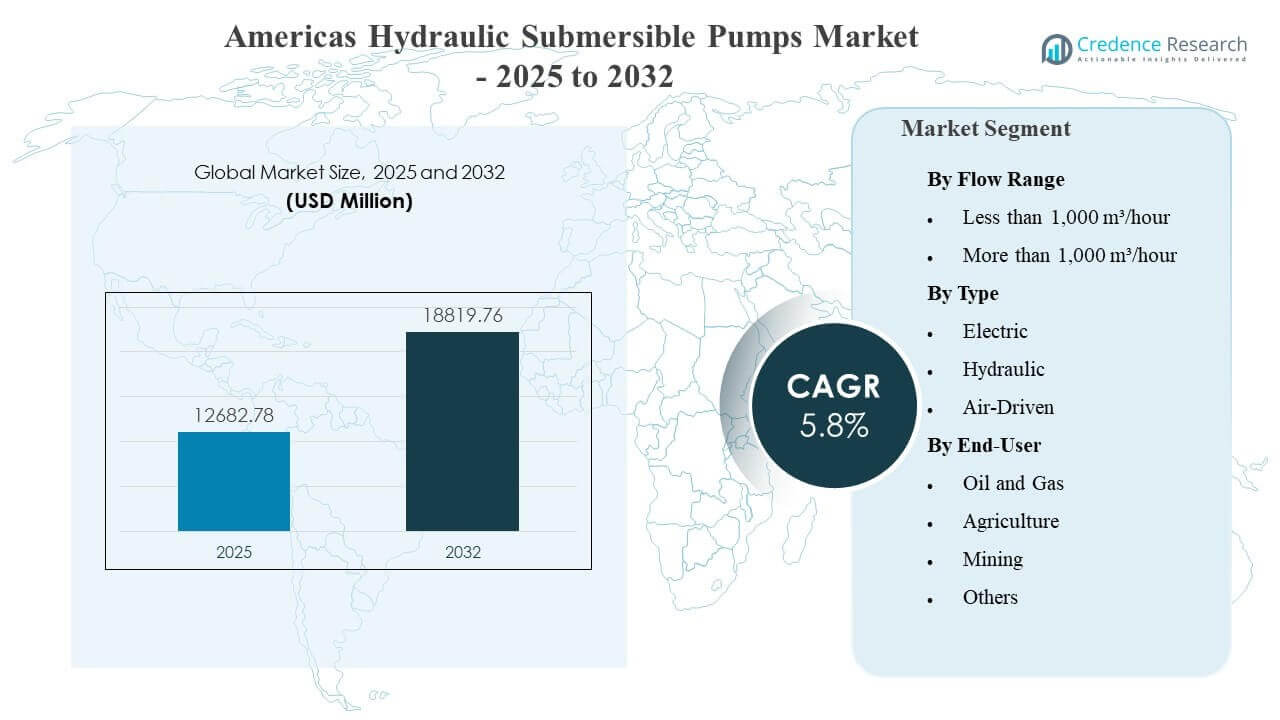
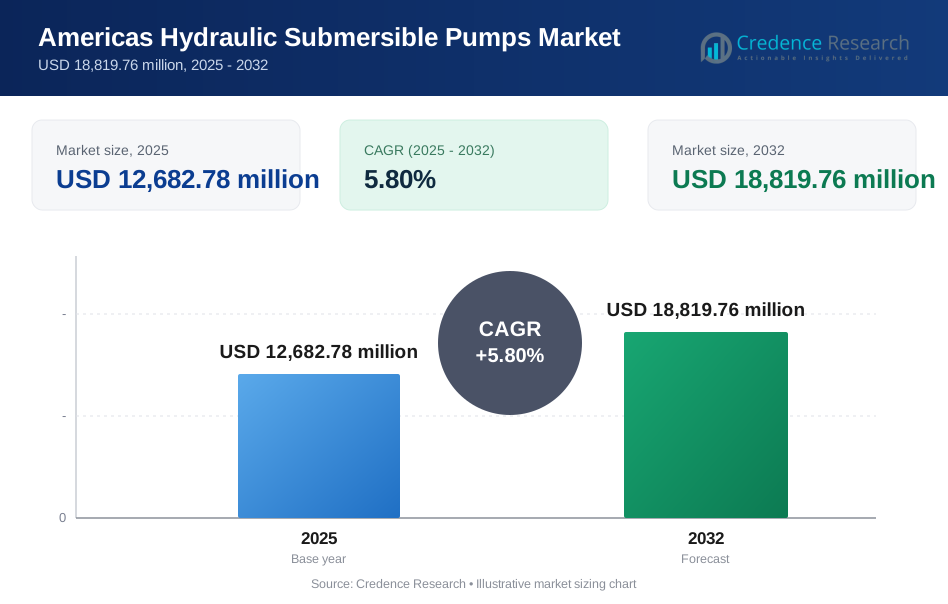
The Americas Hydraulic Submersible Pumps Market is projected to grow from USD 12,682.78 million in 2025 to an estimated USD 18,819.76 million by 2032, with a compound annual growth rate (CAGR) of 5.8% from 2025 to 2032.
| REPORT ATTRIBUTE | DETAILS |
|---|---|
| Historical Period | 2020-2023 |
| Base Year | 2024 |
| Forecast Period | 2025-2032 |
| Americas Hydraulic Submersible Pumps Market Size 2025 | USD 12,682.78 million |
| Americas Hydraulic Submersible Pumps Market, CAGR | 5.8% |
| Americas Hydraulic Submersible Pumps Market Size 2032 | USD 18,819.76 million |
Growth in this market is driven by expanding mining, construction, and oil and gas activities that depend on high-torque pumping systems for dewatering, slurry transfer, and flood control. Industries adopt hydraulic submersible pumps because they perform reliably in submerged and abrasive environments where electric systems face limits. Municipalities invest in drainage upgrades and emergency water management programs, which increase pump deployment across urban regions. Equipment rental expansion supports wider use among small and mid-sized contractors. The market strengthens as end users prioritize durability, continuous operation, and lower maintenance interruptions.
North America leads the market due to strong industrial activity, advanced infrastructure programs, and widespread use of hydraulic pumps across construction, energy, and municipal operations. The United States drives the majority of demand, supported by a well-established supplier network and high adoption of heavy-duty pumping systems. Canada contributes through wastewater improvements and energy sector projects. South America is an emerging region, with Brazil, Chile, and Peru increasing pump usage through mining expansion and infrastructure development. Other countries in the Americas show growing adoption where flood control needs and agricultural water management continue to rise.
Americas Hydraulic Submersible Pumps Market Insights:
- The Americas Hydraulic Submersible Pumps Market is projected to grow from USD 12,682.78 million in 2025 to USD 18,819.76 million by 2032, supported by a 5.8% CAGR through the forecast period.
- Rising mining, construction, and oil and gas operations drive demand for high-torque pumps that perform reliably in submerged and abrasive conditions.
- Market restraints stem from high maintenance needs, skilled technician shortages, and supply-chain delays that affect availability in remote industrial zones.
- North America leads due to strong industrial activity and established pump suppliers, while South America emerges with increasing adoption in mining and infrastructure projects.
- Growing investment in flood control, wastewater upgrades, and rental fleet expansion continues to widen the application base across the region.
Americas Hydraulic Submersible Pumps Market Drivers
Expansion Of Large-Scale Mining, Construction, And Energy Projects Across The Region
Mining operators increase extraction activities across major metal-rich locations and demand reliable dewatering systems. Construction contractors depend on hydraulic pumps to clear water from tunnels and deep foundations. Energy producers use these pumps to handle produced water and heavy sludge. Hydraulic units deliver strong torque and steady output under difficult conditions. Many operators prefer them over electric systems in hazardous areas. Equipment durability supports uninterrupted field operations. Growing investment in resource and infrastructure projects reinforces adoption. The Americas Hydraulic Submersible Pumps Market gains momentum through expanding field activities.
Rising Need For Efficient Water Management And Emergency Dewatering Systems
Flood events increase across cities and industrial zones, creating strong demand for rapid drainage solutions. Municipal agencies upgrade stormwater systems to improve resilience. Emergency teams deploy hydraulic pumps during heavy rainfall to protect assets. Urban redevelopment projects require temporary bypass pumping. Hydraulic pumps operate safely while fully submerged and exposed to debris. Their versatility supports multiple flow requirements across complex sites. Adoption grows due to low downtime and steady performance. Cities and industries rely on robust technologies that support quick response operations.
- For instance, Xylem Inc.’s Godwin HL270M Dri-Prime® pump delivers a maximum head of up to 300 meters and flow rates around 4,360 US GPM with hydraulic efficiency near 70%, making it suited for deep-mine dewatering and high-pressure industrial applications. The pump’s enclosed impeller design also handles solids up to about 1.2 inches in diameter while maintaining reliable continuous operation.
Growing Preference For High-Torque Equipment Suitable For Harsh And Abrasive Environments
Users choose hydraulic designs for their ability to handle slurry, sand, and high-solids content. Heavy industries face challenging environments that damage conventional pumps. Hydraulic motors maintain strong output even when flow conditions fluctuate. Maintenance teams value systems that resist wear across long deployments. Consistent performance supports high productivity at remote locations. Industries build operational workflows around dependable pump technologies. The Americas Hydraulic Submersible Pumps Market strengthens as users prioritize rugged performance. Adoption rises where reliability matters most.
- For instance, Hydra-Tech Pumps employs high-torque hydraulic drive systems in demanding desilting and dredging projects, using models such as the S4TH hydraulic submersible pump designed for high-density slurry and sand applications. The pump’s vortex impeller and heavy-duty construction allow it to operate in environments that commonly lead to premature wear in standard electric centrifugal units.
Increased Adoption Through Expanding Rental Fleets And Short-Term Project Requirements
Rental companies scale fleets to meet contractor demand across varying job durations. Many firms avoid heavy capital purchases and favor rental flexibility. Hydraulic pumps fit temporary, seasonal, and emergency projects. Service providers maintain equipment to ensure steady uptime. Contractors choose models that integrate easily with existing hydraulic power packs. Rental units reach remote areas faster due to high mobility. Short-term project cycles support continuous turnover in rental fleets. The trend increases equipment access across small and mid-sized operators.
Americas Hydraulic Submersible Pumps Market Trends
Integration Of Remote Monitoring, Diagnostic Tools, And Digital Performance Insights
Manufacturers embed smart sensors to deliver real-time insights on pump health. Teams track vibration, flow, and temperature metrics through connected platforms. Digital diagnostics help operators detect early performance issues. Data enhances predictive maintenance planning across fleets. Remote visibility improves decision-making in field operations. Users gain better control over fuel usage and hydraulic efficiency. The Americas Hydraulic Submersible Pumps Market reflects stronger integration of intelligent systems. Digital upgrades improve operational reliability and lifecycle outcomes.
Shift Toward Lightweight, Compact, And Modular Pump Designs For Faster Deployment
Manufacturers redesign pumps to ease transport through tight spaces. Compact units simplify setup across construction, mining, and municipal sites. Modular frames enable quick part replacement during field service. Lighter bodies improve mobility across uneven terrains. Technicians handle installations with fewer tools and less downtime. Contractors value equipment that adapts to varied hydraulic power sources. Modular engineering supports flexible fleet management strategies. Product innovation focuses on improved usability and deployment speed.
- For instance, Atlas Copco AB designed its WEDA D90 submersible pump with a high power-to-weight ratio that supports a maximum head of roughly 164 feet and flow rates exceeding 1,150 GPM. Its compact, corrosion-resistant frame enables rapid deployment in confined urban utility trenches and demanding construction environments.
Advancement In Seal Engineering, Material Durability, And Anti-Clogging Technologies
Improved seal systems reduce leakage and extend service intervals. Corrosion-resistant materials enhance pump longevity in harsh environments. Enhanced impeller designs reduce clogging from solids. Manufacturers adopt advanced coatings to protect pump surfaces. Material upgrades support higher lifecycle performance. Users seek durable designs to lower servicing costs. The Americas Hydraulic Submersible Pumps Market benefits from rising reliability expectations. Engineering improvements support consistent field output across sectors.
Growing Use Of Environmental And Energy-Efficient Hydraulic Configurations
Operators shift toward systems that lower energy consumption during prolonged duty cycles. Engineers optimize hydraulic circuits to increase torque-to-energy ratios. Pumps operate with reduced fuel needs without sacrificing output. Users monitor energy patterns through onboard systems. Environmental standards encourage adoption of cleaner hydraulic fluids. Fleet managers evaluate long-term operating cost before procurement decisions. Demand grows for technology with reduced environmental impact. Energy efficiency becomes a core design priority.
- For instance, The Gorman-Rupp Company engineered its SF Series to operate with NEMA Premium-rated motors and VFD-compatible controls, enabling improved efficiency during variable bypass cycles. The integration of adjustable-speed operation helps operators optimize power use and maintain stable pump performance across changing flow demands.
Americas Hydraulic Submersible Pumps Market Challenges Analysis
High Operating Costs, Maintenance Demands, And Technical Skill Requirements Across End-Users
Hydraulic pumps require skilled technicians for proper handling and maintenance. Many operators face challenges in managing high-pressure hydraulic lines safely. Maintenance costs rise when pumps operate in abrasive or corrosive environments. Spare parts access varies across remote areas and slows repair work. Users rely on trained teams to inspect seals and hydraulic circuits regularly. These factors increase lifecycle ownership cost and slow upgrades. The Americas Hydraulic Submersible Pumps Market faces constraints from limited workforce readiness. It gains slower momentum in regions lacking skilled support networks.
Infrastructure Gaps, Supply Chain Delays, And Variability In Power Supply Integration
Transport delays limit the availability of specialized hydraulic pumps in developing regions. Long-distance logistics add complexity to service and part delivery. Variable access to compatible hydraulic power packs affects deployment speed. Some operators struggle to match pump requirements with available hydraulic systems. Regulatory hurdles slow equipment certification in certain countries. Extreme terrain also complicates equipment movement. These disruptions impact adoption among smaller contractors. Market expansion depends on better supply chain efficiency across the region.
Americas Hydraulic Submersible Pumps Market Opportunities
Expansion Of Water Infrastructure, Urban Resilience Projects, And Flood Control Investments
Governments fund large-scale drainage upgrades to strengthen climate resilience. Cities invest in stormwater networks that require safe submerged pumping. New wastewater treatment facilities adopt hydraulic pumps for solids handling. Contractors deploy pumps for long-duration dewatering at infrastructure sites. Industrial plants modernize fluid management systems to meet environmental rules. Emergency response agencies build stronger pumping capacity for crisis events. The Americas Hydraulic Submersible Pumps Market gains new openings through disaster preparedness programs. Broader investments create steady long-term demand.
Strong Growth Potential Across Mining, Oil And Gas, And Remote Industrial Zones
Expanding mining exploration supports recurring use of heavy-duty hydraulic pumps. Energy operators upgrade fluid handling systems at drilling and pipeline sites. Remote zones need reliable pumping despite lack of electric infrastructure. Industries prefer hydraulic solutions for durability under extreme operating conditions. Rental firms expand inventory to serve isolated industrial clusters. Manufacturers introduce rugged models for high-solids and abrasive environments. Growth in cross-border industrial projects increases adoption opportunities. Regional expansion aligns with rising interest in dependable, high-output hydraulic technology.
Americas Hydraulic Submersible Pumps Market Segmentation Analysis:
By Flow Range
The less than 1,000 m³/hour segment serves construction firms, municipal teams, and small industrial operators that need portable units for light to medium dewatering. These pumps support emergency drainage, utility maintenance, and short-cycle tasks. Users prefer compact designs that ease handling at confined job sites. The more than 1,000 m³/hour segment meets the needs of mining, oil and gas, and large infrastructure projects that demand high-volume discharge. These pumps move slurry, floodwater, and heavy solids with steady performance. Contractors use them in deep excavations where strong hydraulic output matters. The Americas Hydraulic Submersible Pumps Market gains steady growth across both ranges due to varied operational demands.
- For instance, Atlas Copco AB expanded its WEDA+ portfolio with models such as the WEDA D70, engineered to deliver higher efficiency and reduced weight for easier handling in confined job sites
By Type
Electric pumps serve controlled environments where stable power supports continuous operation. Industries deploy them in fixed installations that require consistent flow and lower noise levels. Hydraulic pumps lead heavy-duty applications because they deliver strong torque in submerged and abrasive conditions. Mining, energy, and construction sectors depend on their durability and high performance. Air-driven pumps support hazardous zones where electric systems pose ignition risks. These units help teams work safely in confined or volatile spaces. The Americas Hydraulic Submersible Pumps Market records balanced demand across all three types due to wide application diversity.
- For instance, Hydra-Tech Pumps designed the S4TH hydraulic submersible pump with variable-speed hydraulic control to maintain a maximum head of about 165 feet while delivering strong torque for high-solids slurry work. Its heavy-duty vortex impeller enables reliable pumping in sand and debris-laden environments where standard electric centrifugal units often experience accelerated wear.
By End-User
Oil and gas operators use hydraulic submersible pumps to handle produced water, drilling fluids, and trench dewatering during field development. Reliability in extreme environments makes these pumps essential for upstream and midstream tasks. Agriculture relies on them for irrigation support, pond maintenance, and drainage control across large farmlands. Mining uses robust systems to remove water and slurry during extraction. Other end users, including wastewater treatment, pulp and paper, and construction, deploy these pumps to manage fluid movement with minimal downtime. The Americas Hydraulic Submersible Pumps Market expands through increasing operational needs across these sectors.
Americas Hydraulic Submersible Pumps Market Segmentation:
By Flow Range
- Less than 1,000 m³/hour
- More than 1,000 m³/hour
By Type
- Electric
- Hydraulic
- Air-Driven
By End-User
- Oil and Gas
- Agriculture
- Mining
- Others
Regional Analysis:
North America holds the largest share of the Americas Hydraulic Submersible Pumps Market, accounting for roughly 62% of total demand. Industrial expansion in the United States strengthens equipment adoption across construction, mining, and oil and gas projects. Canada supports steady demand through wastewater upgrades and oil sands activity. Infrastructure rehabilitation programs increase the need for high-capacity pumps that operate safely in submerged environments. The region benefits from strong supplier presence and advanced rental networks. The Americas Hydraulic Submersible Pumps Market gains consistent momentum in North America due to mature industrial activity and stable procurement cycles. It maintains growth through continuous modernization efforts.
South America captures about 28% of the market and records rising adoption due to expanding mining and infrastructure investments. Brazil leads demand through large construction programs and growing municipal drainage requirements. Chile and Peru drive strong need for hydraulic pumps in copper and lithium mining operations. These countries invest in high-torque systems that manage abrasive slurry and deep excavation conditions. Energy sector projects across Colombia and Argentina support fluid-handling requirements during field development. Regional governments fund water management improvements, which increases pump deployment. It reflects strong industrial growth linked to natural resource extraction.
The Rest of America accounts for the remaining 10% and includes smaller markets where industrial expansion occurs at a gradual pace. Demand rises in regions focusing on flood control, irrigation upgrades, and remote construction projects. Procurement remains lower but stable due to selective use across public utilities and agriculture. End users adopt compact hydraulic pumps that suit variable job conditions. Market penetration increases through rental channels that improve equipment access. The region benefits from opportunities created by climate resilience programs. It contributes incremental growth that supports long-term market stability.
Key Player Analysis:
- Atlas Copco AB
- BAKERCORP
- Cornell Pump Company
- The Gorman-Rupp Company
- Griffin Dewatering Corporation
- Xylem Inc.
- Sulzer Ltd.
- Grindex
- Goulds Pumps (ITT Inc.)
- KSB America
- Weir Group
- Tsurumi America
- Franklin Electric
Competitive Analysis:
Competition in the Americas Hydraulic Submersible Pumps Market centers on product durability, hydraulic efficiency, and strong aftermarket support. Leading companies strengthen their position by expanding rental partnerships and enhancing digital monitoring features. Many suppliers focus on rugged pump designs that handle abrasive solids and sustain long duty cycles in harsh environments. Established brands invest in seal technology, corrosion-resistant materials, and improved hydraulic circuits to support performance. New entrants compete through compact units and cost-efficient service models. Manufacturers enhance distribution networks to reach remote industrial zones and reduce service delays. Competitive intensity remains high across mining, construction, and oil and gas applications. It encourages suppliers to differentiate through reliability, speed of deployment, and lifecycle value.
Recent Developments:
- In December 2025, DXP Enterprises, Inc. acquired Pump Solutions, Inc., a leading distributor of pumps, controls, and related services focused on the water and wastewater industry, with the deal signed on December 1, 2025, adding $36.8 million in trailing sales and bolstering DXP's Texas presence.
Report Coverage:
The research report offers an in-depth analysis based on Flow Range, Type and End-User. It details leading market players, providing an overview of their business, product offerings, investments, revenue streams, and key applications. Additionally, the report includes insights into the competitive environment, SWOT analysis, current market trends, as well as the primary drivers and constraints. Furthermore, it discusses various factors that have driven market expansion in recent years. The report also explores market dynamics, regulatory scenarios, and technological advancements that are shaping the industry. It assesses the impact of external factors and global economic changes on market growth. Lastly, it provides strategic recommendations for new entrants and established companies to navigate the complexities of the market.
Future Outlook:
- Demand strengthens due to rising construction, mining, and energy projects that require durable high-torque pumping systems.
- Adoption grows in municipal drainage and flood control programs driven by climate resilience investments across the region.
- Rental fleet expansion improves access for small contractors and supports wider short-term deployment.
- Advances in hydraulic motor efficiency and seal engineering enhance performance in abrasive and submerged conditions.
- Digital monitoring tools improve predictive maintenance and reduce operational downtime across industrial sites.
- Product designs move toward compact and modular configurations to support fast installation in remote areas.
- Oil and gas operations increase usage for produced water handling and deep excavation support.
- Mining activity in copper, lithium, and iron ore regions accelerates demand for high-volume slurry pumps.
- Environmental standards encourage the adoption of energy-efficient hydraulic configurations.
- Strengthening supply chains and service networks improve equipment availability across North and South America.
Request a Free Sample
Fill in your details and we'll send you a free sample report.
- Sample data tables & charts
- Research methodology
Need a Custom Version of This Report?
Tailor the scope, geography, or segments to your exact requirements.
- Custom geography or segment scope
- Direct access to our analyst team
Frequently Asked Questions
What is the current market size for the Americas Hydraulic Submersible Pumps Market, and what is its projected size in 2032?
At what Compound Annual Growth Rate is the Americas Hydraulic Submersible Pumps Market projected to grow between 2025 and 2032?
Which Americas Hydraulic Submersible Pumps Market segment held the largest share in 2025?
What are the primary factors fueling the growth of the Americas Hydraulic Submersible Pumps Market?
Who are the leading companies in the Americas Hydraulic Submersible Pumps Market?
Which region commanded the largest share of the Americas Hydraulic Submersible Pumps Market in 2025?
Table of Content
Chapter 1. Report Introduction
- 1.1 Report Description & Purpose
- 1.1.1 Report Title & Market Definition
- 1.1.2 Unique Selling Propositions (USP) & Key Differentiators
- 1.1.3 Value Proposition for Stakeholders
- 1.2 Research Objectives
- 1.2.1 Market Sizing Objectives (Volume & Revenue)
- 1.2.2 Segmentation Objectives
- 1.2.3 Competitive Intelligence Objectives
- 1.2.4 Forecast & Scenario Objectives
- 1.3 Report Scope
- 1.3.1 Americas Hydraulic Submersible Pumps Scope – Types & Subtypes Covered
- 1.3.2 Geographic Scope – Regions & Countries Covered
- 1.3.3 Historical Period, Base Year & Forecast Period (2025; forecast to 2032)
- 1.3.4 Inclusions & Exclusions
- 1.4 HS Code & Classification Framework
- 1.5 Currency, Units & Pricing Basis
- 1.6 Target Stakeholders
- 1.7 Limitations & Assumptions
Chapter 2. Executive Summary
- 2.1 Global Americas Hydraulic Submersible Pumps Market Snapshot
- 2.1.1 Market Size – Historical (2025) & Forecast (2025-2032) (2025: USD 12,682.78 million → 2032: USD 18,819.76 million)
- 2.1.2 Volume & Revenue – Global Totals
- 2.1.3 Key Market Highlights – Top Five Facts
- 2.2 Americas Hydraulic Submersible Pumps Market Segmentation Snapshot
- 2.2.1 Market Split by Region – 2025 vs. 2032
- 2.3 Competitive Snapshot
- 2.3.1 Top 10 Players by Revenue Share – 2025
- 2.3.2 Top 10 Players by Volume Share – 2025
- 2.3.3 Recent Strategic Developments (18-Month Summary)
- 2.4 Key Investment Highlights & Strategic Conclusions
Chapter 3. Americas Hydraulic Submersible Pumps Market Dynamics & Industry Analysis
- 3.1 Market Overview & Context
- 3.1.1 Americas Hydraulic Submersible Pumps Market Position in the Broader Automotive Value Chain
- 3.1.2 OEM vs. Replacement Market Dynamics
- 3.1.3 Market Maturity & Development Stage by Region
- 3.2 Americas Hydraulic Submersible Pumps Market Drivers
- 3.3 Americas Hydraulic Submersible Pumps Market Restraints & Challenges
- 3.4 Americas Hydraulic Submersible Pumps Market Opportunities
- 3.5 Porter's Five Forces Analysis
- 3.5.1 Threat of New Entrants
- 3.5.2 Bargaining Power of Suppliers
- 3.5.3 Bargaining Power of Buyers
- 3.5.4 Threat of Substitutes
- 3.5.5 Competitive Rivalry – Intensity Assessment
- 3.6 Americas Hydraulic Submersible Pumps Value Chain Analysis
- 3.6.1 Upstream – Raw Material/Input Suppliers
- 3.6.1.1 Raw Material/Input 1
- 3.6.1.2 Raw Material/Input 2
- 3.6.1.3 Raw Material/Input 3
- 3.6.2 Midstream – Production/Manufacturing/Service Delivery
- 3.6.2.1 Production/Process Overview
- 3.6.2.2 Key Facility Locations & Capacity by Manufacturer
- 3.6.3 Downstream – Distribution & End Consumer
- 3.6.3.1 Primary Channel – B2B/OEM
- 3.6.3.2 Secondary Channels – Dealer, Retail, Online, Direct
- 3.6.4 Value Chain Profitability Analysis
- 3.6.1 Upstream – Raw Material/Input Suppliers
- 3.7 PESTEL Analysis
- 3.7.1 Political Factors
- 3.7.2 Economic Factors
- 3.7.3 Social Factors
- 3.7.4 Technological Factors
- 3.7.5 Environmental Factors
- 3.7.6 Legal Factors
- 3.8 Americas Hydraulic Submersible Pumps Supply Chain Analysis
- 3.8.1 Raw Material/Input Supply Risk Assessment
- 3.8.2 Manufacturing Concentration Risk (Geographic Exposure)
- 3.8.3 Trade Disruption Impact Analysis
- 3.9 Regulatory & Policy Landscape
Note: The regulatory and policy landscape section covers regulations based on their applicability to the market, Americas Hydraulic Submersible Pumps category, geography, and scope of the study. Only regulatory frameworks with a material impact on operations, compliance, trade, sustainability, or market access are analyzed in detail.
Chapter 4. Key Investment Pockets & Opportunity Analysis
- 4.1 Americas Hydraulic Submersible Pumps Market Attractiveness Analysis
- 4.1.1 By Region – Investment Attractiveness Matrix (Volume × CAGR)
- 4.2 Absolute Revenue Growth Opportunity
- 4.2.1 By Region – Absolute USD Growth Through 2032
- 4.3 Incremental Volume Opportunity
- 4.3.1 By Region – Incremental Volume Through 2032
- 4.3.2 Segment – Incremental Volume
- 4.4 Emerging Submarket Opportunity Deep Dive (Subject to Applicability)
- 4.5 Emerging Market Opportunity Scorecards
- 4.5.1 United States
- 4.5.2 Europe
- 4.5.3 Asia
- 4.5.4 Middle East & Africa
Note: Emerging Market Opportunity Scorecards will be included based on relevance and strategic importance. Regions listed are indicative and may vary depending on data availability and market dynamics.
Chapter 5. Americas Hydraulic Submersible Pumps Import-Export Analysis & Trade Flows
- 5.1 Global Trade Overview
- 5.1.1 Global Export Value by Country (2025)
- 5.1.2 Global Export Volume by Country (2025)
- 5.1.3 Global Import Value by Country (2025)
- 5.1.4 Global Import Volume by Country (2025)
- 5.1.5 Net Trade Balance by Country (2025)
- 5.2 Export Analysis – Segment
- 5.2.1 Type 1 (HS Code)
- 5.2.2 Type 2 (HS Code)
- 5.2.3 Type 3 (HS Code)
- 5.2.4 Type 4 (HS Code)
- 5.2.5 Type 5 (HS Code)
- 5.3 Import Analysis – Segment
- 5.3.1 Type 1 (HS Code)
- 5.3.2 Type 2 (HS Code)
- 5.3.3 Type 3 (HS Code)
- 5.3.4 Type 4 (HS Code)
- 5.3.5 Type 5 (HS Code)
- 5.4 Average Unit Trade Prices
- 5.4.1 Average Export Price – Segment & Country
- 5.4.2 Average Import Price – Segment & Source Country
- 5.4.3 Price Trends (2025)
- 5.5 Key Trade Route Analysis
- 5.5.1 Trade Route 1
- 5.5.2 Trade Route 2
- 5.5.3 Trade Route 3
- 5.5.4 Trade Route 4
- 5.5.5 Trade Route 5
- 5.6 Trade Policy Impact Assessment
- 5.6.1 US Anti-Dumping & Section 301 Tariffs
- 5.6.2 EU Customs Union Impact
- 5.6.3 Major Free Trade Agreements
- 5.6.4 USMCA Rules of Origin
Note: Trade policy analysis will be included only where relevant to the Americas Hydraulic Submersible Pumps market.
Chapter 6. Competitive Landscape & Company Benchmarking
- 6.1 Americas Hydraulic Submersible Pumps Market Concentration & Structure
- 6.1.1 Herfindahl-Hirschman Index (HHI) – vs. 2025
- 6.1.2 Tier 1, Tier 2 & Tier 3 Market Structure
- 6.1.3 Global, Regional & Local Player Dynamics
- 6.2 Americas Hydraulic Submersible Pumps Market Share Analysis – 2025
- 6.2.1 Global Revenue Share by Company
- 6.2.2 Global Volume Share by Company
- 6.2.3 Regional Revenue Share
- 6.2.4 Market Share Evolution ( vs. 2025)
- 6.2.5 OEM Segment Share by Company
- 6.2.6 Replacement Segment Share by Company
- 6.3 Production/Delivery Capacity & Facility Analysis
- 6.3.1 Global Installed Capacity
- 6.3.2 Capacity Utilization Rates
- 6.3.3 Production/Output Volume
- 6.3.4 Facility Locations & Capacity Map
- 6.3.5 Planned Capacity Additions
- 6.4 Americas Hydraulic Submersible Pumps Competitive Benchmarking Matrix
- 6.4.1 Revenue, Volume, CAGR & Profitability Comparison
- 6.4.2 Channel Revenue Mix
- 6.4.3 Geographic Revenue Exposure
- 6.4.4 R&D Intensity
- 6.4.5 Sustainability Maturity
- 6.5 Strategic Developments in Americas Hydraulic Submersible Pumps (Last 24 Months)
- 6.5.1 Mergers, Acquisitions & Divestments
- 6.5.2 New Americas Hydraulic Submersible Pumps Launches
- 6.5.3 Facility Expansions
- 6.5.4 Strategic Alliances, Joint Ventures & Partnerships
- 6.5.5 Distribution Expansion & Market Entry
- 6.5.6 Sustainability & ESG Initiatives
- 6.6 Competitive Strategy Mapping
- 6.6.1 Leader, Challenger, Follower & Niche Classification
- 6.6.2 Pricing Strategy Comparison
- 6.6.3 Channel Strategy Matrix
Note: Strategic developments are included based on their materiality and the availability of reliable information.
Chapter 7. Global Americas Hydraulic Submersible Pumps Market – By Distribution Channel
- 7.1 Segment Overview
- 7.1.1 Volume & Revenue Split by Channel (2025 & 2032)
- 7.1.2 Channel Mix Evolution (2025-2032)
Chapter 8. Regional Market Analysis – Global Overview
- 8.1 Global Regional Overview
- 8.1.1 Regional Volume Share
- 8.1.2 Regional Revenue Share
- 8.1.3 Regional Volume by Region
- 8.1.4 Regional Revenue by Region
- 8.1.5 Regional Forecast Through 2032
- 8.2 Cross-Regional Segment Analysis
- 8.2.1 By Distribution Channel
- 8.2.2 By Brand/Price Tier
Chapter 9. North America Americas Hydraulic Submersible Pumps Market
- 9.1 United States
- 9.2 Canada
- 9.3 Mexico
Chapter 10. Europe Americas Hydraulic Submersible Pumps Market
- 10.1 Germany
- 10.2 France
- 10.3 Italy
- 10.4 United Kingdom
- 10.5 Spain
- 10.6 Poland
- 10.7 Russia
- 10.8 Netherlands
- 10.9 Belgium
- 10.10 Sweden
- 10.11 Denmark
- 10.12 Norway
- 10.13 Rest of Europe
Chapter 11. Asia Pacific Americas Hydraulic Submersible Pumps Market
- 11.1 China
- 11.2 India
- 11.3 Japan
- 11.4 South Korea
- 11.5 Thailand
- 11.6 Indonesia
- 11.7 Vietnam
- 11.8 Malaysia
- 11.9 Australia
- 11.10 Rest of Asia Pacific
Chapter 12. Latin America Americas Hydraulic Submersible Pumps Market
- 12.1 Brazil
- 12.2 Argentina
- 12.3 Colombia
- 12.4 Chile
- 12.5 Rest of Latin America
Chapter 13. Middle East Americas Hydraulic Submersible Pumps Market
- 13.1 Saudi Arabia
- 13.2 United Arab Emirates
- 13.3 Turkey
- 13.4 Israel
- 13.5 Iran
- 13.6 Rest of the Middle East
Chapter 14. Africa Americas Hydraulic Submersible Pumps Market
- 14.1 South Africa
- 14.2 Egypt
- 14.3 Nigeria
- 14.4 Morocco
- 14.5 Rest of Africa
Chapter 15. Americas Hydraulic Submersible Pumps Company Profiles
- 15.1 [Company 01]
- 15.1.1 Company Overview
- 15.1.2 Key Management Personnel
- 15.1.3 Products & Services Portfolio
- 15.1.4 Financial Performance
- 15.1.5 Key Market Focus & Geographic Presence
- 15.1.6 Recent Developments & Strategic Initiatives
Note: The company profile list is preliminary and may change based on research findings, market developments, data availability, and client requirements.
Chapter 16. Appendices
- Appendix A – List of Abbreviations & Acronyms
- Appendix B – Industry Classification Code Reference – Full Series
- Appendix C – Production & Capacity Data Tables
- Appendix D – End-Use & Demand Base Tables
- Appendix E – Consumption & Replacement Rate Assumptions
- Appendix F – ASP Reference Tables
- Appendix G – Manufacturing & Facility Database
- Appendix H – Import-Export Data Tables
- Appendix I – Regulatory Summary Tables
- Appendix J – Primary Research Participant List (Anonymized)
- Appendix K – Primary Research Questionnaire Framework
- Appendix L – Data Sources & Bibliography
- Appendix M – Market Size Divergence & Source Comparison
Chapter 17. Research Methodology
- 17.1 Research Framework & Philosophy
- 17.2 Secondary Research – Sources, Hierarchy & Data Extraction
- 17.3 Data Modeling – Bottom-Up & Top-Down Market Sizing
- 17.4 Primary Research – Stakeholder Framework, LOI & Sample Sizes
- 17.5 Forecast Methodology – Regression, Scenario & Sensitivity Analysis
- 17.6 Quality Control – Four-Layer Validation Framework
- 17.7 Limitations & Standard Assumptions
- 17.8 Disclaimer
