
| REPORT ATTRIBUTE | DETAILS |
|---|---|
| Historical Period | 2020-2023 |
| Base Year | 2024 |
| Forecast Period | 2025-2032 |
| Asia Mining Simulation Software Market Size 2023 | USD 734.75 Million |
| Asia Mining Simulation Software Market, CAGR | 9.85% |
| Asia Mining Simulation Software Market Size 2032 | USD 1711.69 Million |
Market Overview:
Asia Mining Simulation Software Market size was valued at USD 734.75 million in 2023 and is anticipated to reach USD 1711.69 million by 2032, at a CAGR of 9.85% during the forecast period (2023-2032).
Several factors are propelling the demand for mining simulation software in Asia. The integration of Artificial Intelligence (AI), Internet of Things (IoT), and cloud computing technologies is enhancing real-time analytics and automation in mining operations, leading to improved efficiency and safety. By utilizing simulation software, companies can optimize resource allocation, predictive maintenance, and decision-making processes, thereby reducing operational costs and increasing productivity. Additionally, the growing emphasis on worker safety and environmental sustainability is prompting mining companies to adopt simulation tools for training and hazard assessment. The ability to predict and mitigate environmental impacts through simulations is becoming increasingly important, especially in regions where mining regulations are becoming stricter. As the demand for minerals continues to rise, simulation software plays a critical role in streamlining extraction processes and improving operational performance.
The Asia-Pacific region is at the forefront of the mining simulation software market, accounting for the largest market share. Countries such as China, India, and Australia are leading the adoption of mining technologies, with these nations investing heavily in digital transformation and advanced mining solutions. China’s mining industry is particularly reliant on simulation software to manage its vast and complex operations, while India is also witnessing significant growth in this area as it modernizes its mining sector. The rapid industrialization, increased investments in mining infrastructure, and the push towards digitalization are key factors contributing to the region's dominance in the mining simulation software market. Additionally, the rich mineral resources across the region continue to drive the demand for more efficient and sustainable mining practices, further promoting the adoption of advanced simulation technologies. As mining operations expand and become more sophisticated, the need for simulation software to optimize operations, reduce costs, and enhance safety will continue to grow.
Market Insights:
- Asia Mining Simulation Software Market size was valued at USD 734.75 million in 2023 and is anticipated to reach USD 1711.69 million by 2032, at a CAGR of 9.85% during the forecast period (2023-2032).
- The global mining simulation software market was valued at approximately USD 2.5 billion in 2023 and is projected to reach over USD 5.25 billion by 2032, reflecting a compound annual growth rate (CAGR) of 8.6% during the forecast period.
- Rising mineral demand across Asia is propelling the need for simulation software that helps optimize resource allocation, reduce operational costs, and improve productivity.
- Governments in key countries like China, India, and Australia are investing heavily in the digitalization and modernization of mining operations, driving the adoption of simulation software.
- The market is being driven by the growing focus on worker safety and environmental sustainability, with simulation tools used to simulate hazardous scenarios and mitigate environmental risks.
- High initial investment costs remain a barrier, especially for small and medium-sized mining companies in emerging economies that struggle with upfront financial burdens.
- The complexity of integrating simulation software with existing legacy systems is challenging, requiring expertise and resources for seamless interoperability and data transfer.
- The shortage of skilled professionals proficient in using advanced simulation software presents a challenge for mining companies seeking to fully leverage these technologies.
Market Drivers:
Technological Advancements in Mining Operations
The rapid evolution of technology has significantly contributed to the growth of the Asia Mining Simulation Software market. Innovations such as Artificial Intelligence (AI), Internet of Things (IoT), and cloud computing have enabled mining companies to enhance their operational efficiency through real-time data analysis, automation, and predictive maintenance. For instance, Rio Tinto expanded its fleet of autonomous haul trucks in the Pilbara iron ore mines, which by 2023 had transported over 1 billion tonnes of ore, demonstrating the impact of automation on operational efficiency. These technologies allow mining operations to optimize workflows, streamline resource allocation, and minimize downtime. By integrating simulation software, companies can predict potential issues before they occur, reducing costly operational disruptions and enhancing the overall efficiency of mining activities. The growing demand for advanced technological solutions in the mining industry is one of the primary drivers of the market.
Safety and Environmental Sustainability
Safety and environmental concerns are becoming increasingly important in the mining industry, pushing companies to adopt advanced simulation tools. For instance, Coal India Limited, for example, has institutionalized continuous education, training, and retraining for all employees and contract workers, with an internal safety organization overseeing mandatory safety training using immersive technologies such as VR and AR. Mining operations often involve hazardous environments, and ensuring the safety of workers is a top priority. Simulation software allows for realistic safety training scenarios and hazard assessments, improving the preparedness of workers and minimizing the risk of accidents. Additionally, as environmental regulations continue to tighten across Asia, mining companies are turning to simulation software to reduce their ecological impact. These tools enable operators to simulate various scenarios, allowing them to identify and mitigate potential environmental risks, such as pollution or resource depletion. The growing need for sustainability and worker safety is fueling the demand for mining simulation software.
Increasing Demand for Resource Optimization
As mineral demand continues to rise in Asia, mining companies face increasing pressure to optimize their resource extraction processes. With large-scale mining operations often facing logistical challenges, maximizing productivity while minimizing costs is crucial. Mining simulation software offers solutions to these challenges by providing companies with detailed simulations of their mining processes. These tools help in planning, modeling, and forecasting, enabling better decision-making and more efficient operations. Simulation software aids in identifying bottlenecks, optimizing resource usage, and improving material handling. By maximizing resource extraction efficiency and minimizing waste, companies can achieve higher profitability and meet the growing demand for minerals, further driving the market.
Government Initiatives and Investment in Mining Infrastructure
Government support and investment in the mining sector are significant drivers for the adoption of mining simulation software in Asia. Many countries in the region, particularly China, India, and Australia, are making substantial investments in the modernization and digitalization of their mining sectors. Governments are introducing initiatives to promote the adoption of advanced technologies, including simulation software, to improve the overall competitiveness and sustainability of the industry. These initiatives often include subsidies, tax incentives, and funding for research and development in mining technologies. As governments continue to focus on improving mining infrastructure and adopting digital tools, mining companies are more inclined to invest in simulation software that enhances operational efficiency, ensures safety, and reduces environmental impacts. This support from the government contributes significantly to the market's growth and the widespread adoption of mining simulation solutions across the region.
Market Trends:
Adoption of AI and Machine Learning in Mining Simulation
One of the prominent trends shaping the Asia Mining Simulation Software market is the growing integration of Artificial Intelligence (AI) and machine learning algorithms in simulation tools. These advanced technologies enable mining companies to enhance their ability to predict and model complex mining scenarios. AI and machine learning allow for the analysis of vast amounts of data collected from mining operations, which can then be used to optimize resource extraction, improve operational efficiency, and reduce downtime. For instance, Sandvik’s AutoMine and OptiMine platforms utilize AI and advanced analytics to automate underground loaders and trucks, enabling remote operation and real-time performance optimization. As these technologies evolve, they enable simulation software to adapt in real-time, providing mining operators with insights and recommendations that can be implemented immediately. This trend is expected to accelerate as mining companies continue to recognize the immense potential of AI to enhance operational processes and achieve higher productivity.
Cloud-Based Mining Simulation Solutions
Cloud computing is another significant trend influencing the Asia Mining Simulation Software market. The shift toward cloud-based solutions has enabled mining companies to store, manage, and analyze large datasets more efficiently. Cloud-based simulation software offers greater scalability and flexibility, allowing mining companies to access simulation tools and data from anywhere in the world. This flexibility is particularly beneficial for companies operating across multiple locations, enabling them to centralize operations and improve collaboration among teams. Additionally, cloud-based solutions reduce the need for costly on-premise infrastructure, making them more accessible to smaller mining companies. As cloud technology continues to evolve, its adoption in the mining sector is expected to increase, further driving the growth of simulation software in the region.
Integration of Real-Time Data and Remote Monitoring
The increasing use of real-time data and remote monitoring systems is transforming mining simulation practices across Asia. For instance, Newmont Corporation utilizes Hexagon’s MineOperate and MineProtect solutions to integrate real-time data from equipment, personnel, and environmental sensors. With the advent of IoT devices, mining companies can now gather and analyze real-time data from their operations, including equipment performance, environmental conditions, and worker safety metrics. This influx of data allows for more accurate simulations and decision-making processes. Mining simulation software is increasingly incorporating this real-time data to optimize operations, reduce inefficiencies, and predict maintenance needs before they lead to costly downtime. This trend of integrating real-time data with simulation software not only enhances the accuracy of mining models but also contributes to more informed and proactive decision-making.
Focus on Sustainable Mining Practices
Sustainability continues to be a key focus within the Asia Mining Simulation Software market, as the industry faces increasing pressure to reduce its environmental impact. With stricter regulations and heightened environmental awareness, mining companies are increasingly turning to simulation software to model and assess the potential environmental consequences of their operations. These tools help companies minimize waste, reduce energy consumption, and avoid practices that could lead to long-term environmental damage. By simulating various environmental scenarios, mining operators can make better decisions that align with sustainability goals. The growing trend of using simulation software to enhance sustainability efforts is expected to drive further market growth, as environmental responsibility becomes a central focus for mining companies across the region.
Market Challenges Analysis:
High Initial Investment Costs
One of the primary challenges facing the Asia Mining Simulation Software market is the high initial investment required for implementation. The cost of acquiring and integrating advanced simulation software into existing mining operations can be substantial, particularly for small and medium-sized enterprises (SMEs). In addition to the software itself, companies must also invest in the necessary hardware infrastructure, training programs for staff, and ongoing maintenance. This upfront financial burden can deter some mining companies, especially in developing regions, from adopting these solutions. As a result, the high costs associated with mining simulation software may limit its widespread adoption among smaller players in the market.
Complexity of Software Integration
The complexity of integrating mining simulation software with existing legacy systems poses another significant challenge. Mining operations often rely on a variety of outdated technologies and systems that may not be compatible with newer simulation software. The integration process requires time, expertise, and resources to ensure seamless interoperability between the different systems. Moreover, ensuring the accurate transfer of data and maintaining the integrity of operations during the transition phase can be a challenging task. This complexity can delay the implementation of simulation software, particularly for companies with limited technical expertise or resources to manage the integration process.
Lack of Skilled Workforce
Another challenge hindering the adoption of mining simulation software in Asia is the lack of a skilled workforce capable of effectively utilizing these advanced tools. While mining simulation software offers immense potential to optimize operations, it requires skilled personnel who are proficient in using these systems. For instance, Immersive Technologies highlights that the mining industry is experiencing a shortage of skilled professionals capable of using simulation software, exacerbated by an aging workforce and the increasing complexity of mining technologies. The shortage of professionals with the necessary technical skills, such as data scientists and software engineers, can impede the successful deployment and operation of simulation software. As mining companies strive to modernize their operations, the lack of qualified personnel can delay the adoption of these technologies and hinder their ability to fully leverage their benefits.
Regulatory and Compliance Issues
Mining companies across Asia must also navigate a complex regulatory environment, which can pose a challenge when implementing simulation software. Different countries have varying regulations regarding data privacy, environmental protection, and safety standards, which can impact how simulation software is deployed and used. Ensuring compliance with these regulations can increase the complexity and cost of implementation, as mining companies must ensure that their software solutions meet local legal requirements. This regulatory burden can slow the adoption of mining simulation software and add an additional layer of complexity to its implementation.
Market Opportunities:
The Asia Mining Simulation Software market presents significant opportunities for growth, particularly in emerging economies such as India, Indonesia, and the Philippines. As these nations invest in modernizing their mining industries, there is an increasing demand for digital solutions that enhance operational efficiency and reduce costs. Mining companies in these regions are increasingly looking to adopt advanced technologies, including simulation software, to optimize resource extraction, improve safety protocols, and address environmental concerns. The growing focus on infrastructure development and resource management in these emerging markets presents a substantial opportunity for mining simulation software providers to expand their presence and offer tailored solutions that cater to the unique needs of these markets.
Another key opportunity lies in the continued advancements in simulation software technology. With the integration of AI, machine learning, and real-time data analytics, mining simulation software is becoming increasingly sophisticated. These innovations not only improve the accuracy and efficiency of mining operations but also open new possibilities for predictive maintenance, safety training, and environmental impact assessments. As mining companies seek to stay competitive in a rapidly evolving market, the demand for cutting-edge simulation tools will continue to rise. Providers that offer scalable, cloud-based, and AI-powered simulation solutions are well-positioned to capitalize on this trend, offering mining companies the tools they need to optimize performance, reduce downtime, and enhance sustainability practices.
Market Segmentation Analysis:
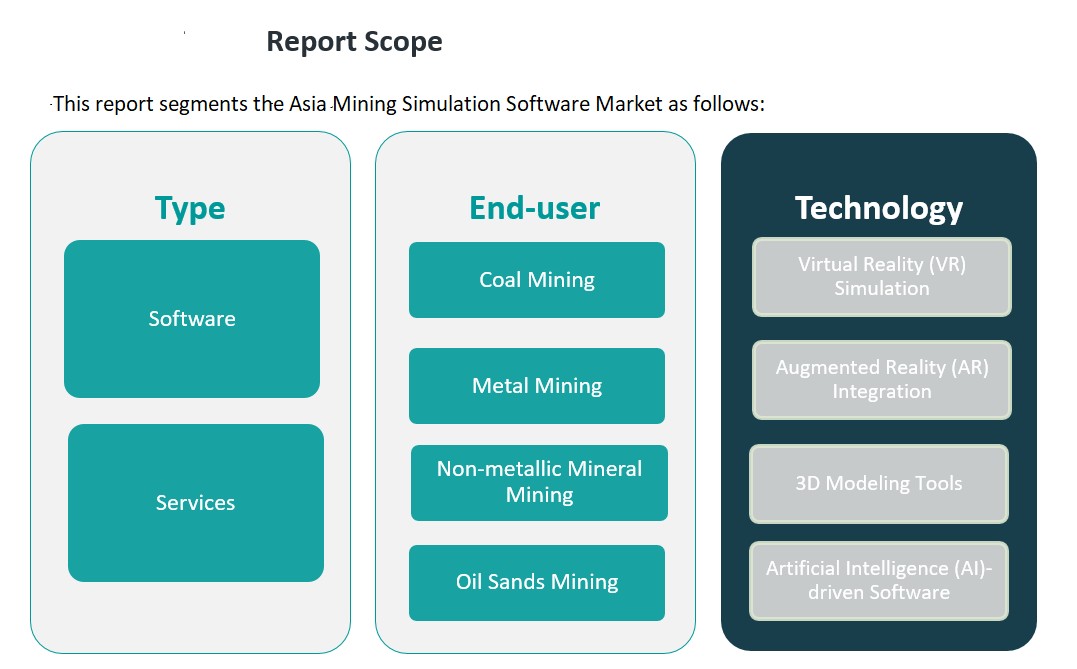
The Asia Mining Simulation Software market is segmented into several categories based on type, end-user, and technology, each with distinct growth drivers and opportunities.
By type segment, the market is divided into software and services. The software segment is expected to dominate, driven by the increasing adoption of advanced simulation tools for mining operations. These software solutions enable real-time data analysis, resource optimization, and operational efficiency. On the other hand, the services segment, which includes consulting, training, and technical support, is also witnessing growth, as companies seek expert guidance for the effective implementation of simulation software.
By end-user segment consists of coal mining, metal mining, non-metallic mineral mining, and oil sands mining. The metal mining sector is the largest contributor, as it involves complex operations that benefit from simulation tools to improve resource extraction, reduce costs, and ensure safety. Coal mining and oil sands mining are also significant contributors to the market, as these industries are increasingly investing in simulation technology to enhance operational efficiency and meet sustainability goals.
By technology, the market is experiencing a shift toward advanced tools such as Virtual Reality (VR) and Augmented Reality (AR) integration, which provide immersive and interactive simulations. 3D modeling tools are increasingly utilized for visualization and planning purposes, while Artificial Intelligence (AI)-driven software is gaining traction due to its ability to offer predictive analytics and automate decision-making processes. These technological innovations are driving the market forward, offering mining companies new ways to optimize their operations and reduce risks.
Segmentation:
By Type Segment:
- Software
- Services
By End-User Segment:
- Coal Mining
- Metal Mining
- Non-metallic Mineral Mining
- Oil Sands Mining
By Technology Segment:
- Virtual Reality (VR) Simulation
- Augmented Reality (AR) Integration
- 3D Modeling Tools
- Artificial Intelligence (AI)-driven Software
Regional Analysis:
The Asia Mining Simulation Software market is witnessing substantial growth across various regions, each with unique market dynamics. The demand for mining simulation software is driven by factors such as industrialization, technological adoption, and government initiatives supporting the modernization of the mining sector. The market is expected to maintain a steady growth trajectory across the key regions of North Asia, Southeast Asia, and South Asia, with each region contributing differently to the overall market share.
East Asia holds the largest market share in the Asia Mining Simulation Software market, accounting for approximately 40% of the total market. This dominance is largely attributed to the advanced mining industries in countries like China, Japan, and South Korea. China, as the world’s largest producer of coal and various metals, has seen a significant rise in the adoption of mining simulation software to enhance productivity and minimize environmental impact. Japan and South Korea are also leaders in technological innovation, with mining companies increasingly investing in digital transformation initiatives to boost efficiency and ensure sustainable operations.
South Asia, primarily driven by India, is the second-largest market in the region, with a share of about 30%. India’s rapidly growing mining sector, fueled by the government’s push to modernize infrastructure and promote sustainable mining practices, is driving the demand for advanced simulation tools. As the country focuses on improving mining safety and optimizing resource extraction, the adoption of simulation software is expected to increase significantly in the coming years. The government’s favorable policies and increasing investments in technology are further bolstering this growth.
Southeast Asia represents a smaller portion of the market but is growing steadily, contributing approximately 20% to the overall market share. Countries such as Indonesia, Malaysia, and the Philippines are investing heavily in mining automation and sustainability efforts. As the demand for minerals and energy resources continues to rise, Southeast Asian nations are increasingly turning to simulation software to enhance operational efficiency, minimize environmental impact, and improve worker safety.
Other parts of Asia, including Central Asia and the Middle East, contribute around 10% to the market share. These regions are seeing gradual adoption of mining simulation software, driven by the expansion of mining activities and the push for more sustainable mining practices. While the market is still emerging, countries such as Kazakhstan, the UAE, and Saudi Arabia are likely to see increased demand for simulation software as their mining sectors grow and modernize.
Key Player Analysis:
- Dassault Systèmes
- Bentley Systems
- RPMGlobal
- Hexagon Mining
- Maptek
- Siemens AG
- VIST Group
- Autodesk
- Caterpillar
- BMT Group
- Eclipse Mining Technologies
- Glencore Technology
Competitive Analysis:
The Asia Mining Simulation Software market is highly competitive, with several global and regional players driving innovation and market expansion. Leading companies in the market include Dassault Systèmes, Hexagon AB, and Trimble Inc., which offer advanced simulation software solutions for optimizing mining operations. These companies provide comprehensive tools that integrate cutting-edge technologies such as Artificial Intelligence (AI), Virtual Reality (VR), and 3D modeling to enhance resource extraction, improve safety, and reduce operational costs. Local players in emerging markets are also contributing to market competition by offering cost-effective, region-specific solutions. Companies such as Micromine and Maptek are expanding their market presence by tailoring their products to meet the unique needs of the Asia-Pacific by these firms to maintain a competitive edge and cater to the growing demand for mining simulation technologies in Asia.
Recent Developments:
- In February 2025, Dassault Systèmes announced that its subsidiary, Centric Software, acquired Contentserv, an AI-powered Product Experience Management (PXM) solution provider, for €220 million. This acquisition strengthens Dassault Systèmes' digital transformation capabilities, especially in cloud-based product lifecycle management.
- On September 25, 2024, RPMGlobal launched its next-generation Automated Pit Design (APD) solution at MINExpo 2024. This new software, developed in collaboration with industry consultants and clients, streamlines open pit mine design, offering faster and more accurate results. The APD is available in multiple languages, including those widely used in Asia, and is designed to support operations of all sizes.
- In November 2024, Maptek announced early access for its new Maptek Vestrex ecosystem, a platform for automation and orchestration in mining operations. This suite includes the Maptek Data System, Compute Framework, and Orchestration Environment, providing integrated solutions for mine planning and scheduling-key for Asian mines seeking operational efficiency.
Market Concentration & Characteristics:
The Asia Mining Simulation Software market is moderately concentrated, with a mix of large global players and regional firms vying for market share. Major companies like Dassault Systèmes, Hexagon AB, and Trimble Inc. dominate the market, leveraging their technological expertise, comprehensive product offerings, and global reach. These leaders focus on continuous innovation, often integrating advanced technologies such as Artificial Intelligence (AI), Virtual Reality (VR), and cloud-based solutions to enhance the efficiency and sustainability of mining operations. Regional players, such as Micromine and Maptek, also have a notable presence, particularly in markets like Australia, India, and Southeast Asia. These companies cater to local needs, offering more cost-effective solutions that address specific operational challenges. The market is characterized by a high level of technological integration, with significant investments in R&D, as companies aim to stay competitive through innovative product offerings and customized solutions for diverse mining needs.
Report Coverage:
The research report offers an in-depth analysis based on Type Segment, End-User Segment and Technology Segment. It details leading market players, providing an overview of their business, product offerings, investments, revenue streams, and key applications. Additionally, the report includes insights into the competitive environment, SWOT analysis, current market trends, as well as the primary drivers and constraints. Furthermore, it discusses various factors that have driven market expansion in recent years. The report also explores market dynamics, regulatory scenarios, and technological advancements that are shaping the industry. It assesses the impact of external factors and global economic changes on market growth. Lastly, it provides strategic recommendations for new entrants and established companies to navigate the complexities of the market.
Future Outlook:
- The adoption of AI and machine learning in simulation software will significantly improve predictive analytics and operational efficiency in mining operations.
- Cloud-based solutions will become more prevalent, offering flexibility, scalability, and cost-effective deployment options for mining companies.
- Increased government investments in digital mining technologies across Asia will drive further market growth, particularly in emerging economies.
- Rising environmental concerns will push mining companies to adopt simulation software for sustainable resource management and environmental impact assessment.
- The demand for simulation tools will increase as mining companies focus on improving safety measures and reducing workforce risks.
- Integration of VR and AR technologies will enhance training programs, providing immersive learning experiences for mine operators and workers.
- The shift towards automation in mining will increase reliance on simulation software for optimizing resource extraction processes.
- Smaller mining companies in emerging markets will gradually adopt mining simulation solutions, expanding the market in Southeast Asia and South Asia.
- The market will see more partnerships and collaborations between software providers and mining firms to develop tailored solutions for specific mining sectors.
- Ongoing advancements in 3D modeling and real-time data analytics will revolutionize the way mining operations are planned, monitored, and executed.

Request a Free Sample
Fill in your details and we'll send you a free sample report.
- Sample data tables & charts
- Research methodology
Market Dynamics
Technological Advancements in Mining Operations
The integration of AI, IoT, and cloud computing is enabling real-time analytics, automation, and predictive maintenance in mining, making simulation software essential for optimizing workflows and minimizing downtime.
Focus on Worker Safety and Environmental Sustainability
Stricter regulations and heightened safety concerns are driving mining companies to use simulation software for immersive training, hazard assessment, and environmental impact modeling, reducing risks and ensuring compliance.
Government Initiatives and Investment in Mining Infrastructure
Substantial government investments and policies in countries like China, India, and Australia are accelerating the adoption of digital mining solutions, including simulation software, to modernize and enhance the competitiveness of the mining sector.
Increasing Demand for Resource Optimization
Rising mineral demand and the need to maximize extraction efficiency are pushing mining companies to adopt simulation tools for better planning, bottleneck identification, and resource allocation, directly impacting profitability.
Adoption of Cloud-Based and AI-Powered Solutions
The shift toward cloud-based and AI-driven simulation platforms is making advanced mining simulation more accessible, scalable, and effective, especially for companies operating across multiple sites or seeking to reduce IT infrastructure costs.
Need a Custom Version of This Report?
Tailor the scope, geography, or segments to your exact requirements.
- Custom geography or segment scope
- Direct access to our analyst team
Frequently Asked Questions
What is the current size of the Asia Mining Simulation Software Market?
What factors are driving the growth of the Asia Mining Simulation Software Market?
What are the key segments within the Asia Mining Simulation Software Market?
What are some challenges faced by the Asia Mining Simulation Software Market?
Who are the major players in the Asia Mining Simulation Software Market?
Table of Content
Chapter 1 Market Segmentation
- 1.1 Segmentation Framework
- 1.1.1 Product and Service Classification
- 1.1.2 Application and End-Use Classification
- 1.1.3 Technology and Solution Classification
- 1.1.4 Customer and Distribution Channel Classification
- 1.1.5 Geographic Segmentation
- 1.1.6 Market Segment Definitions and Boundaries
- 1.2 By Type
- 1.2.1 Software
- 1.2.2 Services
- 1.3 By End-User
- 1.3.1 Coal Mining
- 1.3.2 Metal Mining
- 1.3.3 Non-metallic Mineral Mining
- 1.3.4 Oil Sands Mining
- 1.4 By Technology
- 1.4.1 Virtual Reality (VR) Simulation
- 1.4.2 Augmented Reality (AR) Integration
- 1.4.3 3D Modeling Tools
- 1.4.4 Artificial Intelligence (AI)-driven Software
Chapter 2 Introduction
- 2.1 Report Objectives and Scope
- 2.2 Product Definition and Industry Terminology
- 2.3 Market Inclusions and Exclusions
- 2.4 Research Process
- 2.4.1 Primary Research and Expert Interviews
- 2.4.2 Secondary Research and Source Review
- 2.4.3 Top-Down and Bottom-Up Estimation
- 2.4.4 Data Triangulation and Verification
- 2.5 Market Size Measurement Basis
- 2.5.1 2023: USD 734.75 million → 2032: USD 1711.69 million
- 2.6 Historical and Forecast Reference Periods
- 2.6.1 Base Year: 2023
- 2.6.2 Forecast Period: 2023-2032
- 2.7 Research Assumptions and Limitations
Chapter 3 Executive Summary
- 3.1 Market Snapshot and Key Findings
- 3.2 Base-Year Market Size, 2023
- 3.3 Forecast Market Size, 2032
- 3.4 Revenue and Volume Growth Outlook
- 3.5 Key Demand and Supply Indicators
- 3.6 Leading Market Segments
- 3.7 Fastest-Growing Market Opportunities
- 3.8 Regional Performance Highlights
- 3.9 Technology and Industry Transformation
- 3.10 Competitive Landscape Summary
- 3.11 Analyst View and Strategic Implications
Chapter 4 Asia Mining Simulation Software Market Trends and Developments
- 4.1 Historical Industry Development
- 4.2 Recent Market Trends and Developments
- 4.3 Demand and Customer Behavior Trends
- 4.4 Technology and Product Innovation
- 4.5 Artificial Intelligence, Automation and Digitalization
- 4.6 Local Manufacturing and Supply Chain Realignment
- 4.7 Industry Partnerships, Mergers and Acquisitions
- 4.8 Sustainability and Circular Economy Developments
- 4.9 Government and Private Sector Investment Trends
- 4.10 Emerging Business Models and Commercialization
- 4.11 Industry Developments and Announcements
Chapter 5 Asia Mining Simulation Software Market Supply and Demand Analysis
- 5.1 Demand Trend and Consumption Analysis
- 5.2 Demand Forecast, 2023-2032
- 5.3 Supply Chain Structure and Procurement Trends
- 5.4 Supply-Demand Gap and Bottlenecks
- 5.5 Import Dependence and Sourcing Structure
- 5.6 Regional Supply and Demand Concentration
Chapter 6 Asia Mining Simulation Software Market Pricing Analysis
- 6.1 Pricing Structure and Measurement
- 6.2 Historical Pricing Trends
- 6.3 Pricing Outlook, 2023-2032
- 6.4 Pricing by Product and Market Segment
- 6.5 Geographic Pricing Differences
- 6.6 Key Input, Energy, Labor and Logistics Costs
- 6.7 Contract Pricing and Purchasing Models
- 6.8 Pricing Sensitivity and Competitive Positioning
- 6.9 Price, Margin and Profitability Implications
Chapter 7 Asia Mining Simulation Software Market Dynamics
- 7.1 Market Growth Drivers
- 7.1.1 Demand-Side Drivers
- 7.1.2 Technology and Innovation Drivers
- 7.1.3 Infrastructure and Investment Drivers
- 7.1.4 Regulatory and Policy Drivers
- 7.2 Market Restraints
- 7.2.1 Cost and Affordability Constraints
- 7.2.2 Technology and Adoption Barriers
- 7.2.3 Supply Chain and Operational Constraints
- 7.3 Market Challenges
- 7.3.1 Competitive Pressure and Margin Erosion
- 7.3.2 Skills, Infrastructure and Implementation Gaps
- 7.4 Emerging Market Opportunities
- 7.5 Market Dynamics Impact and Time-Horizon Assessment
Chapter 8 Asia Mining Simulation Software Value Chain Analysis
- 8.1 Industry Value Chain Overview
- 8.2 Upstream Suppliers and Critical Inputs
- 8.3 Technology and Component Providers
- 8.4 Manufacturing or Service Delivery
- 8.5 Distribution, Channel Partners and Integrators
- 8.6 Downstream Applications and End Users
- 8.7 Value Addition and Profit Pools
- 8.8 Vertical Integration and Outsourcing
- 8.9 Supplier Concentration and Risk
- 8.10 Supply Chain Localization and Resilience
Chapter 9 Asia Mining Simulation Software Market Regulations and Policies
- 9.1 Relevant Laws, Standards and Compliance Frameworks
- 9.2 Product, Service, Safety and Quality Requirements
- 9.3 Government Policies, Incentives and Subsidies
- 9.4 Imports, Exports and Trade Barriers
- 9.5 Public Procurement and Local Content Requirements
- 9.6 Data Protection, AI and Cybersecurity Compliance
- 9.7 Upcoming Policy Changes and Market Implications
Chapter 10 Asia Mining Simulation Software Market Hotspots and Opportunities
- 10.1 Market Opportunity Mapping and Growth Hotspots
- 10.2 High-Growth Applications and Customer Groups
- 10.3 Underserved Markets and White-Space Opportunities
- 10.4 Emerging Technology and Product Opportunities
- 10.5 New Capacity and Investment Hotspots
- 10.6 Market Entry and Expansion Opportunities
- 10.7 Distribution and Partnership Opportunities
- 10.8 Near-Term and Long-Term Commercial Potential
- 10.9 Opportunity Attractiveness and Execution Risks
Chapter 11 Asia Mining Simulation Software Market Outlook, 2023-2032
- 11.1 Market Size and Analysis
- 11.1.1 Revenue (Market Measurement: 2023: USD 734.75 million → 2032: USD 1711.69 million)
- 11.1.2 Historical Market Size
- 11.1.3 Base-Year Market Size, 2023
- 11.2 Market Forecast, 2023-2032
- 11.2.1 Revenue Forecast to 2032
- 11.2.2 CAGR and Year-on-Year Growth
- 11.2.3 Incremental Revenue Opportunity
- 11.3 Forecast Assumptions and Scenario Analysis
- 11.3.1 Base-Case Forecast
- 11.3.2 Optimistic and Conservative Scenarios
- 11.3.3 Technology, Pricing and Policy Sensitivities
- 11.4 Market Attractiveness and Growth Outlook
Chapter 12 Asia Mining Simulation Software Market Segmentation and Outlook
- 12.1 Segmentation Summary and Market Shares, 2023
- 12.2 Largest and Fastest-Growing Segments
- 12.3 By Type - Market Size and Forecast, 2023-2032
- 12.3.1 Segment Definition and Scope
- 12.3.2 Historical Market Size
- 12.3.3 Revenue Forecast, 2023-2032
- 12.3.4 Base-Year Market Share, 2023
- 12.3.5 Segment CAGR and Growth Drivers
- 12.3.6 Subsegment Market Size and Forecast
- 12.3.6.1 Software
- 12.3.6.2 Services
- 12.3.7 Subsegment Pricing and Adoption Trends
- 12.3.8 Leading Suppliers and Competition
- 12.3.9 Regional Demand and Opportunities
- 12.4 By End-User - Market Size and Forecast, 2023-2032
- 12.4.1 Segment Definition and Scope
- 12.4.2 Historical Market Size
- 12.4.3 Revenue Forecast, 2023-2032
- 12.4.4 Base-Year Market Share, 2023
- 12.4.5 Segment CAGR and Growth Drivers
- 12.4.6 Subsegment Market Size and Forecast
- 12.4.6.1 Coal Mining
- 12.4.6.2 Metal Mining
- 12.4.6.3 Non-metallic Mineral Mining
- 12.4.6.4 Oil Sands Mining
- 12.4.7 Subsegment Pricing and Adoption Trends
- 12.4.8 Leading Suppliers and Competition
- 12.4.9 Regional Demand and Opportunities
- 12.5 By Technology - Market Size and Forecast, 2023-2032
- 12.5.1 Segment Definition and Scope
- 12.5.2 Historical Market Size
- 12.5.3 Revenue Forecast, 2023-2032
- 12.5.4 Base-Year Market Share, 2023
- 12.5.5 Segment CAGR and Growth Drivers
- 12.5.6 Subsegment Market Size and Forecast
- 12.5.6.1 Virtual Reality (VR) Simulation
- 12.5.6.2 Augmented Reality (AR) Integration
- 12.5.6.3 3D Modeling Tools
- 12.5.6.4 Artificial Intelligence (AI)-driven Software
- 12.5.7 Subsegment Pricing and Adoption Trends
- 12.5.8 Leading Suppliers and Competition
- 12.5.9 Regional Demand and Opportunities
- 12.6 Segment Growth Comparison
- 12.7 Segment Attractiveness and Priority Matrix
Chapter 13 Asia Mining Simulation Software End-Use and Application Market Outlook
- 13.1 End-Use Industry and Customer Demand Structure
- 13.2 Leading Applications and Customer Groups
- 13.3 End-Use Market Size, Share and Forecast
- 13.4 Major End-Use Industry Deep Dives
- 13.4.1 Customer Requirements and Use Cases
- 13.4.2 Demand and Replacement Cycles
- 13.4.3 Technical and Regulatory Considerations
- 13.4.4 Purchasing and Procurement Models
- 13.4.5 Leading Vendors and Distribution Channels
- 13.4.6 Forecast and Commercial Opportunities
- 13.5 Emerging Applications and Cross-Segment Demand
- 13.6 End-Use Industry Investment Priorities
Chapter 14 Asia Mining Simulation Software Geographic Market Outlook, 2023-2032
- 14.1 Regional Market Size and Country-Level Shares, 2023
- 14.2 Country Market Size Comparison, 2023
- 14.3 Country Market Forecasts, 2023-2032
- 14.4 Subregional Industrial and Demand Clusters
- 14.5 Intra-Regional Pricing and Cost Differences
- 14.6 Cross-Border Trade and Supply Networks
- 14.7 Regional Supply and Demand Balances
- 14.8 Country Opportunity Comparison and Prioritization
Note: Every listed country is covered on the structure shown under the first country.
Chapter 15 Asia Mining Simulation Software Technology, Innovation and Sustainability Outlook
- 15.1 Technology Landscape and Maturity
- 15.2 Product, Process and Service Innovation
- 15.3 AI, Automation and Digital Tools in the Industry
- 15.4 Technology Adoption and Performance Benchmarking
- 15.5 Innovation Pipeline and R&D Investment
- 15.6 Patent and Intellectual Property Trends
- 15.7 Energy Efficiency and Resource Management
- 15.8 Sustainability, Recycling and Circularity
- 15.9 Technology Roadmap, 2023-2032
- 15.10 Risks of Obsolescence and Technology Substitution
Chapter 16 Asia Mining Simulation Software Market Key Strategic Imperatives
- 16.1 Growth and Market Entry Priorities
- 16.2 High-Return Products and Segments
- 16.3 Pricing, Profitability and Cost Optimization
- 16.4 Technology Investment and Product Differentiation
- 16.5 Supply Chain Localization and Resilience
- 16.6 Distribution and Customer Acquisition
- 16.7 Partnership, Acquisition and Capacity Strategy
- 16.8 Regional Expansion Priorities
- 16.9 Short-, Medium- and Long-Term Actions
Chapter 17 Competition Outlook
- 17.1 Industry Competition Characteristics
- 17.2 Market Structure and Concentration
- 17.3 Market Share and Competitive Positioning, 2023
- 17.4 Company-Wise Revenue and Product Benchmarking
- 17.5 Production and Service Capacity Benchmarking
- 17.6 Technology, Pricing and Differentiation
- 17.7 Regional Footprint and Distribution Strength
- 17.8 Mergers, Acquisitions and Strategic Alliances
- 17.9 New Entrants and Competitive Threats
- 17.10 Porter's Five Forces and Industry Attractiveness
- 17.11 Competitive Outlook, 2023-2032
Chapter 18 Company Profiles
- 18.1 Company Coverage and Selection Criteria
- 18.2 Dassault Systèmes
- 18.2.1 Business Description
- 18.2.2 Company Ownership and Geographic Presence
- 18.2.3 Product and Service Portfolio
- 18.2.4 Manufacturing and Operating Footprint
- 18.2.5 Financial Performance and Investment
- 18.2.6 Market Share and Competitive Position
- 18.2.7 Technology and Innovation Capabilities
- 18.2.8 Strategic Alliances or Partnerships
- 18.2.9 Recent Developments
- 18.2.10 Growth Strategy and Outlook
- 18.3 Hexagon Mining
- 18.4 RPMGlobal
- 18.5 Maptek
- 18.6 Bentley Systems
- 18.7 Siemens AG
- 18.8 Autodesk
- 18.9 VIST Group
- 18.10 Caterpillar
- 18.11 Eclipse Mining Technologies
- 18.12 Other Relevant Market Participants
Note: Every listed company is profiled on the structure shown under the first company. The company list is preliminary and may change based on research findings, market developments, data availability and client requirements.
Chapter 19 Disclaimer
- 19.1 Research and Forecast Disclaimer
- 19.2 Data Source and Estimation Limitations
Note: The depth of individual sections depends on data availability for this market. Volume, capacity, trade and other unit-based metrics are included where applicable.

