Market Overview
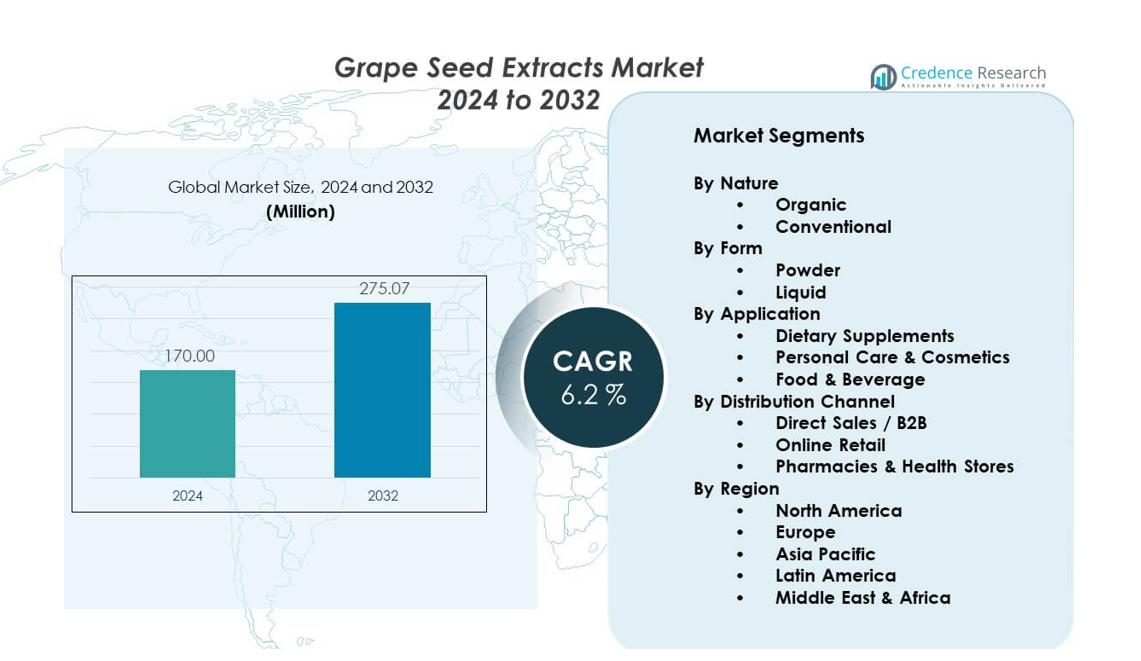
The Grape Seed Extracts Market shows steady expansion across nutraceutical, cosmetic, and functional food applications. The market is projected to grow from USD 170 million in 2024 to USD 275.07 million by 2032, reflecting a compound annual growth rate of 6.2% during the forecast period.
| REPORT ATTRIBUTE |
DETAILS |
| Historical Period |
2020-2023 |
| Base Year |
2024 |
| Forecast Period |
2025-2032 |
| Grape Seed Extracts Market Size 2024 |
USD 170 million |
| Grape Seed Extracts Market, CAGR |
6.2% |
| Grape Seed Extracts Market Size 2032 |
USD 275.07 million |
Rising health awareness strongly drives demand for grape seed extracts across consumer segments. Consumers increasingly prefer plant-based antioxidants for heart, skin, and immune support. Proanthocyanidins attract attention due to proven antioxidant strength and bioavailability. Dietary supplement brands expand clean-label portfolios to meet wellness trends. Cosmetic manufacturers use grape seed extracts for anti-aging and skin repair benefits. Food producers apply extracts for natural preservation and functional positioning. Aging populations seek preventive health solutions. Clinical research reinforces consumer confidence. Digital retail channels further improve product access and awareness.
North America leads the market due to strong dietary supplement consumption and established wellness brands. The United States drives demand through preventive healthcare adoption and high nutraceutical penetration. Europe follows closely, supported by cosmetic and functional food usage, especially in France and Italy. Asia Pacific emerges as a fast-growing region, driven by expanding middle-class populations and rising interest in herbal supplements. China and India show strong momentum in nutraceutical demand. Japan supports growth through beauty-focused applications. Latin America grows steadily, while the Middle East remains niche but expanding through premium wellness imports.
Market Insights:
- The Grape Seed Extracts Market reached USD 170 million in 2024 and is projected to hit USD 275.07 million by 2032, expanding at a CAGR of 6.2% due to steady nutraceutical and cosmetic demand.
- North America leads with about 35% share, driven by high supplement intake and strong brand presence, while Europe holds nearly 30% due to clean-label foods and natural cosmetics adoption, and Asia Pacific accounts for around 25% supported by large consumer bases and herbal preference.
- Asia Pacific is the fastest-growing region with roughly 25% share, fueled by rising disposable income, urban lifestyles, and growing interest in plant-based wellness products.
- By application, dietary supplements dominate with approximately 50% share, supported by antioxidant and heart-health positioning, while personal care and cosmetics contribute close to 30% through anti-aging and skin protection use.
- By form, powder holds about 65% share due to formulation flexibility and storage ease, whereas liquid accounts for nearly 35% driven by beverages, cosmetics, and fast-absorption supplements.
Access crucial information at unmatched prices!
Request your sample report today & start making informed decisions powered by Credence Research Inc.!
Download Sample
Market Drivers:
Rising Consumer Preference For Natural Antioxidant Ingredients
Consumers show strong preference for plant-based health solutions across wellness categories. Grape seed extract benefits from its natural antioxidant profile. Nutraceutical brands promote polyphenol-rich formulations for daily health use. Preventive healthcare trends influence supplement purchase behavior. Physicians often recommend antioxidant intake for long-term wellness. The Grape Seed Extracts Market gains support from this shift toward natural compounds. It aligns well with clean-label and transparency expectations. This driver sustains stable demand across age groups.
- For instance, Indena S.p.A. reports its grape seed extract standardized to over 95% total polyphenols, with proanthocyanidins as the dominant fraction. Nutraceutical brands promote such profiles for daily heart and vascular support. Preventive healthcare trends influence supplement purchase behavior.
Expanding Application Scope Across Nutraceutical And Dietary Supplements
Dietary supplement manufacturers actively diversify ingredient portfolios. Capsules, tablets, and powders include grape seed extract for added value. Clinical literature supports cardiovascular and metabolic health benefits. Consumers seek multifunctional supplements with fewer ingredients. Brand owners focus on evidence-based positioning strategies. The Grape Seed Extracts Market benefits from strong formulation flexibility. It fits preventive health and daily nutrition formats. This application breadth reinforces long-term consumption patterns.
- For instance, DSM-Firmenich highlights grape seed polyphenols for endothelial function support, referencing clinical use at standardized extract purity levels above 90% OPC content. Clinical literature links such extracts with oxidative stress reduction.
Growing Use In Cosmetic And Personal Care Formulations
Cosmetic producers adopt botanical extracts for skin-focused benefits. Grape seed extract supports anti-aging and skin protection claims. Its antioxidant action helps counter environmental stress factors. Premium skincare brands prefer natural actives over synthetic agents. Product developers integrate it into serums and creams. The Grape Seed Extracts Market gains traction from beauty sector demand. It aligns with clean beauty standards. This driver supports steady industrial uptake.
Increased Awareness Of Cardiovascular And Metabolic Health
Public focus on heart health continues to rise globally. Consumers link antioxidants with vascular and metabolic support. Grape seed extract appears in heart-health supplement lines. Healthcare campaigns emphasize lifestyle-based disease prevention. Wellness practitioners promote antioxidant-rich nutrition plans. The Grape Seed Extracts Market responds to these health priorities. It addresses long-term wellness rather than acute care. This awareness sustains repeat purchase behavior.
Market Trends:
Shift Toward Standardized And High-Purity Extract Formulations
Manufacturers focus on consistent potency and quality benchmarks. Standardized extracts ensure predictable polyphenol content. Buyers prefer products with verified composition levels. Quality assurance strengthens brand trust across channels. Processing technologies improve extract stability and purity. The Grape Seed Extracts Market reflects this quality-focused trend. It supports premium positioning strategies. This trend influences supplier selection criteria.
- For instance, Naturex (Givaudan) specifies grape seed extracts with controlled OPC variability below ±5%, supported by HPLC-based quality testing. Buyers prefer products with verified composition levels. Quality assurance strengthens brand trust across channels.
Rising Demand For Traceable And Sustainably Sourced Raw Materials
Supply chain transparency gains importance among ingredient buyers. Brands seek traceable grape sourcing practices. Sustainable extraction supports environmental commitments. Certification standards influence procurement decisions. Ethical sourcing improves brand credibility. The Grape Seed Extracts Market adapts to responsible sourcing expectations. It aligns with global sustainability goals. This trend reshapes supplier partnerships.
- For instance, Alvinesa Natural Ingredients sources grape seeds exclusively from European wine production streams, recovering polyphenols from thousands of metric tons of grape pomace annually under audited sustainability programs.
Product Innovation Through Blended Botanical Formulations
Manufacturers combine grape seed extract with complementary botanicals. Blends target specific health outcomes such as immunity or skin health. Innovation focuses on synergistic ingredient effects. Product differentiation drives competitive positioning. R&D teams test new formulation combinations. The Grape Seed Extracts Market supports flexible blending use. It fits evolving wellness concepts. This trend expands formulation creativity.
Expansion Of Direct-To-Consumer And Digital Sales Channels
Online platforms influence supplement purchase behavior. Consumers research ingredient benefits before buying. Digital brands emphasize education-led marketing strategies. Subscription models support repeat sales cycles. E-commerce improves access in emerging regions. The Grape Seed Extracts Market benefits from digital visibility. It reaches niche wellness consumers effectively. This trend strengthens brand-consumer engagement.
Market Challenges Analysis:
Raw Material Supply Variability And Agricultural Dependence
Grape seed availability depends on wine industry output. Seasonal variations affect raw material consistency. Climate factors influence grape yield quality. Supply volatility impacts production planning. Price fluctuations challenge cost control strategies. The Grape Seed Extracts Market faces sourcing uncertainties. It requires strong supplier relationships. This challenge affects margin stability.
Regulatory Complexity Across Dietary And Cosmetic Applications
Different regions enforce varied compliance standards. Ingredient approval timelines delay product launches. Labelling rules require constant updates. Claims substantiation demands scientific backing. Smaller players face higher compliance costs. The Grape Seed Extracts Market navigates diverse regulations. It demands strong regulatory expertise. This challenge slows expansion in new regions.
Market Opportunities:
Rising Demand In Emerging Asia Pacific Wellness Markets
Middle-class growth drives supplement consumption in Asia Pacific. Consumers show interest in herbal health solutions. Urban lifestyles increase preventive health focus. Local brands adopt botanical extracts rapidly. Import channels expand ingredient availability. The Grape Seed Extracts Market gains from regional expansion. It benefits from rising health awareness. This opportunity supports volume growth.
Innovation In Functional Food And Beverage Applications
Food producers explore antioxidant enrichment strategies. Grape seed extract suits functional beverage formats. Snack and nutrition bars adopt natural actives. Consumers prefer health-added everyday foods. Regulatory clarity improves food application adoption. The Grape Seed Extracts Market supports functional food integration. It expands beyond supplements and cosmetics. This opportunity broadens end-use diversity.
Market Segmentation Analysis:
By Nature
Organic grape seed extracts attract buyers who value clean-label and pesticide-free sourcing. This segment gains relevance in premium supplements and cosmetics. Conventional extracts retain wider adoption due to stable supply and cost efficiency. Large manufacturers prefer conventional inputs for volume-driven production. The Grape Seed Extracts Market reflects this balance between premium demand and commercial scalability. It supports both segments through flexible sourcing models.
- For instance, Nexira offers organic-certified grape seed extracts compliant with EU organic standards, ensuring zero synthetic pesticide residue detection. Conventional extracts retain wider adoption due to stable supply and cost efficiency.
By Form
Powder form leads due to ease of storage and formulation control. Manufacturers favor powder for capsules, tablets, and functional foods. Liquid extracts serve niche applications that require fast absorption or topical use. Cosmetic and beverage producers often select liquid formats. It benefits from form versatility across industries.
- For instance, Polyphenolics, now a supplier under & J. Gallo Winery, supplies spray-dried grape seed extract powders with controlled particle size for high-throughput encapsulation lines. Liquid extracts serve niche applications that require fast absorption or topical use.
By Application
Dietary supplements represent the core application area. Brands position grape seed extract for antioxidant and heart health support. Personal care and cosmetics adopt it for skin protection and anti-aging formulations. Food and beverage producers use it for natural preservation and functional enhancement. It fits diverse product development needs.
By Distribution Channel
Direct sales dominate bulk supply to supplement and cosmetic manufacturers. This channel ensures quality consistency and long-term contracts. Online retail supports branded consumer products and education-driven purchases. Pharmacies and health stores maintain trust-based sales for supplements. It gains reach through both professional and consumer-facing channels.
Segmentation:
By Nature
By Form
By Application
- Dietary Supplements
- Personal Care & Cosmetics
- Food & Beverage
By Distribution Channel
- Direct Sales / B2B
- Online Retail
- Pharmacies & Health Stores
By Region
- North America
- Europe
- Germany
- France
- U.K.
- Italy
- Spain
- Rest of Europe
- Asia Pacific
- China
- Japan
- India
- South Korea
- South-east Asia
- Rest of Asia Pacific
- Latin America
- Brazil
- Argentina
- Rest of Latin America
- Middle East & Africa
- GCC Countries
- South Africa
- Rest of the Middle East and Africa
Regional Analysis:
North America And Europe Market Leadership Dynamics
North America holds the largest share of the market at around 35%. Strong dietary supplement adoption supports steady demand across the United States and Canada. Consumers favor preventive wellness and antioxidant intake. Established nutraceutical brands ensure stable distribution reach. Europe follows closely with nearly 30% share, led by France, Germany, and Italy. Cosmetic and clean-label food demand drive regional consumption. The Grape Seed Extracts Market benefits from mature regulatory frameworks in both regions.
Asia Pacific As A High-Growth Consumption Hub
Asia Pacific accounts for approximately 25% of global market share. China and India drive demand through expanding middle-class populations. Urban lifestyles increase interest in herbal and antioxidant supplements. Japan supports premium usage in beauty and wellness products. Local manufacturers invest in botanical ingredient sourcing. It gains traction through traditional medicine influence and modern nutraceutical growth. Regional production capacity also improves supply reliability.
Latin America And Middle East & Africa Emerging Outlook
Latin America holds close to 6% market share, led by Brazil and Argentina. Grape processing industries support raw material availability. Nutraceutical adoption grows through health-focused urban consumers. Middle East & Africa represent nearly 4% of the market. GCC countries show demand for premium imported supplements. South Africa supports niche cosmetic applications. It expands gradually through wellness awareness and retail development.
Shape Your Report to Specific Countries or Regions & Enjoy 30% Off!
Key Player Analysis:
- Indena S.p.A.
- Naturex (Givaudan)
- Nexira
- Polyphenolics (Constellation Brands)
- Botanic Innovations, LLC
- Alvinesa Natural Ingredients
- Martin Bauer Group
- Koninklijke DSM N.V. (DSM-Firmenich)
Competitive Analysis:
The Grape Seed Extracts Market features a mix of global ingredient suppliers and specialized botanical extract producers. Leading companies focus on quality consistency, standardized extracts, and traceable sourcing. European players leverage strong expertise in plant-based actives for nutraceutical and cosmetic use. North American firms emphasize large-scale production and B2B supply contracts. Strategic differentiation relies on purity levels, formulation support, and regulatory compliance. It remains moderately consolidated, with top players holding strong relationships with supplement and beauty brands. Competitive intensity increases through product customization and application-specific solutions.
Recent Developments:
- In September 2024, Givaudan Active Beauty (the parent division of Naturex) launched the [N.A.S.]™ Vibrant Collection, a new range of 100% natural-origin active botanical extracts. While this collection focuses broadly on high-performance botanical ingredients like turmeric and gardenia, it underscores Givaudan’s continued strategic expansion in the clean-label sector, reinforcing the portfolio that includes their flagship grape seed extracts utilized for antioxidant and anti-aging applications.
- In July 2024, Alvinesa Natural Ingredients significantly expanded its global footprint by acquiring Industrias Vínicas (Chile) and Dervinsa (Argentina). This strategic acquisition establishes Alvinesa as a global leader in upcycled grape ingredients, securing direct access to raw materials in the Southern Hemisphere and ensuring a year-round supply of grape seed extracts and related derivatives to mitigate seasonal fluctuations.
- In March 2024, the newly formed DSM-Firmenich announced a partnership with the biotech startup Interstellar Lab to advance the sustainable production of botanical ingredients. This collaboration aims to utilize AI-controlled bio-farming to optimize the yield and quality of natural extracts, a move that is expected to enhance their broader portfolio of natural ingredients, including those derived from fruit and seed processing.
Report Coverage:
The research report offers an in-depth analysis based on By Nature, By Form, By Application, and By Distribution Channel. It details leading market players, providing an overview of their business, product offerings, investments, revenue streams, and key applications. Additionally, the report includes insights into the competitive environment, SWOT analysis, current market trends, as well as the primary drivers and constraints. Furthermore, it discusses various factors that have driven market expansion in recent years. The report also explores market dynamics, regulatory scenarios, and technological advancements that are shaping the industry. It assesses the impact of external factors and global economic changes on market growth. Lastly, it provides strategic recommendations for new entrants and established companies to navigate the complexities of the market.
Future Outlook:
- Demand for plant-based antioxidants will continue to rise across wellness sectors.
- Standardized extracts will gain preference among premium product developers.
- Cosmetic applications will expand through clean beauty positioning.
- Functional food adoption will increase ingredient diversification.
- Asia Pacific will remain a key growth region.
- Sustainable sourcing will influence supplier selection.
- Digital retail will improve consumer education and access.
- B2B partnerships will strengthen long-term supply stability.
- Innovation will focus on blended botanical formulations.
- Regulatory clarity will support broader application development.



