
Bio Magnetic Ear Stickers Market Overview:
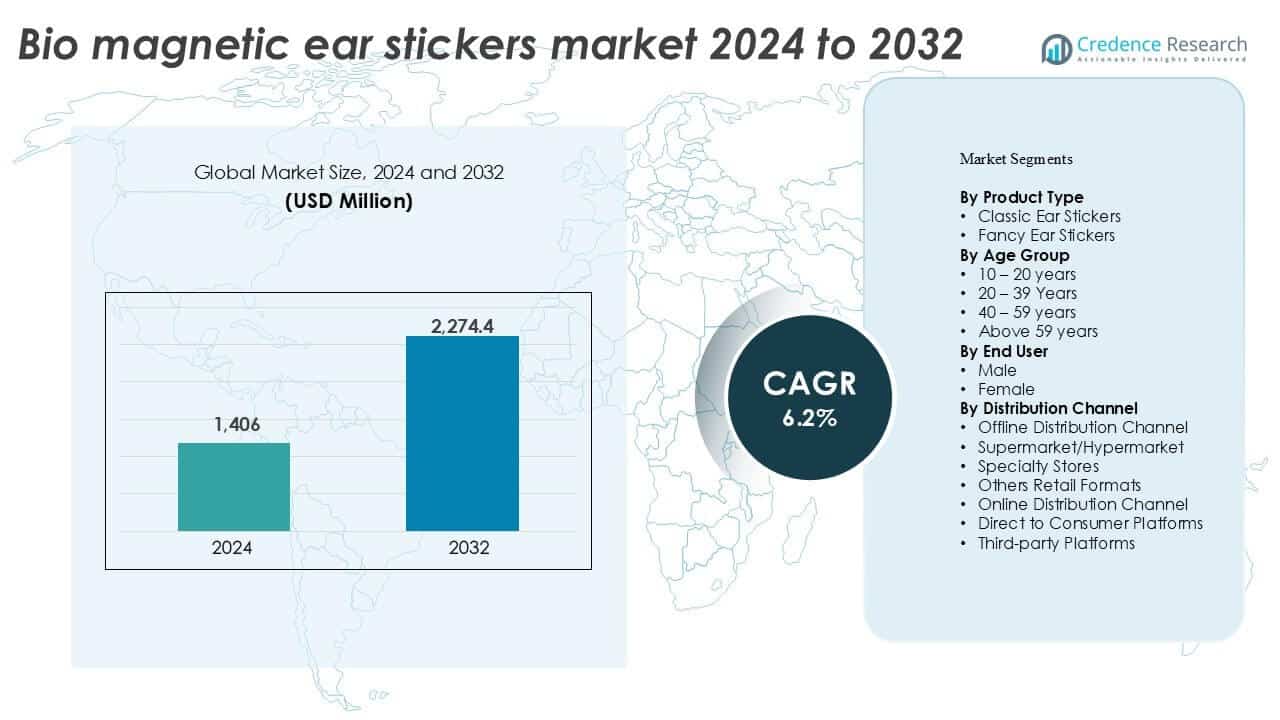
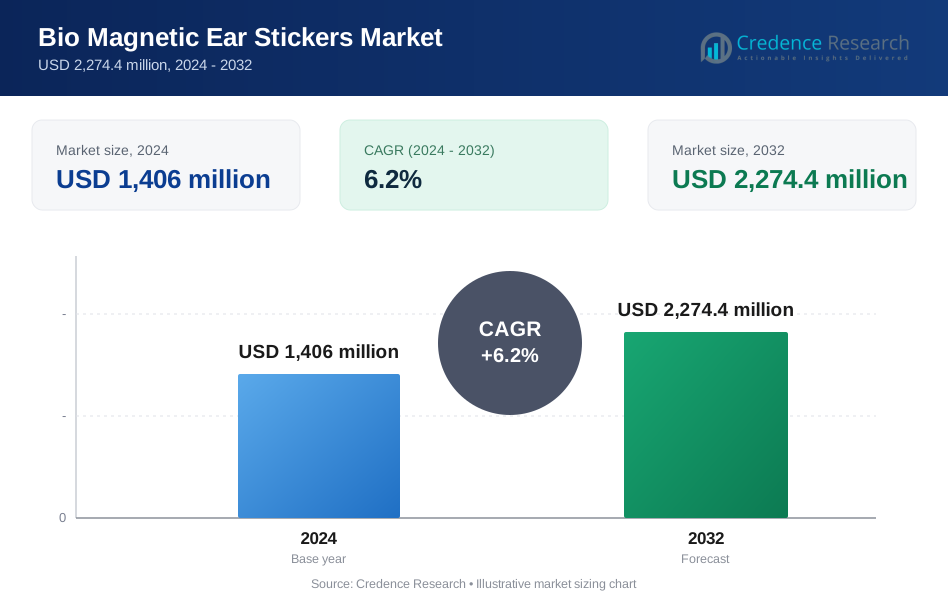
The Bio Magnetic Ear Stickers Market size was valued at USD 1,406 million in 2024 and is anticipated to reach USD 2,274.4 million by 2032, growing at a CAGR of 6.2% during the forecast period.
| REPORT ATTRIBUTE | DETAILS |
|---|---|
| Historical Period | 2020-2023 |
| Base Year | 2024 |
| Forecast Period | 2025-2032 |
| Bio Magnetic Ear Stickers Market Size 2024 | USD 1,406 million |
| Bio Magnetic Ear Stickers Market, CAGR | 6.2% |
| Bio Magnetic Ear Stickers Market Size 2032 | USD 2,274.4 million |
Top players in the bio magnetic ear stickers market include Physiomed Elektromedizin AG, Zimmer MedizinSysteme GmbH, ENRAF-NONIUS B.V., DJO Global LLC, Orthofix Medical Inc., MagnaWave LLC, BEMER International AG, Swiss Bionic Solutions LLC, Curatron Inc., and PEMF Systems Inc. These companies lead through product innovation, user-centric designs, and growing e-commerce presence. North America holds the dominant regional position with a 32% market share in 2024, driven by consumer preference for non-invasive wellness solutions and strong digital retail infrastructure. Europe follows closely with 28% share, backed by acceptance of alternative medicine and rising preventive health awareness.
Bio Magnetic Ear Stickers Market Insights
- The bio magnetic ear stickers market was valued at USD 1,406 million in 2024 and is expected to reach USD 2,274.4 million by 2032, growing at a CAGR of 6.2%.
- Rising interest in non-invasive wellness solutions, stress relief, and acupressure-based therapy drives market demand across urban populations.
- Fashion-forward product variants and influencer-led promotions are creating new trends, especially among females and the 20–39 age group segment, which holds 48% share.
- The market features moderate competition with key players like DJO Global LLC, Zimmer MedizinSysteme GmbH, and BEMER International AG leading through product variety and online sales strategies.
- North America leads with 32% market share, followed by Europe at 28% and Asia Pacific at 23%; however, inconsistent regulatory standards and lack of clinical validation continue to restrain broader adoption.
Bio Magnetic Ear Stickers Market Segmentation Analysis:
By Product Type
Classic ear stickers dominate the bio magnetic ear stickers market, accounting for over 62% of the total share in 2024. Their popularity stems from their minimalist design, ease of use, and broad acceptance in wellness practices such as acupressure therapy. These stickers are widely used for stress relief, weight management, and sleep improvement. Fancy variants, although growing in interest, remain niche due to their decorative focus and higher cost. The classic segment continues to lead as it aligns well with functional health applications and is favored by wellness practitioners and clinics.
- For instance, Nikken produces magnetic ear stickers using 600-gauss neodymium magnets. Neodymium magnets are permanent magnets and do not lose their strength over time or with normal physical use.
By Age Group
The 20–39 years age group holds the largest share, representing 48% of the market. This segment is highly engaged in preventive wellness, stress management, and non-invasive self-care solutions. Younger consumers in this range are more experimental with alternative therapies and influenced by online wellness trends. High disposable income and digital exposure further drive product adoption. Although usage among those above 40 is rising, especially for pain relief and anxiety control, the younger demographic remains the core market due to lifestyle-driven demand.
- For instance, AliExpress product listings for ear acupressure stickers frequently demonstrate high consumer demand, with top-rated sellers reporting thousands of cumulative sales and many individual listings showing hundreds of orders per month.
By End User
Female consumers account for 68% of the market in 2024, making them the dominant end-user group. Women show stronger interest in holistic health and beauty-enhancing treatments, where bio magnetic ear stickers are marketed as tools for slimming, detox, and hormonal balance. Marketing campaigns and influencer promotions are primarily targeted toward female buyers, especially in urban regions. While male adoption is increasing in the sports and mental wellness segments, female usage drives higher frequency of purchase and broader product variety, sustaining their lead in market share.
Bio Magnetic Ear Stickers Market Key Growth Drivers
Rising Interest in Non-Invasive Wellness Therapies
The increasing demand for non-invasive and drug-free wellness solutions significantly drives the bio magnetic ear stickers market. Consumers are increasingly shifting away from traditional pharmaceuticals and embracing alternative therapies for conditions such as stress, insomnia, weight control, and pain relief. Bio magnetic ear stickers, rooted in acupressure principles, offer a needle-free method to stimulate pressure points, making them accessible to a broad audience. Their ease of use, affordability, and minimal side effects further enhance appeal across both urban and semi-urban populations. As wellness awareness rises globally, particularly among millennials and Gen Z consumers, the adoption of non-invasive solutions is accelerating. In wellness-focused economies such as the U.S., Japan, and parts of Europe, the popularity of complementary medicine is boosting category acceptance.
- For instance, Nikken manufactures the Kenko PowerMini, which utilizes 750-gauss strontium ferrite magnets (rather than 600-gauss neodymium). These magnets are designed for reuse and feature a corrosion-resistant polymer coating and medical-grade adhesive intended for continuous, water-resistant wear.
Growth in Preventive Healthcare and Self-Care Culture
Preventive healthcare adoption has surged, driving the popularity of products that support everyday well-being. Bio magnetic ear stickers fit seamlessly into this shift as they offer a passive, low-effort solution for maintaining balance and reducing health risks. Increasing stress levels, sedentary lifestyles, and chronic fatigue have pushed consumers to seek products that proactively manage symptoms before they escalate into medical conditions. The self-care trend, amplified by social media and mental health awareness, is further strengthening market traction. These stickers are often perceived as lifestyle accessories combining function with wellness making them ideal for daily integration. The growing availability of DIY wellness tools, including these stickers, in both online and offline retail channels is expanding access.
- For instance, DongBang Acupuncture supplies magnetic ear pellets used in over 12,000 licensed acupuncture clinics worldwide.
Expansion of E-Commerce and Influencer-Driven Marketing
Digital commerce plays a vital role in driving the market’s reach and revenue. E-commerce platforms allow niche wellness products like bio magnetic ear stickers to reach global consumers without the need for traditional retail infrastructure. Online availability supports easier comparison, access to product reviews, and quick ordering, which helps new users overcome purchase hesitation. Influencer-driven marketing on platforms like Instagram, TikTok, and YouTube has made these stickers highly visible among younger consumers, who are already tuned into alternative wellness trends. Influencers often promote these products as part of morning routines, stress relief practices, or detox hacks, creating strong demand from impressionable audiences.
Bio Magnetic Ear Stickers Market Key Trends & Opportunities
Integration with Fashion and Beauty Products
A growing trend involves merging wellness with aesthetics, offering bio magnetic ear stickers in decorative or themed designs. These variants appeal especially to female consumers and younger age groups who seek functional beauty products. Stickers with gold plating, Swarovski elements, or themed shapes (hearts, stars) allow users to wear them in social settings without drawing negative attention. This cosmetic-wellness hybrid opens up positioning opportunities in both beauty and alternative health markets. Retailers increasingly stock such variants in beauty aisles alongside skincare and cosmetic accessories. Brands also collaborate with beauty influencers to promote ear stickers as part of beauty regimes for hormonal balance, facial slimming, or energy enhancement. This evolution from purely functional to fashionable allows broader consumer adoption and offers manufacturers a way to command premium pricing.
- For instance, Swarovski supplies precision-cut flatback crystals in 1.5 mm to 3.0 mm sizes for cosmetic accessories.
Rising Adoption in Workplace Wellness and Mental Health Programs
Companies are increasingly introducing wellness tools to support employee mental health, stress reduction, and productivity. Bio magnetic ear stickers are being tested in pilot programs and wellness boxes distributed by startups and health-focused firms. Their small size, ease of use, and passive functionality make them suitable for work environments. The growing focus on stress-related absenteeism and burnout has encouraged employers to explore cost-effective wellness add-ons that do not require major behavior changes. Vendors targeting corporate clients can position these stickers as mindfulness aids or fatigue management tools. There is also rising demand among students and remote workers facing digital fatigue. This trend is an untapped opportunity for bulk sales and B2B channel expansion.
Bio Magnetic Ear Stickers Market Key Challenges
Lack of Clinical Validation and Regulatory Oversight
Despite growing popularity, the lack of clinical trials and formal regulatory backing limits the credibility of bio magnetic ear stickers. Most product claims—ranging from weight loss to anxiety relief are anecdotal or supported by minimal research, which raises skepticism among healthcare professionals and regulators. In some regions, health authorities warn consumers against over-reliance on unverified wellness aids. Regulatory classification varies across countries, leading to inconsistent marketing guidelines and legal risks. This limits broader adoption in institutional settings such as hospitals or clinics. Without scientific validation and standardized testing, it is difficult for manufacturers to differentiate their offerings credibly. The absence of oversight also creates room for low-quality, counterfeit, or falsely advertised products, which may erode consumer trust.
Skepticism Among Medical Professionals and Low Awareness in Rural Markets
Healthcare providers often hesitate to recommend or acknowledge the efficacy of bio magnetic ear stickers due to the limited scientific evidence and perceived placebo effect. This skepticism reduces the likelihood of referrals from general practitioners, therapists, or wellness centers. As a result, many consumers depend solely on peer reviews or social media claims, which can lead to misinformation and unrealistic expectations. In addition, awareness and adoption remain low in rural and economically backward regions, where access to wellness trends is limited. Distribution challenges, low disposable income, and lack of trust in non-conventional products further slow penetration. While urban consumers may accept such products as part of self-care, rural populations often need stronger educational outreach and pricing incentives.
Bio Magnetic Ear Stickers Market Regional Analysis
North America
North America leads the bio magnetic ear stickers market, accounting for 32% of the global share in 2024. High awareness of non-invasive therapies, growing mental health concerns, and the popularity of holistic wellness drive strong adoption in the U.S. and Canada. Consumers in urban areas actively seek alternatives for stress relief, sleep enhancement, and weight management. Influencer-led marketing and e-commerce availability further support product visibility. Retail partnerships and wellness app integrations also aid sales growth. Regulatory leniency toward wellness products enables flexible marketing, contributing to North America’s sustained market dominance across both product and age segments.
Europe
Europe holds a 28% share of the bio magnetic ear stickers market, supported by rising preference for complementary and alternative medicine. Countries like Germany, France, and the U.K. show strong consumer interest in acupressure-based wellness tools. The region’s aging population also boosts demand for non-pharmaceutical pain relief and anxiety management products. Wellness retailers, pharmacies, and online health stores promote these stickers as part of self-care regimes. European consumers are also drawn to sustainably packaged and certified wellness products, driving interest in premium sticker variants. Regulatory support for non-drug therapies further sustains product uptake across diverse end-user groups.
Asia Pacific
Asia Pacific accounts for 23% of the market and is the fastest-growing region due to strong cultural alignment with acupressure and holistic healing practices. China, Japan, South Korea, and India are key growth centers. The region’s large young population, rising disposable income, and expanding e-commerce access fuel market penetration. Traditional wellness systems like TCM and Ayurveda promote acupressure’s legitimacy, aiding adoption. Local manufacturers offer affordable options tailored to beauty, stress, and sleep-related needs. Growth is further driven by social media campaigns and integration with fashion accessories. Urban wellness centers and beauty clinics also stock bio magnetic ear stickers.
Latin America
Latin America captures 9% of the global market, with Brazil, Mexico, and Argentina showing the highest demand. Rising awareness of non-invasive wellness solutions and digital health trends are key drivers. Social media influencers and wellness bloggers play a growing role in consumer education. The market benefits from the integration of bio magnetic ear stickers into spa treatments and weight management programs. However, limited regulatory clarity and inconsistent product quality affect consumer trust. Regional distributors focus on importing affordable variants, targeting middle-income consumers. The demand is steadily increasing, but market expansion relies on better retail access and promotional efforts.
Middle East & Africa (MEA)
The MEA region contributes 5% to the global market, driven primarily by demand from urban centers in the UAE, Saudi Arabia, and South Africa. Growing wellness tourism, increasing interest in alternative therapies, and expanding retail channels support modest but rising adoption. Consumers in premium segments explore bio magnetic ear stickers for stress relief and cosmetic benefits. However, cultural sensitivities and lower awareness levels in some areas limit broad acceptance. Retailers in the region focus on targeting female consumers through online platforms and beauty clinics. Market growth depends on educational campaigns and broader regional distribution networks.
Rest of the World
The Rest of the World segment holds the remaining 3% share, primarily including niche markets in Eastern Europe, Central Asia, and small island nations. These markets are still in the early adoption stage, with limited access to wellness products and low product awareness. Growth is constrained by distribution barriers and limited digital exposure. However, as global wellness trends spread and e-commerce penetration increases, new opportunities may arise. International brands entering untapped regions through digital platforms and wellness boxes are likely to expand the category. Market players may benefit by localizing marketing and offering cost-effective starter packs.
Bio Magnetic Ear Stickers Market Segmentations:
By Product Type
- Classic Ear Stickers
- Fancy Ear Stickers
By Age Group
- 10 – 20 years
- 20 – 39 Years
- 40 – 59 years
- Above 59 years
By End User
- Male
- Female
By Distribution Channel
- Offline Distribution Channel
- Supermarket/Hypermarket
- Specialty Stores
- Others Retail Formats
- Online Distribution Channel
- Direct to Consumer Platforms
- Third-party Platforms
By Geography
- North America
- U.S.
- Canada
- Mexico
- Europe
- Germany
- France
- U.K.
- Italy
- Spain
- Rest of Europe
- Asia Pacific
- China
- Japan
- India
- South Korea
- South-east Asia
- Rest of Asia Pacific
- Latin America
- Brazil
- Argentina
- Rest of Latin America
- Middle East & Africa
- GCC Countries
- South Africa
- Rest of the Middle East and Africa
Competitive Landscape
The bio magnetic ear stickers market is moderately fragmented, with several emerging players competing across wellness, alternative medicine, and lifestyle segments. Key companies include Physiomed Elektromedizin AG, Zimmer MedizinSysteme GmbH, ENRAF-NONIUS B.V., DJO Global LLC, Orthofix Medical Inc., MagnaWave LLC, BEMER International AG, Swiss Bionic Solutions LLC, Curatron Inc., and PEMF Systems Inc. These firms focus on expanding their product portfolios through innovations in magnet strength, design, and material quality. Digital marketing and e-commerce partnerships are key strategies used to target wellness-conscious consumers. Some players also position their products through clinical claims or acupressure-backed research. Product differentiation is often achieved via cosmetic appeal, multi-day usability, or packaging bundles. Companies that offer hybrid use for both beauty and health tend to capture wider demographics. Price competition remains strong, especially among Asian and online-native brands. Long-term success depends on branding, influencer outreach, customer education, and certifications for therapeutic efficacy.
Key Player Analysis
- Physiomed Elektromedizin AG
- Zimmer MedizinSysteme GmbH
- ENRAF-NONIUS B.V.
- DJO Global LLC
- Orthofix Medical Inc.
- MagnaWave LLC
- BEMER International AG
- Swiss Bionic Solutions LLC
- Curatron Inc.
- PEMF Systems Inc.
Recent Developments
- In Dec 2025, Zimmer MedizinSysteme GmbH released 2025 Year-in-Review, highlighting clinical and educational growth of non-invasive therapy products (magnetic and energy-based tech).
- In Sep 2024, Orthofix presented new data and highlighted product launches at NASS 2024, including bone growth and PEMF stimulation.
Report Coverage
The research report offers an in-depth analysis based on Product Type, Age Group, End-User, Distribution Channel and Geography. It details leading market players, providing an overview of their business, product offerings, investments, revenue streams, and key applications. Additionally, the report includes insights into the competitive environment, SWOT analysis, current market trends, as well as the primary drivers and constraints. Furthermore, it discusses various factors that have driven market expansion in recent years. The report also explores market dynamics, regulatory scenarios, and technological advancements that are shaping the industry. It assesses the impact of external factors and global economic changes on market growth. Lastly, it provides strategic recommendations for new entrants and established companies to navigate the complexities of the market.
Future Outlook
- Demand for drug-free wellness tools will continue to grow across urban and health-aware populations.
- Younger consumers will drive adoption due to rising stress, sleep issues, and lifestyle concerns.
- E-commerce platforms will expand market access, especially in emerging and underserved regions.
- Decorative and beauty-integrated ear stickers will attract fashion-conscious buyers.
- Clinical research and endorsements will help improve product credibility and professional acceptance.
- Partnerships with wellness centers and beauty clinics will strengthen offline distribution.
- Companies will invest in influencer marketing and subscription-based sales models for retention.
- Asia Pacific will see rapid growth due to traditional healing practices and large consumer base.
- Regulatory clarity and quality certification will become essential for premium positioning.
- Corporate wellness programs may adopt these products for employee stress relief and focus enhancement.
Request a Free Sample
Fill in your details and we'll send you a free sample report.
- Sample data tables & charts
- Research methodology
Need a Custom Version of This Report?
Tailor the scope, geography, or segments to your exact requirements.
- Custom geography or segment scope
- Direct access to our analyst team
Frequently Asked Questions
What is the current market size for the Bio magnetic ear stickers market, and what is its projected size in 2032?
At what Compound Annual Growth Rate is the Bio magnetic ear stickers market projected to grow between 2024 and 2032?
Which Bio magnetic ear stickers market segment held the largest share in 2024?
What are the primary factors fueling the growth of the Bio magnetic ear stickers market?
Who are the leading companies in the Bio magnetic ear stickers market?
Which region commanded the largest share of the Bio magnetic ear stickers market in 2024?
Table of Content
Chapter 1. Report Introduction
- 1.1 Report Description & Purpose
- 1.1.1 Report Title & Market Definition
- 1.1.2 Unique Selling Propositions (USP) & Key Differentiators
- 1.1.3 Value Proposition for Stakeholders
- 1.2 Research Objectives
- 1.2.1 Market Sizing Objectives (Volume & Revenue)
- 1.2.2 Segmentation Objectives
- 1.2.3 Competitive Intelligence Objectives
- 1.2.4 Forecast & Scenario Objectives
- 1.3 Report Scope
- 1.3.1 Bio Magnetic Ear Stickers Scope – Types & Subtypes Covered
- 1.3.2 Geographic Scope – Regions & Countries Covered
- 1.3.3 Historical Period, Base Year & Forecast Period (2024; forecast to 2032)
- 1.3.4 Inclusions & Exclusions
- 1.4 HS Code & Classification Framework
- 1.5 Currency, Units & Pricing Basis
- 1.6 Target Stakeholders
- 1.7 Limitations & Assumptions
Chapter 2. Executive Summary
- 2.1 Global Bio Magnetic Ear Stickers Market Snapshot
- 2.1.1 Market Size – Historical (2024) & Forecast (2024-2032) (2024: USD 1,406 million → 2032: USD 2,274.4 million)
- 2.1.2 Volume & Revenue – Global Totals
- 2.1.3 Key Market Highlights – Top Five Facts
- 2.2 Bio Magnetic Ear Stickers Market Segmentation Snapshot
- 2.2.1 Market Split by Region – 2024 vs. 2032
- 2.3 Competitive Snapshot
- 2.3.1 Top 10 Players by Revenue Share – 2024
- 2.3.2 Top 10 Players by Volume Share – 2024
- 2.3.3 Recent Strategic Developments (18-Month Summary)
- 2.4 Key Investment Highlights & Strategic Conclusions
Chapter 3. Bio Magnetic Ear Stickers Market Dynamics & Industry Analysis
- 3.1 Market Overview & Context
- 3.1.1 Bio Magnetic Ear Stickers Market Position in the Broader Automotive Value Chain
- 3.1.2 OEM vs. Replacement Market Dynamics
- 3.1.3 Market Maturity & Development Stage by Region
- 3.2 Bio Magnetic Ear Stickers Market Drivers
- 3.3 Bio Magnetic Ear Stickers Market Restraints & Challenges
- 3.4 Bio Magnetic Ear Stickers Market Opportunities
- 3.5 Porter's Five Forces Analysis
- 3.5.1 Threat of New Entrants
- 3.5.2 Bargaining Power of Suppliers
- 3.5.3 Bargaining Power of Buyers
- 3.5.4 Threat of Substitutes
- 3.5.5 Competitive Rivalry – Intensity Assessment
- 3.6 Bio Magnetic Ear Stickers Value Chain Analysis
- 3.6.1 Upstream – Raw Material/Input Suppliers
- 3.6.1.1 Raw Material/Input 1
- 3.6.1.2 Raw Material/Input 2
- 3.6.1.3 Raw Material/Input 3
- 3.6.2 Midstream – Production/Manufacturing/Service Delivery
- 3.6.2.1 Production/Process Overview
- 3.6.2.2 Key Facility Locations & Capacity by Manufacturer
- 3.6.3 Downstream – Distribution & End Consumer
- 3.6.3.1 Primary Channel – B2B/OEM
- 3.6.3.2 Secondary Channels – Dealer, Retail, Online, Direct
- 3.6.4 Value Chain Profitability Analysis
- 3.6.1 Upstream – Raw Material/Input Suppliers
- 3.7 PESTEL Analysis
- 3.7.1 Political Factors
- 3.7.2 Economic Factors
- 3.7.3 Social Factors
- 3.7.4 Technological Factors
- 3.7.5 Environmental Factors
- 3.7.6 Legal Factors
- 3.8 Bio Magnetic Ear Stickers Supply Chain Analysis
- 3.8.1 Raw Material/Input Supply Risk Assessment
- 3.8.2 Manufacturing Concentration Risk (Geographic Exposure)
- 3.8.3 Trade Disruption Impact Analysis
- 3.9 Regulatory & Policy Landscape
Note: The regulatory and policy landscape section covers regulations based on their applicability to the market, Bio Magnetic Ear Stickers category, geography, and scope of the study. Only regulatory frameworks with a material impact on operations, compliance, trade, sustainability, or market access are analyzed in detail.
Chapter 4. Key Investment Pockets & Opportunity Analysis
- 4.1 Bio Magnetic Ear Stickers Market Attractiveness Analysis
- 4.1.1 By Region – Investment Attractiveness Matrix (Volume × CAGR)
- 4.2 Absolute Revenue Growth Opportunity
- 4.2.1 By Region – Absolute USD Growth Through 2032
- 4.3 Incremental Volume Opportunity
- 4.3.1 By Region – Incremental Volume Through 2032
- 4.3.2 Segment – Incremental Volume
- 4.4 Emerging Submarket Opportunity Deep Dive (Subject to Applicability)
- 4.5 Emerging Market Opportunity Scorecards
- 4.5.1 United States
- 4.5.2 Europe
- 4.5.3 Asia
- 4.5.4 Middle East & Africa
Note: Emerging Market Opportunity Scorecards will be included based on relevance and strategic importance. Regions listed are indicative and may vary depending on data availability and market dynamics.
Chapter 5. Bio Magnetic Ear Stickers Import-Export Analysis & Trade Flows
- 5.1 Global Trade Overview
- 5.1.1 Global Export Value by Country (2024)
- 5.1.2 Global Export Volume by Country (2024)
- 5.1.3 Global Import Value by Country (2024)
- 5.1.4 Global Import Volume by Country (2024)
- 5.1.5 Net Trade Balance by Country (2024)
- 5.2 Export Analysis – Segment
- 5.2.1 Type 1 (HS Code)
- 5.2.2 Type 2 (HS Code)
- 5.2.3 Type 3 (HS Code)
- 5.2.4 Type 4 (HS Code)
- 5.2.5 Type 5 (HS Code)
- 5.3 Import Analysis – Segment
- 5.3.1 Type 1 (HS Code)
- 5.3.2 Type 2 (HS Code)
- 5.3.3 Type 3 (HS Code)
- 5.3.4 Type 4 (HS Code)
- 5.3.5 Type 5 (HS Code)
- 5.4 Average Unit Trade Prices
- 5.4.1 Average Export Price – Segment & Country
- 5.4.2 Average Import Price – Segment & Source Country
- 5.4.3 Price Trends (2024)
- 5.5 Key Trade Route Analysis
- 5.5.1 Trade Route 1
- 5.5.2 Trade Route 2
- 5.5.3 Trade Route 3
- 5.5.4 Trade Route 4
- 5.5.5 Trade Route 5
- 5.6 Trade Policy Impact Assessment
- 5.6.1 US Anti-Dumping & Section 301 Tariffs
- 5.6.2 EU Customs Union Impact
- 5.6.3 Major Free Trade Agreements
- 5.6.4 USMCA Rules of Origin
Note: Trade policy analysis will be included only where relevant to the Bio Magnetic Ear Stickers market.
Chapter 6. Competitive Landscape & Company Benchmarking
- 6.1 Bio Magnetic Ear Stickers Market Concentration & Structure
- 6.1.1 Herfindahl-Hirschman Index (HHI) – vs. 2024
- 6.1.2 Tier 1, Tier 2 & Tier 3 Market Structure
- 6.1.3 Global, Regional & Local Player Dynamics
- 6.2 Bio Magnetic Ear Stickers Market Share Analysis – 2024
- 6.2.1 Global Revenue Share by Company
- 6.2.2 Global Volume Share by Company
- 6.2.3 Regional Revenue Share
- 6.2.4 Market Share Evolution ( vs. 2024)
- 6.2.5 OEM Segment Share by Company
- 6.2.6 Replacement Segment Share by Company
- 6.3 Production/Delivery Capacity & Facility Analysis
- 6.3.1 Global Installed Capacity
- 6.3.2 Capacity Utilization Rates
- 6.3.3 Production/Output Volume
- 6.3.4 Facility Locations & Capacity Map
- 6.3.5 Planned Capacity Additions
- 6.4 Bio Magnetic Ear Stickers Competitive Benchmarking Matrix
- 6.4.1 Revenue, Volume, CAGR & Profitability Comparison
- 6.4.2 Channel Revenue Mix
- 6.4.3 Geographic Revenue Exposure
- 6.4.4 R&D Intensity
- 6.4.5 Sustainability Maturity
- 6.5 Strategic Developments in Bio Magnetic Ear Stickers (Last 24 Months)
- 6.5.1 Mergers, Acquisitions & Divestments
- 6.5.2 New Bio Magnetic Ear Stickers Launches
- 6.5.3 Facility Expansions
- 6.5.4 Strategic Alliances, Joint Ventures & Partnerships
- 6.5.5 Distribution Expansion & Market Entry
- 6.5.6 Sustainability & ESG Initiatives
- 6.6 Competitive Strategy Mapping
- 6.6.1 Leader, Challenger, Follower & Niche Classification
- 6.6.2 Pricing Strategy Comparison
- 6.6.3 Channel Strategy Matrix
Note: Strategic developments are included based on their materiality and the availability of reliable information.
Chapter 7. Global Bio Magnetic Ear Stickers Market – By Distribution Channel
- 7.1 Segment Overview
- 7.1.1 Volume & Revenue Split by Channel (2024 & 2032)
- 7.1.2 Channel Mix Evolution (2024-2032)
Chapter 8. Regional Market Analysis – Global Overview
- 8.1 Global Regional Overview
- 8.1.1 Regional Volume Share
- 8.1.2 Regional Revenue Share
- 8.1.3 Regional Volume by Region
- 8.1.4 Regional Revenue by Region
- 8.1.5 Regional Forecast Through 2032
- 8.2 Cross-Regional Segment Analysis
- 8.2.1 By Distribution Channel
- 8.2.2 By Brand/Price Tier
Chapter 9. North America Bio Magnetic Ear Stickers Market
- 9.1 United States
- 9.2 Canada
- 9.3 Mexico
Chapter 10. Europe Bio Magnetic Ear Stickers Market
- 10.1 Germany
- 10.2 France
- 10.3 Italy
- 10.4 United Kingdom
- 10.5 Spain
- 10.6 Poland
- 10.7 Russia
- 10.8 Netherlands
- 10.9 Belgium
- 10.10 Sweden
- 10.11 Denmark
- 10.12 Norway
- 10.13 Rest of Europe
Chapter 11. Asia Pacific Bio Magnetic Ear Stickers Market
- 11.1 China
- 11.2 India
- 11.3 Japan
- 11.4 South Korea
- 11.5 Thailand
- 11.6 Indonesia
- 11.7 Vietnam
- 11.8 Malaysia
- 11.9 Australia
- 11.10 Rest of Asia Pacific
Chapter 12. Latin America Bio Magnetic Ear Stickers Market
- 12.1 Brazil
- 12.2 Argentina
- 12.3 Colombia
- 12.4 Chile
- 12.5 Rest of Latin America
Chapter 13. Middle East Bio Magnetic Ear Stickers Market
- 13.1 Saudi Arabia
- 13.2 United Arab Emirates
- 13.3 Turkey
- 13.4 Israel
- 13.5 Iran
- 13.6 Rest of the Middle East
Chapter 14. Africa Bio Magnetic Ear Stickers Market
- 14.1 South Africa
- 14.2 Egypt
- 14.3 Nigeria
- 14.4 Morocco
- 14.5 Rest of Africa
Chapter 15. Bio Magnetic Ear Stickers Company Profiles
- 15.1 [Company 01]
- 15.1.1 Company Overview
- 15.1.2 Key Management Personnel
- 15.1.3 Products & Services Portfolio
- 15.1.4 Financial Performance
- 15.1.5 Key Market Focus & Geographic Presence
- 15.1.6 Recent Developments & Strategic Initiatives
Note: The company profile list is preliminary and may change based on research findings, market developments, data availability, and client requirements.
Chapter 16. Appendices
- Appendix A – List of Abbreviations & Acronyms
- Appendix B – Industry Classification Code Reference – Full Series
- Appendix C – Production & Capacity Data Tables
- Appendix D – End-Use & Demand Base Tables
- Appendix E – Consumption & Replacement Rate Assumptions
- Appendix F – ASP Reference Tables
- Appendix G – Manufacturing & Facility Database
- Appendix H – Import-Export Data Tables
- Appendix I – Regulatory Summary Tables
- Appendix J – Primary Research Participant List (Anonymized)
- Appendix K – Primary Research Questionnaire Framework
- Appendix L – Data Sources & Bibliography
- Appendix M – Market Size Divergence & Source Comparison
Chapter 17. Research Methodology
- 17.1 Research Framework & Philosophy
- 17.2 Secondary Research – Sources, Hierarchy & Data Extraction
- 17.3 Data Modeling – Bottom-Up & Top-Down Market Sizing
- 17.4 Primary Research – Stakeholder Framework, LOI & Sample Sizes
- 17.5 Forecast Methodology – Regression, Scenario & Sensitivity Analysis
- 17.6 Quality Control – Four-Layer Validation Framework
- 17.7 Limitations & Standard Assumptions
- 17.8 Disclaimer
