
Cholesterol Testing Products And Services Market Overview:
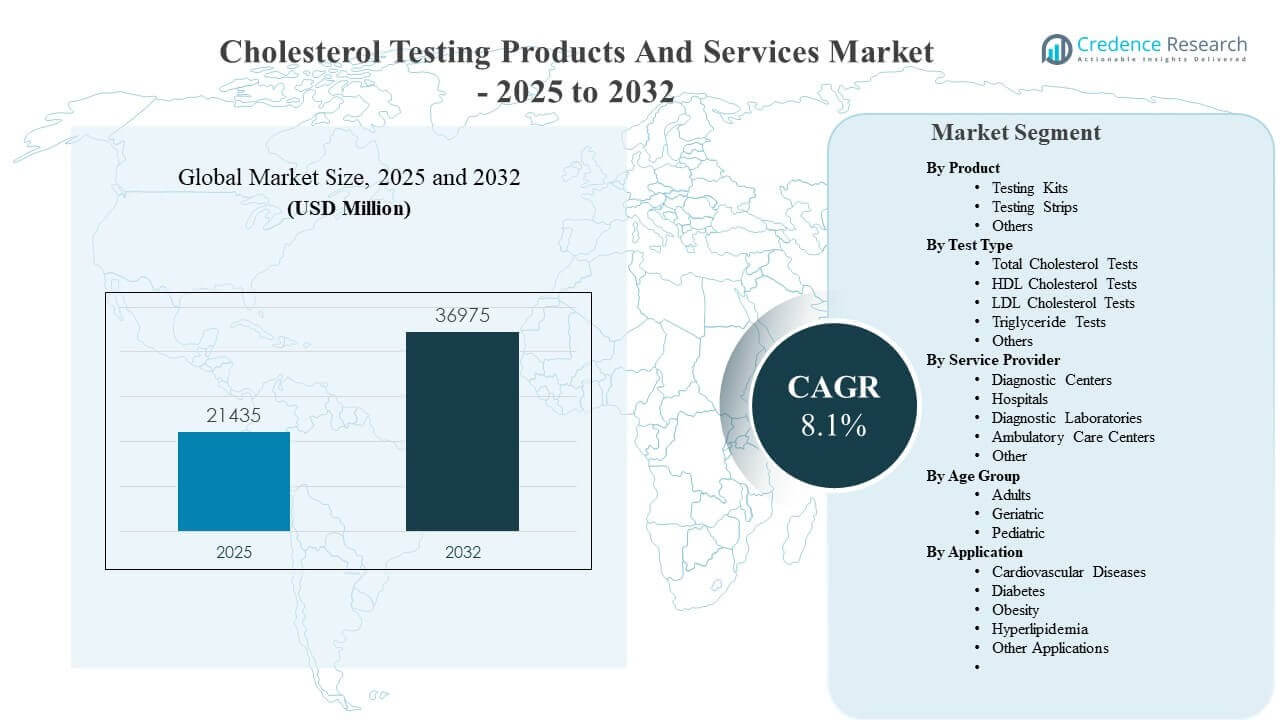
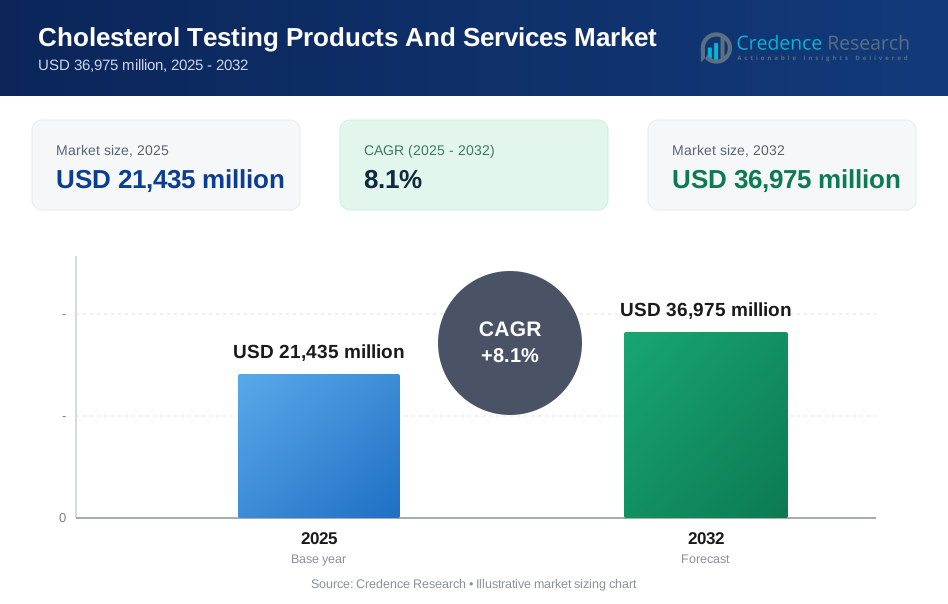
The global Cholesterol Testing Products And Services Market size was estimated at USD 21,435 million in 2025 and is expected to reach USD 36,975 million by 2032, growing at a CAGR of 8.1% from 2025 to 2032. Routine lipid monitoring is increasingly embedded into preventive checkups and long-term cardiometabolic care pathways, expanding both screening frequency and follow-up testing volumes across care settings. Faster turnaround expectations and wider access to point-of-care and at-home formats continue to support broader testing adoption across mature and emerging healthcare systems.
| REPORT ATTRIBUTE | DETAILS |
|---|---|
| Historical Period | 2020-2024 |
| Base Year | 2025 |
| Forecast Period | 2026-2032 |
| Cholesterol Testing Products And Services Market Size 2025 | USD 21,435 million |
| Cholesterol Testing Products And Services Market, CAGR | 8.1% |
| Cholesterol Testing Products And Services Market Size 2032 | USD 36,975 million |
Key Market Trends & Insights
- North America remained the largest regional market in 2025 with a 37.9% share, reflecting strong preventive screening intensity and established lab networks.
- Europe accounted for a 24.8% share in 2025, supported by routine primary-care testing and structured diagnostics reimbursement frameworks.
- Asia Pacific represented 24.1% of global revenue in 2025, driven by expanding access to diagnostics and a rising chronic disease burden.
- Testing Kits led the product landscape in 2025 with a 43.9% share, supported by point-of-care workflows and consumer preference for convenient testing.
- Total Cholesterol Tests held the largest test-type position in 2025 with a 36.4% share, reflecting their role as a standard first-line screening marker.
Segment Analysis
Cholesterol testing demand is shaped by the balance between clinical-grade laboratory workflows and faster point-of-care or consumer-led testing formats. Product innovation focuses on usability, faster results, smaller sample needs, and improved integration with digital records to support routine monitoring. Screening intensity is reinforced by preventive programs and by therapy monitoring needs in patients managed for cardiovascular risk. As testing expands beyond episodic checkups, consumable-driven demand (kits, strips, and reagents) becomes more recurring across healthcare settings.
Service delivery is increasingly influenced by network scale, turnaround time, and care-pathway integration. Hospitals, clinics, and ambulatory settings benefit from rapid testing to support same-visit counseling and treatment decisions, whereas diagnostic laboratories compete on throughput, quality assurance, and contracting breadth. Application growth is strongest where testing becomes a routine input into chronic disease management, including cardiovascular disease and metabolic comorbidities. Age dynamics remain important as older populations require more frequent monitoring, but adult screening growth is supported by broader wellness and preventive uptake.
By Product Insights
Testing Kits accounted for the largest share of 43.9% in 2025. Broad adoption is supported by convenience in clinics and community settings where rapid results enable immediate counseling and care adjustments. Product design improvements in sample handling, workflow speed, and compatibility with point-of-care analyzers strengthen routine use. Wider retail availability and patient preference for accessible screening further reinforce kit-led demand. Repeat monitoring behavior also supports recurring purchases of kit-based consumables.
By Test Type Insights
Total Cholesterol Tests accounted for the largest share of 36.4% in 2025. Total cholesterol remains a common entry point for screening because it is widely used in preventive checkups and initial risk assessment. Standardized ordering practices across primary care and health check packages sustain stable volumes. Testing demand increases when results trigger follow-up lipid profiling and therapy decisions. The segment also benefits from its integration into routine chemistry panels used across multiple care settings.
By Service Provider Insights
Hospitals & Clinics accounted for the largest share of 37.2% in 2025. Clinical settings capture significant testing volume because cholesterol assessment is frequently performed alongside physician visits, chronic disease reviews, and pre-procedure evaluations. Integrated care pathways enable repeat monitoring and support ongoing patient adherence to testing schedules. Provider-based testing is also favored where counseling, medication adjustment, and comorbidity management occur in the same visit. Efficient workflow and consistent quality controls further support hospital and clinic dominance.
By Age Group Insights
Geriatric accounted for the largest share of 44.8% in 2025. Older populations have higher prevalence of dyslipidemia and cardiometabolic comorbidities, increasing the need for routine monitoring and therapy tracking. Regular follow-ups and multi-morbidity management drive higher testing frequency compared to other age groups. Preventive screening recommendations are more consistently applied in older patients with established risk factors. The segment also benefits from stronger clinical engagement and structured monitoring schedules.
By Application Insights
Cardiovascular Diseases accounted for the largest share of 33.1% in 2025. Cholesterol testing is central to cardiovascular risk stratification and ongoing monitoring in both primary and specialty care pathways. Management protocols require repeated testing to evaluate response to lifestyle changes and lipid-lowering therapies. Screening initiatives and population risk awareness further reinforce testing volumes tied to cardiovascular prevention. The segment also benefits from close linkage to comorbid diabetes and obesity, which increase the overall monitoring base.
Cholesterol Testing Products And Services Market Drivers
Expansion of preventive screening and chronic risk management
Cholesterol testing adoption is strengthened by the shift toward preventive healthcare models that prioritize early detection of cardiovascular risk. Routine screening during annual health checks increases baseline testing volumes across hospitals, clinics, and diagnostic centers. Chronic disease programs also drive repeat testing to monitor lipid control over time. Better integration of testing into standard care pathways improves compliance and follow-up rates. These structural drivers support steady demand even when discretionary healthcare spending softens.
- For instance, Roche’s cobas b 101 system delivers a lipid panel in approximately 6 minutes from a 19 µL sample and reports total cholesterol, HDL, triglycerides, LDL, non-HDL, and TC/HDL ratio on one point-of-care platform, which supports incorporation of lipid screening into routine preventive and chronic care workflows.
Wider availability of point-of-care and near-patient testing
Point-of-care testing supports growth by reducing turnaround time and enabling same-visit clinical decision-making. Faster results improve patient engagement and increase the likelihood of immediate counseling, treatment initiation, and follow-up scheduling. Near-patient formats also expand testing reach into ambulatory centers and community-based programs. Workflow efficiency is especially valuable where clinicians manage high patient volumes and need rapid screening inputs. These benefits raise utilization in both mature and developing healthcare systems.
- For instance, PTS Diagnostics’ CardioChek PA Analyzer provides a full lipid panel in as little as 90 seconds and a single blood chemistry result in as little as 45 seconds, while measuring total cholesterol, HDL cholesterol, triglycerides, and glucose and calculating LDL and TC/HDL ratio in a handheld format.
Rising cardiometabolic burden across adult populations
The growing prevalence of obesity, diabetes, and sedentary lifestyles increases the addressable testing pool and the frequency of repeat monitoring. Cholesterol evaluation is routinely paired with metabolic panels, reinforcing bundled testing behavior. As more patients are identified as at-risk, clinicians intensify follow-up testing to track progression and therapy impact. This demand expansion extends beyond older populations into working-age adults. Broadening risk awareness further sustains screening participation across care settings.
Consumables-driven repeat demand and expanded access pathways
Market growth is supported by recurring purchases of consumables such as kits and strips that are required for repeated monitoring. As testing moves into more touchpoints, including wellness programs and ambulatory workflows, consumable volumes rise with utilization. Distribution expansion through healthcare providers and retail channels improves product access and availability. Standardization and packaging improvements also support inventory planning and routine stocking. These factors collectively reinforce predictable, repeatable demand patterns.
Cholesterol Testing Products And Services Market Challenges
Cholesterol testing growth faces constraints related to variability in access, affordability, and screening participation across population groups. Testing uptake can remain uneven where preventive care is underutilized or where insurance coverage limits routine screening. Out-of-pocket costs may reduce repeat testing frequency for patients who need ongoing monitoring. Inconsistent follow-up behavior also weakens conversion from initial screening to longitudinal management. These barriers can slow the full realization of demand in underserved regions.
- For instance, Abbott’s FreeStyle Libre 2 continuous glucose monitoring system, which is often co-deployed in cardiometabolic risk programs, requires a factory-calibrated sensor worn for up to 14 days and delivers a glucose reading every minute with an overall mean absolute relative difference (MARD) of 9.2% versus laboratory reference, illustrating how device cost, calibration model, and wear duration can influence repeat testing behavior and affordability in chronic monitoring pathways.
Operational and quality challenges also affect service providers and product adoption. Point-of-care settings require consistent calibration, staff training, and quality control to maintain reliable results comparable to centralized laboratories. Workflow disruptions, supply continuity for consumables, and device maintenance can reduce testing efficiency. Data integration gaps between devices, labs, and electronic records may limit clinical usability of results. These frictions can slow scaling, particularly in fragmented care environments.
Cholesterol Testing Products And Services Market Trends and Opportunities
Cholesterol testing is increasingly aligned to integrated cardiometabolic management programs that combine diagnostics, counseling, and therapy monitoring. Providers are embedding lipid testing into structured pathways for cardiovascular prevention and weight management, supporting more frequent repeat monitoring. Opportunities expand as care models prioritize early identification of risk and rapid treatment adjustment based on test results. Testing formats that enable fast turnaround and easy ordering gain share in high-throughput settings. Better linkage to lifestyle and therapy pathways supports sustained utilization growth.
- For instance, Quest Diagnostics deployed its Cardio IQ Advanced Lipid Panel across 2,200+ patient service centers in 2025, enabling nonfasting LDL-C calculations using the Martin-Hopkins equation that improved accuracy by 15% compared to the Friedewald method and reduced repeat testing rates by 22% in high-volume cardiac rehabilitation programs.
Digital enablement is another key opportunity across products and services. Connectivity features that support automated reporting, patient reminders, and integration into clinical records improve adherence and reduce administrative burden. Consumer-led testing pathways also expand demand for convenient kits and strips that can be used outside traditional facilities. Product designs that simplify sampling and improve usability can broaden uptake among first-time users. Service providers that combine convenience, quality, and data integration strengthen their competitive position.
Regional Insights
North America
North America led the market in 2025 with a 37.9% share, supported by high screening intensity and mature diagnostic infrastructure. Provider-led testing remains strong due to established preventive care behaviors and broad availability of lab networks. Point-of-care adoption benefits from demand for faster results and operational efficiency in clinics and ambulatory settings. Ongoing cardiometabolic disease management sustains repeat testing volumes and supports consistent consumable demand.
Europe
Europe represented 24.8% of global revenue in 2025, supported by structured primary care systems and routine preventive screening practices. Demand is reinforced by standardized lab workflows and broad access to diagnostic services across many countries. Growth is supported by continued focus on cardiovascular prevention and therapy monitoring, which increases repeat testing. Service providers compete on turnaround time, quality systems, and integration into care pathways.
Asia Pacific
Asia Pacific accounted for 24.1% share in 2025, benefiting from expanding healthcare access and rising awareness of cardiometabolic risk. Urbanization and lifestyle changes increase screening needs across adult populations, supporting growth in both facility-based and near-patient testing. Expanding diagnostic capacity and private-sector lab network growth strengthen service availability. Demand also rises as chronic disease management programs scale and encourage routine monitoring behavior.
Latin America
Latin America captured an 8.2% share in 2025, with growth supported by gradual improvements in diagnostic access and increasing cardiometabolic disease burden. Demand tends to concentrate in urban centers where hospital and private lab networks are more developed. Expanding preventive initiatives and employer-led health checks can increase screening volumes. Service expansion and affordability improvements are key to sustaining broader testing uptake.
Middle East & Africa
Middle East & Africa held a 5.0% share in 2025, shaped by uneven diagnostic access and varying healthcare capacity across countries. Testing demand is stronger in markets with expanding private healthcare systems and growing chronic disease management focus. Investment in diagnostics infrastructure and improved access to routine screening can support higher volumes. Service providers that improve turnaround and strengthen clinical integration can capture rising demand.
Competitive Landscape
Competition is driven by the breadth of test menus, network scale, turnaround performance, and the ability to integrate results into clinical workflows. Providers differentiate through quality assurance, automation, and contracting reach across payers and healthcare systems. Product suppliers compete on reliability, usability, and compatibility with point-of-care workflows and consumables availability. Partnerships and acquisitions remain important to expand geographic coverage, improve capacity utilization, and strengthen service portfolios.
Quest Diagnostics is positioned around scaled diagnostic operations, extensive provider connectivity, and a broad testing portfolio that supports routine screening and longitudinal monitoring. Operational scale enables efficient processing and consistent service levels across large populations. The company’s reach across care settings supports high testing throughput and integration into preventive and chronic care pathways. Ongoing expansion of laboratory assets and regional networks can strengthen access and performance in routine lipid testing services.
The industry research and growth report includes detailed analyses of the competitive landscape of the market and information about key companies, including:
- Quest Diagnostics
- SpectraCell Laboratories / Spectra Laboratories
- Randox Laboratories
- Thermo Fisher Scientific
- Cell Biolabs
- Laboratory Corporation of America Holdings (Labcorp)
- Eurofins Scientific
- SYNLAB AG
- Clinical Reference Laboratory
- BioReference Health
- Elabscience Bionovation
- Novartis AG
Qualitative and quantitative analysis of companies has been conducted to help clients understand the wider business environment as well as the strengths and weaknesses of key industry players. Data is qualitatively analyzed to categorize companies as pure play, category-focused, industry-focused, and diversified; it is quantitatively analyzed to categorize companies as dominant, leading, strong, tentative, and weak.
Recent Developments
- In March 2024, Labcorp announced the acquisition of select assets from BioReference Health’s diagnostics business, covering clinical diagnostics and reproductive and women’s health operations across the United States outside New York and New Jersey. This deal was positioned to expand Labcorp’s laboratory service network and improve access to high-quality testing services, which is relevant to the broader cholesterol and lipid testing services landscape.
- In June 2024, Quest Diagnostics announced a definitive agreement to acquire select laboratory assets from Allina Health. Quest said the transaction was intended to broaden access to innovative and cost-effective laboratory services for providers and patients in Minnesota and western Wisconsin, and the acquisition was completed on September 16, 2024.
- In September 2024, the Family Heart Foundation launched Cholesterol Connect, a free at-home lipid screening and personalized support program, in collaboration with Amgen. The program combines at-home lipid testing with care navigation support and was designed to improve access to LDL-cholesterol and lipoprotein(a) screening, making it a notable partnership update in the cholesterol testing space.
- In September 2024, Verichem Laboratories launched liquid-stable reference materials for calibration verification testing of cholesterol assays, including total cholesterol, HDL, and LDL tests. The launch supports laboratory quality assurance and quality control workflows, making it a relevant new product development within cholesterol testing products.
Report Scope
| Report Attribute | Details |
| Market size value in 2025 | USD 21435 million |
| Revenue forecast in 2032 | USD 36975 million |
| Growth rate (CAGR) | 8.1% (2025–2032) |
| Base year | 2025 |
| Forecast period | 2026-2032 |
| Quantitative units | USD million |
| Segments covered | By Product Outlook: Testing Kits, Testing Strips, Others; By Test Type Outlook: Total Cholesterol Tests, HDL Cholesterol Tests, LDL Cholesterol Tests, Triglyceride Tests, Others; By Service Provider Outlook: Diagnostic Centers, Hospitals, Diagnostic Laboratories, Ambulatory Care Centers, Other End Users; By Age Group Outlook: Adults, Geriatric, Pediatric; By Application Outlook: Cardiovascular Diseases, Diabetes, Obesity, Hyperlipidemia, Other Applications |
| Regional scope | North America, Europe, Asia Pacific, Latin America, Middle East & Africa |
| Key companies profiled | Quest Diagnostics, SpectraCell Laboratories / Spectra Laboratories, Randox Laboratories, Thermo Fisher Scientific, Cell Biolabs, Laboratory Corporation of America Holdings (Labcorp), Eurofins Scientific, SYNLAB AG, Clinical Reference Laboratory, BioReference Health, Elabscience Bionovation, Novartis AG |
| No.of Pages | 337 |
Segmentation
By Product
- Testing Kits
- Testing Strips
- Others
By Test Type
- Total Cholesterol Tests
- HDL Cholesterol Tests
- LDL Cholesterol Tests
- Triglyceride Tests
- Others
By Service Provider
- Diagnostic Centers
- Hospitals
- Diagnostic Laboratories
- Ambulatory Care Centers
- Other End Users
By Age Group
- Adults
- Geriatric
- Pediatric
By Application
- Cardiovascular Diseases
- Diabetes
- Obesity
- Hyperlipidemia
- Other Applications
By Region
- North America
- U.S.
- Canada
- Mexico
- Europe
- Germany
- France
- U.K.
- Italy
- Spain
- Rest of Europe
- Asia Pacific
- China
- Japan
- India
- South Korea
- South-east Asia
- Rest of Asia Pacific
- Latin America
- Brazil
- Argentina
- Rest of Latin America
- Middle East & Africa
- GCC Countries
- South Africa
- Rest of the Middle East and Africa
Request a Free Sample
Fill in your details and we'll send you a free sample report.
- Sample data tables & charts
- Research methodology
Need a Custom Version of This Report?
Tailor the scope, geography, or segments to your exact requirements.
- Custom geography or segment scope
- Direct access to our analyst team
Frequently Asked Questions
What is the current and forecast size of the Cholesterol Testing Products And Services Market?
What is the CAGR for the Cholesterol Testing Products And Services Market during 2025–2032?
What is the largest segment in the market?
What factors are driving growth in this market?
Who are the leading companies in the market?
Which region leads the Cholesterol Testing Products And Services Market?
Table of Content
Chapter 1. Report Introduction
- 1.1 Report Description & Purpose
- 1.1.1 Report Title & Market Definition
- 1.1.2 Unique Selling Propositions (USP) & Key Differentiators
- 1.1.3 Value Proposition for Stakeholders
- 1.2 Research Objectives
- 1.2.1 Market Sizing Objectives (Volume & Revenue)
- 1.2.2 Segmentation Objectives
- 1.2.3 Competitive Intelligence Objectives
- 1.2.4 Forecast & Scenario Objectives
- 1.3 Report Scope
- 1.3.1 Cholesterol Testing Products And Services Scope – Types & Subtypes Covered
- 1.3.2 Geographic Scope – Regions & Countries Covered
- 1.3.3 Historical Period, Base Year & Forecast Period (2025; forecast to 2032)
- 1.3.4 Inclusions & Exclusions
- 1.4 HS Code & Classification Framework
- 1.5 Currency, Units & Pricing Basis
- 1.6 Target Stakeholders
- 1.7 Limitations & Assumptions
Chapter 2. Executive Summary
- 2.1 Global Cholesterol Testing Products And Services Market Snapshot
- 2.1.1 Market Size – Historical (2025) & Forecast (2025-2032) (2025: USD 21,435 million → 2032: USD 36,975 million)
- 2.1.2 Volume & Revenue – Global Totals
- 2.1.3 Key Market Highlights – Top Five Facts
- 2.2 Cholesterol Testing Products And Services Market Segmentation Snapshot
- 2.2.1 Market Split by Region – 2025 vs. 2032
- 2.3 Competitive Snapshot
- 2.3.1 Top 10 Players by Revenue Share – 2025
- 2.3.2 Top 10 Players by Volume Share – 2025
- 2.3.3 Recent Strategic Developments (18-Month Summary)
- 2.4 Key Investment Highlights & Strategic Conclusions
Chapter 3. Cholesterol Testing Products And Services Market Dynamics & Industry Analysis
- 3.1 Market Overview & Context
- 3.1.1 Cholesterol Testing Products And Services Market Position in the Broader Automotive Value Chain
- 3.1.2 OEM vs. Replacement Market Dynamics
- 3.1.3 Market Maturity & Development Stage by Region
- 3.2 Cholesterol Testing Products And Services Market Drivers
- 3.3 Cholesterol Testing Products And Services Market Restraints & Challenges
- 3.4 Cholesterol Testing Products And Services Market Opportunities
- 3.5 Porter's Five Forces Analysis
- 3.5.1 Threat of New Entrants
- 3.5.2 Bargaining Power of Suppliers
- 3.5.3 Bargaining Power of Buyers
- 3.5.4 Threat of Substitutes
- 3.5.5 Competitive Rivalry – Intensity Assessment
- 3.6 Cholesterol Testing Products And Services Value Chain Analysis
- 3.6.1 Upstream – Raw Material/Input Suppliers
- 3.6.1.1 Raw Material/Input 1
- 3.6.1.2 Raw Material/Input 2
- 3.6.1.3 Raw Material/Input 3
- 3.6.2 Midstream – Production/Manufacturing/Service Delivery
- 3.6.2.1 Production/Process Overview
- 3.6.2.2 Key Facility Locations & Capacity by Manufacturer
- 3.6.3 Downstream – Distribution & End Consumer
- 3.6.3.1 Primary Channel – B2B/OEM
- 3.6.3.2 Secondary Channels – Dealer, Retail, Online, Direct
- 3.6.4 Value Chain Profitability Analysis
- 3.6.1 Upstream – Raw Material/Input Suppliers
- 3.7 PESTEL Analysis
- 3.7.1 Political Factors
- 3.7.2 Economic Factors
- 3.7.3 Social Factors
- 3.7.4 Technological Factors
- 3.7.5 Environmental Factors
- 3.7.6 Legal Factors
- 3.8 Cholesterol Testing Products And Services Supply Chain Analysis
- 3.8.1 Raw Material/Input Supply Risk Assessment
- 3.8.2 Manufacturing Concentration Risk (Geographic Exposure)
- 3.8.3 Trade Disruption Impact Analysis
- 3.9 Regulatory & Policy Landscape
Note: The regulatory and policy landscape section covers regulations based on their applicability to the market, Cholesterol Testing Products And Services category, geography, and scope of the study. Only regulatory frameworks with a material impact on operations, compliance, trade, sustainability, or market access are analyzed in detail.
Chapter 4. Key Investment Pockets & Opportunity Analysis
- 4.1 Cholesterol Testing Products And Services Market Attractiveness Analysis
- 4.1.1 By Region – Investment Attractiveness Matrix (Volume × CAGR)
- 4.2 Absolute Revenue Growth Opportunity
- 4.2.1 By Region – Absolute USD Growth Through 2032
- 4.3 Incremental Volume Opportunity
- 4.3.1 By Region – Incremental Volume Through 2032
- 4.3.2 Segment – Incremental Volume
- 4.4 Emerging Submarket Opportunity Deep Dive (Subject to Applicability)
- 4.5 Emerging Market Opportunity Scorecards
- 4.5.1 United States
- 4.5.2 Europe
- 4.5.3 Asia
- 4.5.4 Middle East & Africa
Note: Emerging Market Opportunity Scorecards will be included based on relevance and strategic importance. Regions listed are indicative and may vary depending on data availability and market dynamics.
Chapter 5. Cholesterol Testing Products And Services Import-Export Analysis & Trade Flows
- 5.1 Global Trade Overview
- 5.1.1 Global Export Value by Country (2025)
- 5.1.2 Global Export Volume by Country (2025)
- 5.1.3 Global Import Value by Country (2025)
- 5.1.4 Global Import Volume by Country (2025)
- 5.1.5 Net Trade Balance by Country (2025)
- 5.2 Export Analysis – Segment
- 5.2.1 Type 1 (HS Code)
- 5.2.2 Type 2 (HS Code)
- 5.2.3 Type 3 (HS Code)
- 5.2.4 Type 4 (HS Code)
- 5.2.5 Type 5 (HS Code)
- 5.3 Import Analysis – Segment
- 5.3.1 Type 1 (HS Code)
- 5.3.2 Type 2 (HS Code)
- 5.3.3 Type 3 (HS Code)
- 5.3.4 Type 4 (HS Code)
- 5.3.5 Type 5 (HS Code)
- 5.4 Average Unit Trade Prices
- 5.4.1 Average Export Price – Segment & Country
- 5.4.2 Average Import Price – Segment & Source Country
- 5.4.3 Price Trends (2025)
- 5.5 Key Trade Route Analysis
- 5.5.1 Trade Route 1
- 5.5.2 Trade Route 2
- 5.5.3 Trade Route 3
- 5.5.4 Trade Route 4
- 5.5.5 Trade Route 5
- 5.6 Trade Policy Impact Assessment
- 5.6.1 US Anti-Dumping & Section 301 Tariffs
- 5.6.2 EU Customs Union Impact
- 5.6.3 Major Free Trade Agreements
- 5.6.4 USMCA Rules of Origin
Note: Trade policy analysis will be included only where relevant to the Cholesterol Testing Products And Services market.
Chapter 6. Competitive Landscape & Company Benchmarking
- 6.1 Cholesterol Testing Products And Services Market Concentration & Structure
- 6.1.1 Herfindahl-Hirschman Index (HHI) – vs. 2025
- 6.1.2 Tier 1, Tier 2 & Tier 3 Market Structure
- 6.1.3 Global, Regional & Local Player Dynamics
- 6.2 Cholesterol Testing Products And Services Market Share Analysis – 2025
- 6.2.1 Global Revenue Share by Company
- 6.2.2 Global Volume Share by Company
- 6.2.3 Regional Revenue Share
- 6.2.4 Market Share Evolution ( vs. 2025)
- 6.2.5 OEM Segment Share by Company
- 6.2.6 Replacement Segment Share by Company
- 6.3 Production/Delivery Capacity & Facility Analysis
- 6.3.1 Global Installed Capacity
- 6.3.2 Capacity Utilization Rates
- 6.3.3 Production/Output Volume
- 6.3.4 Facility Locations & Capacity Map
- 6.3.5 Planned Capacity Additions
- 6.4 Cholesterol Testing Products And Services Competitive Benchmarking Matrix
- 6.4.1 Revenue, Volume, CAGR & Profitability Comparison
- 6.4.2 Channel Revenue Mix
- 6.4.3 Geographic Revenue Exposure
- 6.4.4 R&D Intensity
- 6.4.5 Sustainability Maturity
- 6.5 Strategic Developments in Cholesterol Testing Products And Services (Last 24 Months)
- 6.5.1 Mergers, Acquisitions & Divestments
- 6.5.2 New Cholesterol Testing Products And Services Launches
- 6.5.3 Facility Expansions
- 6.5.4 Strategic Alliances, Joint Ventures & Partnerships
- 6.5.5 Distribution Expansion & Market Entry
- 6.5.6 Sustainability & ESG Initiatives
- 6.6 Competitive Strategy Mapping
- 6.6.1 Leader, Challenger, Follower & Niche Classification
- 6.6.2 Pricing Strategy Comparison
- 6.6.3 Channel Strategy Matrix
Note: Strategic developments are included based on their materiality and the availability of reliable information.
Chapter 7. Global Cholesterol Testing Products And Services Market – By Distribution Channel
- 7.1 Segment Overview
- 7.1.1 Volume & Revenue Split by Channel (2025 & 2032)
- 7.1.2 Channel Mix Evolution (2025-2032)
Chapter 8. Regional Market Analysis – Global Overview
- 8.1 Global Regional Overview
- 8.1.1 Regional Volume Share
- 8.1.2 Regional Revenue Share
- 8.1.3 Regional Volume by Region
- 8.1.4 Regional Revenue by Region
- 8.1.5 Regional Forecast Through 2032
- 8.2 Cross-Regional Segment Analysis
- 8.2.1 By Distribution Channel
- 8.2.2 By Brand/Price Tier
Chapter 9. North America Cholesterol Testing Products And Services Market
- 9.1 United States
- 9.2 Canada
- 9.3 Mexico
Chapter 10. Europe Cholesterol Testing Products And Services Market
- 10.1 Germany
- 10.2 France
- 10.3 Italy
- 10.4 United Kingdom
- 10.5 Spain
- 10.6 Poland
- 10.7 Russia
- 10.8 Netherlands
- 10.9 Belgium
- 10.10 Sweden
- 10.11 Denmark
- 10.12 Norway
- 10.13 Rest of Europe
Chapter 11. Asia Pacific Cholesterol Testing Products And Services Market
- 11.1 China
- 11.2 India
- 11.3 Japan
- 11.4 South Korea
- 11.5 Thailand
- 11.6 Indonesia
- 11.7 Vietnam
- 11.8 Malaysia
- 11.9 Australia
- 11.10 Rest of Asia Pacific
Chapter 12. Latin America Cholesterol Testing Products And Services Market
- 12.1 Brazil
- 12.2 Argentina
- 12.3 Colombia
- 12.4 Chile
- 12.5 Rest of Latin America
Chapter 13. Middle East Cholesterol Testing Products And Services Market
- 13.1 Saudi Arabia
- 13.2 United Arab Emirates
- 13.3 Turkey
- 13.4 Israel
- 13.5 Iran
- 13.6 Rest of the Middle East
Chapter 14. Africa Cholesterol Testing Products And Services Market
- 14.1 South Africa
- 14.2 Egypt
- 14.3 Nigeria
- 14.4 Morocco
- 14.5 Rest of Africa
Chapter 15. Cholesterol Testing Products And Services Company Profiles
- 15.1 [Company 01]
- 15.1.1 Company Overview
- 15.1.2 Key Management Personnel
- 15.1.3 Products & Services Portfolio
- 15.1.4 Financial Performance
- 15.1.5 Key Market Focus & Geographic Presence
- 15.1.6 Recent Developments & Strategic Initiatives
Note: The company profile list is preliminary and may change based on research findings, market developments, data availability, and client requirements.
Chapter 16. Appendices
- Appendix A – List of Abbreviations & Acronyms
- Appendix B – Industry Classification Code Reference – Full Series
- Appendix C – Production & Capacity Data Tables
- Appendix D – End-Use & Demand Base Tables
- Appendix E – Consumption & Replacement Rate Assumptions
- Appendix F – ASP Reference Tables
- Appendix G – Manufacturing & Facility Database
- Appendix H – Import-Export Data Tables
- Appendix I – Regulatory Summary Tables
- Appendix J – Primary Research Participant List (Anonymized)
- Appendix K – Primary Research Questionnaire Framework
- Appendix L – Data Sources & Bibliography
- Appendix M – Market Size Divergence & Source Comparison
Chapter 17. Research Methodology
- 17.1 Research Framework & Philosophy
- 17.2 Secondary Research – Sources, Hierarchy & Data Extraction
- 17.3 Data Modeling – Bottom-Up & Top-Down Market Sizing
- 17.4 Primary Research – Stakeholder Framework, LOI & Sample Sizes
- 17.5 Forecast Methodology – Regression, Scenario & Sensitivity Analysis
- 17.6 Quality Control – Four-Layer Validation Framework
- 17.7 Limitations & Standard Assumptions
- 17.8 Disclaimer
