
Market Overview
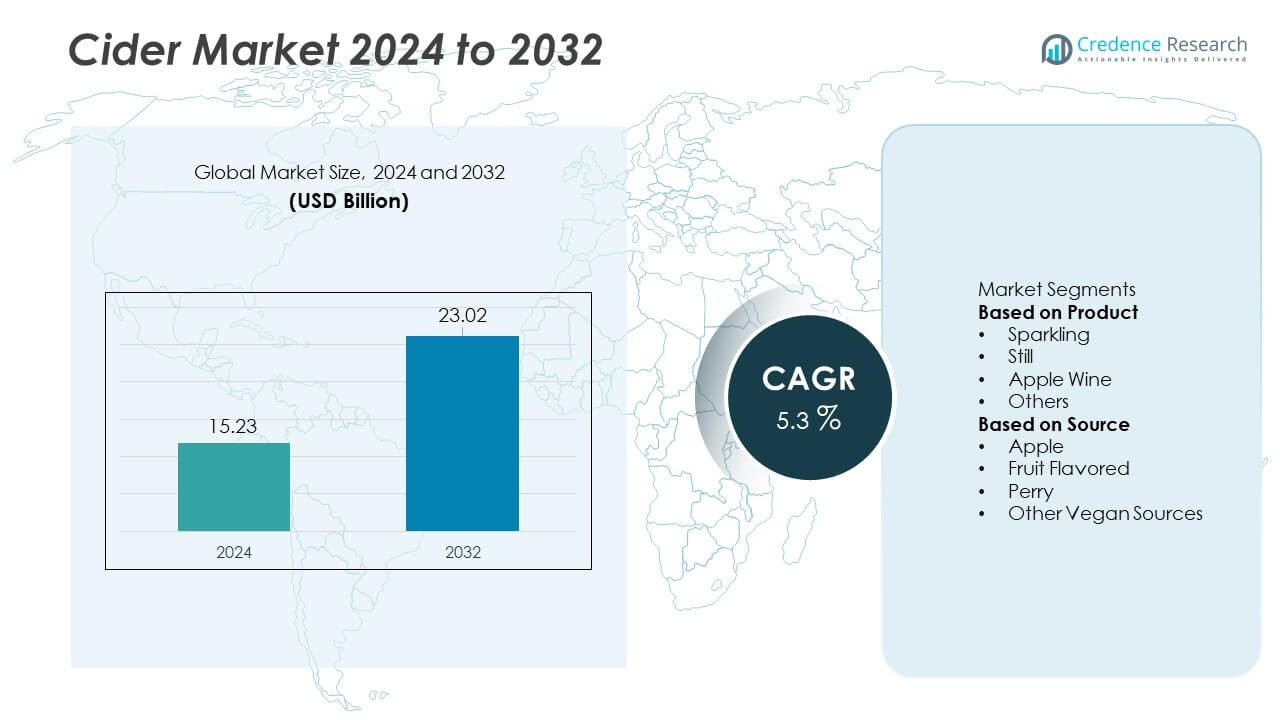
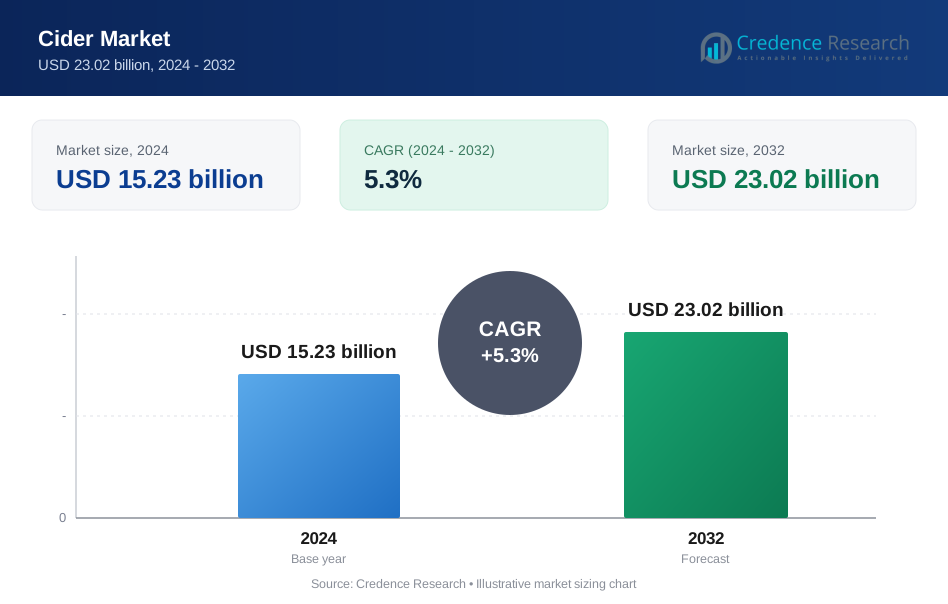
The Cider Market was valued at USD 15.23 billion in 2024 and is projected to reach USD 23.02 billion by 2032. The market is set to grow at a CAGR of 5.3% during the forecast period.
| REPORT ATTRIBUTE | DETAILS |
|---|---|
| Historical Period | 2020-2023 |
| Base Year | 2024 |
| Forecast Period | 2025-2032 |
| Cider Market Size 2024 | USD 15.23 Billion |
| Cider Market, CAGR | 5.3% |
| Cider Market Size 2032 | USD 23.02 Billion |
Top players in the Cider market include Thatchers Cider, AB InBev, Halewood Sales, The Boston Beer Company, Heineken N.V., Aston Manor, KOPPARBERGS BRYGGERI AB, C&C Group PLC, Carlsberg Breweries A/S, and Diageo. These companies strengthen their positions through wide product portfolios, strong distribution networks, and continuous innovation in flavors and packaging. Europe leads the global market with a 41% share, supported by deep-rooted cider traditions and strong consumption across pubs and retail channels. North America follows with a 34% share, driven by rising craft cider production and increasing demand for flavored, low-alcohol beverages.
Market Insights
- The market reached USD 15.23 billion in 2024 and will grow at a CAGR of 5.3 %, driven by steady global demand for flavored alcoholic drinks.
- Sparkling cider leads the product segment with a 46 % share, supported by strong consumer interest in carbonated, low-alcohol beverages across bars, restaurants, and retail outlets.
- Key trends include rising demand for fruit-flavored blends, craft production, and organic or vegan cider variants, strengthening premium product adoption among younger consumers.
- Leading players such as Thatchers Cider, AB InBev, Heineken N.V., and KOPPARBERGS BRYGGERI AB drive competition through flavor innovation, sustainable sourcing, and expanded distribution, while high production and raw material costs act as restraints.
- Europe holds a 41 % share due to strong cultural consumption, followed by North America with 34 %, while apple-based cider dominates sourcing with a 58 % share, reflecting continued preference for traditional fermentation.
Market Segmentation Analysis:
By Product
Sparkling cider leads this segment with a 46% share, driven by strong consumer demand for refreshing, carbonated alcoholic drinks. The segment grows as younger buyers shift toward light, flavorful beverages with lower alcohol content. Still cider attracts traditional consumers who prefer smooth and mellow taste profiles. Apple wine holds steady interest due to its richer flavor, while the “others” category includes niche craft variants gaining traction in urban markets. Brands expand sparkling lines with new flavors to match evolving tastes. Growing availability in bars, restaurants, and retail stores further strengthens segment dominance.
- For instance, The Boston Beer Company invested significantly in its Pennsylvania brewery to handle increased demand for brands including Angry Orchard, and in a prior period completed efficiency projects and expanded capacity as part of its brewing strategy.
By Source
Apple-based cider dominates the market with a 58% share, supported by strong global preference for authentic apple fermentation and classic taste. Fruit-flavored variants grow quickly as consumers seek new blends made from berries, tropical fruits, and citrus. Perry appeals to niche drinkers who enjoy pear-based fermentation. “Other vegan sources” gain attention through plant-based trends and craft innovations. Apple sourcing benefits from established orchards and consistent supply. Rising interest in flavored beverages drives experimentation across brands. Broader retail penetration and premium packaging enhance visibility for all categories within this segment.
- For instance, Aston Manor sources more than 25,000 tonnes of British apples annually for its fermentation operations.
Key Growth Drivers
Rising Demand for Flavored and Low-Alcohol Beverages
Growing interest in flavored alcoholic drinks strengthens demand for cider across all age groups. Consumers prefer light, refreshing options that offer lower alcohol content compared with spirits and beer. Brands introduce fruit-infused blends and seasonal flavors to attract younger buyers. Rising preference for casual drinking occasions supports wider consumption in bars and retail stores. Health-conscious consumers also choose cider as a moderate alternative. Expanding availability of premium and craft variants reinforces steady growth. This shift toward diverse flavors and lighter drinks continues to fuel market expansion.
- For instance, Heineken N.V. expanded its Strongbow flavor line, which is mass-produced using modern methods, including apple concentrate and sugar, and is fermented in vats such as the Bulmers Strongbow vat, the world's largest alcoholic container with a capacity of 6.8 million liters.
Expansion of Craft Cider Production and Premium Offerings
Craft cider makers boost market growth by offering unique blends, small-batch production, and premium ingredients. Consumers value authenticity, artisanal quality, and natural fermentation processes. Local orchards support craft producers with fresh apple supplies, enhancing regional identity. Premium ciders gain popularity in urban markets through distinctive flavors and specialty packaging. Restaurants and gourmet outlets promote craft labels for pairing menus. Growing tourism and tasting events strengthen consumer awareness. This rising craft movement increases product diversity and elevates cider’s position in the alcoholic beverage category.
- For instance, Diageo produces premium spirits and uses a variety of oak casks, including former bourbon casks and seasoned European oak/sherry casks, with maturation often lasting decades to achieve richer profiles
Growing Retail Penetration and Wider Distribution Networks
Retail chains expand shelf space for cider as demand rises across multiple flavor categories. Supermarkets, convenience stores, and online platforms provide extensive visibility for both mass and craft brands. Seasonal promotions encourage trial purchases, while subscription-based delivery supports recurring orders. Bars and restaurants diversify drink menus with sparkling and fruit-flavored ciders. Improved logistics enable producers to reach new markets quickly. Strong partnerships between producers and distributors ensure consistent supply. This widening distribution footprint directly supports sustained market growth.
Key Trends & Opportunities
Shift Toward Natural, Organic, and Vegan Cider Variants
Consumers increasingly seek clean-label, natural, and organic ingredients, encouraging producers to develop preservative-free and vegan-friendly ciders. Fruit-based formulations without artificial additives gain traction among health-conscious buyers. Brands explore organic apple sourcing and low-sugar recipes to meet rising wellness demand. Vegan ciders attract plant-based consumers, expanding reach across new customer groups. Certifications and transparent labeling improve trust and drive premium pricing. This trend creates strong opportunities for companies focusing on sustainable and natural production.
- For instance, beverage companies are upgrading their sugar-reduction technology, such as using flavor modulators, innovative sweetener blends, and advanced fermentation techniques, to deliver flavor stability in blends with significantly reduced sugar content.
Rising Popularity of Fruit-Flavored and Experimental Cider Blends
Fruit-flavored ciders grow as buyers seek bold, refreshing, and innovative taste profiles beyond traditional apple. Blends using berries, tropical fruits, citrus, and botanicals gain strong momentum. Limited-edition flavors support seasonal sales peaks. Craft producers experiment with barrel aging and mixed-fermentation techniques to attract premium drinkers. Younger consumers prefer adventurous flavors that pair well with social events. Global influence from flavored beverage trends increases demand for new varieties. This shift provides a significant opportunity for flavor innovation and portfolio expansion.
- For instance, the C&C Group is a major manufacturer and distributor of drinks, owning brands such as Bulmers and Magners cider, and has a small brewery on their Clonmel site.
Key Challenges
Fluctuating Raw Material Supply and Rising Production Costs
Apple harvest variability affects cider production, creating supply challenges for producers. Weather changes, pests, and seasonal inconsistencies impact yield and fruit quality. Craft producers face higher input costs due to reliance on fresh fruit and local orchards. Rising packaging and logistics expenses add pressure on margins. These cost fluctuations limit pricing flexibility in competitive markets. Producers must secure long-term sourcing agreements and invest in supply stability to maintain consistent product output.
Competition from Beer, Hard Seltzers, and Other Alcoholic Alternatives
Cider competes with fast-growing segments such as beer, hard seltzers, RTDs, and flavored alcoholic beverages. Aggressive marketing by large beverage brands increases competition for shelf space. Younger consumers often shift between categories, reducing long-term loyalty to cider. Price-sensitive buyers choose cheaper alcoholic options during economic slowdowns. Innovation in seltzers and cocktails diverts attention away from traditional cider. Producers must differentiate through flavor innovation, branding, and sustainability to protect market share.
Regional Analysis
North America
North America holds a 34% share, driven by rising demand for flavored alcoholic beverages and strong adoption of craft cider. The U.S. leads consumption due to expanding taprooms, tasting events, and retail availability across supermarkets and specialty stores. Younger consumers prefer low-alcohol options, supporting steady growth of sparkling and fruit-flavored ciders. Local orchards strengthen supply for small producers, while premium brands expand presence in urban markets. Increasing interest in sustainable and organic beverages enhances category visibility. Strong distribution networks and rising on-premise sales continue to support regional market expansion.
Europe
Europe accounts for a 41% share, making it the largest regional market due to long-standing cider traditions in the U.K., France, and Spain. Strong cultural acceptance and widespread consumption in pubs, restaurants, and retail stores reinforce steady demand. Premium apple-based ciders remain popular, while flavored and low-sugar variants grow among younger consumers. Regional producers benefit from established orchards, supporting consistent supply. The rise of artisanal and dry cider styles helps expand the premium segment. Tourism and seasonal festivals further boost consumption, strengthening Europe’s leading position in the global cider market.
Asia Pacific
Asia Pacific holds a 17% share, driven by rising interest in fruit-based alcoholic drinks across China, Japan, Australia, and South Korea. Growing urbanization and exposure to Western drinking trends support cider adoption among younger consumers. Flavored and sparkling variants gain traction due to their light taste profiles. Retail expansion and online alcohol delivery platforms increase availability across urban centers. Craft producers in Australia and New Zealand boost regional production with premium blends. Rising disposable income and lifestyle shifts continue to strengthen cider demand across Asia Pacific markets.
Latin America
Latin America captures a 5% share, supported by emerging interest in flavored alcoholic beverages and rising consumption in Brazil, Mexico, and Chile. Younger consumers shift toward lighter, fruit-based drinks, creating demand for sparkling and fruit-flavored ciders. Retail penetration increases as supermarkets expand imported and premium alcoholic categories. Local craft producers experiment with tropical fruit blends to attract new users. Tourism in coastal regions boosts seasonal consumption. Although niche, the category grows steadily as consumers seek alternatives to beer and traditional spirits across the region.
Middle East & Africa
The Middle East & Africa region holds a 3% share, influenced by growing tourism, premium hospitality outlets, and rising acceptance of low-alcohol beverages in select markets. Countries such as South Africa and the UAE lead demand, supported by expanding retail channels and craft producers introducing premium blends. Non-alcoholic and low-alcohol ciders gain traction in markets with strict alcohol regulations. Fruit-flavored options appeal to younger consumers seeking refreshing alternatives. Hotel chains and beach resorts support rising consumption, gradually strengthening regional market presence.
Market Segmentations:
By Product
- Sparkling
- Still
- Apple Wine
- Others
By Source
- Apple
- Fruit Flavored
- Perry
- Other Vegan Sources
By Geography
- North America
- U.S.
- Canada
- Mexico
- Europe
- Germany
- France
- U.K.
- Italy
- Spain
- Rest of Europe
- Asia Pacific
- China
- Japan
- India
- South Korea
- South-east Asia
- Rest of Asia Pacific
- Latin America
- Brazil
- Argentina
- Rest of Latin America
- Middle East & Africa
- GCC Countries
- South Africa
- Rest of the Middle East and Africa
Competitive Landscape
The competitive landscape includes Thatchers Cider, AB InBev, Halewood Sales, The Boston Beer Company, Heineken N.V., Aston Manor, KOPPARBERGS BRYGGERI AB, C&C Group PLC, Carlsberg Breweries A/S, and Diageo as the major players shaping market growth. These companies strengthen their presence through diverse product portfolios, ranging from traditional apple-based ciders to fruit-flavored and premium craft variants. Leading brands invest in advanced fermentation techniques, sustainable sourcing, and innovative packaging to meet rising consumer expectations. Global players expand distribution through supermarkets, pubs, and online channels, ensuring strong regional penetration. Craft cider producers create competition by offering small-batch blends that attract premium consumers. Marketing campaigns, seasonal launches, and flavor experimentation help companies differentiate their offerings. Steady investment in brand visibility and product innovation continues to elevate competitiveness across global markets.
Key Player Analysis
- Thatchers Cider
- AB InBev
- Halewood Sales
- The Boston Beer Company, Inc.
- Heineken N.V.
- Aston Manor
- KOPPARBERGS BRYGGERI AB
- C&C Group PLC
- Carlsberg Breweries A/S
- Diageo
Recent Developments
- In August 2024, C&C Group PLC struck a cooperation agreement with investment firm Engine Capital under which the company would appoint one new non-executive director from a short-list of nominees agreed upon with Engine Capital.
- In 2023, Anheuser‑Busch InBev sold the U.S. cider brand Virtue Cider to brewer Greg Hall, who plans to steer Virtue back to a craft-style, European-inspired cider focus.
Report Coverage
The research report offers an in-depth analysis based on Product, Source and Geography. It details leading market players, providing an overview of their business, product offerings, investments, revenue streams, and key applications. Additionally, the report includes insights into the competitive environment, SWOT analysis, current market trends, as well as the primary drivers and constraints. Furthermore, it discusses various factors that have driven market expansion in recent years. The report also explores market dynamics, regulatory scenarios, and technological advancements that are shaping the industry. It assesses the impact of external factors and global economic changes on market growth. Lastly, it provides strategic recommendations for new entrants and established companies to navigate the complexities of the market.
Future Outlook
- Demand for cider will grow as consumers choose lighter and fruit-based alcoholic beverages.
- Craft cider producers will expand premium offerings with unique blends and natural ingredients.
- Flavored variants will gain traction as younger consumers seek diverse and refreshing taste profiles.
- Organic and vegan cider lines will rise as clean-label preferences strengthen worldwide.
- Online alcohol delivery platforms will boost accessibility and widen consumer reach.
- Hospitality and restaurant chains will increase cider listings to meet growing on-premise demand.
- Producers will adopt sustainable sourcing and packaging to appeal to eco-conscious buyers.
- Innovation in fermentation and aging techniques will enhance product quality and differentiation.
- Global brands will expand distribution networks to capture emerging markets.
- Seasonal and limited-edition flavors will drive repeat purchases and strengthen brand loyalty.
Request a Free Sample
Fill in your details and we'll send you a free sample report.
- Sample data tables & charts
- Research methodology
Need a Custom Version of This Report?
Tailor the scope, geography, or segments to your exact requirements.
- Custom geography or segment scope
- Direct access to our analyst team
Frequently Asked Questions
What is the current market size for the Cider market, and what is its projected size in 2032?
At what Compound Annual Growth Rate is the Cider market projected to grow between 2025 and 2032?
Which Cider market segment held the largest share in 2024?
What are the primary factors fueling the growth of the Cider market?
Who are the leading companies in the Cider market?
Which region commanded the largest share of the Cider market in 2024?
Table of Content
Chapter 1. Report Introduction
- 1.1 Report Description & Purpose
- 1.1.1 Report Title & Market Definition
- 1.1.2 Unique Selling Propositions (USP) & Key Differentiators
- 1.1.3 Value Proposition for Stakeholders
- 1.2 Research Objectives
- 1.2.1 Market Sizing Objectives (Volume & Revenue) (Volume Where Applicable)
- 1.2.2 Segmentation Objectives
- 1.2.3 Competitive Intelligence Objectives
- 1.2.4 Forecast & Scenario Objectives
- 1.3 Report Scope
- 1.3.1 Cider Scope – Segments & Subsegments Covered
- 1.3.2 Geographic Scope – Regions & Countries Covered
- 1.3.3 Historical Period, Base Year & Forecast Period (2024; forecast to 2032)
- 1.3.4 Inclusions & Exclusions
- 1.4 Industry Classification & Applicable Codes
- 1.5 Currency, Measurement Units & Valuation Basis
- 1.6 Target Stakeholders
- 1.7 Limitations & Assumptions
Chapter 2. Executive Summary
- 2.1 Global Cider Market Snapshot
- 2.1.1 Market Size – Historical (2024) & Forecast (2024-2032) (2024: USD 15.23 billion → 2032: USD 23.02 billion)
- 2.1.2 Volume & Revenue – Global Totals (Volume Where Applicable)
- 2.1.3 Key Market Highlights – Top Five Facts
- 2.2 Cider Market Segmentation Snapshot
- 2.2.1 Market Split by Region – 2024 vs. 2032
- 2.3 Competitive Snapshot
- 2.3.1 Top 10 Players by Revenue Share – 2024
- 2.3.2 Top 10 Players by Volume Share – 2024 (Volume Where Applicable)
- 2.3.3 Recent Strategic Developments (18-Month Summary)
- 2.4 Key Investment Highlights & Strategic Conclusions
Chapter 3. Cider Market Dynamics & Industry Analysis
- 3.1 Market Overview & Context
- 3.1.1 Cider Market Position in the Broader Industry Value Chain
- 3.1.2 Demand Structure & Purchasing Dynamics
- 3.1.3 Market Maturity & Development Stage by Region
- 3.2 Cider Market Drivers
- 3.3 Cider Market Restraints & Challenges
- 3.4 Cider Market Opportunities
- 3.5 Porter's Five Forces Analysis
- 3.5.1 Threat of New Entrants
- 3.5.2 Bargaining Power of Suppliers
- 3.5.3 Bargaining Power of Buyers
- 3.5.4 Threat of Substitutes
- 3.5.5 Competitive Rivalry – Intensity Assessment
- 3.6 Cider Value Chain Analysis
- 3.6.1 Upstream – Key Inputs, Resources & Suppliers
- 3.6.1.1 Key Input/Resource 1
- 3.6.1.2 Key Input/Resource 2
- 3.6.1.3 Key Input/Resource 3
- 3.6.2 Midstream – Core Operations & Value Creation
- 3.6.2.1 Operating Model & Process Overview
- 3.6.2.2 Key Operating Locations & Capabilities by Company
- 3.6.3 Downstream – Market Channels & End Users
- 3.6.3.1 Direct Sales & Customer Engagement Channels
- 3.6.3.2 Indirect Sales, Intermediaries & Partner Channels
- 3.6.4 Value Chain Profitability Analysis
- 3.6.1 Upstream – Key Inputs, Resources & Suppliers
- 3.7 PESTEL Analysis
- 3.7.1 Political Factors
- 3.7.2 Economic Factors
- 3.7.3 Social Factors
- 3.7.4 Technological Factors
- 3.7.5 Environmental Factors
- 3.7.6 Legal Factors
- 3.8 Cider Supply Chain Analysis
- 3.8.1 Critical Input & Resource Availability Risk Assessment
- 3.8.2 Supplier & Operational Concentration Risk (Geographic Exposure)
- 3.8.3 Supply & Service Disruption Impact Analysis
- 3.9 Regulatory & Policy Landscape
Note: The regulatory and policy landscape section covers regulations based on their applicability to the market, Cider category, geography, and scope of the study. Only regulatory frameworks with a material impact on operations, compliance, trade, sustainability, or market access are analyzed in detail.
Chapter 4. Key Investment Pockets & Opportunity Analysis
- 4.1 Cider Market Attractiveness Analysis
- 4.1.1 By Region – Investment Attractiveness Matrix (Market Size × CAGR)
- 4.2 Absolute Revenue Growth Opportunity
- 4.2.1 By Region – Absolute Revenue Growth Through 2032
- 4.3 Incremental Demand Opportunity
- 4.3.1 By Region – Incremental Demand Through 2032
- 4.3.2 Segment – Incremental Demand
- 4.4 Emerging Submarket Opportunity Deep Dive (Subject to Applicability)
- 4.5 Priority Market Opportunity Scorecards
- 4.5.1 United States
- 4.5.2 Europe
- 4.5.3 Asia
- 4.5.4 Middle East & Africa
Note: Priority market opportunity scorecards reflect the geographic scope and strategic relevance of the study. Listed markets are indicative and may be adapted to the industry.
Chapter 5. Cider Cross-Border Trade & Market Access Analysis
- 5.1 International Trade & Cross-Border Activity Overview
- 5.1.1 Global Export Value by Country (2024)
- 5.1.2 Global Export Volume by Country (2024) (Volume Where Applicable)
- 5.1.3 Global Import Value by Country (2024)
- 5.1.4 Global Import Volume by Country (2024) (Volume Where Applicable)
- 5.1.5 Net Trade Balance by Country (2024)
- 5.2 Export Analysis – Segment
- 5.2.1 Category 1 (Applicable Classification Code)
- 5.2.2 Category 2 (Applicable Classification Code)
- 5.2.3 Category 3 (Applicable Classification Code)
- 5.2.4 Category 4 (Applicable Classification Code)
- 5.2.5 Category 5 (Applicable Classification Code)
- 5.3 Import Analysis – Segment
- 5.3.1 Category 1 (Applicable Classification Code)
- 5.3.2 Category 2 (Applicable Classification Code)
- 5.3.3 Category 3 (Applicable Classification Code)
- 5.3.4 Category 4 (Applicable Classification Code)
- 5.3.5 Category 5 (Applicable Classification Code)
- 5.4 Cross-Border Pricing & Transaction Benchmarks
- 5.4.1 Export Pricing – Segment & Country
- 5.4.2 Import Pricing – Segment & Source Country
- 5.4.3 Price Trends (2024)
- 5.5 Key Cross-Border Trade & Delivery Routes
- 5.5.1 Cross-Border Trade/Delivery Route 1
- 5.5.2 Cross-Border Trade/Delivery Route 2
- 5.5.3 Cross-Border Trade/Delivery Route 3
- 5.5.4 Cross-Border Trade/Delivery Route 4
- 5.5.5 Cross-Border Trade/Delivery Route 5
- 5.6 Trade Policy & Market Access Impact Assessment
- 5.6.1 Tariff & Non-Tariff Barriers
- 5.6.2 Regional Trade & Economic Integration Frameworks
- 5.6.3 Bilateral & Multilateral Trade Agreements
- 5.6.4 Cross-Border Operating, Licensing & Localization Requirements
Note: This chapter applies where cross-border trade or delivery is relevant to Cider. Goods, services, and digital offerings are assessed using applicable classifications and transaction measures. Import-export volumes, trade balances, and route analyses are included only where meaningful to the market.
Chapter 6. Competitive Landscape & Company Benchmarking
- 6.1 Cider Market Concentration & Structure
- 6.1.1 Herfindahl-Hirschman Index (HHI) – the historical period vs. 2024
- 6.1.2 Leading, Mid-Sized & Emerging Player Structure
- 6.1.3 Global, Regional & Local Player Dynamics
- 6.2 Cider Market Share Analysis – 2024
- 6.2.1 Global Revenue Share by Company
- 6.2.2 Global Volume Share by Company (Volume Where Applicable)
- 6.2.3 Regional Revenue Share
- 6.2.4 Market Share Evolution (the historical period vs. 2024)
- 6.2.5 Company Market Share by Key Segment
- 6.2.6 Company Market Share by Customer Group
- 6.3 Operating Scale, Capacity & Infrastructure Analysis
- 6.3.1 Global Operating Scale & Supply Capacity
- 6.3.2 Resource Utilization & Operating Efficiency
- 6.3.3 Output, Service Delivery & Activity Metrics
- 6.3.4 Operating Footprint & Infrastructure Map
- 6.3.5 Planned Operational & Capacity Expansion
- 6.4 Cider Competitive Benchmarking Matrix
- 6.4.1 Revenue, Growth, Profitability & Operating Metric Comparison
- 6.4.2 Channel Revenue Mix
- 6.4.3 Geographic Revenue Exposure
- 6.4.4 R&D Intensity
- 6.4.5 Sustainability Maturity
- 6.5 Strategic Developments in Cider (Last 24 Months)
- 6.5.1 Mergers, Acquisitions & Divestments
- 6.5.2 New Products, Services & Solutions in Cider
- 6.5.3 Operational & Infrastructure Expansions
- 6.5.4 Strategic Alliances, Joint Ventures & Partnerships
- 6.5.5 Distribution Expansion & Market Entry
- 6.5.6 Sustainability & ESG Initiatives
- 6.6 Competitive Strategy Mapping
- 6.6.1 Leader, Challenger, Follower & Niche Classification
- 6.6.2 Pricing Strategy Comparison
- 6.6.3 Channel Strategy Matrix
Note: Strategic developments are included based on their materiality and the availability of reliable information.
Chapter 7. Global Cider Market – By Sales & Delivery Channel
- 7.1 Segment Overview
- 7.1.1 Volume & Revenue Split by Channel (2024 & 2032) (Volume Where Applicable)
- 7.1.2 Channel Mix Evolution (2024-2032)
Chapter 8. Regional Market Analysis – Global Overview
- 8.1 Global Regional Overview
- 8.1.1 Regional Volume Share (Volume Where Applicable)
- 8.1.2 Regional Revenue Share
- 8.1.3 Regional Volume by Region (Volume Where Applicable)
- 8.1.4 Regional Revenue by Region
- 8.1.5 Regional Forecast Through 2032
- 8.2 Cross-Regional Segment Analysis
- 8.2.1 By Sales & Delivery Channel
- 8.2.2 By Competitive Positioning & Price Tier
Chapter 9. North America Cider Market
- 9.1 United States
- 9.2 Canada
- 9.3 Mexico
Chapter 10. Europe Cider Market
- 10.1 Germany
- 10.2 France
- 10.3 Italy
- 10.4 United Kingdom
- 10.5 Spain
- 10.6 Poland
- 10.7 Russia
- 10.8 Netherlands
- 10.9 Belgium
- 10.10 Sweden
- 10.11 Denmark
- 10.12 Norway
- 10.13 Rest of Europe
Chapter 11. Asia Pacific Cider Market
- 11.1 China
- 11.2 India
- 11.3 Japan
- 11.4 South Korea
- 11.5 Thailand
- 11.6 Indonesia
- 11.7 Vietnam
- 11.8 Malaysia
- 11.9 Australia
- 11.10 Rest of Asia Pacific
Chapter 12. Latin America Cider Market
- 12.1 Brazil
- 12.2 Argentina
- 12.3 Colombia
- 12.4 Chile
- 12.5 Rest of Latin America
Chapter 13. Middle East Cider Market
- 13.1 Saudi Arabia
- 13.2 United Arab Emirates
- 13.3 Turkey
- 13.4 Israel
- 13.5 Iran
- 13.6 Rest of the Middle East
Chapter 14. Africa Cider Market
- 14.1 South Africa
- 14.2 Egypt
- 14.3 Nigeria
- 14.4 Morocco
- 14.5 Rest of Africa
Chapter 15. Cider Company Profiles
- 15.1 [Company 01]
- 15.1.1 Company Overview
- 15.1.2 Key Management Personnel
- 15.1.3 Products & Services Portfolio
- 15.1.4 Financial Performance
- 15.1.5 Key Market Focus & Geographic Presence
- 15.1.6 Recent Developments & Strategic Initiatives
Note: The company profile list is preliminary and may change based on research findings, market developments, data availability, and client requirements.
Chapter 16. Appendices
- Appendix A – List of Abbreviations & Acronyms
- Appendix B – Industry Classification Code Reference – Full Series
- Appendix C – Supply, Output & Operating Capacity Data Tables
- Appendix D – End-Use & Demand Base Tables
- Appendix E – Demand, Adoption & Usage Assumptions
- Appendix F – Pricing & Revenue Metric Reference Tables
- Appendix G – Company Operations & Infrastructure Database
- Appendix H – Cross-Border Trade & Activity Data Tables (Where Applicable)
- Appendix I – Regulatory Summary Tables
- Appendix J – Primary Research Participant List (Anonymized)
- Appendix K – Primary Research Questionnaire Framework
- Appendix L – Data Sources & Bibliography
- Appendix M – Market Size Divergence & Source Comparison
Chapter 17. Research Methodology
- 17.1 Research Framework & Philosophy
- 17.2 Secondary Research – Sources, Hierarchy & Data Extraction
- 17.3 Data Modeling – Bottom-Up & Top-Down Market Sizing
- 17.4 Primary Research – Stakeholder Framework, LOI & Sample Sizes
- 17.5 Forecast Methodology – Regression, Scenario & Sensitivity Analysis
- 17.6 Quality Control – Four-Layer Validation Framework
- 17.7 Limitations & Standard Assumptions
- 17.8 Disclaimer
