
Market Overview:
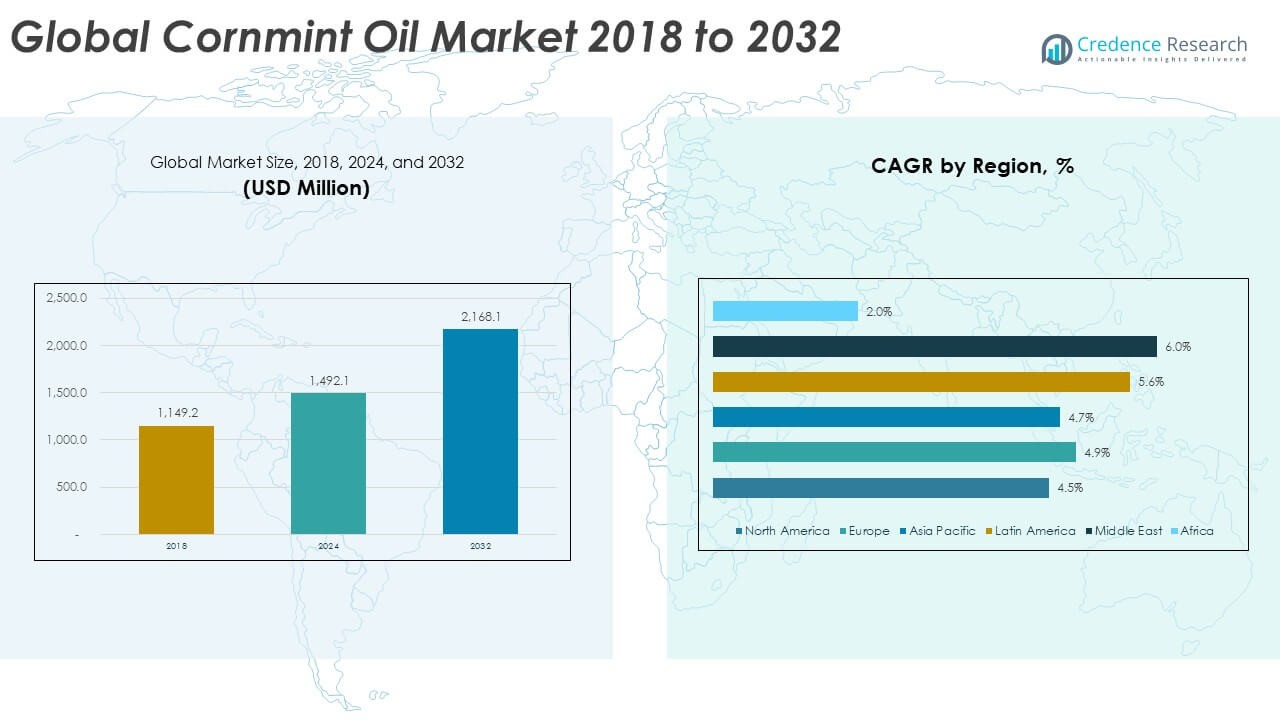
The Global Cornmint Oil Market size was valued at USD 1,149.2 million in 2018 to USD 1,492.1 million in 2024 and is anticipated to reach USD 2,168.1 million by 2032, at a CAGR of 4.81% during the forecast period.
| REPORT ATTRIBUTE | DETAILS |
|---|---|
| Historical Period | 2020-2023 |
| Base Year | 2024 |
| Forecast Period | 2025-2032 |
| Cornmint Oil Market Size 2024 | USD 1,492.1 Million |
| Cornmint Oil Market, CAGR | 4.81% |
| Cornmint Oil Market Size 2032 | USD 2,168.1 Million |
The market growth is driven by the increasing demand for natural ingredients in personal care, pharmaceuticals, and food products. Cornmint oil is valued for its high menthol content, offering strong cooling and aromatic properties. Expanding applications in aromatherapy, oral care, and medicinal formulations further boost its use. Rising consumer preference for organic and sustainable essential oils supports steady global demand among manufacturers and end users.
Asia Pacific dominates the Global Cornmint Oil Market due to the strong cultivation base in India and China. North America and Europe show consistent demand from the pharmaceutical and cosmetic sectors. Emerging economies in Latin America and the Middle East are witnessing increased adoption, supported by growing awareness of natural oil benefits and expanding manufacturing capacities.
Market Insights:
- The Global Cornmint Oil Market size was valued at USD 1,149.2 million in 2018, reached USD 1,492.1 million in 2024, and is projected to hit USD 2,168.1 million by 2032, growing at a CAGR of 4.81%.
- Asia Pacific holds the largest share of about 35%, supported by strong production in India and China, large cultivation bases, and expanding export capabilities.
- Europe follows with 27% share, driven by high demand for natural and sustainable oils across cosmetics, pharmaceuticals, and wellness sectors. North America ranks third with 19%, backed by advanced manufacturing infrastructure and strong consumer awareness of essential oils.
- The Middle East, holding 5% share, is the fastest-growing region with rising demand for aromatherapy and spa products, aided by tourism expansion and higher disposable incomes.
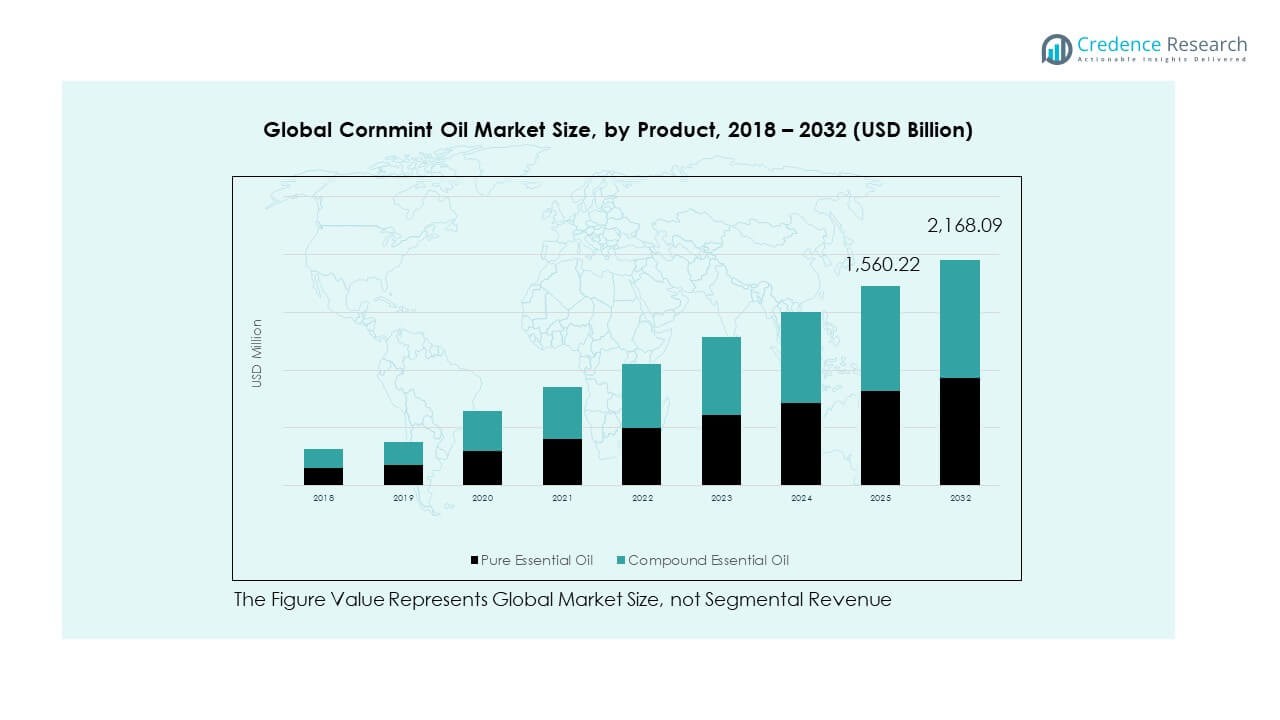
- Based on the chart, pure essential oil contributes around 45% of the total market share, while compound essential oil accounts for roughly 55%, reflecting its growing use in blended wellness and fragrance applications.
Market Drivers:
Growing Use of Natural Ingredients in Food, Pharma, and Cosmetics
The Global Cornmint Oil Market is driven by rising demand for natural and organic ingredients across multiple industries. Consumers increasingly prefer plant-based oils in food flavoring, pharmaceuticals, and cosmetics due to health and environmental awareness. Cornmint oil, rich in menthol, finds widespread use in balms, toothpastes, and cooling agents. Its antimicrobial and anti-inflammatory benefits increase adoption in personal care products. The pharmaceutical sector uses it in pain-relief and digestive formulations. Demand growth in natural fragrances also supports its expansion. Manufacturers are shifting from synthetic to natural oils for safety and consumer trust. Strong marketing around “clean-label” and “chemical-free” products further accelerates growth.
- For instance, BASF has achieved technical milestones in sustainable menthol production by implementing advanced aroma ingredient processes at its Ludwigshafen site, and recently resumed large-scale menthol output aligned with EU sustainability standards and direct supply agreements for oral care, flavor, and cosmetic manufacturers in 2024.
Expanding Applications in Aromatherapy and Wellness Products
The rising popularity of aromatherapy is a key factor supporting the market. Cornmint oil’s refreshing and calming properties make it a popular choice among wellness brands. Consumers associate menthol-rich oils with relaxation, relief from stress, and improved sleep. The market benefits from growing wellness tourism and spa culture in both developed and emerging economies. The use of diffusers, inhalers, and massage oils continues to expand. Health-conscious populations are adopting aromatherapy as a complementary health practice. Producers are developing blends and concentrates targeting specific therapeutic effects. Increased online distribution also enables wider accessibility to consumers globally.
- For instance, doTERRA regularly introduces new essential oil blends for aromatherapy and wellness audiences, with product launches at major conventions that garner attention from tens of thousands of consumers; its focus remains on pure sourcing and verified composition for global wellness markets.
Growth in Oral and Personal Care Segments Enhancing Demand
Cornmint oil is an essential ingredient in oral hygiene and skincare products. Its antibacterial nature supports use in toothpaste, mouthwash, and gum care. Personal care manufacturers include it in creams, lotions, and shampoos for its cooling and soothing sensation. The trend toward natural and herbal products enhances its market value. The Global Cornmint Oil Market benefits from growing cosmetic innovation, including menthol-infused skincare lines. Regulatory approval for use in consumer products strengthens its position. Leading FMCG companies are investing in expanding natural product lines. It continues to see high adoption due to consumer preference for multifunctional products.
Rising Production in Key Cultivation Regions Supporting Supply Stability
High cultivation of cornmint in countries like India and China ensures a stable global supply. Farmers in these regions benefit from favorable climatic conditions and established distillation facilities. Governments are promoting essential oil exports, boosting production capacity. The market benefits from organized supply chains and cooperative farming models. Technological advancements in extraction and purification increase output quality. Rising local consumption in these regions adds to demand balance. The Global Cornmint Oil Market gains from consistent production and reduced dependency on synthetic alternatives. Strong export potential continues to attract new investors and processing firms.
Market Trends:
Shifting Consumer Preference Toward Sustainable and Traceable Sourcing
The market is witnessing a strong shift toward sustainability and transparent sourcing practices. Buyers demand traceable origin information for essential oils to ensure ethical and eco-friendly production. Producers are adopting sustainable farming techniques and fair-trade certification. The Global Cornmint Oil Market is benefiting from companies prioritizing environmentally safe extraction and packaging. Brands are highlighting their supply chain integrity to build consumer trust. Certification labels such as USDA Organic and ISO drive higher value perception. Demand for sustainability-compliant suppliers grows among multinational corporations. This trend supports long-term supply chain resilience and quality assurance.
- For instance, Givaudan prioritizes supply chain transparency and works directly with smallholder producers for natural ingredient sourcing, including mint oils, implementing responsible sourcing policies and direct collection networks to certify traceability at origin.
Technological Advancements in Extraction and Processing Techniques
Advances in distillation and purification technologies are improving yield and product quality. Modern steam distillation systems help reduce energy use while retaining menthol concentration. Manufacturers are exploring CO₂ extraction methods for purity and consistency. These innovations enhance efficiency and reduce waste. The Global Cornmint Oil Market benefits from the ability to produce standardized and high-quality oils for global distribution. Continuous R&D investment supports product diversification and consistency. Process automation also minimizes contamination risk and human error. Improved efficiency encourages smaller producers to adopt advanced processing methods.
- For instance, in November 2024, Robertet Group acquired Phasex Corporation, a pioneer in supercritical CO₂ extraction, to advance the efficiency and sustainability of its natural ingredient extraction operations for fragrances and flavors in North America.
Rising Popularity of Menthol-Based Functional Beverages and Food Products
Manufacturers are introducing menthol-infused food and beverage products targeting health-conscious consumers. Cornmint oil’s natural cooling profile is used in gums, candies, and flavored waters. The trend aligns with the growing preference for sensory and functional ingredients. The Global Cornmint Oil Market experiences rising adoption in confectionery and nutraceutical segments. Food processors are developing sugar-free, refreshing products for broader audiences. The menthol flavor is also appealing for summer-oriented beverages. Rising urbanization and disposable income are driving consumption. Global brands are introducing premium product lines using natural menthol extracts.
Integration of Cornmint Oil in Pharmaceutical and Therapeutic Formulations
The pharmaceutical sector continues to expand applications for cornmint oil. It is used in topical analgesics, nasal sprays, and digestive treatments. Formulators prefer it for its antimicrobial and pain-relief properties. The Global Cornmint Oil Market benefits from the rise of natural therapies and herbal medicine. Consumers seek alternatives to synthetic compounds for chronic and mild conditions. Demand for over-the-counter herbal products continues to grow. Regulatory recognition of essential oils in traditional medicine systems enhances acceptance. Continued R&D in medical aromatherapy boosts its long-term relevance.
Market Challenges Analysis:
Volatile Raw Material Prices and Dependence on Agricultural Yields
The market faces uncertainty due to raw material price fluctuations and crop dependency. Cornmint cultivation relies on specific climatic conditions, making it vulnerable to weather disruptions. Variations in rainfall and temperature can impact yield and oil quality. The Global Cornmint Oil Market must manage risks linked to seasonal production cycles. Farmers’ limited access to technology or irrigation reduces consistency. Sudden increases in demand cause short-term price surges and supply imbalance. Importers face challenges in maintaining long-term contract stability. These factors collectively affect profit margins and pricing predictability across regions.
Stringent Quality Standards and Increasing Competition from Synthetic Substitutes
Strict international quality regulations create compliance challenges for exporters and producers. Essential oils must meet purity, safety, and labeling standards in global trade. The Global Cornmint Oil Market competes with low-cost synthetic menthol, which affects pricing structure. Synthetic alternatives offer uniformity and longer shelf life, appealing to industrial buyers. Smaller producers struggle to match certification and consistency requirements. Adulteration risks further reduce buyer confidence in unregulated markets. Maintaining high purity and quality certification increases production costs. These regulatory and competitive pressures limit small-scale producers’ ability to expand.
Market Opportunities:
Expanding Use of Cornmint Oil in Premium Wellness and Personal Care Products
The Global Cornmint Oil Market holds significant potential in the wellness and cosmetic sectors. Premium skincare and aromatherapy products increasingly use natural menthol oil for sensory appeal. Brands are formulating blends emphasizing freshness, calmness, and organic purity. The trend toward chemical-free beauty supports high-value product launches. Manufacturers targeting luxury consumers are incorporating cornmint oil in premium lotions, oils, and balms. Expanding e-commerce platforms enhance accessibility and consumer reach. Partnerships between beauty and essential oil brands will further boost market visibility.
Growing Export Potential and Investment in Processing Infrastructure
Emerging economies are expanding exports of cornmint oil to global markets. Governments support value-added production through industrial policies and farmer cooperatives. The Global Cornmint Oil Market benefits from investments in advanced extraction facilities and quality testing labs. Rising international demand for natural menthol supports large-scale production upgrades. Investors are exploring partnerships in India, China, and Southeast Asia for raw material sourcing. Improved logistics networks and trade liberalization make exports more efficient. These developments create growth opportunities across both upstream and downstream segments.
Market Segmentation Analysis:
By Product Segment
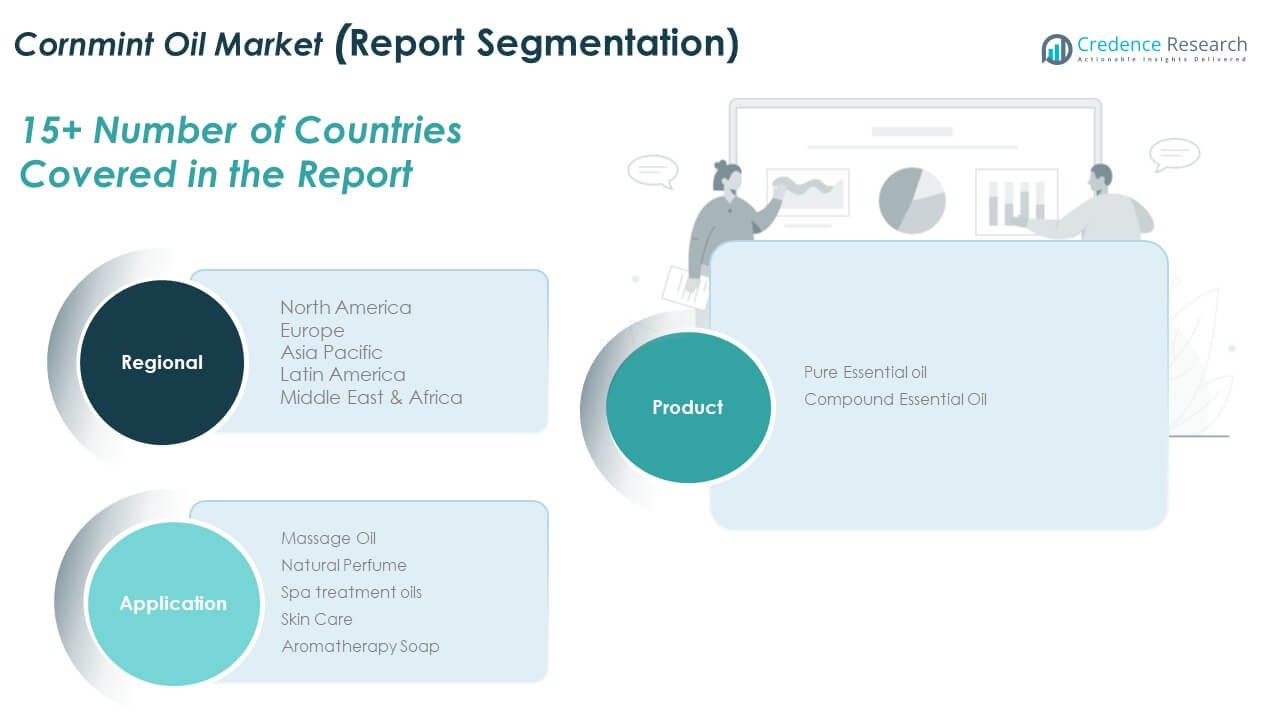
The Global Cornmint Oil Market is segmented into pure essential oil and compound essential oil. Pure essential oil dominates due to its higher menthol concentration and natural aroma, making it ideal for pharmaceutical and personal care applications. It is widely used in therapeutic, cosmetic, and oral care formulations for its cooling and antibacterial properties. Compound essential oil holds a growing share, supported by its blended use in fragrances and aromatherapy products. The segment benefits from expanding consumer demand for affordable yet natural ingredients. Manufacturers continue to innovate blended formulations to meet evolving end-user preferences. Rising interest in customized fragrances and wellness products further enhances growth potential across both product categories.
- For instance, Symrise is recognized internationally for supplying natural mint oils and nature-identical menthol to leading oral care brands and for enabling backward-integrated production processes for thousands of fragrance and flavor customers.
By Application Segment
The market is classified into massage oil, natural perfume, spa treatment oils, skin care, and aromatherapy soap. Massage oil remains a leading segment due to its extensive use in wellness and relaxation therapies. Natural perfume and spa treatment oils are gaining traction with the popularity of organic and chemical-free formulations. Skin care applications show strong demand driven by menthol’s cooling and soothing effects. Aromatherapy soap contributes to growth through its sensory appeal and stress-relief benefits. The expansion of beauty and wellness industries supports sustained adoption across all applications, strengthening the market’s overall performance.
- For instance, L’Occitane en Provence has launched new eco-designed aromachology wellness collections for the hospitality and spa sector, featuring essential oils including mint, and public records confirm these products have been rolled out to premium hotel and spa venues globally since early 2024.
Segmentation:
By Product Segment
- Pure Essential Oil
- Compound Essential Oil
By Application Segment
- Massage Oil
- Natural Perfume
- Spa Treatment Oils
- Skin Care
- Aromatherapy Soap
By Region
- North America
- U.S.
- Canada
- Europe
- Germany
- France
- Italy
- U.K.
- Russia
- Rest of Europe
- Asia-Pacific
- India
- China
- Japan
- Rest of Asia-Pacific
- Latin America
- Brazil
- Mexico
- Rest of Latin America
- Middle East and Africa
- GCC Countries
- South Africa
- Rest of Middle East and Africa
Regional Analysis:
North America
The North America Global Cornmint Oil Market size was valued at USD 227.31 million in 2018 to USD 290.35 million in 2024 and is anticipated to reach USD 412.59 million by 2032, at a CAGR of 4.5% during the forecast period. North America accounts for around 19% share of the global market. The region’s growth is driven by increasing use of cornmint oil in pharmaceuticals, personal care, and aromatherapy products. The United States leads due to advanced processing facilities and higher consumer awareness about natural wellness products. Demand for menthol-based products in oral care and cosmetics continues to rise. Growing adoption of aromatherapy for stress relief and relaxation supports market expansion. Canada and Mexico contribute through manufacturing and export activities. Strong retail distribution networks enhance accessibility of essential oils, strengthening regional market performance.
Europe
The Europe Global Cornmint Oil Market size was valued at USD 307.18 million in 2018 to USD 400.58 million in 2024 and is anticipated to reach USD 585.38 million by 2032, at a CAGR of 4.9% during the forecast period. Europe holds about 27% share of the global market. The region benefits from strong demand for natural and sustainable ingredients in cosmetics, food, and pharmaceutical sectors. Germany, France, and the United Kingdom are key consumers due to established wellness industries. Manufacturers are focusing on organic certification and traceable sourcing. Growth in aromatherapy and spa-based treatments increases product utilization. The European Union’s emphasis on clean-label formulations supports expansion. Rising consumer preference for chemical-free skincare enhances product penetration. The regional market maintains steady growth through innovation and premium product positioning.
Asia Pacific
The Asia Pacific Global Cornmint Oil Market size was valued at USD 409.91 million in 2018 to USD 527.96 million in 2024 and is anticipated to reach USD 758.83 million by 2032, at a CAGR of 4.7% during the forecast period. Asia Pacific represents around 35% share of the global market, making it the largest regional segment. India and China dominate due to large-scale cultivation and processing capacity. The region serves as both a production and export hub for natural essential oils. Growing consumer spending on personal care and natural health products fuels demand. Increasing industrial applications and rising awareness of aromatherapy support long-term growth. Regional governments encourage agricultural exports and essential oil manufacturing. Expanding retail and e-commerce networks enhance product accessibility across emerging economies.
Latin America
The Latin America Global Cornmint Oil Market size was valued at USD 122.62 million in 2018 to USD 167.08 million in 2024 and is anticipated to reach USD 258.00 million by 2032, at a CAGR of 5.6% during the forecast period. Latin America contributes about 11% share of the global market. Brazil and Argentina lead consumption, supported by growing wellness and personal care industries. Local manufacturers are expanding production for export and regional distribution. The rise in demand for herbal cosmetics and natural perfumes strengthens market prospects. Increasing spa culture and aromatherapy adoption improve product visibility. The pharmaceutical and flavoring sectors show interest in menthol-based ingredients. Government support for agricultural processing enhances supply stability. Expanding consumer awareness of organic products supports continued market development.
Middle East
The Middle East Global Cornmint Oil Market size was valued at USD 49.87 million in 2018 to USD 69.62 million in 2024 and is anticipated to reach USD 110.57 million by 2032, at a CAGR of 6.0% during the forecast period. The region represents around 5% share of the global market. The demand is rising due to increasing consumer interest in natural wellness and aromatherapy products. Gulf countries, including the UAE and Saudi Arabia, lead imports for use in personal care and spa industries. Expanding tourism and hospitality sectors create new applications for essential oils. Local distributors focus on high-quality imports to serve luxury wellness brands. The regional climate supports limited cultivation, but processing depends largely on imports. Growing online retail networks make essential oils more accessible. Rising disposable income levels support sustained market demand.
Africa
The Africa Global Cornmint Oil Market size was valued at USD 32.29 million in 2018 to USD 36.56 million in 2024 and is anticipated to reach USD 42.71 million by 2032, at a CAGR of 2.0% during the forecast period. Africa holds about 3% share of the global market. Demand is primarily driven by growing awareness of herbal and natural care products in urban regions. South Africa and Egypt are leading markets due to expanding cosmetic and wellness industries. The region is gradually adopting essential oils for spa and aromatherapy applications. Limited local production capacity restricts supply, increasing dependence on imports. Small-scale enterprises are entering the market through niche organic products. Government initiatives promoting herbal agriculture may strengthen future supply. The market maintains moderate growth, supported by improving retail infrastructure and consumer awareness.
Key Player Analysis:
- Ultra-International B.V.
- Arora Aromatics Pvt. Ltd.
- Berje Inc.
- Hindustan Mint and Agro Products Pvt. Ltd.
- G Industries
- Kelvin Natural Mint Pvt. Ltd.
Competitive Analysis:
The Global Cornmint Oil Market is moderately fragmented, with key players focusing on product purity, sustainable sourcing, and global distribution. Leading companies emphasize high menthol concentration and consistent quality to strengthen competitiveness. It witnesses active participation from manufacturers in India and China, supported by large-scale cultivation and export potential. Strategic collaborations, technological improvements, and capacity expansion enhance production efficiency. Companies target pharmaceutical, cosmetic, and aromatherapy sectors to expand their consumer base. Growing demand for certified organic oils pushes firms to obtain international quality standards. The market’s competitive edge lies in innovation and cost-effective sourcing strategies.
Recent Developments:
- In September 2025, Ultra-International B.V. presented its 2025 Autumn Ultra Essential Oil Market Report, featuring the latest global insights on essential oils and highlighting the launch of their Maison Sanganeria in Grasse. The company also opened a second atelier at their New York facility in 2024, a creative space dedicated to essential oils and natural ingredients, with plans for additional locations internationally.
- In 2025, Arora Aromatics Pvt. Ltd. actively participated in the IFEAT 2025 conference in Sweden, showcasing their commitment to excellence in aromatic specialties, including menthol products and essential oils. The company emphasized quality and sustainability while engaging with the global aroma trades community, but no specific new product launch or acquisition was reported recently.
- Berje Inc. completed the acquisition of Citrolim Peru and Acelim in April 2024, expanding its citrus product line with full ownership and management of farming and lime processing operations in Peru and collaborative management in Mexico. This acquisition strengthens Berje's portfolio and market presence for citrus products.
- Hindustan Mint and Agro Products Pvt. Ltd. reported a reversal in a declining revenue trend in the nine months ending December 2024, with increased sales and improved profitability due to heightened demand and better realization of natural mint products. While no new product launch or alliance was detailed, the company showed promising financial performance improvements in early 2025.
Report Coverage:
The research report offers an in-depth analysis based on product and application segments. It details leading market players, providing an overview of their business, product offerings, investments, revenue streams, and key applications. Additionally, the report includes insights into the competitive environment, SWOT analysis, current market trends, as well as the primary drivers and constraints. Furthermore, it discusses various factors that have driven market expansion in recent years. The report also explores market dynamics, regulatory scenarios, and technological advancements that are shaping the industry. It assesses the impact of external factors and global economic changes on market growth. Lastly, it provides strategic recommendations for new entrants and established companies to navigate the complexities of the market.
Future Outlook:
- Rising demand for natural and organic essential oils across personal care and wellness sectors
- Increasing adoption of menthol-based formulations in pharmaceuticals and food products
- Expansion of production facilities in Asia Pacific to strengthen global supply
- Growing investments in sustainable farming and traceable sourcing practices
- Technological improvements in distillation enhancing oil purity and yield
- Expanding application scope in aromatherapy and spa industries worldwide
- Surge in e-commerce sales boosting product accessibility for retail consumers
- Development of premium and certified organic product lines gaining traction
- Strategic collaborations driving market expansion and global penetration
- Continuous R&D investment supporting product innovation and differentiation
Request a Free Sample
Fill in your details and we'll send you a free sample report.
- Sample data tables & charts
- Research methodology
Need a Custom Version of This Report?
Tailor the scope, geography, or segments to your exact requirements.
- Custom geography or segment scope
- Direct access to our analyst team
Frequently Asked Questions
What is the current market size for Global HR Assessment Services Market, and what is its projected size in 2032?
At what Compound Annual Growth Rate is the Global HR Assessment Services Market projected to grow between 2025 and 2032?
Which Global HR Assessment Services Market segment held the largest share in 2024?
What are the primary factors fueling the growth of the Global HR Assessment Services Market?
Who are the leading companies in the Global HR Assessment Services Market?
Which region commanded the largest share of the Global HR Assessment Services Market in 2024?
Table of Content
Chapter 1. Report Introduction
- 1.1 Report Description & Purpose
- 1.1.1 Report Title & Market Definition
- 1.1.2 Unique Selling Propositions (USP) & Key Differentiators
- 1.1.3 Value Proposition for Stakeholders
- 1.2 Research Objectives
- 1.2.1 Market Sizing Objectives (Volume & Revenue) (Volume Where Applicable)
- 1.2.2 Segmentation Objectives
- 1.2.3 Competitive Intelligence Objectives
- 1.2.4 Forecast & Scenario Objectives
- 1.3 Report Scope
- 1.3.1 Cornmint Oil Scope – Segments & Subsegments Covered
- 1.3.2 Geographic Scope – Regions & Countries Covered
- 1.3.3 Historical Period, Base Year & Forecast Period (2018; forecast to the forecast period)
- 1.3.4 Inclusions & Exclusions
- 1.4 Industry Classification & Applicable Codes
- 1.5 Currency, Measurement Units & Valuation Basis
- 1.6 Target Stakeholders
- 1.7 Limitations & Assumptions
Chapter 2. Executive Summary
- 2.1 Global Cornmint Oil Market Snapshot
- 2.1.1 Market Size – Historical (2018) & Forecast (the forecast period) (2018: USD 18,200.00 million → forecast year: NULL)
- 2.1.2 Volume & Revenue – Global Totals (Volume Where Applicable)
- 2.1.3 Key Market Highlights – Top Five Facts
- 2.2 Cornmint Oil Market Segmentation Snapshot
- 2.2.1 Market Split by Region – 2018 vs.
- 2.3 Competitive Snapshot
- 2.3.1 Top 10 Players by Revenue Share – 2018
- 2.3.2 Top 10 Players by Volume Share – 2018 (Volume Where Applicable)
- 2.3.3 Recent Strategic Developments (18-Month Summary)
- 2.4 Key Investment Highlights & Strategic Conclusions
Chapter 3. Cornmint Oil Market Dynamics & Industry Analysis
- 3.1 Market Overview & Context
- 3.1.1 Cornmint Oil Market Position in the Broader Industry Value Chain
- 3.1.2 Demand Structure & Purchasing Dynamics
- 3.1.3 Market Maturity & Development Stage by Region
- 3.2 Cornmint Oil Market Drivers
- 3.3 Cornmint Oil Market Restraints & Challenges
- 3.4 Cornmint Oil Market Opportunities
- 3.5 Porter's Five Forces Analysis
- 3.5.1 Threat of New Entrants
- 3.5.2 Bargaining Power of Suppliers
- 3.5.3 Bargaining Power of Buyers
- 3.5.4 Threat of Substitutes
- 3.5.5 Competitive Rivalry – Intensity Assessment
- 3.6 Cornmint Oil Value Chain Analysis
- 3.6.1 Upstream – Key Inputs, Resources & Suppliers
- 3.6.1.1 Key Input/Resource 1
- 3.6.1.2 Key Input/Resource 2
- 3.6.1.3 Key Input/Resource 3
- 3.6.2 Midstream – Core Operations & Value Creation
- 3.6.2.1 Operating Model & Process Overview
- 3.6.2.2 Key Operating Locations & Capabilities by Company
- 3.6.3 Downstream – Market Channels & End Users
- 3.6.3.1 Direct Sales & Customer Engagement Channels
- 3.6.3.2 Indirect Sales, Intermediaries & Partner Channels
- 3.6.4 Value Chain Profitability Analysis
- 3.6.1 Upstream – Key Inputs, Resources & Suppliers
- 3.7 PESTEL Analysis
- 3.7.1 Political Factors
- 3.7.2 Economic Factors
- 3.7.3 Social Factors
- 3.7.4 Technological Factors
- 3.7.5 Environmental Factors
- 3.7.6 Legal Factors
- 3.8 Cornmint Oil Supply Chain Analysis
- 3.8.1 Critical Input & Resource Availability Risk Assessment
- 3.8.2 Supplier & Operational Concentration Risk (Geographic Exposure)
- 3.8.3 Supply & Service Disruption Impact Analysis
- 3.9 Regulatory & Policy Landscape
Note: The regulatory and policy landscape section covers regulations based on their applicability to the market, Cornmint Oil category, geography, and scope of the study. Only regulatory frameworks with a material impact on operations, compliance, trade, sustainability, or market access are analyzed in detail.
Chapter 4. Key Investment Pockets & Opportunity Analysis
- 4.1 Cornmint Oil Market Attractiveness Analysis
- 4.1.1 By Region – Investment Attractiveness Matrix (Market Size × CAGR)
- 4.2 Absolute Revenue Growth Opportunity
- 4.2.1 By Region – Absolute Revenue Growth Through the forecast period
- 4.3 Incremental Demand Opportunity
- 4.3.1 By Region – Incremental Demand Through the forecast period
- 4.3.2 Segment – Incremental Demand
- 4.4 Emerging Submarket Opportunity Deep Dive (Subject to Applicability)
- 4.5 Priority Market Opportunity Scorecards
- 4.5.1 United States
- 4.5.2 Europe
- 4.5.3 Asia
- 4.5.4 Middle East & Africa
Note: Priority market opportunity scorecards reflect the geographic scope and strategic relevance of the study. Listed markets are indicative and may be adapted to the industry.
Chapter 5. Cornmint Oil Cross-Border Trade & Market Access Analysis
- 5.1 International Trade & Cross-Border Activity Overview
- 5.1.1 Global Export Value by Country (2018)
- 5.1.2 Global Export Volume by Country (2018) (Volume Where Applicable)
- 5.1.3 Global Import Value by Country (2018)
- 5.1.4 Global Import Volume by Country (2018) (Volume Where Applicable)
- 5.1.5 Net Trade Balance by Country (2018)
- 5.2 Export Analysis – Segment
- 5.2.1 Category 1 (Applicable Classification Code)
- 5.2.2 Category 2 (Applicable Classification Code)
- 5.2.3 Category 3 (Applicable Classification Code)
- 5.2.4 Category 4 (Applicable Classification Code)
- 5.2.5 Category 5 (Applicable Classification Code)
- 5.3 Import Analysis – Segment
- 5.3.1 Category 1 (Applicable Classification Code)
- 5.3.2 Category 2 (Applicable Classification Code)
- 5.3.3 Category 3 (Applicable Classification Code)
- 5.3.4 Category 4 (Applicable Classification Code)
- 5.3.5 Category 5 (Applicable Classification Code)
- 5.4 Cross-Border Pricing & Transaction Benchmarks
- 5.4.1 Export Pricing – Segment & Country
- 5.4.2 Import Pricing – Segment & Source Country
- 5.4.3 Price Trends (2018)
- 5.5 Key Cross-Border Trade & Delivery Routes
- 5.5.1 Cross-Border Trade/Delivery Route 1
- 5.5.2 Cross-Border Trade/Delivery Route 2
- 5.5.3 Cross-Border Trade/Delivery Route 3
- 5.5.4 Cross-Border Trade/Delivery Route 4
- 5.5.5 Cross-Border Trade/Delivery Route 5
- 5.6 Trade Policy & Market Access Impact Assessment
- 5.6.1 Tariff & Non-Tariff Barriers
- 5.6.2 Regional Trade & Economic Integration Frameworks
- 5.6.3 Bilateral & Multilateral Trade Agreements
- 5.6.4 Cross-Border Operating, Licensing & Localization Requirements
Note: This chapter applies where cross-border trade or delivery is relevant to Cornmint Oil. Goods, services, and digital offerings are assessed using applicable classifications and transaction measures. Import-export volumes, trade balances, and route analyses are included only where meaningful to the market.
Chapter 6. Competitive Landscape & Company Benchmarking
- 6.1 Cornmint Oil Market Concentration & Structure
- 6.1.1 Herfindahl-Hirschman Index (HHI) – vs. 2018
- 6.1.2 Leading, Mid-Sized & Emerging Player Structure
- 6.1.3 Global, Regional & Local Player Dynamics
- 6.2 Cornmint Oil Market Share Analysis – 2018
- 6.2.1 Global Revenue Share by Company
- 6.2.2 Global Volume Share by Company (Volume Where Applicable)
- 6.2.3 Regional Revenue Share
- 6.2.4 Market Share Evolution ( vs. 2018)
- 6.2.5 Company Market Share by Key Segment
- 6.2.6 Company Market Share by Customer Group
- 6.3 Operating Scale, Capacity & Infrastructure Analysis
- 6.3.1 Global Operating Scale & Supply Capacity
- 6.3.2 Resource Utilization & Operating Efficiency
- 6.3.3 Output, Service Delivery & Activity Metrics
- 6.3.4 Operating Footprint & Infrastructure Map
- 6.3.5 Planned Operational & Capacity Expansion
- 6.4 Cornmint Oil Competitive Benchmarking Matrix
- 6.4.1 Revenue, Growth, Profitability & Operating Metric Comparison
- 6.4.2 Channel Revenue Mix
- 6.4.3 Geographic Revenue Exposure
- 6.4.4 R&D Intensity
- 6.4.5 Sustainability Maturity
- 6.5 Strategic Developments in Cornmint Oil (Last 24 Months)
- 6.5.1 Mergers, Acquisitions & Divestments
- 6.5.2 New Products, Services & Solutions in Cornmint Oil
- 6.5.3 Operational & Infrastructure Expansions
- 6.5.4 Strategic Alliances, Joint Ventures & Partnerships
- 6.5.5 Distribution Expansion & Market Entry
- 6.5.6 Sustainability & ESG Initiatives
- 6.6 Competitive Strategy Mapping
- 6.6.1 Leader, Challenger, Follower & Niche Classification
- 6.6.2 Pricing Strategy Comparison
- 6.6.3 Channel Strategy Matrix
Note: Strategic developments are included based on their materiality and the availability of reliable information.
Chapter 7. Global Cornmint Oil Market – By Sales & Delivery Channel
- 7.1 Segment Overview
- 7.1.1 Volume & Revenue Split by Channel (2018 & ) (Volume Where Applicable)
- 7.1.2 Channel Mix Evolution (the forecast period)
Chapter 8. Regional Market Analysis – Global Overview
- 8.1 Global Regional Overview
- 8.1.1 Regional Volume Share (Volume Where Applicable)
- 8.1.2 Regional Revenue Share
- 8.1.3 Regional Volume by Region (Volume Where Applicable)
- 8.1.4 Regional Revenue by Region
- 8.1.5 Regional Forecast Through the forecast period
- 8.2 Cross-Regional Segment Analysis
- 8.2.1 By Sales & Delivery Channel
- 8.2.2 By Competitive Positioning & Price Tier
Chapter 9. North America Cornmint Oil Market
- 9.1 United States
- 9.2 Canada
- 9.3 Mexico
Chapter 10. Europe Cornmint Oil Market
- 10.1 Germany
- 10.2 France
- 10.3 Italy
- 10.4 United Kingdom
- 10.5 Spain
- 10.6 Poland
- 10.7 Russia
- 10.8 Netherlands
- 10.9 Belgium
- 10.10 Sweden
- 10.11 Denmark
- 10.12 Norway
- 10.13 Rest of Europe
Chapter 11. Asia Pacific Cornmint Oil Market
- 11.1 China
- 11.2 India
- 11.3 Japan
- 11.4 South Korea
- 11.5 Thailand
- 11.6 Indonesia
- 11.7 Vietnam
- 11.8 Malaysia
- 11.9 Australia
- 11.10 Rest of Asia Pacific
Chapter 12. Latin America Cornmint Oil Market
- 12.1 Brazil
- 12.2 Argentina
- 12.3 Colombia
- 12.4 Chile
- 12.5 Rest of Latin America
Chapter 13. Middle East Cornmint Oil Market
- 13.1 Saudi Arabia
- 13.2 United Arab Emirates
- 13.3 Turkey
- 13.4 Israel
- 13.5 Iran
- 13.6 Rest of the Middle East
Chapter 14. Africa Cornmint Oil Market
- 14.1 South Africa
- 14.2 Egypt
- 14.3 Nigeria
- 14.4 Morocco
- 14.5 Rest of Africa
Chapter 15. Cornmint Oil Company Profiles
- 15.1 [Company 01]
- 15.1.1 Company Overview
- 15.1.2 Key Management Personnel
- 15.1.3 Products & Services Portfolio
- 15.1.4 Financial Performance
- 15.1.5 Key Market Focus & Geographic Presence
- 15.1.6 Recent Developments & Strategic Initiatives
Note: The company profile list is preliminary and may change based on research findings, market developments, data availability, and client requirements.
Chapter 16. Appendices
- Appendix A – List of Abbreviations & Acronyms
- Appendix B – Industry Classification Code Reference – Full Series
- Appendix C – Supply, Output & Operating Capacity Data Tables
- Appendix D – End-Use & Demand Base Tables
- Appendix E – Demand, Adoption & Usage Assumptions
- Appendix F – Pricing & Revenue Metric Reference Tables
- Appendix G – Company Operations & Infrastructure Database
- Appendix H – Cross-Border Trade & Activity Data Tables (Where Applicable)
- Appendix I – Regulatory Summary Tables
- Appendix J – Primary Research Participant List (Anonymized)
- Appendix K – Primary Research Questionnaire Framework
- Appendix L – Data Sources & Bibliography
- Appendix M – Market Size Divergence & Source Comparison
Chapter 17. Research Methodology
- 17.1 Research Framework & Philosophy
- 17.2 Secondary Research – Sources, Hierarchy & Data Extraction
- 17.3 Data Modeling – Bottom-Up & Top-Down Market Sizing
- 17.4 Primary Research – Stakeholder Framework, LOI & Sample Sizes
- 17.5 Forecast Methodology – Regression, Scenario & Sensitivity Analysis
- 17.6 Quality Control – Four-Layer Validation Framework
- 17.7 Limitations & Standard Assumptions
- 17.8 Disclaimer
