
Market Overview
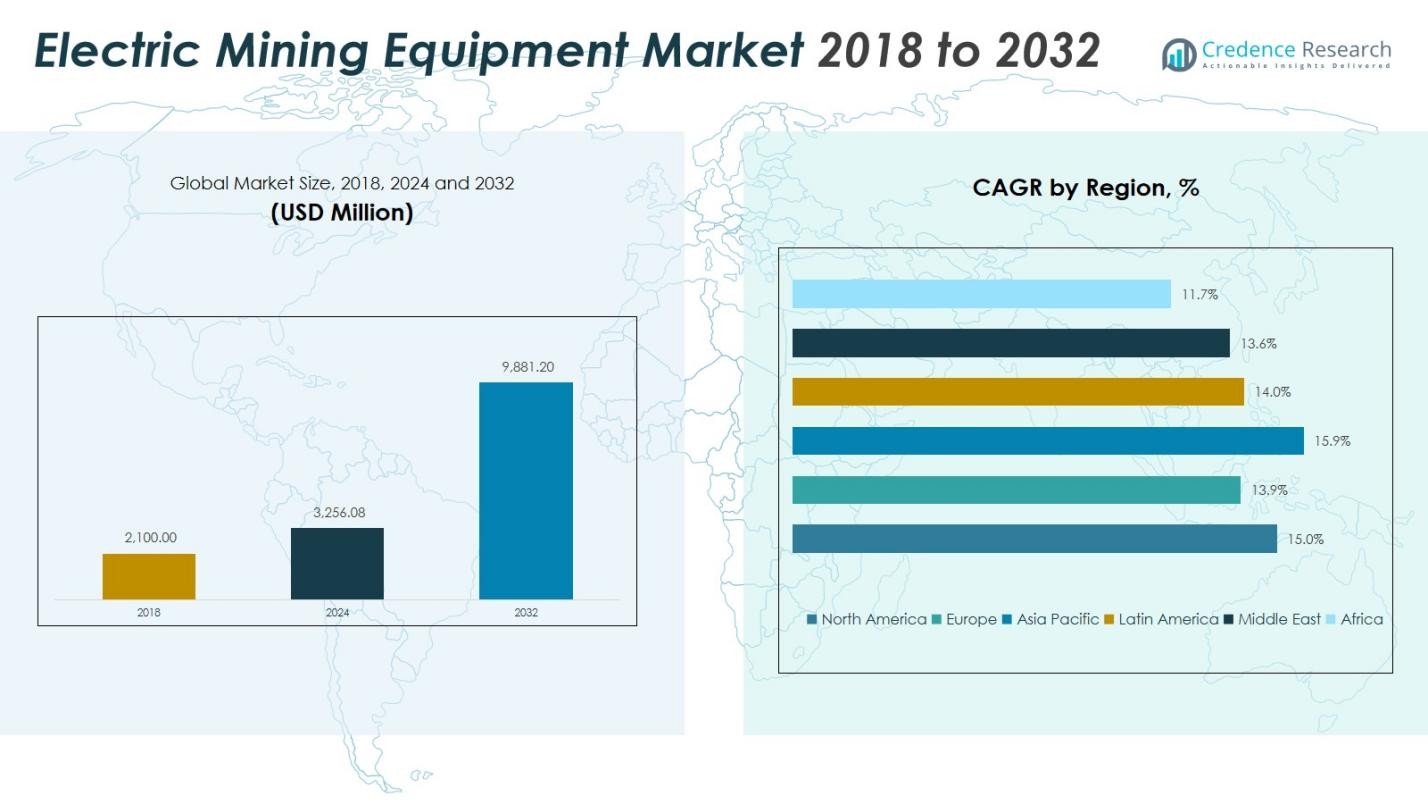
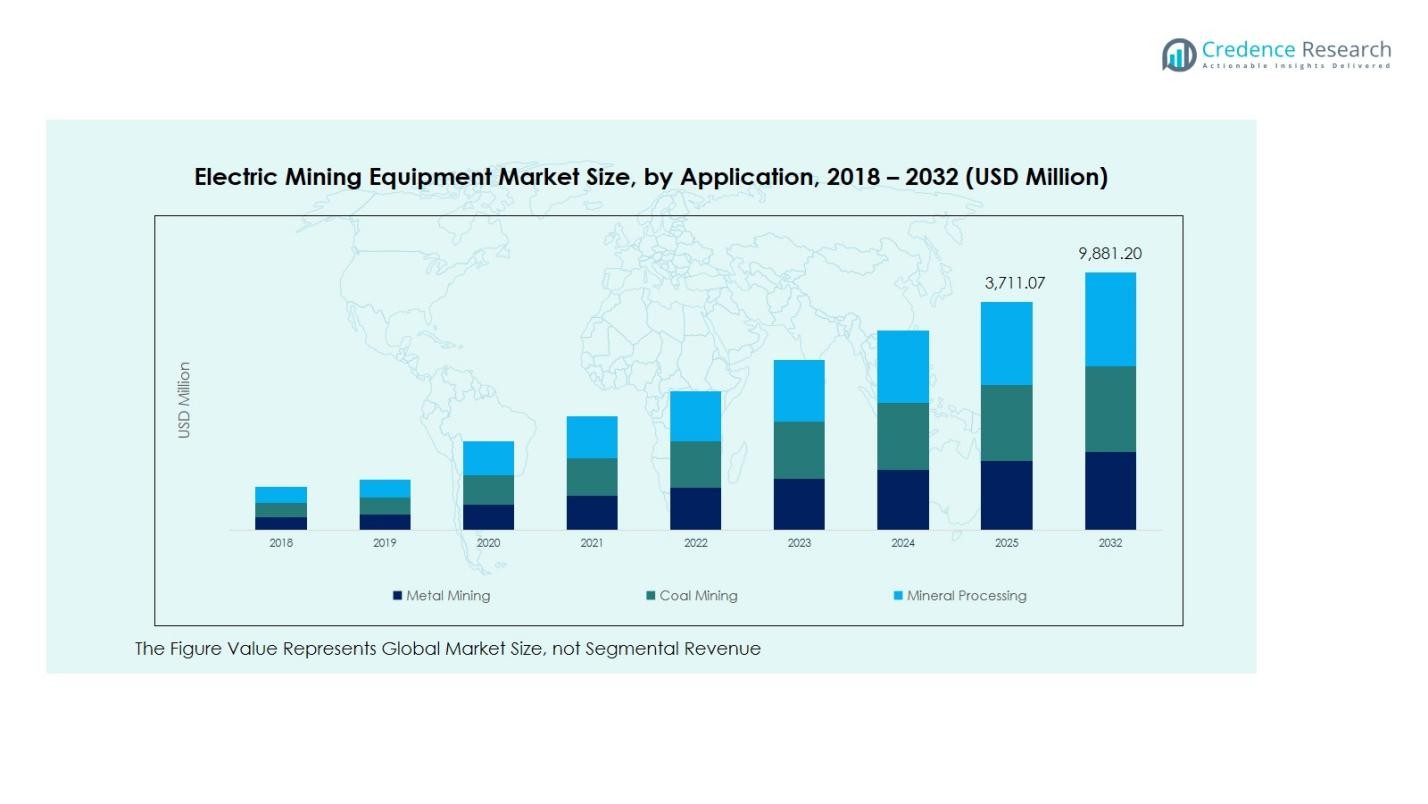
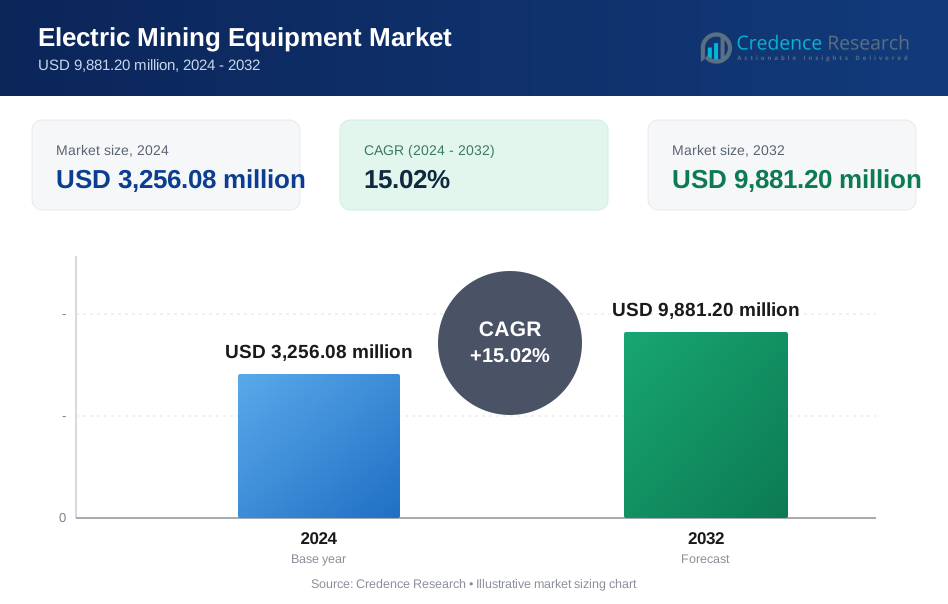
The Electric Mining Equipment Market size was valued at USD 2,100.00 million in 2018, increasing to USD 3,256.08 million in 2024, and is anticipated to reach USD 9,881.20 million by 2032, growing at a CAGR of 15.02% during the forecast period.
| REPORT ATTRIBUTE | DETAILS |
|---|---|
| Historical Period | 2020-2023 |
| Base Year | 2024 |
| Forecast Period | 2025-2032 |
| Electric Mining Equipment Market Size 2024 | USD 3,256.08 Million |
| Electric Mining Equipment Market, CAGR | 15.02% |
| Electric Mining Equipment Market Size 2032 | USD 9,881.20 Million |
The Electric Mining Equipment Market is dominated by leading players such as Caterpillar Inc., Komatsu Ltd., Sandvik AB, Epiroc AB, Hitachi Construction Machinery Co., Ltd., AB Volvo, Liebherr Group, Siemens AG, ABB Ltd., XCMG Group, and SANY Group. These companies are driving market innovation through advancements in battery technology, automation, and hybrid power systems to enhance efficiency and reduce emissions. Strategic partnerships between OEMs and mining operators are accelerating fleet electrification and digital integration across major mining sites. Asia Pacific emerged as the leading region in 2024, commanding a 43.9% market share, driven by extensive mining activities in China, India, and Australia, along with strong government policies promoting industrial electrification and sustainable operations.
Market Insights
- The Electric Mining Equipment Market was valued at USD 3,256.08 million in 2024 and is projected to reach USD 9,881.20 million by 2032, growing at a CAGR of 15.02% during the forecast period.
- The market is driven by the rising demand for sustainable and low-emission mining operations as companies shift from diesel to electric fleets to meet global carbon reduction targets and enhance operational efficiency.
- Key trends include rapid advancements in battery technology, automation, and digital mining solutions, along with growing interest in hydrogen and hybrid power systems for extended-range operations.
- The market is highly competitive, with major players such as Caterpillar, Komatsu, Sandvik, Epiroc, Hitachi, and ABB focusing on R&D, partnerships, and product innovation to expand their electrification portfolios.
- Asia Pacific dominates the market with a 43.9% regional share in 2024, while the electric trucks segment leads by type with a 34.2% share, driven by large-scale adoption in surface mining.
Market Segmentation Analysis:
By Type
The electric trucks segment held the dominant position in 2024 with a 34.2% market share, leading the electric mining equipment market by type. The demand surge is driven by the need for cleaner, high-capacity haulage systems that reduce operating and ventilation costs. Mining companies are prioritizing electric haul trucks to meet sustainability goals, aided by advancements in fast-charging batteries and higher payload capabilities. Additionally, electric excavators and LHDs are witnessing steady growth due to their operational efficiency in both surface and underground mining operations.
For instance, Komatsu Ltd. introduced its 930E-5 electric drive haul truck featuring a 2,700-horsepower electric drive system, designed to enhance haul efficiency while minimizing emissions in large-scale mining operations.
By Application
The metal mining segment accounted for the largest share, 46.5% of the global market in 2024, owing to the rising electrification of large-scale mineral extraction operations. The growing demand for copper, nickel, and lithium essential for EV batteries and renewable energy infrastructure has intensified the use of electric mining equipment in metal extraction. Enhanced government initiatives toward sustainable mining practices and reduced carbon intensity are further propelling the adoption of electric equipment across metallic ore mines globally.
For instance, ABB Ltd. partnered with Boliden to electrify the Aitik copper mine in Sweden, integrating a 700-meter trolley-assist line that cuts diesel consumption by up to 800,000 liters annually.
By Mining
In terms of mining method, surface mining dominated the market with 59.8% share in 2024, supported by the extensive deployment of electric haul trucks, shovels, and excavators in open-pit operations. The segment benefits from easier charging infrastructure setup, larger vehicle compatibility, and ongoing decarbonization goals of leading miners. However, underground mining is projected to grow at a faster CAGR due to increasing investments in battery-powered LHDs and drills, which reduce ventilation needs and improve worker safety in confined environments.
Key Growth Drivers
Rising Demand for Sustainable and Low-Emission Mining Operations
The growing global emphasis on reducing carbon footprints in the mining industry is a major driver for the electric mining equipment market. Governments and mining corporations are setting aggressive net-zero targets, prompting investments in electric fleets that cut diesel use and emissions. The shift toward sustainable mining operations also supports compliance with stricter environmental regulations. As a result, electric haul trucks, drills, and excavators are increasingly adopted to meet sustainability benchmarks while improving efficiency and operational performance in large-scale mining sites.
For instance, Rio Tinto collaborated with Scania to trial a battery-electric mining truck at its Dampier Salt operations in Western Australia, capable of hauling 40 tonnes per load with zero tailpipe emissions.
Technological Advancements in Battery and Charging Infrastructure
Rapid advancements in lithium-ion and solid-state battery technologies are significantly enhancing the performance and range of electric mining vehicles. Modern high-capacity batteries allow longer operating cycles and faster recharging, addressing key operational bottlenecks in deep-pit and continuous mining operations. Parallel innovations in fast-charging systems, battery swapping, and energy recovery solutions further optimize equipment uptime. These developments make electrification more feasible and cost-effective, driving widespread adoption across both surface and underground mining applications globally.
For instance, Hitachi Construction Machinery developed an ultra-fast charging system that can recharge large mining trucks in less than 30 minutes, significantly reducing downtime and supporting round-the-clock production cycles.
Growing Investments and Electrification Initiatives
Leading mining operators are heavily investing in electric fleets to align with global decarbonization goals and ESG mandates. Companies such as Rio Tinto, BHP, and Glencore are introducing electric haul trucks, loaders, and support equipment to replace diesel-powered fleets. Government-backed incentives and carbon credits further accelerate these transitions. Strategic collaborations between OEMs and mining firms for pilot projects and mine-site electrification programs are fostering innovation, creating new growth opportunities, and reinforcing the market’s shift toward fully electric mining ecosystems.
Key Trends and Opportunities
Integration of Automation and Digital Mining Technologies
The convergence of electric mining equipment with automation, IoT, and AI-based monitoring systems is transforming mine operations. Autonomous electric haul trucks and remote-controlled drills enhance safety, reduce human error, and optimize energy use. Digital twin technology and real-time performance analytics allow predictive maintenance and fleet optimization. This trend not only enhances productivity but also complements sustainability efforts, offering a strong opportunity for manufacturers to deliver connected, intelligent electric mining solutions tailored to next-generation mining operations.
For instance, Komatsu Ltd. deployed its FrontRunner Autonomous Haulage System with electric drive trucks at the Komatsu Arizona Proving Grounds, achieving 24/7 autonomous haul cycles and reducing idle energy consumption through predictive digital control.
Expansion of Hydrogen and Hybrid Power Solutions
An emerging opportunity lies in the integration of hydrogen fuel cells and hybrid systems within electric mining machinery. Hydrogen-powered haul trucks and loaders are gaining attention as viable solutions for extended-range operations where pure battery systems face limitations. These technologies combine the benefits of zero emissions with superior energy density and quick refueling. Continuous R&D investments and pilot deployments by major OEMs highlight hydrogen as a critical enabler for achieving complete decarbonization in heavy-duty mining applications.
For instance, Anglo American unveiled its hydrogen-powered ultra-class haul truck at the Mogalakwena platinum mine in South Africa, equipped with a 2-megawatt hydrogen fuel cell system capable of displacing approximately 3,000 liters of diesel per day.
Key Challenges
High Initial Capital and Infrastructure Costs
Despite long-term savings, the high upfront cost of electric mining equipment and supporting infrastructure remains a major challenge. Battery-electric vehicles require substantial investment in charging stations, power management systems, and mine-site electrical upgrades. For many mid-tier miners, these capital requirements delay adoption. Additionally, uncertainties around equipment resale value and battery lifecycle costs further restrain widespread market penetration, particularly in developing regions with limited access to reliable grid infrastructure.
Limited Power Availability and Range Constraints in Remote Mines
Many mining operations are located in remote or off-grid regions where electricity supply is inconsistent or insufficient for large-scale charging needs. Limited grid connectivity and low renewable integration pose operational risks for fully electric fleets. Range limitations of battery-powered vehicles also restrict their deployment in deep or high-load mines. Overcoming these issues requires significant investment in renewable microgrids, on-site storage solutions, and hybrid technologies to ensure operational continuity in energy-challenged mining environments.
Regional Analysis
North America
The North America electric mining equipment market was valued at USD 541.80 million in 2018, growing to USD 825.72 million in 2024, and is projected to reach USD 2,500.95 million by 2032, registering a CAGR of 15.0%. The region accounts for 25.3% of the global market share in 2024, driven by strong electrification initiatives in the U.S. and Canada. Major mining companies are rapidly transitioning toward battery-powered and hybrid mining fleets to meet stringent emission standards and ESG targets, supported by substantial government incentives and advanced technological infrastructure.
Europe
Europe’s electric mining equipment market was valued at USD 409.08 million in 2018, increasing to USD 600.98 million in 2024, and is expected to reach USD 1,685.26 million by 2032, expanding at a CAGR of 13.9%. The region represents 18.5% of the global market share, driven by strong sustainability policies, high energy efficiency standards, and early adoption of automation technologies. Countries such as Germany, Sweden, and the UK are at the forefront of transitioning underground mining operations to electric fleets, supported by leading OEMs such as Epiroc, Sandvik, and ABB.
Asia Pacific
Asia Pacific leads the global electric mining equipment market with the highest market share of 43.9% in 2024. Valued at USD 898.80 million in 2018, the market grew to USD 1,428.92 million in 2024 and is projected to reach USD 4,597.73 million by 2032, expanding at a CAGR of 15.9%. China, India, and Australia dominate regional demand, driven by the large-scale adoption of electric haul trucks and drills in metal and coal mining. Strong government policies supporting carbon neutrality, coupled with rapid industrialization and expansion of battery manufacturing ecosystems, are fueling sustained growth across the region.
Latin America
The Latin America electric mining equipment market reached USD 136.92 million in 2018, rising to USD 210.31 million in 2024, and is expected to achieve USD 593.56 million by 2032, growing at a CAGR of 14.0%. The region holds 6.5% of the global market share, primarily driven by Chile, Brazil, and Peru. The increasing demand for copper and lithium mining projects is boosting investment in electric trucks and loaders. Government-backed sustainability initiatives and partnerships between OEMs and mining operators are further accelerating the transition to electric mining solutions.
Middle East
In the Middle East, the electric mining equipment market was valued at USD 79.80 million in 2018, growing to USD 115.90 million in 2024, and is forecast to reach USD 317.24 million by 2032, recording a CAGR of 13.6%. The region contributes 3.8% of the global market share, driven by increased mineral exploration activities in GCC countries and Turkey. Investment in electric-powered mining fleets is gradually rising, supported by diversification programs such as Saudi Vision 2030, which encourages sustainable industrial and mining development across the region.
Africa
Africa’s electric mining equipment market was valued at USD 33.60 million in 2018, reaching USD 74.25 million in 2024, and is projected to attain USD 186.45 million by 2032, expanding at a CAGR of 11.7%. The region accounts for 2.9% of the global market share, led by South Africa’s adoption of battery-powered drills and loaders in underground mines. Increasing investment in green mining projects and government initiatives to modernize extraction processes are fostering gradual electrification, though infrastructure limitations and high capital costs continue to constrain faster adoption rates.
Market Segmentations:
By Type
- Electric Trucks
- Electric Drills
- Electric LHDs (Load-Haul-Dump)
- Electric Excavators
- Electric Shovels
- Others
By Application
- Metal Mining
- Coal Mining
- Mineral Processing
By Mining
- Surface Mining
- Underground Mining
By Power Source
- Battery Powered
- Trolley Assisted
- Hybrid
- Hydrogen Fuel Cells
By Region
- North America
- U.S.
- Canada
- Mexico
- Europe
- Germany
- France
- U.K.
- Italy
- Spain
- Rest of Europe
- Asia Pacific
- China
- Japan
- India
- South Korea
- South-east Asia
- Rest of Asia Pacific
- Latin America
- Brazil
- Argentina
- Rest of Latin America
- Middle East & Africa
- GCC Countries
- South Africa
- Rest of the Middle East and Africa
Competitive Landscape
The competitive landscape of the Electric Mining Equipment Market is characterized by the presence of major players such as Caterpillar Inc., Komatsu Ltd., Sandvik AB, Epiroc AB, Hitachi Construction Machinery Co., Ltd., AB Volvo, Liebherr Group, Siemens AG, ABB Ltd., XCMG Group, and SANY Group. These companies are actively investing in advanced electrification technologies, automation, and digital solutions to enhance operational efficiency and reduce emissions in mining operations. Strategic collaborations between OEMs and mining operators are driving innovation in battery systems, charging infrastructure, and hybrid power solutions. Leading manufacturers are also expanding their portfolios through acquisitions and new product launches, focusing on battery-powered haul trucks, LHDs, and excavators. The competition is intensifying as companies emphasize sustainability-driven product differentiation and regional expansion, particularly in Asia Pacific and North America. Continuous R&D efforts toward cost-effective, high-performance, and emission-free mining equipment are shaping the future dynamics of this rapidly evolving market.
Key Player Analysis
- Caterpillar Inc.
- Komatsu Ltd.
- Sandvik AB
- Epiroc AB
- Hitachi Construction Machinery Co., Ltd.
- AB Volvo
- ABB Ltd.
- Siemens AG
- Liebherr Group
- XCMG Group
- SANY Group
Recent Developments
- In January 2025, Epiroc AB launched its new battery-electric loader Scooptram ST10 G, designed for smaller drift sizes with a 10-ton payload capacity, enhancing productivity in underground mining.
- In October 2025, Rio Tinto and China’s State Power Investment Corporation began a battery-swap electric haul truck trial at the Oyu Tolgoi mine in Mongolia, showcasing advancements in large-scale electrified mining operations.
- In April 2024, Sany India launched the SKT105E, India’s first locally manufactured fully-electric open-cast mining truck with a 70-tonne payload.
- On April 8 2025, Volvo Construction Equipment unveiled the A30 Electric and A40 Electric, the world’s first serial-produced battery-electric articulated haulers of their size class for mining and quarry operations.
Report Coverage
The research report offers an in-depth analysis based on Type, Application, Mining, Power Source and Region. It details leading market players, providing an overview of their business, product offerings, investments, revenue streams, and key applications. Additionally, the report includes insights into the competitive environment, SWOT analysis, current market trends, as well as the primary drivers and constraints. Furthermore, it discusses various factors that have driven market expansion in recent years. The report also explores market dynamics, regulatory scenarios, and technological advancements that are shaping the industry. It assesses the impact of external factors and global economic changes on market growth. Lastly, it provides strategic recommendations for new entrants and established companies to navigate the complexities of the market.
Future Outlook
- The market will experience strong growth driven by increasing adoption of battery-powered trucks and loaders in both surface and underground mining.
- Advancements in battery energy density and fast-charging technology will significantly enhance equipment performance and operational efficiency.
- Major mining companies will continue investing in full-fleet electrification to achieve zero-emission and sustainability targets.
- Integration of automation, AI, and IoT will optimize fleet management, maintenance, and energy consumption.
- Hydrogen fuel cell technology will emerge as a viable alternative for large-capacity mining vehicles.
- OEMs will focus on developing modular and scalable electric platforms to serve diverse mining applications.
- Supportive government regulations and carbon neutrality goals will accelerate global adoption of electric mining equipment.
- Partnerships between equipment manufacturers and mining operators will increase to co-develop tailored electric solutions.
- Asia Pacific will remain the fastest-growing region due to expanding mining operations and industrial electrification initiatives.
- Continuous R&D efforts will reduce equipment costs, improve durability, and make electric mining more economically feasible.
Request a Free Sample
Fill in your details and we'll send you a free sample report.
- Sample data tables & charts
- Research methodology
Need a Custom Version of This Report?
Tailor the scope, geography, or segments to your exact requirements.
- Custom geography or segment scope
- Direct access to our analyst team
Frequently Asked Questions
What is the current market size for the Electric Mining Equipment Market, and what is its projected size in 2032?
At what Compound Annual Growth Rate is the Electric Mining Equipment Market projected to grow between 2025 and 2032?
Which Electric Mining Equipment Market segment held the largest share in 2024?
What are the primary factors fueling the growth of the Electric Mining Equipment Market?
Who are the leading companies in the Electric Mining Equipment Market?
Which region commanded the largest share of the Electric Mining Equipment Market in 2024?
Table of Content
Chapter 1. Report Introduction
- 1.1 Report Description & Purpose
- 1.1.1 Report Title & Market Definition
- 1.1.2 Unique Selling Propositions (USP) & Key Differentiators
- 1.1.3 Value Proposition for Stakeholders
- 1.2 Research Objectives
- 1.2.1 Market Sizing Objectives (Volume & Revenue)
- 1.2.2 Segmentation Objectives
- 1.2.3 Competitive Intelligence Objectives
- 1.2.4 Forecast & Scenario Objectives
- 1.3 Report Scope
- 1.3.1 Electric Mining Equipment Scope – Types & Subtypes Covered
- 1.3.2 Geographic Scope – Regions & Countries Covered
- 1.3.3 Historical Period, Base Year & Forecast Period (2024; forecast to 2032)
- 1.3.4 Inclusions & Exclusions
- 1.4 HS Code & Classification Framework
- 1.5 Currency, Units & Pricing Basis
- 1.6 Target Stakeholders
- 1.7 Limitations & Assumptions
Chapter 2. Executive Summary
- 2.1 Global Electric Mining Equipment Market Snapshot
- 2.1.1 Market Size – Historical (2024) & Forecast (2024-2032) (2024: USD 3,256.08 million → 2032: USD 9,881.20 million)
- 2.1.2 Volume & Revenue – Global Totals
- 2.1.3 Key Market Highlights – Top Five Facts
- 2.2 Electric Mining Equipment Market Segmentation Snapshot
- 2.2.1 Market Split by Region – 2024 vs. 2032
- 2.3 Competitive Snapshot
- 2.3.1 Top 10 Players by Revenue Share – 2024
- 2.3.2 Top 10 Players by Volume Share – 2024
- 2.3.3 Recent Strategic Developments (18-Month Summary)
- 2.4 Key Investment Highlights & Strategic Conclusions
Chapter 3. Electric Mining Equipment Market Dynamics & Industry Analysis
- 3.1 Market Overview & Context
- 3.1.1 Electric Mining Equipment Market Position in the Broader Automotive Value Chain
- 3.1.2 OEM vs. Replacement Market Dynamics
- 3.1.3 Market Maturity & Development Stage by Region
- 3.2 Electric Mining Equipment Market Drivers
- 3.3 Electric Mining Equipment Market Restraints & Challenges
- 3.4 Electric Mining Equipment Market Opportunities
- 3.5 Porter's Five Forces Analysis
- 3.5.1 Threat of New Entrants
- 3.5.2 Bargaining Power of Suppliers
- 3.5.3 Bargaining Power of Buyers
- 3.5.4 Threat of Substitutes
- 3.5.5 Competitive Rivalry – Intensity Assessment
- 3.6 Electric Mining Equipment Value Chain Analysis
- 3.6.1 Upstream – Raw Material/Input Suppliers
- 3.6.1.1 Raw Material/Input 1
- 3.6.1.2 Raw Material/Input 2
- 3.6.1.3 Raw Material/Input 3
- 3.6.2 Midstream – Production/Manufacturing/Service Delivery
- 3.6.2.1 Production/Process Overview
- 3.6.2.2 Key Facility Locations & Capacity by Manufacturer
- 3.6.3 Downstream – Distribution & End Consumer
- 3.6.3.1 Primary Channel – B2B/OEM
- 3.6.3.2 Secondary Channels – Dealer, Retail, Online, Direct
- 3.6.4 Value Chain Profitability Analysis
- 3.6.1 Upstream – Raw Material/Input Suppliers
- 3.7 PESTEL Analysis
- 3.7.1 Political Factors
- 3.7.2 Economic Factors
- 3.7.3 Social Factors
- 3.7.4 Technological Factors
- 3.7.5 Environmental Factors
- 3.7.6 Legal Factors
- 3.8 Electric Mining Equipment Supply Chain Analysis
- 3.8.1 Raw Material/Input Supply Risk Assessment
- 3.8.2 Manufacturing Concentration Risk (Geographic Exposure)
- 3.8.3 Trade Disruption Impact Analysis
- 3.9 Regulatory & Policy Landscape
Note: The regulatory and policy landscape section covers regulations based on their applicability to the market, Electric Mining Equipment category, geography, and scope of the study. Only regulatory frameworks with a material impact on operations, compliance, trade, sustainability, or market access are analyzed in detail.
Chapter 4. Key Investment Pockets & Opportunity Analysis
- 4.1 Electric Mining Equipment Market Attractiveness Analysis
- 4.1.1 By Region – Investment Attractiveness Matrix (Volume × CAGR)
- 4.2 Absolute Revenue Growth Opportunity
- 4.2.1 By Region – Absolute USD Growth Through 2032
- 4.3 Incremental Volume Opportunity
- 4.3.1 By Region – Incremental Volume Through 2032
- 4.3.2 Segment – Incremental Volume
- 4.4 Emerging Submarket Opportunity Deep Dive (Subject to Applicability)
- 4.5 Emerging Market Opportunity Scorecards
- 4.5.1 United States
- 4.5.2 Europe
- 4.5.3 Asia
- 4.5.4 Middle East & Africa
Note: Emerging Market Opportunity Scorecards will be included based on relevance and strategic importance. Regions listed are indicative and may vary depending on data availability and market dynamics.
Chapter 5. Electric Mining Equipment Import-Export Analysis & Trade Flows
- 5.1 Global Trade Overview
- 5.1.1 Global Export Value by Country (2024)
- 5.1.2 Global Export Volume by Country (2024)
- 5.1.3 Global Import Value by Country (2024)
- 5.1.4 Global Import Volume by Country (2024)
- 5.1.5 Net Trade Balance by Country (2024)
- 5.2 Export Analysis – Segment
- 5.2.1 Type 1 (HS Code)
- 5.2.2 Type 2 (HS Code)
- 5.2.3 Type 3 (HS Code)
- 5.2.4 Type 4 (HS Code)
- 5.2.5 Type 5 (HS Code)
- 5.3 Import Analysis – Segment
- 5.3.1 Type 1 (HS Code)
- 5.3.2 Type 2 (HS Code)
- 5.3.3 Type 3 (HS Code)
- 5.3.4 Type 4 (HS Code)
- 5.3.5 Type 5 (HS Code)
- 5.4 Average Unit Trade Prices
- 5.4.1 Average Export Price – Segment & Country
- 5.4.2 Average Import Price – Segment & Source Country
- 5.4.3 Price Trends (2024)
- 5.5 Key Trade Route Analysis
- 5.5.1 Trade Route 1
- 5.5.2 Trade Route 2
- 5.5.3 Trade Route 3
- 5.5.4 Trade Route 4
- 5.5.5 Trade Route 5
- 5.6 Trade Policy Impact Assessment
- 5.6.1 US Anti-Dumping & Section 301 Tariffs
- 5.6.2 EU Customs Union Impact
- 5.6.3 Major Free Trade Agreements
- 5.6.4 USMCA Rules of Origin
Note: Trade policy analysis will be included only where relevant to the Electric Mining Equipment market.
Chapter 6. Competitive Landscape & Company Benchmarking
- 6.1 Electric Mining Equipment Market Concentration & Structure
- 6.1.1 Herfindahl-Hirschman Index (HHI) – vs. 2024
- 6.1.2 Tier 1, Tier 2 & Tier 3 Market Structure
- 6.1.3 Global, Regional & Local Player Dynamics
- 6.2 Electric Mining Equipment Market Share Analysis – 2024
- 6.2.1 Global Revenue Share by Company
- 6.2.2 Global Volume Share by Company
- 6.2.3 Regional Revenue Share
- 6.2.4 Market Share Evolution ( vs. 2024)
- 6.2.5 OEM Segment Share by Company
- 6.2.6 Replacement Segment Share by Company
- 6.3 Production/Delivery Capacity & Facility Analysis
- 6.3.1 Global Installed Capacity
- 6.3.2 Capacity Utilization Rates
- 6.3.3 Production/Output Volume
- 6.3.4 Facility Locations & Capacity Map
- 6.3.5 Planned Capacity Additions
- 6.4 Electric Mining Equipment Competitive Benchmarking Matrix
- 6.4.1 Revenue, Volume, CAGR & Profitability Comparison
- 6.4.2 Channel Revenue Mix
- 6.4.3 Geographic Revenue Exposure
- 6.4.4 R&D Intensity
- 6.4.5 Sustainability Maturity
- 6.5 Strategic Developments in Electric Mining Equipment (Last 24 Months)
- 6.5.1 Mergers, Acquisitions & Divestments
- 6.5.2 New Electric Mining Equipment Launches
- 6.5.3 Facility Expansions
- 6.5.4 Strategic Alliances, Joint Ventures & Partnerships
- 6.5.5 Distribution Expansion & Market Entry
- 6.5.6 Sustainability & ESG Initiatives
- 6.6 Competitive Strategy Mapping
- 6.6.1 Leader, Challenger, Follower & Niche Classification
- 6.6.2 Pricing Strategy Comparison
- 6.6.3 Channel Strategy Matrix
Note: Strategic developments are included based on their materiality and the availability of reliable information.
Chapter 7. Global Electric Mining Equipment Market – By Distribution Channel
- 7.1 Segment Overview
- 7.1.1 Volume & Revenue Split by Channel (2024 & 2032)
- 7.1.2 Channel Mix Evolution (2024-2032)
Chapter 8. Regional Market Analysis – Global Overview
- 8.1 Global Regional Overview
- 8.1.1 Regional Volume Share
- 8.1.2 Regional Revenue Share
- 8.1.3 Regional Volume by Region
- 8.1.4 Regional Revenue by Region
- 8.1.5 Regional Forecast Through 2032
- 8.2 Cross-Regional Segment Analysis
- 8.2.1 By Distribution Channel
- 8.2.2 By Brand/Price Tier
Chapter 9. North America Electric Mining Equipment Market
- 9.1 United States
- 9.2 Canada
- 9.3 Mexico
Chapter 10. Europe Electric Mining Equipment Market
- 10.1 Germany
- 10.2 France
- 10.3 Italy
- 10.4 United Kingdom
- 10.5 Spain
- 10.6 Poland
- 10.7 Russia
- 10.8 Netherlands
- 10.9 Belgium
- 10.10 Sweden
- 10.11 Denmark
- 10.12 Norway
- 10.13 Rest of Europe
Chapter 11. Asia Pacific Electric Mining Equipment Market
- 11.1 China
- 11.2 India
- 11.3 Japan
- 11.4 South Korea
- 11.5 Thailand
- 11.6 Indonesia
- 11.7 Vietnam
- 11.8 Malaysia
- 11.9 Australia
- 11.10 Rest of Asia Pacific
Chapter 12. Latin America Electric Mining Equipment Market
- 12.1 Brazil
- 12.2 Argentina
- 12.3 Colombia
- 12.4 Chile
- 12.5 Rest of Latin America
Chapter 13. Middle East Electric Mining Equipment Market
- 13.1 Saudi Arabia
- 13.2 United Arab Emirates
- 13.3 Turkey
- 13.4 Israel
- 13.5 Iran
- 13.6 Rest of the Middle East
Chapter 14. Africa Electric Mining Equipment Market
- 14.1 South Africa
- 14.2 Egypt
- 14.3 Nigeria
- 14.4 Morocco
- 14.5 Rest of Africa
Chapter 15. Electric Mining Equipment Company Profiles
- 15.1 [Company 01]
- 15.1.1 Company Overview
- 15.1.2 Key Management Personnel
- 15.1.3 Products & Services Portfolio
- 15.1.4 Financial Performance
- 15.1.5 Key Market Focus & Geographic Presence
- 15.1.6 Recent Developments & Strategic Initiatives
Note: The company profile list is preliminary and may change based on research findings, market developments, data availability, and client requirements.
Chapter 16. Appendices
- Appendix A – List of Abbreviations & Acronyms
- Appendix B – Industry Classification Code Reference – Full Series
- Appendix C – Production & Capacity Data Tables
- Appendix D – End-Use & Demand Base Tables
- Appendix E – Consumption & Replacement Rate Assumptions
- Appendix F – ASP Reference Tables
- Appendix G – Manufacturing & Facility Database
- Appendix H – Import-Export Data Tables
- Appendix I – Regulatory Summary Tables
- Appendix J – Primary Research Participant List (Anonymized)
- Appendix K – Primary Research Questionnaire Framework
- Appendix L – Data Sources & Bibliography
- Appendix M – Market Size Divergence & Source Comparison
Chapter 17. Research Methodology
- 17.1 Research Framework & Philosophy
- 17.2 Secondary Research – Sources, Hierarchy & Data Extraction
- 17.3 Data Modeling – Bottom-Up & Top-Down Market Sizing
- 17.4 Primary Research – Stakeholder Framework, LOI & Sample Sizes
- 17.5 Forecast Methodology – Regression, Scenario & Sensitivity Analysis
- 17.6 Quality Control – Four-Layer Validation Framework
- 17.7 Limitations & Standard Assumptions
- 17.8 Disclaimer
