
Market overview
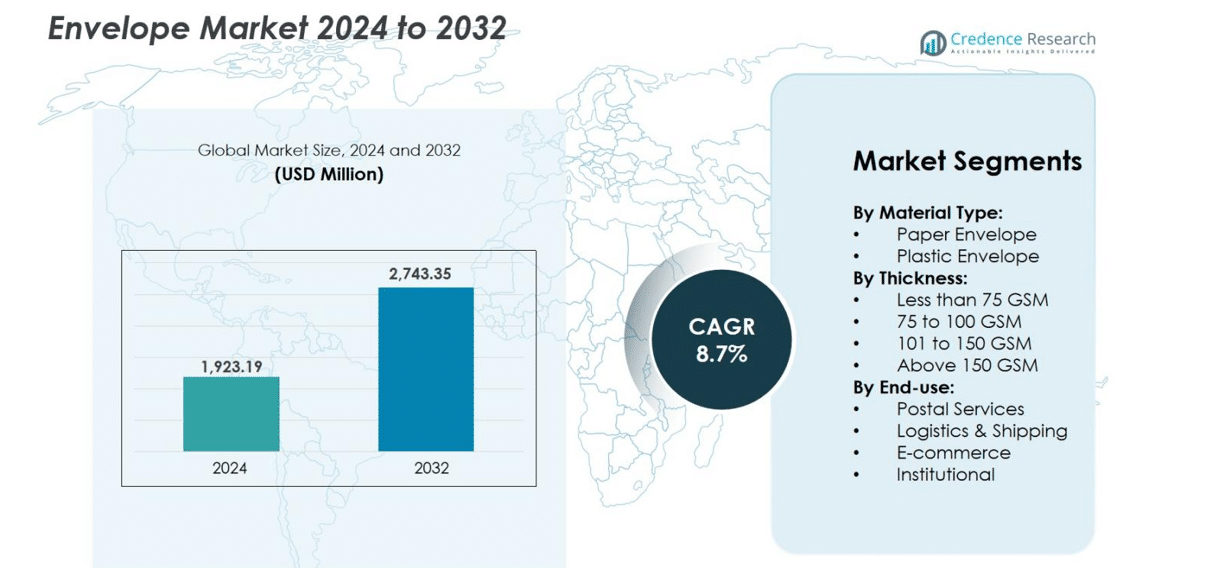
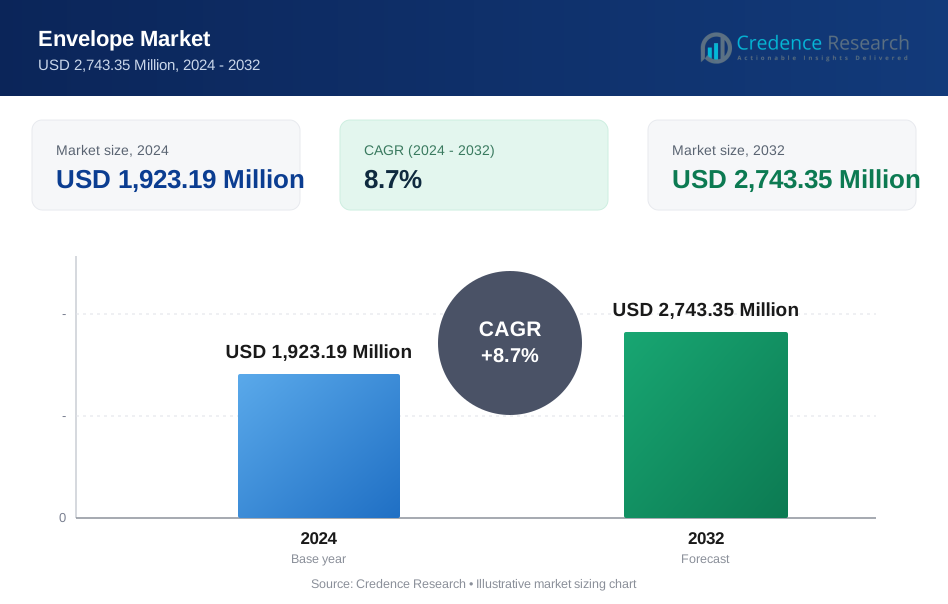
The Envelope Market size was valued at USD 1,923.19 Million in 2024 and is anticipated to reach USD 2,743.35 Million by 2032, growing at a CAGR of 8.7% during the forecast period.
| REPORT ATTRIBUTE | DETAILS |
|---|---|
| Historical Period | 2020-2023 |
| Base Year | 2024 |
| Forecast Period | 2025-2032 |
| Envelope Market Size 2024 | USD 1,923.19 Million |
| Envelope Market, CAGR | 8.7% |
| Envelope Market Size 2032 | USD 2,743.35 Million |
The Envelope Market includes major players such as Allen Envelopes, Bong AB, Cenveo Worldwide Limited, Clariana, Elite Envelope & Graphics, Inc., Envelope 1 Inc., Fedrigoni S.p.A., Heinrich Envelope Corporation, Lucart S.p.A. and MacKay Mitchell Envelope Company. These companies emphasize sustainable materials, digital customisation and global distribution strategies to address diverse applications across postal, e‑commerce and institutional segments. Regionally, North America leads with a 34 % share, followed by Asia Pacific at 28 % and Europe at 27 %. Each firm is investing in local supply chain development and premium envelope formats as demand evolves away from traditional mail toward secure, branded and multi‑functional packaging.
Market Insights
- The market size for the Envelope Market was valued at USD 1,923.19 million in 2024 and is projected to reach USD 2,743.35 million by 2032 at a CAGR of 8.7 %.
- Growth is driven by e‑commerce logistics and sustainability paper envelopes hold 69.5 % share in 2024 and plastic holds 30.5 % as companies seek recyclable, brandable packaging solutions.
- Trends include high demand for thickness ranges like 75‑100 GSM (42 % share) and increasing adoption of features like tamper‑evident closures, digital print customisation and multi‑functional envelope designs.
- In competitive analysis, major players such as Allen Envelopes, Bong AB, Cenveo Worldwide Limited, Fedrigoni S.p.A., Lucart S.p.A. and MacKay Mitchell Envelope Company prioritise global capacity expansion, sustainable material sourcing and regional footprint optimisation to maintain edge.
- Regional analysis reveals North America leading with 34 % share in 2024, Asia Pacific at 28 % and Europe at 27 %, while Latin America and Middle East & Africa compose smaller shares, constrained by digital substitution and infrastructure gaps.
Market Segmentation Analysis:
By Material Type
In the global envelope market, the paper envelope sub‑segment is projected to dominate with 69.5% share in 2024. The strong preference for paper envelopes is driven by heightened sustainability initiatives such as the demand for recyclable and biodegradable packaging and enhanced customization options for branding and print. Paper offers cost‑effectiveness relative to plastic and supports eco‑friendly credentials, which appeals to both business and consumer customers. Meanwhile, the plastic envelope sub‑segment, while smaller, is expected to account for 30.5% of the market share in 2024, benefiting from its moisture‑resistant and durable features, particularly in logistics and e‑commerce contexts.
- For instance, Mondi Group launched its Protective Mailers in 2024, a fully paper-based envelope solution developed in collaboration with Amazon. These mailers are made from Mondi’s strong, lightweight kraft paper and feature a unique open-flute design that eliminates the need for plastic bubble wrap.
By Thickness
Within the thickness segmentation, the 75 to 100 GSM band is expected to be the dominant sub‑segment in 2024, accounting for 42% of the market share. This mid‑thickness range strikes an optimal balance between material cost and functional performance offering adequate durability for business correspondence, mailers, and standard shipments, while maintaining manageable mailing weight. Lighter (<75 GSM) options are projected to account for 28% of the market share, competing on cost, while heavier (>150 GSM) grades are expected to hold 15% market share, finding niche use in high‑end branding or secure document applications.
- For instance, JK Paper manufactures a 100 GSM A4 copier paper widely used for office printing and photostat copying, offering a reliable balance of thickness and durability.
By End‑use
In the end‑use breakdown, the postal services segment is projected to hold the largest share of 75.6% in 2024. The continued absorption of envelopes within national postal networks, government correspondence, and business mail underpins this dominance. Key drivers include established mailing infrastructure, legal/regulatory requirements for physical document delivery, and the volume of transactional mail still processed globally. The e‑commerce segment is projected to hold 14.8% of the market share in 2024, expanding rapidly as online retail growth boosts demand for flat packing and envelope‑style shipments. Logistics & shipping is expected to account for 6% of the market share, while institutional use will hold 3.6% of the envelope market.
Key Growth Drivers
Rising Demand for E-commerce Packaging
The rapid growth of the e-commerce sector is one of the primary drivers of the envelope market. As online shopping continues to surge, the need for protective, lightweight packaging solutions like envelopes grows exponentially. Envelopes provide an efficient way to ship small goods, documents, and promotional materials. The convenience, cost-effectiveness, and eco-friendly appeal of envelopes are making them a preferred choice for packaging in e-commerce, contributing to the market’s expansion, particularly in regions with high online retail activity.
- For instance, Amazon's "frustration-free packaging" aims to protect products while allowing easy opening and returns, improving customer satisfaction.
Sustainability and Eco-friendly Packaging Trends
Consumers and businesses are increasingly prioritizing sustainability, driving demand for eco-friendly envelope solutions. Paper envelopes, which are recyclable and biodegradable, align with the global shift towards reducing plastic waste and adopting sustainable practices. This trend is particularly strong in markets that are seeing heightened environmental awareness. As companies seek to enhance their corporate social responsibility (CSR) profiles, the demand for environmentally friendly envelope options is expected to increase, bolstering market growth.
- For instance, PaperWise produces sustainable envelopes made from agricultural waste such as leaves and stems, which results in 47% less environmental impact compared to traditional wood fiber-based paper and supports local communities in production regions.
Technological Advancements in Envelope Production
Technological innovations in envelope manufacturing are boosting market growth by improving product quality, customization, and production efficiency. The introduction of digital printing technologies allows for greater customization, enhancing the appeal of envelopes in promotional and business communications. Additionally, automated production processes are lowering costs and improving speed, making envelopes a cost-effective solution for businesses. These advancements ensure that envelope producers can meet increasing demand while offering high-quality, diverse products that cater to various consumer and business needs.
Key Trends & Opportunities
Personalized and Customizable Envelopes
Customization and personalization are becoming key trends in the envelope market. As businesses seek to stand out in a crowded marketplace, there is increasing demand for personalized envelopes that align with branding and customer engagement strategies. Digital printing technologies are enabling companies to produce customized envelopes with logos, promotional messages, and vibrant designs. This trend is especially prevalent in industries like direct mail marketing, where the aesthetic appeal of an envelope can enhance consumer engagement and improve response rates, presenting a significant growth opportunity.
- For instance, HP Inc. uses its advanced digital printing technology, including HP Indigo presses, to produce short-run, full-color customizable envelopes with variable data for direct mail campaigns, allowing marketing firms to enhance consumer engagement.
Shift Towards Multi-functional Packaging
Envelopes are evolving beyond their traditional roles as simple mailing solutions. The demand for multi-functional packaging envelopes that can serve as protective, secure, and branding tools is on the rise. Features like tamper-proof seals, moisture resistance, and security closures are becoming more common, especially in industries that require secure document delivery, such as legal, healthcare, and finance. This shift presents an opportunity for manufacturers to diversify product offerings and capture a broader share of the market by catering to businesses seeking more secure, versatile packaging options.
- For instance, LeghornGroup supplies tamper-evident envelopes with peel-and-close seals that show irreversible tampering marks and provide moisture resistance, catering to sectors like e-commerce, banking, and healthcare requiring secure transit of sensitive items.
Key Challenges
Competition from Alternative Packaging Solutions
The envelope market faces competition from alternative packaging solutions, particularly in sectors where plastic or rigid packaging is seen as more durable and protective. For instance, plastic bags, bubble wraps, and cardboard boxes are often preferred for shipping fragile or bulky items. As consumers and businesses increasingly seek packaging that offers greater protection or is suitable for larger products, envelopes face the challenge of maintaining relevance. To combat this, envelope manufacturers must innovate in terms of durability and functionality while keeping up with evolving consumer preferences.
Rising Raw Material Costs
The fluctuating costs of raw materials, particularly paper and plastic, are a significant challenge for envelope manufacturers. Prices for these materials can be volatile due to factors such as global supply chain disruptions, environmental regulations, and changes in demand. As raw material costs rise, manufacturers face pressure to either absorb these increased costs or pass them on to consumers, which could impact market growth. Efficient production methods and material sourcing strategies will be essential for maintaining profitability in the face of these challenges.
Regional Analysis
North America
In the global envelope market, the North American region holds a significant share of 34% in 2024. The strong presence of established postal systems, large volumes of direct‑mail campaigns, and the consistent demand for business correspondence underpin this dominance. Manufacturers benefit from a mature supply chain and high consumer awareness of premium envelope solutions. Growth is supported by the rising use of secure, branded envelopes in sectors such as finance and healthcare. However, digitalization continues to pressure traditional mail volumes, necessitating innovation in multifunctional envelope formats to maintain momentum.
Europe
Europe contributes around 27% of the global envelope market share in 2024. The region’s focus on sustainability drives demand for recyclable and eco‑certified envelope materials, while well‑established postal and business mail networks continue to generate volume. Players in this region leverage advanced digital printing and customization capabilities to cater to branding and institutional use cases. Regulatory frameworks, such as strict recycling rates and forest‑management certifications, further influence envelope producers and strengthen the position of Europe in this sector.
Asia Pacific
The Asia Pacific region commands 28% of the global envelope market in 2024. Rapid industrialization, growing e‑commerce penetration, and expanding corporate sectors drive demand for envelope formats in this region. Countries such as China and India contribute substantially due to increases in consumer communication, institutional mail, and promotional packaging. Manufacturers are responding with localized production, cost‑effective material sourcing, and differentiated product portfolios tailored for the dynamic growth markets here.
Latin America
Latin America holds a 11% share of the envelope market in 2024. The region’s growth is driven by rising literacy rates, expanding business infrastructure, and increasing use of physical mail for banking, government, and corporate correspondence. While digital transformation pressures traditional mail, opportunities persist in institutional and promotional mail segments. Key strategic considerations include logistics efficiency, localized manufacturing, and cost‑effectiveness to serve emerging markets within Latin America.
Middle East & Africa
The Middle East & Africa region contributes 14% of the global envelope market share in 2024. Growth in this region is anchored by governmental communications, expanding financial inclusion initiatives, and rising small‑business activity requiring mailing solutions. Infrastructure constraints and digital diversion present challenges, yet the demand for secure document delivery and new institutional mail flows offer potential upside. Manufacturers focusing on low‑cost, localized envelope formats stand to capture incremental growth here.
Market Segmentations:
By Material Type:
- Paper Envelope
- Plastic Envelope
By Thickness:
- Less than 75 GSM
- 75 to 100 GSM
- 101 to 150 GSM
- Above 150 GSM
By End-use:
- Postal Services
- Logistics & Shipping
- E-commerce
- Institutional
By Region
- North America
- U.S.
- Canada
- Mexico
- Europe
- Germany
- France
- U.K.
- Italy
- Spain
- Rest of Europe
- Asia Pacific
- China
- Japan
- India
- South Korea
- South-east Asia
- Rest of Asia Pacific
- Latin America
- Brazil
- Argentina
- Rest of Latin America
- Middle East & Africa
- GCC Countries
- South Africa
- Rest of the Middle East and Africa
Competitive Landscape
In the global envelope market, key players such as Allen Envelopes, Bong AB, Cenveo Worldwide Limited, Clariana, Elite Envelope & Graphics, Inc., Envelope 1 Inc., Fedrigoni S.p.A., Heinrich Envelope Corporation, Lucart S.p.A. and MacKay Mitchell Envelope Company drive competitiveness across material innovation, sustainability credentials and regional footprint. These companies are actively expanding production capacity, introducing high‑customization envelope formats and forging distribution partnerships to capture growth in e‑commerce, direct mail and institutional segments. Market participation is tempered by moderate concentration-leading firms account for a significant share of global shipments-while smaller regional players focus on niche applications such as luxury stationery or security‑sealed envelopes. Competitive pressure remains high as manufacturers optimize cost structures, invest in recycled‑content materials and enhance digital printing capabilities to differentiate. Continuous innovation in envelope functions such as tamper‑evident closures and moisture‑resistant coatings is becoming a deciding factor in supplier selection as users demand both sustainability and performance.
Key Player Analysis
- MacKay Mitchell Envelope Company
- Lucart S.p.A.
- Bong AB
- Heinrich Envelope Corporation
- Fedrigoni S.p.A.
- Allen Envelopes
- Envelope 1 Inc.
- Clariana
- Elite Envelope & Graphics, Inc.
- Cenveo Worldwide Limited
Recent Developments
- In June 2025, Leader Paper Products acquired Unique Envelope Corporation (Chicago‑based custom envelope manufacturer).
- In April 2025, Ennis, Inc. acquired Northeastern Envelope (Pennsylvania) to strengthen its envelope converting and printing business.
- In May 2024, Supremex Inc. announced the acquisition of Forest Envelope to strengthen its North American envelope and paper‑based packaging footprint
Report Coverage
The research report offers an in-depth analysis based on Material Type, Thickness, End User and Region. It details leading market players, providing an overview of their business, product offerings, investments, revenue streams, and key applications. Additionally, the report includes insights into the competitive environment, SWOT analysis, current market trends, as well as the primary drivers and constraints. Furthermore, it discusses various factors that have driven market expansion in recent years. The report also explores market dynamics, regulatory scenarios, and technological advancements that are shaping the industry. It assesses the impact of external factors and global economic changes on market growth. Lastly, it provides strategic recommendations for new entrants and established companies to navigate the complexities of the market.
Future Outlook
- Manufacturers will increasingly adopt recycled‑content and biodegradable materials as regulatory pressure and sustainability commitments rise.
- Growth will be driven by the e‑commerce segment as small‑parcel and document shipments fuel demand for flat, lightweight mailing formats.
- Customisation and branding will become more prominent, with variable‑data printing and premium finishes enabling envelopes to serve as marketing platforms.
- Security features such as tamper‑evident seals, moisture‑resistant coatings and tracked closures will gain traction in sectors like finance, legal and healthcare.
- Digitalisation of communication will continue to reduce traditional mail volumes, prompting manufacturers to pivot into niche, high‑value envelope formats.
- Productionefficiency initiatives such as automation, waste reduction and digital workflows will become key competitive differentiators.
- Growth in emerging markets (especially in Asia Pacific and Latin America) will outpace mature regions due to expanding corporate infrastructure and postal networks.
- Vertical integration and consolidation will accelerate as key players align with paper‑ and material‑suppliers to control cost and quality.
- Hybrid envelope formats combining physical and digital print zones (e.g., QR codes, augmented‑reality triggers) will emerge as value‑added offerings.
- Service‑based models such as subscription‑based mail‑pack kits, on‑demand envelope printing and e‑commerce fulfilment partnerships will open new revenue streams.
Request a Free Sample
Fill in your details and we'll send you a free sample report.
- Sample data tables & charts
- Research methodology
Need a Custom Version of This Report?
Tailor the scope, geography, or segments to your exact requirements.
- Custom geography or segment scope
- Direct access to our analyst team
Frequently Asked Questions
What is the current market size for Envelope Market, and what is its projected size in 2032?
At what Compound Annual Growth Rate is the Envelope Market projected to grow between 2025 and 2032?
Which is the leading market for envelopes?
What are the key drivers for the growth of the envelope market?
Who are the leading companies in the Envelope Market?
Table of Content
Chapter 1. Report Introduction
- 1.1 Report Description & Purpose
- 1.1.1 Report Title & Market Definition
- 1.1.2 Unique Selling Propositions (USP) & Key Differentiators
- 1.1.3 Value Proposition for Stakeholders
- 1.2 Research Objectives
- 1.2.1 Market Sizing Objectives (Volume & Revenue)
- 1.2.2 Segmentation Objectives
- 1.2.3 Competitive Intelligence Objectives
- 1.2.4 Forecast & Scenario Objectives
- 1.3 Report Scope
- 1.3.1 Envelope Scope – Types & Subtypes Covered
- 1.3.2 Geographic Scope – Regions & Countries Covered
- 1.3.3 Historical Period, Base Year & Forecast Period (2024; forecast to 2032)
- 1.3.4 Inclusions & Exclusions
- 1.4 HS Code & Classification Framework
- 1.5 Currency, Units & Pricing Basis
- 1.6 Target Stakeholders
- 1.7 Limitations & Assumptions
Chapter 2. Executive Summary
- 2.1 Global Envelope Market Snapshot
- 2.1.1 Market Size – Historical (2024) & Forecast (2024-2032) (2024: USD 1,923.19 Million → 2032: USD 2,743.35 Million)
- 2.1.2 Volume & Revenue – Global Totals
- 2.1.3 Key Market Highlights – Top Five Facts
- 2.2 Envelope Market Segmentation Snapshot
- 2.2.1 Market Split by Region – 2024 vs. 2032
- 2.3 Competitive Snapshot
- 2.3.1 Top 10 Players by Revenue Share – 2024
- 2.3.2 Top 10 Players by Volume Share – 2024
- 2.3.3 Recent Strategic Developments (18-Month Summary)
- 2.4 Key Investment Highlights & Strategic Conclusions
Chapter 3. Envelope Market Dynamics & Industry Analysis
- 3.1 Market Overview & Context
- 3.1.1 Envelope Market Position in the Broader Automotive Value Chain
- 3.1.2 OEM vs. Replacement Market Dynamics
- 3.1.3 Market Maturity & Development Stage by Region
- 3.2 Envelope Market Drivers
- 3.3 Envelope Market Restraints & Challenges
- 3.4 Envelope Market Opportunities
- 3.5 Porter's Five Forces Analysis
- 3.5.1 Threat of New Entrants
- 3.5.2 Bargaining Power of Suppliers
- 3.5.3 Bargaining Power of Buyers
- 3.5.4 Threat of Substitutes
- 3.5.5 Competitive Rivalry – Intensity Assessment
- 3.6 Envelope Value Chain Analysis
- 3.6.1 Upstream – Raw Material/Input Suppliers
- 3.6.1.1 Raw Material/Input 1
- 3.6.1.2 Raw Material/Input 2
- 3.6.1.3 Raw Material/Input 3
- 3.6.2 Midstream – Production/Manufacturing/Service Delivery
- 3.6.2.1 Production/Process Overview
- 3.6.2.2 Key Facility Locations & Capacity by Manufacturer
- 3.6.3 Downstream – Distribution & End Consumer
- 3.6.3.1 Primary Channel – B2B/OEM
- 3.6.3.2 Secondary Channels – Dealer, Retail, Online, Direct
- 3.6.4 Value Chain Profitability Analysis
- 3.6.1 Upstream – Raw Material/Input Suppliers
- 3.7 PESTEL Analysis
- 3.7.1 Political Factors
- 3.7.2 Economic Factors
- 3.7.3 Social Factors
- 3.7.4 Technological Factors
- 3.7.5 Environmental Factors
- 3.7.6 Legal Factors
- 3.8 Envelope Supply Chain Analysis
- 3.8.1 Raw Material/Input Supply Risk Assessment
- 3.8.2 Manufacturing Concentration Risk (Geographic Exposure)
- 3.8.3 Trade Disruption Impact Analysis
- 3.9 Regulatory & Policy Landscape
Note: The regulatory and policy landscape section covers regulations based on their applicability to the market, Envelope category, geography, and scope of the study. Only regulatory frameworks with a material impact on operations, compliance, trade, sustainability, or market access are analyzed in detail.
Chapter 4. Key Investment Pockets & Opportunity Analysis
- 4.1 Envelope Market Attractiveness Analysis
- 4.1.1 By Region – Investment Attractiveness Matrix (Volume × CAGR)
- 4.2 Absolute Revenue Growth Opportunity
- 4.2.1 By Region – Absolute USD Growth Through 2032
- 4.3 Incremental Volume Opportunity
- 4.3.1 By Region – Incremental Volume Through 2032
- 4.3.2 Segment – Incremental Volume
- 4.4 Emerging Submarket Opportunity Deep Dive (Subject to Applicability)
- 4.5 Emerging Market Opportunity Scorecards
- 4.5.1 United States
- 4.5.2 Europe
- 4.5.3 Asia
- 4.5.4 Middle East & Africa
Note: Emerging Market Opportunity Scorecards will be included based on relevance and strategic importance. Regions listed are indicative and may vary depending on data availability and market dynamics.
Chapter 5. Envelope Import-Export Analysis & Trade Flows
- 5.1 Global Trade Overview
- 5.1.1 Global Export Value by Country (2024)
- 5.1.2 Global Export Volume by Country (2024)
- 5.1.3 Global Import Value by Country (2024)
- 5.1.4 Global Import Volume by Country (2024)
- 5.1.5 Net Trade Balance by Country (2024)
- 5.2 Export Analysis – Segment
- 5.2.1 Type 1 (HS Code)
- 5.2.2 Type 2 (HS Code)
- 5.2.3 Type 3 (HS Code)
- 5.2.4 Type 4 (HS Code)
- 5.2.5 Type 5 (HS Code)
- 5.3 Import Analysis – Segment
- 5.3.1 Type 1 (HS Code)
- 5.3.2 Type 2 (HS Code)
- 5.3.3 Type 3 (HS Code)
- 5.3.4 Type 4 (HS Code)
- 5.3.5 Type 5 (HS Code)
- 5.4 Average Unit Trade Prices
- 5.4.1 Average Export Price – Segment & Country
- 5.4.2 Average Import Price – Segment & Source Country
- 5.4.3 Price Trends (2024)
- 5.5 Key Trade Route Analysis
- 5.5.1 Trade Route 1
- 5.5.2 Trade Route 2
- 5.5.3 Trade Route 3
- 5.5.4 Trade Route 4
- 5.5.5 Trade Route 5
- 5.6 Trade Policy Impact Assessment
- 5.6.1 US Anti-Dumping & Section 301 Tariffs
- 5.6.2 EU Customs Union Impact
- 5.6.3 Major Free Trade Agreements
- 5.6.4 USMCA Rules of Origin
Note: Trade policy analysis will be included only where relevant to the Envelope market.
Chapter 6. Competitive Landscape & Company Benchmarking
- 6.1 Envelope Market Concentration & Structure
- 6.1.1 Herfindahl-Hirschman Index (HHI) – vs. 2024
- 6.1.2 Tier 1, Tier 2 & Tier 3 Market Structure
- 6.1.3 Global, Regional & Local Player Dynamics
- 6.2 Envelope Market Share Analysis – 2024
- 6.2.1 Global Revenue Share by Company
- 6.2.2 Global Volume Share by Company
- 6.2.3 Regional Revenue Share
- 6.2.4 Market Share Evolution ( vs. 2024)
- 6.2.5 OEM Segment Share by Company
- 6.2.6 Replacement Segment Share by Company
- 6.3 Production/Delivery Capacity & Facility Analysis
- 6.3.1 Global Installed Capacity
- 6.3.2 Capacity Utilization Rates
- 6.3.3 Production/Output Volume
- 6.3.4 Facility Locations & Capacity Map
- 6.3.5 Planned Capacity Additions
- 6.4 Envelope Competitive Benchmarking Matrix
- 6.4.1 Revenue, Volume, CAGR & Profitability Comparison
- 6.4.2 Channel Revenue Mix
- 6.4.3 Geographic Revenue Exposure
- 6.4.4 R&D Intensity
- 6.4.5 Sustainability Maturity
- 6.5 Strategic Developments in Envelope (Last 24 Months)
- 6.5.1 Mergers, Acquisitions & Divestments
- 6.5.2 New Envelope Launches
- 6.5.3 Facility Expansions
- 6.5.4 Strategic Alliances, Joint Ventures & Partnerships
- 6.5.5 Distribution Expansion & Market Entry
- 6.5.6 Sustainability & ESG Initiatives
- 6.6 Competitive Strategy Mapping
- 6.6.1 Leader, Challenger, Follower & Niche Classification
- 6.6.2 Pricing Strategy Comparison
- 6.6.3 Channel Strategy Matrix
Note: Strategic developments are included based on their materiality and the availability of reliable information.
Chapter 7. Global Envelope Market – By Distribution Channel
- 7.1 Segment Overview
- 7.1.1 Volume & Revenue Split by Channel (2024 & 2032)
- 7.1.2 Channel Mix Evolution (2024-2032)
Chapter 8. Regional Market Analysis – Global Overview
- 8.1 Global Regional Overview
- 8.1.1 Regional Volume Share
- 8.1.2 Regional Revenue Share
- 8.1.3 Regional Volume by Region
- 8.1.4 Regional Revenue by Region
- 8.1.5 Regional Forecast Through 2032
- 8.2 Cross-Regional Segment Analysis
- 8.2.1 By Distribution Channel
- 8.2.2 By Brand/Price Tier
Chapter 9. North America Envelope Market
- 9.1 United States
- 9.2 Canada
- 9.3 Mexico
Chapter 10. Europe Envelope Market
- 10.1 Germany
- 10.2 France
- 10.3 Italy
- 10.4 United Kingdom
- 10.5 Spain
- 10.6 Poland
- 10.7 Russia
- 10.8 Netherlands
- 10.9 Belgium
- 10.10 Sweden
- 10.11 Denmark
- 10.12 Norway
- 10.13 Rest of Europe
Chapter 11. Asia Pacific Envelope Market
- 11.1 China
- 11.2 India
- 11.3 Japan
- 11.4 South Korea
- 11.5 Thailand
- 11.6 Indonesia
- 11.7 Vietnam
- 11.8 Malaysia
- 11.9 Australia
- 11.10 Rest of Asia Pacific
Chapter 12. Latin America Envelope Market
- 12.1 Brazil
- 12.2 Argentina
- 12.3 Colombia
- 12.4 Chile
- 12.5 Rest of Latin America
Chapter 13. Middle East Envelope Market
- 13.1 Saudi Arabia
- 13.2 United Arab Emirates
- 13.3 Turkey
- 13.4 Israel
- 13.5 Iran
- 13.6 Rest of the Middle East
Chapter 14. Africa Envelope Market
- 14.1 South Africa
- 14.2 Egypt
- 14.3 Nigeria
- 14.4 Morocco
- 14.5 Rest of Africa
Chapter 15. Envelope Company Profiles
- 15.1 [Company 01]
- 15.1.1 Company Overview
- 15.1.2 Key Management Personnel
- 15.1.3 Products & Services Portfolio
- 15.1.4 Financial Performance
- 15.1.5 Key Market Focus & Geographic Presence
- 15.1.6 Recent Developments & Strategic Initiatives
Note: The company profile list is preliminary and may change based on research findings, market developments, data availability, and client requirements.
Chapter 16. Appendices
- Appendix A – List of Abbreviations & Acronyms
- Appendix B – Industry Classification Code Reference – Full Series
- Appendix C – Production & Capacity Data Tables
- Appendix D – End-Use & Demand Base Tables
- Appendix E – Consumption & Replacement Rate Assumptions
- Appendix F – ASP Reference Tables
- Appendix G – Manufacturing & Facility Database
- Appendix H – Import-Export Data Tables
- Appendix I – Regulatory Summary Tables
- Appendix J – Primary Research Participant List (Anonymized)
- Appendix K – Primary Research Questionnaire Framework
- Appendix L – Data Sources & Bibliography
- Appendix M – Market Size Divergence & Source Comparison
Chapter 17. Research Methodology
- 17.1 Research Framework & Philosophy
- 17.2 Secondary Research – Sources, Hierarchy & Data Extraction
- 17.3 Data Modeling – Bottom-Up & Top-Down Market Sizing
- 17.4 Primary Research – Stakeholder Framework, LOI & Sample Sizes
- 17.5 Forecast Methodology – Regression, Scenario & Sensitivity Analysis
- 17.6 Quality Control – Four-Layer Validation Framework
- 17.7 Limitations & Standard Assumptions
- 17.8 Disclaimer
